Corporate Finance, 4e (Berk / DeMarzo)
Chapter 6 Valuing Bonds
6.1 Bond Cash Flows, Prices, and Yields
1) Which of the following statements is FALSE?
A) Bonds are a securities sold by governments and corporations to raise money from investors today in
exchange for promised future payments.
B) By convention the coupon rate is expressed as an effective annual rate.
C) Bonds typically make two types of payments to their holders.
D) The time remaining until the repayment date is known as the term of the bond.
2) Which of the following statements is FALSE?
A) The principal or face value of a bond is the notional amount we use to compute the interest
payments.
B) Payments are made on bonds until a final repayment date, called the term date of the bond.
C) The coupon rate of a bond is set by the issuer and stated on the bond certificate.
D) The promised interest payments of a bond are called coupons.
3) Which of the following statements is FALSE?
A) The bond certificate typically specifies that the coupons will be paid periodically until the maturity
date of the bond.
B) The bond certificate indicates the amounts and dates of all payments to be made.
C) The only cash payments the investor will receive from a zero coupon bond are the interest payments
that are paid up until the maturity date.
D) Usually the face value of a bond is repaid at maturity.
4) Which of the following statements is FALSE?
A) The amount of each coupon payment is determined by the coupon rate of the bond.
B) Prior to its maturity date, the price of a zero-coupon bond is always greater than its face value.
C) The simplest type of bond is a zero-coupon bond.
D) Treasury bills are U.S. government bonds with a maturity of up to one year.
5) Which of the following statements is FALSE?
A) Bond traders typically quote bond prices rather than bond yields .
B) Treasury bills are zero-coupon bonds.
C) Zero-coupon bonds always trade at a discount.
D) The yield to maturity is typically stated as an annual rate by multiplying the calculated YTM by the
number of coupon payment per year, thereby converting it to an APR.
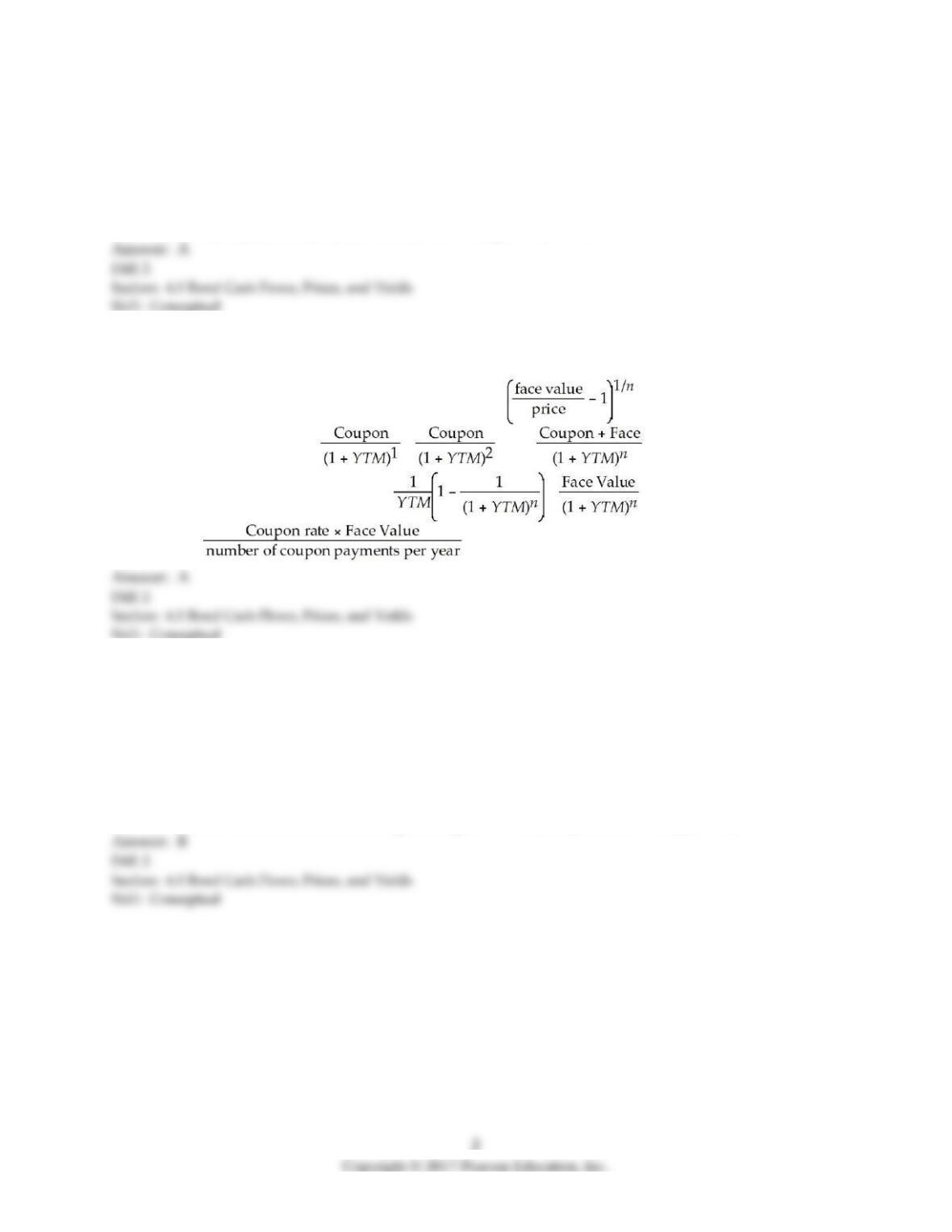
6) Which of the following formulas is incorrect?
A) Yield to maturity for an n-period zero-coupon bond =
B) Price of an n-period bond = + + … +
C) Price of an n–period bond = Coupon × +
D) Coupon =
7) Which of the following statements is FALSE?
A) One advantage of quoting the yield to maturity rather than the price is that the yield is independent
of the face value of the bond.
B) Unlike the case of bonds that pay coupons, for zero-coupon bonds, there is no simple formula to
solve for the yield to maturity directly.
C) Because we can convert any bond price into a yield, and vice versa, bond prices and yields are often
used interchangeably.
D) The IRR of an investment in a bond is given a special name, the yield to maturity (YTM).
8) Which of the following statements is FALSE?
A) The IRR of an investment in a zero-coupon bond is the rate of return that investors will earn on their
money if they buy a default free bond at its current price and hold it to maturity.
B) The yield to maturity of a bond is the discount rate that sets the future value of the promised bond
payments equal to the current market price of the bond.
C) Financial professionals also use the term spot interest rates to refer to the default–free zero-coupon
yields.
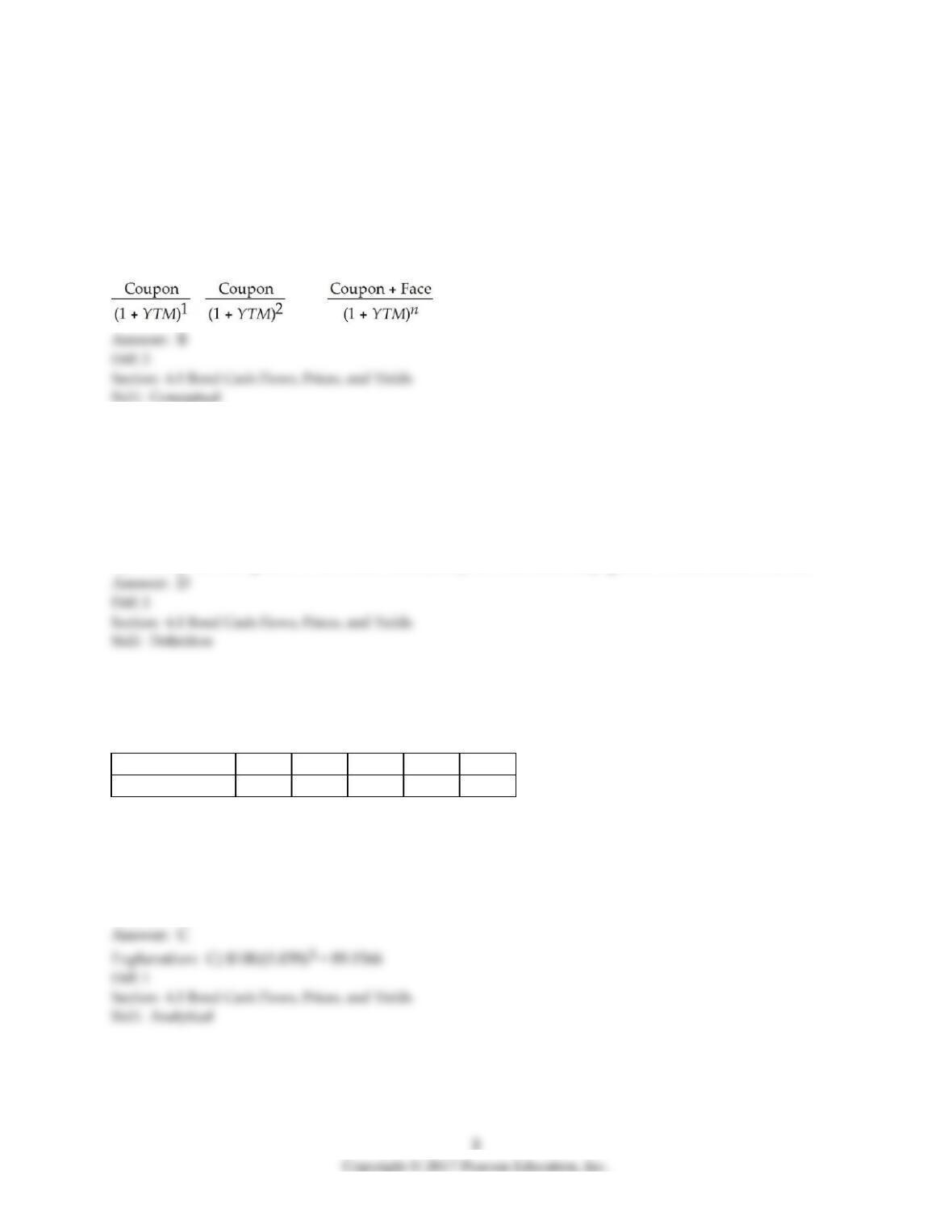
D) When we calculate a bond’s yield to maturity by solving the formula, Price of an n-period bond =
+ + … + , the yield we compute will be a rate per coupon interval.
9) Which of the following statements is FALSE?
A) Zero-coupon bonds are also called pure discount bonds.
B) The IRR of an investment opportunity is the discount rate at which the NPV of the investment
opportunity is equal to zero.
C) The yield to maturity for a zero-coupon bond is the return you will earn as an investor from holding
the bond to maturity and receiving the promised face value payment.
D) When prices are quoted in the bond market, they are conventionally quoted in increments of $1000.
Use the following information to answer the question(s) below.
Suppose the current zero-coupon yield curve for risk-free bonds is as follows:
Maturity (years)
1
2
3
4
5
YTM
3.25%
3.50%
3.90%
4.25%
4.40%
10) The price per $100 face value of a three-year, zero-coupon, risk-free bond is closest to:
A) $93.80
B) $90.06
C) $89.16
D) $86.39
11) The price per $100 face value of a four-year, zero-coupon, risk-free bond is closest to:
A) $90.06
B) $89.16
C) $86.39
D) $84.66
12) Suppose a five- year bond with a 7% coupon rate and semiannual compounding is trading for a
price of $951.58. Expressed as an APR with semiannual compounding, this bonds yield to maturity
(YTM) is closest to:
A) 7.0%
B) 7.5%
C) 7.8%
D) 8.2%
13) Suppose a ten-year bond with semiannual coupons has a price of $1,071.06 and a yield to maturity
of 7%. This bond’s coupon rate is closest to:
A) 3.5%
B) 6.0%
C) 7.0%
D) 8.0%
14) A three-month treasury bill sold for a price of $99.311998 per $100 face value. The yield to maturity
of this bond expressed as an EAR is closest to:
A) 2.5%
B) 2.8%
C) 3.2%
D) 4.0%
15) Consider a zero coupon bond with 20 years to maturity. The price will this bond trade if the YTM is
6% is closest to:
A) $215
B) $312
C) $335
D) $306
16) Consider a zero-coupon bond with a $1000 face value and 10 years left until maturity. If the YTM of
this bond is 10.4%, then the price of this bond is closest to:
A) $1000
B) $602
C) $1040
D) $372
17) Consider a zero-coupon bond with a $1000 face value and 10 years left until maturity. If the bond is
currently trading for $459, then the yield to maturity on this bond is closest to:
A) 7.5%
B) 10.4%
C) 9.7%
D) 8.1%
Use the information for the question(s) below.
The Sisyphean Company has a bond outstanding with a face value of $1000 that reaches maturity in 15
years. The bond certificate indicates that the stated coupon rate for this bond is 8% and that the coupon
payments are to be made semiannually.
18) How much will each semiannual coupon payment be?
A) $60
B) $40
C) $120
D) $80
19) Assuming the appropriate YTM on the Sisyphean bond is 7.5%, then the price that this bond trades
for will be closest to:
A) $1045
B) $691
C) $1000
D) $957
20) Assuming the appropriate YTM on the Sisyphean bond is 7.5%, then this bond will trade at
A) par.
B) a discount.
C) a premium.
D) None of the above
21) Assuming the appropriate YTM on the Sisyphean bond is 9.0%, then the price that this bond trades
for will be closest to:
A) $946
B) $919
C) $1086
D) $1000
22) Assuming the appropriate YTM on the Sisyphean bond is 9%, then this bond will trade at
A) a premium.
B) a discount.
C) par.
D) None of the above
23) Assuming that this bond trades for $1112, then the YTM for this bond is closest to:
A) 8.0%
B) 3.4%
C) 6.8%
D) 9.2%
24) Assuming that this bond trades for $903, then the YTM for this bond is closest to:
A) 8.0%
B) 6.8%
C) 9.9%
D) 9.2%
Use the table for the question(s) below.
The following table summarizes prices of various default-free zero-coupon bonds (expressed as a
percentage of face value):
Maturity (years)
1
2
3
4
5
Price (per $100 face value)
94.52
89.68
85.40
81.65
78.35
25) The yield to maturity for the two year zero-coupon bond is closest to:
A) 6.0%
B) 5.8%
C) 5.6%
D) 5.5%
26) The yield to maturity for the three year zero-coupon bond is closest to:
A) 5.4%
B) 5.8%
C) 5.6%
D) 6.0%
27) Based upon the information provided in the table above, you can conclude
A) that the yield curve is flat.
B) nothing about the shape of the yield curve.
C) that the yield curve is downward sloping.
D) that the yield curve is upward sloping.
28) What is the relationship between a bond’s price and its yield to maturity?
Use the information for the question(s) below.
The Sisyphean Company has a bond outstanding with a face value of $1000 that reaches maturity in 15
years. The bond certificate indicates that the stated coupon rate for this bond is 8% and that the coupon
payments are to be made semiannually.
29) How much are each of the semiannual coupon payments? Assuming the appropriate YTM on the
Sisyphean bond is 8.8%, then at what price should this bond trade for?
30) Assuming that this bond trades for $1035.44, then the YTM for this bond is equal to:
Use the table for the question(s) below.
The following table summarizes prices of various default-free zero-coupon bonds (expressed as a
percentage of face value):
Maturity (years)
1
2
3
4
5
Price (per $100 face value)
94.52
89.68
85.40
81.65
78.35
31) Compute the yield to maturity for each of the five zero-coupon bonds.
Maturity (years)
1
2
3
4
5
Price (per $100 face value)
94.52
89.68
85.40
81.65
78.35
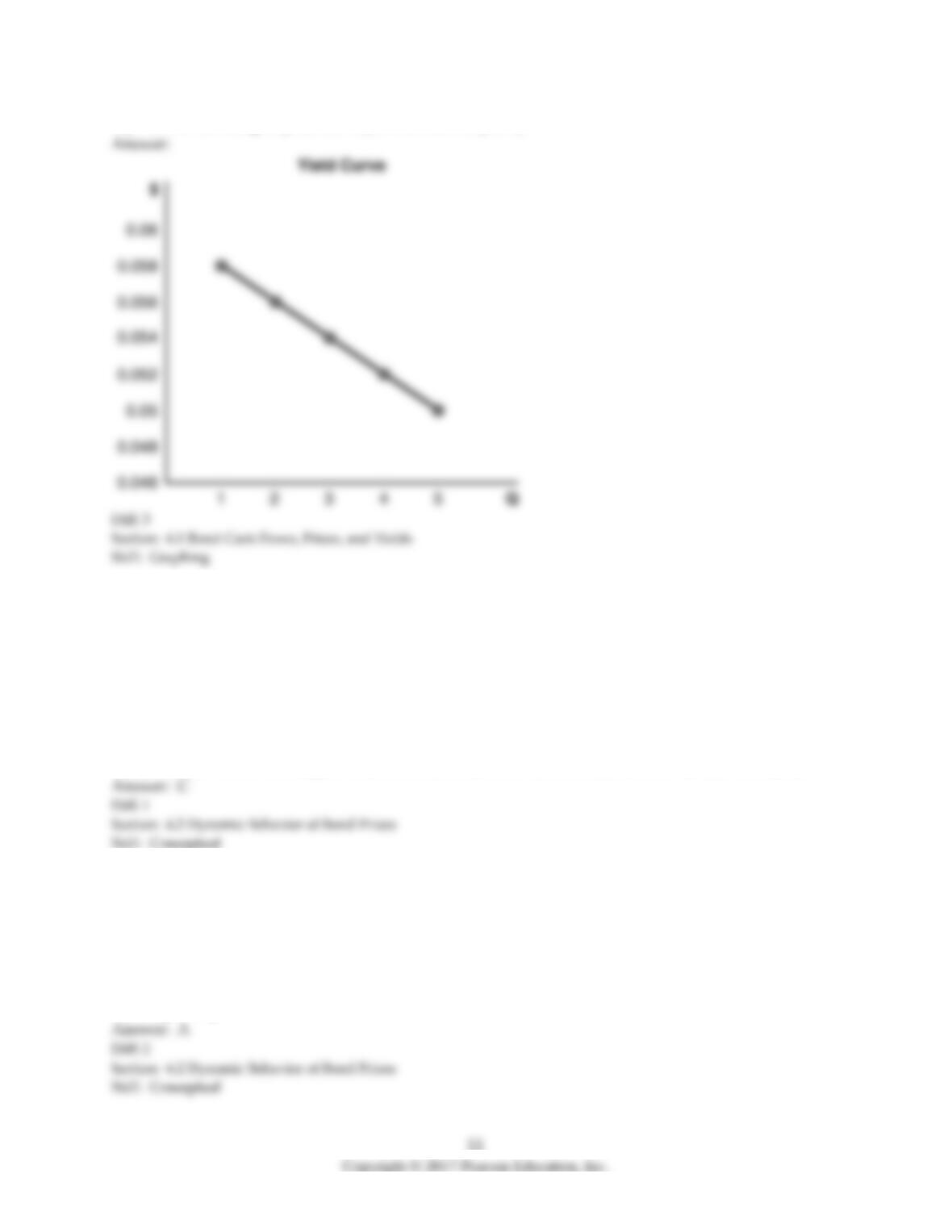
32) Plot the zero-coupon yield curve (for the first five years).
6.2 Dynamic Behavior of Bond Prices
1) Which of the following statements is FALSE?
A) If the bond trades at a discount, and investor who buys the bond will earn a return both from
receiving the coupons and from receiving a face value that exceeds the price paid for the bond.
B) Most coupon bond issuers choose a coupon rate so that the bonds will initially trade at, or very near
to, par.
C) Coupon bonds always trade for a discount.
D) At any point in time, changes in market interest rates affect a bond’s yield to maturity and its price.
2) Which of the following statements is FALSE?
A) When a bond is trading at a discount, the price drop when a coupon is paid will be larger than the
price increase between coupons, so the bond’s discount will tend to decline as time passes.
B) When a bond trades at a price equal to its face value, it is said to trade at par.
C) As interest rates and bond yield rise, bond prices will fall.
D) Ultimately, the prices of all bonds approach the bond‘s face value when the bonds mature and their
last coupon is paid.
3) Which of the following statements is FALSE?
A) A bond trades at par when its coupon rate is equal to its yield to maturity.
B) The clean price of a bond is adjusted for accrued interest.
C) The price of the bond will drop by the amount of the coupon immediately after the coupon is paid.
D) If a coupon bond’s yield to maturity exceeds its coupon rate, the present value of its cash flows at the
yield to maturity will be greater than its face value.
4) Which of the following statements is FALSE?
A) Bond prices converge to the bond’s face value due to the time effect, but simultaneously move up
and down due to unpredictable changes in bond yields.
B) As interest rates and bond yields fall, bond prices will rise.
C) Bonds with higher coupon rates are more sensitive to interest rate changes.
D) Shorter maturity zero coupon bonds are less sensitive to changes in interest rates than are longer–
term zero coupon bonds.
5) Which of the following statements is FALSE?
A) If a bond trades at a premium, its yield to maturity will exceed its coupon rate.
B) A bond that trades at a premium is said to trade above par.
C) When a coupon-paying bond is trading at a premium, an investor’s return from the coupons is
diminished by receiving a face value less than the price paid for the bond.
D) Holding fixed the bond’s yield to maturity, for a bond not trading at par, the present value of the
bond’s remaining cash flows changes as the time to maturity decreases.
6) Which of the following formulas is INCORRECT?
A) Invoice price = dirty price
B) Clean price = dirty price – accrued interest
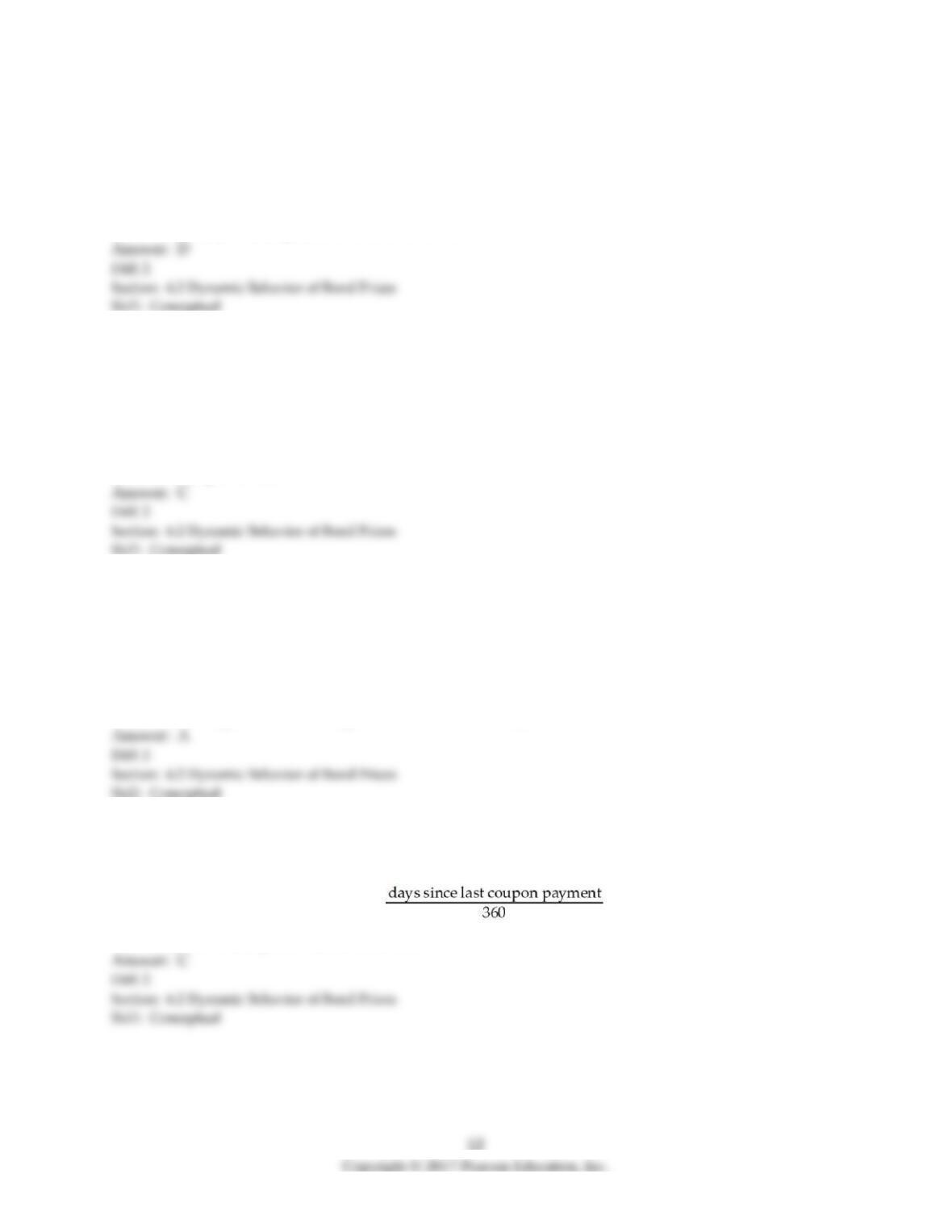
C) Accrued interest = coupon amount ×
D) Cash price = clean price + accrued interest
7) Which of the following statements is FALSE?
A) Prices of bonds with lower durations are more sensitive to interest rate changes.
B) When a bond is trading at a discount, the price increase between coupons will exceed the drop when
a coupon is paid, so the bond’s price will rise and its discount will decline as time passes.
C) Coupon bonds may trade at a discount, at a premium, or at par.
D) The sensitivity of a bond’s price changes in interest rates is the bond’s duration.
8) Which of the following statements is TRUE?
A) Prices of bonds with lower durations are more sensitive to interest rate changes.
B) If a bond’s yield to maturity exceeds its coupon rate, the bond trades at a premium.
C) Bonds with higher coupon rates are more sensitive to interest rate changes.
D) If a bond’s yield to maturity is less than its coupon rate, the bond trades at a premium.
9) If a bond is currently trading at its face (par) value, then it must be the case that:
A) the bond’s yield to maturity is less than its coupon rate.
B) the bond’s yield to maturity is equal to its coupon rate.
C) the bond’s yield to maturity is greater than its coupon rate.
D) the bond is a zero-coupon bond.
10) The discount rate that sets the present value of the promised bond payments equal to the current
market price of the bond is called:
A) the current yield.
B) the yield to maturity.
C) the zero coupon yield.
D) the discount yield.
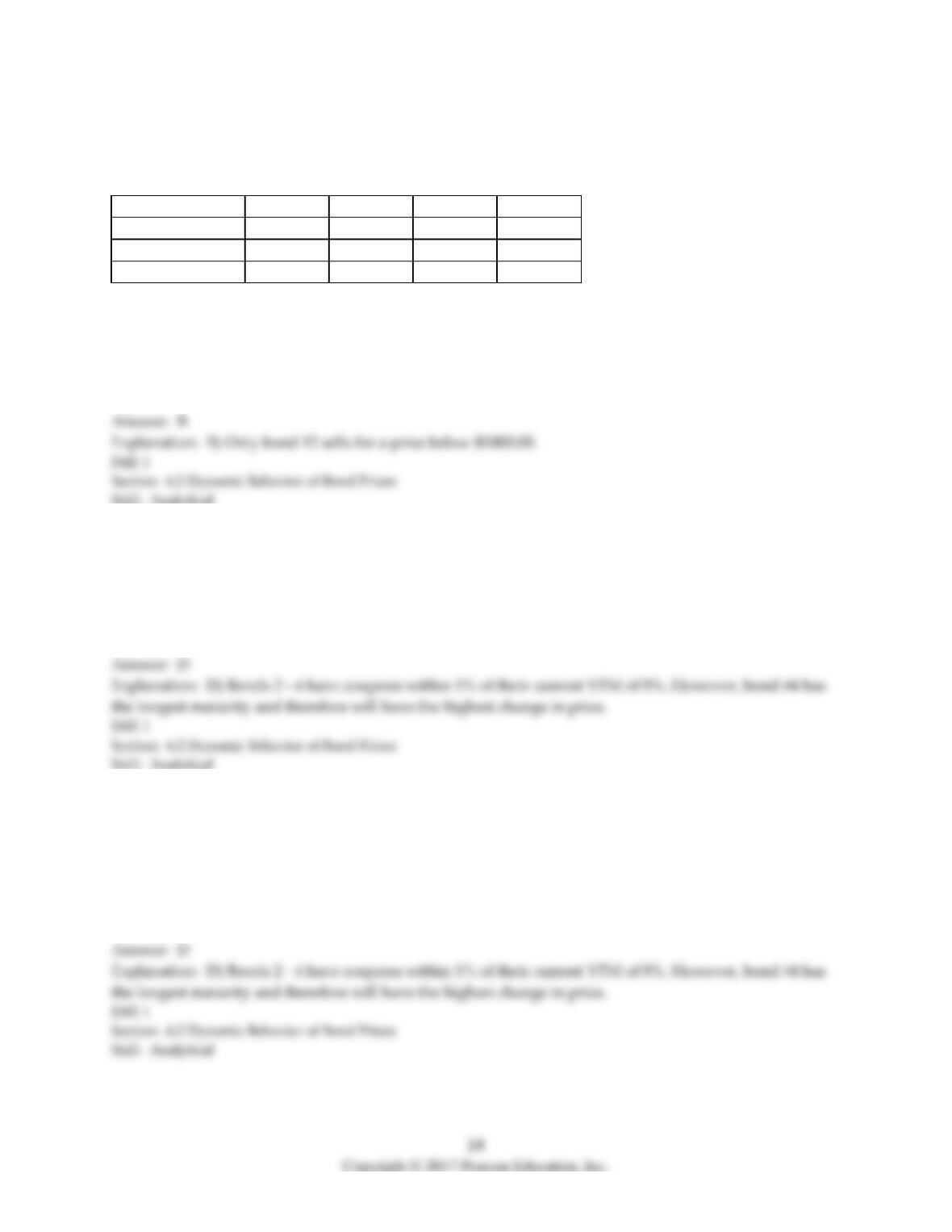
Use the following information to answer the question(s) below.
Consider the following four corporate bonds that have semiannual compounding:
Bond
#1
#2
#3
#4
Price
$1000.00
$932.05
$1067.95
$1098.96
Coupon Rate
8%
7%
9%
9%
Years to Maturity
5
10
10
20
11) Which of these bonds sells at a discount?
A) #1
B) #2
C) #3
D) #4
12) If the YTM of these bonds increased to 9%, which bond’s price would be most sensitive to this
change in YTM?
A) #1
B) #2
C) #3
D) #4
13) If the YTM of these bonds decreases to 7%, which bond’s price would be most sensitive to this
change in YTM?
A) #1
B) #2
C) #3
D) #4
E) #3 and #4
Use the following information to answer the question(s) below.
Suppose you purchase a 20-year treasury bond with a 6% annual coupon ten years ago at par. Today
the bond’s yield to maturity has risen to 8% (EAR).
14) If you hold this bond to maturity, the internal rate of return you will earn on your investment will
be closest to:
A) 5.0%
B) 5.6%
C) 6.0%
D) 8.0%
15) If you sell this bond now, the internal rate of return you will earn on your investment will be closest
to:
A) 5.0%
B) 4.9%
C) 6.0%
D) 8.0%
16) Consider a zero coupon bond with 20 years to maturity. The amount that the price of the bond will
change if its yield to maturity decreases from 7% to 5% is closest to:
A) $120
B) -$53
C) $53
D) $673
17) Consider a zero coupon bond with 20 years to maturity. The percentage change in the price of the
bond if its yield to maturity decreases from 7% to 5% is closest to:
A) 46%
B) 17%
C) 22%
D) 38%
18) Consider a bond that pays annually an 8% coupon with 20 years to maturity. The amount that the
price of the bond will change if its yield to maturity increases from 5% to 7% is closest to:
A) -$270
B) -$225
C) -$310
D) –$250
19) Consider a bond that pays annually an 8% coupon with 20 years to maturity. The percentage
change in the price of the bond if its yield to maturity increases from 5% to 7% is closest to:
A) 22%
B) 24%
C) –22%
D) –24%
Use the table for the question(s) below.
Consider the following four bonds that pay annual coupons:
Bond
Years to
maturity
Coupon
YTM
A
1
0%
5%
B
5
6%
7%
C
10
10%
9%
D
20
0%
8%
20) The percentage change in the price of the bond “A” if its yield to maturity increases from 5% to 6% is
closest to:
A) –4%
B) –6%
C) –1%
D) 4%
Bond
Coupon
A
C
D
21) The percentage change in the price of the bond “C” if its yield to maturity increases from 9% to 10%
is closest to:
A) -17%
B) –6%
C) –4%
D) 4%
22) The amount that the price of bond “B” will change if its yield to maturity increases from 7% to 8% is
closest to:
A) -$36
B) $9
C) $36
D) $39
23) The amount that the price of bond “D” will change if its yield to maturity increases from 8% to 9% is
closest to:
A) -$36
B) -$39
C) $36
D) $9
24) Which of the four bonds is the most sensitive to a one percent increase in the YTM?
A) Bond A
B) Bond B
C) Bond C
D) Bond D