d.
$200
53. Refer to Terry Corporation. What is the total percentage return on the investment for the one year?
a.
9.09%
b.
10.00%
c.
18.18%
d.
20.00%
54. Refer to Terry Corporation. What is the capital gains yield on the investment for the one year?
a.
9.09%
b.
10.00%
c.
18.18%
d.
20.00%
55. What is the risk premium?
a.
It is the risk associated with investing in Treasury bonds.
b.
It is the difference in annual returns between common stocks and Treasury bills.
c.
It is the annual return associated with investing in Treasury bonds.
d.
It is the variance in stock market returns over the last fifty years.
NARRBEGIN: Big Diesel Incorporated
Big Diesel Incorporated
Consider the following historical returns for Big Diesel Incorporated:
YEAR
Return
1999
5%
2000
9%
2001
-8%
2002
5%
2003
20%
56. Refer to Big Diesel Incorporated. What is the average return over the five year time period?
a.
6.00%
b.
6.20%
c.
6.40%
d.
6.60%
57. Refer to Big Diesel Incorporated. What is the standard deviation of the returns over the five year time
period?
a.
8.97%
b.
9.25%
c.
9.74%
d.
10.03%
58. Refer to Big Diesel Incorporated. If we assume that these returns represent the full sample of Big
Diesel returns, what is the 95% confidence interval for Big Diesel returns next year?
a.
Between -13.86% and 26.26%
b.
Between -11.74% and 42.08%
c.
Between 6.20% and 20.06%
d.
Between -3.83% and 17.94%
59. Consider the following historical returns for Big Diesel Incorporated and inflation for the United
States economy:
YEAR
Big Diesel
Return
Inflation
1999
5%
2.00%
2000
9%
2.00%
2001
-8%
2.20%
2002
5%
2.20%
2003
20%
2.20%
What is the average real return for Big Diesel over the five-year time period?
a.
2.92%
b.
3.40%
c.
4.00%
d.
4.12%
60. Inflation, recession, and higher interest rates are economic events that are characterized as:
a.
Company-specific risk that can be diversified away.
b.
Market risk.
c.
Systematic risk that can be diversified away.
d.
Diversifiable risk
61. A financial publication states that Stone Cold stock had a return of 15% last year. If the price of Stone
Cold went from $20 to $20.75 over the last year, what dividend was paid?
a.
$2.00
b.
$2.15
c.
$2.25
d.
$2.36
62. A financial publication states that Stone Cold stock had a return of 15% last year. If the price of Stone
Cold went from $20 to $20.75 over the last year, what was the dividend yield over the last year?
a.
10.25%
b.
11.25%
c.
13.25%
d.
14.25%
NARRBEGIN: Exhibit 6-2
Exhibit 6-2
You purchased a bond last year that pays an 8% annual coupon with a face value of $1,000. At the
time of purchase, the bond had a yield to maturity of 10% and had 10 years until maturity. Today, the
bond trades at a yield to maturity of 9%.
NARREND
63. Refer to Exhibit 6-2. What was the dollar return of this investment over the last year?
a.
$80
b.
$93
c.
$143
d.
$160
64. Refer to Exhibit 6-2. What was the percentage return of this investment over the last year?
a.
8.00%
b.
9.00%
c.
15.21%
d.
16.30%
65. An investor seeks a 4% real return on his investment in a stock fund. If there is 3% inflation in the
economy, what nominal return must this stock fund provide to meet his objective?
a.
1%
b.
4%
c.
7.12%
d.
9.71%
66. Which statement is FALSE regarding risk and return?
a.
For broad asset classes, the relationship between risk and return is nearly linear.
b.
Adding multiple stocks to a portfolio can reduce non-systematic risk.
c.
There is a nearly linear relationship between risk and return for individual stocks.
d.
Because investors can easily eliminate risk through diversification, investors should only
be rewarded for non-diversifiable risk.
67. Which statements are TRUE regarding risk and return?
Statement I:
Diversification is the process of removing systematic risk from a portfolio.
Statement II:
In general, the greater the risk, the greater the return required by an
investor.
Statement III:
Investors should focus on real returns if they are concerned about the
purchasing power of their wealth.
a.
Statement I only
b.
Statements I and III only
c.
Statements II and III only
d.
Statements I and II only
NARRBEGIN: Exhibit 6-3
Exhibit 6-3
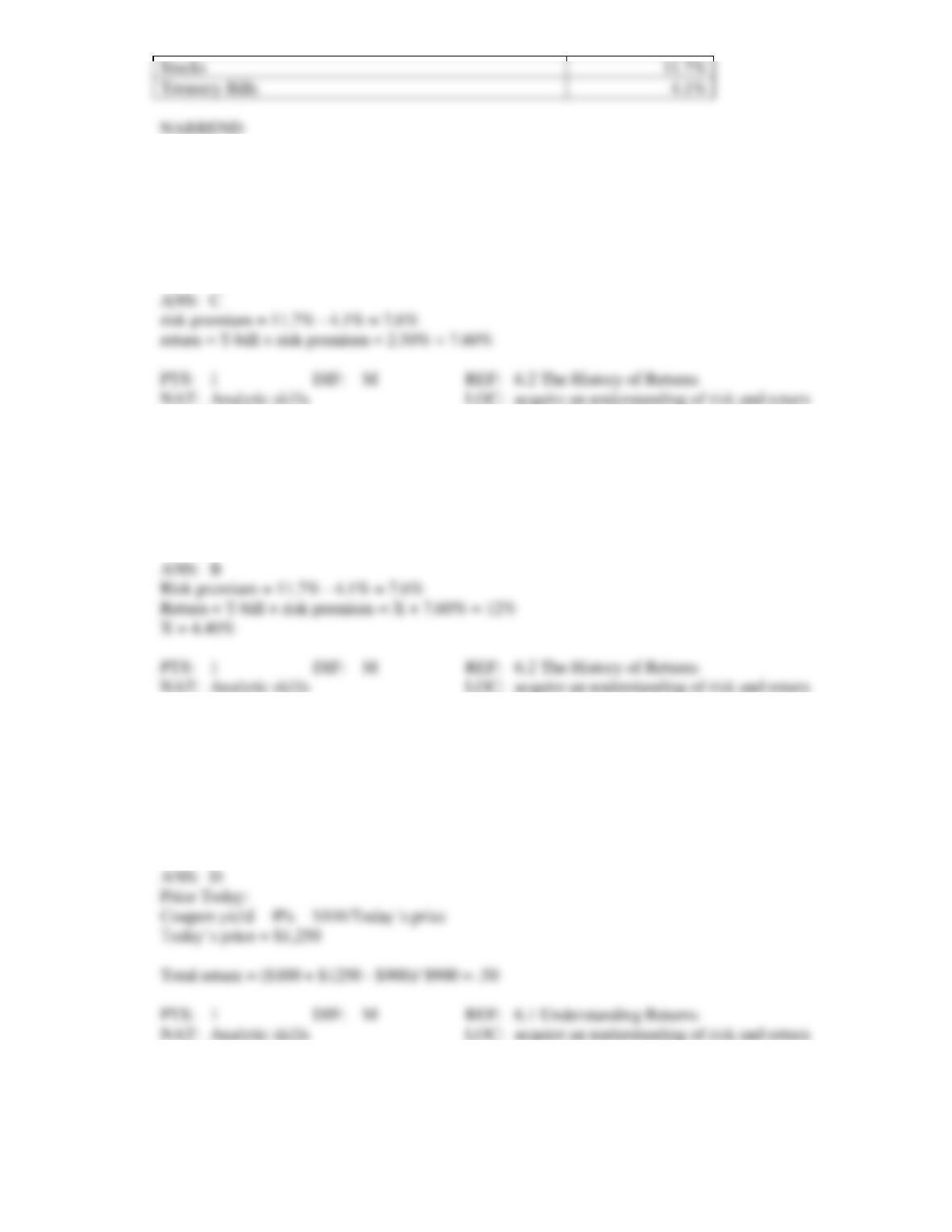
Consider the following information concerning stock returns and bond returns over the last 75 years:
Average Return
1934-2004
68. Refer to Exhibit 6-3. Currently, Treasury bills yield 2.50% on the secondary market. What is a good
estimate for the return on the stock market in the next year given this information?
a.
6.60%
b.
7.60%
c.
10.10%
d.
11.70%
69. Refer to Exhibit 6-3. Currently, investors want a 12% return on stocks as a whole. Based on this
information, what is a good estimate for the current return on Treasury Bills?
a.
4.10%
b.
4.40%
c.
7.20%
d.
7.60%
70. A bond was purchased last year for $900. The bond pays a 10% annual coupon and has a face value of
$1,000. Today, the bond has a coupon yield of 8%. What is the total return for this bond over the last
year?
a.
8%
b.
10%
c.
39%
d.
50%
71. Which statement is TRUE regarding diversification?
a.
The greater the systematic risk, the greater the return required by the investor.
b.
The greater the diversifiable risk, the greater the return required by the investor.
c.
We are able to remove all systematic risk if enough stocks are added to a portfolio.
d.
Systematic risk is diversifiable.
72. A brochure for an investment company reports average nominal returns of 9% per year. If the
economy has averaged 3% inflation over these years, what is the average real return for this
investment company?
a.
3.00%
b.
5.83%
c.
6.00%
d.
9.00%
73. Suppose you are interested in the following two stocks:
Stock
Expected Return
Alpha
10%
Beta
6%
What is your expected portfolio return if you put 40% of you investment in Alpha, and 60% of your
investment in Beta?
a.
7.20%
b.
7.60%
c.
8.00%
d.
8.40%
74. A stock was purchased two years ago for $20. The stock does not pay dividends and sells today for
$26.00. If sold today, what was the annual realized return on your investment?
a.
9%
b.
12%
c.
14%
d.
15%
75. Which of the following statements is true?
a.
While finance teaches that investments with higher risk should have higher returns there is
no historical evidence in the capital markets to suggest this relationship exists.
b.
Finance teaches that investments with higher risk should have higher returns and historical
evidence in the capital markets suggests this relationship exists.
c.
When individuals decide how to invest their money they must weigh the expected benefits
(returns) against the costs of additional risk.
d.
Both (a) and (c) are true.
e.
Both (b) and (c) are true.
76. Why are Treasury bills among the safest investments in the world?
a.
They are short-term investments and therefore extremely sensitive to interest rate changes.
b.
They are long-term investments and therefore extremely insensitive to interest rate
changes.
c.
They are short-term investments and therefore fairly insensitive to interest rate changes.
d.
They are backed by the full faith and credit of the U.S. government.
e.
Both (c) and (d).
77. According to historical data, in the last 106 years returns on stocks in the U.S. have been negative
about ____ of the time.
a.
50%
b.
20%
c.
26%
d.
42%
e.
33%
78. Based upon a histogram of nominal returns on equities for the last 100 years, we can conjecture that
stock returns follow a ____ distribution.
a.
normal
b.
skewed
c.
uniform
d.
binomial
e.
None of the above
79. A normal distribution is ____.
a.
skewed
b.
symmetrical
c.
uniform
d.
all of the above
e.
none of the above
80. Which of the following statements is true?
a.
While asset classes with higher standard deviations tend to have higher returns, this
relationship seems to break down for specific securities.
b.
Asset classes with higher standard deviations tend to have higher returns, and this
relationship tends to hold true when examining specific securities as well.
c.
Asset classes with higher standard deviations tend to have higher returns, but when we
examine specific assets within those classes we find that high standard deviation securities
tend to have lower returns.
d.
None of the above
81. Which of the following statements is true?
a.
It is very difficult for investors to remove their exposure to unsystematic risk.
b.
It is very easy for investors to remove their exposure to systematic risk.
c.
It is very easy for investors to remove their exposure to unsystematic risk.
d.
Both (a) and (b) are true
e.
None of the above statements is true
82. Investors should expect to be compensated for bearing ____ risk, but they should not expect to be
compensated for bearing ____ risk.
a.
unsystematic; systematic
b.
systematic; unsystematic
c.
co-movement; systematic
d.
unsystematic; co-movement
e.
total risk; unsystematic
83. Consider the adjusted closing prices for Louis Stock
Year
Adj. Price
2011
$
15.00
2010
$
16.00
2009
$
14.00
2008
$
12.00
2007
$
8.00
What is the holding period return for Louis?
a.
18.68%
b.
13.00%
c.
15.60%
d.
16.70%
84. Consider the adjusted closing prices for Louis Stock
Year
Adj. Price
2011
$
15.00
2010
$
16.00
2009
$
14.00
2008
$
12.00
2007
$
8.00
What is the variance of returns for Louis stock?
a.
0.041
b.
0.054
c.
0.233
d.
0.202
85. Consider the adjusted closing prices for Louis Stock
Year
Adj. Price
2011
$
15.00
2010
$
16.00
2009
$
14.00
2008
$
12.00
2007
$
8.00
What is the standard deviation of return of returns for Louis stock?
a.
0.041
b.
0.054
c.
0.233
d.
0.202
86. Consider the adjusted closing prices for Roxy Stock
Year
Adj. Price
2011
$
26.00
2010
$
24.00
2009
$
21.00
2008
$
22.00
2007
$
20.00
What is the holding period return for Roxy?
a.
7.02%
b.
22.60%
c.
15.60%
d.
16.70%
87. Consider the adjusted closing prices for Roxy Stock
Year
Adj. Price
2011
$
26.00
2010
$
24.00
2009
$
21.00
2008
$
22.00
2007
$
20.00
What is the variance of returns for Roxy stock?
a.
0.005
b.
0.007
c.
0.081
d.
0.070
88. Consider the adjusted closing prices for Roxy Stock
Year
Adj. Price
2011
$
26.00
2010
$
24.00
2009
$
21.00
2008
$
22.00
2007
$
20.00
What is the standard deviation of returns for Roxy stock?
a.
0.005
b.
0.007
c.
0.081
d.
0.070
89. Consider the adjusted closing prices for MA Stock
Year
Adj. Price
2011
$
37.00
2010
$
34.00
2009
$
36.00
2008
$
35.00
2007
$
35.00
What is the holding period return for MA?
a.
1.53%
b.
2.35%
c.
-1.20%
d.
3.25%
90. Consider the adjusted closing prices for MA Stock
Year
Adj. Price
2011
$
37.00
2010
$
34.00
2009
$
36.00
2008
$
35.00
2007
$
35.00
What is the variance of returns for MA stock?
a.
0.003
b.
0.004
c.
0.060
d.
0.052
91. Consider the adjusted closing prices for MA Stock
Year
Adj. Price
2011
$
37.00
2010
$
34.00
2009
$
36.00
2008
$
35.00
2007
$
35.00
What is the variance of returns for MA stock?
a.
0.003
b.
0.004
c.
0.060
d.
0.052