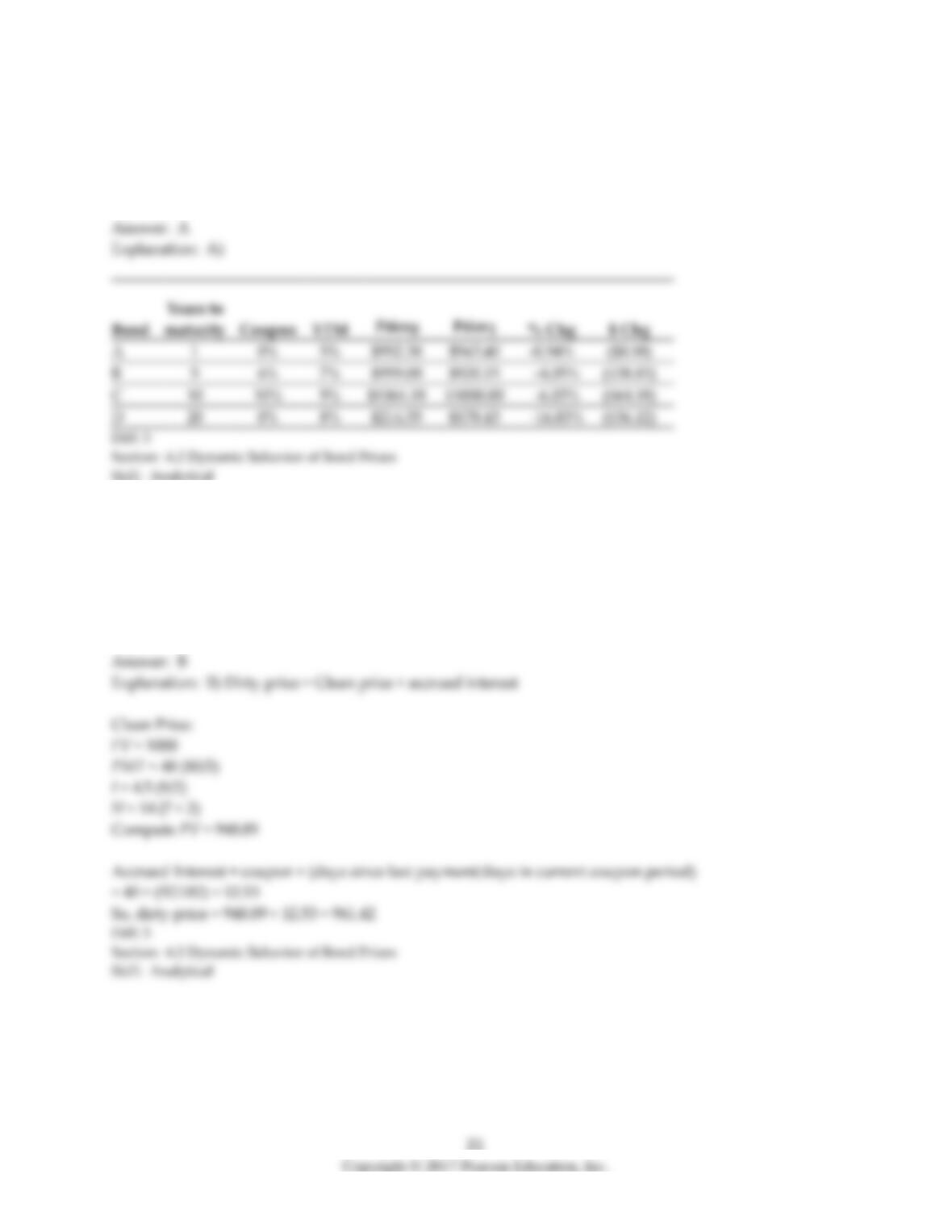
25) Which of the four bonds is the least sensitive to a one percent increase in the YTM?
A) Bond A
B) Bond B
C) Bond C
D) Bond D
26) Consider a corporate bond with a $1000 face value, 8% coupon with semiannual coupon payments,
7 years until maturity, and a YTM of 9%. It has been 57 days since the last coupon payment was made
and there are 182 days in the current coupon period. The dirty (cash) price for this bond is closest to:
A) $949.70
B) $961.40
C) $936.40
D) $948.90
27) Consider a corporate bond with a $1000 face value, 10% coupon with semiannual coupon payments,
5 years until maturity, currently selling for a cash price of $1113.80. The next coupon payment will be
made in 63 days and there are 182 days in the current coupon period. The clean price for this bond is
closest to:
A) $1146.50
B) $1065.70
C) $1113.80
D) $1081.10
28) If its YTM does not change, how does a bond’s cash price change between coupon payments?
Use the table for the question(s) below.
Consider the following four bonds that pay annual coupons:
Bond
Years to
maturity
Coupon
YTM
A
1
0%
5%
B
5
6%
7%
C
10
10%
9%
D
20
0%
8%
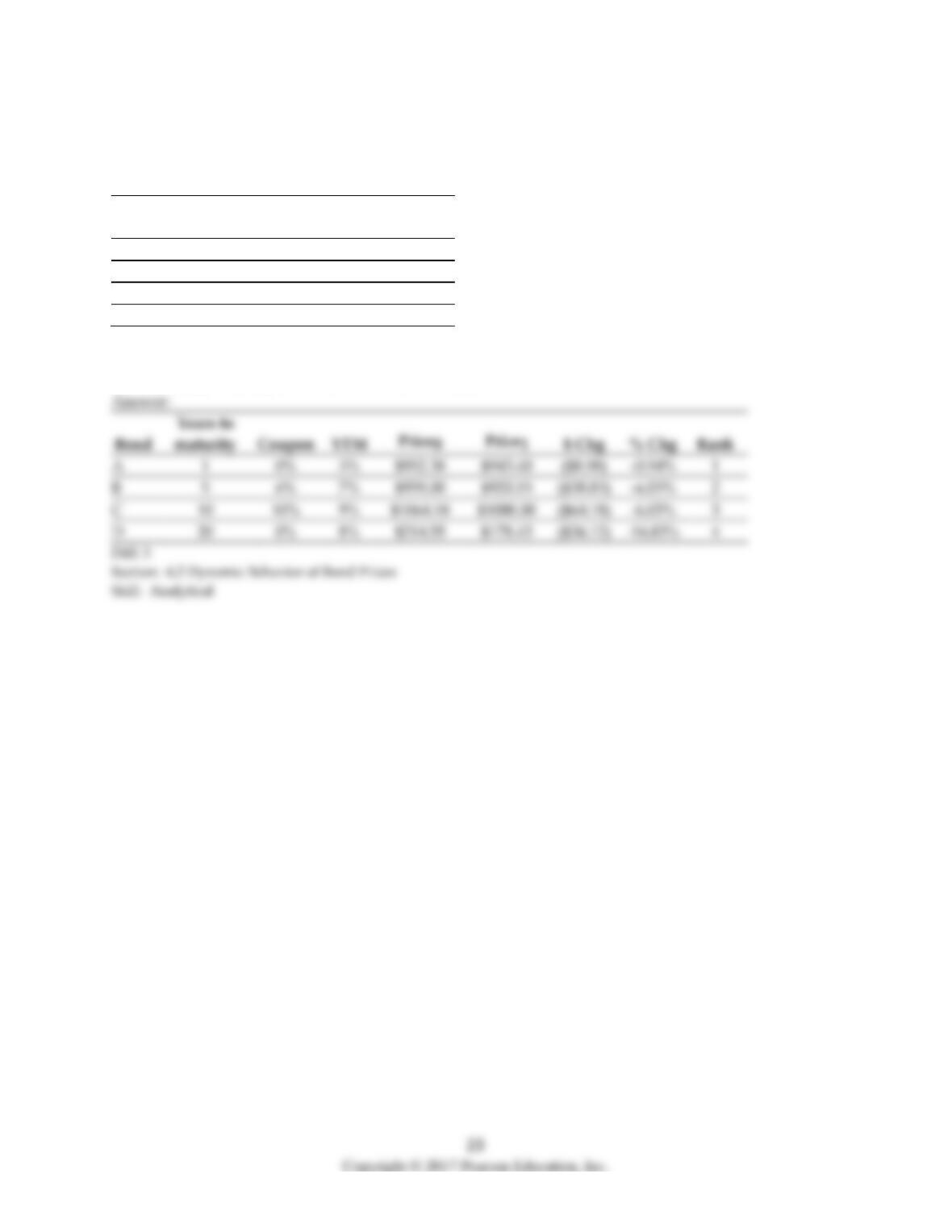
29) Assume that the YTM increases by 1% for each of the four bonds listed. Rank the bonds based upon
the sensitivity of their prices from least to most sensitive.
A
B
C
D
6.3 The Yield Curve and Bond Arbitrage
1) Which of the following statements is FALSE?
A) Given the spot interest rates, we can determine the price and yield of any other default-free bond.
B) As the coupon increases, earlier cash flows become relatively less important than later cash flows in
the calculation of the present value.
C) When the yield curve is flat, all zero-coupon and coupon-paying bonds will have the same yield,
independent of their maturities and coupon rates.
D) When U.S. bond traders refer to “the yield curve,” they are often referring to the coupon-paying
Treasury yield curve.
2) Which of the following statements is FALSE?
A) We can use the law of one price to compute the price of a coupon bond from the prices of zero–
coupon bonds.
B) The plot of the yields of coupon bonds of different maturities is called the coupon-paying yield
curve.
C) It is possible to replicate the cash flows of a coupon bond using zero-coupon bonds.
D) Because the coupon bond provides cash flows at different points in time, the yield to maturity of a
coupon bond is the simple average of the yields of the zero-coupon bonds of equal and shorter
maturities.
3) Which of the following statements is FALSE?
A) By convention, practitioners always plot the yield of the most senior issued bonds, termed the on–
the-run-bonds.
B) We can determine the no-arbitrage price of a coupon bond by discounting its cash flows using the
zero-coupon yields.
C) If the zero coupon yield curve is upward sloping, the resulting yield to maturity decreases with the
coupon rate of the bond.
D) The yield to maturity of a coupon bond is a weighted average of the yields on the zero-coupon
bonds.
4) Which of the following statements is FALSE?
A) The yield to maturity of a coupon bond is a weighted average of the yields on the zero-coupon
bonds.
B) If the zero-coupon yield curve is downward sloping, the yield to maturity will decrease with the
coupon rate.
C) The information in the zero-coupon yield curve is sufficient to price all other risk-free bonds.
D) When the yield curve is flat, all zero-coupon and coupon-paying bonds will have the same yield,
independent of their maturities and coupon rates.
Use the following information to answer the question(s) below.
Maturity (years)
1
2
3
4
5
Zero-Coupon YTM
3.25%
3.50%
3.90%
4.25%
4.40%
5) The price today of a two-year default-free security with a face value of $1000 and an annual coupon
rate of 5% is closest to:
A) $1002.78
B) $1003.31
C) $1028.50
D) $1028.61
6) The price today of a three-year default-free security with a face value of $1000 and an annual coupon
rate of 4% is closest to:
A) $1002.78
B) $1003.31
C) $1028.50
D) $1028.61
7) A default-free security has an annual coupon rate of 3.25% and sells for par. This bond will mature in:
A) 1 year
B) 2 years
C) 3 years
D) 4 years
8) Consider a five-year, default-free bond with an annual coupon rate of 5% and a face value of $1000.
The YTM on this bond is closest to:
A) 3.85%
B) 4.20%
C) 4.35%
D) 4.40%
9) Consider a four-year, default-free bond with an annual coupon rate of 4.5% and a face value of $1000.
The YTM on this bond is closest to:
A) 3.85%
B) 4.20%
C) 4.35%
D) 4.40%
Use the table for the question(s) below.
Consider the following zero-coupon yields on default free securities:
Maturity (years)
1
2
3
4
5
Zero-Coupon YTM
5.80%
5.50%
5.20%
5.00%
4.80%
10) The price today of a 3 year default free security with a face value of $1000 and an annual coupon
rate of 6% is closest to:
A) $1000
B) $1021
C) $1013
D) $1005
11) A 3 year default free security with a face value of $1000 and an annual coupon rate of 6% will trade:
A) at a discount.
B) at a premium.
C) at par.
D) There is insufficient information provided to answer this question.
12) The YTM of a 3 year default free security with a face value of $1000 and an annual coupon rate of 6%
is closest to:
A) 5.5%
B) 5.8%
C) 5.7%
D) 5.2%
13) The price of a five-year, zero-coupon, default-free security with a face value of $1000 is closest to:
A) $754
B) $772
C) $776
D) $791
14) The price today of a 4 year default free security with a face value of $1000 and an annual coupon
rate of 5.25% is closest to:
A) $1000
B) $1003
C) $1008
D) $987
15) A 4 year default free security with a face value of $1000 and an annual coupon rate of 5.25% will
trade:
A) at a premium.
B) at par.
C) at a discount.
D) There is insufficient information provided to answer this question.
16) The YTM of a 4 year default free security with a face value of $1000 and an annual coupon rate of
5.25% is closest to:
A) 5.2%
B) 5.0%
C) 4.9%
D) 5.25%
17) What is the price today of a two-year, default-free security with a face value of $1000 and an annual
coupon rate of 5.75%? Does this bond trade at a discount, premium, or at par?

6.4 Corporate Bonds
1) A corporate bond which receives a BBB rating from Standard and Poor’s is considered:
A) a junk bond.
B) an investment grade bond.
C) a defaulted bond.
D) a high-yield bond.
2) Which of the following statements is FALSE?
A) Investors pay less for bonds with credit risk than they would for an otherwise identical default-free
bond.
B) The yield to maturity of a defaultable bond is equal to the expected return of investing in the bond.
C) The risk of default, which is known as the credit risk of the bond, means that the bond’s cash flows
are not known with certainty.
D) For corporate bonds, the issuer may default—that is, it might not pay back the full amount promised
in the bond certificate.
3) Which of the following statements is FALSE?
A) Because the cash flows promised by the bond are the most that bondholders can hope to receive, the
cash flows that a purchaser of a bond with credit risk expects to receive may be less than that amount.
B) By consulting bond ratings, investors can assess the credit-worthiness of a particular bond issue.
C) Because the yield to maturity for a bond is calculated using the promised cash flows, the yield of
bonds with credit risk will be lower than that of otherwise identical default-free bonds.
D) A higher yield to maturity does not necessarily imply that a bond’s expected return is higher.
4) Which of the following statements is FALSE?
A) The bond’s expected return, which is equal to the firm’s debt cost of capital, is less than the yield to
maturity if there is a risk of default.
B) The two best-known bond-rating companies are Standard & Poor’s and Dow Jones.
C) Bonds in the bottom five categories are often called speculative bonds, junk bonds, or high-yield
bonds.
D) Bond ratings encourage widespread investor participation and relatively liquid markets.
5) Which of the following statements is FALSE?
A) Bond ratings encourage widespread investor participation and relatively liquid markets.
B) Bonds in the top four categories are often referred to as investment grade bonds.
C) A bond’s rating depends on the risk of bankruptcy as well as the bondholder‘s ability to lay claim to
the firm’s assets in the event of a bankruptcy.
D) Debt issues with a low-priority claim in bankruptcy will have a better rating than issues from the
same company that have a higher priority in bankruptcy.
6) Which of the following statements is FALSE?
A) Investors pay less for bonds with credit risk than they would for otherwise identical default-free
bonds.
B) Credit spreads fluctuate as perceptions regarding the probability of default change.
C) Credit spreads are high for bonds with high ratings.
D) We refer to the difference between the yields of the corporate bonds and the Treasury yields as the
default spread or credit spread.
7) Taggart Transcontinental has issued at par a zero-coupon bond with a ten-year maturity. Investors
believe there is a 10% chance that Taggart Transcontinental will default on these bonds. If they do
default, investors expect to receive only 50 cents per dollar they are owed. If investors require an 8%
return on their investment in these bonds, then the yield to maturity on these bonds will be closest to
(assume annual compounding):
A) 6.0%
B) 6.5%
C) 7.0%
D) 8.56%