Chapter 06: Risk and Return
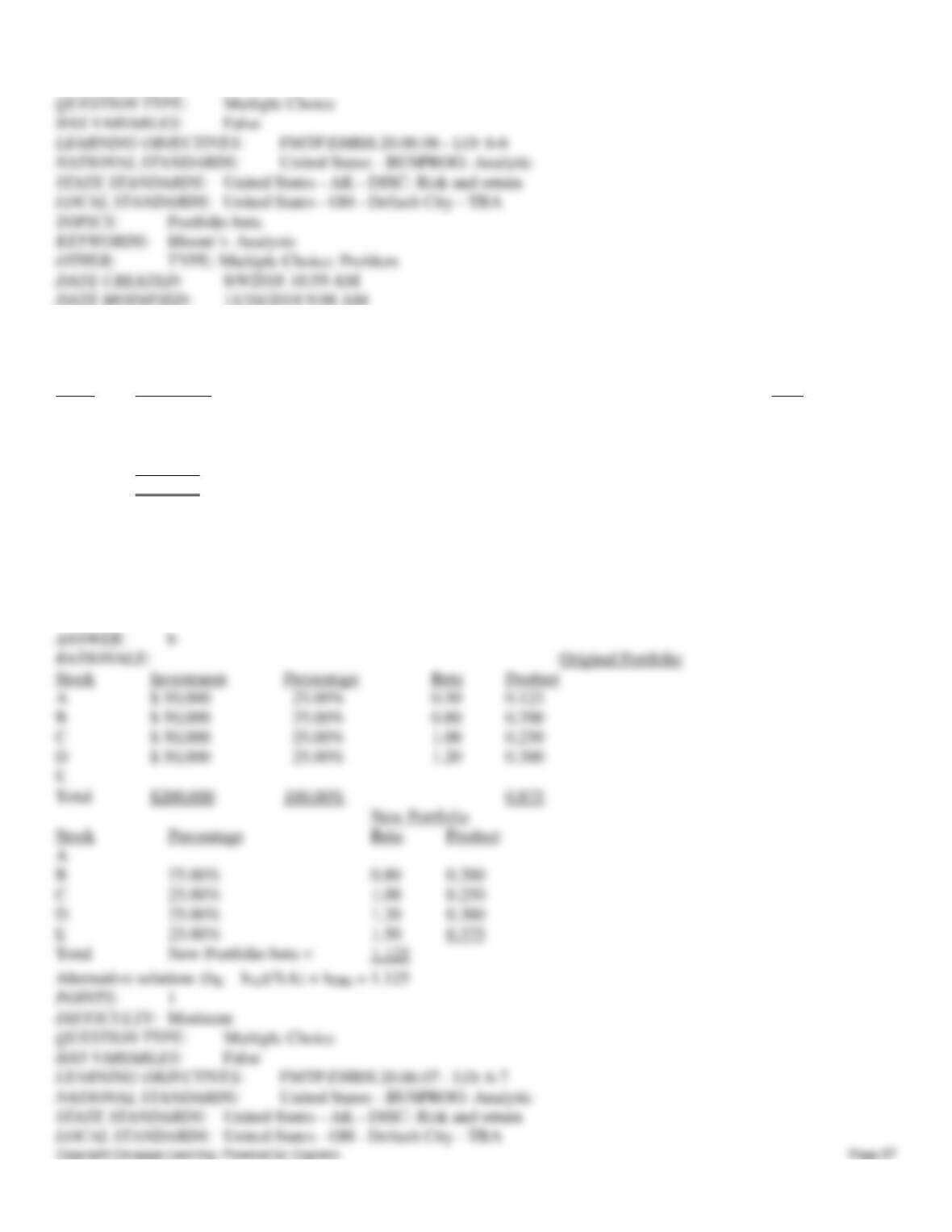
127. Sherrie Hymes holds a $200,000 portfolio consisting of the following stocks. The portfolio’s beta is 0.875.
Stock Investment Beta
A $50,000 0.50
B 50,000 0.80
C 50,000 1.00
D 50,000 1.20
Total $200,000
If Sherrie replaces Stock A with another stock, E, which has a beta of 1.50, what will the portfolio’s new beta be?
a. 1.07
b. 1.13
c. 1.18
d. 1.24
e. 1.30
Chapter 06: Risk and Return
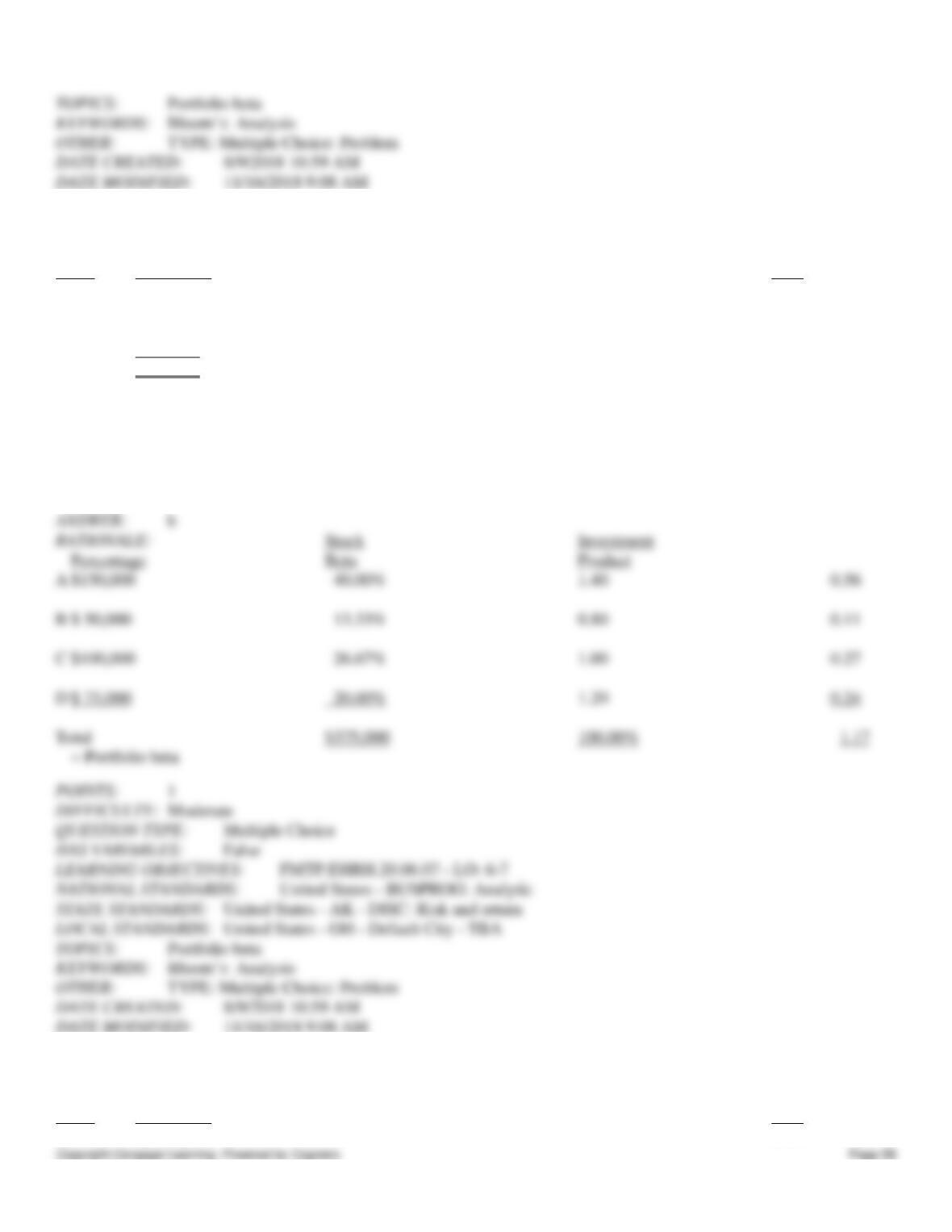
128. Megan Ross holds the following portfolio:
Stock Investment Beta
A $150,000 1.40
B 50,000 0.80
C 100,000 1.00
D 75,000 1.20
Total $375,000
What is the portfolio’s beta?
a. 1.06
b. 1.17
c. 1.29
d. 1.42
e. 1.56
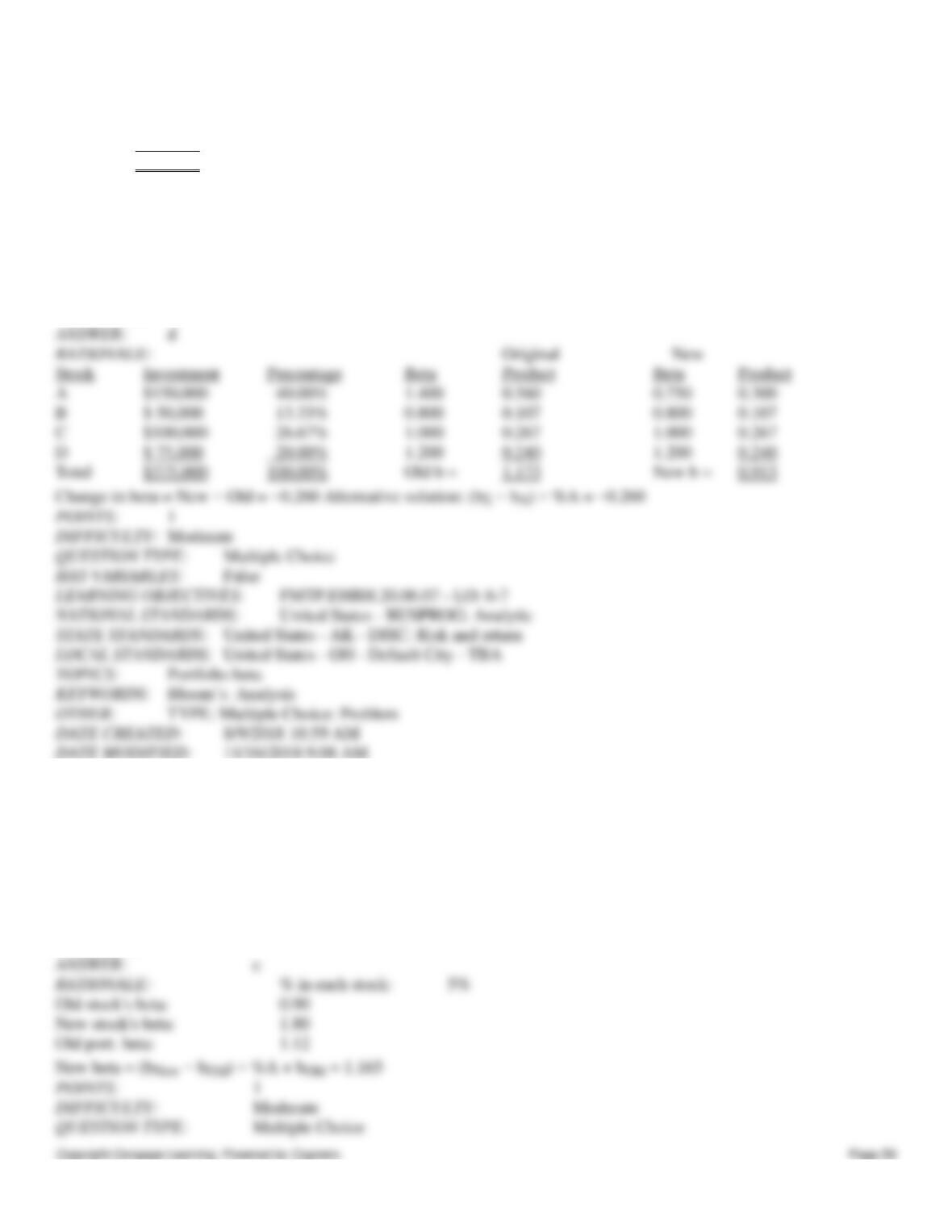
129. Paul McLaren holds the following portfolio:
Stock Investment Beta
A $150,000 1.40
Chapter 06: Risk and Return
B 50,000 0.80
C 100,000 1.00
D 75,000 1.20
Total $375,000
Paul plans to sell Stock A and replace it with Stock E, which has a beta of 0.75. By how much will the portfolio beta
change?
a. −0.190
b. −0.211
c. −0.234
d. −0.260
e. −0.286
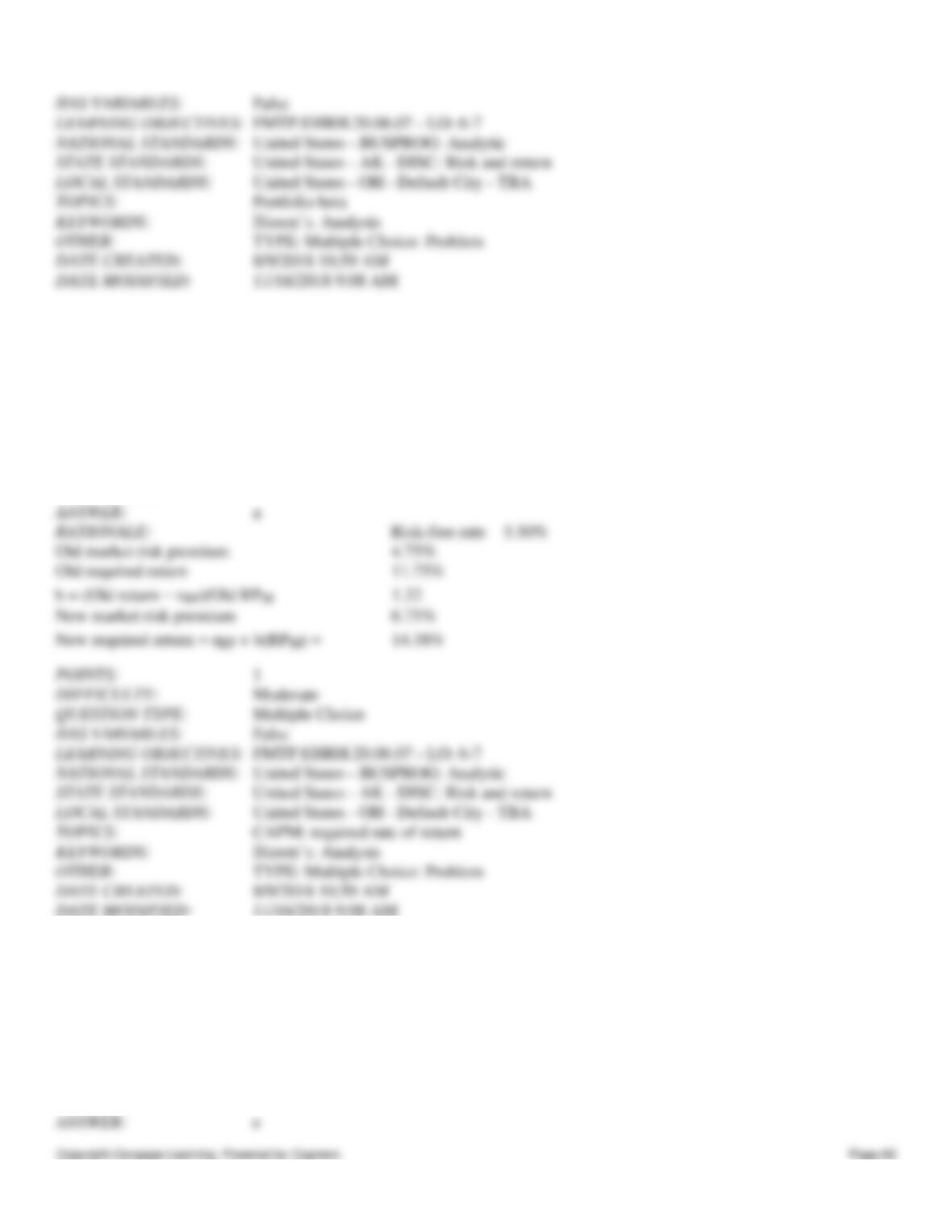
130. Jenna holds a diversified $100,000 portfolio consisting of 20 stocks with $5,000 invested in each. The portfolio’s beta
is 1.12. Jenna plans to sell a stock with b = 0.90 and use the proceeds to buy a new stock with b = 1.80. What will the
portfolio’s new beta be?
a. 1.286
b. 1.255
c. 1.224
d. 1.194
e. 1.165
Chapter 06: Risk and Return
131. Porter Plumbing’s stock had a required return of 11.75% last year, when the risk-free rate was 5.50% and the market
risk premium was 4.75%. Then an increase in investor risk aversion caused the market risk premium to rise by 2%. The
risk-free rate and the firm’s beta remain unchanged. What is the company’s new required rate of return? (Hint: First
calculate the beta, then find the required return.)
a. 14.38%
b. 14.74%
c. 15.11%
d. 15.49%
e. 15.87%
132. Company A has a beta of 0.70, while Company B‘s beta is 1.20. The required return on the stock market is 11.00%,
and the risk-free rate is 4.25%. What is the difference between A’s and B’s required rates of return? (Hint: First find the
market risk premium, then find the required returns on the stocks.)
a. 2.75%
b. 2.89%
c. 3.05%
d. 3.21%
e. 3.38%
Chapter 06: Risk and Return
133. Stock A’s stock has a beta of 1.30, and its required return is 12.00%. Stock B’s beta is 0.80. If the risk-free rate is
4.75%, what is the required rate of return on B’s stock? (Hint: First find the market risk premium.)
a. 8.76%
b. 8.98%
c. 9.21%
d. 9.44%
e. 9.68%
Chapter 06: Risk and Return
134. Barker Corp. has a beta of 1.10, the real risk-free rate is 2.00%, investors expect a 3.00% future inflation rate, and the
market risk premium is 4.70%. What is Barker’s required rate of return?
a. 9.43%
b. 9.67%
c. 9.92%
d. 10.17%
e. 10.42%
135. Brodkey Shoes has a beta of 1.30, the T-bill rate is 3.00%, and the T-bond rate is 6.5%. The annual return on the
stock market during the past 3 years was 15.00%, but investors expect the annual future stock market return to be 13.00%.
Based on the SML, what is the firm’s required return?
a. 13.51%
b. 13.86%
c. 14.21%
d. 14.58%
e. 14.95%
Chapter 06: Risk and Return
136. Gardner Electric has a beta of 0.88 and an expected dividend growth rate of 4.00% per year. The T-bill rate is 4.00%,
and the T-bond rate is 5.25%. The annual return on the stock market during the past 4 years was 10.25%. Investors expect
the average annual future return on the market to be 12.50%. Using the SML, what is the firm’s required rate of return?
a. 11.34%
b. 11.63%
c. 11.92%
d. 12.22%
e. 12.52%
137. Consider the following information and then calculate the required rate of return for the Universal Investment Fund,
which holds 4 stocks. The market’s required rate of return is 13.25%, the risk-free rate is 7.00%, and the Fund’s assets are
as follows:
Stock Investment Beta
Chapter 06: Risk and Return
A $ 200,000 1.50
B $ 300,000 −0.50
C $ 500,000 1.25
D $1,000,000 0.75
a. 9.58%
b. 10.09%
c. 10.62%
d. 11.18%
e. 11.77%
138. Data for Atwill Corporation is shown below. Now Atwill acquires some risky assets that cause its beta to increase by
30%. In addition, expected inflation increases by 2.00%. What is the stock’s new required rate of return?
Initial beta 1.00
Initial required return (rs) 10.20%
Market risk premium, RPM 6.00%
Percentage increase in beta 30.00%
Increase in inflation premium, IP 2.00%
a. 14.00%
b. 14.70%
c. 15.44%
Chapter 06: Risk and Return
d. 16.21%
e. 17.02%
139. Fiske Roofing Supplies’ stock has a beta of 1.23, its required return is 11.75%, and the risk-free rate is 4.30%. What
is the required rate of return on the market? (Hint: First find the market risk premium.)
a. 10.36%
b. 10.62%
c. 10.88%
d. 11.15%
e. 11.43%
Chapter 06: Risk and Return
140. Suppose Stan holds a portfolio consisting of a $10,000 investment in each of 8 different common stocks. The
portfolio’s beta is 1.25. Now suppose Stan decided to sell one of his stocks that has a beta of 1.00 and to use the proceeds
to buy a replacement stock with a beta of 1.35. What would the portfolio’s new beta be?
a. 1.17
b. 1.23
c. 1.29
d. 1.36
e. 1.43
141. Returns for the Alcoff Company over the last 3 years are shown below. What’s the standard deviation of the firm’s
returns? (Hint: This is a sample, not a complete population, so the sample standard deviation formula should be used.)
Year Return
2010 21.00%
2009 −12.50%
2008 25.00%
a. 20.08%
b. 20.59%
c. 21.11%
d. 21.64%
e. 22.18%
Chapter 06: Risk and Return
142. Stuart Company’s manager believes that economic conditions during the next year will be strong, normal, or weak,
and she thinks that the firm’s returns will have the probability distribution shown below. What’s the standard deviation of
the estimated returns? (Hint: Use the formula for the standard deviation of a population, not a sample.)
Economic
Conditions Prob. Return
Strong 30% 32.0%
Normal 40% 10.0%
Weak 30% −16.0%
a. 17.69%
b. 18.62%
c. 19.55%
d. 20.52%
e. 21.55%
Chapter 06: Risk and Return
143. Assume that your cousin holds just one stock, Eastman Chemical Bonding (ECB), which he thinks has very little
risk. You agree that the stock is relatively safe, but you want to demonstrate that his risk would be even lower if he were
more diversified. You obtain the following returns data for Wilder’s Creations and Buildings (WCB). Both companies
have had less variability than most other stocks over the past 5 years. Measured by the standard deviation of returns, by
how much would your cousin’s risk have been reduced if he had held a portfolio consisting of 60% in ECB and the
remainder in WCB? (Hint: Use the sample standard deviation formula.)
Year ECB WCB
2011 40.00% 40.00%
2012 −10.00% 15.00%
2013 35.00% −5.00%
2014 −5.00% −10.00%
2015 15.00% 35.00%
Average return = 15.00% 15.00%
Standard deviation = 22.64% 22.64%
a. 3.29%
b. 3.46%
c. 3.65%
d. 3.84%
e. 4.03%
Chapter 06: Risk and Return
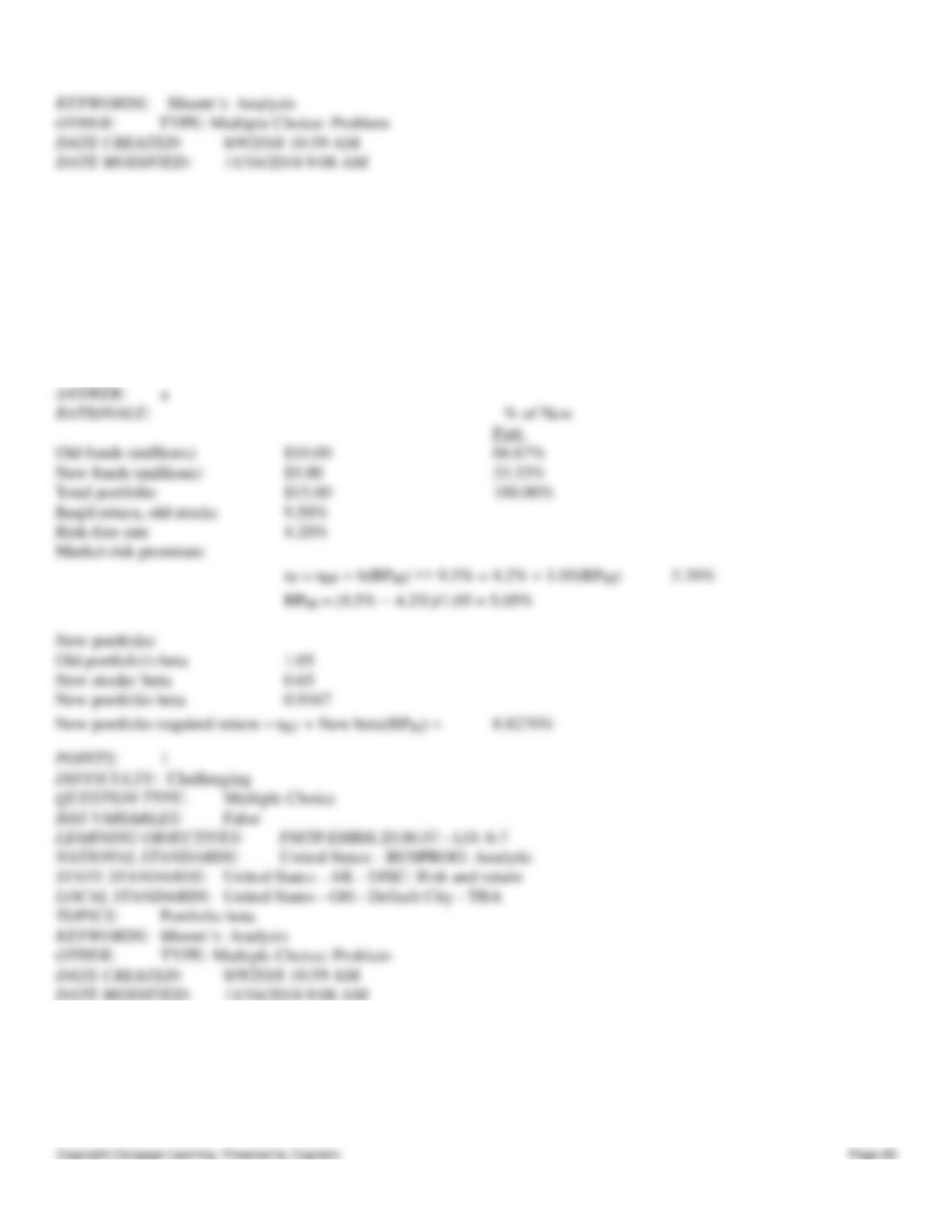
144. The $10.00 million mutual fund Henry manages has a beta of 1.05 and a 9.50% required return. The risk-free rate is
4.20%. Henry now receives another $5.00 million, which he invests in stocks with an average beta of 0.65. What is the
required rate of return on the new portfolio? (Hint: You must first find the market risk premium, then find the new
portfolio beta.)
a. 8.83%
b. 9.05%
c. 9.27%
d. 9.51%
e. 9.74%
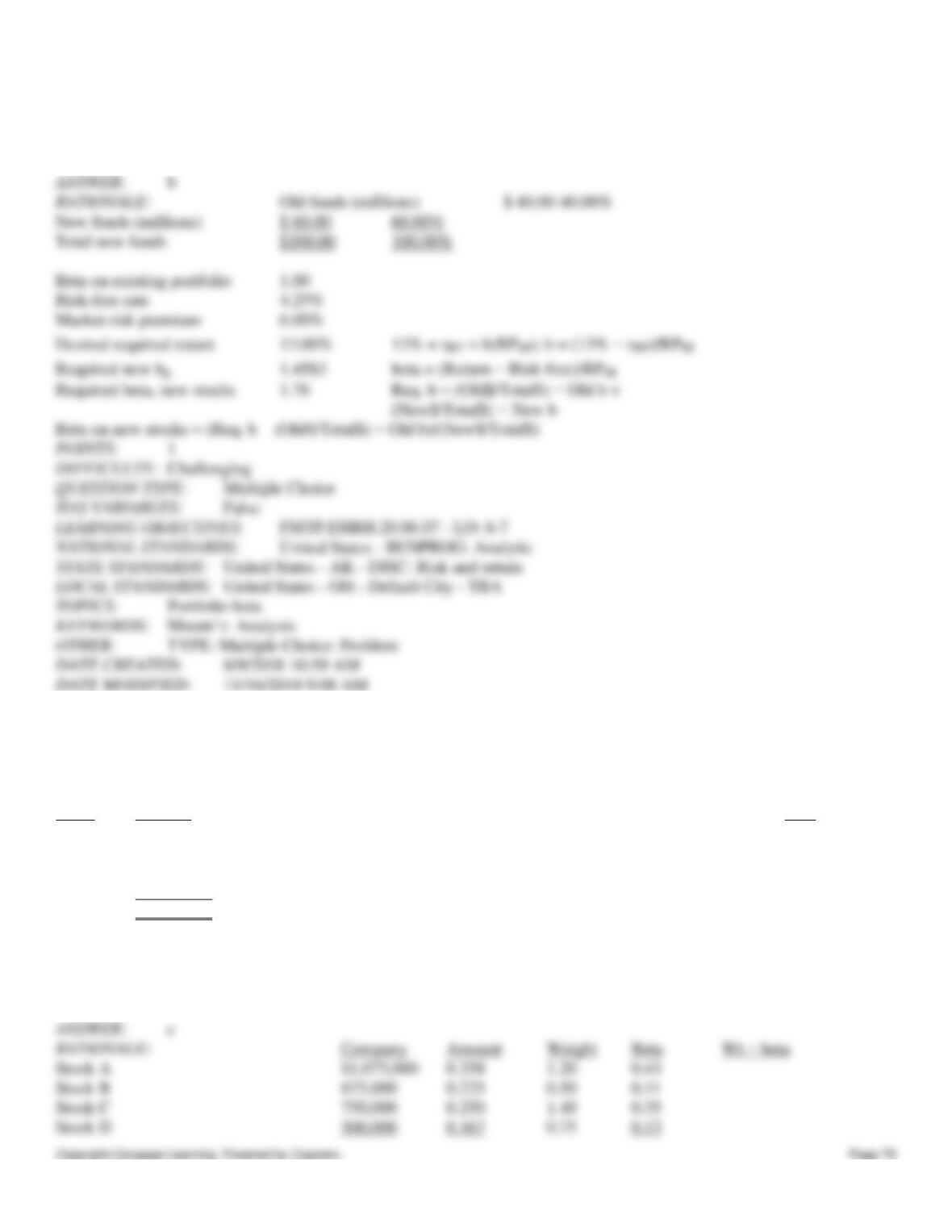
145. Hazel Morrison, a mutual fund manager, has a $40 million portfolio with a beta of 1.00. The risk-free rate is 4.25%,
and the market risk premium is 6.00%. Hazel expects to receive an additional $60 million, which she plans to invest in
additional stocks. After investing the additional funds, she wants the fund’s required and expected return to be 13.00%.
What must the average beta of the new stocks be to achieve the target required rate of return?
a. 1.68
Chapter 06: Risk and Return
b. 1.76
c. 1.85
d. 1.94
e. 2.04
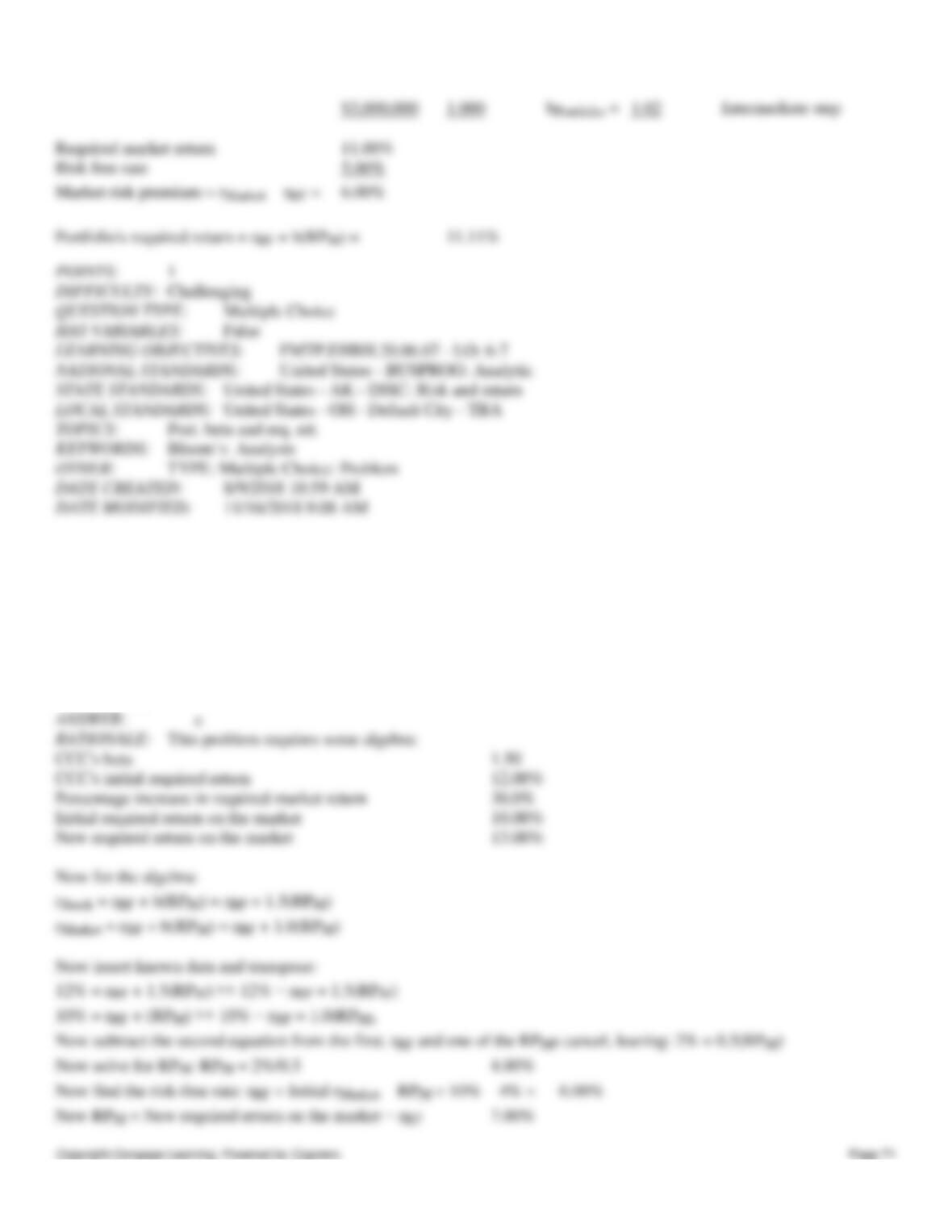
146. Joel Foster is the portfolio manager of the SF Fund, a $3 million hedge fund that contains the following stocks. The
required rate of return on the market is 11.00% and the risk-free rate is 5.00%. What rate of return should investors expect
(and require) on this fund?
Stock Amount Beta
A $1,075,000 1.20
B 675,000 0.50
C 750,000 1.40
D 500,000 0.75
$3,000,000
a. 10.56%
b. 10.83%
c. 11.11%
d. 11.38%
e. 11.67%
Chapter 06: Risk and Return
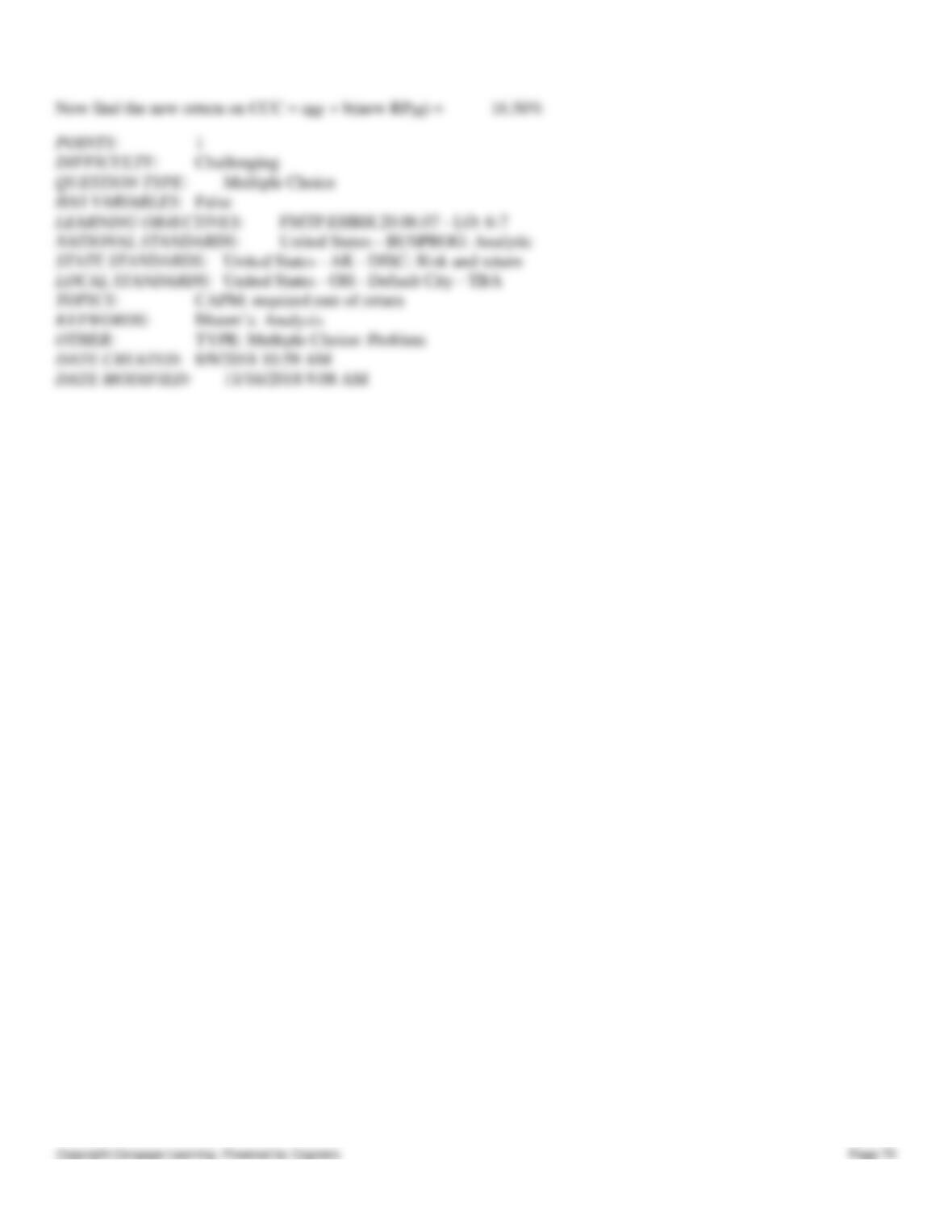
147. DHF Company has a beta of 1.5 and is currently in equilibrium. The required rate of return on the stock is 12.00%
versus a required return on an average stock of 10.00%. Now the required return on an average stock increases by 30.0%
(not percentage points). Neither betas nor the risk-free rate change. What would DHF’s new required return be?
a. 14.89%
b. 15.68%
c. 16.50%
d. 17.33%
e. 18.19%
Chapter 06: Risk and Return