Chapter 06: Risk and Return
c. If the risk-free rate increases while the market risk premium remains constant, then the required return on an
average stock will increase.
d. If the market risk premium decreases but the risk-free rate remains unchanged, Dixon’s required return will
decrease because it has a beta greater than 1.0 and Clark’s will also decrease, but by more than Dixon’s because it has a
beta less than 1.0.
e. If the risk-free rate increases but the market risk premium remains unchanged, the required return will increase for
both stocks but the increase will be larger for Dixon since it has a higher beta.
97. Stock X has a beta of 0.6, while Stock Y has a beta of 1.4. Which of the following statements is CORRECT?
a. Stock Y must have a higher expected return and a higher standard deviation than Stock X.
b. If expected inflation increases but the market risk premium is unchanged, then the required return on both stocks
will fall by the same amount.
c. If the market risk premium declines but expected inflation is unchanged, the required return on both stocks will
decrease, but the decrease will be greater for Stock Y.
d. If expected inflation declines but the market risk premium is unchanged, then the required return on both stocks
will decrease but the decrease will be greater for Stock Y.
e. A portfolio consisting of $50,000 invested in Stock X and $50,000 invested in Stock Y will have a required return
that exceeds that of the overall market.
98. Stock A has a beta of 0.8 and Stock B has a beta of 1.2. 50% of Portfolio P is invested in Stock A and 50% is invested
in Stock B. If the market risk premium (rM − rRF) were to increase but the risk-free rate (rRF) remained constant, which of
the following would occur?
a. The required return would decrease by the same amount for both Stock A and Stock B.
Chapter 06: Risk and Return
b. The required return would increase for Stock A but decrease for Stock B.
c. The required return on Portfolio P would remain unchanged.
d. The required return would increase for Stock B but decrease for Stock A.
e. The required return would increase for both stocks but the increase would be greater for Stock B than for Stock A.
99. Stock A has a beta of 0.7, whereas Stock B has a beta of 1.3. Portfolio P has 50% invested in both A and B. Which of
the following would occur if the market risk premium increased by 1% but the risk-free rate remained constant?
a. The required return on both stocks would increase by 1%.
b. The required return on Portfolio P would remain unchanged.
c. The required return on Stock A would increase by more than 1%, while the return on Stock B would increase by
less than 1%.
d. The required return for Stock A would fall, but the required return for Stock B would increase.
e. The required return on Portfolio P would increase by 1%.
100. Assume that the risk-free rate remains constant, but the market risk premium declines. Which of the following is
most likely to occur?
a. The required return on a stock with beta > 1.0 will increase.
b. The return on “the market” will remain constant.
c. The return on “the market” will increase.
d. The required return on a stock with beta < 1.0 will decline.
e. The required return on a stock with beta = 1.0 will not change.
Chapter 06: Risk and Return
101. Which of the following statements is CORRECT?
a. The SML shows the relationship between companies’ required returns and their diversifiable risks. The slope and
intercept of this line cannot be influenced by a firm’s managers, but the position of the company on the line can be
influenced by its managers.
b. Suppose you plotted the returns of a given stock against those of the market, and you found that the slope of the
regression line was negative. The CAPM would indicate that the required rate of return on the stock should be less than
the risk-free rate for a well-diversified investor, assuming investors expect the observed relationship to continue on into
the future.
c. If investors become less risk averse, the slope of the Security Market Line will increase.
d. If a company increases its use of debt, this is likely to cause the slope of its SML to increase, indicating a higher
required return on the stock.
e. The slope of the SML is determined by the value of beta.
102. How would the Security Market Line be affected, other things held constant, if the expected inflation rate decreases
and investors also become more risk averse?
a. The x-axis intercept would decline, and the slope would increase.
b. The y-axis intercept would increase, and the slope would decline.
c. The SML would be affected only if betas changed.
d. Both the y-axis intercept and the slope would increase, leading to higher required returns.
e. The y-axis intercept would decline, and the slope would increase.
Chapter 06: Risk and Return
103. Assume that the risk-free rate, rRF, increases but the market risk premium, (rM − rRF), declines, with the net effect
being that the overall required return on the market, rM, remains constant. Which of the following statements is
CORRECT?
a. The required return will decline for stocks that have a beta less than 1.0 but will increase for stocks that have a
beta greater than 1.0.
b. Since the overall return on the market stays constant, the required return on each individual stock will also remain
constant.
c. The required return will increase for stocks that have a beta less than 1.0 but decline for stocks that have a beta
greater than 1.0.
d. The required return of all stocks will fall by the amount of the decline in the market risk premium.
e. The required return of all stocks will increase by the amount of the increase in the risk-free rate.
104. Suppose that Federal Reserve actions have caused an increase in the risk-free rate, rRF. Meanwhile, investors are
afraid of a recession, so the market risk premium, (rM − rRF), has increased. Under these conditions, with other things held
constant, which of the following statements is most correct?
a. The required return on all stocks would increase, but the increase would be greatest for stocks with betas of less
than 1.0.
b. Stocks’ required returns would change, but so would expected returns, and the result would be no change in
stocks’ prices.
c. The prices of all stocks would decline, but the decline would be greatest for high-beta stocks.
d. The prices of all stocks would increase, but the increase would be greatest for high-beta stocks.
e. The required return on all stocks would increase by the same amount.
Chapter 06: Risk and Return
105. Which of the following statements is CORRECT?
a. The slope of the Security Market Line is beta.
b. Any stock with a negative beta must in theory have a negative required rate of return, provided rRF is positive.
c. If a stock’s beta doubles, its required rate of return must also double.
d. If a stock’s returns are negatively correlated with returns on most other stocks, the stock’s beta will be negative.
e. If a stock has a beta of to 1.0, its required rate of return will be unaffected by changes in the market risk premium.
106. Assume that investors have recently become more risk averse, so the market risk premium has increased. Also,
assume that the risk-free rate and expected inflation have not changed. Which of the following is most likely to occur?
a. The required rate of return will decline for stocks whose betas are less than 1.0.
b. The required rate of return on the market, rM, will not change as a result of these changes.
c. The required rate of return for each individual stock in the market will increase by an amount equal to the increase
in the market risk
d. The required rate of return on a riskless bond will decline.
e. The required rate of return for an average stock will increase by an amount equal to the increase in the market risk
premium.
Chapter 06: Risk and Return
107. Which of the following statements is CORRECT?
a. The CAPM has been thoroughly tested, and the theory has been confirmed beyond any reasonable doubt.
b. If two “normal” or “typical” stocks were combined to form a 2-stock portfolio, the portfolio’s expected return
would be a weighted average of the stocks’ expected returns, but the portfolio’s standard deviation would probably be
greater than the average of the stocks’ standard deviations.
c. If investors become more risk averse, then (1) the slope of the SML would increase and (2) the required rate of
return on low-beta stocks would increase by more than the required return on high-beta stocks.
d. An increase in expected inflation, combined with a constant real risk-free rate and a constant market risk
premium, would lead to identical increases in the required returns on a riskless asset and on an average stock, other things
held constant.
e. A graph of the SML as applied to individual stocks would show required rates of return on the vertical axis and
standard deviations of returns on the horizontal axis.
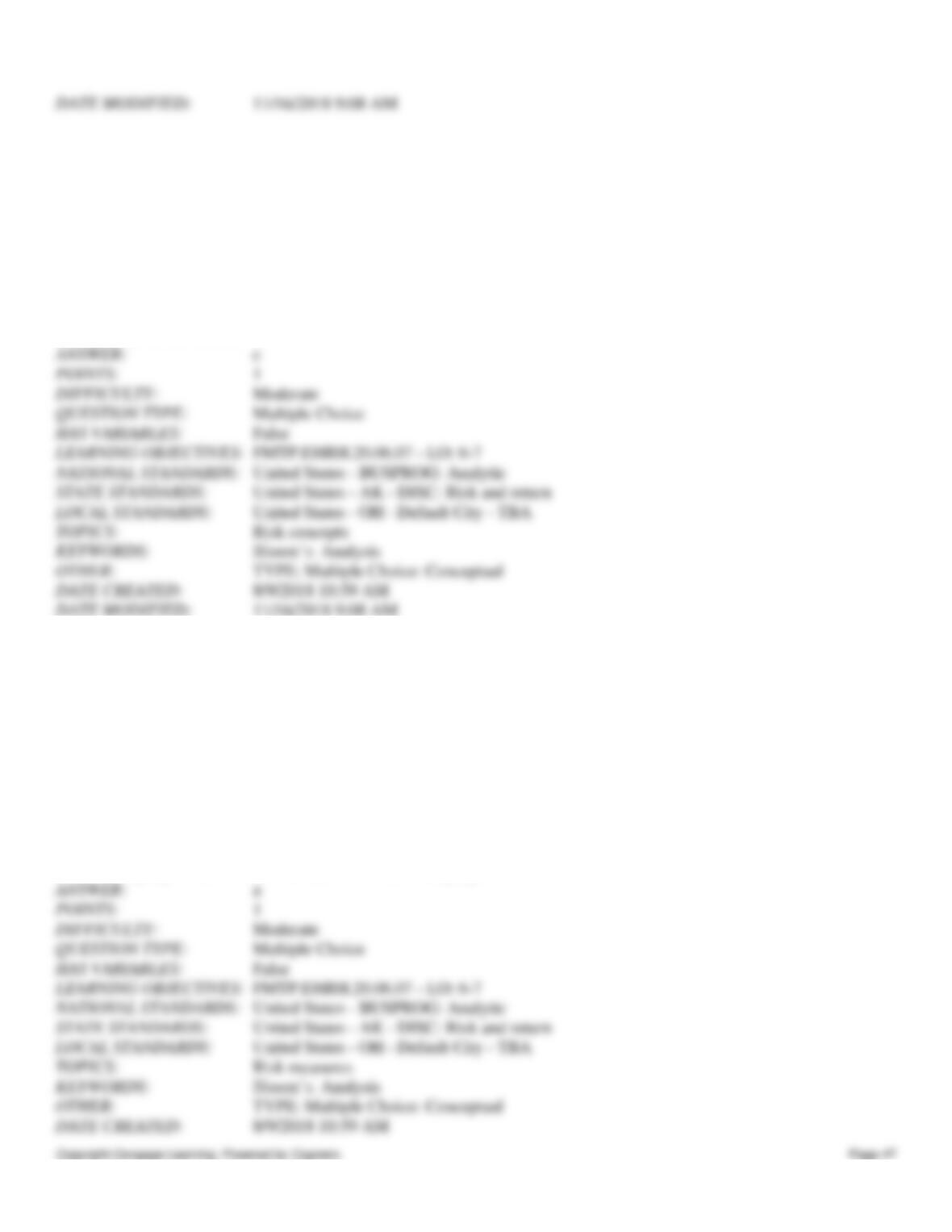
108. For markets to be in equilibrium, that is, for there to be no strong pressure for prices to depart from their current
levels,
a. The past realized rate of return must be equal to the expected future rate of return; that is, .
b. The required rate of return must equal the past realized rate of return; that is, r = .
c. The expected rate of return must be equal to the required rate of return; that is, = r.
d. All of the above statements must hold for equilibrium to exist; that is = r = .
e. None of the above statements is correct.
Chapter 06: Risk and Return
109. Which of the following statements is CORRECT?
a. Portfolio diversification reduces the variability of returns on an individual stock.
b. Risk refers to the chance that some unfavorable event will occur, and a probability distribution is completely
described by a listing of the likelihood of unfavorable events.
c. The SML relates a stock’s required return to its market risk. The slope and intercept of this line cannot be
controlled by the firms’ managers, but managers can influence their firms’ positions on the line by such actions as
changing the firm’s capital structure or the type of assets it employs.
d. A stock with a beta of −1.0 has zero market risk if held in a 1-stock portfolio.
e. When diversifiable risk has been diversified away, the inherent risk that remains is market risk, which is constant
for all stocks in the market.
110. You observe the following information regarding Companies X and Y:
∙ Company X has a higher expected return than Company Y.
∙ Company X has a lower standard deviation of returns than Company Y.
∙ Company X has a higher beta than Company Y.
Given this information, which of the following statements is CORRECT?
a. Company X has a lower coefficient of variation than Company Y.
b. Company X has less market risk than Company Y.
c. Company X’s returns will be negative when Y’s returns are positive.
d. Company X’s stock is a better buy than Company Y’s stock.
e. Company X has more diversifiable risk than Company Y.
Chapter 06: Risk and Return
111. Stocks A and B both have an expected return of 10% and a standard deviation of returns of 25%. Stock A has a beta
of 0.8 and Stock B has a beta of 1.2. The correlation coefficient, r, between the two stocks is 0.6. Portfolio P has 50%
invested in Stock A and 50% invested in B. Which of the following statements is CORRECT?
a. Based on the information we are given, and assuming those are the views of the marginal investor, it is apparent
that the two stocks are in equilibrium.
b. Portfolio P has more market risk than Stock A but less market risk than B.
c. Stock A should have a higher expected return than Stock B as viewed by the marginal investor.
d. Portfolio P has a coefficient of variation equal to 2.5.
e. Portfolio P has a standard deviation of 25% and a beta of 1.0.
112. For a stock to be in equilibrium, that is, for there to be no long-term pressure for its price to depart from its current
level, then
a. the past realized return must be equal to the expected return during the same period.
b. the required return must equal the realized return in all periods.
c. the expected return must be equal to both the required future return and the past realized return.
d. the expected future returns must be equal to the required return.
e. the expected future return must be less than the most recent past realized return.
113. Which of the following are the factors for the Fama-French model?
a. The excess market return, a debt factor, and a book-to-market factor.
Chapter 06: Risk and Return
b. The excess market return, a size factor, and a debt.
c. A debt factor, a size factor, and a book-to-market factor.
d. The excess market return, an industrial production factor, and a book-to–market factor.
e. The excess market return, a size factor, and a book-to-market factor.
114. Gretta’s portfolio consists of $700,000 invested in a stock that has a beta of 1.2 and $300,000 invested in a stock that
has a beta of 0.8. The risk-free rate is 6% and the market risk premium is 5%. Which of the following statements is
CORRECT?
a. The required return on the market is 10%.
b. The portfolio’s required return is less than 11%.
c. If the risk-free rate remains unchanged but the market risk premium increases by 2%, Gretta’s portfolio’s required
return will increase by more than 2%.
d. If the market risk premium remains unchanged but expected inflation increases by 2%, Gretta’s portfolio’s
required return will increase by more than 2%.
e. If the stock market is efficient, Gretta’s portfolio’s expected return should equal the expected return on the market,
which is 11%.
115. Assume that the market is in equilibrium and that Portfolio AB has 50% invested in Stock A and 50% invested in
Stock B. Stock A has an expected return of 10% and a standard deviation of 20%. Stock B has an expected return of 13%
and a standard deviation of 30%. The risk-free rate is 5% and the market risk premium, rM − rRF, is 6%. The returns of
Chapter 06: Risk and Return
Stock A and Stock B are independent of one another, i.e., the correlation coefficient between them is zero. Which of the
following statements is CORRECT?
a. Since the two stocks have zero correlation, Portfolio AB is riskless.
b. Stock B’s beta is 1.0000.
c. Portfolio AB’s required return is 11%.
d. Portfolio AB’s standard deviation is 25%.
e. Stock A’s beta is 0.8333.
116. Portfolio AB was created by investing in a combination of Stocks A and B. Stock A has a beta of 1.2 and a standard
deviation of 25%. Stock B has a beta of 1.4 and a standard deviation of 20%. Portfolio AB has a beta of 1.25 and a
standard deviation of 18%. Which of the following statements is CORRECT?
a. Stock A has more market risk than Stock B but less stand-alone risk.
b. Portfolio AB has more money invested in Stock A than in Stock B.
c. Portfolio AB has the same amount of money invested in each of the two stocks.
d. Portfolio AB has more money invested in Stock B than in Stock A.
e. Stock A has more market risk than Portfolio AB.
117. Which of the following statements is CORRECT?
Chapter 06: Risk and Return
a. If investors become more risk averse but rRF does not change, then the required rate of return on high-beta stocks
will rise and the required return on low-beta stocks will decline, but the required return on an average-risk stock will not
change.
b. An investor who holds just one stock will generally be exposed to more risk than an investor who holds a
portfolio of stocks, assuming the stocks are all equally risky. Since the holder of the 1-stock portfolio is exposed to more
risk, he or she can expect to earn a higher rate of return to compensate for the greater risk.
c. There is no reason to think that the slope of the yield curve would have any effect on the slope of the SML.
d. Assume that the required rate of return on the market, rM, is given and fixed at 10%. If the yield curve were
upward sloping, then the Security Market Line (SML) would have a steeper slope if 1-year Treasury securities were used
as the risk-free rate than if 30-year Treasury bonds were used for rRF.
e. If Mutual Fund A held equal amounts of 100 stocks, each of which had a beta of 1.0, and Mutual Fund B held
equal amounts of 10 stocks with betas of 1.0, then the two mutual funds would both have betas of 1.0. Thus, they would
be equally risky from an investor’s standpoint, assuming the investor’s only asset is one or the other of the mutual funds.
118. Freedman Flowers’ stock has a 50% chance of producing a 25% return, a 30% chance of producing a 10% return, and
a 20% chance of producing a −28% return. What is the firm’s expected rate of return?
a. 9.41%
b. 9.65%
c. 9.90%
d. 10.15%
e. 10.40%
Chapter 06: Risk and Return
119. Bloome Co.’s stock has a 25% chance of producing a 30% return, a 50% chance of producing a 12% return, and a
25% chance of producing a −18% return. What is the firm’s expected rate of return?
a. 7.72%
b. 8.12%
c. 8.55%
d. 9.00%
e. 9.50%
120. Donald Gilmore has $100,000 invested in a 2-stock portfolio. $35,000 is invested in Stock X and the remainder is
invested in Stock Y. X’s beta is 1.50 and Y’s beta is 0.70. What is the portfolio’s beta?
a. 0.65
b. 0.72
c. 0.80
d. 0.89
Chapter 06: Risk and Return
e. 0.98
121. Shirley Paul’s 2-stock portfolio has a total value of $100,000. $37,500 is invested in Stock A with a beta of 0.75 and
the remainder is invested in Stock B with a beta of 1.42. What is her portfolio’s beta?
a. 1.17
b. 1.23
c. 1.29
d. 1.35
e. 1.42
Chapter 06: Risk and Return
122. Ivan Knobel holds a well-diversified portfolio that has an expected return of 11.0% and a beta of 1.20. He is in the
process of buying 1,000 shares of Syngine Corp at $10 a share and adding it to his portfolio. Syngine has an expected
return of 13.0% and a beta of 1.50. The total value of Ivan’s current portfolio is $90,000. What will the expected return
and beta on the portfolio be after the purchase of the Syngine stock?
a. 10.64%; 1.17
b. 11.20%; 1.23
c. 11.76%; 1.29
d. 12.35%; 1.36
e. 12.97%; 1.42
123. Calculate the required rate of return for Everest Expeditions Inc., assuming that (1) investors expect a 4.0% rate of
inflation in the future, (2) the real risk-free rate is 3.0%, (3) the market risk premium is 5.0%, (4) the firm has a beta of
1.00, and (5) its realized rate of return has averaged 15.0% over the last 5 years.
a. 10.29%
b. 10.83%
c. 11.40%
d. 12.00%
e. 12.60%
Chapter 06: Risk and Return
124. Zacher Co.’s stock has a beta of 1.40, the risk-free rate is 4.25%, and the market risk premium is 5.50%. What is the
firm’s required rate of return?
a. 11.36%
b. 11.65%
c. 11.95%
d. 12.25%
e. 12.55%
125. Nystrand Corporation’s stock has an expected return of 12.25%, a beta of 1.25, and is in equilibrium. If the risk-free
rate is 5.00%, what is the market risk premium?
a. 5.80%
b. 5.95%
c. 6.09%
d. 6.25%
e. 6.40%
Chapter 06: Risk and Return
126. Martin Ortner holds a $200,000 portfolio consisting of the following stocks:
Stock Investment Beta
A $50,000 0.95
B 50,000 0.80
C 50,000 1.00
D 50,000 1.20
Total $200,000
What is the portfolio’s beta?
a. 0.938
b. 0.988
c. 1.037
d. 1.089
e. 1.143