
4) The typical shape for a yield curve is
A) gently upward sloping.
B) mound shaped.
C) flat.
D) bowl shaped.
5) When yield curves are steeply upward sloping
A) long-term interest rates are above short-term interest rates.
B) short-term interest rates are above long-term interest rates.
C) short-term interest rates are about the same as long-term interest rates.
D) medium-term interest rates are above both short-term and long-term interest rates.
6) When yield curves are flat
A) long-term interest rates are above short-term interest rates.
B) short-term interest rates are above long-term interest rates.
C) short-term interest rates are about the same as long-term interest rates.
D) medium-term interest rates are above both short-term and long-term interest rates.
7) When yield curves are downward sloping
A) long-term interest rates are above short-term interest rates.
B) short-term interest rates are above long-term interest rates.
C) short-term interest rates are about the same as long-term interest rates.
D) medium-term interest rates are above both short-term and long-term interest rates.
8) An inverted yield curve
A) slopes up.
B) is flat.
C) slopes down.
D) has a U shape.
9) Economists’ attempts to explain the term structure of interest rates
A) illustrate how economists modify theories to improve them when they are inconsistent with
the empirical evidence.
B) illustrate how economists continue to accept theories that fail to explain observed behavior of
interest rate movements.
C) prove that the real world is a special case that tends to get short shrift in theoretical models.
D) have proved entirely unsatisfactory to date.
10) According to the expectations theory of the term structure, the interest rate on a long-term
bond will equal the ________ of the short-term interest rates that people expect to occur over the
life of the long-term bond.
A) average
B) sum
C) difference
D) multiple
11) If bonds with different maturities are perfect substitutes, then the ________ on these bonds
must be equal.
A) expected return
B) surprise return
C) surplus return
D) excess return
12) If the expected path of one-year interest rates over the next five years is 4 percent, 5 percent,
7 percent, 8 percent, and 6 percent, then the expectations theory predicts that today’s interest rate
on the five-year bond is
A) 4 percent.
B) 5 percent.
C) 6 percent.
D) 7 percent.
13) If the expected path of 1-year interest rates over the next four years is 5 percent, 4 percent, 2
percent, and 1 percent, then the expectations theory predicts that today’s interest rate on the four–
year bond is
A) 1 percent.
B) 2 percent.
C) 3 percent.
D) 4 percent.
14) If the expected path of 1-year interest rates over the next five years is 1 percent, 2 percent, 3
percent, 4 percent, and 5 percent, the expectations theory predicts that the bond with the highest
interest rate today is the one with a maturity of
A) two years.
B) three years.
C) four years.
D) five years.
15) If the expected path of 1-year interest rates over the next five years is 2 percent, 4 percent, 1
percent, 4 percent, and 3 percent, the expectations theory predicts that the bond with the lowest
interest rate today is the one with a maturity of
A) one year.
B) two years.
C) three years.
D) four years.
16) Over the next three years, the expected path of 1-year interest rates is 4, 1, and 1 percent. The
expectations theory of the term structure predicts that the current interest rate on 3-year bond is
A) 1 percent.
B) 2 percent.
C) 3 percent.
D) 4 percent.
17) According to the expectations theory of the term structure
A) the interest rate on long-term bonds will exceed the average of short-term interest rates that
people expect to occur over the life of the long-term bonds, because of their preference for short-
term securities.
B) interest rates on bonds of different maturities move together over time.
C) buyers of bonds prefer short-term to long-term bonds.
D) buyers require an additional incentive to hold long-term bonds.
18) According to the expectations theory of the term structure
A) when the yield curve is steeply upward sloping, short-term interest rates are expected to
remain relatively stable in the future.
B) when the yield curve is downward sloping, short-term interest rates are expected to remain
relatively stable in the future.
C) investors have strong preferences for short-term relative to long-term bonds, explaining why
yield curves typically slope upward.
D) yield curves should be equally likely to slope downward as slope upward.
19) According to the segmented markets theory of the term structure
A) bonds of one maturity are close substitutes for bonds of other maturities, therefore, interest
rates on bonds of different maturities move together over time.
B) the interest rate for each maturity bond is determined by supply and demand for that maturity
bond.
C) investors’ strong preferences for short-term relative to long-term bonds explains why yield
curves typically slope downward.
D) because of the positive term premium, the yield curve will not be observed to be downward-
sloping.
20) According to the segmented markets theory of the term structure
A) the interest rate on long-term bonds will equal an average of short-term interest rates that
people expect to occur over the life of the long-term bonds.
B) buyers of bonds do not prefer bonds of one maturity over another.
C) interest rates on bonds of different maturities do not move together over time.
D) buyers require an additional incentive to hold long-term bonds.
21) A key assumption in the segmented markets theory is that bonds of different maturities
A) are not substitutes at all.
B) are perfect substitutes.
C) are substitutes only if the investor is given a premium incentive.
D) are substitutes but not perfect substitutes.
22) The segmented markets theory can explain
A) why yield curves usually tend to slope upward.
B) why interest rates on bonds of different maturities tend to move together.
C) why yield curves tend to slope upward when short-term interest rates are low and to be
inverted when short-term interest rates are high.
D) why yield curves have been used to forecast business cycles.
23) According to the liquidity premium theory of the term structure
A) because buyers of bonds may prefer bonds of one maturity over another, interest rates on
bonds of different maturities do not move together over time.
B) the interest rate on long-term bonds will equal an average of short-term interest rates that
people expect to occur over the life of the long-term bonds plus a term premium.
C) because of the positive term premium, the yield curve will not be observed to be downward
sloping.
D) the interest rate for each maturity bond is determined by supply and demand for that maturity
bond.
24) According to the liquidity premium theory of the term structure
A) bonds of different maturities are not substitutes.
B) if yield curves are downward sloping, then short-term interest rates are expected to fall by so
much that, even when the positive term premium is added, long-term rates fall below short-term
rates.
C) yield curves should never slope downward.
D) interest rates on bonds of different maturities do not move together over time.
25) The additional incentive that the purchaser of a Treasury security requires to buy a long-term
security rather than a short-term security is called the
A) risk premium.
B) term premium.
C) tax premium.
D) market premium.

26) If 1-year interest rates for the next three years are expected to be 1, 1, and 1 percent, and the
3-year term premium is 1 percent, than the 3-year bond rate will be
A) 1 percent.
B) 2 percent.
C) 3 percent.
D) 4 percent.
27) If 1-year interest rates for the next five years are expected to be 4, 2, 5, 4, and 5 percent, and
the 5-year term premium is 1 percent, than the 5-year bond rate will be
A) 2 percent.
B) 3 percent.
C) 4 percent.
D) 5 percent.
28) According to the liquidity premium theory of the term structure, a steeply upward sloping
yield curve indicates that short-term interest rates are expected to
A) rise in the future.
B) remain unchanged in the future.
C) decline moderately in the future.
D) decline sharply in the future.
29) According to the liquidity premium theory of the term structure, a slightly upward sloping
yield curve indicates that short-term interest rates are expected to
A) rise in the future.
B) remain unchanged in the future.
C) decline moderately in the future.
D) decline sharply in the future.
30) According to the liquidity premium theory of the term structure, a flat yield curve indicates
that short-term interest rates are expected to
A) rise in the future.
B) remain unchanged in the future.
C) decline moderately in the future.
D) decline sharply in the future.

31) According to the liquidity premium theory of the term structure, a downward sloping yield
curve indicates that short-term interest rates are expected to
A) rise in the future.
B) remain unchanged in the future.
C) decline moderately in the future.
D) decline sharply in the future.
32) According to the liquidity premium theory, a yield curve that is flat means that
A) bond purchasers expect interest rates to rise in the future.
B) bond purchasers expect interest rates to stay the same.
C) bond purchasers expect interest rates to fall in the future.
D) the yield curve has nothing to do with expectations of bond purchasers.
33) If the yield curve is flat for short maturities and then slopes downward for longer maturities,
the liquidity premium theory (assuming a mild preference for shorter-term bonds) indicates that
the market is predicting
A) a rise in short-term interest rates in the near future and a decline further out in the future.
B) constant short-term interest rates in the near future and a decline further out in the future.
C) a decline in short-term interest rates in the near future and a rise further out in the future.
D) a decline in short-term interest rates in the near future and an even steeper decline further out
in the future.
34) If the yield curve slope is flat for short maturities and then slopes steeply upward for longer
maturities, the liquidity premium theory (assuming a mild preference for shorter-term bonds)
indicates that the market is predicting
A) a rise in short-term interest rates in the near future and a decline further out in the future.
B) constant short-term interest rates in the near future and further out in the future.
C) a decline in short-term interest rates in the near future and a rise further out in the future.
D) constant short-term interest rates in the near future and a decline further out in the future.
35) If the yield curve has a mild upward slope, the liquidity premium theory (assuming a mild
preference for shorter-term bonds) indicates that the market is predicting
A) a rise in short-term interest rates in the near future and a decline further out in the future.
B) constant short-term interest rates in the near future and further out in the future.
C) a decline in short-term interest rates in the near future and a rise further out in the future.
D) a decline in short-term interest rates in the near future and an even steeper decline further out
in the future.
36) The preferred habitat theory of the term structure is closely related to the
A) expectations theory of the term structure.
B) segmented markets theory of the term structure.
C) liquidity premium theory of the term structure.
D) the inverted yield curve theory of the term structure.
37) The expectations theory and the segmented markets theory do not explain the facts very well,
but they provide the groundwork for the most widely accepted theory of the term structure of
interest rates
A) the Keynesian theory.
B) the separable markets theory.
C) the liquidity premium theory.
D) the asset market approach.
38) The ________ of the term structure of interest rates states that the interest rate on a long-term
bond will equal the average of short-term interest rates that individuals expect to occur over the
life of the long-term bond, and investors have no preference for short-term bonds relative to
long-term bonds.
A) segmented markets theory
B) expectations theory
C) liquidity premium theory
D) separable markets theory
39) According to this theory of the term structure, bonds of different maturities are not
substitutes for one another.
A) segmented markets theory
B) expectations theory
C) liquidity premium theory
D) separable markets theory
40) In actual practice, short-term interest rates and long-term interest rates usually move
together; this is the major shortcoming of the
A) segmented markets theory.
B) expectations theory.
C) liquidity premium theory.
D) separable markets theory.
41) The ________ of the term structure states the following: the interest rate on a long-term bond
will equal an average of short-term interest rates expected to occur over the life of the long-term
bond plus a term premium that responds to supply and demand conditions for that bond.
A) segmented markets theory
B) expectations theory
C) liquidity premium theory
D) separable markets theory
42) A particularly attractive feature of the ________ is that it tells you what the market is
predicting about future short-term interest rates by just looking at the slope of the yield curve.
A) segmented markets theory
B) expectations theory
C) liquidity premium theory
D) separable markets theory
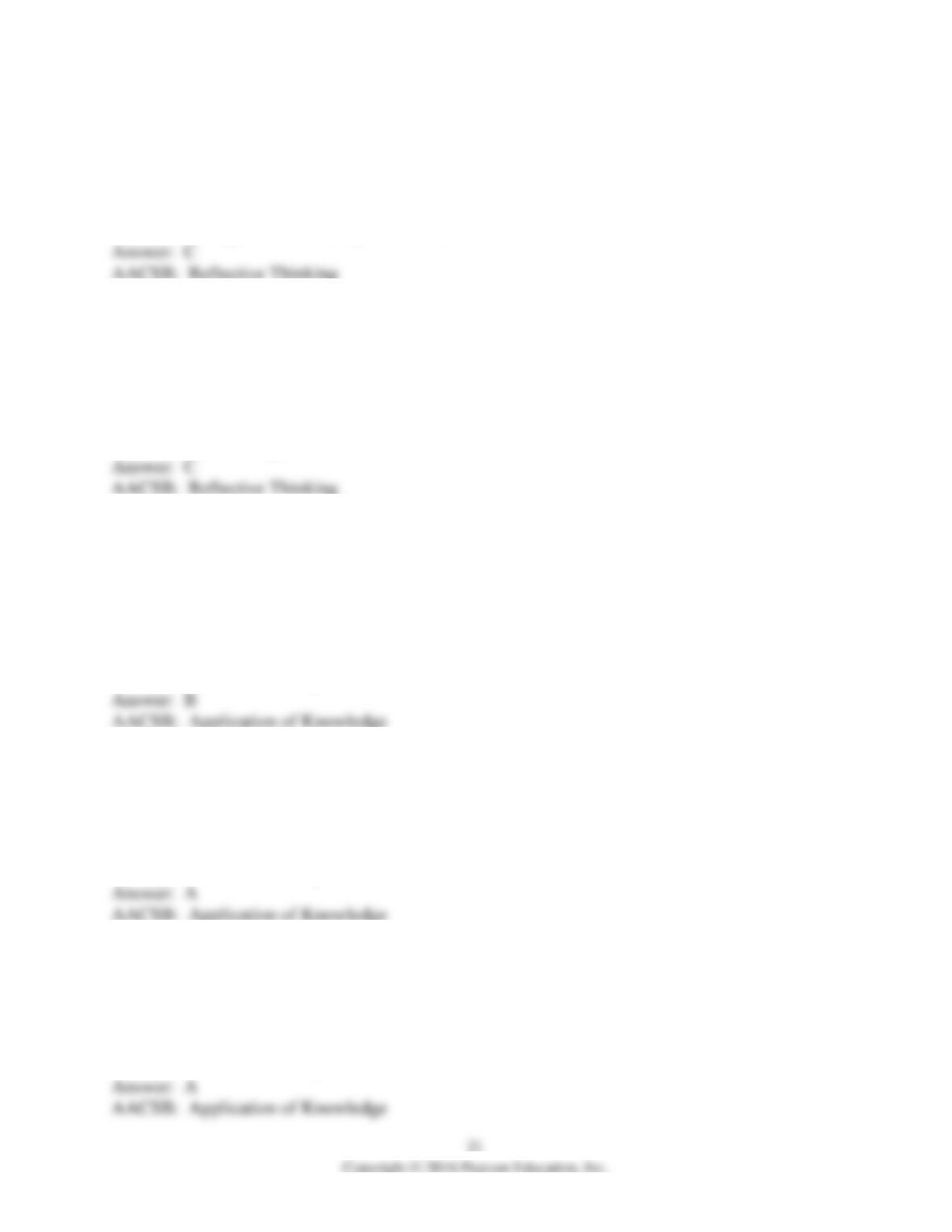
43) The steeply upward sloping yield curve in the figure above indicates that
A) short-term interest rates are expected to rise in the future.
B) short-term interest rates are expected to fall moderately in the future.
C) short-term interest rates are expected to fall sharply in the future.
D) short-term interest rates are expected to remain unchanged in the future.
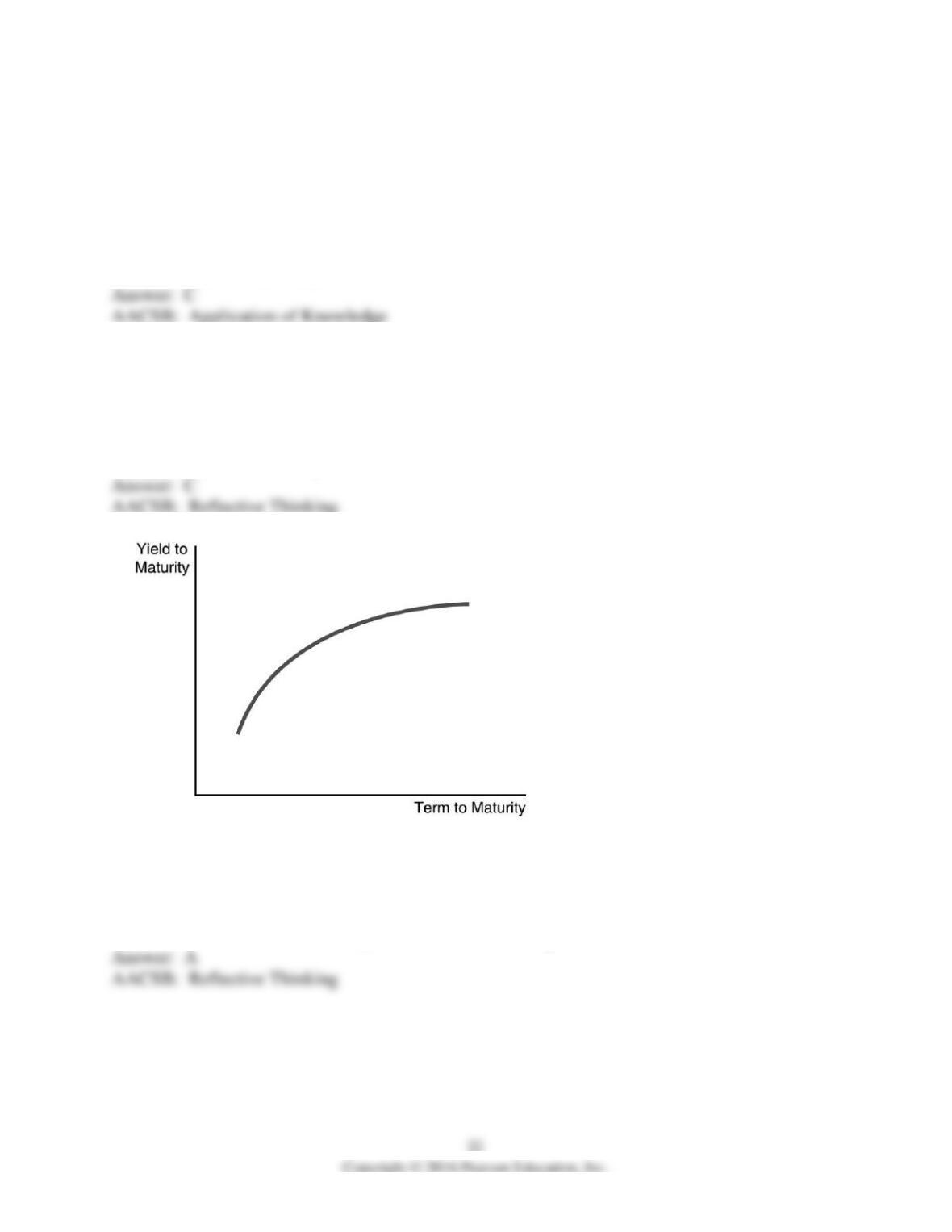
44) The steeply upward sloping yield curve in the figure above indicates that ________ interest
rates are expected to ________ in the future.
A) short-term; rise
B) short-term; fall moderately
C) short-term; remain unchanged
D) long-term; fall moderately
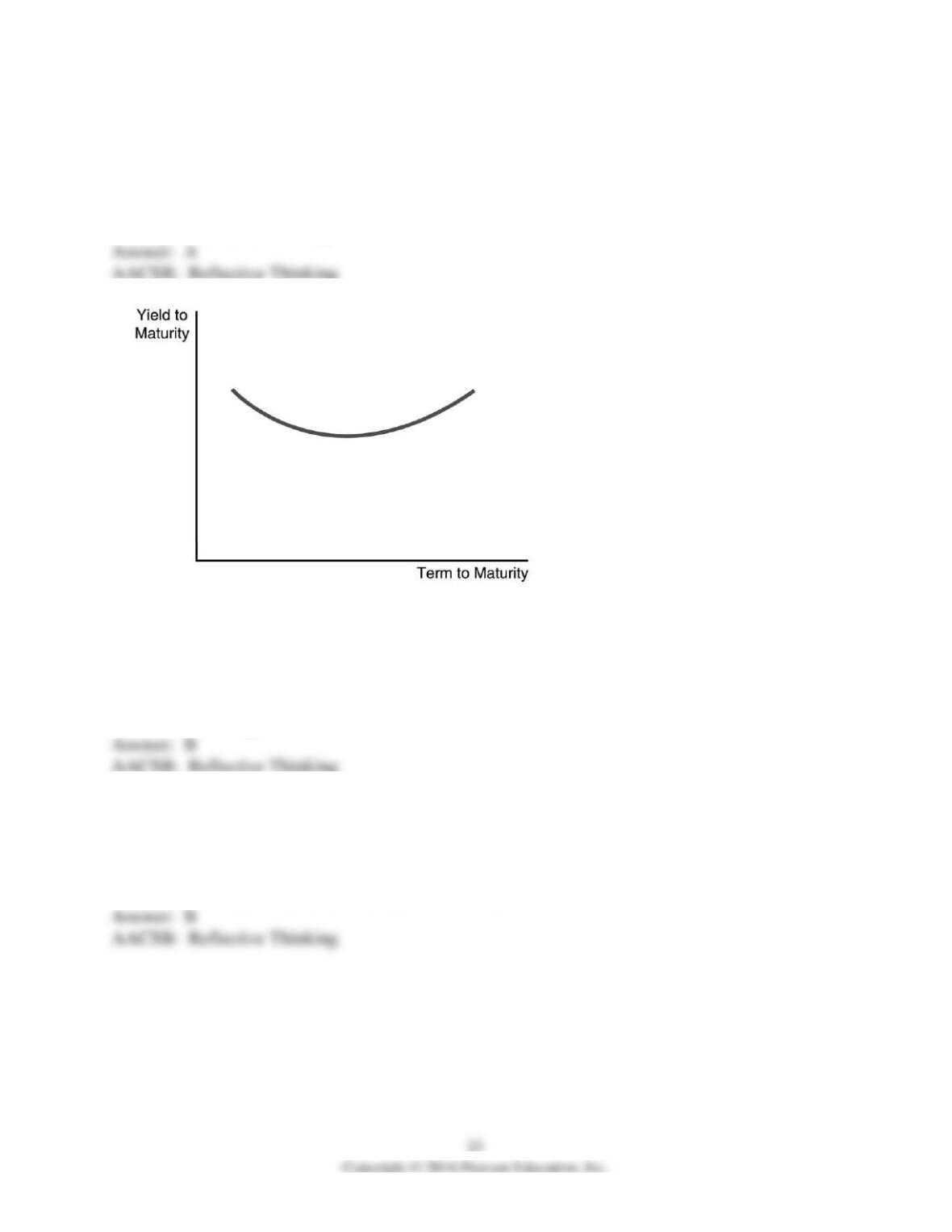
45) The U-shaped yield curve in the figure above indicates that short-term interest rates are
expected to
A) rise in the near-term and fall later on.
B) fall sharply in the near-term and rise later on.
C) fall moderately in the near-term and rise later on.
D) remain unchanged in the near-term and rise later on.
46) The U-shaped yield curve in the figure above indicates that the inflation rate is expected to
A) remain constant in the near-term and fall later on.
B) fall sharply in the near-term and rise later on.
C) rise moderately in the near-term and fall later on.
D) remain constant in the near-term and rise later on.
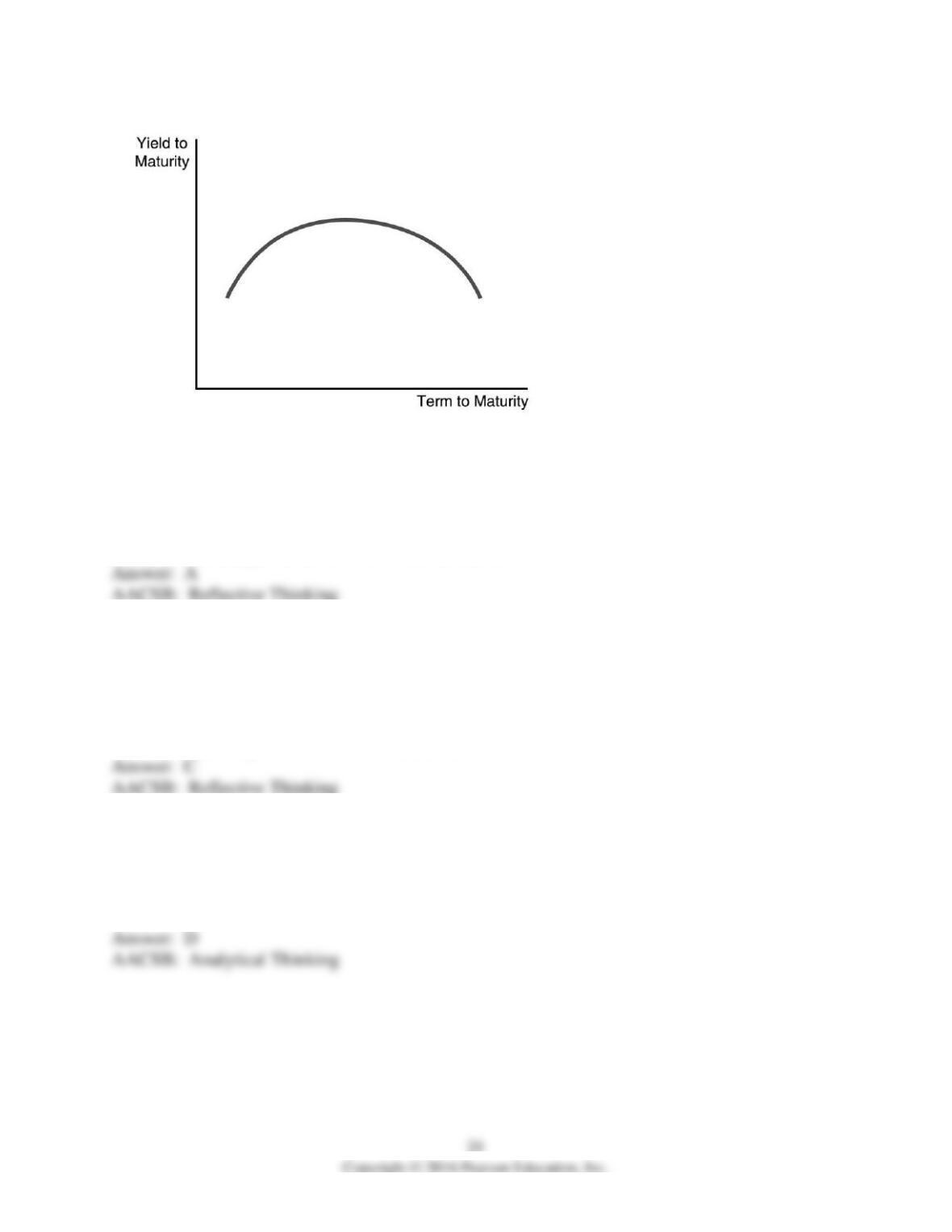
47) The mound-shaped yield curve in the figure above indicates that short-term interest rates are
expected to
A) rise in the near-term and fall later on.
B) fall moderately in the near-term and rise later on.
C) fall sharply in the near-term and rise later on.
D) remain unchanged in the near-term and fall later on.
48) The mound-shaped yield curve in the figure above indicates that the inflation rate is expected
to
A) remain constant in the near-term and fall later on.
B) fall moderately in the near-term and rise later on.
C) rise moderately in the near-term and fall later on.
D) remain unchanged in the near-term and rise later on.
49) An inverted yield curve predicts that short-term interest rates
A) are expected to rise in the future.
B) will rise and then fall in the future.
C) will remain unchanged in the future.
D) will fall in the future.
50) When short-term interest rates are expected to fall sharply in the future, the yield curve will
A) slope up.
B) be flat.
C) be inverted.
D) be an inverted U shape.
51) If investors expect interest rates to fall significantly in the future, the yield curve will be
inverted. This means that the yield curve has a ________ slope.
A) steep upward
B) slight upward
C) flat
D) downward
52) When the yield curve is flat or downward-sloping, it suggest that the economy is more likely
to enter
A) a recession.
B) an expansion.
C) a boom time.
D) a period of increasing output.
53) A ________ yield curve predicts a future increase in inflation.
A) steeply upward sloping
B) slight upward sloping
C) flat
D) downward sloping
54) If a higher inflation is expected, what would you expect to happen to the shape of the yield
curve? Why?