32) You are considering buying some stock in Continental Grain. Which of the following are
examples of non-diversifiable risks?
I. Risk resulting from a general decline in the stock market.
II. Risk resulting from a possible increase in income taxes.
III. Risk resulting from an explosion in a grain elevator owned by Continental.
IV. Risk resulting from a pending lawsuit against Continental.
A) I and II
B) III and IV
C) I only
D) II, III, and IV
33) Of the following, which differs in meaning from the other three?
A) Systematic Risk
B) Market Risk
C) Undiversifiable Risk
D) Asset-unique Risk
34) Most stocks have betas between
A) -1.00 and 1.00.
B) 0.00 and 1.00.
C) 0.60 and 1.60.
D) 1.00 and 2.00.
35) A well-diversified portfolio includes investments in 50 securities. The portfolio’s systematic
risk is likely to be about
A) 50% of the total risk.
B) 40% of the total risk.
C) 25% of the total risk.
D) zero because risk is eliminated with a portfolio of 50 securities or more.
36) Beta is a statistical measure of
A) unsystematic risk.
B) total risk.
C) the standard deviation.
D) the relationship between an investment’s returns and the market return.
37) A stock’s beta is a measure of its
A) unsystematic risk.
B) systematic risk.
C) company-unique risk.
D) diversifiable risk.
38) If you hold a portfolio made up of the following stocks:
Investment Value Beta
Stock A $8,000 1.5
Stock B $10,000 1.0
Stock C $2,000 .5
What is the beta of the portfolio?
A) 1.33
B) 1.24
C) 1.15
D) 1.00
39) Which of the following is/are true?
A) Most of the unsystematic risk is removed by the time a portfolio contains 30 stocks.
B) Two points on the Characteristic Line are the T-bill and the market portfolio.
C) The greater the total risk of an asset, the greater the expected return.
D) All securities have a beta between 0 and 1.
40) If we are able to fully diversify, what is the appropriate measure of risk to use?
A) Expected Return
B) Standard Deviation
C) Beta
D) Risk-free Rate of Return
41) You hold a portfolio with the following securities:
Expected
Security Value Beta Return
Able Corporation 20% 3.20 36.0%
Baker Corporation 40% 1.60 20.0%
Charlie Corporation 40% .20 6.0%
What is the expected return for the portfolio?
A) 17.60%
B) 20.67%
C) 23.54%
D) 28.59%
42) The prices for the Electric Circuit Corporation for the first quarter of 2009 are given below.
The price of the stock on January 1, 2009 was $130. Find the holding period return for an
investor who purchased the stock on January 1, 2009 and sold it the last day of March 2009.
Month End Price
January $125.00
February 138.50
March 132.75
A) -4.2%
B) -3.7%
C) 2.1%
D) 3.7%
43) You must add one of two investments to an already well- diversified portfolio.
Security A Security B
Expected Return = 14% Expected Return = 14%
Standard Deviation of Standard Deviation of
Returns = 15.8% Returns = 19.7%
Beta = 1.8 Beta = 1.5
If you are a risk-averse investor, which one is the better choice?
A) Security A
B) Security B
C) Either security would be acceptable.
D) Cannot be determined with information given.
44) Beginning with an investment in one company’s securities, as we add securities of other
companies to our portfolio, which type of risk declines?
A) Systematic risk
B) Market risk
C) Non-diversifiable risk
D) Unsystematic risk
45) Assume that you expect to hold a $20,000 investment for one year. It is forecasted to have a
yearend value of $21,000 with a 30% probability; a yearend value of $24,000 with a 45%
probability; and a yearend value of $30,000 with a 25% probability. What is the expected
holding period return for this investment?
A) 50%
B) 25%
C) 23%
D) 18%
46) Assume that you expect to hold a $20,000 investment for one year. It is forecasted to have a
yearend value of $21,000 with a 30% probability; a yearend value of $24,000 with a 45%
probability; and a yearend value of $30,000 with a 25% probability. What is the standard
deviation of the holding period return for this investment?
A) 12.06%
B) 14.36%
C) 16.36%
D) 33.45%
47) You must add one of two investments to an already well- diversified portfolio.
Security A Security B
Expected Return = 14% Expected Return = 12%
Standard Deviation of Standard Deviation of
Returns = 15.0% Returns = 11%
Beta = 1.5 Beta = 1.5
If you are a risk-averse investor, which one is the better choice?
A) Security A
B) Security B
C) Either security would be acceptable.
D) Cannot be determined with information given.
48) Portfolio risk is typically measured by ________ while the risk of a single investment is
measured by ________.
A) standard deviation; beta
B) security market line; standard deviation
C) beta; standard deviation
D) beta; slope of the characteristic line
49) How can investors reduce the risk associated with an investment portfolio without having to
accept a lower expected return?
A) Wait until the stock market rises.
B) Increase the amount of money invested in the portfolio.
C) Purchase a variety of securities; i.e., diversify.
D) Purchase stocks that have exceptionally high standard deviations.
50) Which of the following types of risk is diversifiable?
A) Unsystematic, or company-unique risk.
B) Betagenic, or ecocentric risk.
C) Systematic risk.
D) Market risk.
51) You purchased 1,000 shares of K.C Inc. common stock one year ago for $50 per share. You
received a dividend of $2 per share today and decide to take your profits by selling at $54.50 per
share. What is your holding period return?
A) 13.0%
B) 9.0%
C) 6.5%
D) 4.0%
52) Which of the following measures the average relationship between a stock’s returns and the
market’s returns?
A) Coefficient of validation
B) Standard deviation
C) Geometric regression
D) Beta coefficient
53) Assume that you have $165,000 invested in a stock whose beta is 1.25, $85,000 invested in a
stock whose beta is 2.35, and $235,000 invested in a stock whose beta is 1.11. What is the beta
of your portfolio?
A) 1.37
B) 2.01
C) 1.85
D) 1.57
54) Assume that you have $100,000 invested in a stock whose beta is .85, $200,000 invested in a
stock whose beta is 1.05, and $300,000 invested in a stock whose beta is 1.25. What is the beta
of your portfolio?
A) 0.97
B) 1.02
C) 1.12
D) 1.21
55) Which of the following statements is most correct regarding beta?
A) Beta must be calculated using at least 5 years of monthly returns data to be accurate.
B) Beta can only be measured properly using daily returns.
C) Beta for a particular company remains constant over time.
D) Even professionals may not agree on the measurement of beta.
56) What is diversifying among different kinds of assets known as?
A) Portfolio funding
B) Capital asset classification
C) Asset allocation
D) Multi-diversification
6.5 Learning Objective 5
1) The required rate of return for an asset is equal to the risk-free rate plus a risk premium.
2) The T-bill return is used in the CAPM model as the risk free rate.
3) The CAPM designates the risk-return tradeoff existing in the market, where risk is defined in
terms of beta.
4) The S&P 500 index must be used as the measure of market return in the CAPM or the results
are not theoretically accurate.
5) According to the CAPM, for each unit of Beta an asset’s required rate of return increases by
the market’s return.
6) According to the CAPM, for each unit of Beta an asset’s required rate of return increases by
the market’s risk premium.
7) Stocks that plot above the security market line are underpriced because their expected returns
exceed their risk-adjusted required returns.
8) The capital asset pricing model
A) provides a risk-return trade off in which risk is measured in terms of the market volatility.
B) provides a risk-return trade off in which risk is measured in terms of beta.
C) measures risk as the coefficient of variation between security and market rates of return.
D) depicts the total risk of a security.
9) A typical measure for the risk-free rate of return is the
A) U.S. Treasury Bill rate.
B) prime lending rate.
C) money market rate.
D) short-term AAA-rated bond rate.
10) If the Beta for stock A equals zero, then
A) stock A’s required return is equal to the required return on the market portfolio.
B) stock A’s required return is equal to the risk-free rate of return.
C) stock A has a guaranteed return.
D) stock A’s required return is greater than the required return on the market portfolio.
11) The risk-free rate of interest is 4% and the market risk premium is 9%. Howard Corporation
has a beta of 2.0, and last year generated a return of 16% with a standard deviation of returns of
27%. The required return on Howard Corporation stock is
A) 36%.
B) 34%.
C) 26%.
D) 22%.
12) Stock A has a beta of 1.2 and a standard deviation of returns of 18%. Stock B has a beta of
1.8 and a standard deviation of returns of 18%. If the market risk premium increases, then
A) the required return on stock B will increase more than the required return on stock A.
B) the required returns on stocks A and B will both increase by the same amount.
C) the required returns on stocks A and B will remain the same.
D) the required return on stock A will increase more than the required return on stock B.
13) Stock A has a beta of 1.2 and a standard deviation of returns of 14%. Stock B has a beta of
1.8 and a standard deviation of returns of 18%. If the risk-free rate of return increases and the
market risk premium remains constant, then
A) the required return on stock B will increase more than the required return on stock A.
B) the required returns on stocks A and B will both increase by the same amount.
C) the required returns on stocks A and B will not change.
D) the required return on stock A will increase more than the required return on stock B.
14) An investor currently holds the following portfolio:
Amount
Invested
8,000 shares of Stock A $16,000 Beta = 1.3
15,000 shares of Stock B $48,000 Beta = 1.8
25,000 shares of Stock C $96,000 Beta = 2.2
The beta for the portfolio is
A) 1.99.
B) 1.77.
C) 1.45.
D) 1.27.
15) An investor currently holds the following portfolio:
Amount
Invested
8,000 shares of Stock A $16,000 Beta = 1.3
15,000 shares of Stock B $48,000 Beta = 1.8
25,000 shares of Stock C $96,000 Beta = 2.2
If the risk-free rate of return is 4% and the market risk premium is 9%, then the required return
on the portfolio is
A) 14.00%.
B) 17.91%.
C) 21.91%.
D) 23.85%.
16) Joe purchased 800 shares of Robotics Stock at $3 per share on 1/1/09. Bill sold the shares on
12/31/09 for $3.45. Robotics stock has a beta of 1.9, the risk-free rate of return is 4%, and the
market risk premium is 9%. The required return on Robotics Stock is
A) 15.0%.
B) 16.5%.
C) 17.6%.
D) 21.1%.
17) Based on the security market line, Robo-Tech stock has a required return of 14% and
Friendly Insurance Company has a required return of 10%. Robo-Tech has a standard deviation
of returns of 18%. Therefore
A) Friendly must have a standard deviation of returns of less than 18% because Friendly is less
risky than Robo-Tech.
B) all rational investors will prefer Friendly over Robo-Tech.
C) for a well-diversified investor, Friendly is less risky than Robo-Tech.
D) the beta for Friendly must be greater than the beta for Robo-Tech because Friendly is the
better buy for a risk-averse investor.
18) White Company stock has a beta of 2 and a required return of 23%, while Black Company
stock has a beta of 1.0 and a required return of 14%. The standard deviation of returns for White
Company is 10% more than the standard deviation for Black Company. The expected return on
the market portfolio according to the CAPM is
A) 9%.
B) 10%.
C) 12%.
D) 14%.
19) White Company stock has a beta of 2 and a required return of 23%, while Black Company
stock has a beta of 1.0 and a required return of 14%. The standard deviation of returns for White
Company is 10% more than the standard deviation for Black Company. The risk free rate of
return according to the CAPM is
A) 4%.
B) 5%.
C) 6%.
D) Impossible to determine with the information given.
20) Emery Inc. has a beta equal to 1.8 and a required return of 15% based on the CAPM. If the
market risk premium is 7.5%, the risk-free rate of return is
A) 4.1%.
B) 3.4%.
C) 2.0%.
D) 1.5%.
21) Emery Inc. has a beta equal to 1.8 and a required return of 15% based on the CAPM. If the
risk free rate of return is 4.2%, the expected return on the market portfolio is
A) 21%.
B) 19.2%.
C) 13.4%.
D) 10.2%.
22) You are going to add one of the following three projects to your already well-diversified
portfolio.
PROJECT 1 PROJECT 2
Standard Standard
Probability Return Deviation Beta Probability Return Deviation Beta
50% Chance 22% 12% 1.1 30% Chance 36% 19.5% 0.8
50% Chance -4% 40% Chance10.5%
30% Chance-20%
PROJECT 3
Standard
Probability Return Deviation Beta
10% Chance 28% 12% 2.0
70% Chance 18%
20% Chance -8%
Assume the risk-free rate of return is 2% and the market risk premium is 8%. If you are a risk
averse investor, which project should you choose?
A) Project 1
B) Project 2
C) Project 3
D) Either Project 2 or Project 3 because the higher expected return on project 3 offsets its higher
risk.
23) The appropriate measure for risk according to the capital asset pricing model is
A) the standard deviation of a firm’s cash flows.
B) alpha.
C) the standard deviation of a firm’s stock returns.
D) beta.
24) SeeBreeze Incorporated has a beta of 1.0. If the expected return on the market is 15%, what
is the expected return on SeeBreeze Incorporated’s stock?
A) 15%
B) 14%
C) 18%
D) cannot be determined without the risk free rate
25) Stanley Corp. common stock has a required return of 17.5% and a beta of 1.75. If the
expected risk free return is 3%, what is the expected return for the market based on the CAPM?
A) 11.29%
B) 14.29%
C) 13.35%
D) 15.27%
26) Billings, Inc. common stock has a beta of 1.2. If the expected risk free return is 4% and the
expected market risk premium is 9%, what is the expected return on Billing’s stock?
A) 10.0%
B) 12.0%
C) 13.8%
D) 14.8%
27) You determine that XYZ common stock has an expected return of 24%. XYZ has a Beta of
1.5. The risk-free rate is 5%, and the market expected return is 15%. Which of the following is
most likely to happen?
A) You and other investors will buy up XYZ stock and its price will rise.
B) You and other investors will sell XYZ stock and its return will fall.
C) You and other investors will buy up XYZ stock and its return will rise.
D) You and other investors will sell XYZ stock and its price will fall.
28) You hold a portfolio made up of the following stocks:
Investment Value Beta
Stock A $4,000 2.0
Stock B $9,000 1.5
Stock C $7,000 .4
If the market’s expected return is 14%, and the risk free rate of return is 5%, what is the expected
return of the portfolio?
A) 17.010%
B) 16.700%
C) 15.935%
D) 14.698%
29) Collectibles Corp. has a beta of 2.5 and a standard deviation of returns of 20%. The return on
the market portfolio is 15% and the risk free rate is 4%. What is the risk premium on the market?
A) 5%
B) 6%
C) 9.00%
D) 11%
30) Collectibles Corp. has a beta of 2.5 and a standard deviation of returns of 20%. The return on
the market portfolio is 15% and the risk free rate is 4%. According to CAPM, what is the
required rate of return on Collectible’s stock?
A) 37.5%
B) 31.5%
C) 26.5%
D) 23.5%
31) You hold a portfolio with the following securities:
Percent Expected
Security of Portfolio Beta Return
Able Corporation 20% 3.20 36.0%
Baker Corporation 40% 1.60 20.0%
Charlie Corporation 40% .20 6.0%
What is the expected return for the market, according to the CAPM?
A) 14.0%
B) 13.8%
C) 12.0%
D) 10.0%
32) The beta of ABC Co. stock is the slope of
A) the security market line.
B) the characteristic line for a plot of returns on the S&P 500 versus returns on short-term
Treasury bills.
C) the arbitrage pricing line.
D) the characteristic line for a plot of ABC Co. returns against the returns of the market portfolio
for the same period.
33) The rate on T-bills is currently 2%. Environment Help Company stock has a beta of 1.5 and a
required rate of return of 17%. According to CAPM, determine the return on the market
portfolio.
A) 27.5%
B) 19.0%
C) 14.0%
D) 12.0%
34) The return on the market portfolio is currently 12%. Mobile Phone Corporation stockholders
require a rate of return of 30% and the stock has a beta of 3.2. According to CAPM, determine
the risk-free rate.
A) 9.80%
B) 6.50%
C) 4.64%
D) 3.82%
35) Which of the following is the slope of the security market line?
A) beta
B) one
C) it varies, and is steeper for riskier securities
D) the market risk premium
36) What is the name given to the equation that financial managers use to measure an investor’s
required rate of return?
A) The standard deviation
B) The capital asset pricing model
C) The coefficient of variation
D) The MIRR
37) You are considering an investment in First Allegiance Corp. The firm has a beta of 1.6.
Currently, U.S. Treasury bills are yielding 2.75% and the expected return for the S & P 500 is
14%. What rate of return should you expect for your investment in First Allegiance?
A) 11.15%
B) 15.39%
C) 16.75%
D) 20.75%
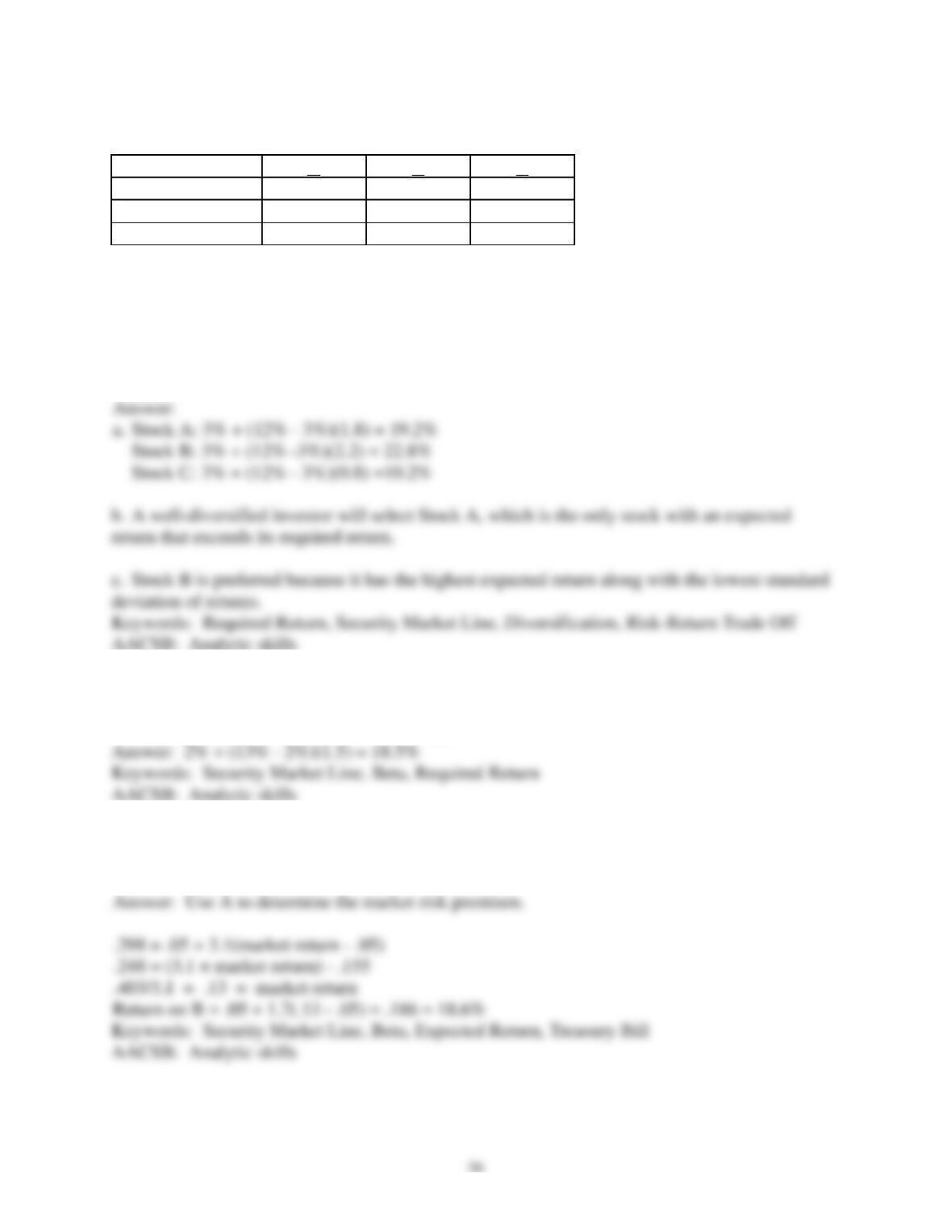
38) Answer the questions below using the following information on stocks A, B, and C.
A
B
C
Expected Return
20%
21%
10%
Standard Deviation
12%
10%
10%
Beta
1.8
2.2
0.8
Assume the risk-free rate of return is 3% and the expected market return is 12%
a. Calculate the required return for stocks A, B, and C.
b. Assuming an investor with a well-diversified portfolio, which stock would the investor want
to add to his portfolio?
c. Assuming an investor who will invest all of his money into one security, which stock will the
investor choose?
39) The expected return for the market portfolio is 13%, the expected return on U.S. Treasury
Bills is 2%, and the expected return on AAA-rated short-term corporate bonds is 7%. Calculate
the required return for a stock with a beta equal to 1.5.
40) Security A has an expected rate of return of 29.8 percent and a beta of 3.1. Security B has a
beta of 1.70. If the Treasury bill rate is 5 percent, what is the expected rate of return for Security
B?
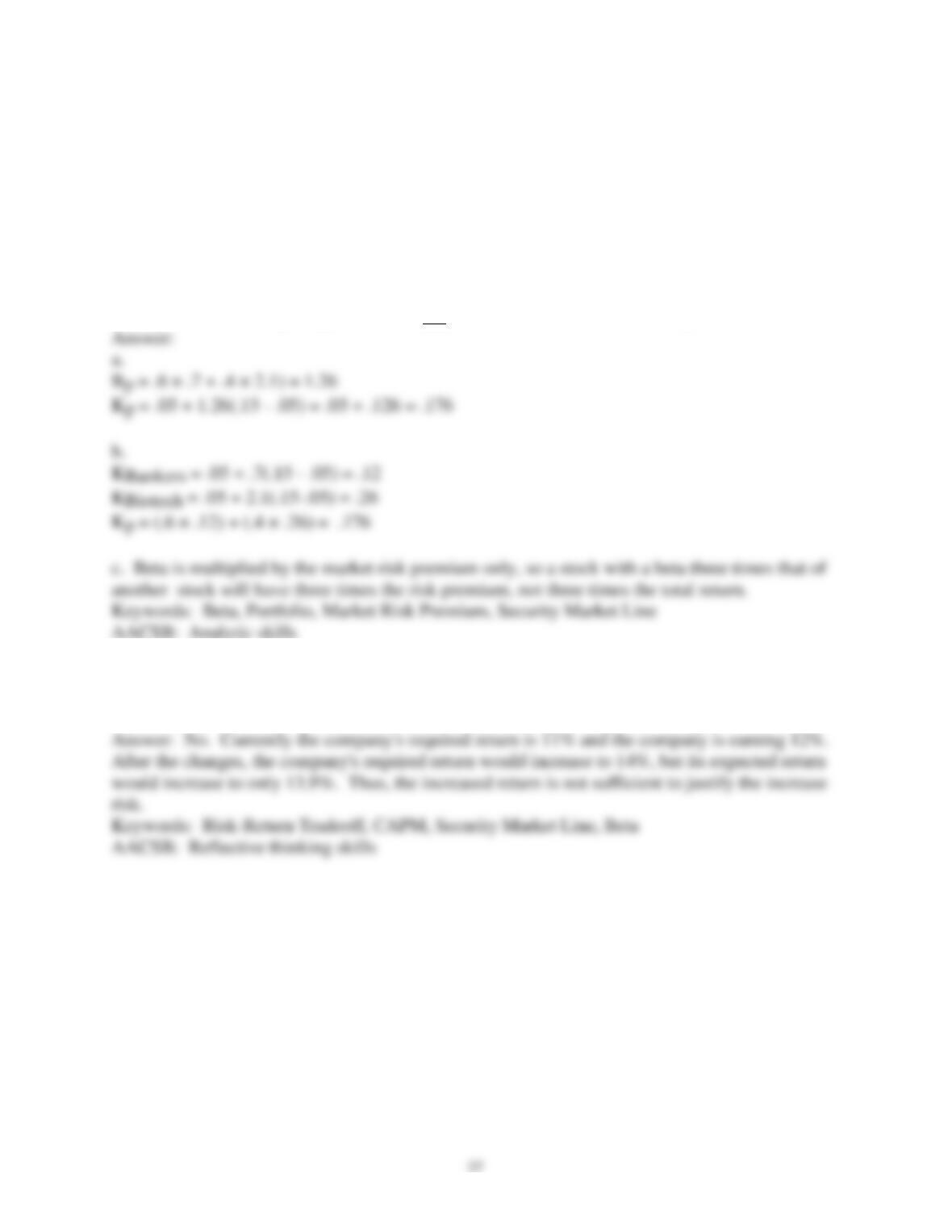
41) Bankers Corp has a very conservative Beta of .7, while Biotech Corp has a Beta of 2.1.
Given that the T-bill rate is 5%, and the market is expected to return 15%, what is the expected
return of Bankers Corp, Biotech Corp, and a portfolio composed of 60% of Bankers Corp and
40% Biotech Corp?
a. Solve this problem first by weighting the Betas to calculate a portfolio Beta, and then using
CAPM to calculate the portfolio expected return.
b. Then solve the problem again by calculating the expected return of each asset and weighting
those returns to calculate the portfolio expected return.
c. Why is Biotech Corp’s expected return not three times that of Bankers Corp?
42) Redesign Corp is considering a new strategy that would increase its expected return from
12% to 13.9%, but would also increase its beta from 1.2 to 1.8. If the risk free rate is 5% and the
return on the market is expected to be 10%, should Redesign change its strategy?