90.
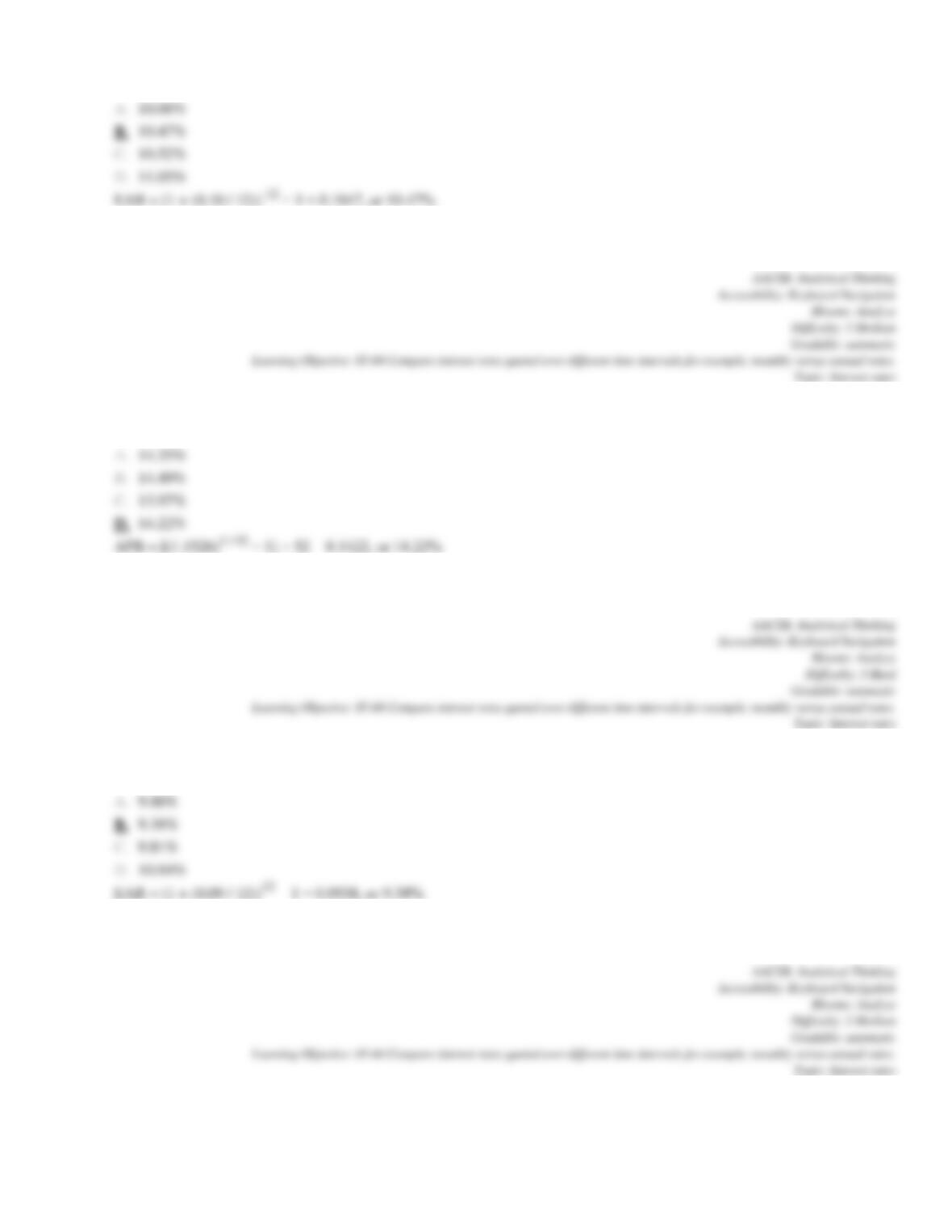
What is the annually compounded rate of interest on an account with an APR of 10% and monthly compounding?
91.
What is the APR on a loan with an effective annual rate of 15.26% and weekly compounding of interest?
92.
What is the effective annual interest rate on a 9% APR automobile loan that has monthly payments?
93.
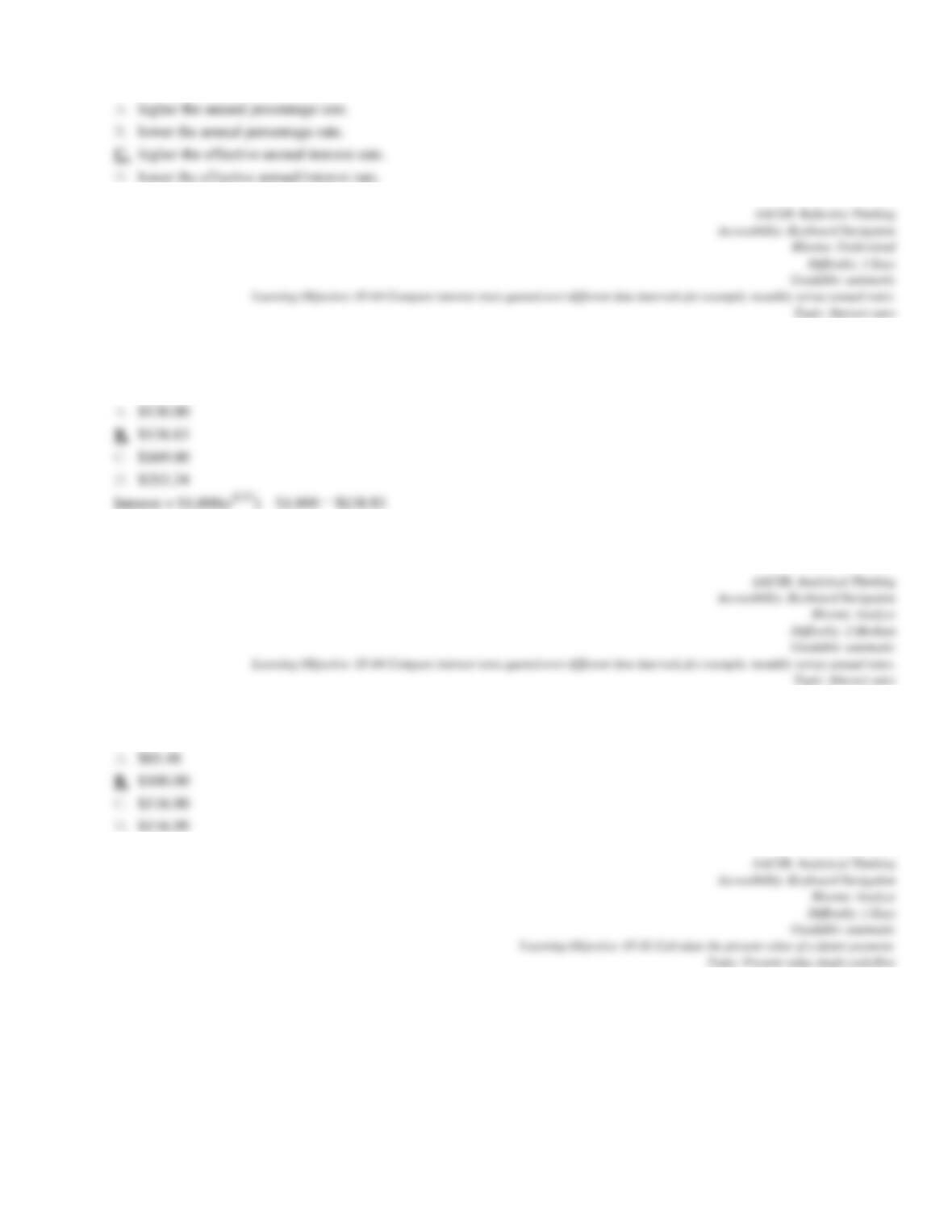
Other things being equal, the more frequent the compounding period, the:
94.
How much interest will be earned in an account into which $1,000 is deposited for one year with continuous compounding at
a 13% rate?
95.
What is the present value of $100 to be deposited today into an account paying 8%, compounded semiannually for 2 years?
96.
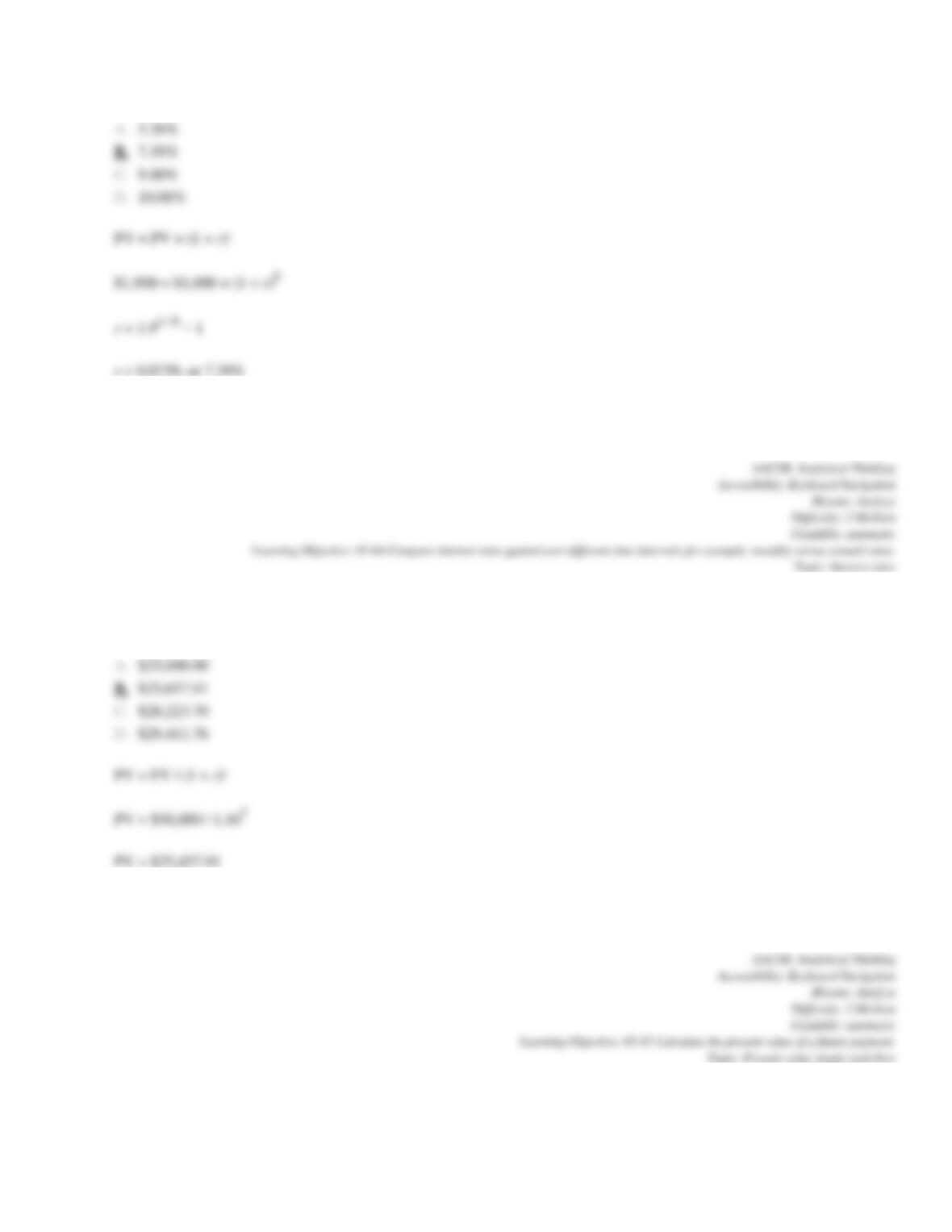
If a borrower promises to pay you $1,900 nine years from now in return for a loan of $1,000 today, what effective annual
interest rate is being offered if interest is compounded annually?
97.
What is the present value of your trust fund if you have projected that it will provide you with $50,000 7 years from today
and it earns 10% compounded annually?
98.
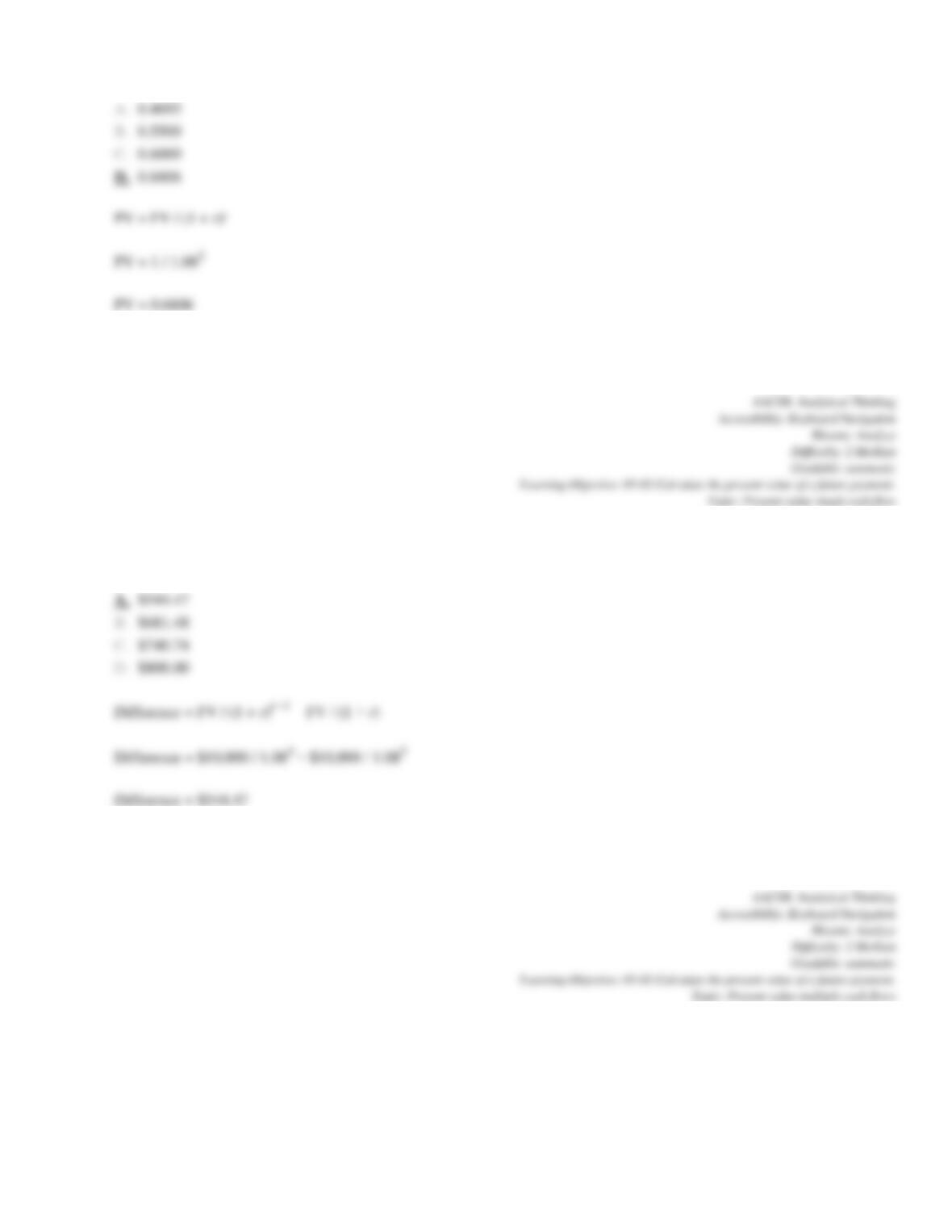
What is the discount factor for $1 to be received in 5 years at a discount rate of 8%?
99.
How much more would you be willing to pay today for an investment offering $10,000 in 4 years rather than in 5 years?
Your discount rate is 8%.
100.
“Give me $5,000 today and I’ll return $10,000 to you in 5 years,” offers the investment broker. To the nearest percent, what
annual interest rate is being offered?
101.
The APR on a loan must be equal to the effective annual rate when:
102.
A car dealer offers payments of $522.59 per month for 48 months on a $25,000 car after making a $4,000 down payment.
What is the loan’s APR?
103.
A credit card account that charges interest at the rate of 1.25% per month would have an annually compounded rate of _____
and an APR of ____.
104.
Eighteen years from now, 4 years of college are expected to cost $150,000. How much more must be deposited into an
account today to fund this expense if you can earn only 8% on your savings rather than the 11% you hope to earn?
105.
Prizes are often not “worth” as much as claimed. What is the value of a prize of $5,000,000 that is to be received in 20 equal
yearly payments, with the first payment beginning today? Assume an interest rate of 7%.
106.
A loan officer states, “Thousands of dollars can be saved by switching to a 15-year mortgage from a 30-year mortgage.”
Calculate the difference in payments on a 30-year mortgage at an interest rate of .75% a month versus a 15-year mortgage
with an interest rate of .7% a month. Both mortgages are for $100,000 and have monthly payments. What is the difference in
total dollars that will be paid to the lender under each loan? (Round the monthly payment amounts to 2 decimal places.)
107.
Would you prefer a savings account that paid 7% interest compounded quarterly, 6.8% compounded monthly, 7.2%
compounded weekly, or an account that paid 7.5% with annual compounding?
108.
After reading the fine print in your credit card agreement, you find that the “low” interest rate is actually an 18% APR, or
1.5% per month. What is the effective annual rate?
109.
You are considering the purchase of a home that would require a mortgage of $150,000. How much more in total interest
will you pay if you select a 30-year mortgage at 5.65% rather than a 15-year mortgage at 4.9%? (Round the monthly
payment amount to 2 decimal places.)
110.
Lester’s just signed a contract that will provide the firm with annual cash inflows of $28,000, $35,000, and $42,000 over the
next three years with the first payment of $28,000 occurring one year from today. What is this contract worth today at a
discount rate of 7.25%?
111.
Miller’s Hardware plans on saving $42,000, $54,000, and $58,000 at the end of each year for the next three years,
respectively. How much will the firm have saved at the end of the three years if it can earn 4.5% on its savings?

Chapter 05 Test Bank – Static Summary
Category
# of Questions
AACSB: Analytical Thinking
68
AACSB: Communication
7
AACSB: Reflective Thinking
36
Accessibility: Keyboard Navigation
111
Blooms: Analyze
68
Blooms: Remember
7
Blooms: Understand
36
Difficulty: 1 Easy
21
Difficulty: 2 Medium
74
Difficulty: 3 Hard
16
Gradable: automatic
111
Learning Objective: 05–01 Calculate the future value of money that is invested at a particular interest rate.
18
Learning Objective: 05–02 Calculate the present value of a future payment.
30
Learning Objective: 05–03 Calculate present and future values of a level stream of cash payments.
29
Learning Objective: 05–04 Compare interest rates quoted over different time intervals-
for example; monthly versus annual rates.
24
Learning Objective: 05–05 Understand the difference between real and nominal cash flows and between real
and nominal interest rates.
10
Topic: Amortization
8
Topic: Annuities
11
Topic: Future value-annuity
1
Topic: Future value-multiple cash flows
1
Topic: Future value-single cash flow
6
Topic: Interest rates
23
Topic: Loan payments
2
Topic: Nominal and real rates
9
Topic: Perpetuities
7
Topic: Present value-annuity
9
Topic: Present value-multiple cash flows
10
Topic: Present value-single cash flow
13
Topic: Simple and compound interest
11