Chapter 05: Bonds, Bond Valuation, and Interest Rates
DATE MODIFIED: 11/16/2018 8:56 AM
42. A Treasury bond has an 8% annual coupon and a 7.5% yield to maturity. Which of the following statements is
CORRECT?
a. The bond has a current yield greater than 8%.
b. The bond sells at a discount.
c. The bond’s required rate of return is less than 7.5%.
d. If the yield to maturity remains constant, the price of the bond will decline over time.
e. The bond sells at a price below par.
43. Bonds A and B are 15-year, $1,000 face value bonds. Bond A has a 7% annual coupon, while Bond B has a 9% annual
coupon. Both bonds have a yield to maturity of 8%, which is expected to remain constant for the next 15 years. Which of
the following statements is CORRECT?
a. One year from now, Bond A’s price will be higher than it is today.
b. Bond A’s current yield is greater than 8%.
c. Bond A has a higher price than Bond B today, but one year from now the bonds will have the same price.
d. Both bonds have the same price today, and the price of each bond is expected to remain constant until the bonds
mature.
e. Bond B has a higher price than Bond A today, but one year from now the bonds will have the same price.
44. Which of the following statements is CORRECT?
a. The total yield on a bond is derived from dividends plus changes in the price of the bond.
b. Bonds are riskier than common stocks and therefore have higher required returns.
Chapter 05: Bonds, Bond Valuation, and Interest Rates
c. Bonds issued by larger companies always have lower yields to maturity (less risk) than bonds issued by smaller
companies.
d. The market value of a bond will always approach its par value as its maturity date approaches, provided the
bond’s required return remains constant.
e. If the Federal Reserve unexpectedly announces that it expects inflation to increase, then we would probably
observe an immediate increase in bond prices.
45. Which of the following statements is CORRECT?
a. If rates fall after its issue, a zero coupon bond could trade at a price above its par value.
b. If rates fall rapidly, a zero coupon bond’s expected appreciation could become negative.
c. If a firm moves from a position of strength toward financial distress, its bonds’ yield to maturity would probably
decline.
d. If a bond is selling at a premium, this implies that its yield to maturity exceeds its coupon rate.
e. If a coupon bond is selling at par, its current yield equals its yield to maturity.
46. Which of the following statements is CORRECT?
a. The market value of a bond will always approach its par value as its maturity date approaches. This holds true
even if the firm has filed for bankruptcy.
b. Rising inflation makes the actual yield to maturity on a bond greater than a quoted yield to maturity that is based
on market prices.
c. The yield to maturity on a coupon bond that sells at its par value consists entirely of a current interest yield; it has
a zero expected capital gains yield.
d. On an expected yield basis, the expected capital gains yield will always be positive because an investor would not
purchase a bond with an expected capital loss.
Chapter 05: Bonds, Bond Valuation, and Interest Rates
e. The yield to maturity for a coupon bond that sells at a premium consists entirely of a positive capital gains yield;
it has a zero current interest yield.
47. Which of the following statements is CORRECT?
a. If a coupon bond is selling at a discount, then the bond’s expected capital gains yield is negative.
b. If a bond is selling at a discount, the yield to call is a better measure of the expected return than the yield to
maturity.
c. The current yield on Bond A exceeds the current yield on Bond B. Therefore, Bond A must have a higher yield to
maturity than Bond B.
d. If a coupon bond is selling at par, its current yield equals its yield to maturity.
e. If a coupon bond is selling at a premium, then the bond’s current yield is zero.
48. Bond A has a 9% annual coupon, while Bond B has a 7% annual coupon. Both bonds have the same maturity, a face
value of $1,000, and an 8% yield to maturity. Which of the following statements is CORRECT?
a. Bond A trades at a discount, whereas Bond B trades at a premium.
b. If the yield to maturity for both bonds remains at 8%, Bond A’s price one year from now will be higher than it is
today, but Bond B’s price one year from now will be lower than it is today.
c. If the yield to maturity for both bonds immediately decreases to 6%, Bond A’s bond will have a larger percentage
increase in value.
d. Bond A’s current yield is greater than that of Bond B.
e. Bond A’s capital gains yield is greater than Bond B’s capital gains yield.
Chapter 05: Bonds, Bond Valuation, and Interest Rates
49. Which of the following statements is CORRECT?
a. A callable 10-year, 10% bond should sell at a higher price than an otherwise similar noncallable bond.
b. Corporate treasurers dislike issuing callable bonds because these bonds may require the company to raise
additional funds earlier than would be true if noncallable bonds with the same maturity were used.
c. Two bonds have the same maturity and the same coupon rate. However, one is callable and the other is not. The
difference in prices between the bonds will be greater if the current market interest rate is above the coupon rate than if it
is below the coupon rate.
d. The actual life of a callable bond will always be equal to or less than the actual life of a noncallable bond with the
same maturity. Therefore, if the yield curve is upward sloping, the required rate of return will be lower on the callable
bond.
e. Two bonds have the same maturity and the same coupon rate. However, one is callable and the other is not. The
difference in prices between the bonds will be greater if the current market interest rate is below the coupon rate than if it
is above the coupon rate.
50. Which of the following statements is CORRECT?
a. A bond is likely to be called if its market price is below its par value.
b. Even if a bond’s YTC exceeds its YTM, an investor with an investment horizon longer than the bond’s maturity
would be worse off if the bond were called.
c. A bond is likely to be called if its market price is equal to its par value.
d. A bond is likely to be called if it sells at a discount below par.
e. A bond is likely to be called if its coupon rate is below its YTM.
Chapter 05: Bonds, Bond Valuation, and Interest Rates
51. Which of the following statements is CORRECT?
a. A bond’s current yield must always be either equal to its yield to maturity or between its yield to maturity and its
coupon rate.
b. If a bond sells at par, then its current yield will be less than its yield to maturity.
c. If a bond sells for less than par, then its yield to maturity is less than its coupon rate.
d. A discount bond’s price declines each year until it matures, when its value equals its par value.
e. Assume that two bonds have equal maturities and are of equal risk, but one bond sells at par while the other sells
at a premium above par. The premium bond must have a lower current yield and a higher capital gains yield than the par
bond.
Chapter 05: Bonds, Bond Valuation, and Interest Rates
52. Which of the following statements is CORRECT?
a. All else equal, an increase in interest rates will have a greater effect on the prices of short-term than long-term
bonds.
b. All else equal, an increase in interest rates will have a greater effect on higher-coupon bonds than it will have on
lower-coupon bonds.
c. If a bond’s yield to maturity exceeds its coupon rate, the bond’s price must be less than its maturity value.
d. If a bond’s yield to maturity exceeds its coupon rate, the bond’s current yield must be less than its coupon rate.
e. If two bonds have the same maturity, the same yield to maturity, and the same level of risk, the bonds should sell
for the same price regardless of the bond’s coupon rates.
53. Curtis Corporation’s noncallable bonds currently sell for $1,165. They have a 15-year maturity, an annual coupon of
$95, and a par value of $1,000. What is their yield to maturity?
a. 6.20%
b. 6.53%
c. 6.87%
d. 7.24%
e. 7.62%
Chapter 05: Bonds, Bond Valuation, and Interest Rates
54. Sommers Co.’s bonds currently sell for $1,080 and have a par value of $1,000. They pay a $100 annual coupon and
have a 15-year maturity, but they can be called in 5 years at $1,125. What is their yield to maturity (YTM)?
a. 8.56%
b. 9.01%
c. 9.46%
d. 9.93%
e. 10.43%
55. Sentry Corp. bonds have an annual coupon payment of 7.25%. The bonds have a par value of $1,000, a current price
of $1,125, and they will mature in 13 years. What is the yield to maturity on these bonds?
a. 5.56%
b. 5.85%
c. 6.14%
d. 6.45%
e. 6.77%
Chapter 05: Bonds, Bond Valuation, and Interest Rates
56. Meacham Enterprises’ bonds currently sell for $1,280 and have a par value of $1,000. They pay a $135 annual coupon
and have a 15-year maturity, but they can be called in 5 years at $1,050. What is their yield to call (YTC)?
a. 6.39%
b. 6.72%
c. 7.08%
d. 7.45%
e. 7.82%
57. Perry Inc.’s bonds currently sell for $1,150. They have a 6-year maturity, an annual coupon of $85, and a par value of
$1,000. What is their current yield?
a. 7.39%
b. 7.76%
c. 8.15%
d. 8.56%
e. 8.98%
Chapter 05: Bonds, Bond Valuation, and Interest Rates
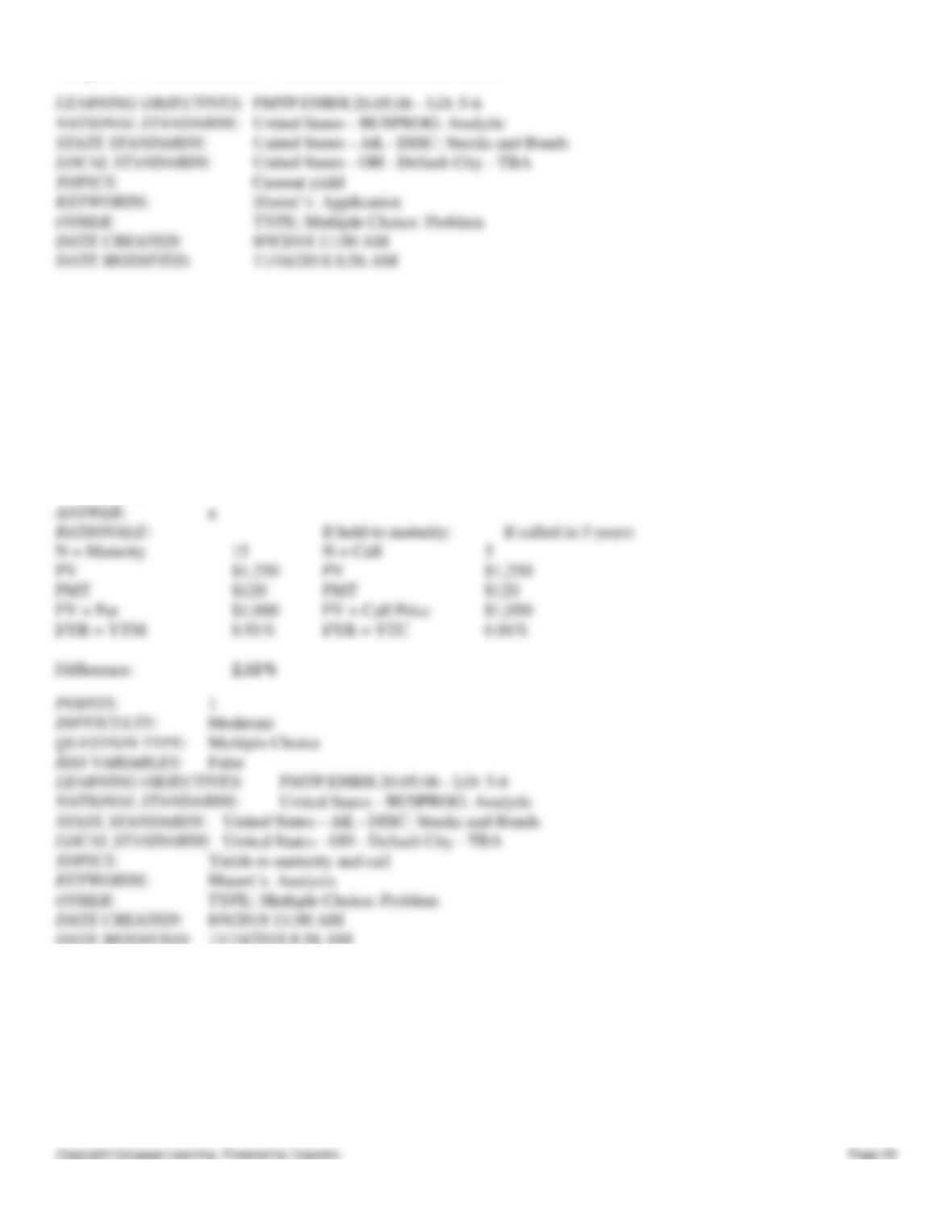
58. Currently, Bruner Inc.’s bonds sell for $1,250. They pay a $120 annual coupon, have a 15-year maturity, and a $1,000
par value, but they can be called in 5 years at $1,050. Assume that no costs other than the call premium would be incurred
to call and refund the bonds, and also assume that the yield curve is horizontal, with rates expected to remain at current
levels on into the future. What is the difference between this bond’s YTM and its YTC? (Subtract the YTC from the
YTM.)
a. 2.11%
b. 2.32%
c. 2.55%
d. 2.80%
e. 3.09%
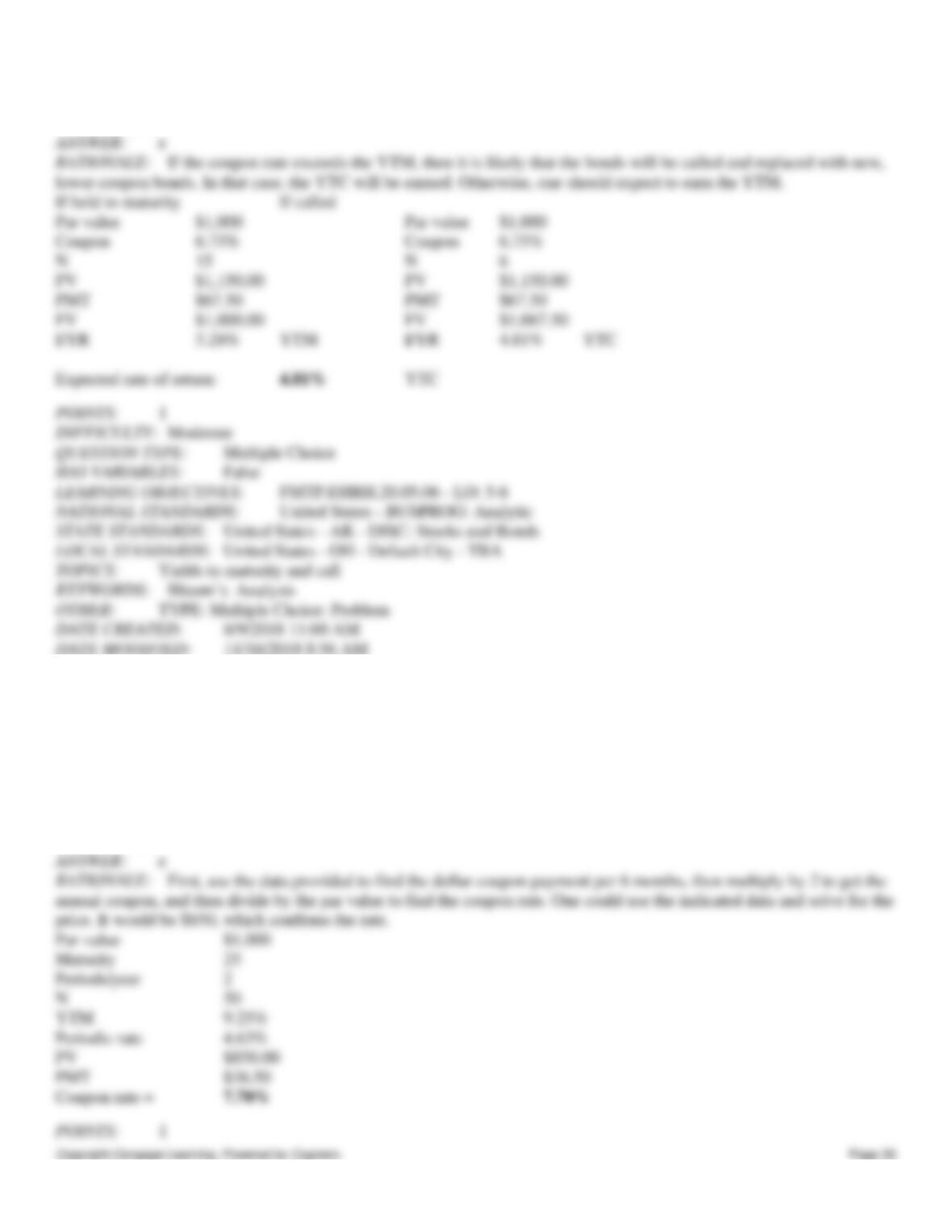
59. Gilligan Co.’s bonds currently sell for $1,150. They have a 6.75% annual coupon rate and a 15-year maturity, and are
callable in 6 years at $1,067.50. Assume that no costs other than the call premium would be incurred to call and refund the
bonds, and also assume that the yield curve is horizontal, with rates expected to remain at current levels on into the future.
Under these conditions, what rate of return should an investor expect to earn if he or she purchases these bonds, the YTC
or the YTM?
a. 3.92%
b. 4.12%
c. 4.34%
Chapter 05: Bonds, Bond Valuation, and Interest Rates
d. 4.57%
e. 4.81%
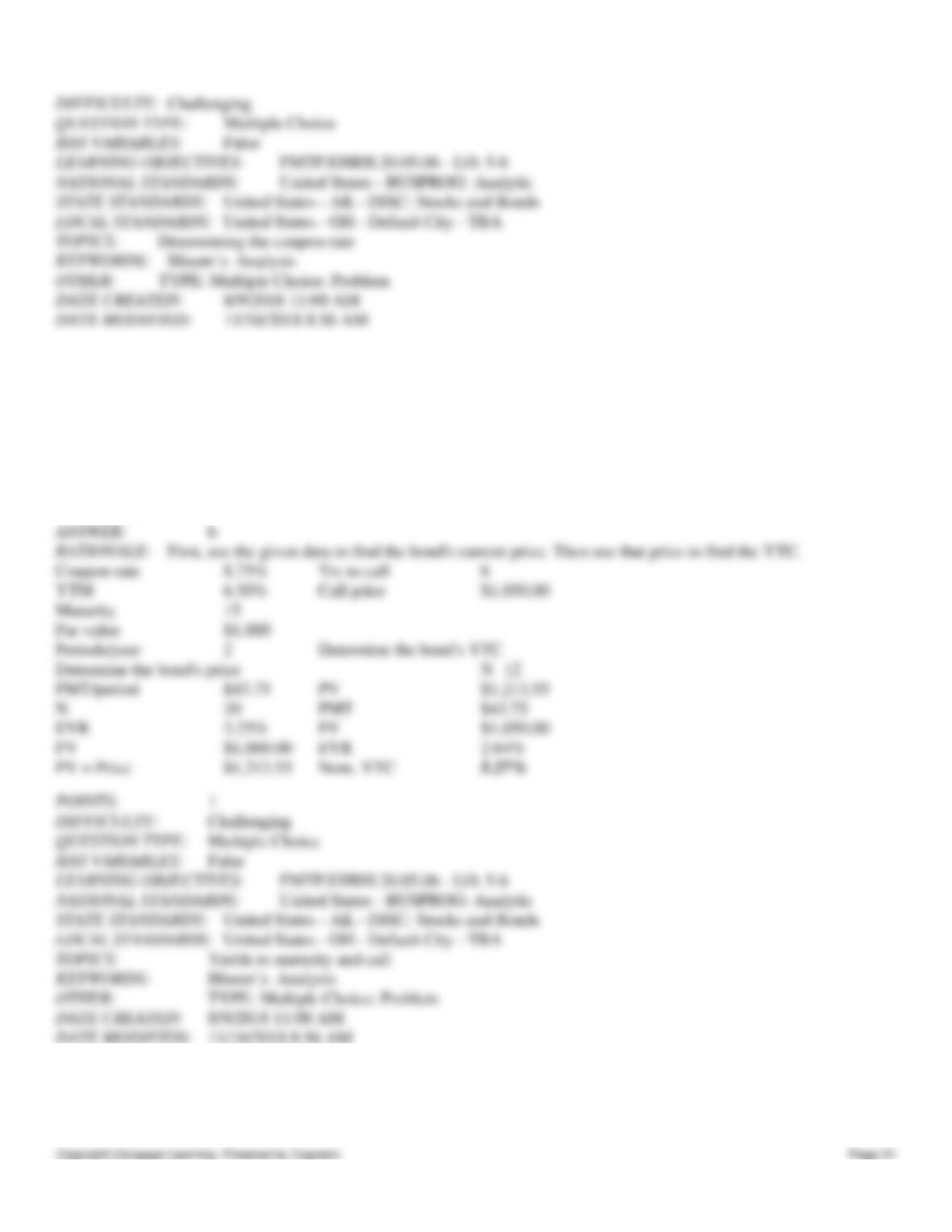
60. Field Industries’ outstanding bonds have a 25-year maturity and $1,000 par value. Their nominal yield to maturity is
9.25%, they pay interest semiannually, and they sell at a price of $850. What is the bond’s nominal (annual) coupon
interest rate?
a. 6.27%
b. 6.60%
c. 6.95%
d. 7.32%
e. 7.70%
Chapter 05: Bonds, Bond Valuation, and Interest Rates
61. Jerome Corporation’s bonds have 15 years to maturity, an 8.75% coupon paid semiannually, and a $1,000 par value.
The bond has a 6.50% nominal yield to maturity, but it can be called in 6 years at a price of $1,050. What is the bond’s
nominal yield to call?
a. 5.01%
b. 5.27%
c. 5.54%
d. 5.81%
e. 6.10%
62. Assume that interest rates on 15-year noncallable Treasury and corporate bonds with different ratings are as follows:
T-bond = 7.72% A = 9.64%
Chapter 05: Bonds, Bond Valuation, and Interest Rates
AAA = 8.72% BBB = 10.18%
The differences in rates among these issues were most probably caused primarily by:
a. Tax effects.
b. Default risk differences.
c. Maturity risk differences.
d. Inflation differences.
e. Real risk-free rate differences.
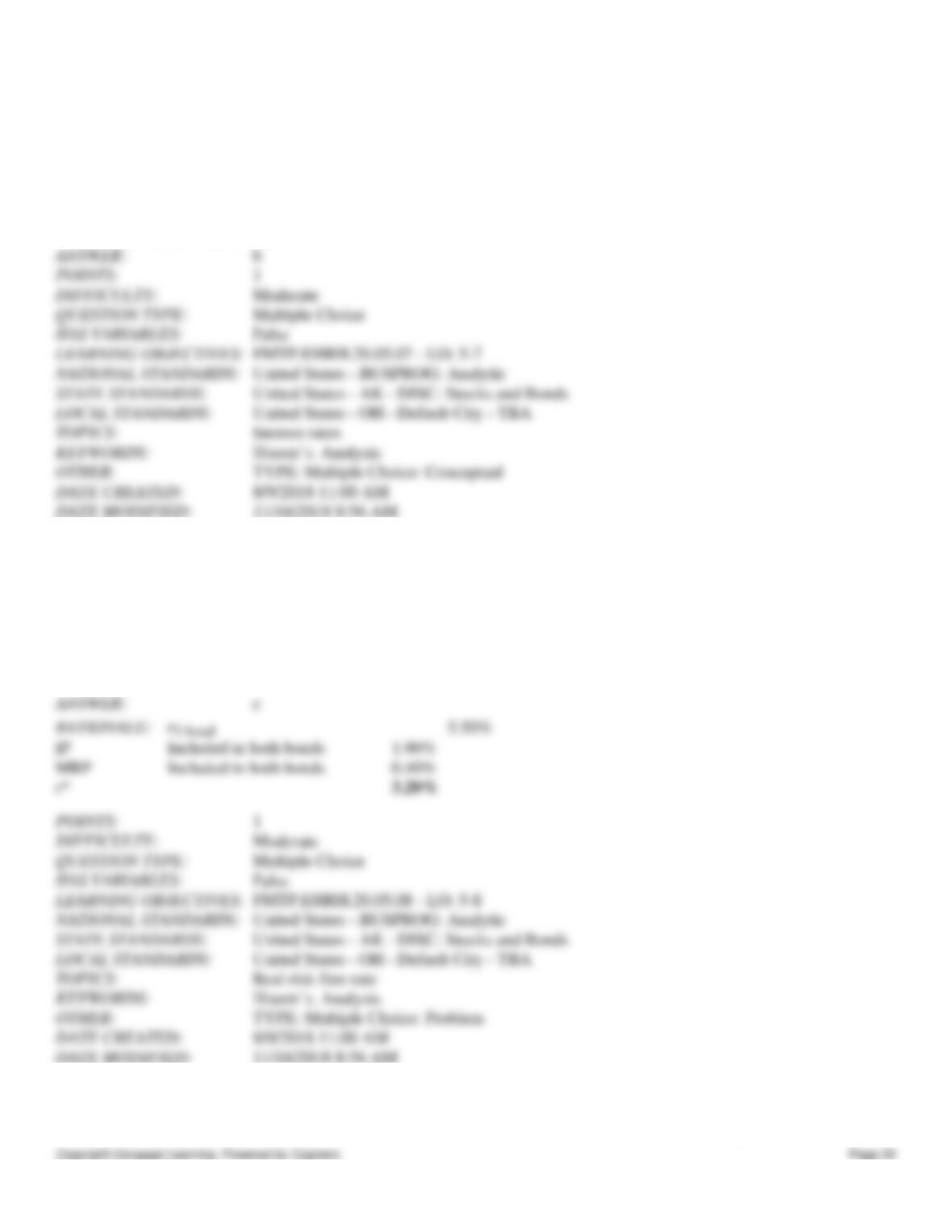
63. 5-year Treasury bonds yield 5.5%. The inflation premium (IP) is 1.9%, and the maturity risk premium (MRP) on 5-
year bonds is 0.4%. What is the real risk-free rate, r*?
a. 2.59%
b. 2.88%
c. 3.20%
d. 3.52%
e. 3.87%
64. The Gergen Group’s 5-year bonds yield 6.85%, and 5-year T-bonds yield 4.75%. The real risk-free rate is r* = 2.80%,
the default risk premium for Gergen’s bonds is DRP = 0.85% versus zero for T-bonds, the liquidity premium on Gergen’s
Chapter 05: Bonds, Bond Valuation, and Interest Rates
bonds is LP = 1.25%, and the maturity risk premium for all bonds is found with the formula MRP = (t − 1) × 0.1%, where
t = number of years to maturity. What is the inflation premium (IP) on 5-year bonds?
a. 1.40%
b. 1.55%
c. 1.71%
d. 1.88%
e. 2.06%
65. As a general rule, a company’s debentures have higher required interest rates than its mortgage bonds because
mortgage bonds are backed by specific assets while debentures are unsecured.
a. True
b. False
66. Other things equal, a firm will have to pay a higher coupon rate on its subordinated debentures than on its second
mortgage bonds.
Chapter 05: Bonds, Bond Valuation, and Interest Rates
a. True
b. False
67. There is an inverse relationship between bonds’ quality ratings and their required rates of return. Thus, the required
return is lowest for AAA-rated bonds, and required returns increase as the ratings get lower.
a. True
b. False
68. “Restrictive covenants” are designed primarily to protect bondholders by constraining the actions of managers. Such
covenants are spelled out in bond indentures.
a. True
b. False
Chapter 05: Bonds, Bond Valuation, and Interest Rates
69. Cornwall Corporation is planning to raise $1,000,000 to finance a new plant. Which of the following statements is
CORRECT?
a. If debt is used to raise the million dollars, but $500,000 is raised as first mortgage bonds on the new plant and
$500,000 as debentures, the interest rate on the first mortgage bonds would be lower than it would be if the entire $1
million were raised by selling first mortgage bonds.
b. If two tiers of debt are used (with one senior and one subordinated debt class), the subordinated debt will carry a
lower interest rate.
c. If debt is used to raise the million dollars, the cost of the debt would be lower if the debt were in the form of a
fixed-rate bond rather than a floating-rate bond.
d. If debt is used to raise the million dollars, the cost of the debt would be higher if the debt were in the form of a
mortgage bond rather than an unsecured term loan.
e. The company would be especially eager to have a call provision included in the indenture if its management
thinks that interest rates are almost certain to rise in the foreseeable future.
70. Listed below are some provisions that are often contained in bond indentures. Which of these provisions, viewed
alone, would tend to reduce the yield to maturity that investors would otherwise require on a newly issued bond?
1. Fixed assets are used as security for a bond.
2. A given bond is subordinated to other classes of debt.
3. The bond can be converted into the firm’s common stock.
4. The bond has a sinking fund.
5. The bond has a call provision.
6. The indenture contains covenants that prevent the use of additional debt.
a. 1, 4, 6
b. 1, 2, 3, 4, 6
c. 1, 2, 3, 4, 5, 6
d. 1, 3, 4, 5, 6
e. 1, 3, 4, 6