47) Which bond would someone in a 35% tax bracket choose to buy: a municipal bond with an
interest rate of 7% or a corporate bond with an interest rate of 10%?
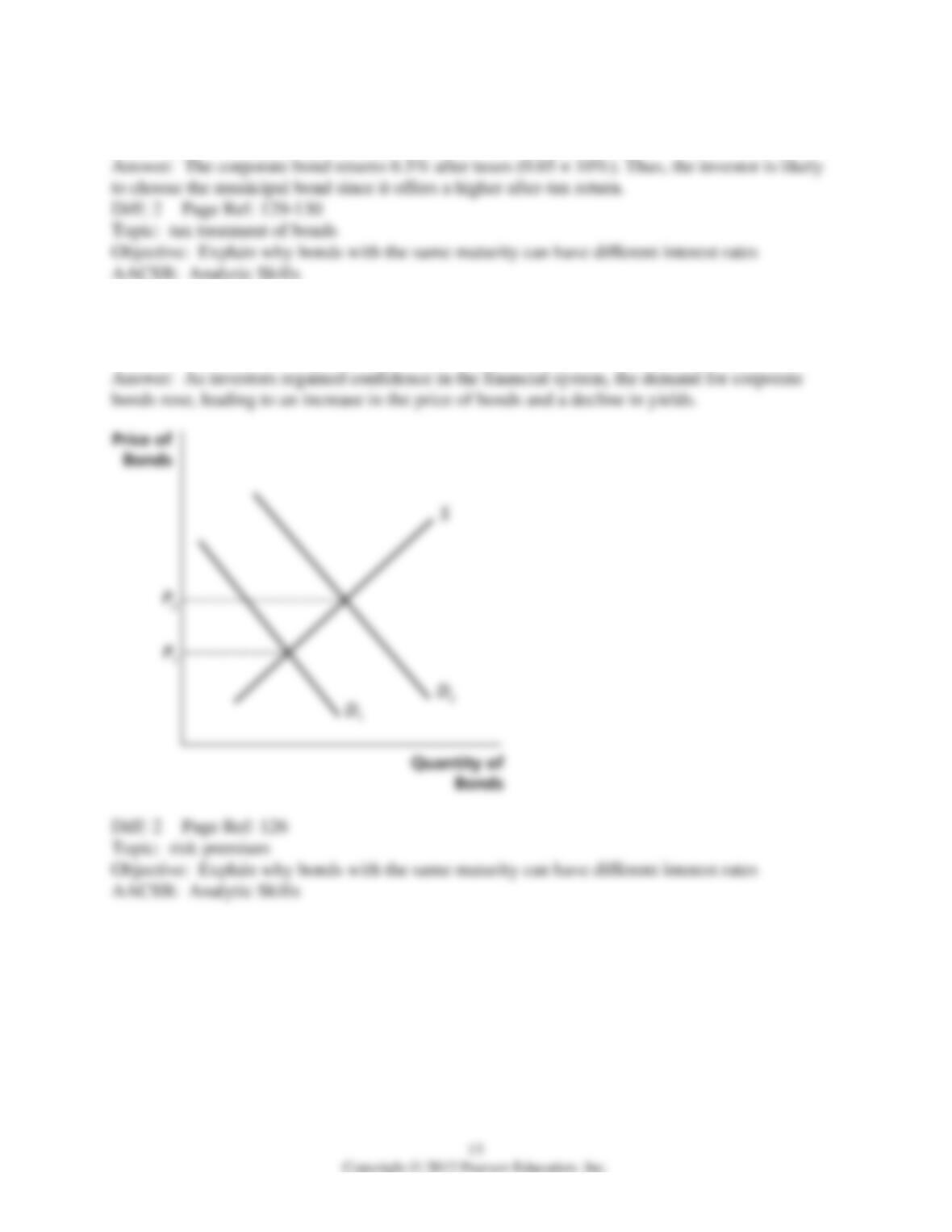
48) In 2009, global investors began to regain confidence in the financial system and reversed the
flight to safety that had taken place during the depths of the financial crisis. Make use of a graph
of the market for corporate bonds to show the impact on corporate bonds prices and yields.

5.2 The Term Structure of Interest Rates
1) The term structure of interest rates
A) represents the relationship among the interest rates on bonds that are otherwise similar but
that have different maturities.
B) reflects differing tax treatment received by different instruments.
C) always results in an upward-sloping yield curve.
D) usually results in a downward-sloping yield curve.
2) The term structure is usually defined with yields on which securities?
A) Corporate bonds
B) Commercial paper
C) U.S. Treasury securities
D) Municipal bonds
3) When the yield curve is downward-sloping,
A) short-term yields are higher than long-term yields.
B) long-term yields are higher than short-term yields.
C) the bond market is anticipating the U.S. Treasury may default on its obligations.
D) the inflation rate is expected to rise.
4) Which of the following is NOT true of the yield curve for U.S. Treasury securities?
A) Typically, it slopes upward.
B) It depicts the relationship among yields on securities of different maturities.
C) Typically, it shifts up or down rather than twists.
D) Typically, it slopes downward.

5) Which of the following is true of the segmented markets theory?
A) It assumes that borrowers have particular periods for which they want to borrow.
B) It assumes that lenders always lend for short periods.
C) It provides a good explanation for why yield curves usually slope upward.
D) It assumes that instruments with different maturities are perfect substitutes.
6) The segmented markets theory
A) explains upward-sloping yield curves as resulting from the demand for long-term bonds being
high relative to the demand for short-term bonds.
B) explains upward-sloping yield curves as resulting from the demand for long-term bonds being
low relative to the demand for short-term bonds.
C) explains upward-sloping yield curves as resulting from the favorable tax treatment of long-
term bonds.
D) is unable to account for upward-sloping yield curves.
7) The segmented markets theory
A) has difficulty explaining why yield curves usually slope up.
B) has difficulty explaining why yield curves usually slope down.
C) has difficulty explaining why yields on instruments of different maturities tend to move
together.
D) provides a good explanation of why yields on instruments of different maturities tend to move
together.

8) The yield on a thirty-year Treasury bond is 8% at the same time as the yield on two-year
Treasury note is 5%. This occurrence
A) indicates that the yield curve is downward sloping.
B) is well explained by the segmented markets theory.
C) is largely explained by the favorable tax treatment of Treasury notes.
D) indicates that the bond market is anticipating that inflation will fall.
9) What is the most important contrast between the segmented markets theory and the
expectations theory?
A) The expectation theory states that investors view similar assets that differ only with respect to
maturity as perfect substitutes.
B) The segmented markets theory states that investors view similar assets that differ only with
respect to maturity as perfect substitutes.
C) The expectations theory does a better job of explaining why yield curves typically are
upward-sloping.
D) The segmented markets theory does a better job of explaining why yields on instruments of
different maturities tend to move together.
10) The expectations theory suggests that
A) the yield curve should usually be upward-sloping.
B) the yield curve should usually be downward-sloping.
C) the slope of the yield curve depends on the expected future path of short-term rates.
D) the slope of the yield curve reflects the risk premium incorporated into the yields on long-
term bonds.

11) If the expected path of interest rates on one-year bonds over the next five years is 2%, 4%,
3%, 2%, and 1%, the expectations theory predicts that the bond with the lowest interest rate
today is the one with a maturity of
A) one year.
B) two years.
C) three years.
D) five years.
12) The implication of the expectations theory that expected returns for a holding period must be
the same for bonds of different maturities depends on the assumption that
A) yield curves usually slope upward.
B) yield curves usually slope downward.
C) instruments with different maturities are perfect substitutes.
D) savers are usually risk averse.
13) A one-year bond currently pays 5% interest. It’s expected that it will pay 4.5% next year and
4% the following year. The two-year term premium is 0.2% while the three-year term premium
is 0.35%. What is the interest rate on a two-year bond according to the liquidity premium theory?
A) 4.5%
B) 4.75%
C) 4.95%
D) 4.975%

14) A one-year bond currently pays 5% interest. It’s expected that it will pay 4.5% next year and
4% the following year. The two-year term premium is 0.2% while the three-year term premium
is 0.35%. What is the interest rate on a three-year bond according to the liquidity premium
theory?
A) 4.5%
B) 4.68%
C) 4.85%
D) 5.05%
15) According to the liquidity premium theory, what does a flat yield curve indicate?
A) Short-term interest rates are expected to remain stable.
B) Short-term interest rates are expected to rise.
C) Short-term interest rates are expected to fall.
D) Long-term interest rates are expected to fall.
16) According to the liquidity premium theory, a steep yield curve may be an indicator of
A) expectations of a significant increase in inflation.
B) an upcoming recession.
C) an economic slowdown.
D) lower future short-term interest rates.
17) According to the liquidity premium theory, the yield curve normally has a positive slope
because
A) short-term interest rates are expected to rise.
B) term premiums rise as the time to maturity increases.
C) risk premiums rise over time.
D) long-term bonds are more liquid than short-term bonds.

18) Under the expectations theory if market participants expect that future short-term rates will
be higher than current short-term rates, the yield curve will
A) slope upward.
B) slope downward.
C) be flat.
D) slope upward, slope downward, or be flat, depending on risk, liquidity, cost of information,
and tax considerations.
19) Unlike the segmented markets theory, the expectations theory attributes the slope of the yield
curve to
A) tax considerations.
B) the fact that short-term bonds are not perfect substitutes for long-term bonds.
C) the market’s view of future short-term interest rates.
D) the variance in the inflation rates over the business cycle.
20) The expectations theory
A) has difficulty explaining why U.S. Treasury securities have lower yields than corporate
bonds.
B) has difficulty explaining why yields on bonds of different maturities move together.
C) has difficulty explaining why yield curves usually slope upward.
D) accounts well for the fact that yield curves usually slope upward.

21) According to the expectations theory, which of the following is false?
A) It assumes that instruments with different maturities are perfect substitutes.
B) It implies that a long-term bond rate equals the average of short-term rates covering the same
investment period.
C) It implies that the yield curve will usually slope upward.
D) It implies that the shape of the yield curve depends on the expected pattern of future short-
term rates.
22) The key assumption of the liquidity premium theory is that investors
A) view bonds of different maturities as perfect substitutes.
B) view bonds of different maturities as completely unsubstitutable.
C) always choose the bond with the highest expected return, regardless of maturity.
D) care about both expected returns and time to maturity.
23) According to the liquidity premium theory
A) investors prefer longer to shorter maturities.
B) investors prefer shorter to longer maturities.
C) investors are indifferent between short and long maturities.
D) investors are more interested in the tax treatment of bonds than they are in the liquidity of
bonds.
24) The liquidity premium theory holds that investors
A) always choose the bond with the highest expected return, regardless of maturity.
B) require a term premium to compensate them for investing in a less preferred maturity.
C) view bonds of different maturities as perfect substitutes.
D) view bonds of different maturities as completely unsubstitutable.

25) If a one-year bond currently yields 5% and is expected to yield 7% next year, the liquidity
premium theory predicts that the yield today on a two-year bond should be
A) 5%.
B) less than 6%, but more than 5%.
C) 6%.
D) more than 6%.
26) Which of the following is NOT true of the term premium?
A) It is zero under the expectations theory.
B) It is infinite under the segmented markets theory.
C) It increases as a bond’s maturity increases.
D) It is zero for thirty-year bonds.
27) Under the liquidity premium theory the shape of the yield curve depends on
A) the relative return of investments in common stocks versus investments in corporate bonds.
B) the size of the federal government’s budget deficit.
C) government tax treatment of long-term versus short-term bonds.
D) the expected pattern of future short-term rates and the size of the term premium at each
maturity.
28) Under the liquidity premium theory, the expectation that future short-term rates will be
constant results in a yield curve that
A) is flat.
B) slopes upward.
C) slopes downward.
D) is flat, slopes upward, or slopes downward, depending on the size of the term premium at
each maturity.

29) Under the expectations theory, an upward-sloping yield curve indicates that investors expect
future short-term rates to
A) fall.
B) rise.
C) remain constant.
D) either rise or remain constant.
30) Under the liquidity premium theory, a flat yield curve indicates that investors expect future
short-term rates to
A) fall.
B) rise.
C) remain constant.
D) either fall or remain constant.
31) According to the liquidity premium theory, if market participants expect that inflation in the
future will be lower than it currently is, the yield curve will
A) slope upward.
B) be flat.
C) be inverted.
D) be vertical.
32) In which of the following periods was the yield curve inverted?
A) February 2004
B) February 2007
C) February 2010
D) The yield curve was not inverted during any of these periods.

33) If the expectations theory of the term structure is correct, would a reduction in the supply of
thirty-year Treasury bonds affect their yields?
34) Describe the facts found in the bond market about the relationship between interest rates on
bonds of different maturities.
35) According to the expectations theory, what will be the interest rate on a three-year bond if a
one-year bond has an interest rate of 2% and is expected to have an interest rate of 3% next year
and 5% in two year? Report your answer using a percentage with two decimal places.
36) Why does the segmented markets theory suggest think that bonds of different maturities are
not perfect substitutes for each other?
37) A one-year bond has an interest rate of 3% and is expected to fall to 2.5% next year and 2%
in two years. The term premium for a two-year bond is 0.3% and for a three-year bond is 0.5%.
What are the interest rates on a two-year bond and three-year bond according to the liquidity
premium theory?

38) How does the liquidity premium theory explain an upward sloping yield curve during normal
economic times?
39) What are the economic implications of an inverted yield curve?