14
© 2013 Pearson Canada Inc.
8) Pet Shop Ltd. is a large retail outlet with ten full time employees in addition to the owner. You
dropped by on your way home one day to organize the audit planning process for the coming
year, and noticed brand new terminals at the cashier’s desk. One of the employees was having
fun zapping inventory items. The owner teased him about the new laser scanning devices and
told him to get to work to see which items needed to be ordered. It turns out that Pet Shop Ltd.
has implemented a new point of sale computer system that is integrated with inventory. The last
time you were there to buy dog food (about three months ago) there were old computer terminals
that were no longer functional and recorded sales transactions manually in the sales journal.
Required:
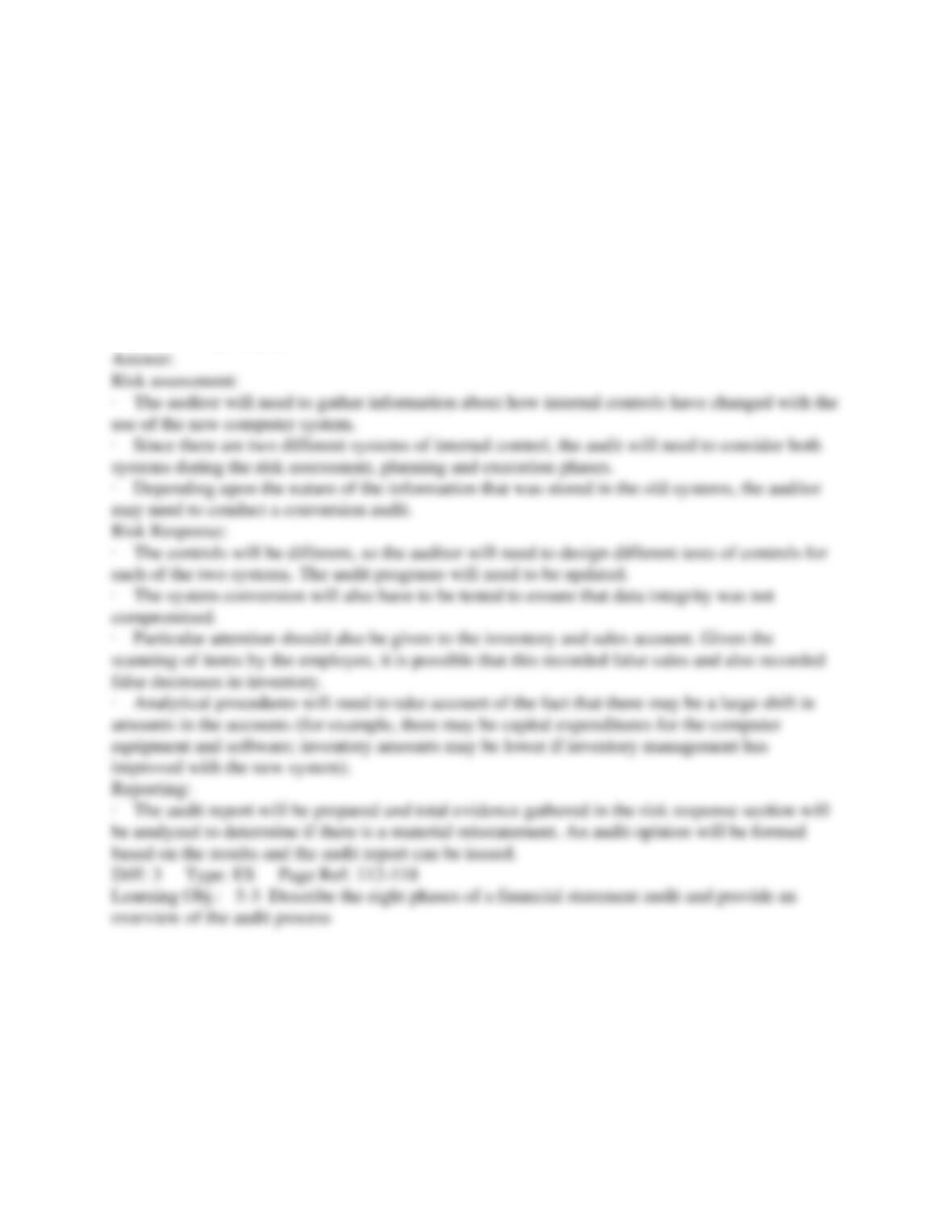
List the three sections of the audit. For each section, explain how these new computer systems
might affect the audit process.
5.4 Show how transactions underlying financial statements are divided into cycles
1) Prior to looking at the specific cycles, the auditor will first
A) inquire and document corporate governance systems.
B) perform tests of controls on significant cycles.
C) perform analytical review of specific accounts.
D) perform a risk assessment for the audit of the organization.
2) Marianne is currently performing tests of controls on the presence of an employee code of
conduct, the presence of a whistle blower line and on how management responded and
implemented systematic penalties for instances where violations of the code of conduct existed.
Marianne is currently evaluating the
A) industry and business environment.
B) risk of fraud.
C) client acceptance.
D) entity-level controls.
3) Transaction cycles begin and end at
A) the beginning and end of the fiscal period.
B) the balance sheet date.
C) January 1 and December 31.
D) the origin and final disposition of the company.
4) For the most part, auditors treat each transaction cycle
A) separately as the audit is being performed.
B) as an interrelated unit with the other cycles throughout the entire audit.
C) as a separate business unit with different audit teams.
D) as a joint venture with other clients in the same industry.
5) Often, numerous classes of transactions affect the ending balance of a particular general
ledger account. This is handled during the audit engagement by
A) ensuring that tests are conducted for each class of transactions.
B) obtaining a high level of assurance for at least one of the transaction types.
C) using a combination of assurance for each class of transactions and for the ending balance.
D) testing only the ending balance, as this is the significant amount on the financial statements.
6) Your PA firm audits the Barney Bloke Parts company, which manufactures plastic bumpers
and other automobile parts in eight factories scattered across southern Ontario. The company has
a December year end. It is now November 14.
The planning file indicates that internal controls in the accounts receivable area are poor, as there
has been significant employee turnover. A review of the prior year’s working paper file indicates
that there was a poor response to the accounts receivable and accounts payable confirmation
requests. There were several errors in inventory pricing and problems with obsolescence.
Required:
List the financial statement cycles that need to be tested. For each cycle, identify at least one
transaction that needs to be examined. For that transaction, identify a management assertion that
may have a high risk of error associated with it and explain why you believe the risk of error is
high.
5.5 Describe management assertions about financial information
1) Management assertions are
A) stated in the footnotes to the financial statements.
B) implied or expressed representations about the accounts in the financial statements.
C) explicitly expressed representations about the financial statements.
D) provided to the auditor in the engagement letter, but are not disclosed on the financial
statements.
2) Management assertions are
A) directly related to auditing standards.
B) directly related to accounting standards.
C) indirectly related to auditing standards.
D) indirectly related to accounting standards.
3) Frankinfurter Limited decided that it wanted to improve earnings. To do this, it understated its
expenses by omitting unpaid expenses from the accrued liabilities account at year end. Which
management assertion has been violated?
A) existence
B) disclosure
C) rights and obligations
D) completeness
4) Gabori Company would like to pay less income tax this year. It decided that it could do this by
understating its inventory values, increasing costs of goods sold. This was done by deliberately
pricing the inventory at incorrect amounts, so that it would be shown at a lower value than it was
really worth (for example, items worth five dollars each were shown at fifty cents each). Which
management assertion has been violated?
A) valuation
B) accuracy
C) statement presentation
D) completeness
5) If the purchase of a long-term note receivable is included as cost of goods sold, there is a
violation of the
A) existence objective.
B) completeness objective.
C) classification objective.
D) timing objective.
6) When considering each material type (or class) of transactions during the audit, which general
transaction-related audit objectives are assessed during the audit?
A) those transaction-related audit objectives where there is the highest risk of error
B) all five transaction-related audit objectives
C) those transaction-related audit objectives where there are poor internal controls
D) primarily completeness, occurrence and accuracy, since this is where most errors occur
7) XYZ Brick Company decided to inflate sales by recording fictitious sales. Several non-
existent clients were created and the sales were added into the sales journal throughout the year.
The general transaction-related audit objective affected by these actions is
A) occurrence.
B) completeness.
C) accuracy.
D) posting and summarization.
8) Georgina was working as the part time accountant for three small businesses. Whenever she
could, she pocketed cash and neglected to record the sale in the sales system. The general
transaction-related audit objective affected by her actions is
A) occurrence.
B) completeness.
C) accuracy.
D) posting and summarization.
9) Flagpole Company Limited recently upgraded its accounting software due to changes in the
payroll income tax rates. Unfortunately, there was an error in the software, and income tax was
calculated incorrectly. The general transaction-related audit objective affected by these errors is
A) occurrence.
B) completeness.
C) accuracy.
D) posting and summarization.
10) Big Bank had a program failure occur on Sunday night due to a maintenance program error.
Transaction posting was interrupted, with several errors occurring in posting to the master files.
Although sales had been posted to the general ledger, individual accounts were not recorded until
subsequent days. The general transaction-related audit objective affected by this activity is
A) timing.
B) accuracy.
C) occurrence.
D) classification.
11) In testing for cutoff, the objective is to determine
A) whether all of the current period’s transactions are recorded.
B) that no transactions from the prior period are included in the current period’s balances.
C) that no transactions of the current period have been delayed and recorded in a future period.
D) whether transactions are recorded in the proper period.
12) Heavy Manufacturing Company is in the business of making steel plates, forming heavy
metal slabs and drilling and scoring metals. Recently, it upgraded many of its forming machines.
Fortunately, the company was able to sell its old equipment at a reasonable price. The effect was
that sales for the quarter are substantially improved over the same period in the prior year. The
general transaction-related audit objective affected by this activity is
A) timing.
B) accuracy.
C) occurrence.
D) classification.
13) Balance-related audit objectives are applied to which types of general ledger accounts?
A) balance sheet accounts only
B) income statement accounts only
C) balance sheet accounts and some income statement accounts
D) accounts that affect the cash flow statement
14) Heavy Manufacturing Company is in the business of making steel plates, forming heavy
metal slabs and drilling and scoring metals. Recently, it upgraded many of its forming machines.
There were five machines purchased on four different invoices. Unfortunately, one of the
invoices was recorded twice, resulting in five invoices being recorded. The general balance-
related audit objective affected by this activity is
A) completeness.
B) accuracy.
C) classification.
D) existence.
15) Camilla is preparing the audit program for the inventory of Summers, a large department
store. Camilla listed “select a sample of invoices from suppliers to verify that the risks and
rewards of the inventory were transferred to Summers”. Camilla is concerned that some of the
inventory in the store might be on consignment. The account balance related objective that
Camilla is concerned about is
A) rights and obligation (ownership).
B) accuracy.
C) valuation.
D) existence.
16) The sole shareholder of Jade Company had a contractor pave the parking lot at the company
building, and also pave the driveway of his home. Both paving jobs were billed to the company
on a single invoice. The general balance-related audit objective affected by this activity is
A) existence.
B) allocation.
C) completeness.
D) rights and obligations.
17) The Big Insurance Company implemented a new computer system to track and record
insurance premiums receivable. The program automatically prints invoices and sends them to
customers when premiums are due. Due to a program error, a whole series of invoices were
included in sales but not in accounts receivable. The general balance-related audit objective
affected by this activity is
A) completeness.
B) accuracy.
C) classification.
D) existence.
18) Radio Supplies Limited sells parts and components to organizations that repair radios and
other forms of audio equipment. It has many parts on its inventory listing at cost that were
purchased up to fifteen years ago. Some of these parts have not seen any movement in the last
ten years. The general balance-related audit objective affected by this activity is
A) completeness.
B) accuracy.
C) valuation.
D) existence.
19) To help improve the cash balance on the financial statements, the controller recorded several
deposits from early January in the month of December. The general balance-related audit
objective affected by this activity is
A) allocation timing.
B) accuracy.
C) classification.
D) existence.
20) Jane’s employer purchased a new calculator this month. When Jane added up the sales for the
day, she was a bit confused with the new calculator and made numerous adding errors. The daily
sales total for the next week was incorrectly posted to the general ledger. The general balance-
related audit objective affected by this activity is
A) cutoff.
B) accuracy (of allocation).
C) classification.
D) existence.
21) Formamould Inc. sells plastic moulds to a variety of companies. Some moulds are custom
made and cost thousands of dollars. To help customers finance these purchases, Formamould
uses a variety of methods, such as payment terms stretched over three years, delayed payment,
and pay-as-you-produce models tailored to the individual customer’s needs. The outstanding
balance is included in current accounts receivable. The general balance-related audit objective
affected by this activity is
A) completeness.
B) accuracy.
C) allocation to accounts.
D) existence.

23
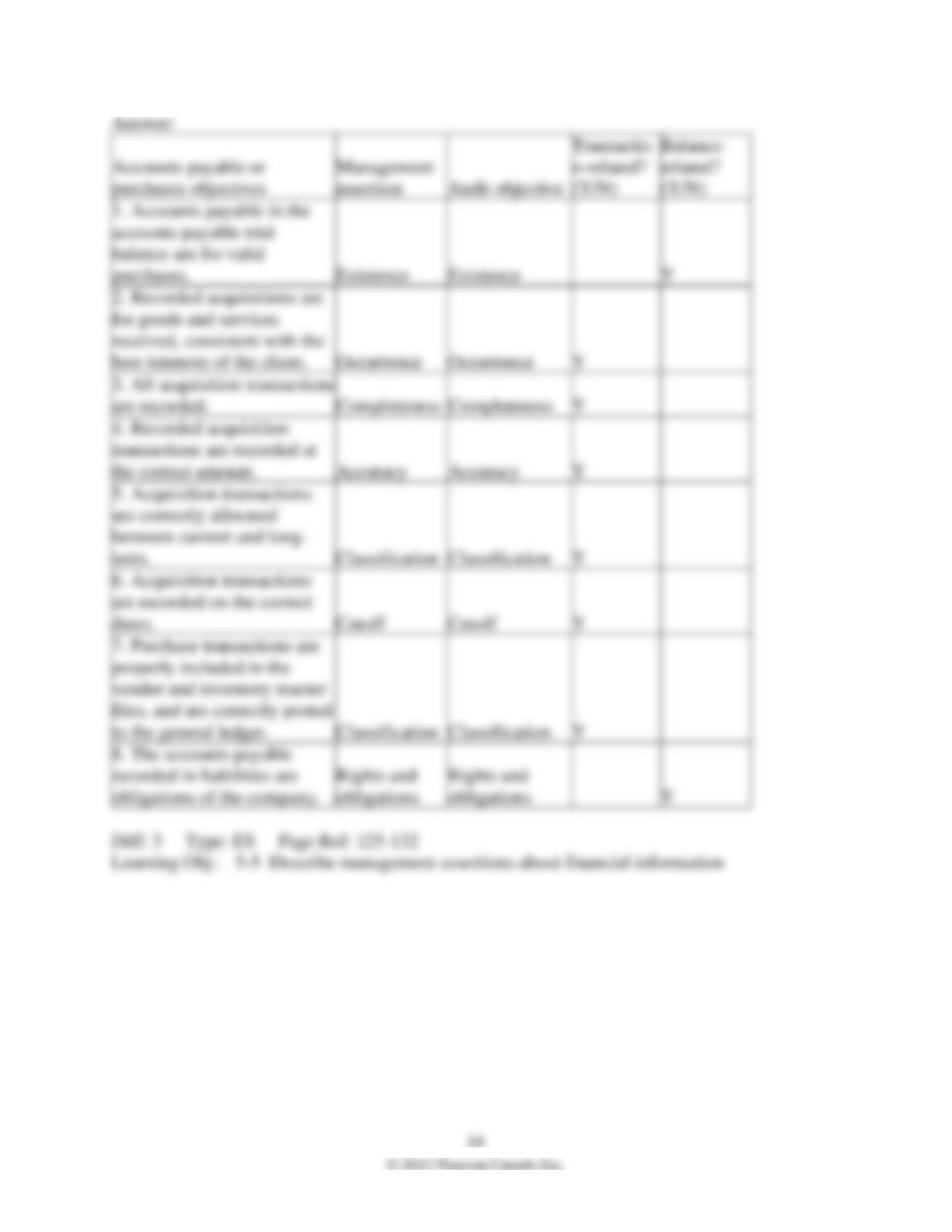
22) In the following table, there are listed common audit objectives for accounts payable or
purchases. For each procedure, list the management assertion, and the related general audit
objective. State whether the audit objective is transaction-related or balance-related.
Accounts payable or
purchases objectives
Management
assertion
Audit objective
Transactio
n-related?
(Y/N)
Balance-
related?
(Y/N)
1. Accounts payable in the
accounts payable trial
balance are for valid
purchases.
2. Recorded acquisitions are
for goods and services
received, consistent with the
best interests of the client.
3. All acquisition transactions
are recorded.
4. Recorded acquisition
transactions are recorded at
the correct amount.
5. Acquisition transactions
are correctly allocated
between current and long-
term.
6. Acquisition transactions
are recorded on the correct
dates.
7. Purchase transactions are
properly included in the
vendor and inventory master
files, and are correctly posted
to the general ledger.
8. The accounts payable
recorded in liabilities are
obligations of the company.
23) Bratlett Company has purchased all of the shares of another company, but does not want to
consolidate its financial statements. Management has drafted a rather long and confusing note to
the financial statements that describes the transaction that took place briefly, and states that debt
has been acquired in a foreign currency. In your view, the transaction, its effect on the company
and the accounts have not properly been disclosed.
Required:
List the audit objectives about presentation and disclosure that have been affected and explain
how they are affected.