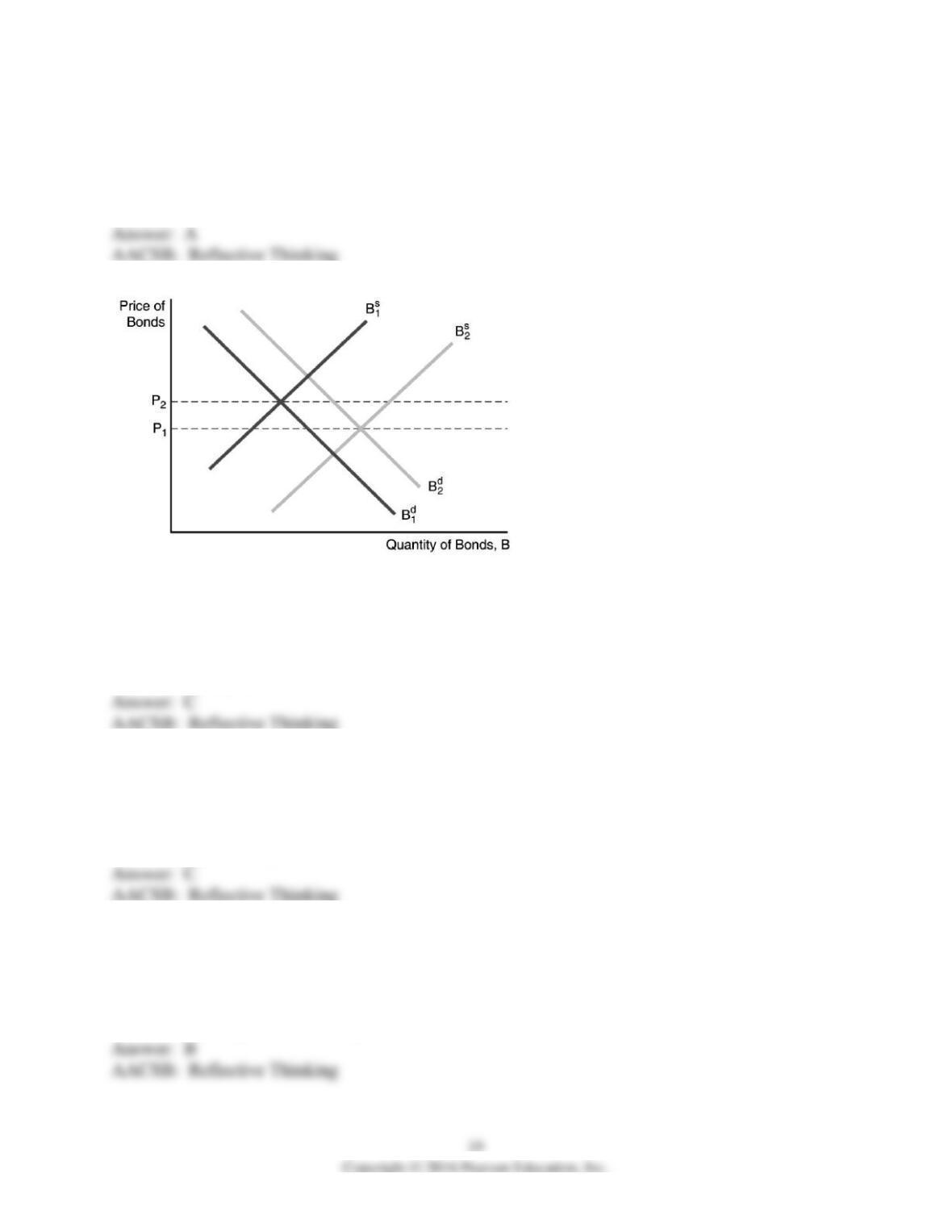
47) In the figure above, the price of bonds would fall from P1 to P2 when
A) inflation is expected to increase in the future.
B) interest rates are expected to fall in the future.
C) the expected return on bonds relative to other assets is expected to increase in the future.
D) the riskiness of bonds falls relative to other assets.
48) In the figure above, a factor that could cause the supply of bonds to increase (shift to the
right) is
A) a decrease in government budget deficits.
B) a decrease in expected inflation.
C) expectations of more profitable investment opportunities.
D) a business cycle recession.
49) In the figure above, a factor that could cause the demand for bonds to shift to the right is
A) an increase in the riskiness of bonds relative to other assets.
B) an increase in the expected rate of inflation.
C) expectations of lower interest rates in the future.
D) a decrease in wealth.
50) In the figure above, the price of bonds would fall from P2 to P1 if
A) there is a business cycle recession.
B) there is a business cycle expansion.
C) inflation is expected to increase in the future.
D) inflation is expected to decrease in the future.
51) What is the impact on interest rates when the Federal Reserve decreases the money supply by
selling bonds to the public?
52) Use demand and supply analysis to explain why an expectation of Fed rate hikes would
cause Treasury prices to fall.
5.4 Supply and Demand in the Market for Money: The Liquidity Preference Framework
1) In Keynes’s liquidity preference framework, individuals are assumed to hold their wealth in
two forms
A) real assets and financial assets.
B) stocks and bonds.
C) money and bonds.
D) money and gold.
2) In Keynes’s liquidity preference framework
A) the demand for bonds must equal the supply of money.
B) the demand for money must equal the supply of bonds.
C) an excess demand of bonds implies an excess demand for money.
D) an excess supply of bonds implies an excess demand for money.
3) In Keynes’s liquidity preference framework, if there is excess demand for money, there is
A) an excess demand for bonds.
B) equilibrium in the bond market.
C) an excess supply of bonds.
D) too much money.
4) The bond supply and demand framework is easier to use when analyzing the effects of
changes in ________, while the liquidity preference framework provides a simpler analysis of
the effects from changes in income, the price level, and the supply of ________.
A) expected inflation; bonds
B) expected inflation; money
C) government budget deficits; bonds
D) government budget deficits; money
5) Keynes assumed that money has ________ rate of return.
A) a positive
B) a negative
C) a zero
D) an increasing
6) In his Liquidity Preference Framework, Keynes assumed that money has a zero rate of return;
thus
A) when interest rates rise, the expected return on money falls relative to the expected return on
bonds, causing the demand for money to fall.
B) when interest rates rise, the expected return on money falls relative to the expected return on
bonds, causing the demand for money to rise.
C) when interest rates fall, the expected return on money falls relative to the expected return on
bonds, causing the demand for money to fall.
D) when interest rates fall, the expected return on money falls relative to the expected return on
bonds, causing the demand for money to rise.
7) In Keynes’s liquidity preference framework, as the expected return on bonds increases
(holding everything else unchanged), the expected return on money ________, causing the
demand for ________ to fall.
A) falls; bonds
B) falls; money
C) rises; bonds
D) rises; money
8) The opportunity cost of holding money is
A) the level of income.
B) the price level.
C) the interest rate.
D) the discount rate.
9) An increase in the interest rate
A) increases the demand for money.
B) increases the quantity of money demanded.
C) decreases the demand for money.
D) decreases the quantity of money demanded.
10) If there is an excess supply of money
A) individuals sell bonds, causing the interest rate to rise.
B) individuals sell bonds, causing the interest rate to fall.
C) individuals buy bonds, causing interest rates to fall.
D) individuals buy bonds, causing interest rates to rise.
11) If there is an excess demand for money, individuals ________ bonds, causing interest rates
to ________.
A) sell; rise
B) sell; fall
C) buy; rise
D) buy; fall
12) When the interest rate is above the equilibrium interest rate, there is an excess ________
money and the interest rate will ________.
A) demand for; rise
B) demand for; fall
C) supply of; fall
D) supply of; rise
13) In the market for money, an interest rate below equilibrium results in an excess ________
money and the interest rate will ________.
A) demand for; rise
B) demand for; fall
C) supply of; fall
D) supply of; rise
1) In the Keynesian liquidity preference framework, an increase in the interest rate causes the
demand curve for money to ________, everything else held constant.
A) shift right
B) shift left
C) stay where it is
D) invert
2) A lower level of income causes the demand for money to ________ and the interest rate to
________, everything else held constant.
A) decrease; decrease
B) decrease; increase
C) increase; decrease
D) increase; increase
3) When real income ________, the demand curve for money shifts to the ________ and the
interest rate ________, everything else held constant.
A) falls; right; rises
B) rises; right; rises
C) falls; left; rises
D) rises; left; rises
4) A business cycle expansion increases income, causing money demand to ________ and
interest rates to ________, everything else held constant.
A) increase; increase
B) increase; decrease
C) decrease; decrease
D) decrease; increase
5) In the Keynesian liquidity preference framework, a rise in the price level causes the demand
for money to ________ and the demand curve to shift to the ________, everything else held
constant.
A) increase; left
B) increase; right
C) decrease; left
D) decrease; right
6) When the price level ________, the demand curve for money shifts to the ________ and the
interest rate ________, everything else held constant.
A) falls; right; rises
B) rises; right; falls
C) falls; left; rises
D) rises; right; rises
7) A rise in the price level causes the demand for money to ________ and the interest rate to
________, everything else held constant.
A) decrease; decrease
B) decrease; increase
C) increase; decrease
D) increase; increase
8) When the price level falls, the ________ curve for nominal money ________, and interest
rates ________, everything else held constant.
A) demand; decreases; fall
B) demand; increases; rise
C) supply; increases; rise
D) supply; decreases; fall
9) A decline in the expected inflation rate causes the demand for money to ________ and the
demand curve to shift to the ________, everything else held constant.
A) decrease; right
B) decrease; left
C) increase; right
D) increase; left
10) When the Fed decreases the money stock, the money supply curve shifts to the ________
and the interest rate ________, everything else held constant.
A) right; rises
B) right; falls
C) left; falls
D) left; rises
11) When the Fed ________ the money stock, the money supply curve shifts to the ________
and the interest rate ________, everything else held constant.
A) decreases; right; rises
B) increases; right; falls
C) decreases; left; falls
D) increases; left; rises
12) ________ in the money supply creates excess ________ money, causing interest rates to
________, everything else held constant.
A) A decrease; demand for; rise
B) An increase; demand for; fall
C) An increase; supply of; rise
D) A decrease; supply of; fall
13) ________ in the money supply creates excess demand for ________, causing interest rates to
________, everything else held constant.
A) An increase; money; rise
B) An increase; bonds; fall
C) A decrease; bonds; rise
D) A decrease; money; fall
14) When the price level falls, the ________ curve for nominal money ________, and interest
rates ________, everything else held constant.
A) demand; decreases; fall
B) demand; increases; rise
C) supply; increases; rise
D) supply; decreases; fall
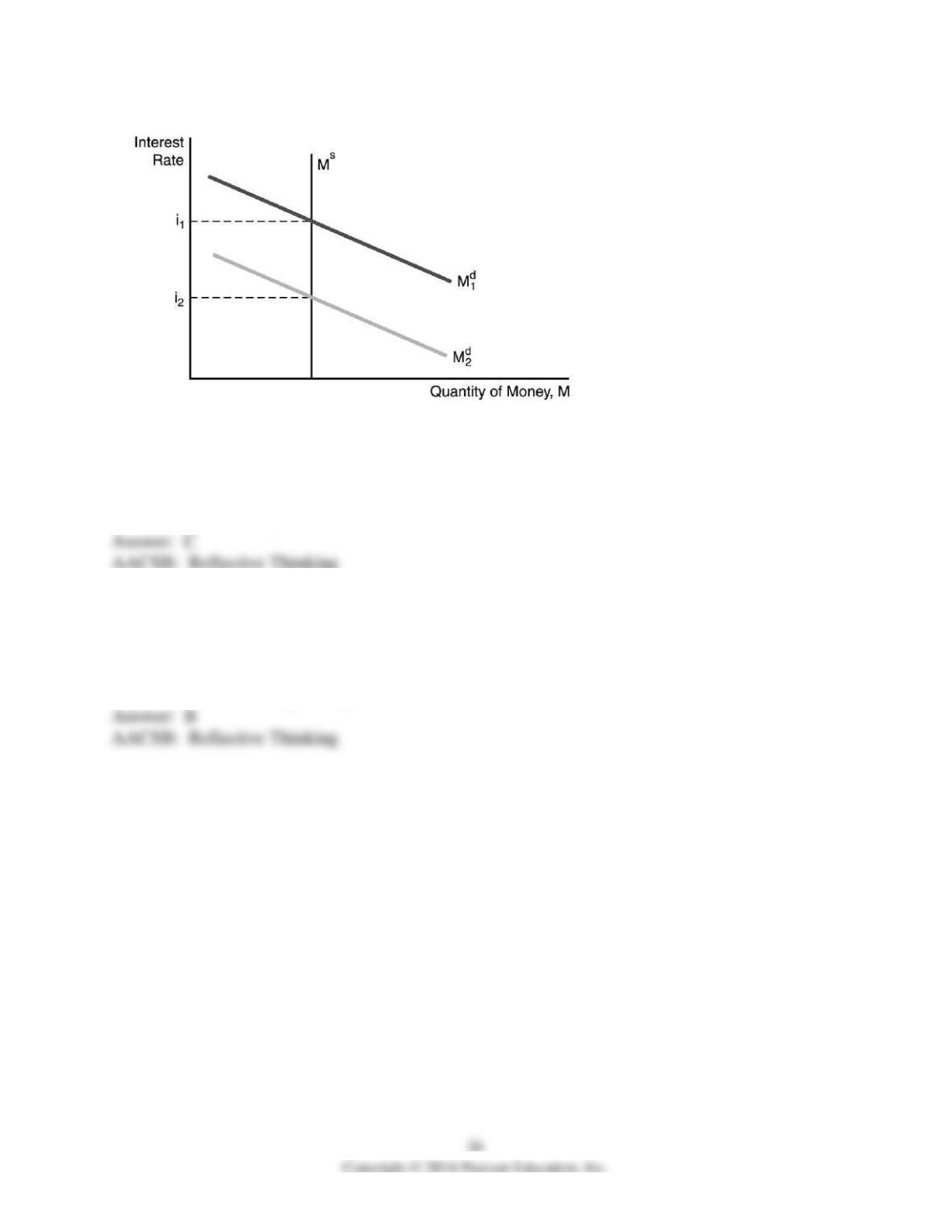
15) In the figure above, one factor NOT responsible for the decline in the demand for money is
A) a decline the price level.
B) a decline in income.
C) an increase in income.
D) a decline in the expected inflation rate.
16) In the figure above, the decrease in the interest rate from i1 to i2 can be explained by
A) a decrease in money growth.
B) a decline in the expected price level.
C) an increase in income.
D) an increase in the expected price level.
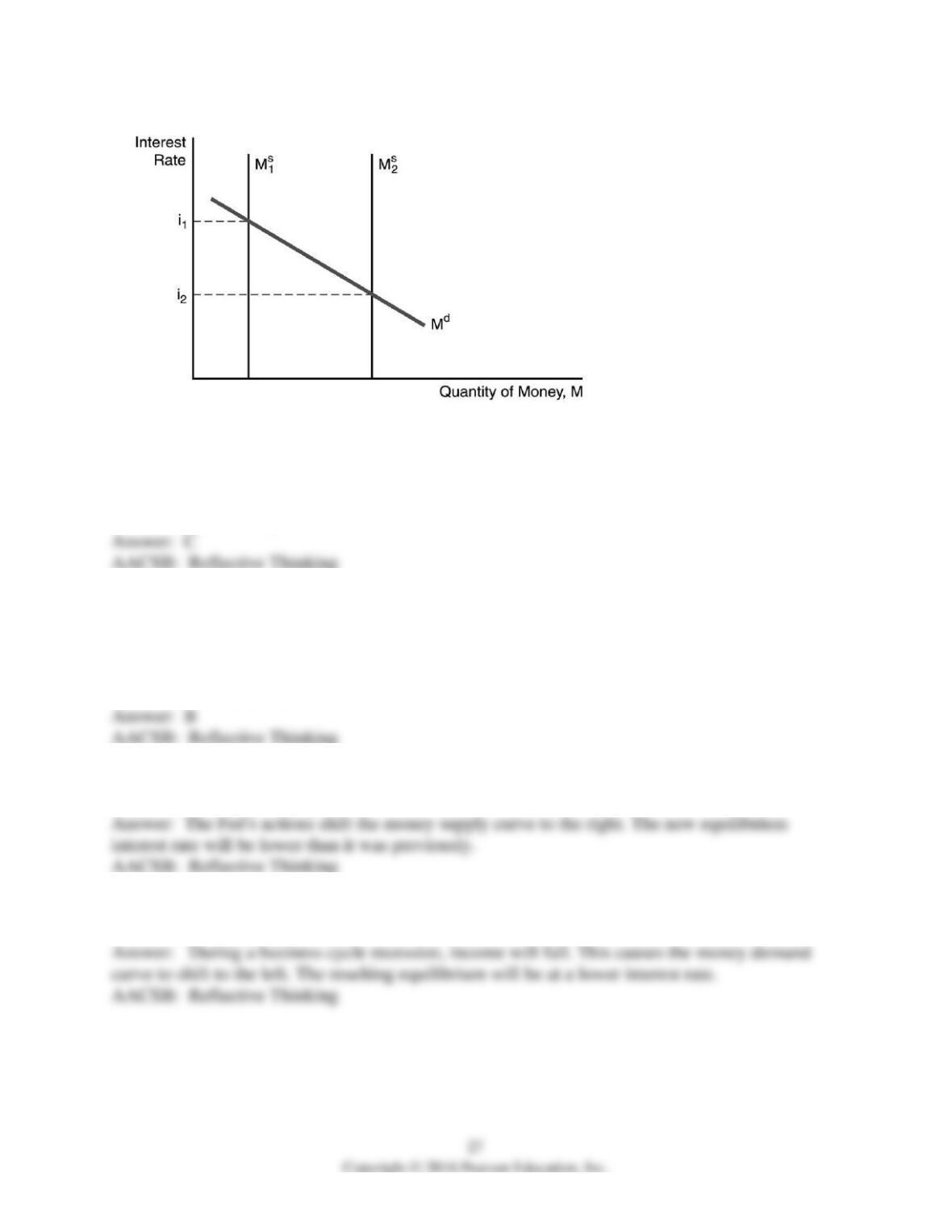
17) In the figure above, the factor responsible for the decline in the interest rate is
A) a decline the price level.
B) a decline in income.
C) an increase in the money supply.
D) a decline in the expected inflation rate.
18) In the figure above, the decrease in the interest rate from i1 to i2 can be explained by
A) a decrease in money growth.
B) an increase in money growth.
C) a decline in the expected price level.
D) an increase in income.
19) Using the liquidity preference framework, what will happen to interest rates if the Fed
increases the money supply?
20) Using the liquidity preference framework, show what happens to interest rates during a
business cycle recession.
5.6 Money and Interest Rates
1) Milton Friedman called the response of lower interest rates resulting from an increase in the
money supply the ________ effect.
A) liquidity
B) price level
C) expected-inflation
D) income
2) Of the four effects on interest rates from an increase in the money supply, the initial effect is,
generally, the
A) income effect.
B) liquidity effect.
C) price level effect.
D) expected inflation effect.
3) In the liquidity preference framework, a one-time increase in the money supply results in a
price level effect. The maximum impact of the price level effect on interest rates occurs
A) at the moment the price level hits its peak (stops rising) because both the price level and
expected inflation effects are at work.
B) immediately after the price level begins to rise, because both the price level and expected
inflation effects are at work.
C) at the moment the expected inflation rate hits its peak.
D) at the moment the inflation rate hits it peak.
4) Of the four effects on interest rates from an increase in the money supply, the one that works
in the opposite direction of the other three is the
A) liquidity effect.
B) income effect.
C) price level effect.
D) expected inflation effect.
5) It is possible that when the money supply rises, interest rates may ________ if the ________
effect is more than offset by changes in income, the price level, and expected inflation.
A) fall; liquidity
B) fall; risk
C) rise; liquidity
D) rise; risk
6) When the growth rate of the money supply increases, interest rates end up being permanently
lower if
A) the liquidity effect is larger than the other effects.
B) there is fast adjustment of expected inflation.
C) there is slow adjustment of expected inflation.
D) the expected inflation effect is larger than the liquidity effect.
7) When the growth rate of the money supply is increased, interest rates will fall immediately if
the liquidity effect is ________ than the other money supply effects and there is ________
adjustment of expected inflation.
A) larger; fast
B) larger; slow
C) smaller; slow
D) smaller; fast
8) If the Fed wants to permanently lower interest rates, then it should raise the rate of money
growth if
A) there is fast adjustment of expected inflation.
B) there is slow adjustment of expected inflation.
C) the liquidity effect is smaller than the expected inflation effect.
D) the liquidity effect is larger than the other effects.
9) If the liquidity effect is smaller than the other effects, and the adjustment to expected inflation
is slow, then the
A) interest rate will fall.
B) interest rate will rise.
C) interest rate will initially fall but eventually climb above the initial level in response to an
increase in money growth.
D) interest rate will initially rise but eventually fall below the initial level in response to an
increase in money growth.
10) If the liquidity effect is smaller than the other effects, and the adjustment to expected
inflation is immediate, then the
A) interest rate will fall.
B) interest rate will rise.
C) interest rate will fall immediately below the initial level when the money supply grows.
D) interest rate will rise immediately above the initial level when the money supply grows.
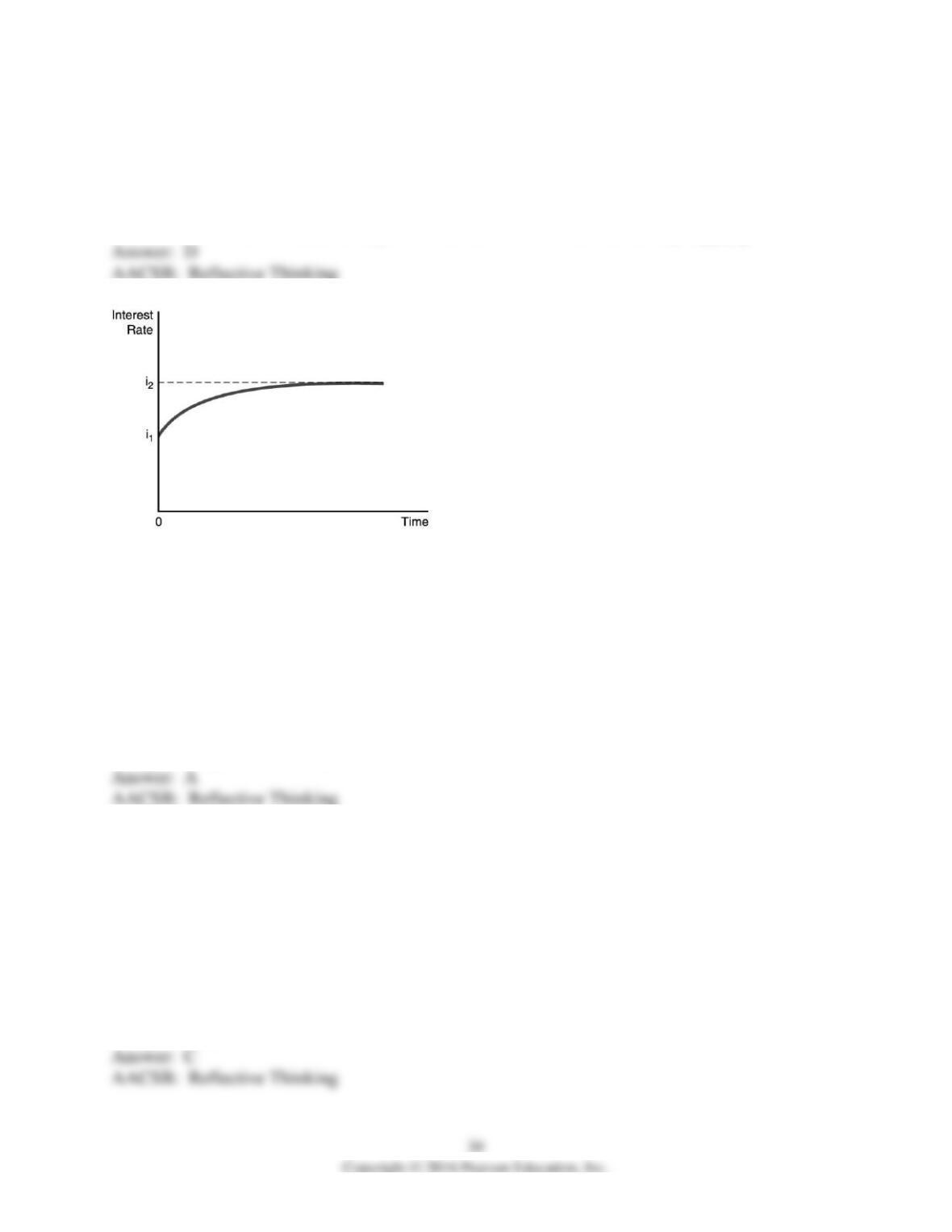
11) In the figure above, illustrates the effect of an increased rate of money supply growth at time
period 0. From the figure, one can conclude that the
A) liquidity effect is smaller than the expected inflation effect and interest rates adjust quickly to
changes in expected inflation.
B) liquidity effect is larger than the expected inflation effect and interest rates adjust quickly to
changes in expected inflation.
C) liquidity effect is larger than the expected inflation effect and interest rates adjust slowly to
changes in expected inflation.
D) liquidity effect is smaller than the expected inflation effect and interest rates adjust slowly to
changes in expected inflation.
12) In the figure above, illustrates the effect of an increased rate of money supply growth at time
period 0. From the figure, one can conclude that the
A) Fisher effect is dominated by the liquidity effect and interest rates adjust slowly to changes in
expected inflation.
B) liquidity effect is dominated by the Fisher effect and interest rates adjust slowly to changes in
expected inflation.
C) liquidity effect is dominated by the Fisher effect and interest rates adjust quickly to changes in
expected inflation.
D) Fisher effect is smaller than the expected inflation effect and interest rates adjust quickly to
changes in expected inflation.
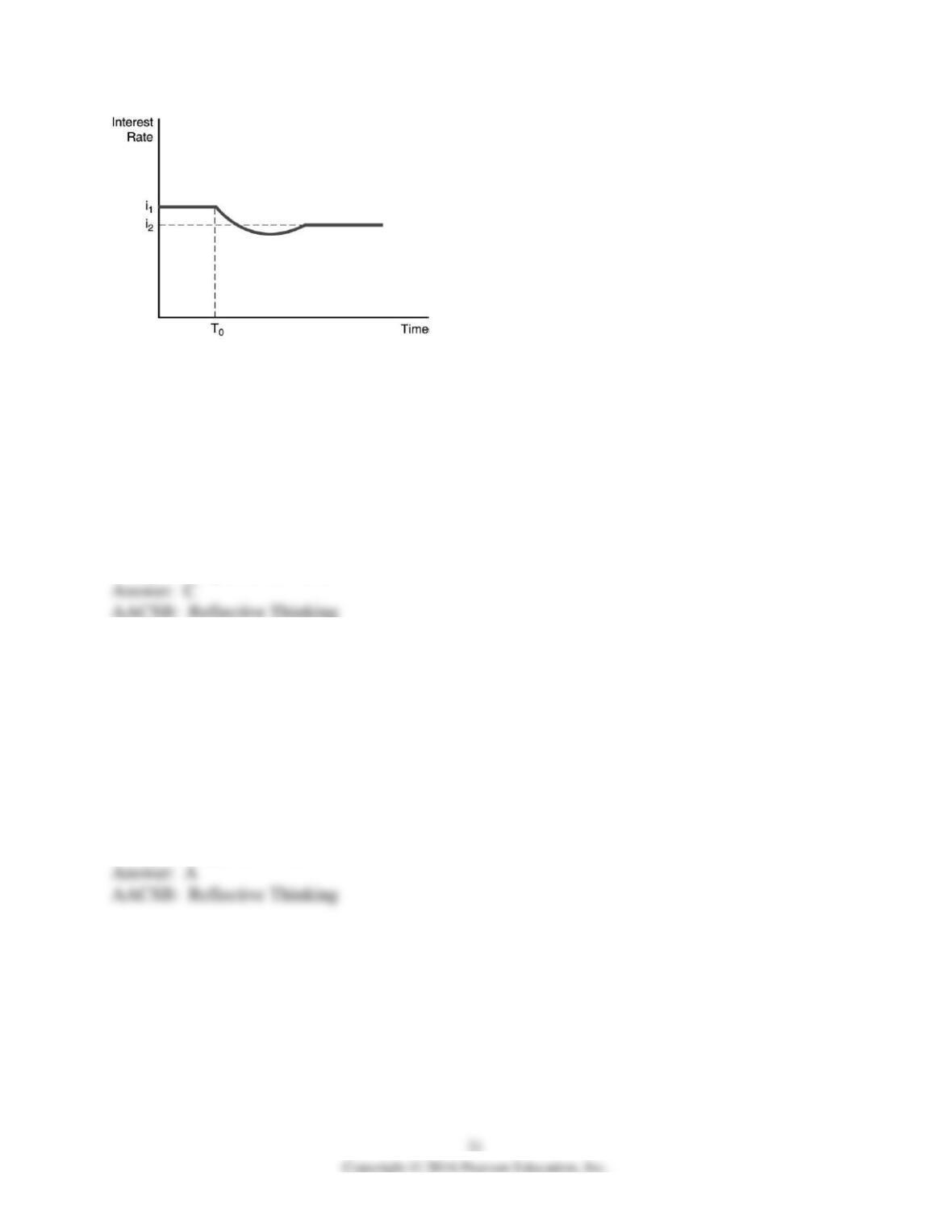
13) The figure above illustrates the effect of an increased rate of money supply growth at time
period T0. From the figure, one can conclude that the
A) liquidity effect is smaller than the expected inflation effect and interest rates adjust quickly to
changes in expected inflation.
B) liquidity effect is larger than the expected inflation effect and interest rates adjust quickly to
changes in expected inflation.
C) liquidity effect is larger than the expected inflation effect and interest rates adjust slowly to
changes in expected inflation.
D) liquidity effect is smaller than the expected inflation effect and interest rates adjust slowly to
changes in expected inflation.
14) The figure above illustrates the effect of an increased rate of money supply growth at time
period T0. From the figure, one can conclude that the
A) Fisher effect is dominated by the liquidity effect and interest rates adjust slowly to changes in
expected inflation.
B) liquidity effect is dominated by the Fisher effect and interest rates adjust slowly to changes in
expected inflation.
C) liquidity effect is dominated by the Fisher effect and interest rates adjust quickly to changes in
expected inflation.
D) Fisher effect is smaller than the expected inflation effect and interest rates adjust quickly to
changes in expected inflation.
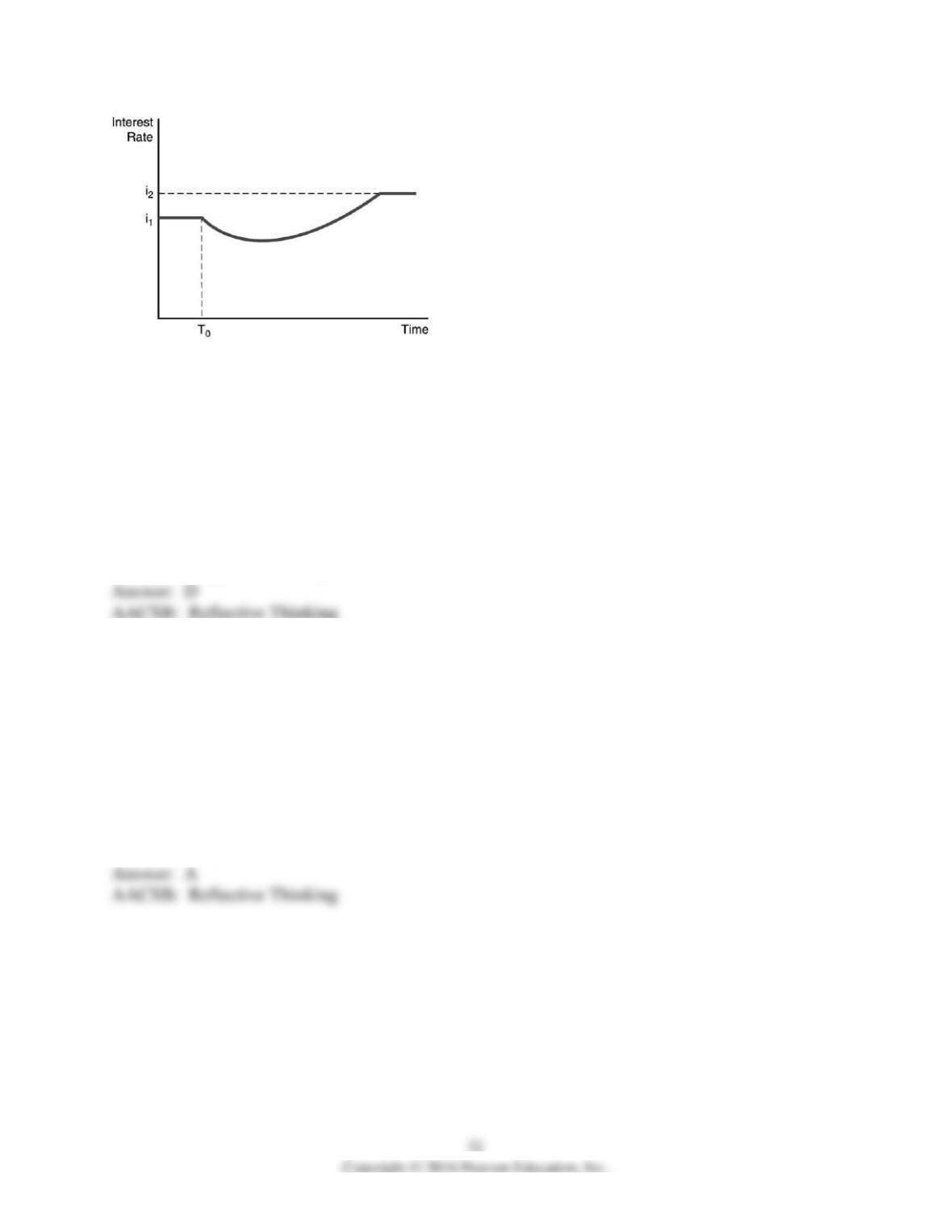
15) The figure above illustrates the effect of an increased rate of money supply growth at time
period T0. From the figure, one can conclude that the
A) liquidity effect is smaller than the expected inflation effect and interest rates adjust quickly to
changes in expected inflation.
B) liquidity effect is larger than the expected inflation effect and interest rates adjust quickly to
changes in expected inflation.
C) liquidity effect is larger than the expected inflation effect and interest rates adjust slowly to
changes in expected inflation.
D) liquidity effect is smaller than the expected inflation effect and interest rates adjust slowly to
changes in expected inflation.
16) The figure above illustrates the effect of an increased rate of money supply growth at time
period T0. From the figure, one can conclude that the
A) Fisher effect is dominated by the liquidity effect and interest rates adjust slowly to changes in
expected inflation.
B) liquidity effect is dominated by the Fisher effect and interest rates adjust slowly to changes in
expected inflation.
C) liquidity effect is dominated by the Fisher effect and interest rates adjust quickly to changes in
expected inflation.
D) Fisher effect is smaller than the expected inflation effect and interest rates adjust quickly to
changes in expected inflation.
17) Interest rates increased continuously during the 1970s. The most likely explanation is
A) banking failures that reduced the money supply.
B) a rise in the level of income.
C) the repeated bouts of recession and expansion.
D) increasing expected rates of inflation.
5.7 Web Appendix 1: Models of Asset Pricing
1) The riskiness of an asset is measured by
A) the magnitude of its return.
B) the absolute value of any change in the asset’s price.
C) the standard deviation of its return.
D) risk is impossible to measure.
2) Holding many risky assets and thus reducing the overall risk an investor faces is called
A) diversification.
B) foolishness.
C) risk acceptance.
D) capitalization.
3) The ________ the returns on two securities move together, the ________ benefit there is from
diversification.
A) less; more
B) less; less
C) more; more
D) more; greater
4) A higher ________ means that an asset’s return is more sensitive to changes in the value of the
market portfolio.
A) alpha
B) beta
C) CAPM
D) APT
5) The riskiness of an asset that is unique to the particular asset is
A) systematic risk.
B) portfolio risk.
C) investment risk.
D) nonsystematic risk.
6) The risk of a well-diversified portfolio depends only on the ________ risk of the assets in the
portfolio.
A) systematic
B) nonsystematic
C) portfolio
D) investment
7) Both the CAPM and APT suggest that an asset should be priced so that it has a higher
expected return
A) when it has a greater systematic risk.
B) when it has a greater risk in isolation.
C) when it has a lower systematic risk.
D) when it has a lower systematic risk and a lower risk in isolation.
8) In contrast to the CAPM, the APT assumes that there can be several sources of ________ that
cannot be eliminated through diversification.
A) nonsystematic risk
B) systematic risk
C) credit risk
D) arbitrary risk
5.8 Web Appendix 2: Applying the Asset Market Approach to a Commodity Market: The Case
of Gold
1) When stock prices become more volatile, the ________ curve for gold shifts right and gold
prices ________, everything else held constant.
A) demand; increase
B) demand; decrease
C) supply; increase
D) supply; decrease
2) A return to the gold standard, that is, using gold for money will ________ the ________ for
gold, ________ its price, everything else held constant.
A) increase; demand; increasing
B) decrease; demand; decreasing
C) increase; supply; increasing
D) decrease; supply; increasing
3) When gold prices become more volatile, the ________ curve for gold shifts to the ________;
________ the price of gold.
A) supply; right; increasing
B) supply; left; increasing
C) demand; right; decreasing
D) demand; left; decreasing
4) Discovery of new gold in Alaska will ________ the ________ of gold, ________ its price,
everything else held constant.
A) increase; demand; increasing
B) decrease; demand; decreasing
C) decrease; supply; increasing
D) increase; supply; decreasing
5) An increase in the expected inflation rate will ________ the ________ for gold, ________ its
price, everything else held constant.
A) increase; demand; increasing
B) decrease; demand; decreasing
C) increase; supply; increasing
D) decrease; supply; increasing
6) The price of gold should be ________ to the expected inflation rate.
A) positively related
B) negatively related
C) inversely related
D) unrelated
5.9 Web Appendix 3: Loanable Funds Framework
1) In the loanable funds framework, the ________ curve of bonds is equivalent to the ________
curve of loanable funds.
A) demand; demand
B) demand; supply
C) supply; supply
D) supply; equilibrium
2) In the loanable funds framework, the ________ is measured on the vertical axis.
A) price of bonds
B) interest rate
C) quantity of bonds
D) quantity of loanable funds