Chapter 05: Bonds, Bond Valuation, and Interest Rates
1. If a firm raises capital by selling new bonds, it is called the “issuing firm,” and the coupon rate is generally set equal to
the required rate on bonds of equal risk.
a. True
2. A call provision gives bondholders the right to demand, or “call for,” repayment of a bond. Typically, calls are
exercised if interest rates rise, because when rates rise the bondholder can get the principal amount back and reinvest it
elsewhere at higher rates.
a. True
3. Sinking funds are devices used to force companies to retire bonds on a scheduled basis prior to their maturity. Many
bond indentures allow the company to acquire bonds for a sinking fund by either purchasing bonds in the market or
selecting the bonds to be acquired by a lottery administered by the trustee through a call at face value.
a. True
Chapter 05: Bonds, Bond Valuation, and Interest Rates
4. A zero coupon bond is a bond that pays no interest and is offered (and subsequently sells initially) at par. These bonds
provide compensation to investors in the form of capital appreciation.
a. True
5. The desire for floating-rate bonds, and consequently their increased usage, arose out of the experience of the early
1980s, when inflation pushed interest rates up to very high levels and thus caused sharp declines in the prices of
outstanding bonds.
a. True
6. A bond that is callable has a chance of being retired earlier than its stated term to maturity. Therefore, if the yield curve
is upward sloping, an outstanding callable bond should have a lower yield to maturity than an otherwise identical
noncallable bond.
a. True
Chapter 05: Bonds, Bond Valuation, and Interest Rates
7. Income bonds pay interest only if the issuing company actually earns the indicated interest. Thus, these securities
cannot bankrupt a company, and this makes them safer from an investor’s perspective than regular bonds.
a. True
8. You are considering 2 bonds that will be issued tomorrow. Both are rated triple B (BBB, the lowest investment-grade
rating), both mature in 20 years, both have a 10% coupon, neither can be called except for sinking fund purposes, and both
are offered to you at their $1,000 par values. However, Bond SF has a sinking fund while Bond NSF does not. Under the
sinking fund, the company must call and pay off 5% of the bonds at par each year. The yield curve at the time is upward
sloping. The bond’s prices, being equal, are probably not in equilibrium, as Bond SF, which has the sinking fund, would
generally be expected to have a higher yield than Bond NSF.
a. True
Chapter 05: Bonds, Bond Valuation, and Interest Rates
9. Floating-rate debt is advantageous to investors because the interest rate moves up if market rates rise. Since floating-
rate debt shifts interest rate risk to companies, it offers no advantages to issuers.
a. True
10. Ranger Inc. would like to issue new 20-year bonds. Initially, the plan was to make the bonds non-callable. If the bonds
were made callable after 5 years at a 5% call premium, how would this affect their required rate of return?
a. There is no reason to expect a change in the required rate of return.
b. The required rate of return would decline because the bond would then be less risky to a bondholder.
c. The required rate of return would increase because the bond would then be more risky to a bondholder.
d. It is impossible to say without more information.
11. Which of the following statements is CORRECT?
a. Most sinking funds require the issuer to provide funds to a trustee, who saves the money so that it will be available
to pay off bondholders when the bonds mature.
b. A sinking fund provision makes a bond more risky to investors at the time of issuance.
c. Sinking fund provisions never require companies to retire their debt; they only establish “targets” for the company
to reduce its debt over time.
Chapter 05: Bonds, Bond Valuation, and Interest Rates
d. If interest rates have increased since a company issued bonds with a sinking fund, the company is less likely to
retire the bonds by buying them back in the open market, as opposed to calling them in at the sinking fund call price.
e. Sinking fund provisions sometimes turn out to adversely affect bondholders, and this is most likely to occur if
12. Nicholas Industries can issue a 20-year bond with a 6% annual coupon. This bond is not convertible, is not callable,
and has no sinking fund. Alternatively, Nicholas could issue a 20-year bond that is convertible into common equity, may
be called, and has a sinking fund. Which of the following most accurately describes the coupon rate that Nicholas would
have to pay on the convertible, callable bond?
a. It could be less than, equal to, or greater than 6%.
b. Greater than 6%.
c. Exactly equal to 8%.
d. Less than 6%.
13. The market value of any real or financial asset, including stocks, bonds, or art work purchased in hope of selling it at a
profit, may be estimated by determining future cash flows and then discounting them back to the present.
a. True
14. For bonds, price sensitivity to a given change in interest rates is generally greater the longer before the bond matures.
a. True
15. A bond has a $1,000 par value, makes annual interest payments of $100, has 5 years to maturity, cannot be called, and
is not expected to default. The bond should sell at a premium if interest rates are below 10% and at a discount if interest
rates are greater than 10%.
a. True
16. You have funds that you want to invest in bonds, and you just noticed in the financial pages of the local newspaper
that you can buy a $1,000 par value bond for $800. The coupon rate is 10% (with annual payments), and there are 10
years before the bond will mature and pay off its $1,000 par value. You should buy the bond if your required return on
bonds with this risk is 12%.
a. True
b. False
Chapter 05: Bonds, Bond Valuation, and Interest Rates
17. Under normal conditions, which of the following would be most likely to increase the coupon rate required to enable a
bond to be issued at par?
a. Adding a call provision.
b. The rating agencies change the bond’s rating from Baa to Aaa.
c. Making the bond a first mortgage bond rather than a debenture.
d. Adding a sinking fund.
18. The YTMs of three $1,000 face value bonds that mature in 10 years and have the same level of risk are equal. Bond A
has an 8% annual coupon, Bond B has a 10% annual coupon, and Bond C has a 12% annual coupon. Bond B sells at par.
Assuming interest rates remain constant for the next 10 years, which of the following statements is CORRECT?
a. Since the bonds have the same YTM, they should all have the same price, and since interest rates are not expected
to change, their prices should all remain at their current levels until maturity.
b. Bond C sells at a premium (its price is greater than par), and its price is expected to increase over the next year.
c. Bond A sells at a discount (its price is less than par), and its price is expected to increase over the next year.
d. Over the next year, Bond A’s price is expected to decrease, Bond B’s price is expected to stay the same, and Bond
C’s price is expected to increase.
Chapter 05: Bonds, Bond Valuation, and Interest Rates
19. Kessen Inc.’s bonds mature in 7 years, have a par value of $1,000, and make an annual coupon payment of $70. The
market interest rate for the bonds is 8.5%. What is the bond’s price?
a. $923.22
b. $946.30
c. $969.96
d. $994.21
20. Noncallable bonds that mature in 10 years were recently issued by Sternglass Inc. They have a par value of $1,000 and
an annual coupon of 5.5%. If the current market interest rate is 7.0%, at what price should the bonds sell?
a. $829.21
b. $850.47
c. $872.28
d. $894.65
Chapter 05: Bonds, Bond Valuation, and Interest Rates
21. One year ago Lerner and Luckmann Co. issued 15-year, noncallable, 7.5% annual coupon bonds at their par value of
$1,000. Today, the market interest rate on these bonds is 5.5%. What is the current price of the bonds, given that they now
have 14 years to maturity?
a. $1,077.01
b. $1,104.62
c. $1,132.95
d. $1,162.00
Chapter 05: Bonds, Bond Valuation, and Interest Rates
22. If the required rate of return on a bond (rd) is greater than its coupon interest rate and will remain above that rate, then
the market value of the bond will always be below its par value until the bond matures, at which time its market value will
equal its par value. (Accrued interest between interest payment dates should not be considered when answering this
question.)
a. True
23. Which of the following statements is CORRECT?
a. The time to maturity does not affect the change in the value of a bond in response to a given change in interest
rates.
b. You hold two bonds. One is a 10-year, zero coupon, bond and the other is a 10-year bond that pays a 6% annual
coupon. The same market rate, 6%, applies to both bonds. If the market rate rises from the current level, the zero coupon
bond will experience the smaller percentage decline.
c. The shorter the time to maturity, the greater the change in the value of a bond in response to a given change in
interest rates.
d. The longer the time to maturity, the smaller the change in the value of a bond in response to a given change in
interest rates.
e. You hold two bonds. One is a 10-year, zero coupon, issue and the other is a 10-year bond that pays a 6% annual
coupon. The same market rate, 6%, applies to both bonds. If the market rate rises from the current level, the zero coupon
24. Which of the following events would make it more likely that a company would choose to call its outstanding callable
bonds?
a. Market interest rates rise sharply.
Chapter 05: Bonds, Bond Valuation, and Interest Rates
b. Market interest rates decline sharply.
c. The company’s financial situation deteriorates significantly.
d. Inflation increases significantly.
25. A 15-year bond has an annual coupon rate of 8%. The coupon rate will remain fixed until the bond matures. The bond
has a yield to maturity of 6%. Which of the following statements is CORRECT?
a. The bond is currently selling at a price below its par value.
b. If market interest rates remain unchanged, the bond’s price one year from now will be lower than it is today.
c. The bond should currently be selling at its par value.
d. If market interest rates remain unchanged, the bond’s price one year from now will be higher than it is today.
26. An 8-year Treasury bond has a 10% coupon, and a 10-year Treasury bond has an 8% coupon. Both bonds have the
same yield to maturity. If the yield to maturity of both bonds increases by the same amount, which of the following
statements would be CORRECT?
a. Both bonds would decline in price, but the 10-year bond would have the greater percentage decline in price.
b. The prices of both bonds would increase by the same amount.
c. One bond’s price would increase, while the other bond’s price would decrease.
d. The prices of the two bonds would remain constant.
Chapter 05: Bonds, Bond Valuation, and Interest Rates
27. Bond A has a 9% annual coupon while Bond B has a 6% annual coupon. Both bonds have a 7% yield to maturity, and
the YTM is expected to remain constant. Which of the following statements is CORRECT?
a. The prices of both bonds will remain unchanged.
b. The price of Bond A will decrease over time, but the price of Bond B will increase over time.
c. The prices of both bonds will increase by 7% per year.
d. The prices of both bonds will increase over time, but the price of Bond A will increase by more.
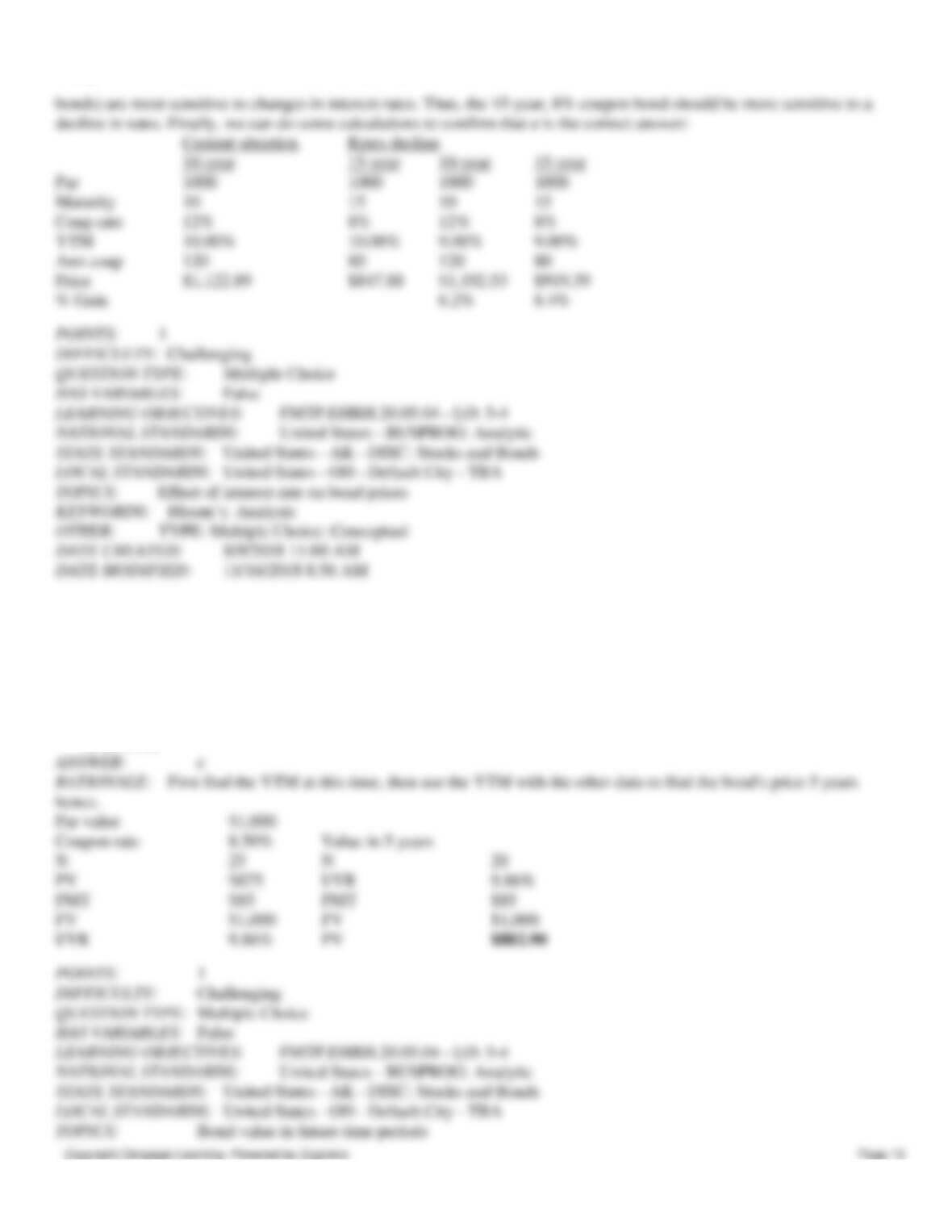
28. Assume that a 10-year Treasury bond has a 12% annual coupon, while a 15-year T-bond has an 8% annual coupon.
Assume also that the yield curve is flat, and all Treasury securities have a 10% yield to maturity. Which of the following
statements is CORRECT?
a. If interest rates decline, the prices of both bonds will increase, but the 10-year bond would have a larger
percentage increase in price.
b. The 10-year bond would sell at a discount, while the 15-year bond would sell at a premium.
c. The 10-year bond would sell at a premium, while the 15-year bond would sell at par.
d. If the yield to maturity on both bonds remains at 10% over the next year, the price of the 10-year bond would
increase, but the price of the 15-year bond would fall.
e. If interest rates decline, the prices of both bonds will increase, but the 15-year bond would have a larger
Chapter 05: Bonds, Bond Valuation, and Interest Rates
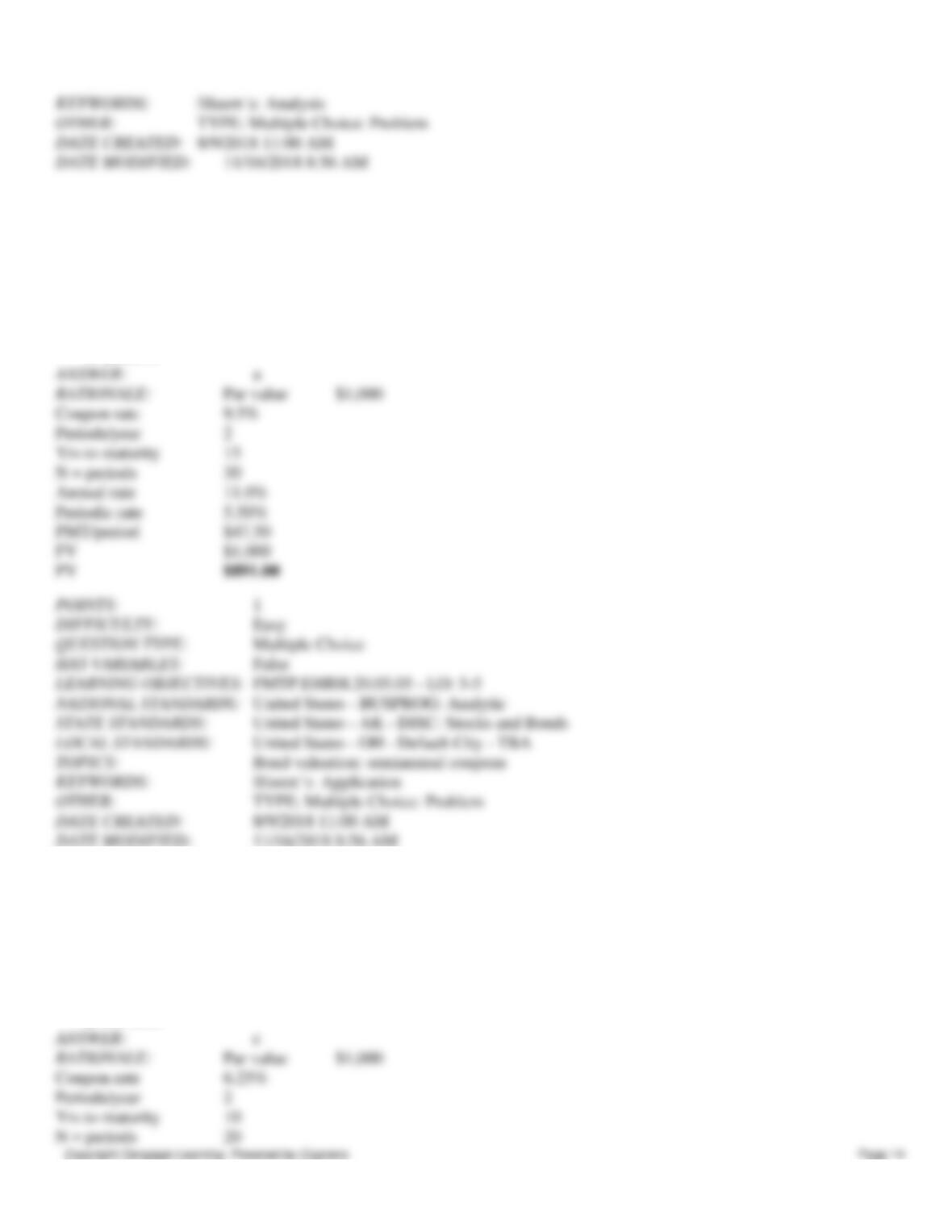
29. A 25-year, $1,000 par value bond has an 8.5% annual coupon. The bond currently sells for $875. If the yield to
maturity remains at its current rate, what will the price be 5 years from now?
a. $839.31
b. $860.83
c. $882.90
d. $904.97
Chapter 05: Bonds, Bond Valuation, and Interest Rates
30. Rogoff Co.’s 15-year bonds have an annual coupon rate of 9.5%. Each bond has face value of $1,000 and makes
semiannual interest payments. If you require an 11.0% nominal yield to maturity on this investment, what is the maximum
price you should be willing to pay for the bond?
a. $891.00
b. $913.27
c. $936.10
d. $959.51
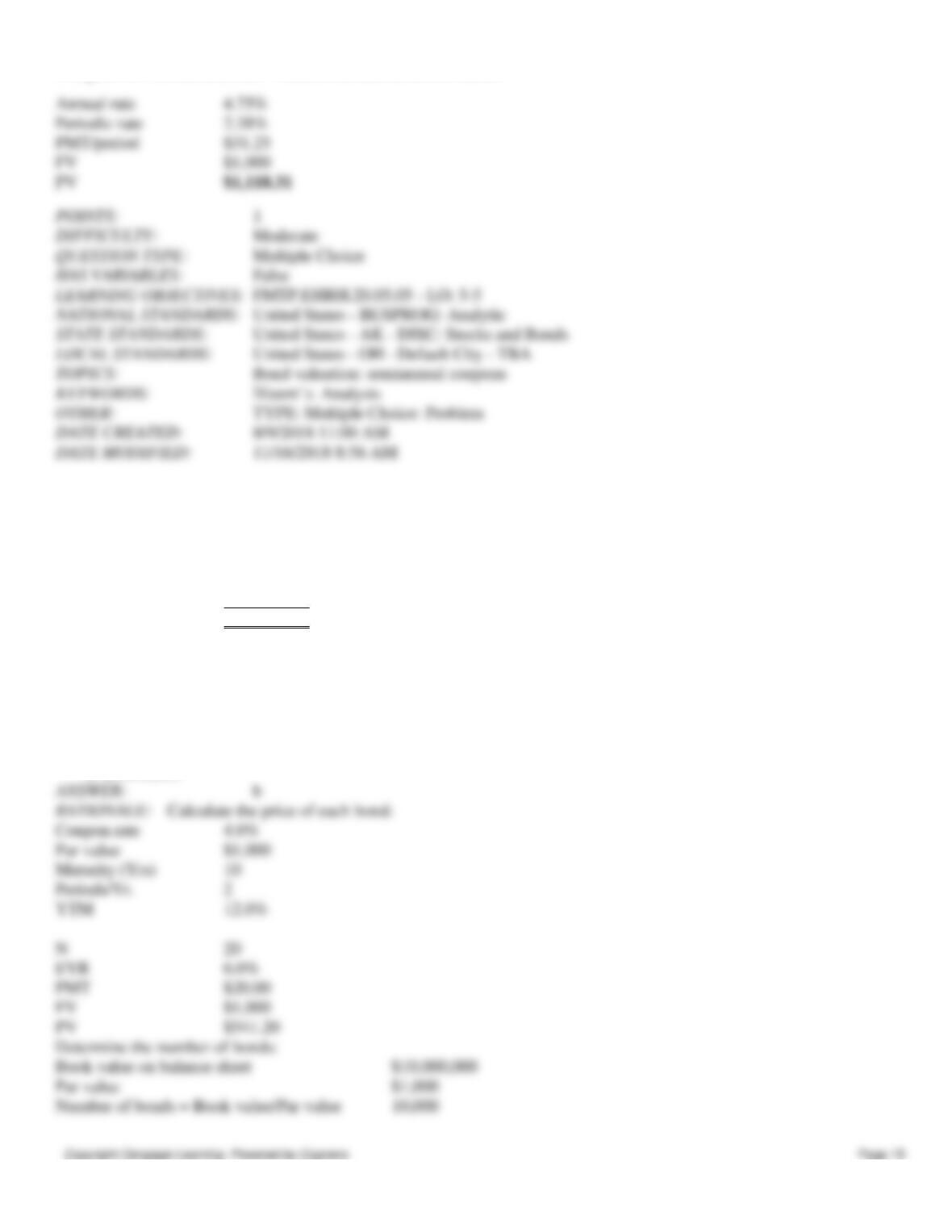
31. Haswell Enterprises’ bonds have a 10-year maturity, a 6.25% semiannual coupon, and a par value of $1,000. The
going interest rate (rd) is 4.75%, based on semiannual compounding. What is the bond’s price?
a. 1,063.09
b. 1,090.35
c. 1,118.31
d. 1,146.27
Chapter 05: Bonds, Bond Valuation, and Interest Rates
32. CMS Corporation’s balance sheet as of today is as follows:
Long-term debt (bonds, at par) $10,000,000
Preferred stock 2,000,000
Common stock ($10 par) 10,000,000
Retained earnings 4,000,000
Total debt and equity $26,000,000
The bonds have a 4.0% coupon rate, payable semiannually, and a par value of $1,000. They mature exactly 10 years from
today. The yield to maturity is 12%, so the bonds now sell below par. What is the current market value of the firm’s debt?
a. $5,276,731
b. $5,412,032
c. $5,547,332
d. $7,706,000
Chapter 05: Bonds, Bond Valuation, and Interest Rates
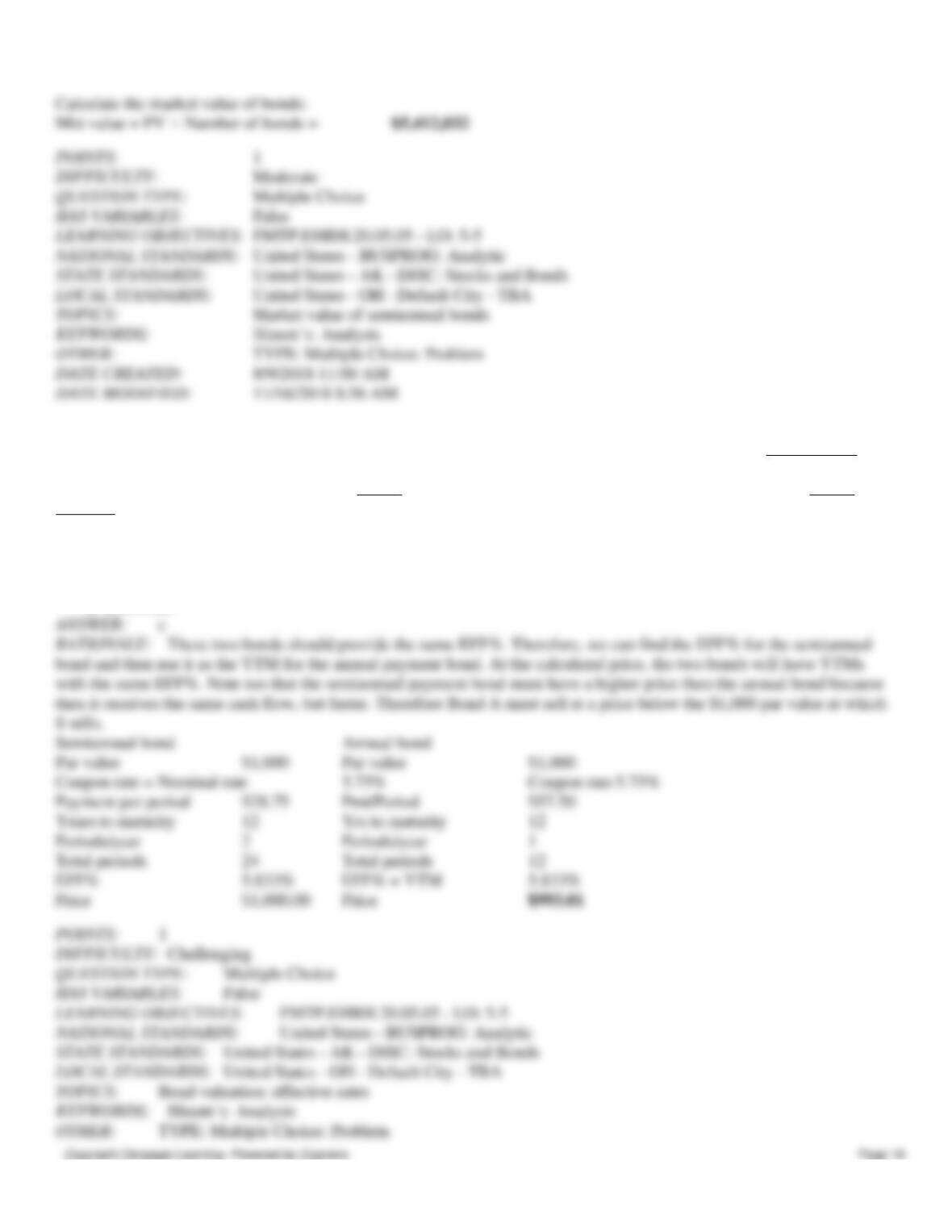
33. McCurdy Co.’s Class Q bonds have a 12-year maturity, $1,000 par value, and a 5.75% coupon paid semiannually
(2.875% each 6 months), and those bonds sell at their par value. McCurdy’s Class P bonds have the same risk, maturity,
and par value, but the P bonds pay a 5.75% annual coupon. Neither bond is callable. At what price should the annual
payment bond sell?
a. $943.98
b. $968.18
c. $993.01
d. $1,017.83
Chapter 05: Bonds, Bond Valuation, and Interest Rates
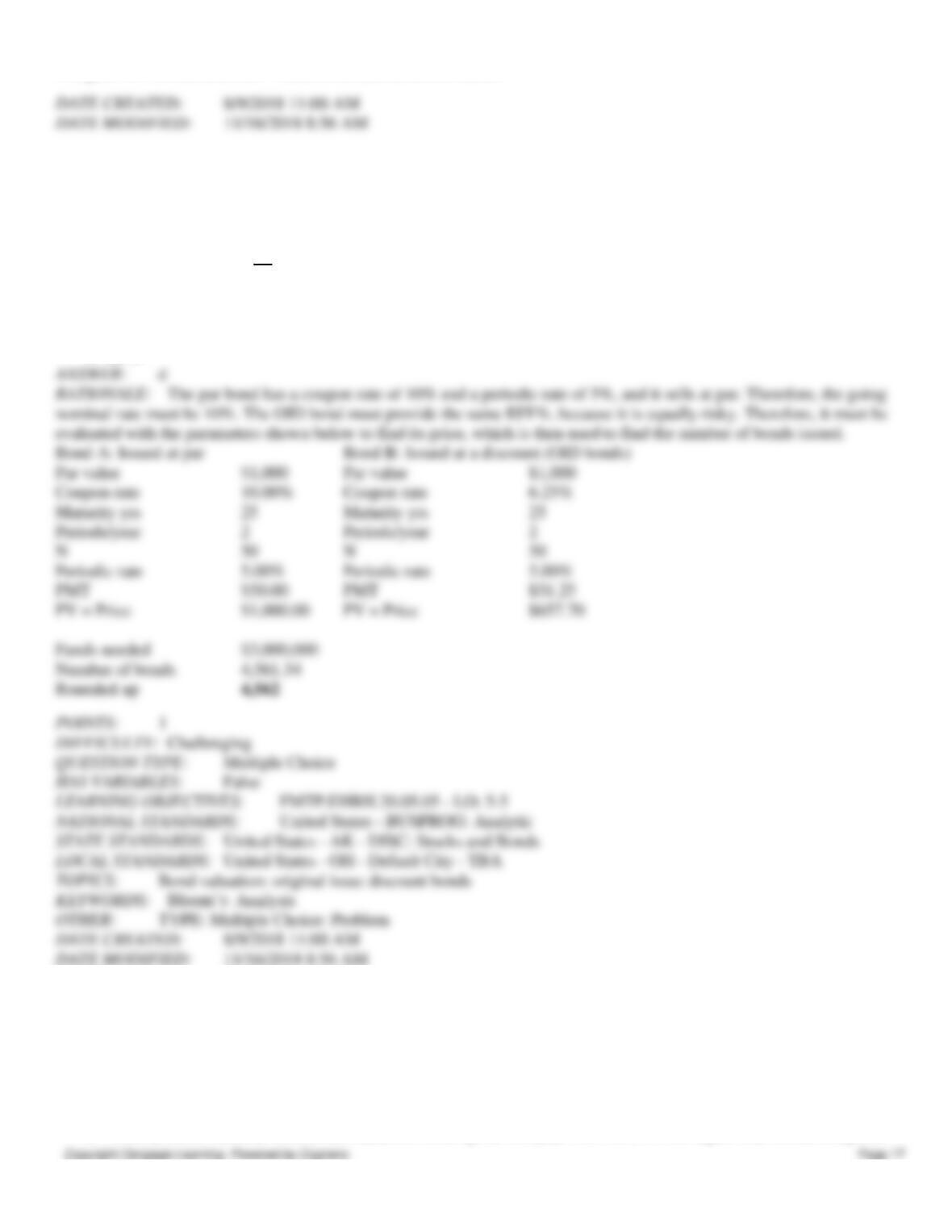
34. Reinegar Corporation is planning two new issues of 25-year bonds. Bond Par will be sold at its $1,000 par value, and
it will have a 10% semiannual coupon. Bond OID will be an Original Issue Discount bond, and it will also have a 25-year
maturity and a $1,000 par value, but its semiannual coupon will be only 6.25%. If both bonds are to provide investors with
the same effective yield, how many of the OID bonds must Reinegar issue to raise $3,000,000? Disregard flotation costs,
and round your final answer up to a whole number of bonds.
a. 4,228
b. 4,337
c. 4,448
d. 4,562
35. A 10-year bond with a 9% annual coupon has a yield to maturity of 8%. Which of the following statements is
CORRECT?
a. The bond is selling below its par value.
b. The bond is selling at a discount.
c. If the yield to maturity remains constant, the bond’s price one year from now will be lower than its current price.
d. The bond’s current yield is greater than 9%.
e. If the yield to maturity remains constant, the bond’s price one year from now will be higher than its current price.
Chapter 05: Bonds, Bond Valuation, and Interest Rates
36. A 10-year corporate bond has an annual coupon of 9%. The bond is currently selling at par ($1,000). Which of the
following statements is NOT CORRECT?
a. The bond’s yield to maturity is 9%.
b. The bond’s current yield is 9%.
c. If the bond’s yield to maturity remains constant, the bond will continue to sell at par.
d. The bond’s current yield exceeds its capital gains yield.
37. Which of the following statements is CORRECT?
a. If a bond’s yield to maturity exceeds its coupon rate, the bond will sell at par.
b. All else equal, if a bond’s yield to maturity increases, its price will fall.
c. If a bond’s yield to maturity exceeds its coupon rate, the bond will sell at a premium over par.
d. All else equal, if a bond’s yield to maturity increases, its current yield will fall.
Chapter 05: Bonds, Bond Valuation, and Interest Rates
38. Stephenson Co.’s 15-year bond with a face value of $1,000 currently sells for $850. Which of the following statements
is CORRECT?
a. The bond’s current yield exceeds its yield to maturity.
b. The bond’s yield to maturity is greater than its coupon rate.
c. The bond’s current yield is equal to its coupon rate.
d. If the yield to maturity stays constant until the bond matures, the bond’s price will remain at $850.
39. A 10-year bond pays an annual coupon, its YTM is 8%, and it currently trades at a premium. Which of the following
statements is CORRECT?
a. If the yield to maturity remains at 8%, then the bond’s price will decline over the next year.
b. The bond’s coupon rate is less than 8%.
c. If the yield to maturity increases, then the bond’s price will increase.
d. If the yield to maturity remains at 8%, then the bond’s price will remain constant over the next year.
Chapter 05: Bonds, Bond Valuation, and Interest Rates
40. Which of the following statements is CORRECT?
a. On an expected yield basis, the expected capital gains yield will always be positive because an investor would not
purchase a bond with an expected capital loss.
b. On an expected yield basis, the expected current yield will always be positive because an investor would not
purchase a bond that is not expected to pay any cash coupon interest.
c. If a coupon bond is selling at par, its current yield equals its yield to maturity.
d. The current yield on Bond A exceeds the current yield on Bond B; therefore, Bond A must have a higher yield to
maturity than Bond B.
41. Which of the following statements is CORRECT?
a. If a coupon bond is selling at a discount, its price will continue to decline until it reaches its par value at maturity.
b. If interest rates increase, the price of a 10-year coupon bond will decline by a greater percentage than the price of
a 10-year zero coupon bond.
c. If a bond’s yield to maturity exceeds its annual coupon, then the bond will trade at a premium.
d. If a coupon bond is selling at a premium, its current yield equals its yield to maturity.