
CHAPTER 4—BOND VALUATION
United States – AK – DISC: Stocks and Bonds
United States – OH – Default City – TBA
Bond concepts
TYPE: Multiple Choice: Conceptual
52. Which of the following statements is CORRECT?
a.
If a 10-year, $1,000 par, 10% coupon bond were issued at par, and if interest rates then dropped to the point
where rd = YTM = 5%, we could be sure that the bond would sell at a premium above its $1,000 par value.
b.
Other things held constant, a corporation would rather issue noncallable bonds than callable bonds.
c.
Other things held constant, a callable bond would have a lower required rate of return than a noncallable bond.
d.
Reinvestment rate risk is worse from an investor’s standpoint than interest rate price risk if the investor has a
short investment time horizon.
e.
If a 10-year, $1,000 par, zero coupon bond were issued at a price that gave investors a 10% yield to maturity,
and if interest rates then dropped to the point where rd = YTM = 5%, the bond would sell at a premium over its
$1,000 par value.
Difficulty: Moderate
INTE.GENE.16.21 – LO: 4-13
United States – BUSPROG: Analytic
United States – AK – DISC: Stocks and Bonds
United States – OH – Default City – TBA
Bond concepts
TYPE: Multiple Choice: Conceptual
53. Which of the following statements is CORRECT?
a.
The total yield on a bond is derived from dividends plus changes in the price of the bond.
b.
Bonds are riskier than common stocks and therefore have higher required returns.
c.
Bonds issued by larger companies always have lower yields to maturity (less risk) than bonds issued by
smaller companies.
d.
The market value of a bond will always approach its par value as its maturity date approaches, provided the
bond’s required return remains constant.
e.
If the Federal Reserve unexpectedly announces that it expects inflation to increase, then we would probably
observe an immediate increase in bond prices.
Difficulty: Moderate
INTE.GENE.16.24 – LO: 4-6
United States – BUSPROG: Analytic
United States – AK – DISC: Stocks and Bonds
United States – OH – Default City – TBA
Bond concepts

CHAPTER 4—BOND VALUATION
54. Which of the following statements is CORRECT?
a.
If rates fall after its issue, a zero coupon bond could trade at a price above its par value.
b.
If rates fall rapidly, a zero coupon bond’s expected appreciation could become negative.
c.
If a firm moves from a position of strength toward financial distress, its bonds’ yield to maturity would
probably decline.
d.
If a bond is selling at a premium, this implies that its yield to maturity exceeds its coupon rate.
e.
If a coupon bond is selling at par, its current yield equals its yield to maturity.
Difficulty: Moderate
INTE.GENE.16.24 – LO: 4-6
United States – BUSPROG: Analytic
United States – AK – DISC: Stocks and Bonds
United States – OH – Default City – TBA
Bond concepts
TYPE: Multiple Choice: Conceptual
55. You are considering three different bonds for your portfolio. Each bond has a 10-year maturity and a yield to maturity
of 10%. Bond X has an 8% annual coupon, Bond Y has a 10% annual coupon, and Bond Z has a 12% annual coupon.
Which of the following statements is CORRECT?
a.
Bond X has the greatest reinvestment rate risk.
b.
If market interest rates decline, all of the bonds will have an increase in price, and Bond Z will have the largest
percentage increase in price.
c.
If market interest rates remain at 10%, Bond Z’s price will be 10% higher one year from today.
d.
If market interest rates increase, Bond X’s price will increase, Bond Z’s price will decline, and Bond Y’s price
will remain the same.
e.
If the bonds’ market interest rates remain at 10%, Bond Z’s price will be lower one year from now than it is
today.
Difficulty: Moderate
INTE.GENE.16.21 – LO: 4-13
United States – BUSPROG: Analytic
United States – AK – DISC: Stocks and Bonds
United States – OH – Default City – TBA
Bond concepts
TYPE: Multiple Choice: Conceptual
56. Bonds A, B, and C all have a maturity of 15 years and a yield to maturity of 9%. Bond A’s price exceeds its par value,
Bond B’s price equals its par value, and Bond C’s price is less than its par value. Which of the following statements is
TYPE: Multiple Choice: Conceptual
CHAPTER 4—BOND VALUATION
CORRECT?
a.
Bond A has the most interest rate risk.
b.
If the yield to maturity on the three bonds remains constant, the prices of the three bonds will remain the same
over the next year.
c.
If the yield to maturity on each bond increases to 8%, the prices of all three bonds will decline.
d.
Bond C sells at a premium over its par value.
e.
If the yield to maturity on each bond decreases to 6%, Bond A will have the largest percentage increase in its
price.
c
Difficulty: Moderate
INTE.GENE.16.21 – LO: 4-13
United States – BUSPROG: Analytic
United States – AK – DISC: Stocks and Bonds
United States – OH – Default City – TBA
Bond concepts
TYPE: Multiple Choice: Conceptual
57. Which of the following statements is CORRECT?
a.
A 10-year, 10% coupon bond has less reinvestment rate risk than a 10-year, 5% coupon bond (assuming all
else equal).
b.
The total return on a bond during a given year is the sum of the coupon interest payments received during the
year and the change in the value of the bond from the beginning to the end of the year.
c.
The price of a 20-year, 10% bond is less sensitive to changes in interest rates than the price of a 5-year, 10%
bond.
d.
A $1,000 bond with $100 annual interest payments that has 5 years to maturity and is not expected to default
would sell at a discount if interest rates were below 9% and at a premium if interest rates were greater than
11%.
e.
10-year, zero coupon bonds have higher reinvestment rate risk than 10-year, 10% coupon bonds.
Difficulty: Moderate
INTE.GENE.16.21 – LO: 4-13
United States – BUSPROG: Analytic
United States – AK – DISC: Stocks and Bonds
United States – OH – Default City – TBA
Bond concepts
TYPE: Multiple Choice: Conceptual
58. Which of the following statements is CORRECT?
a.
The market value of a bond will always approach its par value as its maturity date approaches. This holds true
even if the firm has filed for bankruptcy.
b.
Rising inflation makes the actual yield to maturity on a bond greater than a quoted yield to maturity that is
CHAPTER 4—BOND VALUATION
based on market prices.
c.
The yield to maturity on a coupon bond that sells at its par value consists entirely of a current interest yield; it
has a zero expected capital gains yield.
d.
On an expected yield basis, the expected capital gains yield will always be positive because an investor would
not purchase a bond with an expected capital loss.
e.
The yield to maturity for a coupon bond that sells at a premium consists entirely of a positive capital gains
yield; it has a zero current interest yield.
c
Difficulty: Moderate
INTE.GENE.16.24 – LO: 4-6
United States – BUSPROG: Analytic
United States – AK – DISC: Stocks and Bonds
United States – OH – Default City – TBA
Bond yields
TYPE: Multiple Choice: Conceptual
59. Which of the following statements is CORRECT?
a.
If a coupon bond is selling at a discount, then the bond’s expected capital gains yield is negative.
b.
If a bond is selling at a discount, the yield to call is a better measure of the expected return than the yield to
maturity.
c.
The current yield on Bond A exceeds the current yield on Bond B. Therefore, Bond A must have a higher
yield to maturity than Bond B.
d.
If a coupon bond is selling at par, its current yield equals its yield to maturity.
e.
If a coupon bond is selling at a premium, then the bond’s current yield is zero.
Difficulty: Moderate
INTE.GENE.16.24 – LO: 4-6
United States – BUSPROG: Analytic
United States – AK – DISC: Stocks and Bonds
United States – OH – Default City – TBA
Bond yields
TYPE: Multiple Choice: Conceptual
60. Which of the following statements is CORRECT?
a.
If the maturity risk premium (MRP) is greater than zero, then the yield curve must have an upward slope.
b.
Because long-term bonds are riskier than short-term bonds, yields on long-term Treasury bonds will always be
higher than yields on short-term T-bonds.
c.
If the maturity risk premium (MRP) equals zero, the yield curve must be flat.
d.
The yield curve can never be downward sloping.
e.
If inflation is expected to increase in the future, and if the maturity risk premium (MRP) is greater than zero,
then the yield curve will have an upward slope.
CHAPTER 4—BOND VALUATION
Difficulty: Moderate
INTE.GENE.16.27 – LO: 4-14
United States – BUSPROG: Analytic
United States – AK – DISC: Stocks and Bonds
United States – OH – Default City – TBA
Yield curve
TYPE: Multiple Choice: Conceptual
61. Assume that the current corporate bond yield curve is upward sloping. Under this condition, then we could be sure that
a.
The economy is not in a recession.
b.
Long-term bonds are a better buy than short-term bonds.
c.
Maturity risk premiums could help to explain the yield curve’s upward slope.
d.
Long-term interest rates are more volatile than short-term rates.
e.
Inflation is expected to decline in the future.
Difficulty: Moderate
INTE.GENE.16.27 – LO: 4-14
United States – BUSPROG: Analytic
United States – AK – DISC: Stocks and Bonds
United States – OH – Default City – TBA
Yield curve
TYPE: Multiple Choice: Conceptual
62. Which of the following statements is CORRECT?
a.
The most likely explanation for an inverted yield curve is that investors expect inflation to increase.
b.
The most likely explanation for an inverted yield curve is that investors expect inflation to decrease.
c.
If the yield curve is inverted, short-term bonds have lower yields than long-term bonds.
d.
Inverted yield curves can exist for Treasury bonds, but because of default premiums, the corporate yield curve
can never be inverted.
e.
The higher the maturity risk premium, the higher the probability that the yield curve will be inverted.
Difficulty: Moderate
INTE.GENE.16.27 – LO: 4-14
United States – BUSPROG: Analytic
United States – AK – DISC: Stocks and Bonds

CHAPTER 4—BOND VALUATION
63. Bonds for two companies were just issued: Short Corp.’s bonds will mature in 5 years, and Long Corp.’s bonds will
mature in 15 years. Both bonds promise to pay a semiannual coupon, they are not callable or convertible, and they are
equally liquid. Further, assume that the Treasury yield curve is based only on expectations about future inflation, i.e., that
the maturity risk premium is zero for T-bonds. Under these conditions, which of the following statements is correct?
a.
If the Treasury yield curve is downward sloping, Long’s bonds must under all conditions have the lower yield.
b.
If the yield curve for Treasury securities is upward sloping, Long’s bonds must under all conditions have a
higher yield than Short’s bonds.
c.
If the yield curve for Treasury securities is flat, Short’s bond must under all conditions have the same yield as
Long’s bonds.
d.
If Long’s and Short’s bonds have the same default risk, their yields must under all conditions be equal.
e.
If the Treasury yield curve is upward sloping and Short has less default risk than Long, then Short’s bonds
must under all conditions have the lower yield.
Difficulty: Moderate
INTE.GENE.16.27 – LO: 4-14
United States – BUSPROG: Analytic
United States – AK – DISC: Stocks and Bonds
United States – OH – Default City – TBA
Corporate yield curve
TYPE: Multiple Choice: Conceptual
64. Bond A has a 9% annual coupon, while Bond B has a 7% annual coupon. Both bonds have the same maturity, a face
value of $1,000, and an 8% yield to maturity. Which of the following statements is CORRECT?
a.
Bond A trades at a discount, whereas Bond B trades at a premium.
b.
If the yield to maturity for both bonds remains at 8%, Bond A’s price one year from now will be higher than it
is today, but Bond B’s price one year from now will be lower than it is today.
c.
If the yield to maturity for both bonds immediately decreases to 6%, Bond A’s bond will have a larger
percentage increase in value.
d.
Bond A’s current yield is greater than that of Bond B.
e.
Bond A’s capital gains yield is greater than Bond B’s capital gains yield.
Difficulty: Moderate
INTE.GENE.16.24 – LO: 4-6
United States – BUSPROG: Analytic
United States – OH – Default City – TBA
Bond rates and prices
United States – OH – Default City – TBA
Yield curve
TYPE: Multiple Choice: Conceptual

CHAPTER 4—BOND VALUATION
65. Which of the following statements is CORRECT?
a.
A callable 10-year, 10% bond should sell at a higher price than an otherwise similar noncallable bond.
b.
Corporate treasurers dislike issuing callable bonds because these bonds may require the company to raise
additional funds earlier than would be true if noncallable bonds with the same maturity were used.
c.
Two bonds have the same maturity and the same coupon rate. However, one is callable and the other is not.
The difference in prices between the bonds will be greater if the current market interest rate is above the
coupon rate than if it is below the coupon rate.
d.
The actual life of a callable bond will always be equal to or less than the actual life of a noncallable bond with
the same maturity. Therefore, if the yield curve is upward sloping, the required rate of return will be lower on
the callable bond.
e.
Two bonds have the same maturity and the same coupon rate. However, one is callable and the other is not.
The difference in prices between the bonds will be greater if the current market interest rate is below the
coupon rate than if it is above the coupon rate.
Difficulty: Moderate
INTE.GENE.16.24 – LO: 4-6
United States – BUSPROG: Analytic
United States – AK – DISC: Stocks and Bonds
United States – OH – Default City – TBA
Callable bonds
TYPE: Multiple Choice: Conceptual
66. Cornwall Corporation is planning to raise $1,000,000 to finance a new plant. Which of the following statements is
CORRECT?
a.
If debt is used to raise the million dollars, but $500,000 is raised as first mortgage bonds on the new plant and
$500,000 as debentures, the interest rate on the first mortgage bonds would be lower than it would be if the
entire $1 million were raised by selling first mortgage bonds.
b.
If two tiers of debt are used (with one senior and one subordinated debt class), the subordinated debt will carry
a lower interest rate.
c.
If debt is used to raise the million dollars, the cost of the debt would be lower if the debt were in the form of a
fixed-rate bond rather than a floating-rate bond.
d.
If debt is used to raise the million dollars, the cost of the debt would be higher if the debt were in the form of a
mortgage bond rather than an unsecured term loan.
e.
The company would be especially eager to have a call provision included in the indenture if its management
thinks that interest rates are almost certain to rise in the foreseeable future.
TYPE: Multiple Choice: Conceptual
CHAPTER 4—BOND VALUATION
67. Which of the following statements is CORRECT?
a.
Subordinated debt has less default risk than senior debt.
b.
Convertible bonds have lower coupon rates than non-convertible bonds of similar default risk because they
offer the possibility of capital gains.
c.
Junk bonds typically provide a lower yield to maturity than investment-grade bonds.
d.
A debenture is a secured bond that is backed by some or all of the firm’s fixed assets.
e.
Junior debt is debt that has been more recently issued, and in bankruptcy it is paid off after senior debt because
the senior debt was issued first.
Difficulty: Moderate
INTE.GENE.16.22 – LO: 4-15
United States – BUSPROG: Analytic
United States – AK – DISC: Stocks and Bonds
United States – OH – Default City – TBA
Types of debt
TYPE: Multiple Choice: Conceptual
68. Which of the following statements is CORRECT?
a.
Other things held constant, a callable bond should have a lower yield to maturity than a noncallable bond.
b.
Once a firm declares bankruptcy, it must then be liquidated by the trustee, who uses the proceeds to pay
bondholders, unpaid wages, taxes, and lawyer fees.
c.
Income bonds must pay interest only if the company earns the interest. Thus, these securities cannot bankrupt
a company prior to their maturity, and this makes them safer to the issuing corporation than “regular” bonds.
d.
A firm with a sinking fund that gave it the choice of calling the required bonds at par or buying the bonds in
the open market would generally choose the open market purchase if the coupon rate exceeded the going
interest rate.
e.
One disadvantage of zero coupon bonds is that the issuing firm cannot realize any tax savings from the debt
until the bonds mature.
Difficulty: Moderate
United States – BUSPROG: Analytic
United States – AK – DISC: Stocks and Bonds
Difficulty: Moderate
INTE.GENE.16.20 – LO: 4-11
United States – BUSPROG: Analytic
United States – AK – DISC: Stocks and Bonds
United States – OH – Default City – TBA
Costs of types of debt
TYPE: Multiple Choice: Conceptual
CHAPTER 4—BOND VALUATION
69. Which of the following statements is CORRECT?
a.
All else equal, a bond that has a coupon rate of 10% will sell at a discount if the required return for bonds of
similar risk is 8%.
b.
The price of a discount bond will increase over time, assuming that the bond’s yield to maturity remains
constant.
c.
For a given firm, its debentures are likely to have a lower yield to maturity than its mortgage bonds.
d.
When large firms are in financial distress, they are almost always liquidated, whereas smaller firms are
generally reorganized.
e.
The total return on a bond during a given year consists only of the coupon interest payments received.
Difficulty: Moderate
INTE.GENE.16.25 – LO: 4-16
United States – BUSPROG: Analytic
United States – AK – DISC: Stocks and Bonds
United States – OH – Default City – TBA
Miscellaneous concepts
70. Which of the following statements is NOT CORRECT?
a.
The expected return on a corporate bond must be less than its promised return if the probability of default is
greater than zero.
b.
All else equal, senior debt has less default risk than subordinated debt.
c.
A company’s bond rating is affected by its financial ratios and provisions in its indenture.
d.
Under Chapter 11 of the Bankruptcy Act, the assets of a firm that declares bankruptcy must be liquidated, and
the sale proceeds must be used to pay off its debt according to the seniority of the debt as spelled out in the
Act.
e.
All else equal, secured debt is less risky than unsecured debt.
Difficulty: Moderate
INTE.GENE.16.25 – LO: 4-16
United States – BUSPROG: Analytic
United States – AK – DISC: Stocks and Bonds
United States – OH – Default City – TBA
Default and bankruptcy
TYPE: Multiple Choice: Conceptual
United States – OH – Default City – TBA
Miscellaneous concepts
TYPE: Multiple Choice: Conceptual
CHAPTER 4—BOND VALUATION
71. Which of the following statements is CORRECT?
a.
A bond is likely to be called if its market price is below its par value.
b.
Even if a bond’s YTC exceeds its YTM, an investor with an investment horizon longer than the bond’s
maturity would be worse off if the bond were called.
c.
A bond is likely to be called if its market price is equal to its par value.
d.
A bond is likely to be called if it sells at a discount below par.
e.
A bond is likely to be called if its coupon rate is below its YTM.
Difficulty: Moderate
INTE.GENE.16.24 – LO: 4-6
United States – BUSPROG: Analytic
United States – AK – DISC: Stocks and Bonds
United States – OH – Default City – TBA
Call provision
TYPE: Multiple Choice: Conceptual
72. Which of the following statements is CORRECT?
a.
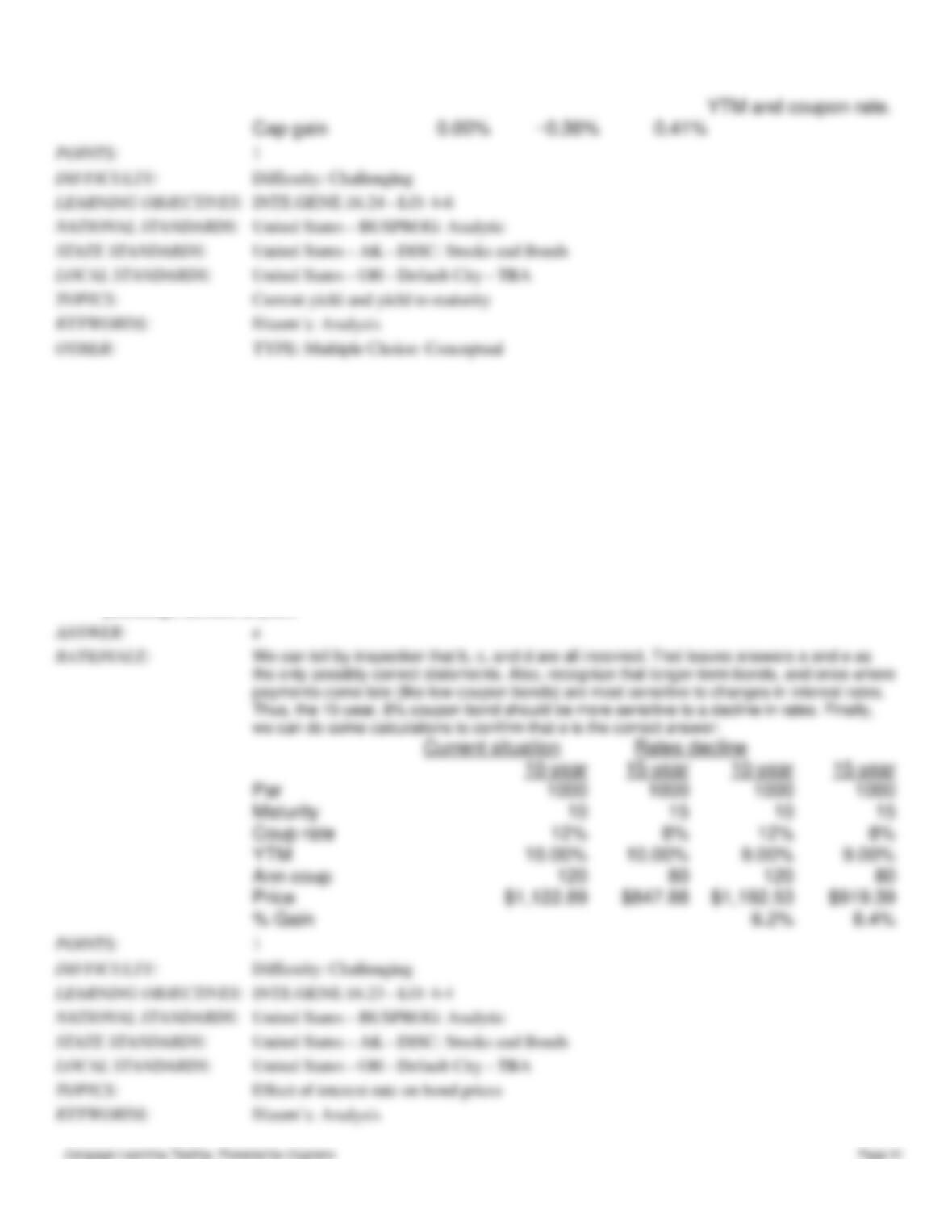
A bond’s current yield must always be either equal to its yield to maturity or between its yield to maturity and
its coupon rate.
b.
If a bond sells at par, then its current yield will be less than its yield to maturity.
c.
If a bond sells for less than par, then its yield to maturity is less than its coupon rate.
d.
A discount bond’s price declines each year until it matures, when its value equals its par value.
e.
Assume that two bonds have equal maturities and are of equal risk, but one bond sells at par while the other
sells at a premium above par. The premium bond must have a lower current yield and a higher capital gains
yield than the par bond.
CHAPTER 4—BOND VALUATION
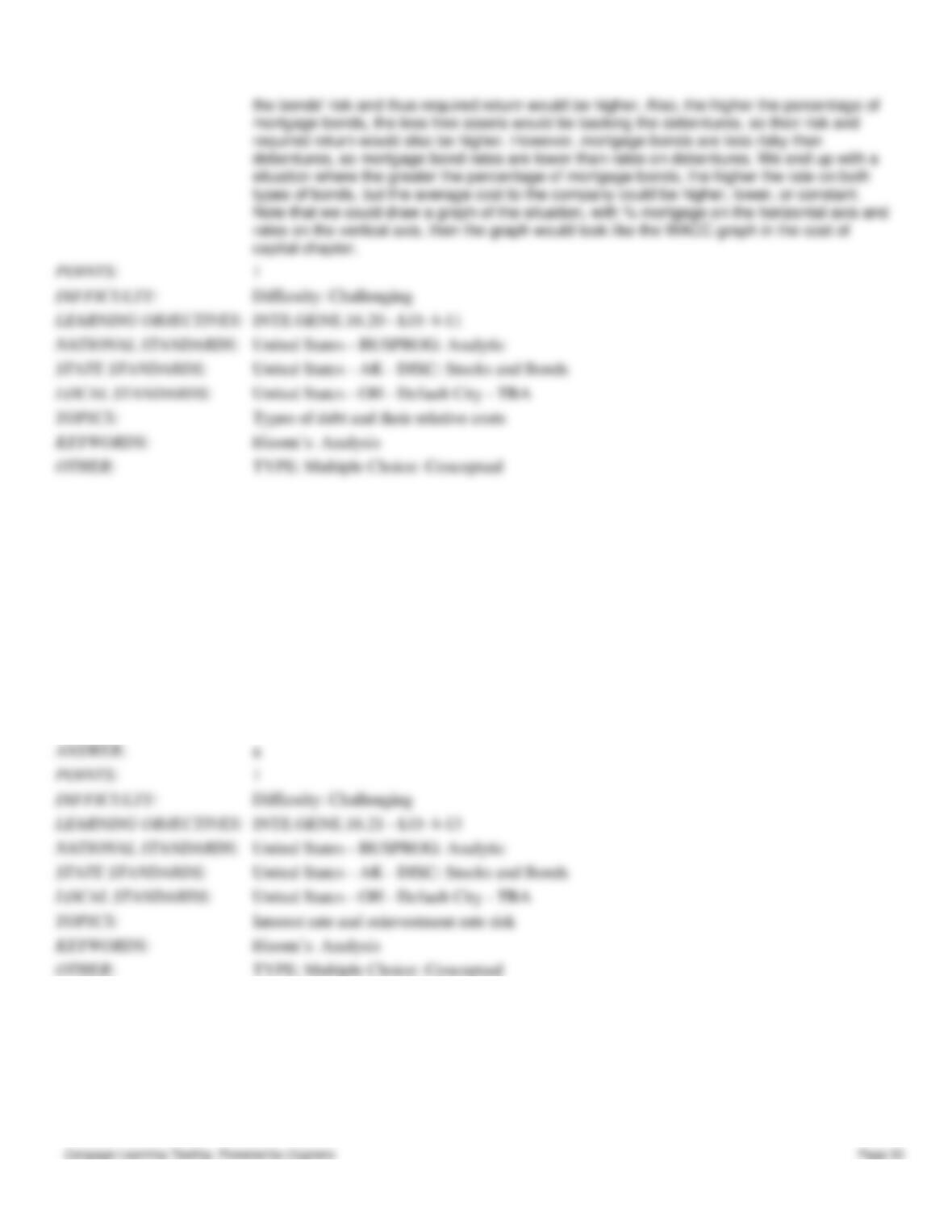
73. Assume that a 10-year Treasury bond has a 12% annual coupon, while a 15-year T-bond has an 8% annual coupon.
Assume also that the yield curve is flat, and all Treasury securities have a 10% yield to maturity. Which of the following
statements is CORRECT?
a.
If interest rates decline, the prices of both bonds will increase, but the 10-year bond would have a larger
percentage increase in price.
b.
The 10-year bond would sell at a discount, while the 15-year bond would sell at a premium.
c.
The 10-year bond would sell at a premium, while the 15-year bond would sell at par.
d.
If the yield to maturity on both bonds remains at 10% over the next year, the price of the 10-year bond would
increase, but the price of the 15-year bond would fall.
e.
If interest rates decline, the prices of both bonds will increase, but the 15-year bond would have a larger
percentage increase in price.
Difficulty: Challenging
INTE.GENE.16.23 – LO: 4-4
United States – BUSPROG: Analytic
United States – AK – DISC: Stocks and Bonds
United States – OH – Default City – TBA
Effect of interest rate on bond prices
Difficulty: Challenging
INTE.GENE.16.24 – LO: 4-6
United States – BUSPROG: Analytic
United States – AK – DISC: Stocks and Bonds
United States – OH – Default City – TBA
Current yield and yield to maturity
TYPE: Multiple Choice: Conceptual

CHAPTER 4—BOND VALUATION
74. Listed below are some provisions that are often contained in bond indentures. Which of these provisions, viewed
alone, would tend to reduce the yield to maturity that investors would otherwise require on a newly issued bond?
1.
Fixed assets are used as security for a bond.
2.
A given bond is subordinated to other classes of debt.
3.
The bond can be converted into the firm’s common stock.
4.
The bond has a sinking fund.
5.
The bond has a call provision.
6.
The indenture contains covenants that prevent the use of additional debt.
a.
1, 4, 6
b.
1, 2, 3, 4, 6
c.
1, 2, 3, 4, 5, 6
d.
1, 3, 4, 5, 6
e.
1, 3, 4, 6
Difficulty: Challenging
INTE.GENE.16.20 – LO: 4-11
United States – BUSPROG: Analytic
United States – AK – DISC: Stocks and Bonds
United States – OH – Default City – TBA
Bond indenture
TYPE: Multiple Choice: Conceptual
75. Suppose International Digital Technologies decides to raise a total of $200 million, with $100 million as long-term
debt and $100 million as common equity. The debt can be mortgage bonds or debentures, but by an iron-clad provision in
its charter, the company can never raise any additional debt beyond the original $100 million. Given these conditions,
which of the following statements is CORRECT?
a.
If the debt were raised by issuing $50 million of debentures and $50 million of first mortgage bonds, we could
be certain that the firm’s total interest expense would be lower than if the debt were raised by issuing $100
million of debentures.
b.
In this situation, we cannot tell for sure how, or whether, the firm’s total interest expense on the $100 million
of debt would be affected by the mix of debentures versus first mortgage bonds. The interest rate on each of
the two types of bonds would increase as the percentage of mortgage bonds used was increased, but the result
might well be such that the firm’s total interest charges would not be affected materially by the mix between
the two.
c.
The higher the percentage of debentures, the greater the risk borne by each debenture, and thus the higher the
required rate of return on the debentures.
d.
If the debt were raised by issuing $50 million of debentures and $50 million of first mortgage bonds, we could
be certain that the firm’s total interest expense would be lower than if the debt were raised by issuing $100
million of first mortgage bonds.
e.
The higher the percentage of debt represented by mortgage bonds, the riskier both types of bonds will be and,
consequently, the higher the firm’s total dollar interest charges will be.
TYPE: Multiple Choice: Conceptual
CHAPTER 4—BOND VALUATION
76. Which of the following statements is CORRECT?
a.
If their maturities and other characteristics were the same, a 5% coupon bond would have more interest rate
price risk than a 10% coupon bond.
b.
A 10-year coupon bond would have more reinvestment rate risk than a 5-year coupon bond, but all 10-year
coupon bonds have the same amount of reinvestment rate risk.
c.
A 10-year coupon bond would have more interest rate price risk than a 5-year coupon bond, but all 10-year
coupon bonds have the same amount of interest rate price risk.
d.
If their maturities and other characteristics were the same, a 5% coupon bond would have less interest rate
price risk than a 10% coupon bond.
e.
A zero coupon bond of any maturity will have more interest rate price risk than any coupon bond, even a
perpetuity.
a
77. Which of the following statements is CORRECT?
a.
All else equal, an increase in interest rates will have a greater effect on the prices of short-term than long-term
bonds.
b.
All else equal, an increase in interest rates will have a greater effect on higher-coupon bonds than it will have
on lower-coupon bonds.
c.
If a bond’s yield to maturity exceeds its coupon rate, the bond’s price must be less than its maturity value.
CHAPTER 4—BOND VALUATION
d.
If a bond’s yield to maturity exceeds its coupon rate, the bond’s current yield must be less than its coupon rate.
e.
If two bonds have the same maturity, the same yield to maturity, and the same level of risk, the bonds should
sell for the same price regardless of the bond’s coupon rates.
c
Difficulty: Challenging
INTE.GENE.16.24 – LO: 4-6
United States – BUSPROG: Analytic
United States – AK – DISC: Stocks and Bonds
United States – OH – Default City – TBA
Bond yields and prices
TYPE: Multiple Choice: Conceptual
78. Assuming all else is constant, which of the following statements is CORRECT?
a.
For any given maturity, a 1.0 percentage point decrease in the market interest rate would cause a smaller dollar
capital gain than the capital loss stemming from a 1.0 percentage point increase in the interest rate.
b.
From a corporate borrower’s point of view, interest paid on bonds is not tax-deductible.
c.
Price sensitivity as measured by the percentage change in price due to a given change in the required rate of
return decreases as a bond’s maturity increases.
d.
For a bond of any maturity, a 1.0 percentage point increase in the market interest rate (rd) causes a larger dollar
capital loss than the capital gain stemming from a 1.0 percentage point decrease in the interest rate.
e.
A 20-year zero coupon bond has more reinvestment rate risk than a 20-year coupon bond.
Difficulty: Challenging
INTE.GENE.16.21 – LO: 4-13
United States – BUSPROG: Analytic
United States – AK – DISC: Stocks and Bonds
United States – OH – Default City – TBA
Bond concepts
TYPE: Multiple Choice: Conceptual
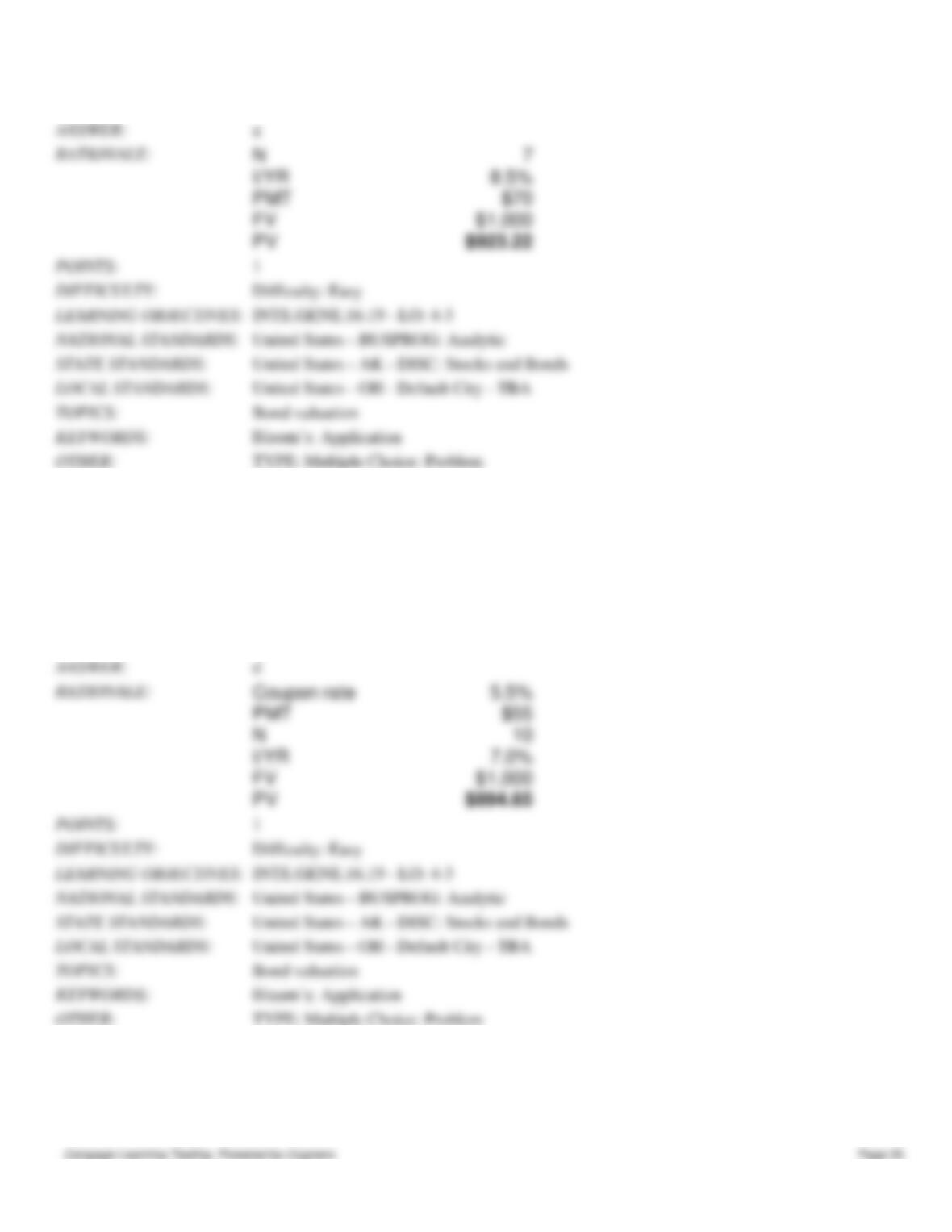
79. Kessen Inc.’s bonds mature in 7 years, have a par value of $1,000, and make an annual coupon payment of $70. The
market interest rate for the bonds is 8.5%. What is the bond‘s price?
a.
$923.22
b.
$946.30
c.
$969.96
d.
$994.21
CHAPTER 4—BOND VALUATION
e.
$1,019.06
a
80. Noncallable bonds that mature in 10 years were recently issued by Sternglass Inc. They have a par value of $1,000 and
an annual coupon of 5.5%. If the current market interest rate is 7.0%, at what price should the bonds sell?
a.
$829.21
b.
$850.47
c.
$872.28
d.
$894.65
e.
$917.01
81. Curtis Corporation’s noncallable bonds currently sell for $1,165. They have a 15-year maturity, an annual coupon of
$95, and a par value of $1,000. What is their yield to maturity?
a.
6.20%
b.
6.53%