Accrual Accounting Concepts
4-41
purchased supplies for $950 and consumed supplies of $700. If no adjusting entry is made
for supplies:
a. stockholders’ equity will be overstated by $700.
b. expenses will be understated by $950.
c. assets will be understated by $450.
d. net income will be understated by $700.
ing
172. Regions Inc. pays its rent of $48,000 annually on January 1 and makes monthly adjusting
entries. If the February 28 monthly adjusting entry for prepaid rent is omitted, which of the fol-
lowing are true?
a. Failure to make the adjustment does not affect the February financial statements.
b. Expenses will be overstated by $4,000 and net income and stockholders’ equity will be
understated by $4,000.
c. Assets will be overstated by $8,000 and net income and stockholders’ equity will be un-
derstated by $8,000.
d. Assets will be overstated by $4,000 and net income and stockholders’ equity will be over-
stated by $4,000.
173. An adjusting entry can include a:
a. debit to an asset and a credit to a revenue.
b. debit to a revenue and a credit to an asset.
c. credit to an expense and a debit to a revenue.
d. debit to an expense and a credit to a revenue.
174. A revenue–asset relationship exists with:
a. prepaid expense adjusting entries.
b. accrued expense adjusting entries.
c. unearned revenue adjusting entries.
d. accrued revenue adjusting entries.
175. The accounts of a business before an adjusting entry is made to record accrued revenue re-
flect an:
a. understated liability and an overstated revenue.
b. overstated asset and an understated revenue.
c. understated expense and an overstated revenue.
d. understated asset and an understated revenue.
Test Bank for Accounting: Tools for Business Decision Making, Fifth Edition
4-42
176. Adjustments for accrued revenues:
a. increase assets and increase revenues.
b. increase assets and increase liabilities.
c. decrease assets and increase revenues.
d. decrease liabilities and increase revenues.
177. Failure to prepare an adjusting entry at the end of the period to record an accrued expense
would cause:
a. net income to be understated.
b. an overstatement of assets and an overstatement of liabilities.
c. an understatement of expenses and an understatement of liabilities.
d. an overstatement of expenses and an overstatement of liabilities.
178. Failure to prepare an adjusting entry at the end of a period to record an accrued revenue
would cause:
a. net income to be overstated.
b. an understatement of assets and an understatement of revenues.
c. an understatement of revenues and an understatement of liabilities.
d. an understatement of revenues and an overstatement of liabilities.
179. An adjusting entry made to record accrued interest on a note receivable due next year con-
sists of a:
a. debit to Interest Expense and a credit to Interest Payable.
b. debit to Interest Receivable and a credit to Interest Revenue.
c. debit to Interest Expense and a credit to Notes Payable.
d. debit to Interest Expense and a credit to Cash.
180. Raxon Company borrowed $40,000 from the bank signing a 6%, 3-month note on September
1. Principal and interest are payable to the bank on December 1. If the company prepares
monthly financial statements, the adjusting entry that the company should make for interest
on September 30, would be:
a. debit Interest Expense, $2,400; credit Interest Payable, $2,400.
b. debit Interest Expense, $200; credit Interest Payable, $200.
c. debit Note Payable, $2,400; credit Cash, $2,400.
d. debit Cash, $600; credit Interest Payable, $600.
Accrual Accounting Concepts
4-43
181. Nacron Company borrowed $10,000 from the bank signing a 6%, 3-month note on Septem-
ber 1. Principal and interest are payable to the bank on December 1. If the company
prepares monthly financial statements, the adjusting entry that the company should make for
interest on September 30, would be:
a. debit Interest Expense, $50; credit Interest Payable, $50.
b. debit Interest Expense, $600; credit Interest Payable, $600.
c. debit Note Payable, $600; credit Cash, $600.
d. debit Cash, $50; credit Interest Payable, $50.
182. Mary Richardo has performed $500 of CPA services for a client but has not billed the client
as of the end of the accounting period. What adjusting entry must Mary make?
a. Debit Cash and credit Unearned Service Revenue
b. Debit Accounts Receivable and credit Unearned Service Revenue
c. Debit Accounts Receivable and credit Service Revenue
d. Debit Unearned Service Revenue and credit Service Revenue
ing
183. Mary Richardo, CPA, has billed her clients for services performed. She subsequently re-
ceives payments from her clients. What entry will she make upon receipt of the payments?
a. Debit Unearned Service Revenue and credit Service Revenue
b. Debit Cash and credit Accounts Receivable
c. Debit Accounts Receivable and credit Service Revenue
d. Debit Cash and credit Service Revenue
ing
184. Amos Real Estate signed a four-month note payable in the amount of $16,000 on September
1. The note requires interest at an annual rate of 9%. The amount of interest to be accrued at
the end of September is:
a. $480.
b. $120.
c. $1,440.
d. $160.
185. DeNova Real Estate signed a four-month note payable in the amount of $8,000 on Septem-
ber 1. The note requires interest at an annual rate of 6%. The amount of interest to be
accrued at the end of September is:
a. $480.
b. $120.
c. $40.
d. $90.
Test Bank for Accounting: Tools for Business Decision Making, Fifth Edition
4-44
186. A gift shop signs a three-month note payable to help finance increases in inventory for the
Christmas shopping season. The note is signed on November 1 in the amount of $30,000 with
annual interest of 6%. What is the adjusting entry to be made on December 31 for the interest
expense accrued to that date, if no entries have been made previously for the interest?
a. Interest Expense 300
Interest Payable 300
b. Interest Expense 450
Interest Payable 450
c. Interest Expense 300
Cash 300
d. Interest Expense 450
Note Payable 450
187. Ye Olde Christmas shop signs a three-month note payable to help finance increases in in-
ventory for the Christmas shopping season. The note is signed on October 1 in the amount
of $20,000 with annual interest of 6%. What is the adjusting entry to be made on December
31 for the interest expense accrued to that date, if no entries have been made previously for
the interest?
a. Interest Expense 100
Interest Payable 100
b. Interest Expense 200
Interest Payable 200
c. Interest Expense 300
Interest Payable 300
d. Interest Expense 1,200
Note Payable 1,200
188. Snelling Tables paid employee wages on and through Friday, January 26, and the next pay-
roll will be paid in February. There are three more working days in January (29–31).
Employees work 5 days a week and the company pays $900 a day in wages. What will be
the adjusting entry to accrue wages expense at the end of January?
a. Salaries and Wages Expense 900
Salaries and Wages Payable 900
b. Salaries and Wages Expense 4,500
Salaries and Wages Payable 4,500
c. Salaries and Wages Expense 2,700
Salaries and Wages Payable 2,700
d. No adjusting entry is required.
Accrual Accounting Concepts
4-45
189. Jill Clown earned a salary of $500 for the last week of October. She will be paid on Novem-
ber 1. The adjusting entry for Jill’s employer October 31 is:
a. No entry is required.
b. Salaries and Wages Expense 500
Salaries and Wages payable 500
c. Salaries and Wages Expense 500
Cash 500
d. Salaries and Wages Payable 500
Cash 500
190. At the end of the fiscal year, the usual adjusting entry for accrued salaries owed to employ-
ees was omitted. Which of the following statements is true?
a. Salaries and Wages Expense for the year is overstated.
b. Liabilities at the end of the year are understated.
c. Assets at the end of the year are understated.
d. Stockholders’ equity at the end of the year is understated.
191. A company shows a balance in Salaries and Wages Payable of $40,000 at the end of the
month. The next payroll amounting to $60,000 is to be paid in the following month. What will
be the journal entry to record the payment of salaries?
a. Salaries and Wages Expense 60,000
Salaries and Wages Payable 60,000
b. Salaries and Wages Expense 60,000
Cash 60,000
c. Salaries and Wages Expense 20,000
Cash 20,000
d. Salaries and Wages Payable 40,000
Salaries and Wages Expense 20,000
Cash 60,000
192. De Meaning Corporation issued a one-year 6% $300,000 note on April 30, 2014. Interest ex-
pense for the year ended December 31, 2014 was:
a. $18,000.
b. $13,500.
c. $12,000.
d. $10,500.
Test Bank for Accounting: Tools for Business Decision Making, Fifth Edition
4-46
193. Bluing Corporation issued a one-year 9% $300,000 note on April 30, 2014. Interest expense
for the year ended December 31, 2014 was:
a. $27,000.
b. $20,250.
c. $18,000.
d. $15,750.
194. Employees at Biquell Corporation are paid $9,000 cash every Friday for working Monday
through Friday. The calendar year accounting period ends on Wednesday, December 31.
How much salaries and wages expense should be recorded two days later on January 2?
a. $9,000
b. $5,400
c. None, expense recognition requires the weekly salary to be accrued on December 31.
d. $3,600
195. An adjusted trial balance:
a. is prepared after the financial statements are completed.
b. proves the equality of the total debit balances and total credit balances of ledger ac-
counts after all adjustments have been made.
c. is a required financial statement under generally accepted accounting principles.
d. cannot be used to prepare financial statements.
196. Which of the statements below is not true?
a. An adjusted trial balance should show ledger account balances.
b. An adjusted trial balance can be used to prepare financial statements.
c. An adjusted trial balance proves the mathematical equality of debits and credits in the
ledger.
d. An adjusted trial balance is prepared before all transactions have been journalized.
Accrual Accounting Concepts
4-47
197. Which statement is incorrect concerning the adjusted trial balance?
a. An adjusted trial balance proves the equality of the total debit balances and the total
credit balances in the ledger after all adjustments are made.
b. The adjusted trial balance provides the primary basis for the preparation of financial
statements.
c. The adjusted trial balance lists the account balances in order of their magnitude.
d. The adjusted trial balance is prepared after the adjusting entries have been journalized
and posted.
198. Can financial statements be prepared directly from the adjusted trial balance?
a. They cannot. The general ledger must be used.
b. Yes, adjusting entries have been recorded in the general journal and posted to the ledger
accounts.
c. No, the adjusted trial balance merely proves the equality of the total debit and total credit
balances in the ledger after adjustments are posted. It has no other purpose.
d. They can because that is the only reason that an adjusted trial balance is prepared.
199. The primary source used in the preparation of the financial statements is the:
a. trial balance.
b. post-closing trial balance.
c. general trial balance.
d. adjusted trial balance.
200. Which of the following accounts will reflect the account’s beginning balance on the adjusted
trial balance?
a. Prepaid rent
b. Retained earnings
c. Prepaid insurance
d. Unearned revenue
201. The following accounts show balances on the adjusted trial balance. Which of these account
balances will not appear the same on the balance sheet?
a. Retained earnings
b. Accounts receivable
c. Common stock
d. Notes payable
Test Bank for Accounting: Tools for Business Decision Making, Fifth Edition
4-48
202. Which trial balance will consist of the greatest number of accounts?
a. Post-closing trial balance
b. Trial balance
c. Adjusted trial balance
d. All of the above will contain the same number of accounts.
203. Based on the account balances below, what is the total of the debit and credit columns of the
adjusted trial balance?
Service revenue $4,300 Equipment $7,400
Cash 1,525 Prepaid insurance 1,225
Unearned service rev. 5,320 Depreciation expense 640
Salaries and wages expense 1,050 Accum. depreciation 1,280
Common stock 390 Retained earnings 550
a. $10,150
b. $11,840
c. $10,560
d. $11,430
Accrual Accounting Concepts
4-49
204. Given the following adjusted trial balance:
Debit Credit
Cash $1,562
Accounts receivable 2,098
Inventory 3,124
Prepaid rent 86
Equipment 300
Accumulated depreciation-equipment 52
Accounts payable 82
Unearned service revenue 122
Common stock 206
Retained earnings 6,610
Service revenue 268
Interest revenue 56
Salaries and wages expense 160
Travel expense 66
Total $7,396 $7,396
Net income for the year is:
a. $98.
b. $270.
c. $324.
d. $496.
205. Given the following adjusted trial balance:
Debit Credit
Cash $1,562
Accounts receivable 2,098
Inventory 3,124
Prepaid rent 86
Equipment 300
Accumulated depreciation-equipment 52
Accounts payable 82
Unearned service revenue 122
Common stock 206
Retained earnings 6,610
Service revenue 268
Interest revenue 56
Salaries and wages expense 160
Travel expense 66
Total $7,396 $7,396
After closing entries have been posted, the balance in retained earnings will be:
a. $6,340.
b. $6,512.
c. $6,880.
d. $6,708.
Test Bank for Accounting: Tools for Business Decision Making, Fifth Edition
4-50
206. Given the following adjusted trial balance:
Debit Credit
Cash $781
Accounts receivable 1,049
Inventory 1,562
Prepaid rent 43
Equipment 150
Accumulated depreciation–equipment 26
Accounts payable 41
Unearned service revenue 61
Common stock 103
Retained earnings 3,305
Service revenue 134
Interest revenue 28
Salaries and wages expense 80
Travel expense 33
Total $3,698 $3,698
Net income for the year is:
a. $49.
b. $135.
c. $162.
d. $248.
207. Given the following adjusted trial balance:
Debit Credit
Cash $781
Accounts receivable 1,049
Inventory 1,562
Prepaid rent 43
Equipment 150
Accumulated depreciation-equipment 26
Accounts payable 41
Unearned service revenue 61
Common stock 103
Retained earnings 3,305
Service revenue 134
Interest revenue 28
Salaries and wages expense 80
Travel expense 33
Total $3,698 $3,698
After closing entries have been posted, the balance in retained earnings will be:
a. $3,256.
b. $3,170.
c. $3,440.
d. $3,354.
Accrual Accounting Concepts
4-51
208. Which statement is correct concerning the adjusted trial balance?
a. An adjusted trail balance eliminates the need for the preparation of financial statements.
b. The purpose of an adjusted trial balance is to prove the equality of the total debit balanc-
es and the total credit balances in the ledger.
c. An adjusted trial balance will contain only permanent—balance sheet—accounts.
d. The adjusted trial balance is prepared after the adjusting entries have been journalized
but before they have been posted.
209. Which of the following is a true statement about closing the books of a corporation?
a. Expenses are closed to the Expense Summary account.
b. Only revenues are closed to the Income Summary account.
c. Revenues and expenses are closed to the Income Summary account.
d. Revenues, expenses, and the Dividends account are closed to the Income Summary ac-
count.
210. The closing entry process consists of closing:
a. all asset and liability accounts.
b. out the Retained Earnings account.
c. all permanent accounts.
d. all temporary accounts.
211. Which account will have a zero balance after closing entries have been journalized and post-
ed?
a. Service revenue.
b. Supplies.
c. Prepaid Insurance.
d. Accumulated Depreciation.
212. A post-closing trial balance will show:
a. zero balances for all accounts.
b. zero balances for balance sheet accounts.
c. only balance sheet accounts.
d. only income statement accounts.
213. Which types of accounts will appear in the post-closing trial balance?
a. Permanent accounts.
b. Temporary accounts.
c. Accounts shown in the income statement columns of a work sheet.
d. None of these answer choices are correct.
Test Bank for Accounting: Tools for Business Decision Making, Fifth Edition
4-52
214. The purpose of the post-closing trial balance is to:
a. prove that no mistakes were made.
b. prove the equality of the permanent account balances that are carried forward into the
next accounting period.
c. prove the equality of the temporary account balances that are carried forward into the
next accounting period.
d. list all the balance sheet accounts in alphabetical order for easy reference.
215. Closing entries:
a. are prepared before the financial statements.
b. reduce the number of permanent accounts.
c. cause the revenue and expense accounts to have zero balances.
d. summarize the activity in every account.
216. Which of the following account’s balance will change between the adjusted trial balance and
the post-closing trial balance?
a. Common stock
b. Prepaid rent
c. Unearned service revenue
d. Retained earnings
217. Which type of accounts will not appear in the post-closing trial balance?
a. Asset accounts
b. Permanent accounts
c. Liability accounts
d. Temporary accounts
218. There are usually how many closing journal entries?
a. 5
b. 4
c. 3
d. 2
Accrual Accounting Concepts
4-53
219. Given the following adjusted trial balance, what will be the totals for the debit and credit col-
umns of the post-closing trial balance?
Debit Credit
Cash $1,562
Accounts receivable 2,098
Inventory 3,124
Prepaid rent 86
Equipment 300
Accumulated depreciation-equipment $ 52
Accounts payable 82
Unearned service revenue 172
Common stock 206
Retained earnings 6,610
Service revenue 218
Interest revenue 56
Salaries and wages expense 160
Travel expense 66
Totals $7,396 $7,396
a. $7,396
b. $7,118
c. $7,344
d. $7,170
Test Bank for Accounting: Tools for Business Decision Making, Fifth Edition
4-54
220. Given the following adjusted trial balance, what will be the totals for the debit and credit col-
umns of the post-closing trial balance?
Debit Credit
Cash $ 781
Accounts receivable 1,049
Inventory 1,562
Prepaid rent 43
Equipment 150
Accumulated depreciation-equipment $ 26
Accounts payable 41
Unearned service revenue 86
Common stock 103
Retained earnings 3,305
Service revenue 109
Interest revenue 28
Salaries and wages expense 80
Travel expense 33
Totals $3,698 $3,698
a. $3,585
b. $3,559
c. $3,698
d. $3,672
221. The following information is from the Income Statement of the Dirt Poor Laundry Service:
__________________________________________________________________________
Revenues
Service Revenue $5,500
Expenses
Salaries and wages expense $ 1,950
Advertising expense 500
Rent expense 300
Supplies expense 200
Insurance expense 100
Total expenses 3,050
Net Income $2,450
The entry to close the Service Revenue account includes a:
a. debit to Service Revenue for $5,500.
b. credit to Service Revenue for $5,500.
c. debit to Income Summary for $5,500.
d. debit to Retained Earnings for $5,500.
Accrual Accounting Concepts
4-55
222. The following information is from the Income Statement of the Dirt Poor Laundry Service:
___________________________________________________________________________
Revenues
Service Revenue $5,500
Expenses
Salaries and Wages expense $ 1,950
Advertising expense 500
Rent expense 300
Supplies expense 200
Insurance expense 100
Total expenses 3,050
Net Income $2,450
The entry to close the expense accounts includes a:
a. credit to Income Summary for $3,050.
b. debit to Income Summary for $3,050.
c. debit to Salaries and Wages Expense for $1,950.
d. credit to Retained Earnings for $3,050.
223. The following information is from the Income Statement of the Dirt Poor Laundry Service:
___________________________________________________________________________
Revenues
Service Revenue $5,500
Expenses
Salaries and Wages expense $ 1,950
Advertising expense 500
Rent expense 300
Supplies expense 200
Insurance expense 100
Total expenses 3,050
Net Income $2,450
The entry to close the Income Summary includes a:
a. credit to Income Summary for $2,450.
b. debit to Income Summary for $2,450.
c. debit to Retained Earnings for $2,450.
d. credit to Common Stock for $2,450.
224. The final step in the accounting cycle is to prepare:
a. closing entries.
b. financial statements.
c. a post-closing trial balance.
d. adjusting entries.
Test Bank for Accounting: Tools for Business Decision Making, Fifth Edition
4-56
225. All of the following are required steps in the accounting cycle except:
a. journalizing and posting closing entries.
b. preparing an adjusted trial balance.
c. preparing a post-closing trial balance.
d. preparing a work sheet.
226. The first required step in the accounting cycle is:
a. adjusting entries.
b. journalizing transactions.
c. analyzing transactions.
d. posting transactions.
227. How many required steps are there in the accounting cycle?
a. 11
b. 9
c. 7
d. 5
228. Which of the following steps in the accounting cycle usually occurs only at the end of a com-
pany’s annual accounting period?
a. Step 3: Post to the ledger accounts.
b. Step 7: Prepare financial statements.
c. Step 6: Prepare adjusting trial balance.
d. Step 9: Prepare a post-closing trial balance.
229. The Accounts Receivable account has a beginning balance of $52,000 and an ending bal-
ance of $69,000. If $42,000 was sold on account during the year, what were the total
collections on account?
a. $25,000
b. $59,000
c. $69,000
d. $79,000
Accrual Accounting Concepts
FOR INSTRUCTOR USE ONLY
4-57
a. part of the journal.
b. a financial statement.
c. part of the ledger.
d. none of these answer choices are correct.
*231. The worksheet starts with two columns for the:
a. adjustments.
b. financial statements.
c. trial balance.
d. adjusted trial balance.
*232. The worksheet does not contain columns for the:
a. income statement.
b. statement of retained earnings.
c. balance sheet.
d. adjusted trial balance.
*233. The worksheet contains columns for the:
a. statement of retained earnings.
b. statement of cash flows.
c. post-closing trial balance.
d. balance sheet.
*234. Net income is recorded on the worksheet under the:
a. debit column of the adjusted trial balance and the credit column of retained earnings.
b. debit column of the income statement and the credit column of the balance sheet.
c. credit column of the adjusted trial balance and the debit column of retained earnings.
d. credit column of the income statement and the debit column of the balance sheet.
Test Bank for Accounting: Tools for Business Decision Making, Fifth Edition
FOR INSTRUCTOR USE ONLY
4-58
Answers to Multiple Choice Questions
Accrual Accounting Concepts
FOR INSTRUCTOR USE ONLY
4-59
BRIEF EXERCISES
Be. 235
Identify the effect, if any, that each of the following transactions would have upon cash and retained
earnings. Show the dollar amount and the effect (+, –, N).
Retained
_Cash__ Earnings
1. Purchases capital asset for $3,000 _______ _______
2. Purchased $200 of supplies for cash _______ _______
3. Recorded an adjusting entry to record use of
$110 of the above supplies. _______ _______
4. Received $600 from customers in payment of
their accounts _______ _______
5. Recorded depreciation of equipment for period
used, $900. _______ _______
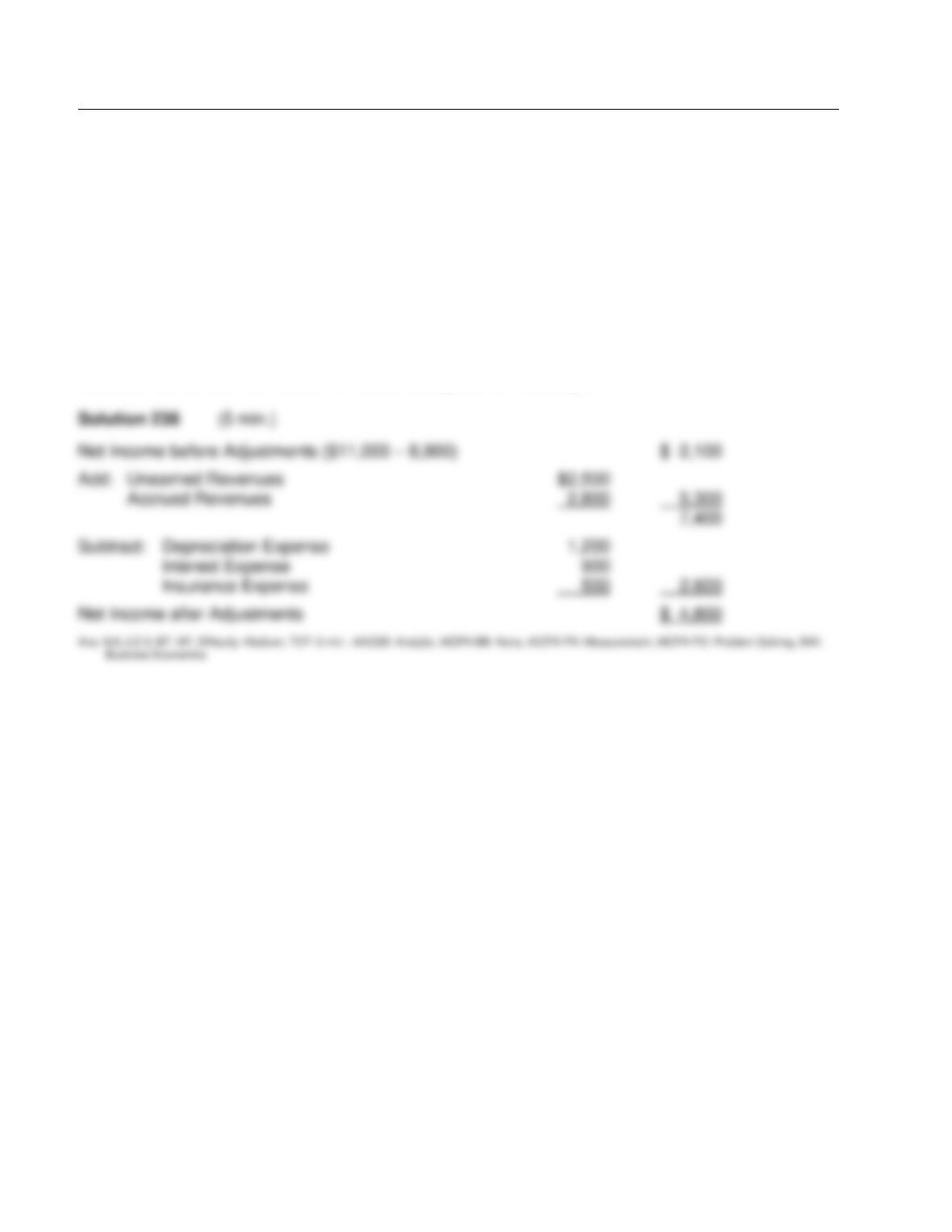
Solution 235 (5 min.)
Test Bank for Accounting: Tools for Business Decision Making, Fifth Edition
FOR INSTRUCTOR USE ONLY
4-60
Be. 236
Before month-end adjustments are made, the February 28 trial balance of Cole’s Enterprise contains
revenue of $11,000 and expenses of $8,900. Adjustments are necessary for the following items:
• Depreciation for February is $1,200.
• Revenue earned but not yet billed is $2,800.
• Accrued interest expense is $900.
• Revenue collected in advance that is now earned is $2,500.
• Portion of prepaid insurance expired during February is $500.
Instructions:
Calculate the correct net income for Cole’s Enterprise for February 3.
Be. 237
Before month-end adjustments are made, the September 30 trial balance of Horton Enterprise con-
tains revenue of $9,200 and expenses of $6,500. Adjustments are necessary for the following items:
• Depreciation for September is $300.
• Revenue earned but not yet billed is $2,100.
• Accrued interest expense is $800.
• Revenue collected in advance that is now earned is $3,400.
• Portion of prepaid insurance expired during September is $300.
Instructions:
Calculate the correct net income for Horton’s Enterprise for September.