
Test Bank Questions, Chapter 4
1. What does a household represent?
a. An organizational structure that unites its occupants.
b. A structure with a form that affects a business.
c. The combined financial actions of a family.
d. Logical decision making by a family.
e. None of the above.
2. Which of the following best describes a household?
a. An organization of multiple people who live in the same dwelling and share
financial and other resources intended for the well-being of its members.
b. A structure for one individual that lives in the same home.
c. A organized financial relationship with a relative.
d. An organization of one or more people who live in the same dwelling and share
financial and other resources intended for the well-being of its members.
e. None of the above.
3. How does a multiperson household lead to financial efficiencies?
a. Reduction in income fluctuation.
b. Specialization of task.
c. Economies of scale.
d. All of the above.
e. Only b and c.
Answer: d
4. A household’s sharing of fixed costs for shelter and other goods is an example of:
a. Reduction in income fluctuation.
b. Specialization of task.
c. Economies of scale.
d. All of the above.
e. None of the above.

5. What are the legal responsibilities associated with a household consisting of
unmarried persons?
a. Marital responsibilities set by the government.
b. Few legal responsibilities unless set by contract recognized by state or local
municipality.
c. Favorable tax treatment that result in tax deduction.
d. Reduction in risk of income fluctuation.
e. None of the above.
6. What is the effect on taxation of a household consisting of unmarried persons with
children?
a. Favorable tax treatment for single adult-head of household in income taxation
b. Unfavorable tax treatment for single adult-head of household in income taxation
c. A disadvantage for income taxation.
d. Only a and c.
e. Only b and c.
7. What percentage of U.S. households consist of married couples with children?
a. A little less than 75 percent.
b. A little more than 50 percent.
c. A little less than 40 percent.
d. A little more than 30 percent.
e. None of the above.
8. Which of the following may be a reason why household savings in the U.S. have
declined n recent years?
a. Below average growth of the single-adult-household category (including
households with children).
b. Above average growth of the single-adult-household category (excluding
households with children).
c. Above average growth of the single-adult-household category (including
households with children).
d. Below average growth of the single-adult-household category (including
households with children).

e. None of the above.
Answer: c
9. Why is theory useful to the personal financial planning process?
a. With theory, we can attempt to explain why people do what they do.
b. The assumptions required by theory are always realistic.
c. Theory encapsulates all of reality.
d. All of the above.
e. None of the above.
10. The method by which people select goods and services to satisfy their needs is:
a. The theory of market selection.
b. A mechanical process.
c. The theory of household finance.
d. The theory of consumer choice.
e. None of the above.
11. How do people select goods and services from those made available in the
marketplace?
a. By grouping goods and services into consumption bundles and ranking the
bundles in order of attractiveness.
b. By ranking goods and services in order of attractiveness, and then using these
rankings to form consumption bundles.
c. By ranking goods and services into consumption bundles and ranking the
bundles in order of price.
d. By ranking goods and services into consumption bundles and ranking the
bundles in order of satisfaction.
e. By ranking goods and services in order of price, and then using these rankings to
form consumption bundles.
12. How is the attractiveness of combinations of goods and services measured?
a. Through the satisfaction associated with the combination.
b. Through the satisfaction in relation to price associated with the combination.

c. Through the price in relation to cost associated with the combination.
d. Through the price associated with the combination.
e. None of the above.
Answer: b
13. We naturally select:
a. The consumption bundle that provides us with the lowest price given our budget
constraint.
b. The consumption bundle that provides us with the lowest price given the
attractiveness.
c. The consumption bundle that provides us with the greatest enjoyment given our
budget constraint.
d. Either a, b, or c.
e. None of the above.
14. How do savings influence the theory of consumer choice?
a. Savings allow us to consider a wide range of multi-year consumption bundles.
b. Savings allow us to consider a more realistic multi-year time frame.
c. Savings allow us to make selections that are not only made for this year but for
future periods as well.
d. All of the above.
e. None of the above.
15. Which of the following is a characteristic of the life cycle theory of savings?
a. It assumes that utility cannot be measured in money terms.
b. It says that our spending decisions are based on the amount of income we earn
currently.
c. Is says that before we establish our lifetime resources, we try to maintain a
constant level of expenditures throughout our life cycle.
d. All of the above.
e. None of the above.
16. An implication of the life cycle theory is that:

a. Households are planners whose actions extend beyond their current resources
and pleasurable activities today to future needs and assets to meet them.
b. Utility can be measured in money terms.
c. Household spending decisions are based on the amount of income they earn
currently.
d. All of the above.
e. None of the above.
17. Which of the following is not true according to the life cycle theory?
a. Borrowing generally takes place early in the household’s life, when income is
low.
b. As income rises, people increase their debt rather than save for retirement.
c. Upon retirement savings are liquidated steadily to maintain their cost of living.
d. The goal is to “die broke.”
e. All of the above are true according to the life cycle theory.
18. Which of the following is not a shortcoming of the life cycle theory?
a. It doesn’t provide for money to be left for non-household members.
b. It assumes that expenditures can remain level throughout a person’s life.
c. It doesn’t account for uncertainty in projecting future incomes and expenses.
d. It doesn’t account for the desire by some to have a standard of living that varies
by age.
e. All of the above are shortcomings of the life cycle theory.
19. Which of the following is a characteristic of a firm?
a. It purchases inputs to produce its offerings.
b. The business concentrates on revenues and not costs.
c. If strives to identify the optimum level of profits that provides the most
production.
d. All of the above.
e. None of the above.
20. What is a nondiscretionary cost?

a. A variable cost.
b. A fixed cost.
c. A cost that cannot be estimated.
d. All of the above, depending on the accounting method used.
e. None of the above.
21. What is the opportunity cost of time?
a. The utility one gains from working.
b. The value of the leisure time lost due to engaging in work-related activities.
c. The amount of money we could have made if we had worked instead on
engaging in an activity that doesn’t provide us with money.
d. The cost associated with engaging in time consuming work.
e. None of the above.
22. If an individual can earn $42 per hour and chooses to exercise ten hours a week rather
than work, what is the individual’s opportunity cost of time per week?
a. 10 hours.
b. $42
c. $420
d. All of the above are different ways of expressing the opportunity cost of time per
week.
e. None of the above.
23. Which of the following best characterizes the household enterprise?
a. It attempts to earn as much money as possible.
b. It attempts to minimize pleasurable activities so as to maximize revenue-
generating opportunities.
c. It attempts to maximize pleasurable activities so as to minimize time-wasting
activities.
d. It attempts to run the household as efficiently as possible in order to provide as
much time and money as possible for pleasurable activities.
e. None of the above.

24. Which of the following statements regarding the relation between finance and
economics is inaccurate?
a. Finance places more stress on practicality in its analysis.
b. Finance describes most processes in tangible money terms.
c. Finance is able to look at how assets interact so as to provide an integrated
solution to a problem.
d. Finance more often incorporates risk in decision making and can offer outcomes
in combined risk-return terms.
e. All of the above statements are accurate.
25. Into which of the following categories do personal support costs such as eating, non–
business clothing, and personal care belong?
a. Maintenance costs.
b. Overhead costs.
c. Leisure outlays
d. All of the above.
e. Both a and b.
26. What are capital expenditures?
a. Cash outflows that provide household operating benefits over an extended period
of time.
b. Maintenance costs that require the investment of cash.
c. Leisure costs that require the investment of cash.
d. All of the above.
e. Only b and c.
27. What is the goal of a household?
a. To earn as much money as it can.
b. To maximize utility.
c. To identify and manage revenues and expenses.
d. All of the above.
e. None of the above.

28. Which of the following is not a key principle of Modern Portfolio Theory?
a. Investments should be viewed as part of a portfolio.
b. Look at both risk and return when making investment decisions.
c. Overall risk is not influenced by the degree of diversification among assets in the
portfolio.
d. The more dissimilar assets are the lower the risk for the portfolio.
e. All of the above are key principles of Modern Portfolio Theory.
Answer: c
29. The view of a household as a financial enterprise that uses a portfolio risk-return
framework to provide solutions to financial planning goals is characteristic of:
a. The theory of financial planning.
b. PFP goal achievement.
c. The household enterprise.
d. The life cycle approach.
e. None of the above.
30. Why is the Total Portfolio Management approach unique?
a. It only analyzes marketable financial assets.
b. It analyzes all household assets and obligations.
c. It is dependent on the validity or lack of appropriateness of several practical
interpretations of its principles.
d. It selects the best mix of assets to achieve this objective.
e. None of the above.
31. Why don’t many young people begin saving for retirement once they begin working?
a. Sound financial planning advises against such savings.
b. These savings are much less “high powered” for accumulation purposes.
c. Young people prefer enjoyment today over what they perceive as a distant
concern about retirement.
d. All of the above.
e. None of the above.
32. Which of the following statements is inaccurate?
a. The maintenance and leisure approach is more consistent with pure financial
planning theory.
b. The maintenance and leisure approach is a more straightforward, logical
approach to household finance.
c. The nondiscretionary and discretionary approach is more practical.
d. All of the above statements are accurate.
e. None of the above statements are accurate.
Essay questions:
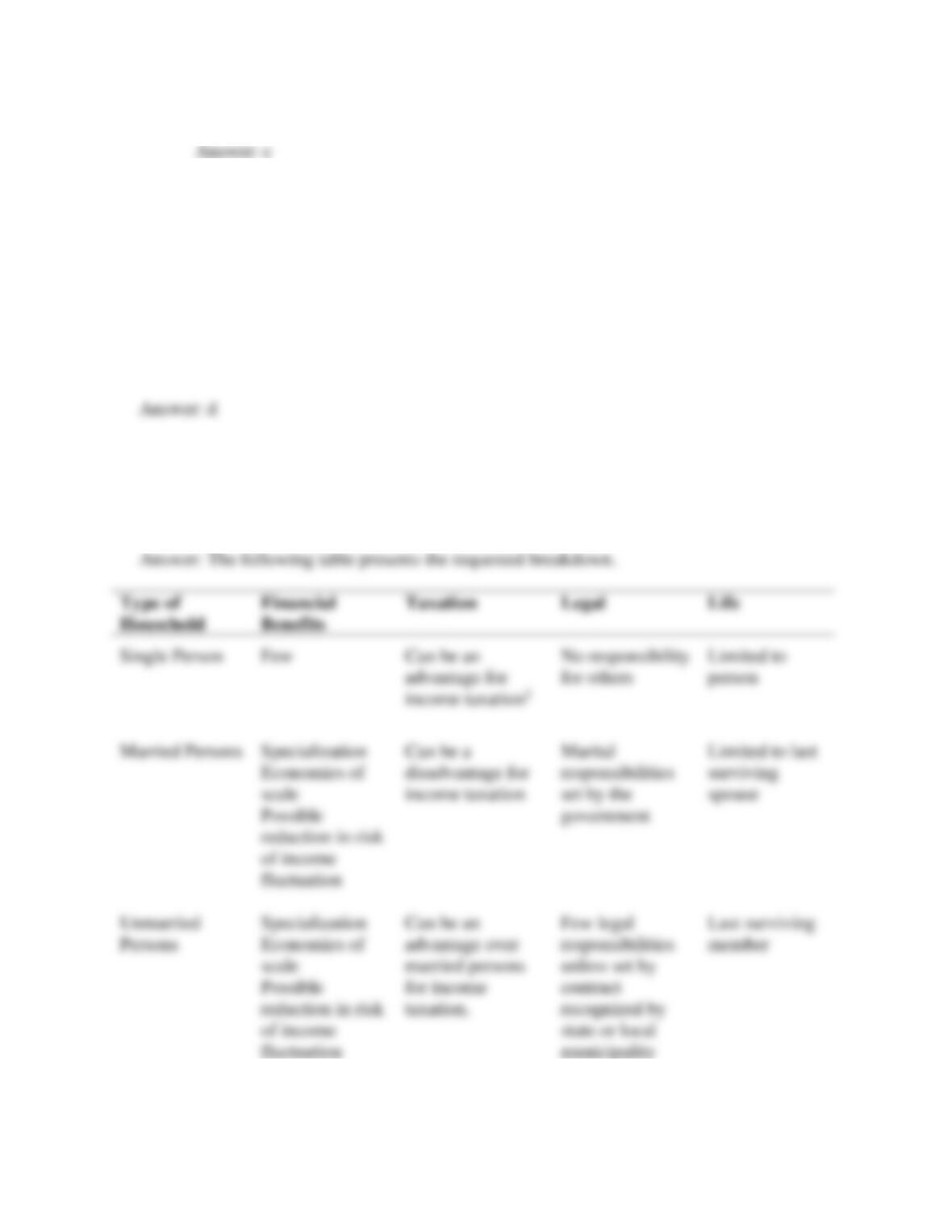
33. Please provide a breakdown of alternative household structures and their effect on
financial, legal, and tax matters.
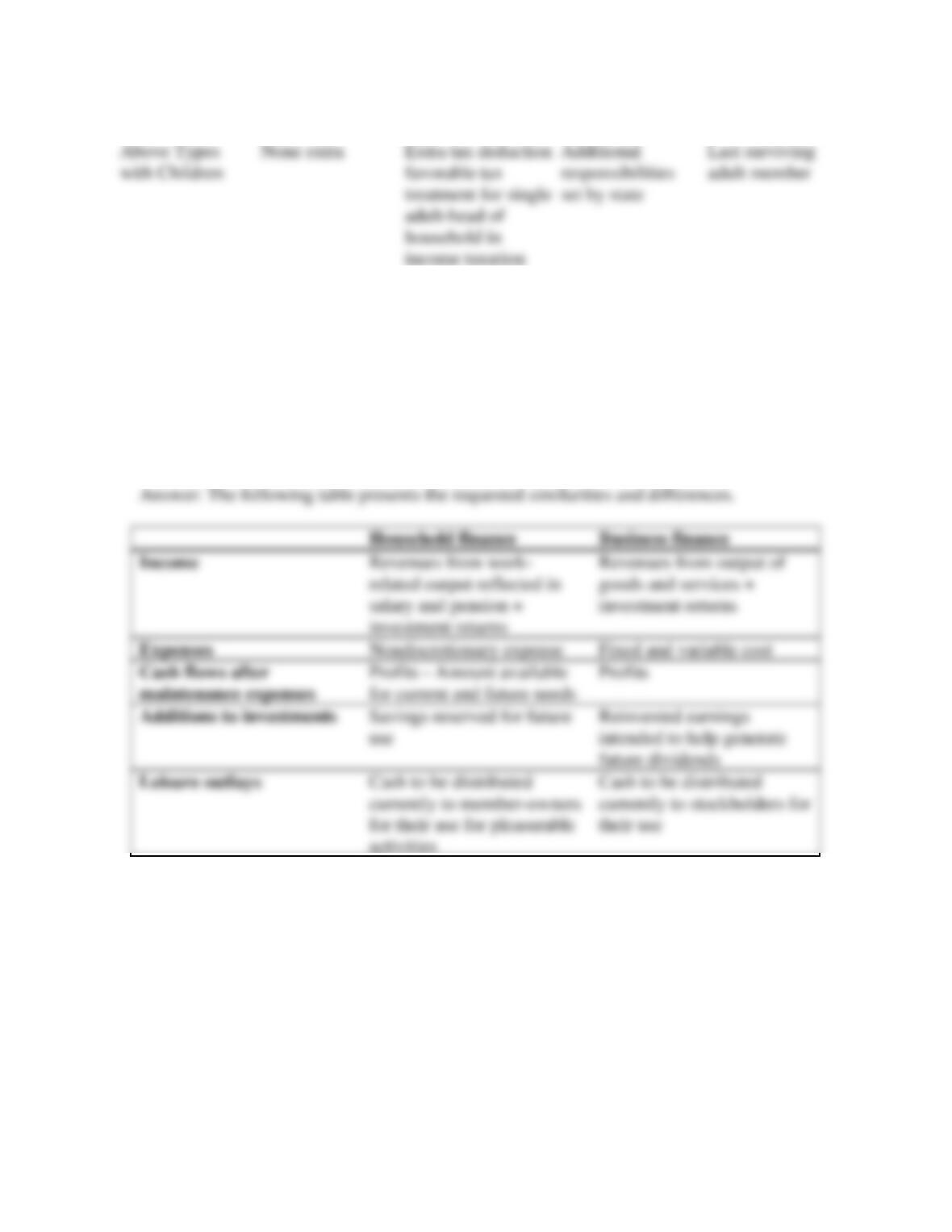
34. What are the similarities and differences between household and business financial
processes for each of the following?
• Income
• Expenses
• Cash flows after maintenance expenses
• Additions to investments
• Leisure outlays