Chapter 4—Managing Your Cash and Savings
127. Eric has $1,000 and would like to use it to start a savings program. He will add to the program regularly by investing
$50 per month in a liquid account. Which of the following types of accounts would be most appropriate in this situation?
a. Series EE savings bonds
b. Money market deposit account
c. Certificates of deposit
d. U.S. Treasury bills
e. NOW account
128. Low interest rates that have persisted since the financial crisis of 2008-09 have provided a net benefit to
a. pension funds. b. retirees.
c. banks. d. savers.
e. bond investors.
129. Which of the following is not true of low interest rates?
a. It encourages investors to search out investments like high-
dividend stocks. b. It encourages the substitution of debt for equity.
c. Low interest rates have increased the supply of credit.
d. Low rates penalize savers.
e. Low rates may discourage paying down the national debt.
130. Low interest rates are helpful in
a. facilitating a greater supply of money for borrowers.
b. reducing the service cost on our national debt.
c. encouraging a higher savings rate.
d. both a and b.
e. none of the above.
Chapter 4—Managing Your Cash and Savings
131. The least expensive method for banks to interact with their customers is
a. in person. b. on the phone.
c. online. d. ATM machine.
e. self service kiosks.
INSTRUCTIONS: Choose the word or phrase in [ ] which will correctly complete the statement. Select A for the first
item, B for the second item, and C if neither item will correctly complete the statement.
132. Interest rates will be lower on your [savings | checking] account.
133. Liquid assets would include your savings account and your [money market deposit account | stock mutual fund].
134. Today the differences between a commercial bank and an S&L are [minor | major].
Chapter 4—Managing Your Cash and Savings
135. Savings and loan associations are more likely to be paying [much | slightly] higher interest rates on their accounts
than a commercial bank.
136. Credit unions are generally [small | large] institutions when compared with commercial banks and savings and loans.
137. A [checking | savings] account is called a demand deposit account.
138. A bank customer would expect to be able to write checks on his regular checking account and on his [certificate of
deposit | money market fund].
139. A bank customer would typically expect to receive higher interest rates on her [certificate of deposit | money market
deposit account].
Chapter 4—Managing Your Cash and Savings
140. Banks must notify customers [30 | 60] days before lowering rates on deposit accounts or certificates of deposit.
141. Money market deposit accounts [are | are not] insured by an agency of the federal government.
142. [Money market deposit accounts | Money market mutual funds] are protected by the Federal Deposit Insurance
Corporation.
143. [Money market deposit accounts | Asset management accounts] are protected by the Securities Investor Protection
Corporation.
Chapter 4—Managing Your Cash and Savings
144. Financial institutions [must pay at least a federally mandated minimum interest rate | may pay any interest rate they
want] on their certificates of deposit.
145. [Almost all | Nearly 75 percent] of the banking institutions in the United States are federally insured.
146. You are planning to deposit $5,000 in a bank. At the end of one year, you will have more money in this account if
interest is compounded [semiannually | quarterly].
147. Your bank pays 3% interest, compounded quarterly. At the end of one year, your $5,000 will have earned [$150 |
over $150] interest.
148. Natalie is faced with two savings choices: Making a single deposit of $5,000 or making five annual deposits of
$1,000. The interest rate on both is 4%, compounded monthly. The [lump sum deposit | annual deposits] plan will result in
a higher balance at the end of five years.
Chapter 4—Managing Your Cash and Savings
149. Your bank does not levy a service charge on your checking account as long as a $1,000 minimum balance is
maintained. Your bank [can | cannot] advertise this as free checking.
150. You make a promise to keep funds on deposit for a stated period of time when you open a [MMDA | CD].
151. Interest earned on your [MMDA account | Series EE savings bonds] are free of state income taxes.
152. Interest earned on your [Series EE savings bonds | T-bills] are exempt from federal income taxes if the proceeds are
used to pay for education expenses.
Chapter 4—Managing Your Cash and Savings
153. [I savings bonds | Treasury bills] are sold at face value.
154. You [would | would not] expect to receive a cash flow of interest from your Series EE bonds.
155. Series EE savings bonds may be redeemed [any time after the first 12 months | only at the maturity date].
156. Series EE savings bonds are also called [War Bonds | Patriot Bonds].
157. You would expect to find an asset management account at a [commercial bank | brokerage firm].
Chapter 4—Managing Your Cash and Savings
158. An asset management account is likely to require a minimum investment of at least [$1,000 | $5,000].
159. The most common type of joint checking account would require the [signature of either party | signatures of both
parties] on all checks.
160. Joe and Mary have a tenants in common savings account. When Joe dies, his portion of the account [will | will not]
automatically go to Mary.
161. Dottie and Jasper have a joint checking account with rights of survivorship. If Jasper dies, his portion of the account
[will | will not] automatically go to Dottie.
162. “For deposit only” would indicate a [blank | restricted] endorsement.
Chapter 4—Managing Your Cash and Savings
163. [Both the depositor and writer | Only the writer] of a “bad” check will likely be charged a fee by their/his
banks/bank.
164. Having some type of overdraft protection with your bank will end up costing [more | less] than having a check
bounce.
165. Errors discovered during the reconciliation process are most likely to have been made by the [depositor | bank].
166. [Anyone | Only those with an account at the bank] can purchase cashiers’ checks.
167. [Anyone | Only those with an account at the bank] can get a check certified.
Chapter 4—Managing Your Cash and Savings
168. Your bank probably [will | will not] levy a transaction fee if you use the ATM of another bank.
169. Banks [may | must] state interest rates they pay as annual percentage yields.
170. It costs financial institutions more for their customers to perform [ATM transactions | Internet transactions.]
171. Low interest rates that have persisted since the financial crisis of 2008-09 have been a net benefit to [borrowers |
retirees].
172. Low interest rates have [increased | decreased | not impacted ] the supply of credit.
Chapter 4—Managing Your Cash and Savings
173. With low interest rates, savers have begun investing in [bonds | stocks] where higher yields can be found.
174. In the wake of the recent financial crisis, the U.S. personal saving rate has [increased | decreased].
175. The most expensive method for banks to interact with their customers is [in person | by ATM ].
176. Maggie wants to open a checking account that will be the least expensive given her normal financial transactions.
She typically writes 15 checks a month and uses an ATM 35 times a month. Her minimum checking balance falls to about
$350 in an average month. Which of the following accounts would be least expensive for Maggie? (Show all your work.)
Account A:
∙ No monthly fee is charged if a minimum balance of at least $300 is maintained.
∙ A $5.00 fee is charged in any month the minimum balance falls below $300.
∙ An ATM fee of $0.10 per transaction is charged on all transactions.
Account B:
∙ No monthly fee is charged if a minimum balance of at least $500 is maintained.
∙ A $3.00 fee plus $0.10/check is charged in any month the minimum balance falls below $500.
Chapter 4—Managing Your Cash and Savings
∙ There is no ATM fee on transactions.
177. You have a savings plan into which you put $3,000 per year. How much will you accumulate in the account in 25
years if the interest rate is 10%? (Show all work.)
178. Gordon and Susan have a regular savings plan and have accumulated $8,000. How much will this be worth in 10
years if they can earn 2% on the money. They are not planning to add to this savings account. (Show all work.)
179. Sammi and Jason have $4,000 to deposit in a money market fund earning 5%. If they add $2,000 to that account
annually, how much will they have accumulated in 15 years? (Show all work.)
Chapter 4—Managing Your Cash and Savings
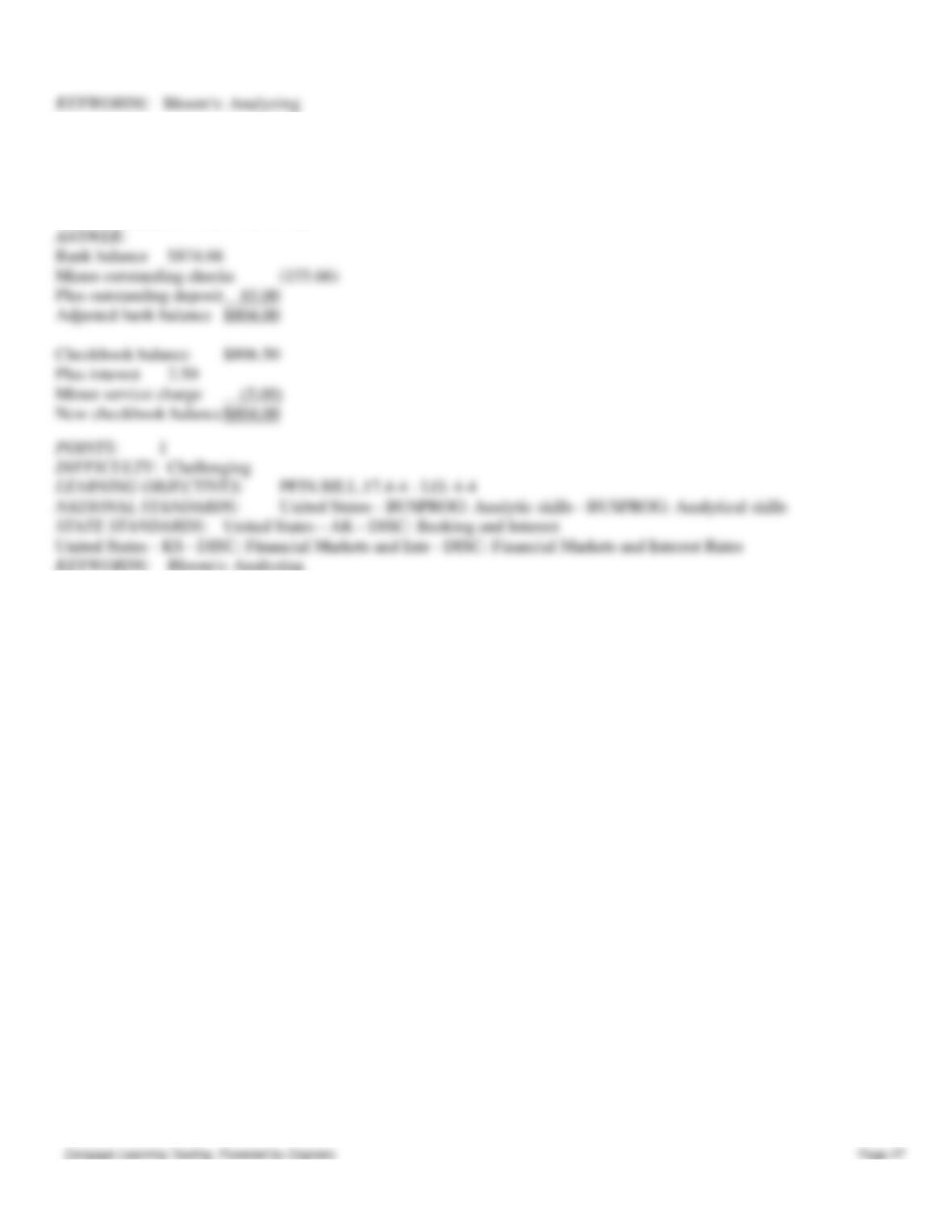
180. Your checkbook balance shows $806.50. The bank statement shows $874.66. The bank paid you $2.50 in interest.
You issued Checks 1501 ($85), 1507 ($50.16), and 1511 ($20.50), but they are not shown on the statement. A service
charge of $5 was levied by the bank. You made an $85 deposit yesterday that is not on the statement. What is the
reconciled balance? (Show all work.)