26) The key input to any cash budget is ________.
A) the sales forecast
B) the production plan
C) the pro forma balance sheet
D) the current tax laws
27) Of the following components of a cash budget, generally the easiest to estimate would be the
________.
A) cash sales
B) cash receipts
C) cash disbursements
D) month-to-month short-term borrowing
28) Cash disbursements include ________.
A) amortization expense
B) rent payments
C) depreciation expense
D) depletion
29) A projected excess cash balance for a month may be ________.
A) financed with short-term securities
B) financed with long-term securities
C) invested in marketable securities
D) invested in long-term securities
30) If a firm expects short-term cash surpluses, it can plan ________.
A) long-term investments
B) short-term borrowing
C) short-term investments
D) leverage decisions
31) A firm has actual sales in November of $1,000 and projected sales in December and January
of $3,000 and $4,000, respectively. The firm makes 10 percent of its sales for cash, collects 40
percent of its sales one month following the sale, and collects the balance two months following
the sale. The firm’s total cash receipts in November is ________.
A) $1,000
B) $100
C) $700
D) $400
32) A firm has actual sales in November of $1,000 and projected sales in December and January
of $3,000 and $4,000, respectively. The firm makes 10 percent of its sales for cash, collects 40
percent of its sales one month following the sale, and collects the balance two months following
the sale. The firm’s total expected cash receipts in January is ________.
A) $700
B) $2,100
C) $1,900
D) $300
33) In April, a firm had an ending cash balance of $35,000. In May, the firm had total cash
receipts of $40,000 and total cash disbursements of $50,000. The minimum cash balance
required by the firm is $25,000. At the end of May, the firm had ________.
A) an excess cash balance of $25,000
B) an excess cash balance of $0
C) required financing of $10,000
D) required financing of $25,000
34) In October, a firm had an ending cash balance of $35,000. In November, the firm had a net
cash flow of $40,000. The minimum cash balance required by the firm is $25,000. At the end of
November, the firm had ________.
A) an excess cash balance of $50,000
B) an excess cash balance of $75,000
C) required total financing of $15,000
D) required total financing of $5,000
35) In the month of August, a firm had total cash receipts of $10,000, total cash disbursements of
$8,000, depreciation expense of $1,000, a minimum cash balance of $3,000, and a beginning
cash balance of $500. The ending cash balance for August totals ________.
A) $1,500
B) $5,500
C) $2,500
D) $3,500
36) In the month of August, a firm had total cash receipts of $10,000, total cash disbursements of
$8,000, depreciation expense of $1,000, a minimum cash balance of $3,000, and a beginning
cash balance of $500. At the end of August, the firm ________.
A) required total financing of $500
B) had an excess cash balance of $5,500
C) had an excess cash balance of $500
D) required total financing of $2,500
37) Which of the following represents a way of coping with uncertainty in a cash budget?
A) careful estimation of cash budgets outputs
B) developing a pro forma income statement to forecast sales and then express the various
income statement items as percentage of projected sales
C) always using the prior year’s data for estimates of the future
D) using scenario analysis, or “what if” approach, to analyze cash flows under a variety of
circumstances
38) One way a firm can reduce the amount of cash it needs in any month is to ________.
A) slow down the payment of receivables
B) delay the payment of wages
C) accrue taxes
D) speed up payment of accounts payable
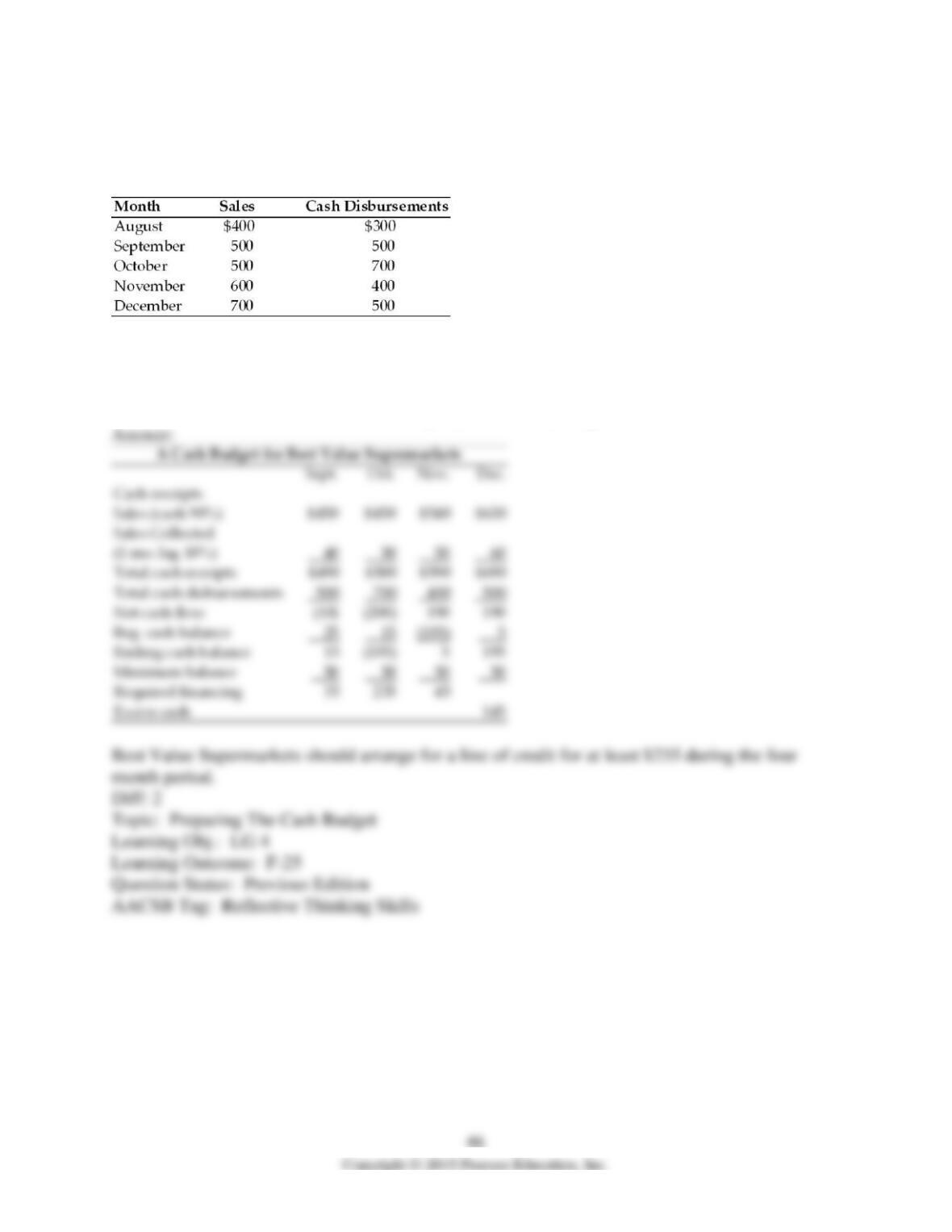
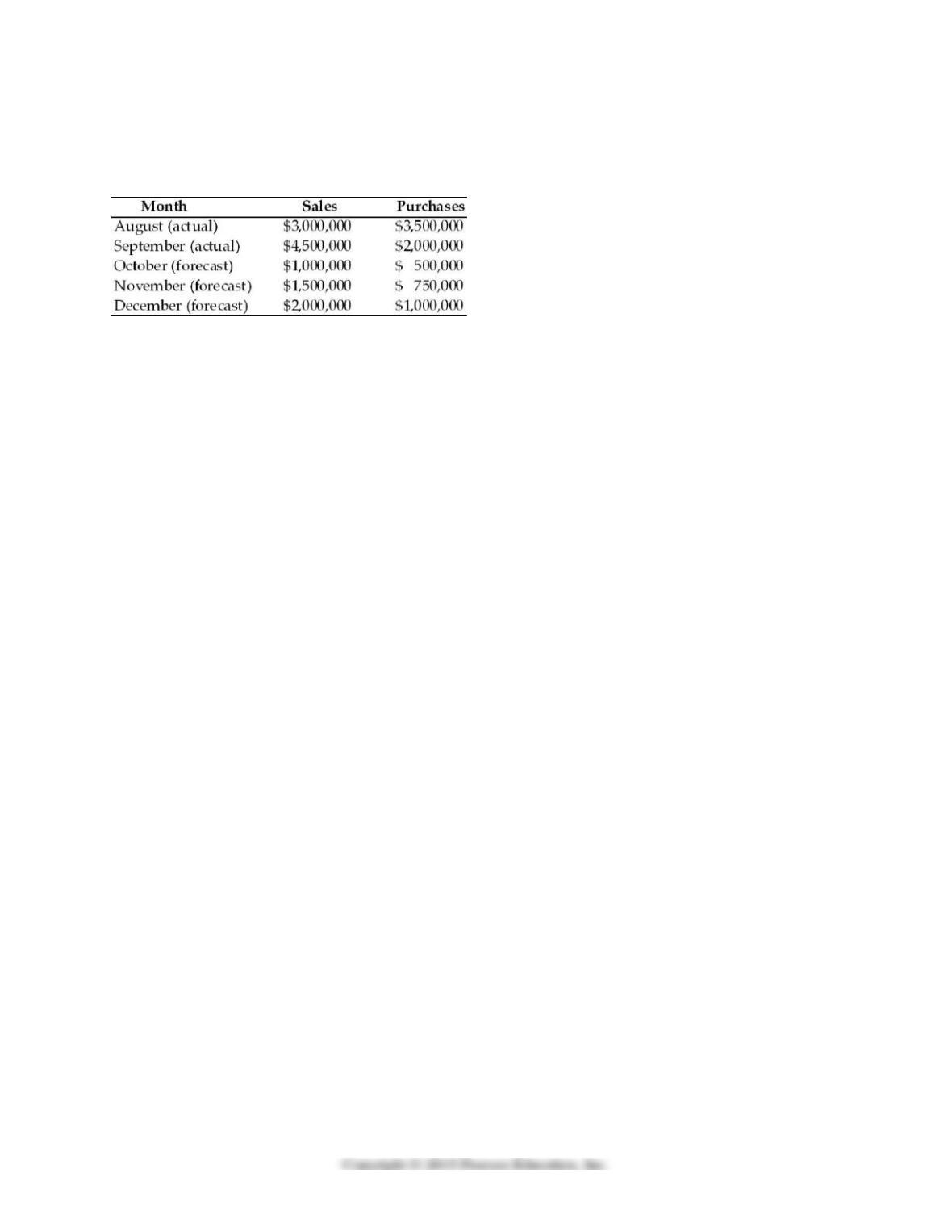
39) Gerry Jacobs, a financial analyst for Best Value Supermarkets, has prepared the following
sales and cash disbursement estimates for the period August through December of the current
year.
Ninety percent of sales are for cash, the remaining 10 percent are collected one month later. All
disbursements are on a cash basis. The firm wishes to maintain a minimum cash balance of $50.
The beginning cash balance in September is $25. Prepare a cash budget for the months of
October, November, and December, noting any needed financing or excess cash available.
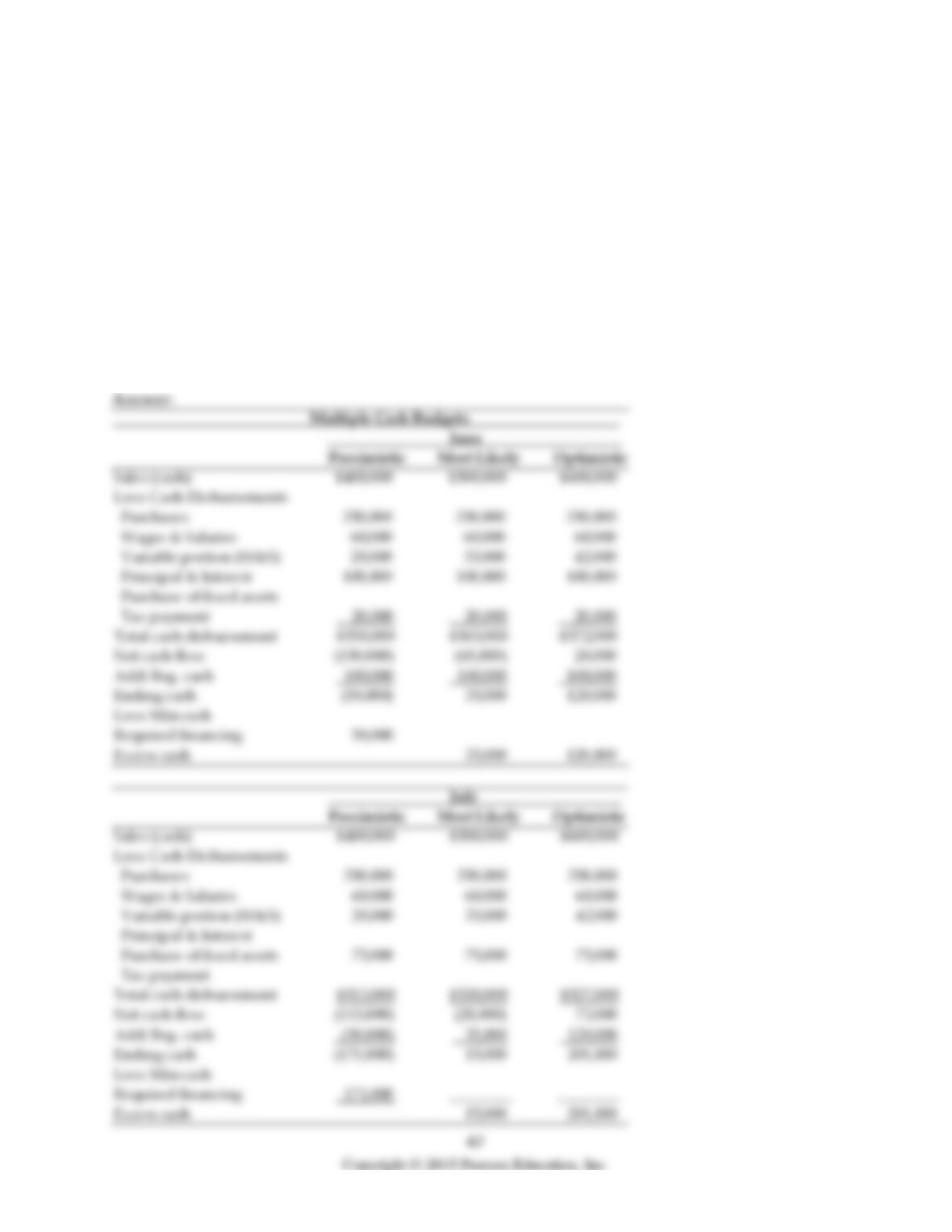
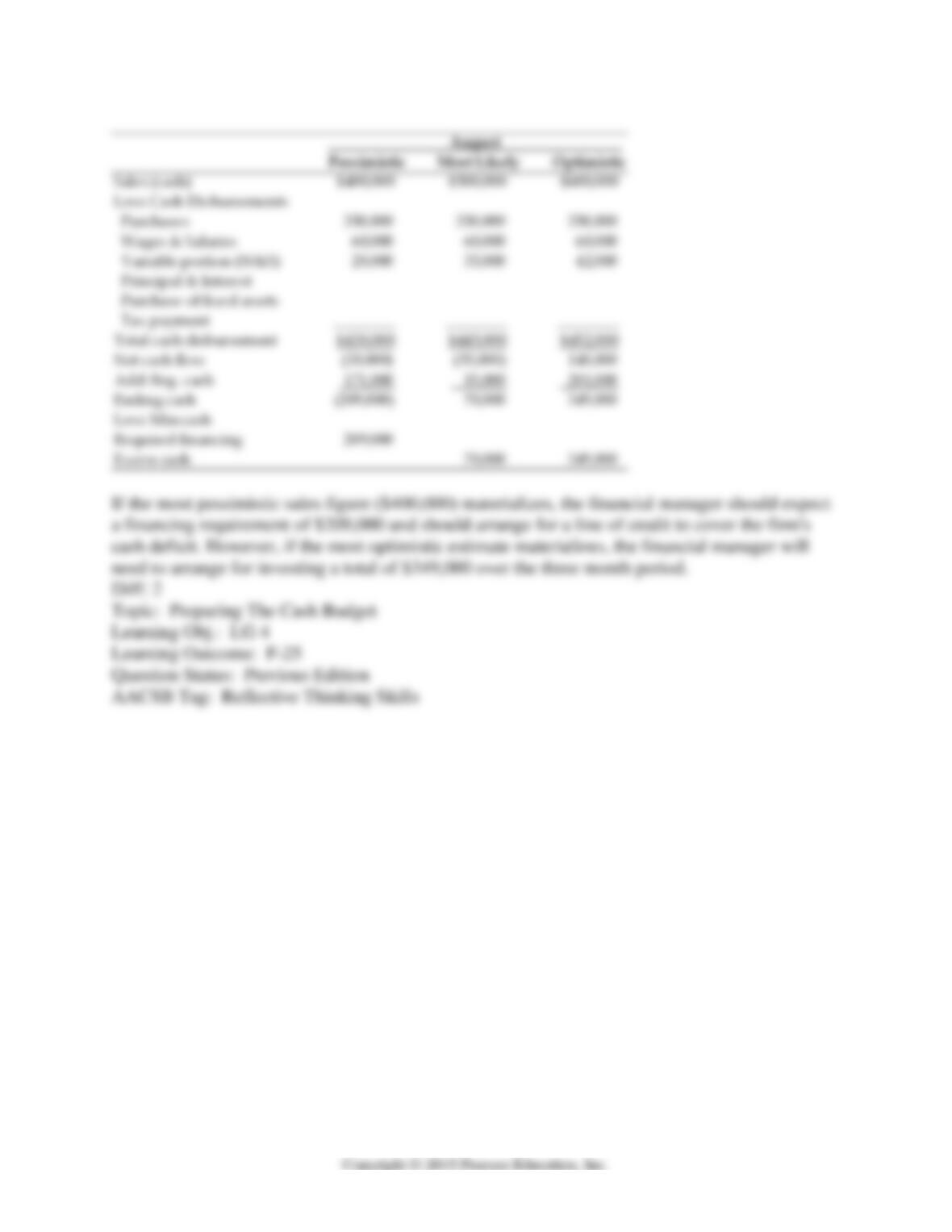
40) Terrel Manufacturing expects stable sales through the summer months of June, July, and
August of $500,000 per month. The firm will make purchases of $350,000 per month during
these months. Wages and salaries are estimated at $60,000 per month plus 7 percent of sales. The
firm must make a principal and interest payment on an outstanding loan in June of $100,000. The
firm plans a purchase of a fixed asset costing $75,000 in July. The second quarter tax payment of
$20,000 is also due in June. All sales are for cash.
(a) Construct a cash budget for June, July, and August, assuming the firm has a
beginning cash balance of $100,000 in June.
(b) The sales projections may not be accurate due to the lack of experience by a
newly-hired sales manager. If the sales manager believes the most optimistic
and pessimistic estimates of sales are $600,000 and $400,000, respectively, what
are the monthly net cash flows and required financing or excess cash balances?
48
49
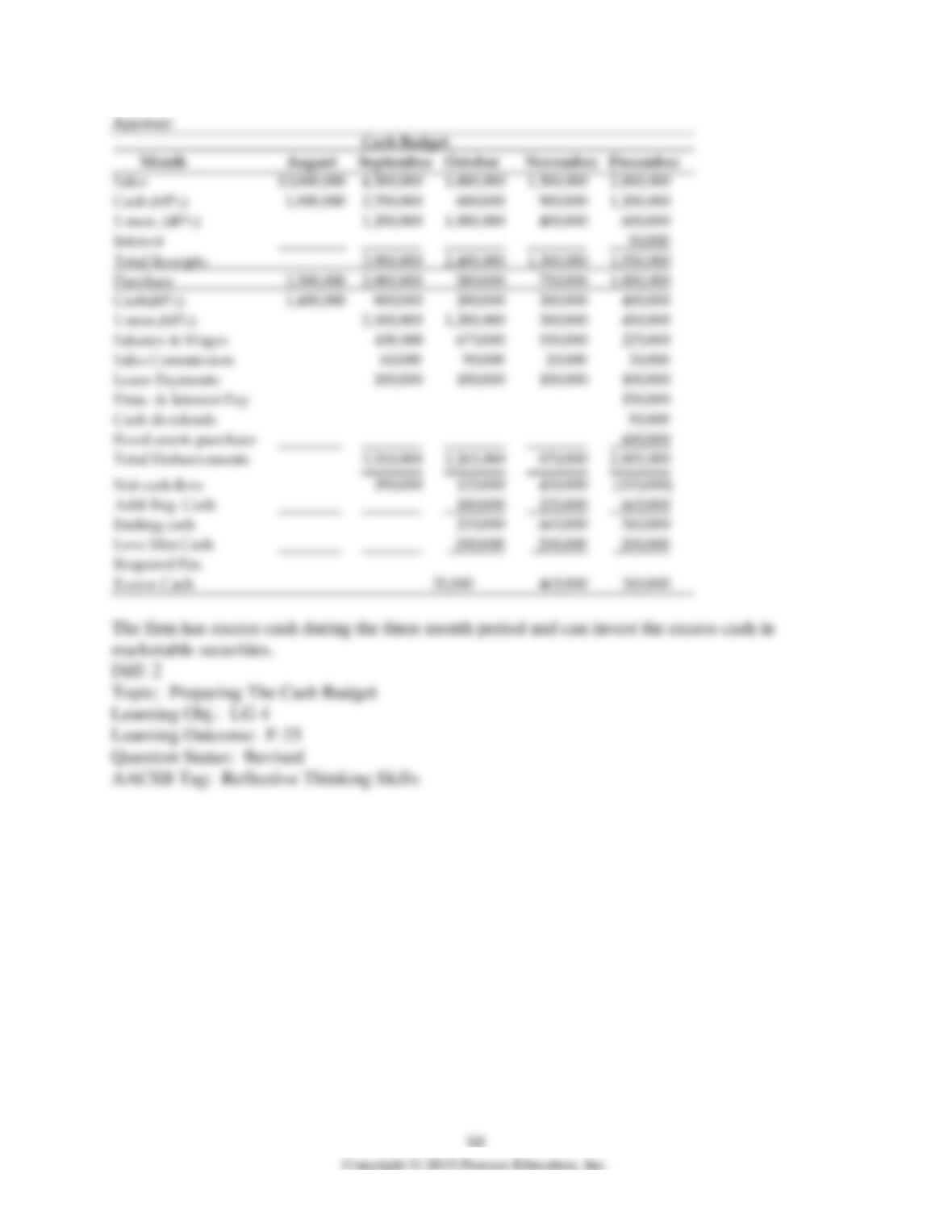
41) In the preparation of a quarterly cash budget, the following revenue and cost information
have been compiled. Prepare and evaluate a cash budget for the months of October, November,
and December based on the information shown below.
• The firm collects 60 percent of sales for cash and 40 percent of its sales one month later.
• Interest income of $50,000 on marketable securities will be received in December.
• The firm pays cash for 40 percent of its purchases.
• The firm pays for 60 percent of its purchases the following month.
• Salaries and wages amount to 15 percent of the preceding month’s sales.
• Sales commissions amount to 2 percent of the preceding month’s sales.
• Lease payments of $100,000 must be made each month.
• A principal and interest payment on an outstanding loan is due in December of $150,000.
• The firm pays dividends of $50,000 at the end of the quarter.
• Fixed assets costing $600,000 will be purchased in December.
• Depreciation expense each month of $45,000.
• The firm has a beginning cash balance in October of $100,000 and maintains a minimum
cash balance of $200,000.

51
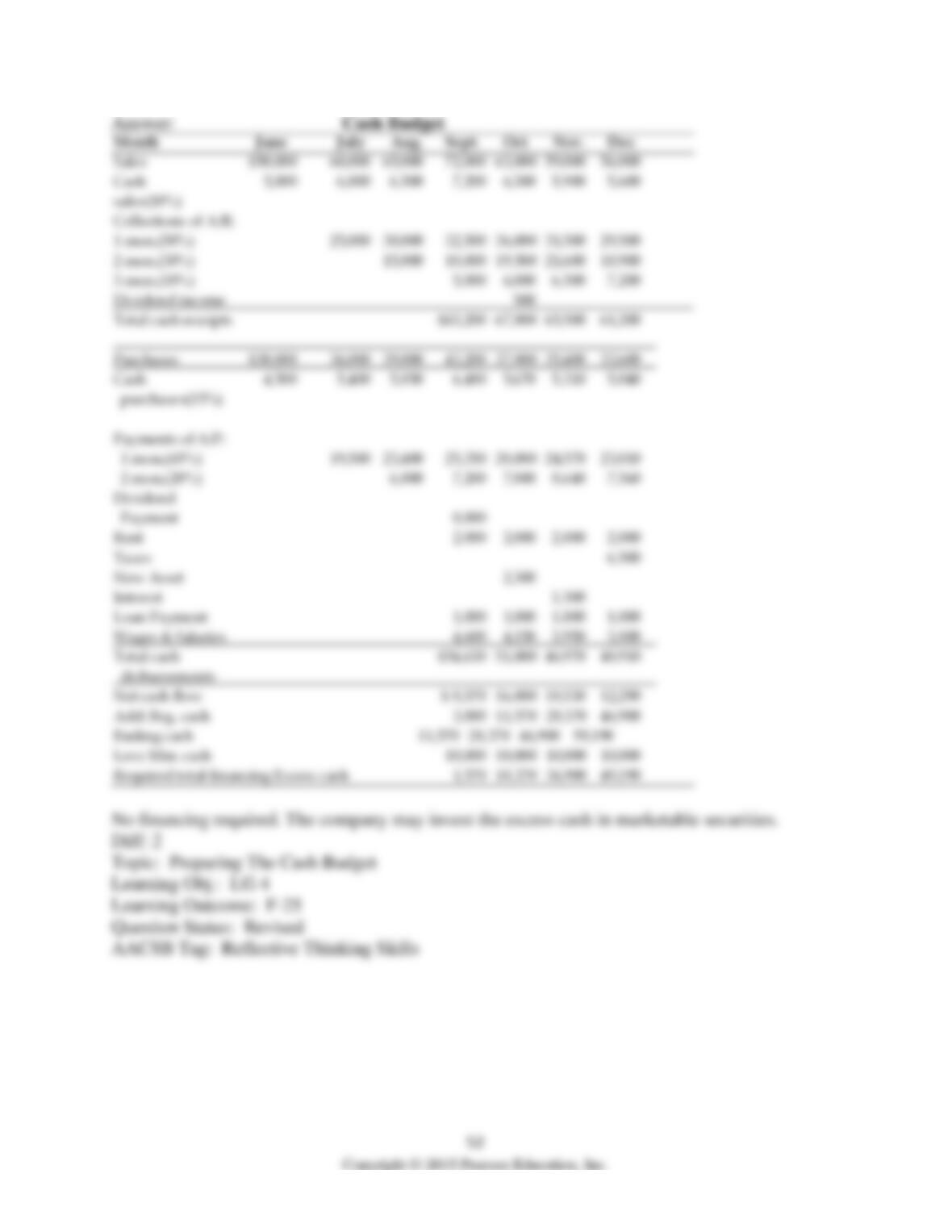
42) Harry’s House of Hamburgers (HHH) wants to prepare a cash budget for months of
September through December. Using the following information, prepare the cash budget
schedule and interpret the results.
• Sales were $50,000 in June and $60,000 in July. Sales have been forecasted to be $65,000,
$72,000, $63,000, $59,000, and $56,000 for months of August, September, October, November,
and December, respectively. In the past, 10 percent of sales were on cash basis, and the
collection were 50 percent in the first month, 30 percent in the second month, and 10 percent in
the third month following the sales.
• Every four months (three times a year) $500 of dividends from investments are expected. The
first dividend payment was received in January.
• Purchases are 60 percent of sales, 15 percent of which are paid in cash, 65 percent are paid one
month later, and the rest is paid two months after purchase.
• $8,000 dividends are paid twice a year (in March and September).
• The monthly rent is $2,000.
• Taxes are $6,500 payable in December.
• A new hamburger press will be purchased in October for $2,300.
• $1,500 interest will be paid in November.
• $1,000 loan payments are paid every month.
• Wages and salaries are $1,000 plus 5 percent of sales in each month.
• August’s ending cash balance is $3,000.
• HHH would like to maintain a minimum cash balance of $10,000.
4.5 Explain the simplified procedures used to prepare and evaluate the pro forma income
statement and the pro forma balance sheet.
1) Development of pro forma financial statements helps a financial manager to project the
amount of external financing required to support a given level of sales as well as overall financial
performance of the firm in the coming year.
2) Since the percentage-of-sales method assumes that all the form’s costs and expenses are
variable, it tends to understate profits when sales are increasing and overstate profits when sales
are decreasing.
3) In the development of pro forma statements, a firm that requires external funds means that its
projected level of cash is in excess of its needs and that funds would therefore be available for
repaying debt, repurchasing stock, or increasing the dividend to stockholders.
4) The primary purpose in preparing pro forma financial statements is ________.
A) for cash planning
B) to ensure the ability to pay dividends
C) for risk analysis
D) for profit planning
5) ________ are projected financial statements.
A) Pro forma statements
B) Statements of retained earnings
C) Cash budgets
D) Cash flow statements
6) The key inputs for preparing pro forma income statements using the simplified approaches are
the ________.
A) sales forecast for the preceding year and financial statements for the coming year
B) sales forecast for the coming year and the cash budget for the preceding year
C) sales forecast for the coming year and financial statements for the preceding year
D) cash budget for the coming year and sales forecast for the preceding year
7) In the next planning period, a firm plans to change its policy of all cash sales and initiate a
credit policy requiring payment within 30 days. The statements that will be directly affected
immediately are the ________.
A) pro forma income statement, balance sheet, and cash budget
B) pro forma balance sheet and cash budget
C) cash budget and statement of retained earnings
D) pro forma income statement and pro forma balance sheet
8) A firm plans to retire outstanding bonds in the next planning period. Which of the following
gets affected?
A) pro forma income statement and pro forma balance sheet
B) previous year income statement and previous year balance sheet
C) previous year income statement and statement of retained earnings
D) pro forma income statement and proxy statement
9) A firm plans to depreciate a five year asset in the next planning period. The statements that
will be directly affected are the ________.
A) pro forma income statement, pro forma balance sheet, and cash budget
B) pro forma balance sheet, cash budget, and statement of retained earnings
C) cash budget and pro forma balance sheet
D) pro forma income statement and pro forma balance sheet
10) In a period of rising sales, utilizing past cost and expense ratios (percent-of-sales method)
when preparing pro forma financial statements will tend to ________.
A) overstate costs and overstate profits
B) overstate costs and understate profits
C) understate costs and overstate profits
D) understate costs and understate profits
11) The percentage-of-sales method of preparing pro forma income statements assumes that
________.
A) sales are fixed
B) all costs inversely vary with sales
C) all costs are independent
D) all costs are variable
12) The percent-of-sales method of developing a pro forma income statement forecasts sales and
other line items as a ________.
A) percentage of projected sales
B) percentage of average sales over a period
C) percentage of projected total assets
D) percentage of average total assets over a period
13) The best way to adjust for the presence of fixed costs when using the simplified approach for
pro forma income statement preparation is ________.
A) to proportionately vary the fixed costs with the change in sales
B) to adjust for projected fixed-asset outlays
C) to disproportionately vary the costs with the change in sales
D) to break the firm’s historical costs into fixed and variable components
14) The percent-of-sales method to prepare a pro forma income statement assumes a firm has no
fixed costs. Therefore, the use of the past cost and expense ratios generally tends to ________
profits when sales are increasing.
A) accurately predict
B) overstate
C) understate
D) have no effect on
15) For firms with high fixed costs, the percent-of-sales approach for preparing a pro forma
income statement tends to ________.
A) overestimate profits when sales are increasing
B) underestimate profits when sales are increasing
C) underestimate profits when assets are increasing
D) overestimate profits when assets are increasing
16) In a period of rising sales utilizing past cost and expense ratios (percent-of-sales method),
when preparing pro forma financial statements and planning financing, will tend to ________.
A) understate retained earnings and understate the additional financing needed
B) overstate retained earnings and overstate the additional financing needed
C) understate retained earnings and overstate the financing needed
D) overstate retained earnings and understate the financing needed
17) Under the judgmental approach for developing a pro forma balance sheet, the “plug” figure
required to bring the statement into balance may be called the ________.
A) cash balance
B) retained earnings
C) external financing required
D) accounts receivable
18) The ________ method of developing a pro forma balance sheet estimates values of certain
balance sheet accounts while external financing is used as a balancing, or plug, figure.
A) percent-of-sales
B) accrual
C) judgmental
D) cash
19) A firm has prepared the coming year’s pro forma balance sheet resulting in a plug figure in a
preliminary statement—called the external financing required—of $230,000. The firm should
prepare to ________.
A) repurchase common stock totaling $230,000
B) arrange for a loan of $230,000
C) do nothing; the balance sheet balances
D) invest in marketable securities totaling $230,000
20) A firm has prepared the coming year’s pro forma balance sheet resulting in a plug figure in a
preliminary statement—called the external financing required—of negative $250,000. The firm
may prepare to ________.
A) sell common stock totaling $250,000
B) arrange for a loan of $250,000
C) do nothing; the balance sheet balances
D) invest in marketable securities totaling $250,000
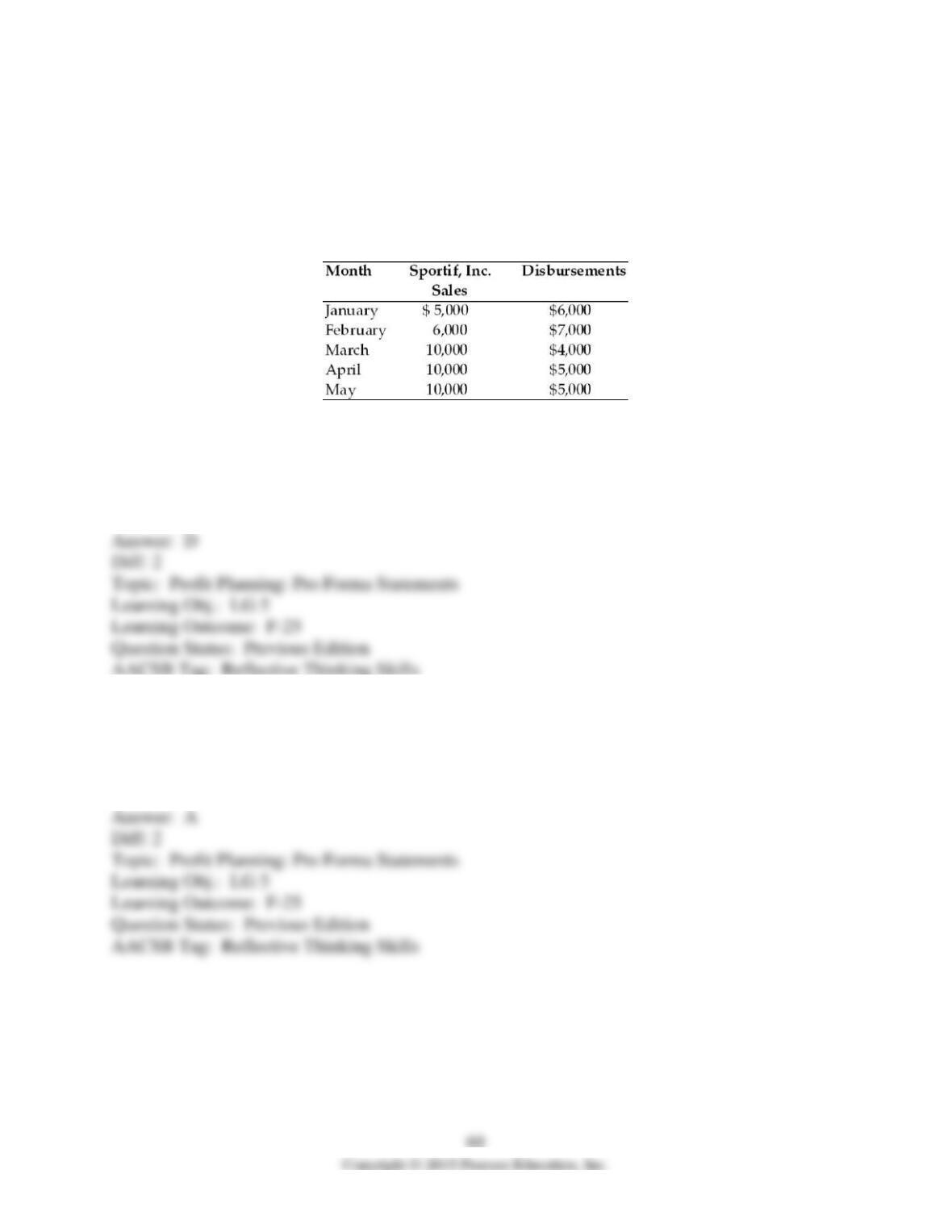
Table 4.3
The financial analyst for Sportif, Inc. has compiled sales and disbursement estimates for the
coming months of January through May. Historically, 75 percent of sales are for cash with the
remaining 25 percent collected in the following month. The ending cash balance in January is
$3,000.
21) The total cash receipts for April are ________. (See Table 4.3)
A) $5,000
B) $7,500
C) $9,250
D) $10,000
22) The net cash flow for February is ________. (See Table 4.3)
A) -$1,250
B) -$1,000
C) $5,750
D) $750