Chapter 04: Time Value of Money
d. $19,601
e. $20,633
81. Your friend offers to pay you an annuity of $2,500 at the end of each year for 3 years in return for cash today. You
could earn 5.5% on your money in other investments with equal risk. What is the most you should pay for the annuity?
a. $5,493.71
b. $5,782.85
c. $6,087.21
d. $6,407.59
e. $6,744.83
Chapter 04: Time Value of Money
82. After receiving a reward for information leading to the arrest of a notorious criminal, you are considering investing it
in an annuity that pays $5,000 at the end of each year for 20 years. You could earn 5% on your money in other
investments with equal risk. What is the most you should pay for the annuity?
a. $50,753
b. $53,424
c. $56,236
d. $59,195
e. $62,311
83. An uncle of yours who is about to retire wants to sell some of his stock and buy an annuity that will provide him with
income of $50,000 per year for 30 years, beginning a year from today. The going rate on such annuities is 7.25%. How
much would it cost him to buy such an annuity today?
a. $574,924
b. $605,183
c. $635,442
d. $667,214
e. $700,575
Chapter 04: Time Value of Money
84. What is the PV of an annuity due with 5 payments of $2,500 at an interest rate of 5.5%?
a. $11,262.88
b. $11,826.02
c. $12,417.32
d. $13,038.19
e. $13,690.10
85. A new investment opportunity for you is an annuity that pays $550 at the beginning of each year for 3 years. You
could earn 5.5% on your money in other investments with equal risk. What is the most you should pay for the annuity?
a. $1,412.84
b. $1,487.20
c. $1,565.48
d. $1,643.75
e. $1,725.94
Chapter 04: Time Value of Money
86. Your father is considering purchasing an annuity that pays $5,000 at the beginning of each year for 5 years. He could
earn 4.5% on his money in other investments with equal risk. What is the most he should pay for the annuity?
a. 20,701
b. $21,791
c. $22,938
d. $24,085
e. $25,289
87. Because your mother is about to retire, she wants to buy an annuity that will provide her with $75,000 of income a
year for 20 years, with the first payment coming immediately. The going rate on such annuities is 5.25%. How much
would it cost her to buy the annuity today?
a. $825,835
b. $869,300
c. $915,052
d. $963,213
e. $1,011,374
Chapter 04: Time Value of Money
88. Now that your uncle has decided to retire, he wants to buy an annuity that will provide him with $85,000 of income a
year for 25 years, with the first payment coming immediately. The going rate on such annuities is 5.15%. How much
would it cost him to buy the annuity today?
a. $1,063,968
b. $1,119,966
c. $1,178,912
d. $1,240,960
e. $1,303,008
89. A salt mine you inherited will pay you $25,000 per year for 25 years, with the first payment being made today. If you
think a fair return on the mine is 7.5%, how much should you ask for it if you decide to sell it?
a. $284,595
b. $299,574
c. $314,553
Chapter 04: Time Value of Money
d. $330,281
e. $346,795
90. Geraldine was injured in a car accident, and the insurance company has offered her the choice of $25,000 per year for
15 years, with the first payment being made today, or a lump sum. If a fair return is 7.5%, how large must the lump sum
be to leave her as well off financially as with the annuity?
a. $225,367
b. $237,229
c. $249,090
d. $261,545
e. $274,622
Chapter 04: Time Value of Money
91. What’s the present value of a 4-year ordinary annuity of $2,250 per year plus an additional $3,000 at the end of Year 4
if the interest rate is 5%?
a. $8,509
b. $8,957
c. $9,428
d. $9,924
e. $10,446
92. When a loan is amortized, a relatively high percentage of the payment goes to reduce the outstanding principal in the
early years, and the principal repayment’s percentage declines in the loan’s later years.
a. True
b. False
Chapter 04: Time Value of Money
93. When a loan is amortized, a relatively low percentage of the payment goes to reduce the outstanding principal in the
early years, and the principal repayment’s percentage increases in the loan’s later years.
a. True
b. False
94. The payment made each period on an amortized loan is constant, and it consists of some interest and some principal.
The closer we are to the end of the loan’s life, the greater the percentage of the payment that will be a repayment of
principal.
a. True
b. False
95. The payment made each period on an amortized loan is constant, and it consists of some interest and some principal.
The closer we are to the end of the loan’s life, the smaller the percentage of the payment that will be a repayment of
principal.
a. True
b. False
Chapter 04: Time Value of Money
96. Midway through the life of an amortized loan, the percentage of the payment that represents interest must be equal to
the percentage that represents repayment of principal. This is true regardless of the original life of the loan or the interest
rate on the loan.
a. True
b. False
97. Midway through the life of an amortized loan, the percentage of the payment that represents interest could be equal to,
less than, or greater than to the percentage that represents repayment of principal. The proportions depend on the original
life of the loan and the interest rate.
a. True
b. False
Chapter 04: Time Value of Money
98. A $250,000 loan is to be amortized over 8 years, with annual end-of-year payments. Which of these statements is
CORRECT?
a. The proportion of interest versus principal repayment would be the same for each of the 8 payments.
b. The annual payments would be larger if the interest rate were lower.
c. If the loan were amortized over 10 years rather than 8 years, and if the interest rate were the same in either case,
the first payment would include more dollars of interest under the 8-year amortization plan.
d. The proportion of each payment that represents interest as opposed to repayment of principal would be lower if
the interest rate were lower.
e. The last payment would have a higher proportion of interest than the first payment.
Chapter 04: Time Value of Money
99. A $150,000 loan is to be amortized over 6 years, with annual end-of-year payments. Which of these statements is
CORRECT?
a. The proportion of interest versus principal repayment would be the same for each of the 7 payments.
b. The annual payments would be larger if the interest rate were lower.
c. If the loan were amortized over 10 years rather than 6 years, and if the interest rate were the same in either case,
the first payment would include more dollars of interest under the 6-year amortization plan.
d. The proportion of each payment that represents interest as opposed to repayment of principal would be higher if
the interest rate were lower.
e. The proportion of each payment that represents interest versus repayment of principal would be higher if the
interest rate were higher.
100. Which of the following statements regarding a 20-year (240-month) $225,000, fixed-rate mortgage is CORRECT?
(Ignore taxes and transactions costs.)
a. The outstanding balance declines at a slower rate in the later years of the loan’s life.
b. The remaining balance after three years will be $225,000 less one third of the interest paid during the first three
years.
c. Because it is a fixed-rate mortgage, the monthly loan payments (which include both interest and principal
payments) are constant.
d. Interest payments on the mortgage will increase steadily over time, but the total amount of each payment will
remain constant.
e. The proportion of the monthly payment that goes towards repayment of principal will be lower 10 years from now
than it will be the first year.
Chapter 04: Time Value of Money
101. Which of the following statements regarding a 15-year (180-month) $225,000, fixed-rate mortgage is CORRECT?
(Ignore taxes and transactions costs.)
a. The outstanding balance declines at a faster rate in the later years of the loan’s life.
b. The remaining balance after three years will be $125,000 less one third of the interest paid during the first three
years.
c. Because the outstanding balance declines over time, the monthly payments will also decline over time.
d. Interest payments on the mortgage will increase steadily over time, but the total amount of each payment will
remain constant.
e. The proportion of the monthly payment that goes towards repayment of principal will be lower 10 years from now
than it will be the first year.
102. Which of the following statements regarding a 30-year monthly payment amortized mortgage with a nominal interest
rate of 8% is CORRECT?
a. Exactly 8% of the first monthly payment represents interest.
b. The monthly payments will decline over time.
c. A smaller proportion of the last monthly payment will be interest, and a larger proportion will be principal, than
for the first monthly payment.
d. The total dollar amount of principal being paid off each month gets smaller as the loan approaches maturity.
e. The amount representing interest in the first payment would be higher if the nominal interest rate were 6% rather
than 8%.
Chapter 04: Time Value of Money
103. Which of the following statements regarding a 20-year monthly payment amortized mortgage with a nominal interest
rate of 10% is CORRECT?
a. Exactly 10% of the first monthly payment represents interest.
b. The monthly payments will increase over time.
c. A larger proportion of the first monthly payment will be interest, and a smaller proportion will be principal, than
for the last monthly payment.
d. The total dollar amount of interest being paid off each month gets larger as the loan approaches maturity.
e. The amount representing interest in the first payment would be higher if the nominal interest rate were 7% rather
than 10%.
Chapter 04: Time Value of Money
104. Suppose you borrowed $12,000 at a rate of 9.0% and must repay it in 4 equal installments at the end of each of the
next 4 years. How large would your payments be?
a. $3,704.02
b. $3,889.23
c. $4,083.69
d. $4,287.87
e. $4,502.26
105. Suppose you are buying your first home for $145,000, and you have $15,000 for your down payment. You have
arranged to finance the remainder with a 30-year, monthly payment, amortized mortgage at a 6.5% nominal interest rate,
with the first payment due in one month. What will your monthly payments be?
a. $741.57
b. $780.60
c. $821.69
d. $862.77
e. $905.91
Chapter 04: Time Value of Money
106. Your cousin will sell you his coffee shop for $250,000, with “seller financing,” at a 6.0% nominal annual rate. The
terms of the loan would require you to make 12 equal end-of-month payments per year for 4 years, and then make an
additional final (balloon) payment of $50,000 at the end of the last month. What would your equal monthly payments be?
a. $4,029.37
b. $4,241.44
c. $4,464.67
d. $4,699.66
e. $4,947.01
107. Suppose you borrowed $14,000 at a rate of 10.0% and must repay it in 5 equal installments at the end of each of the
next 5 years. How much interest would you have to pay in the first year?
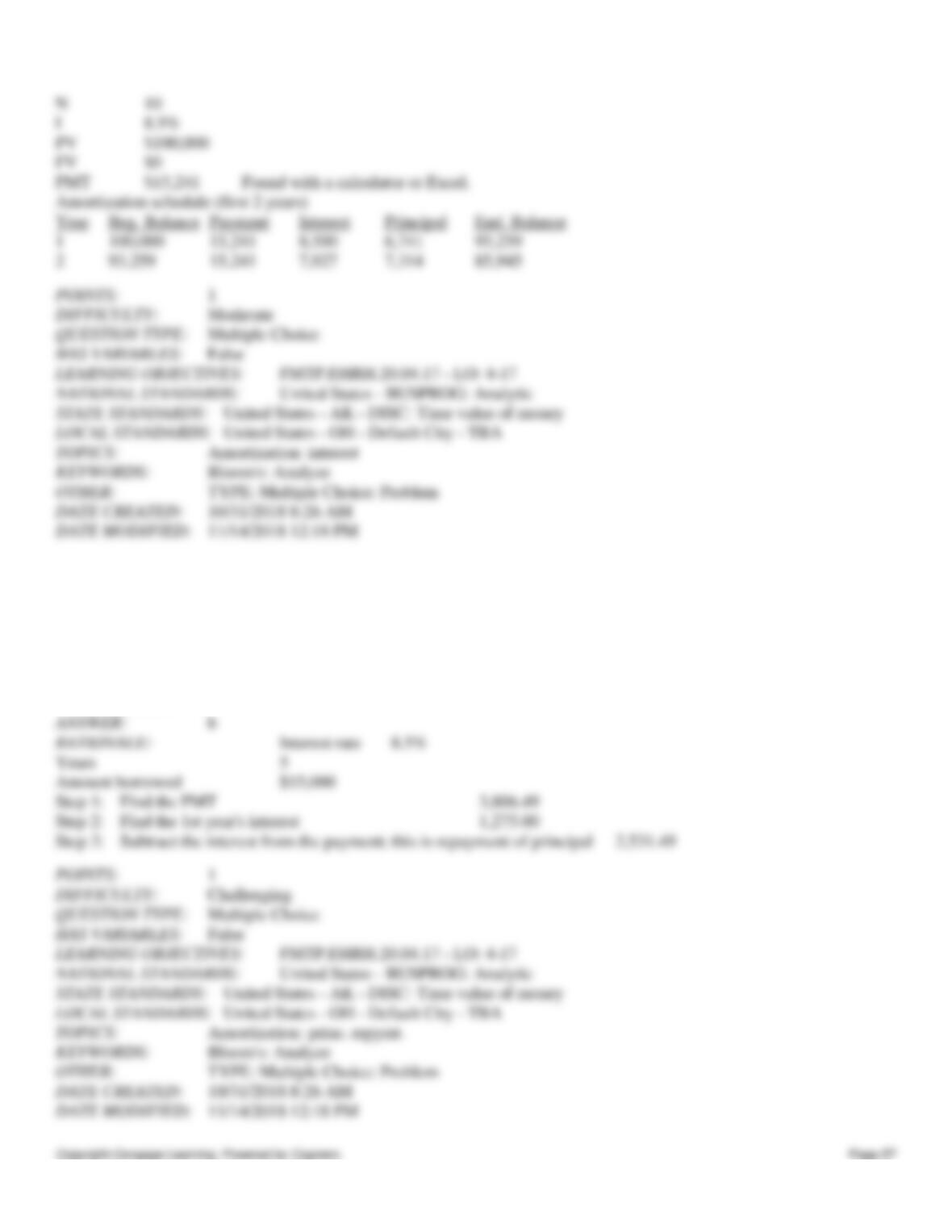
a. $1,200.33
b. $1,263.50
c. $1,330.00
d. $1,400.00
e. $1,470.00
Chapter 04: Time Value of Money
108. You plan to borrow $35,000 at a 7.5% annual interest rate. The terms require you to amortize the loan with 7 equal
end-of-year payments. How much interest would you be paying in Year 2?
a. $1,994.49
b. $2,099.46
c. $2,209.96
d. $2,326.27
e. $2,442.59
109. Your bank offers to lend you $100,000 at an 8.5% annual interest rate to start your new business. The terms require
you to amortize the loan with 10 equal end-of-year payments. How much interest would you be paying in Year 2?
a. $7,531
b. $7,927
c. $8,323
d. $8,740
e. $9,177
Chapter 04: Time Value of Money
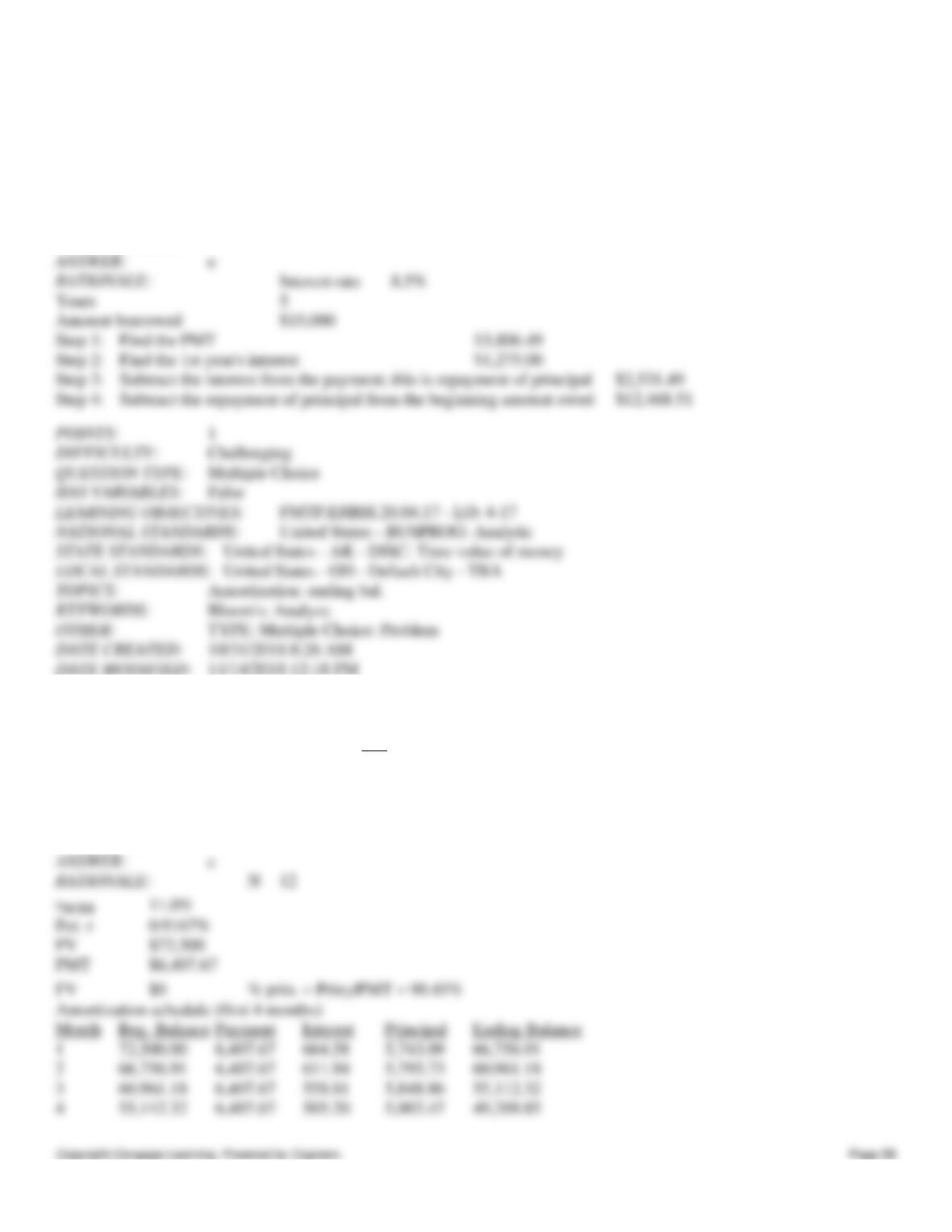
110. Suppose you borrowed $15,000 at a rate of 8.5% and must repay it in 5 equal installments at the end of each of the
next 5 years. By how much would you reduce the amount you owe in the first year?
a. $2,404.91
b. $2,531.49
c. $2,658.06
d. $2,790.96
e. $2,930.51
Chapter 04: Time Value of Money
111. Suppose you borrowed $15,000 at a rate of 8.5% and must repay it in 5 equal installments at the end of each of the
next 5 years. How much would you still owe at the end of the first year, after you have made the first payment?
a. $10,155.68
b. $10,690.19
c. $11,252.83
d. $11,845.09
e. $12,468.51
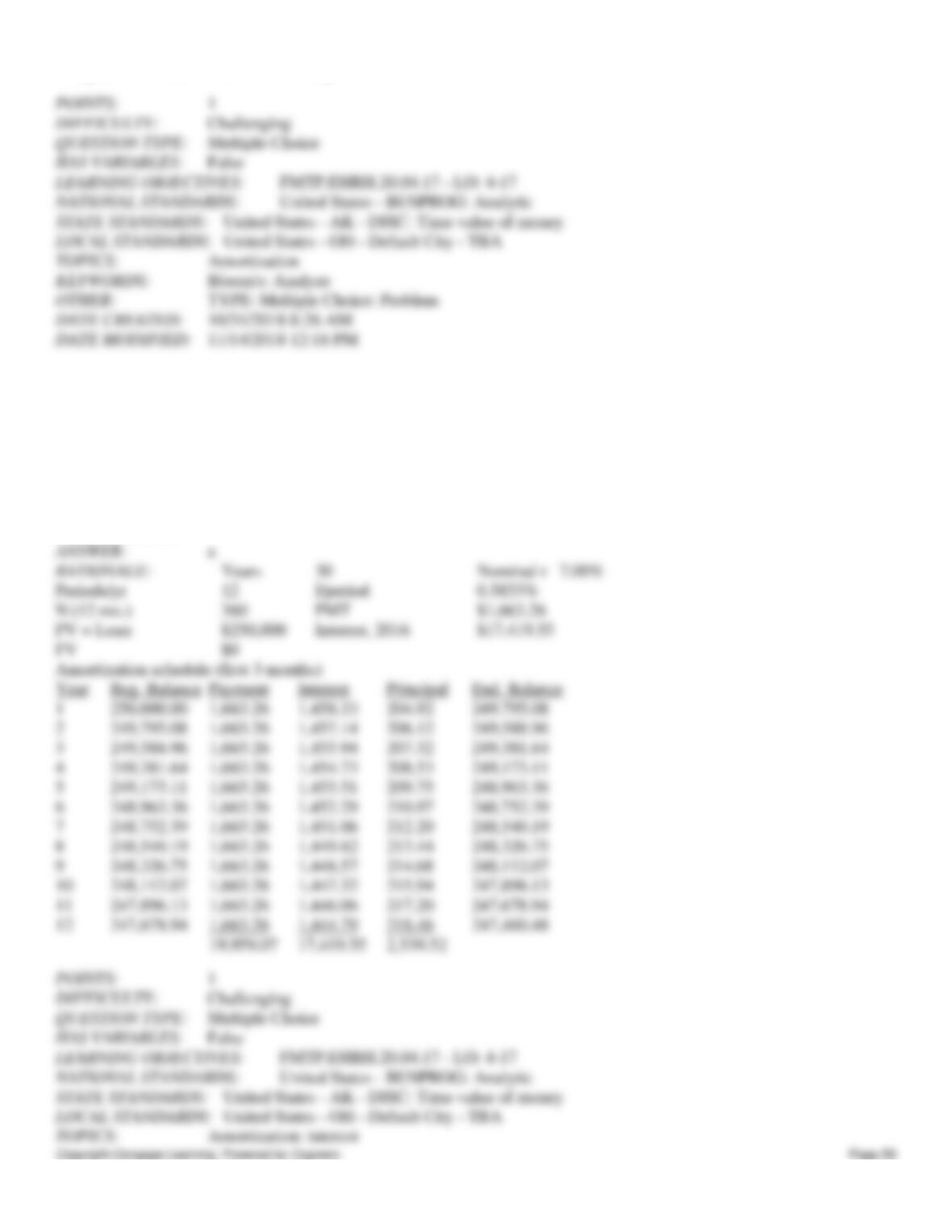
112. Your business has just taken out a 1-year installment loan for $72,500 at a nominal rate of 11.0% but with equal end-
of-month payments. What percentage of the 2nd monthly payment will go toward the repayment of principal?
a. 73.67%
b. 77.55%
c. 81.63%
d. 85.93%
e. 90.45%
Chapter 04: Time Value of Money
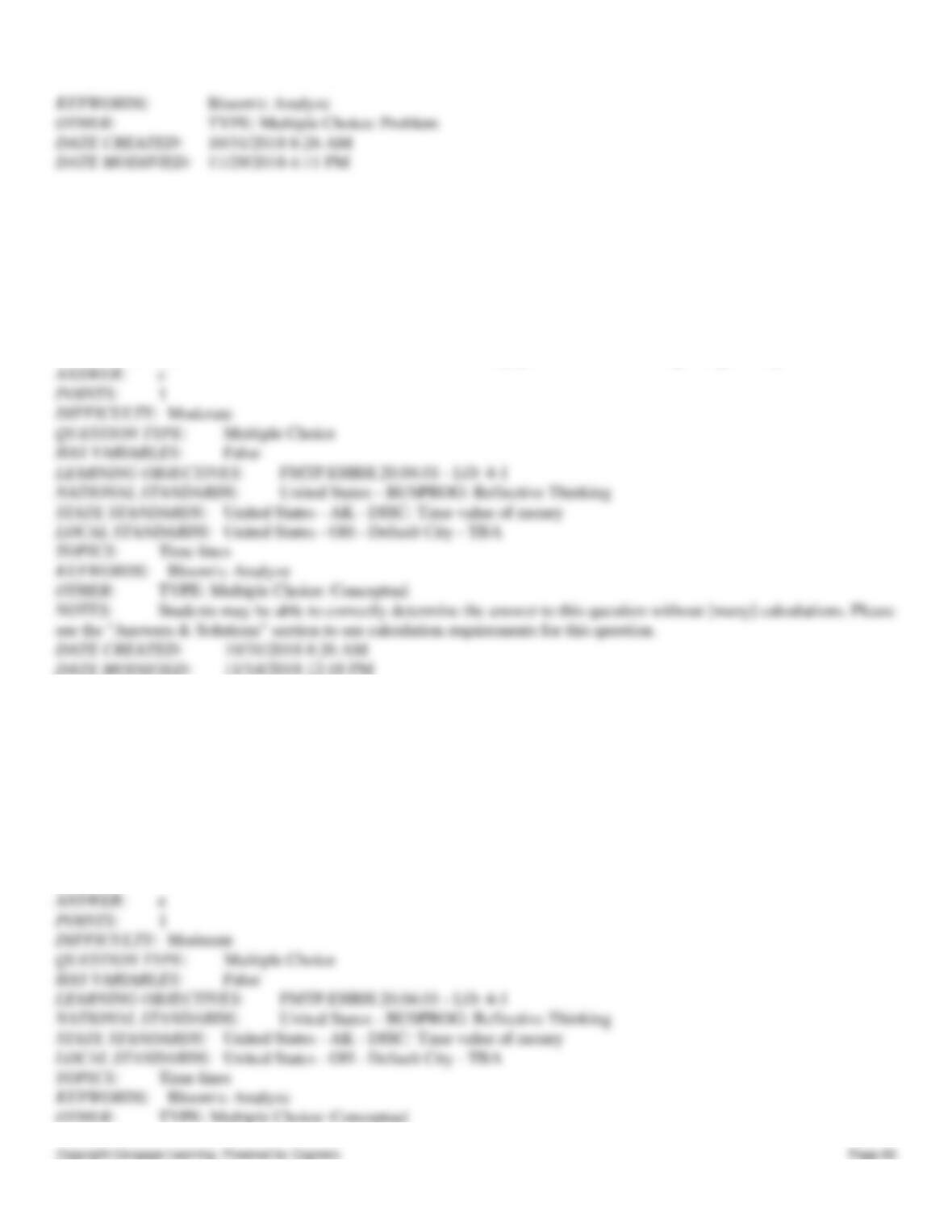
113. Your sister’s pet supplies business obtained a 30-year amortized mortgage loan for $250,000 at a nominal annual rate
of 7.0%, with 360 end-of-month payments. The firm can deduct the interest paid for tax purposes. What will the interest
tax deduction be for for the first year of the loan? (Assume she took out the loan on January 1.)
a. $17,419.55
b. $17,593.75
c. $17,769.68
d. $17,947.38
e. $18,126.85
Chapter 04: Time Value of Money
114. Which of the following statements is CORRECT?
a. Some of the cash flows shown on a time line can be in the form of annuity payments, but none can be uneven
amounts.
b. A time line is not meaningful unless all cash flows occur annually.
c. Time lines are useful for visualizing complex problems prior to doing actual calculations.
d. Time lines cannot be constructed in situations where some of the cash flows occur annually but others occur
quarterly.
e. Time lines cannot be constructed for annuities where the payments occur at the beginning of the periods.
115. Which of the following statements is CORRECT?
a. Some of the cash flows shown on a time line can be in the form of annuity payments, but none can be uneven
amounts.
b. A time line is not meaningful unless all cash flows occur annually.
c. Time lines are not useful for visualizing complex problems prior to doing actual calculations.
d. Time lines cannot be constructed in situations where some of the cash flows occur annually but others occur
quarterly.
e. Time lines can be constructed for annuities where the payments occur at either the beginning or the end of the
periods.