Chapter 04: Time Value of Money
48. Of the following investments, which would have the lowest present value? Assume that the effective annual rate for
all investments is the same and is greater than zero.
a. Investment A pays $250 at the end of every year for the next 10 years (a total of 10 payments).
b. Investment B pays $125 at the end of every 6-month period for the next 10 years (a total of 20 payments).
c. Investment C pays $125 at the beginning of every 6-month period for the next 10 years (a total of 20 payments).
d. Investment D pays $2,500 at the end of 10 years (just one payment).
e. Investment E pays $250 at the beginning of every year for the next 10 years (a total of 10 payments).
49. A U.S. Treasury bond will pay a lump sum of $1,000 exactly 3 years from today. The nominal interest rate is 6%,
semiannual compounding. Which of the following statements is CORRECT?
a. The PV of the $1,000 lump sum has a higher present value than the PV of a 3-year, $333.33 ordinary annuity.
Chapter 04: Time Value of Money
b. The periodic interest rate is greater than 3%.
c. The periodic rate is less than 3%.
d. The present value would be greater if the lump sum were discounted back for more periods.
e. The present value of the $1,000 would be smaller if interest were compounded monthly rather than semiannually.
50. A U.S. Treasury bond will pay a lump sum of $1,000 exactly 3 years from today. The nominal interest rate is 6%,
semiannual compounding. Which of the following statements is CORRECT?
a. The PV of the $1,000 lump sum has a smaller present value than the PV of a 3-year, $333.33 ordinary annuity.
b. The periodic interest rate is greater than 3%.
c. The periodic rate is less than 3%.
d. The present value would be greater if the lump sum were discounted back for more periods.
e. The present value of the $1,000 would be larger if interest were compounded monthly rather than semiannually.
51. Which of the following statements is CORRECT, assuming positive interest rates and holding other things constant?
a. Banks A and B offer the same nominal annual rate of interest, but A pays interest quarterly and B pays
semiannually. Deposits in Bank B will provide the higher future value if you leave your funds on deposit.
b. The present value of a 5-year, $250 annuity due will be lower than the PV of a similar ordinary annuity.
c. A 30-year, $150,000 amortized mortgage will have larger monthly payments than an otherwise similar 20-year
mortgage.
d. A bank loan’s nominal interest rate will always be equal to or less than its effective annual rate.
Chapter 04: Time Value of Money
e. If an investment pays 10% interest, compounded annually, its effective annual rate will be less than 10%.
52. Which of the following statements is CORRECT, assuming positive interest rates and holding other things constant?
a. Banks A and B offer the same nominal annual rate of interest, but A pays interest quarterly and B pays
semiannually. Deposits in Bank B will provide the higher future value if you leave your funds on deposit.
b. The present value of a 5-year, $250 annuity due will be lower than the PV of a similar ordinary annuity.
c. A 30-year, $150,000 amortized mortgage will have larger monthly payments than an otherwise similar 20-year
mortgage.
d. A bank loan’s nominal interest rate will always be equal to or greater than its effective annual rate.
e. If an investment pays 10% interest, compounded quarterly, its effective annual rate will be greater than 10%.
53. Which of the following statements is CORRECT?
a. An investment that has a nominal rate of 6% with semiannual payments will have an effective rate that is smaller
than 6%.
b. The present value of a 3-year, $150 annuity due will exceed the present value of a 3-year, $150 ordinary annuity.
c. If a loan has a nominal annual rate of 8%, then the effective rate can never be greater than 8%.
d. If a loan or investment has annual payments, then the effective, periodic, and nominal rates of interest will all be
different.
e. The proportion of the payment that goes toward interest on a fully amortized loan increases over time.
Chapter 04: Time Value of Money
54. Which of the following statements is CORRECT?
a. An investment that has a nominal rate of 6% with semiannual payments will have an effective rate that is smaller
than 6%.
b. The present value of a 3-year, $150 ordinary annuity will exceed the present value of a 3-year, $150 annuity due.
c. If a loan has a nominal annual rate of 7%, then the effective rate will never be less than 7%.
d. If a loan or investment has annual payments, then the effective, periodic, and nominal rates of interest will all be
different.
e. The proportion of the payment that goes toward interest on a fully amortized loan increases over time.
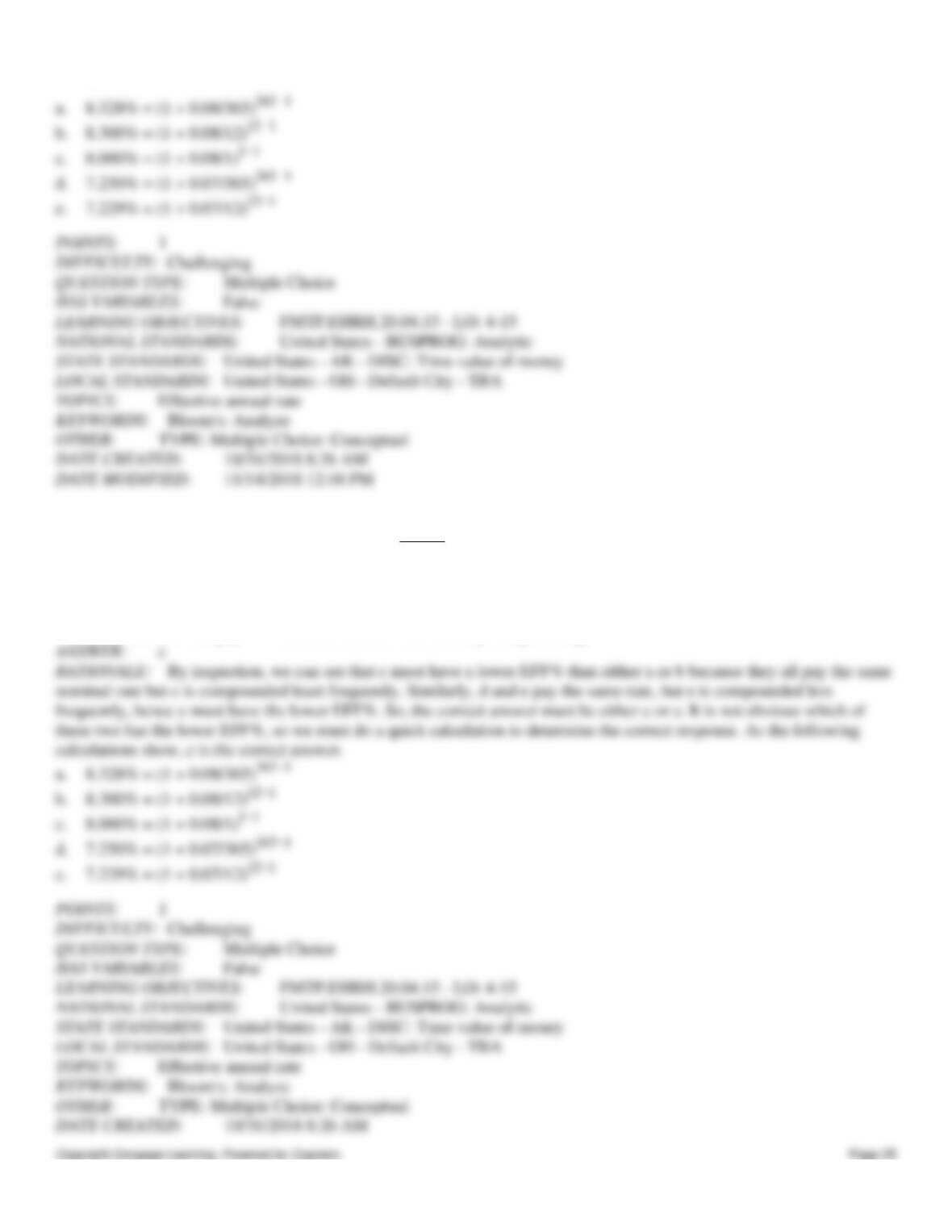
55. Which of the following bank accounts has the highest effective annual return?
a. An account that pays 8% nominal interest with daily (365-day) compounding.
b. An account that pays 8% nominal interest with monthly compounding.
c. An account that pays 8% nominal interest with annual compounding.
d. An account that pays 7% nominal interest with daily (365-day) compounding.
e. An account that pays 7% nominal interest with monthly compounding.
Chapter 04: Time Value of Money
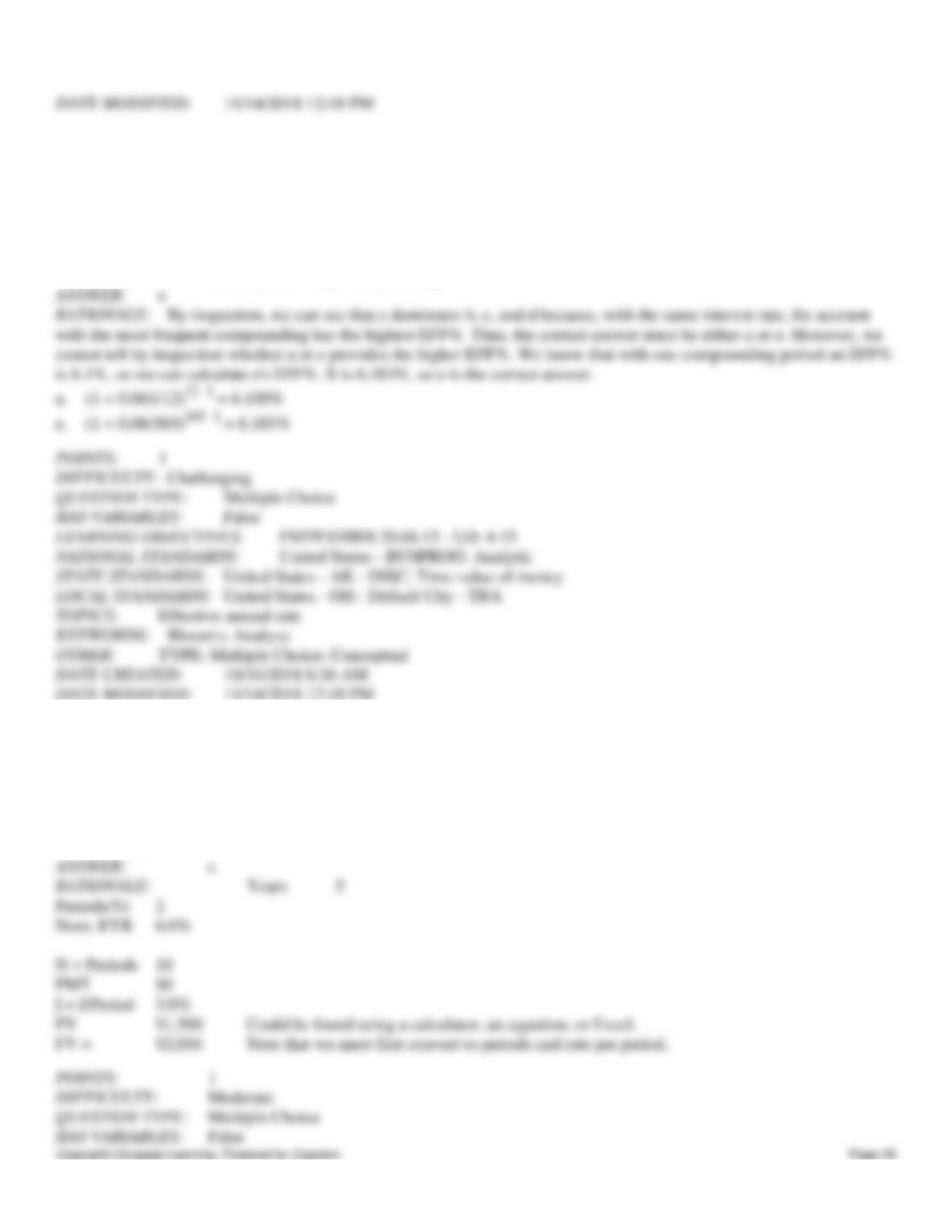
56. Which of the following bank accounts has the lowest effective annual return?
a. An account that pays 8% nominal interest with daily (365-day) compounding.
b. An account that pays 8% nominal interest with monthly compounding.
c. An account that pays 8% nominal interest with annual compounding.
d. An account that pays 7% nominal interest with daily (365-day) compounding.
e. An account that pays 7% nominal interest with monthly compounding.
Chapter 04: Time Value of Money
57. You plan to invest some money in a bank account. Which of the following banks provides you with the highest
effective rate of interest?
a. Bank 1; 6.1% with annual compounding.
b. Bank 2; 6.0% with monthly compounding.
c. Bank 3; 6.0% with annual compounding.
d. Bank 4; 6.0% with quarterly compounding.
e. Bank 5; 6.0% with daily (365-day) compounding.
58. What’s the future value of $1,500 after 5 years if the appropriate interest rate is 6%, compounded semiannually?
a. $1,819
b. $1,915
c. $2,016
d. $2,117
e. $2,223
Chapter 04: Time Value of Money
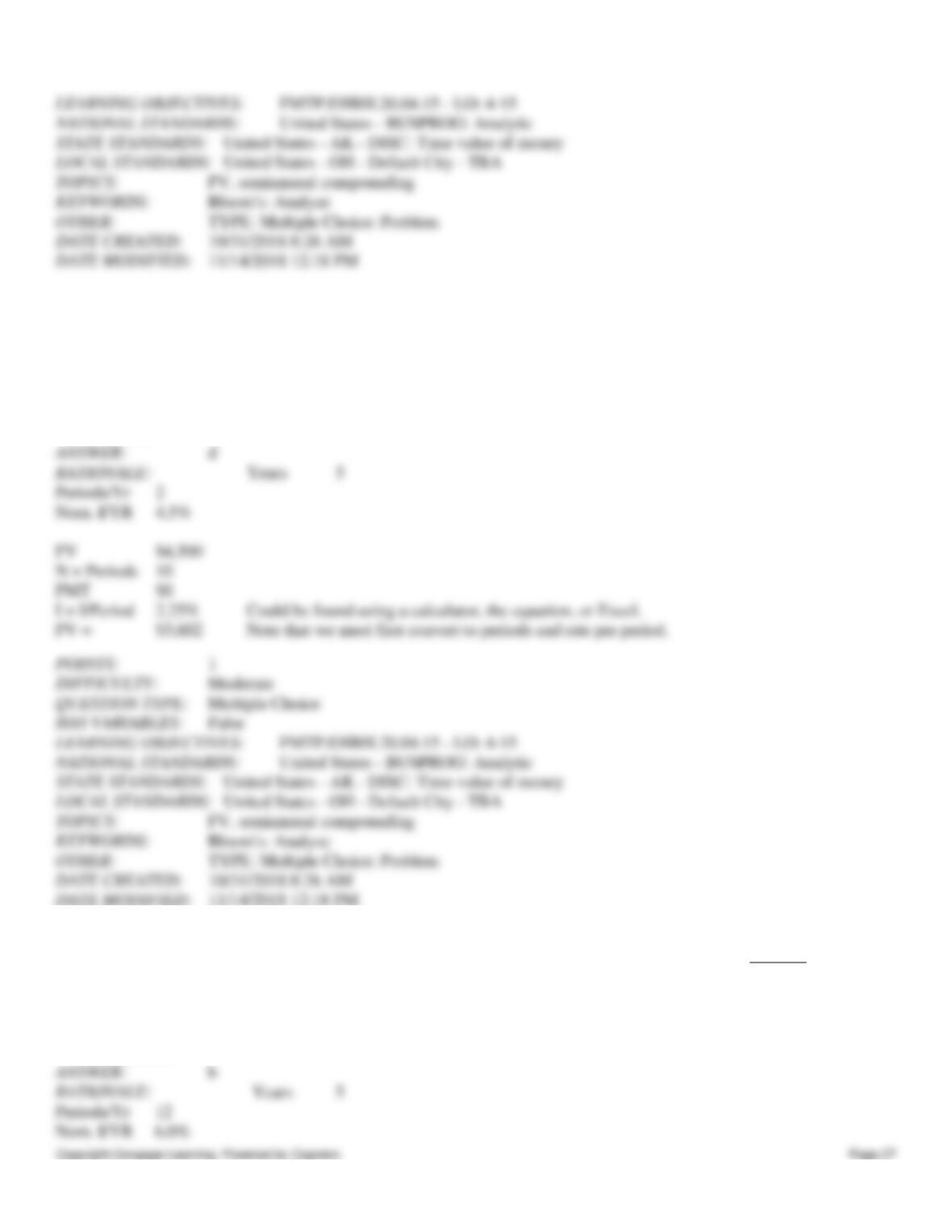
59. What’s the present value of $4,500 discounted back 5 years if the appropriate interest rate is 4.5%, compounded
semiannually?
a. $3,089
b. $3,251
c. $3,422
d. $3,602
e. $3,782
60. What’s the future value of $1,200 after 5 years if the appropriate interest rate is 6%, compounded monthly?
a. $1,537.69
b. $1,618.62
c. $1,699.55
d. $1,784.53
e. $1,873.76
Chapter 04: Time Value of Money
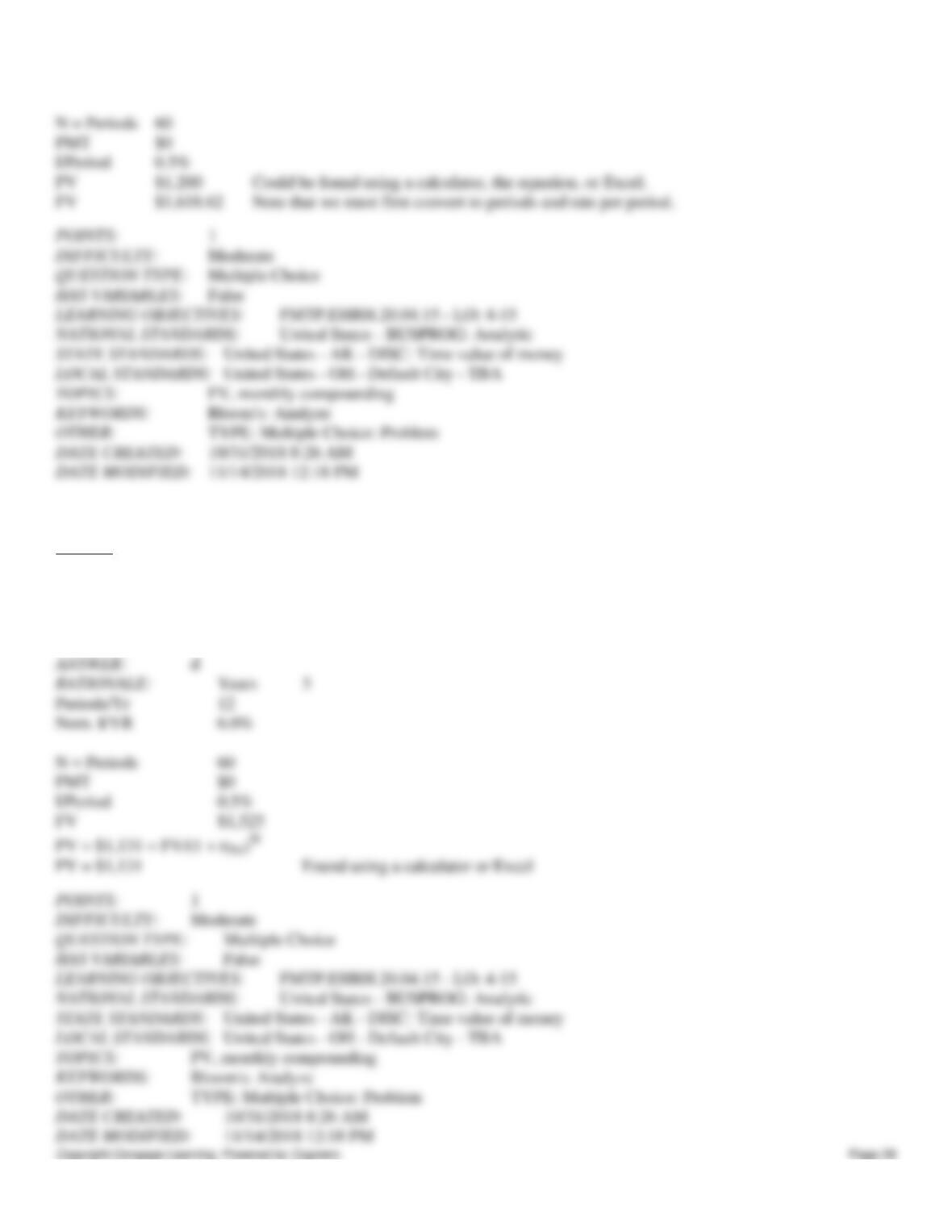
61. What’s the present value of $1,525 discounted back 5 years if the appropriate interest rate is 6%, compounded
monthly?
a. $969
b. $1,020
c. $1,074
d. $1,131
e. $1,187
Chapter 04: Time Value of Money
62. American Express and other credit card issuers must by law print the Annual Percentage Rate (APR) on their monthly
statements. If the APR is stated to be 18.00%, with interest paid monthly, what is the card’s EFF%?
a. 18.58%
b. 19.56%
c. 20.54%
d. 21.57%
e. 22.65%
63. Southwestern Bank offers to lend you $50,000 at a nominal rate of 6.5%, compounded monthly. The loan (principal
plus interest) must be repaid at the end of the year. Woodburn Bank also offers to lend you the $50,000, but it will charge
an annual rate of 7.0%, with no interest due until the end of the year. How much higher or lower is the effective annual
rate charged by Woodburn versus the rate charged by Southwestern?
a. 0.52%
b. 0.44%
c. 0.36%
d. 0.30%
e. 0.24%
Chapter 04: Time Value of Money
64. Suppose United Bank offers to lend you $10,000 for one year at a nominal annual rate of 8.00%, but you must make
interest payments at the end of each quarter and then pay off the $10,000 principal amount at the end of the year. What is
the effective annual rate on the loan?
a. 8.24%
b. 8.45%
c. 8.66%
d. 8.88%
e. 9.10%
65. Suppose People’s bank offers to lend you $10,000 for 1 year on a loan contract that calls for you to make interest
payments of $250.00 at the end of each quarter and then pay off the principal amount at the end of the year. What is the
effective annual rate on the loan?
a. 8.46%
b. 8.90%
c. 9.37%
d. 9.86%
e. 10.38%
Chapter 04: Time Value of Money
66. Pacific Bank pays a 4.50% nominal rate on deposits, with monthly compounding. What effective annual rate (EFF%)
does the bank pay?
a. 3.72%
b. 4.13%
c. 4.59%
d. 5.05%
e. 5.56%
67. Suppose your credit card issuer states that it charges a 15.00% nominal annual rate, but you must make monthly
payments, which amounts to monthly compounding. What is the effective annual rate?
a. 15.27%
b. 16.08%
c. 16.88%
Chapter 04: Time Value of Money
d. 17.72%
e. 18.61%
68. You just deposited $2,500 in a bank account that pays a 4.0% nominal interest rate, compounded quarterly. If you also
add another $5,000 to the account one year (4 quarters) from now and another $7,500 to the account two years (8 quarters)
from now, how much will be in the account three years (12 quarters) from now?
a. $15,234.08
b. $16,035.88
c. $16,837.67
d. $17,679.55
e. $18,563.53
Chapter 04: Time Value of Money
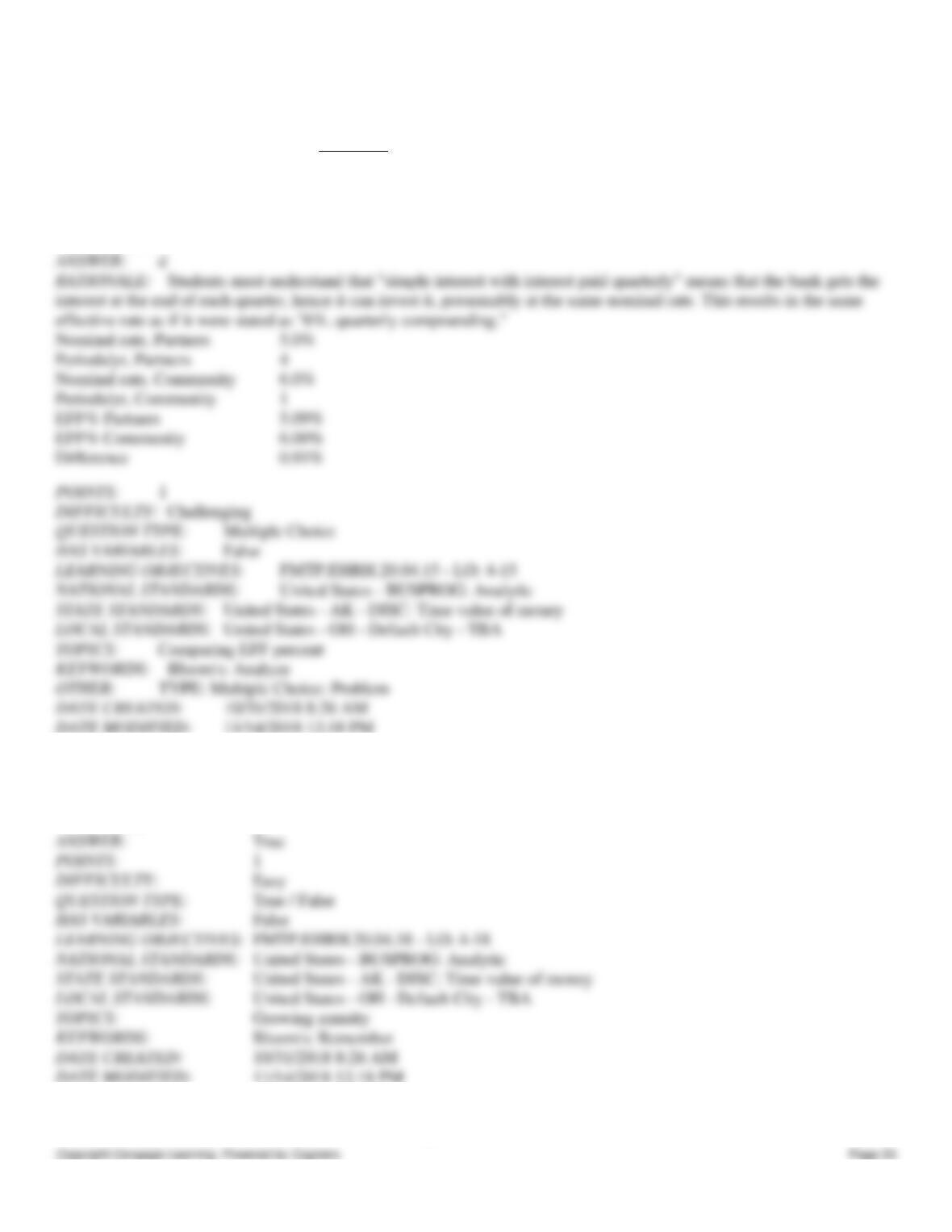
69. Partners Bank offers to lend you $50,000 at a nominal rate of 5.0%, simple interest, with interest paid quarterly. An
offer to lend you the $50,000 also comes from Community Bank, but it will charge 6.0%, simple interest, with interest
paid at the end of the year. What’s the difference in the effective annual rates charged by the two banks?
a. 1.56%
b. 1.30%
c. 1.09%
d. 0.91%
e. 0.72%
70. A “growing annuity” is a cash flow stream that grows at a constant rate for a specified number of periods.
a. True
b. False
71. A “growing annuity” is any cash flow stream that grows over time.
Chapter 04: Time Value of Money
a. True
b. False
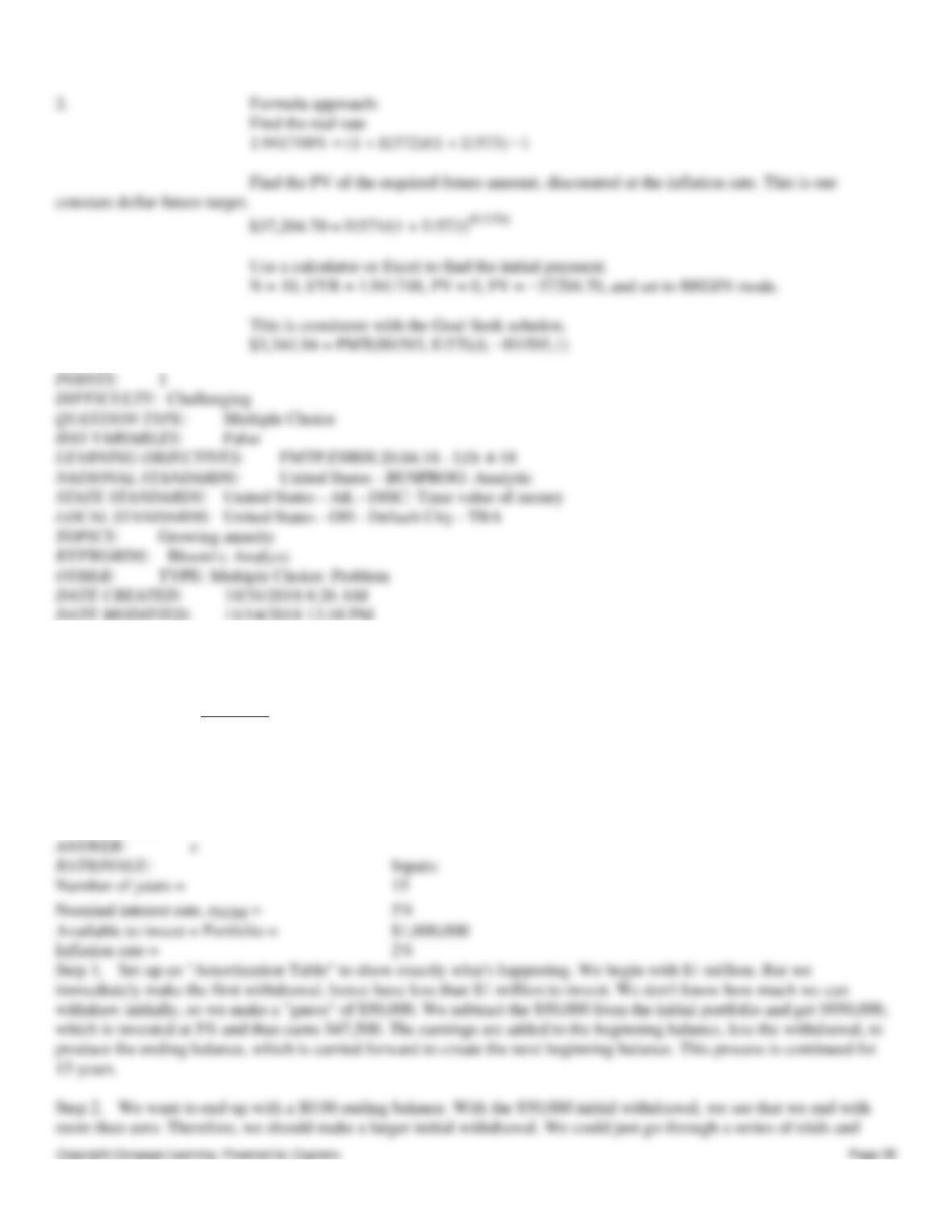
72. You borrowed $50,000 which you must repay in 10 years. You plan to make an initial deposit today, then make 9
more deposits at the beginning of each the next 9 years, but with the deposits increasing at the inflation rate. You expect
to earn 5% on your funds, and you expect a 3% inflation rate. To the nearest dollar, how large must your initial deposit be
to enable you to reach your $50,000 target?
a. $3,008
b. $3,342
c. $3,676
d. $4,044
e. $4,448
Chapter 04: Time Value of Money
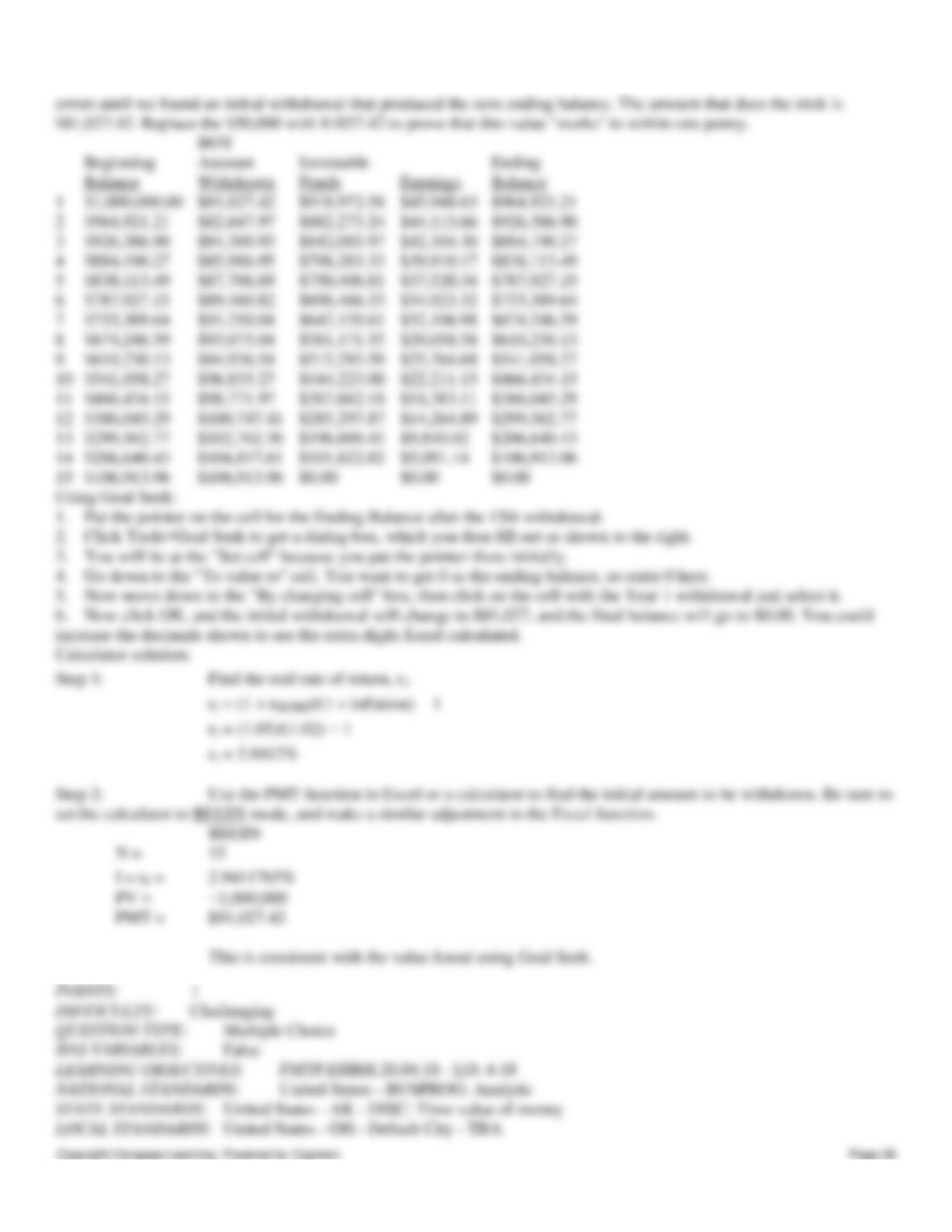
73. Your 75-year-old grandmother expects to live for another 15 years. She currently has $1,000,000 of savings, which is
invested to earn a guaranteed 5% rate of return. If inflation averages 2% per year, how much can she withdraw (to the
nearest dollar) at the beginning of each year and keep the withdrawals constant in real terms, i.e., growing at the same rate
as inflation and thus enabling her to maintain a constant standard of living?
a. $65,632
b. $72,925
c. $81,027
d. $89,130
e. $98,043
Chapter 04: Time Value of Money
Chapter 04: Time Value of Money
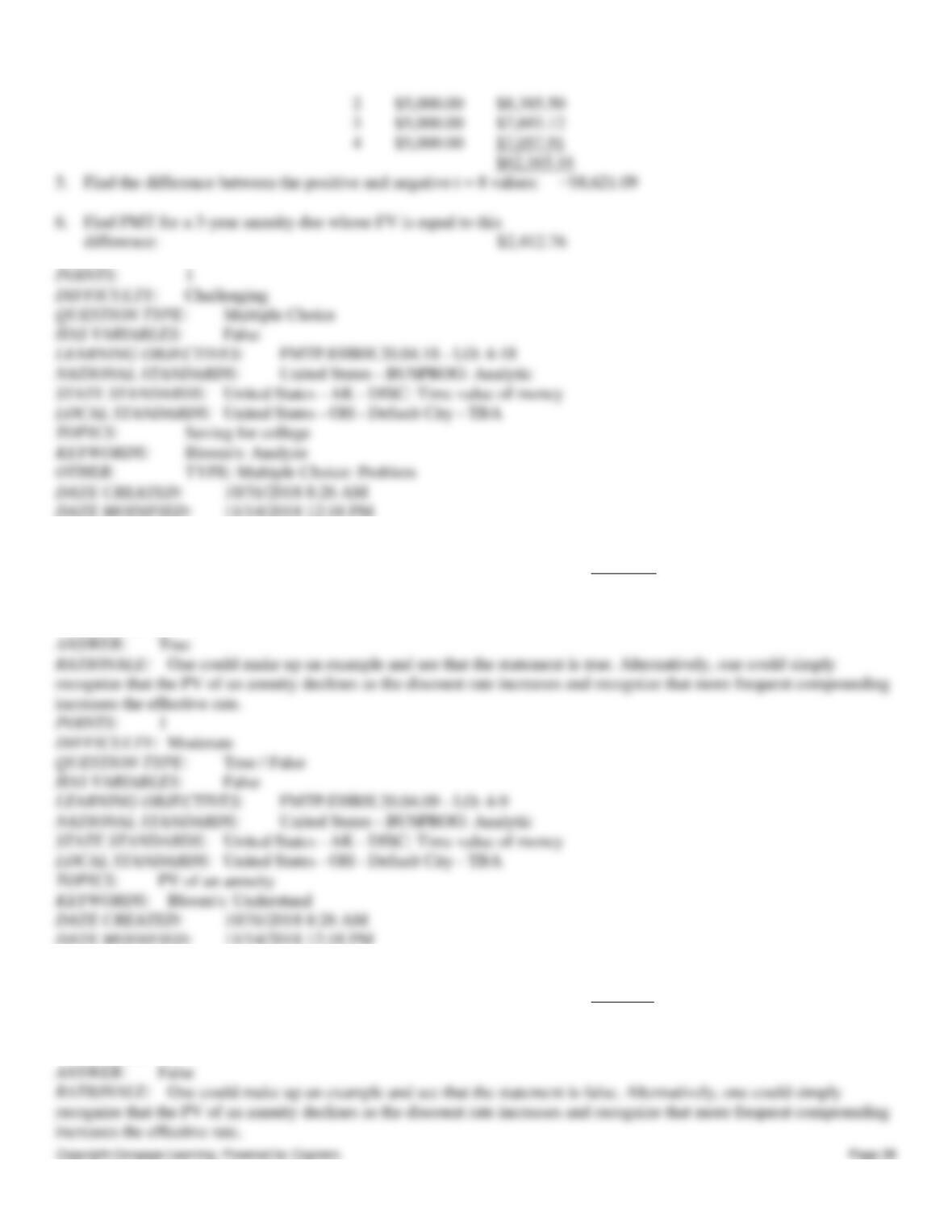
74. Scott and Linda have been saving to pay for their daughter Casie’s college education. Casie just turned 10 at (t = 0),
and she will be entering college 8 years from now (at t = 8). College tuition and expenses at State U. are currently $14,500
a year, but they are expected to increase at a rate of 3.5% a year. Ellen should graduate in 4 years⎯if she takes longer or
wants to go to graduate school, she will be on her own. Tuition and other costs will be due at the beginning of each school
year (at t = 8, 9, 10, and 11).
So far, Scott and Linda have accumulated $15,000 in their college savings account (at t = 0). Their long-run financial plan
is to add an additional $5,000 in each of the next 4 years (at t = 1, 2, 3, and 4). Then they plan to make 3 equal annual
contributions in each of the following years, t = 5, 6, and 7. They expect their investment account to earn 9%. How large
must the annual payments at t = 5, 6, and 7 be to cover Casie’s anticipated college costs?
a. $1,965.21
b. $2,068.64
c. $2,177.51
d. $2,292.12
e. $2,412.76
Chapter 04: Time Value of Money
75. All other things held constant, the present value of a given annual annuity decreases as the number of periods per year
increases.
a. True
b. False
76. All other things held constant, the present value of a given annual annuity increases as the number of periods per year
increases.
a. True
b. False
Chapter 04: Time Value of Money
77. You are considering two equally risky annuities, each of which pays $15,000 per year for 20 years. Investment ORD
is an ordinary (or deferred) annuity, while Investment DUE is an annuity due. Which of the following statements is
CORRECT?
a. If the going rate of interest decreases from 10% to 0%, the difference between the present value of ORD and the
present value of DUE would remain constant.
b. The present value of ORD must exceed the present value of DUE, but the future value of ORD may be less than
the future value of DUE.
c. The present value of DUE exceeds the present value of ORD, while the future value of DUE is less than the future
value of ORD.
d. The present value of ORD exceeds the present value of DUE, and the future value of ORD also exceeds the future
value of DUE.
e. The present value of DUE exceeds the present value of ORD, and the future value of DUE also exceeds the future
value of ORD.
78. You are considering two equally risky annuities, each of which pays $25,000 per year for 10 years. Investment ORD
is an ordinary (or deferred) annuity, while Investment DUE is an annuity due. Which of the following statements is
CORRECT?
a. If the going rate of interest decreases from 10% to 0%, the difference between the present value of ORD and the
present value of DUE would remain constant.
b. A rational investor would be willing to pay more for DUE than for ORD, so their market prices should differ.
c. The present value of DUE exceeds the present value of ORD, while the future value of DUE is less than the future
value of ORD.
Chapter 04: Time Value of Money
d. The present value of ORD exceeds the present value of DUE, and the future value of ORD also exceeds the future
value of DUE.
e. The present value of ORD exceeds the present value of DUE, while the future value of DUE exceeds the future
value of ORD.
79. What is the PV of an ordinary annuity with 10 payments of $2,700 if the appropriate interest rate is 5.5%?
a. $16,576
b. $17,449
c. $18,367
d. $19,334
e. $20,352
80. What is the PV of an ordinary annuity with 5 payments of $4,700 if the appropriate interest rate is 4.5%?
a. $16,806
b. $17,690
c. $18,621