33) Studies by economists suggest that
A) households do not increase their saving as the government’s dissaving increases.
B) households increase their saving, but not by the full amount of an increase in government
dissaving.
C) households also increase their dissaving when the government increases its dissaving.
D) households also increase their saving when the government increases its saving.
34) If the government increases taxes while holding expenditures constant,
A) the bond supply curve will shift to the left and the equilibrium interest rate will fall.
B) the bond supply curve will shift to the right and the real interest rate will fall.
C) government borrowing will be increased.
D) the government’s deficit will increase.
35) If households increase their saving at the same time that the government increases its deficit,
A) the demand and supply curves for bonds will be unaffected.
B) the demand curve for bonds will shift to the left.
C) the supply curve for bonds will shift to the right.
D) the equilibrium interest rate will definitely rise.
36) The supply curve for bonds would be shifted to the right by
A) a decrease in expected profitability.
B) a decrease in the corporate tax on profits.
C) a decrease in tax subsidies for investment.
D) a decrease in government borrowing.
37) The supply curve for bonds would be shifted to the left by
A) a decrease in government borrowing.
B) a decrease in the corporate tax on profits.
C) an increase in tax subsidies for investment.
D) an increase in expected inflation.
38) Assess the impact on the bond market of the rise in Internet trading of stocks.
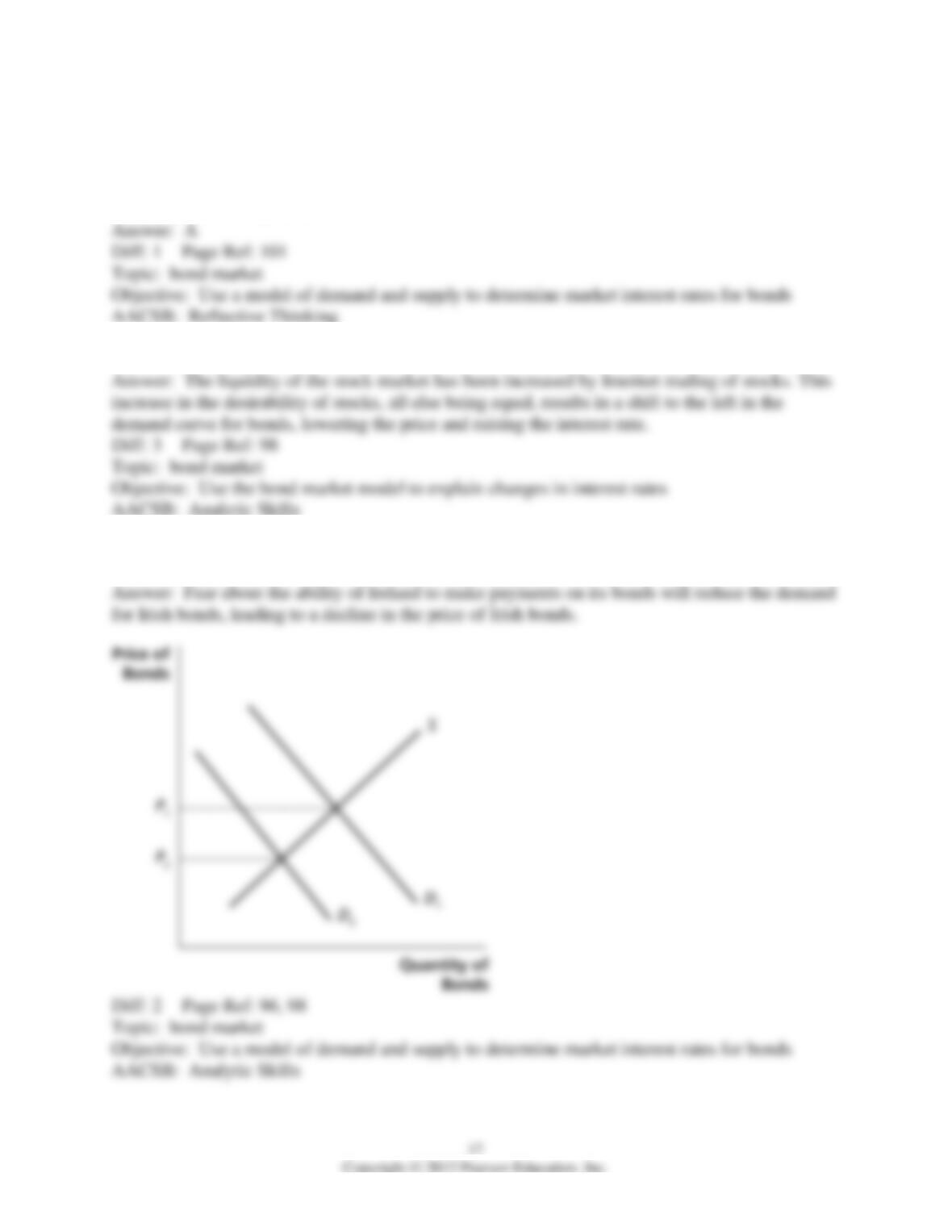
39) In November 2010, concern was raised about Ireland’s sovereign debt. Make use of a graph
of the bond market to show how this would affect the price of Irish bonds.
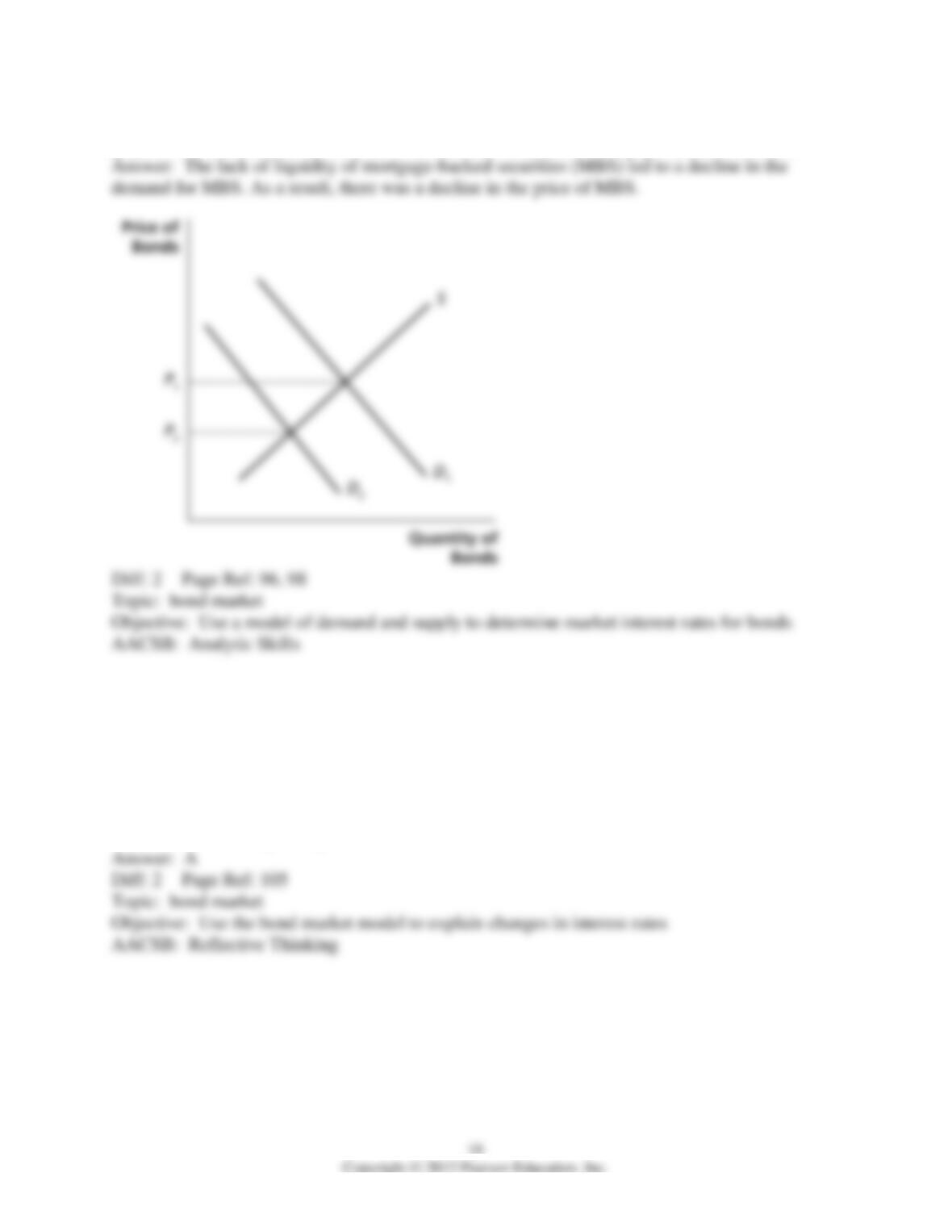
40) In 2008, the liquidity of mortgage-backed securities declined significantly. Make use of a
graph of the bond market to show how this affected the price of mortgage-backed securities.
4.3 The Bond Market Model and Changes in Interest Rates
1) Which of the following is the most likely explanation of Japan’s very low market interest rates
in the early 2000s?
A) expected deflation
B) an increasing budget deficit
C) an increasing trade surplus
D) an increase in corporate profits
2) The Federal Reserve issues a report indicating that future inflation will be higher than had
previously seemed likely. As a result
A) the supply curve for bonds shifts to the right.
B) the demand curve for loanable funds shifts to the left.
C) the equilibrium interest rate falls.
D) the equilibrium price of bonds rises.
3) During a period of economic expansion, when expected profitability is high,
A) the demand curve for bonds shifts to the left.
B) the supply curve of bonds shifts to the right.
C) the equilibrium interest rate falls.
D) the equilibrium price of bonds rises.
4) During an economic recession,
A) the bond demand and supply curves both shift to the left and the equilibrium interest rate
usually falls.
B) the bond demand and supply curves both shift to the right and the equilibrium interest rate
usually rises.
C) the bond demand curve shifts to the right, the bond supply curve shifts to the left, and the
equilibrium interest rate usually falls.
D) the bond demand curve shifts to the left, the bond supply curve shifts to the right, and the
equilibrium interest rate usually rises.
5) During an economic recession,
A) the demand and supply curves for loanable funds both shift to the right and the equilibrium
interest rate usually rises.
B) the demand and supply curves for loanable funds both shift to the left and the equilibrium
interest rate usually falls.
C) the demand curve for loanable funds shifts to the right, the supply curve for loanable funds
shifts to the left, and the equilibrium interest rate usually falls.
D) the demand curve for loanable funds shifts to the left, the supply curve for loanable funds
shifts to the right, and the equilibrium interest rate usually rises.
6) A decrease in expected inflation
A) usually leads to falling nominal interest rates.
B) results in increased nominal capital gains on physical assets.
C) will shift the bond demand curve to the left.
D) will shift the supply curve for loanable funds to the left.
7) As a result of higher expected inflation,
A) the demand and supply curves for loanable funds both shift to the right and the equilibrium
interest rate usually rises.
B) the demand and supply curves for loanable funds both shift to the left and the equilibrium
interest rate usually falls.
C) the demand curve for loanable funds shifts to the right, the supply curve for loanable funds
shifts to the left, and the equilibrium interest rate usually rises.
D) the demand curve for loanable funds shifts to the left, the supply curve for loanable funds
shifts to the right, and the equilibrium interest rate usually rises.
8) If expected inflation declines by 2%, what should happen to nominal interest rates according
to the Fisher effect?
A) rise by 2%
B) fall by 2%
C) be cut in half
D) double in size
9) An increase in expected inflation results in
A) lower nominal interest rates and higher bond prices.
B) lower real interest rates and higher bond prices.
C) higher real interest rates and lower bond prices.
D) higher nominal interest rates and lower bond prices.
10) The idea that nominal interest rates rise or fall one-for-one with expected inflation is known
as
A) market risk.
B) systematic risk.
C) idiosyncratic risk.
D) the Fisher effect.
11) During 2000, the government repurchased $30 billion in U.S. Treasury bonds outstanding.
This was the first time this had been done since the administration of Herbert Hoover in the early
1930s. Analyze the impact of this repurchase on the bond market.
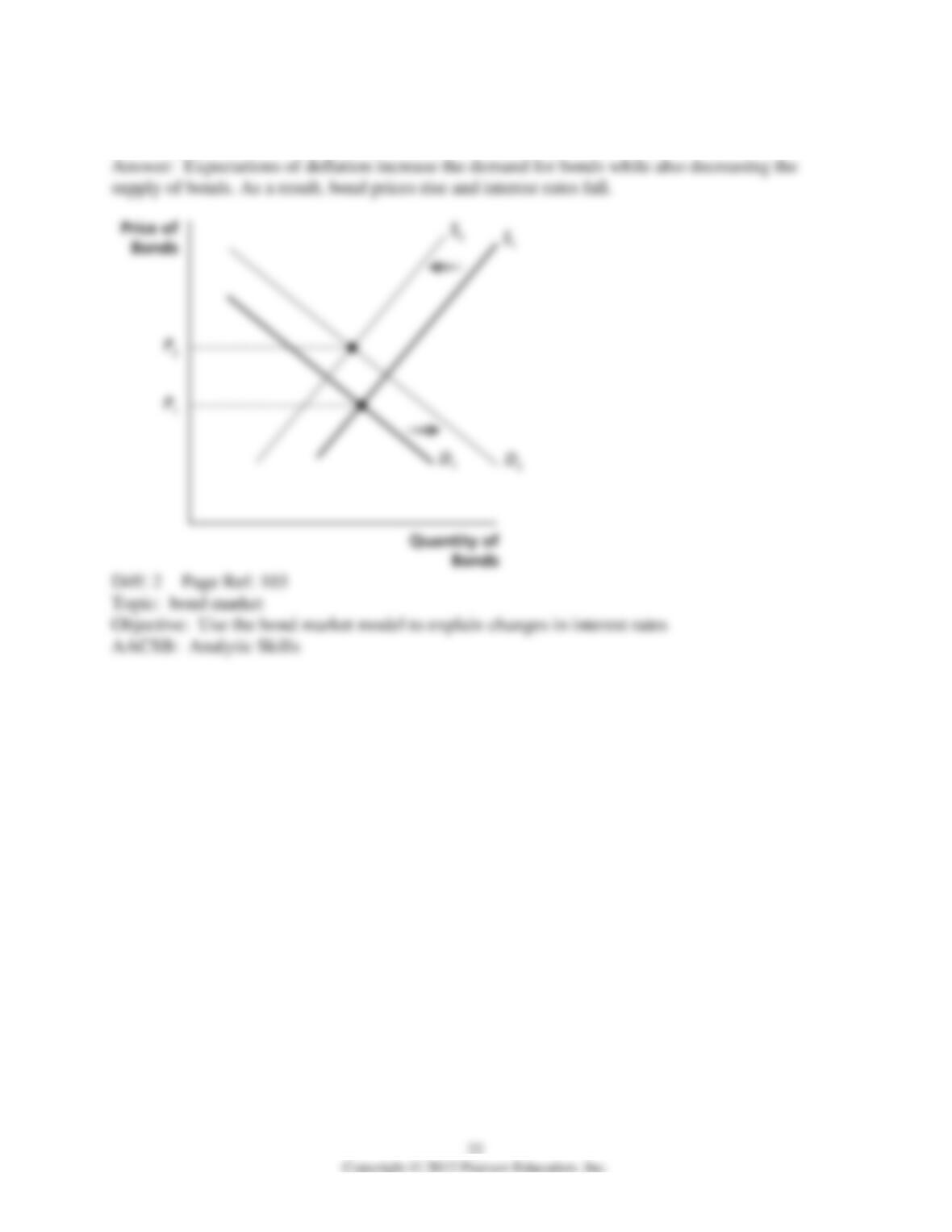
12) In late 2008 and early 2009, many feared that the economy may experience deflation. Make
use of a graph of the bond market to show how this affected interest rates.
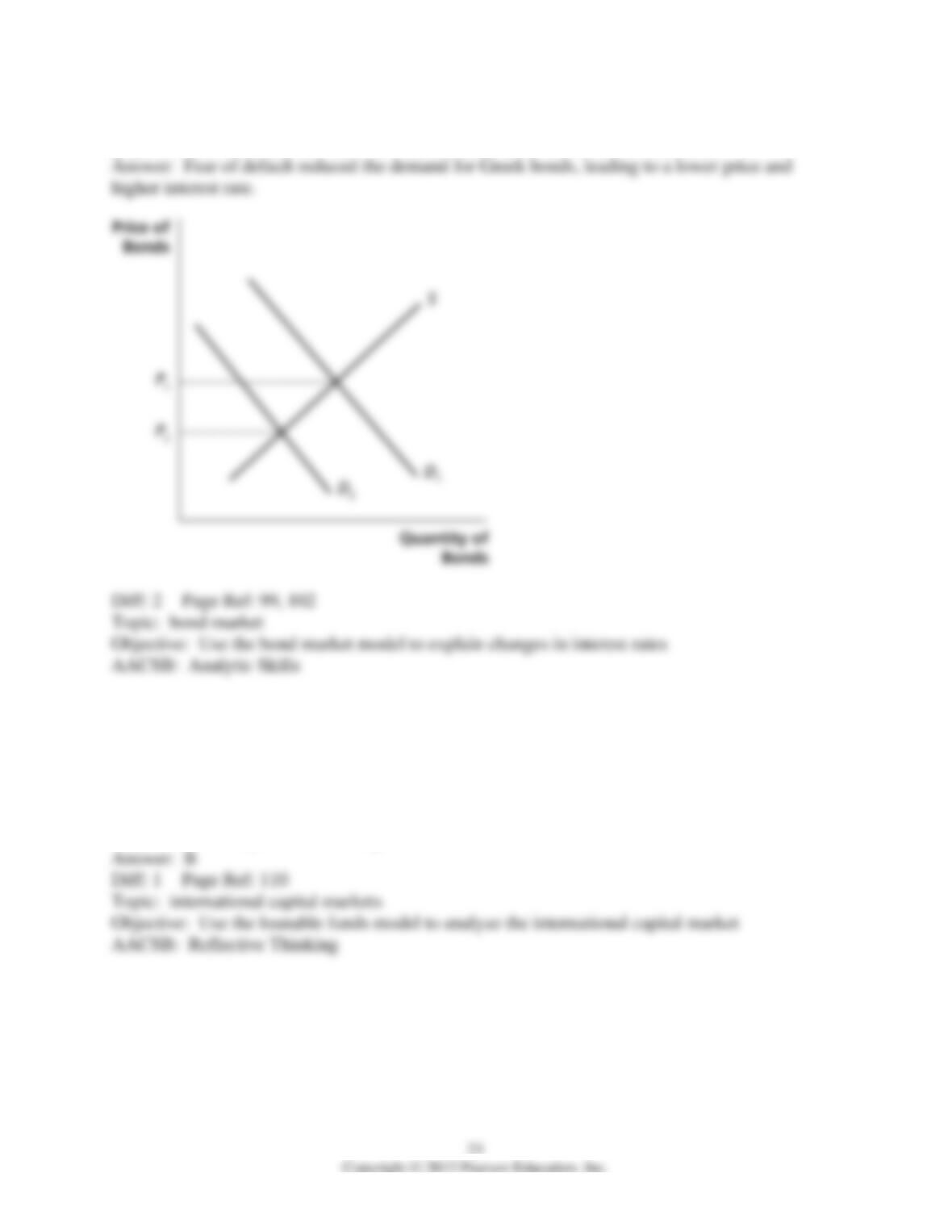
13) In Spring 2010, many investors feared that Greece may default on its bonds. Make use of a
graph of the bond market to show how this affected interest rates on Greek bonds.
4.4 The Loanable Funds Model and International Capital Market
1) A closed economy is one that
A) has no government sector.
B) neither borrows from nor lends to foreign countries.
C) produces mainly agricultural goods.
D) produces mainly manufactured goods.
2) Loanable funds refers to
A) only those funds loaned from one bank to another.
B) only those funds loaned to banks by the Federal Reserve.
C) only those funds loaned by banks to private individuals.
D) all those funds changing hands between lenders and borrowers in the bond market.
3) The supply curve for loanable funds would increase due to a(n)
A) increase in wealth.
B) increase in expected inflation.
C) decrease in the liquidity of bonds relative to other assets.
D) increase in the information costs of bonds relative to other assets.
4) The supply curve of loanable funds slopes up because
A) at higher bond prices more loanable funds will be supplied.
B) higher interest rates reduce the inflation rate.
C) an increase in the interest rate makes lenders more willing and able to supply more funds.
D) a decrease in the interest rate makes lenders more willing and able to supply more funds.
5) The demand for bonds is
A) equivalent to the demand for loanable funds.
B) equivalent to the supply of loanable funds.
C) represented by an upward-sloping line when the price of bonds is on the vertical axis and the
quantity of bonds demanded is on the horizontal axis.
D) represented by a downward-sloping line when the interest rate is on the vertical axis and the
quantity of bonds demanded is on the horizontal axis.
6) Which of the following statements is correct?
A) The supply curve for loanable funds slopes up, whereas the supply curve for bonds slopes
down.
B) The demand curve for loanable funds slopes up, whereas the demand curve for bonds slopes
down.
C) The demand curve for loanable funds and the demand curve for bonds both slope up.
D) The supply curve for bonds and the supply curve for loanable funds both slope up.
7) The demand curve for loanable funds slopes down because
A) at lower bond prices more loanable funds will be supplied.
B) lower interest rates reduce the inflation rate.
C) an increase in the interest rate makes borrowers more willing and able to demand more funds.
D) a decrease in the interest rate makes borrowers more willing and able to demand more funds.
8) In the market for loanable funds, the seller is considered to be
A) the lender.
B) the borrower.
C) the lender or the borrower depending upon the use to which the funds are put.
D) the lender or the borrower depending upon whether interest rates are rising or falling.
9) In the market for loanable funds the price of the funds exchanged is
A) the price of bonds.
B) the volume of bonds purchased.
C) the volume of bonds sold.
D) the interest rate.
10) In recent decades, the United States
A) was essentially a closed economy.
B) was generally a net borrower of foreign funds.
C) was generally a net lender abroad.
D) experienced a net outflow of savings.
11) An open economy is one that
A) has a large government sector.
B) lends and borrows in the international capital market.
C) produces mainly agricultural goods.
D) produces mainly manufactured goods.
12) The world real interest rate is
A) set annually by a special commission at the United Nations.
B) set annually by a special commission at the International Monetary Fund.
C) determined in the international capital market.
D) determined daily on the New York Stock Exchange.
13) In an open economy, desired domestic lending
A) must equal desired domestic borrowing.
B) must equal desired domestic borrowing plus the amount of international lending.
C) is always greater than desired domestic borrowing.
D) is always less than desired domestic borrowing.
14) A small open economy
A) is unable to affect the world real interest rate by its borrowing and lending decisions.
B) will always be a net borrower from abroad.
C) will always be a net lender abroad.
D) is almost never able to borrow abroad.
15) The equilibrium real interest rate in Belgium will be
A) generally above the world real interest rate.
B) generally below the world real interest rate.
C) equal to the world real interest rate.
D) determined by the equilibrium between desired domestic saving and desired domestic
investment.
16) In a large open economy,
A) domestic lending and borrowing decisions have no impact on the world real interest rate.
B) an increase in the domestic supply of loanable funds would lower the world real interest rate.
C) the domestic equilibrium real interest rate is determined independently of foreign borrowing
and lending.
D) an increase in the domestic demand for loanable funds would lower the world real interest
rate.
17) Since Germany is a large open economy, the increase in German borrowing and investment
in what was formerly East Germany in the early 1990s resulted in
A) a decline in the world real interest rate.
B) a shift to the right in the German supply of loanable funds curve.
C) an increase in the real interest rate in the United States.
D) a shift to the left in the German demand for loanable funds curve.
18) Suppose that a small economy that had previously been closed becomes open. If its real
interest rate had previously been below the world real interest rate, we would expect that
A) the country’s real interest rate would remain below the world level.
B) the country would become a net lender abroad.
C) the country would become a new borrower abroad.
D) the amount of loanable funds supplied in the country would decline.
19) How can a global savings glut affect the United States?
A) It can reduce the world real interest rate, thus encouraging borrowing by Americans.
B) It can increase the world real interest rate, thus encouraging saving by Americans.
C) It can reduce the supply of loanable funds for the United States.
D) It can reduce the demand for loanable funds for the United States.
20) What impact do savings rates in Belgium have on the real interest rate that businesses in
Belgium must pay to obtain the funds to finance their spending on plant and equipment?
21) Suppose that businesses in Japan reduce their spending on plant and equipment. What will be
the effect on spending on plant and equipment by businesses in the United States?
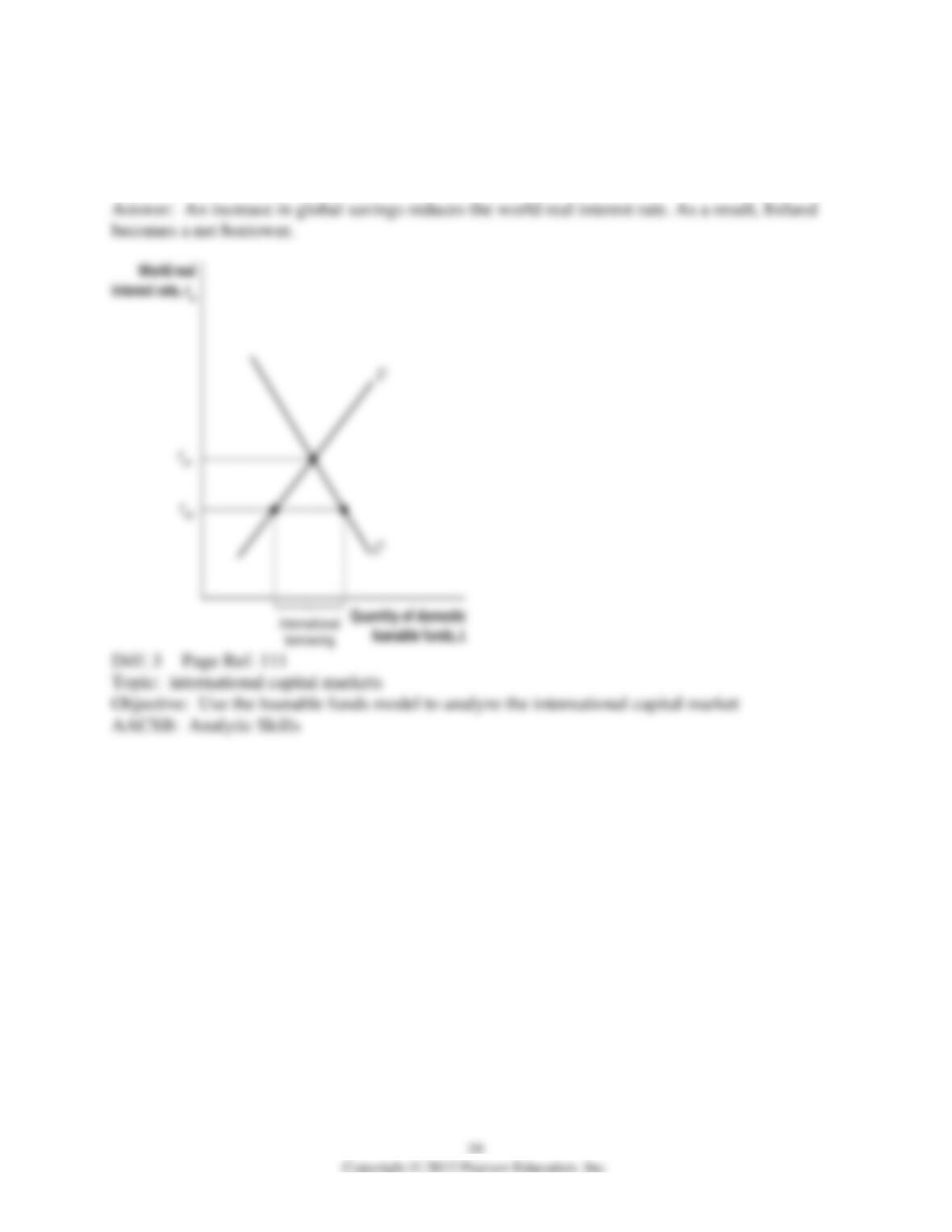
22) Suppose Ireland is a small open economy that is neither a net international borrower or
international lender. Many countries increase their savings resulting in a lower world real interest
rate. Make use of a graph of the loanable funds market for a small open economy to show the
impact this has on Ireland’s international financial position.