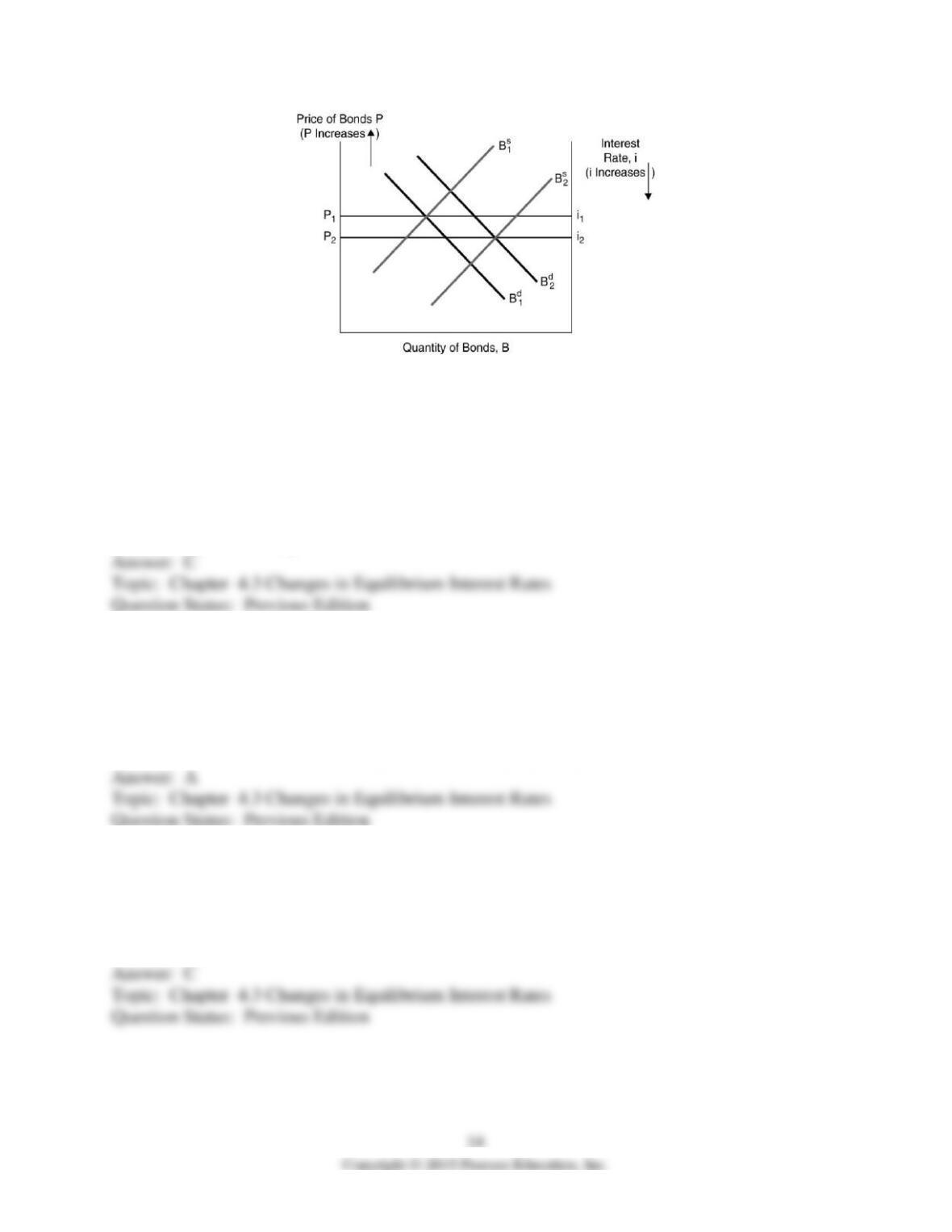
Figure 4.2
54) In Figure 4.2, one possible explanation for the increase in the interest rate from i1 to i2 is
a(n) ________ in ________.
A) increase; the expected inflation rate
B) decrease; the expected inflation rate
C) increase; economic growth
D) decrease; economic growth
55) In Figure 4.2, one possible explanation for the increase in the interest rate from i1 to i2 is
A) an increase in economic growth.
B) an increase in government budget deficits.
C) a decrease in government budget deficits.
D) a decrease in economic growth.
E) a decrease in the riskiness of bonds relative to other investments.
56) In Figure 4.2, one possible explanation for a decrease in the interest rate from i2 to i1 is
A) an increase in government budget deficits.
B) an increase in expected inflation.
C) a decrease in economic growth.
D) a decrease in the riskiness of bonds relative to other investments.
57) In Keynes’s liquidity preference framework, individuals are assumed to hold their wealth in
two forms:
A) real assets and financial assets.
B) stocks and bonds.
C) money and bonds.
D) money and gold.
58) In his liquidity preference framework, Keynes assumed that money has a zero rate of return;
thus, when interest rates ________ the expected return on money falls relative to the expected
return on bonds, causing the demand for money to ________.
A) rise; fall
B) rise; rise
C) fall; fall
D) fall; rise
59) The loanable funds framework is easier to use when analyzing the effects of changes in
________, while the liquidity preference framework provides a simpler analysis of the effects
from changes in income, the price level, and the supply of ________.
A) expected inflation; bonds
B) expected inflation; money
C) government budget deficits; bonds
D) the supply of money; bonds
60) When comparing the loanable funds and liquidity preference frameworks of interest rate
determination, which of the following is true?
A) The liquidity preference framework is easier to use when analyzing the effects of changes in
expected inflation.
B) The loanable funds framework provides a simpler analysis of the effects of changes in
income, the price level, and the supply of money.
C) In most instances, the two approaches to interest rate determination yield the same
predictions.
D) All of the above are true.
E) Only A and B of the above are true.
61) A higher level of income causes the demand for money to ________ and the interest rate to
________.
A) decrease; decrease
B) decrease; increase
C) increase; decrease
D) increase; increase
62) A lower level of income causes the demand for money to ________ and the interest rate to
________.
A) decrease; decrease
B) decrease; increase
C) increase; decrease
D) increase; increase
63) A rise in the price level causes the demand for money to ________ and the demand curve to
shift to the ________.
A) decrease; right
B) decrease; left
C) increase; right
D) increase; left
64) A decline in the price level causes the demand for money to ________ and the demand curve
to shift to the ________.
A) decrease; right
B) decrease; left
C) increase; right
D) increase; left
65) A decline in the expected inflation rate causes the demand for money to ________ and the
demand curve to shift to the ________.
A) decrease; right
B) decrease; left
C) increase; right
D) increase; left
66) Holding everything else constant, an increase in the money supply causes
A) interest rates to decline initially.
B) interest rates to increase initially.
C) bond prices to decline initially.
D) both A and C of the above.
E) both B and C of the above.
67) Holding everything else constant, a decrease in the money supply causes
A) interest rates to decline initially.
B) interest rates to increase initially.
C) bond prices to increase initially.
D) both A and C of the above.
E) both B and C of the above.
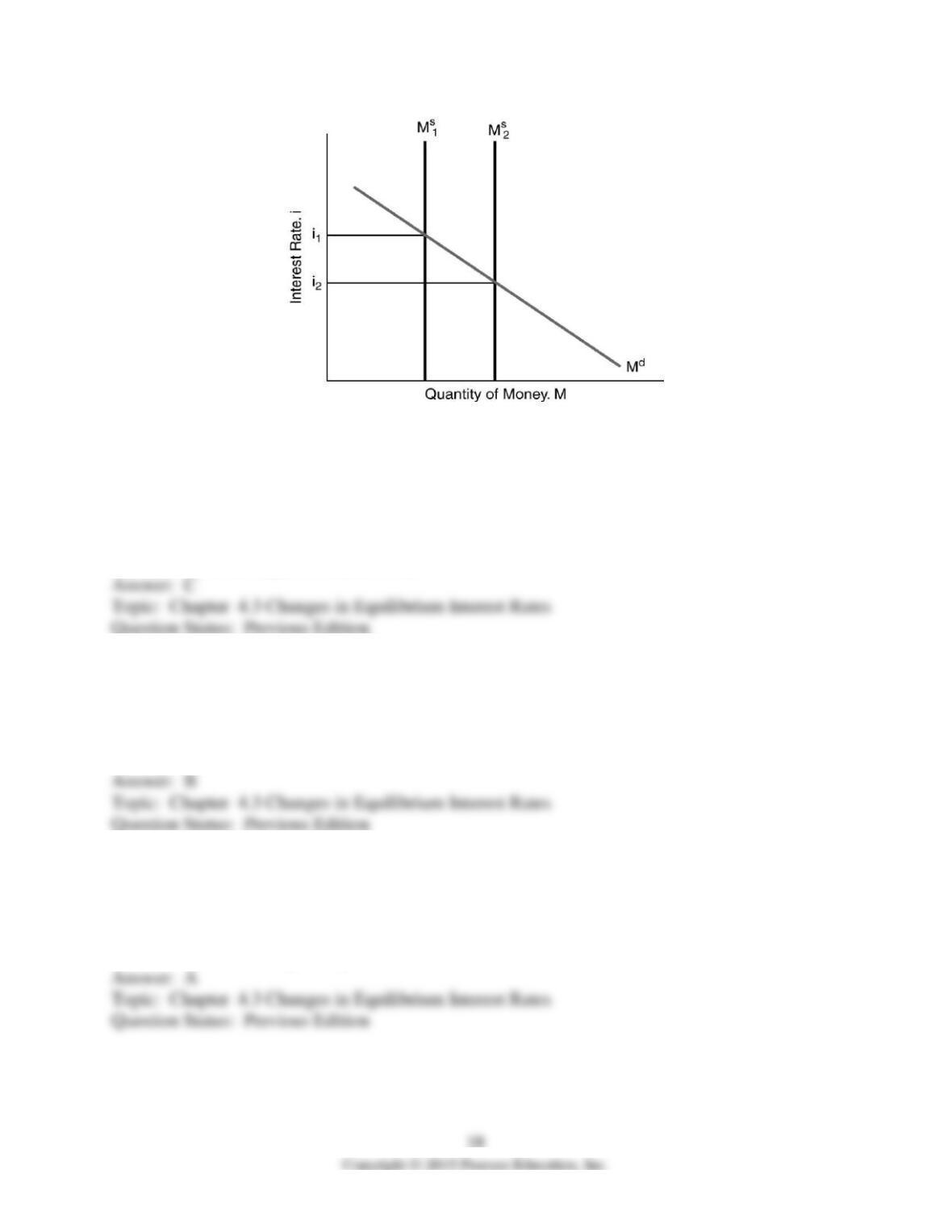
Figure 4.3
68) In Figure 4.3, the factor responsible for the decline in the interest rate is
A) a decline in the price level.
B) a decline in income.
C) an increase in the money supply.
D) a decline in the expected inflation rate.
69) In Figure 4.3, the decrease in the interest rate from i1 to i2 can be explained by
A) a decrease in money growth.
B) an increase in money growth.
C) a decline in the expected price level.
D) only A and B of the above.
70) In Figure 4.3, an increase in the interest rate from i2 to i1 can be explained by
A) a decrease in money growth.
B) an increase in money growth.
C) a decline in the price level.
D) an increase in the expected price level.
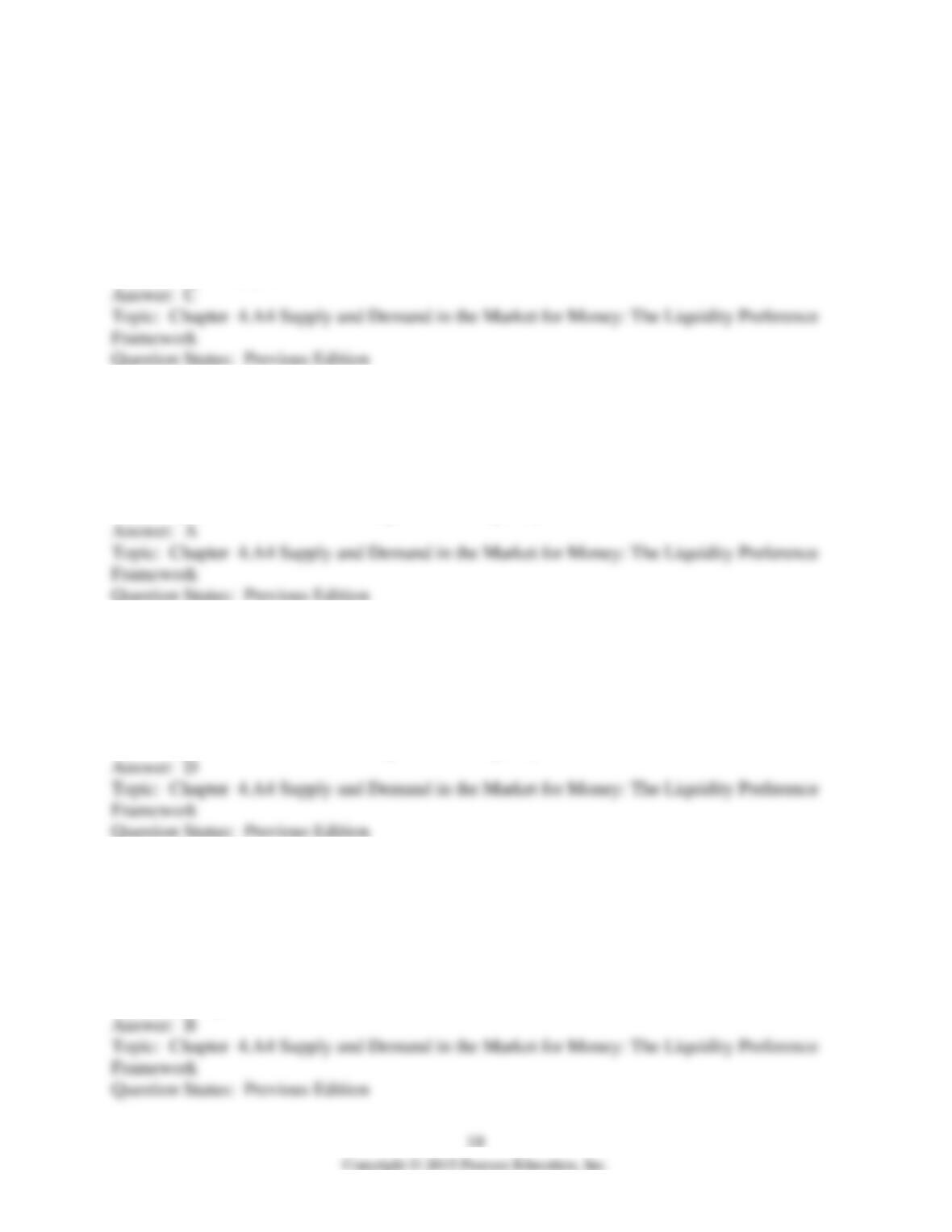
71) If the liquidity effect is smaller than the other effects, and the adjustment of expected
inflation is slow, then the
A) interest rate will fall.
B) interest rate will rise.
C) interest rate will initially fall but eventually climb above the initial level in response to an
increase in money growth.
D) interest rate will initially rise but eventually fall below the initial level in response to an
increase in money growth.
72) When the growth rate of the money supply increases, interest rates end up being permanently
lower if
A) the liquidity effect is larger than the other effects.
B) there is fast adjustment of expected inflation.
C) there is slow adjustment of expected inflation.
D) the expected inflation effect is larger than the liquidity effect.
73) When the growth rate of the money supply decreases, interest rates end up being
permanently lower if
A) the liquidity effect is larger than the other effects.
B) there is fast adjustment of expected inflation.
C) there is slow adjustment of expected inflation.
D) the expected inflation effect is larger than the liquidity effect.
74) When the growth rate of the money supply is decreased, interest rates will rise immediately
if the liquidity effect is ________ than the other effects and if there is ________ adjustment of
expected inflation.
A) larger; rapid
B) larger; slow
C) smaller; slow
D) smaller; rapid
75) When the growth rate of the money supply is increased, interest rates will rise immediately if
the liquidity effect is ________ than the other effects and if there is ________ adjustment of
expected inflation.
A) larger; rapid
B) larger; slow
C) smaller; slow
D) smaller; rapid
76) If the Fed wants to permanently lower interest rates, then it should lower the rate of money
growth if
A) there is fast adjustment of expected inflation.
B) there is slow adjustment of expected inflation.
C) the liquidity effect is smaller than the expected inflation effect.
D) the liquidity effect is larger than the other effects.
77) If the Fed wants to permanently lower interest rates, then it should raise the rate of money
growth if
A) there is fast adjustment of expected inflation.
B) there is slow adjustment of expected inflation.
C) the liquidity effect is smaller than the expected inflation effect.
D) the liquidity effect is larger than the other effects.
78) Milton Friedman contends that it is entirely possible that when the money supply rises,
interest rates may ________ if the ________ effect is more than offset by changes in income, the
price level, and expected inflation.
A) fall; liquidity
B) fall; risk
C) rise; liquidity
D) rise; risk
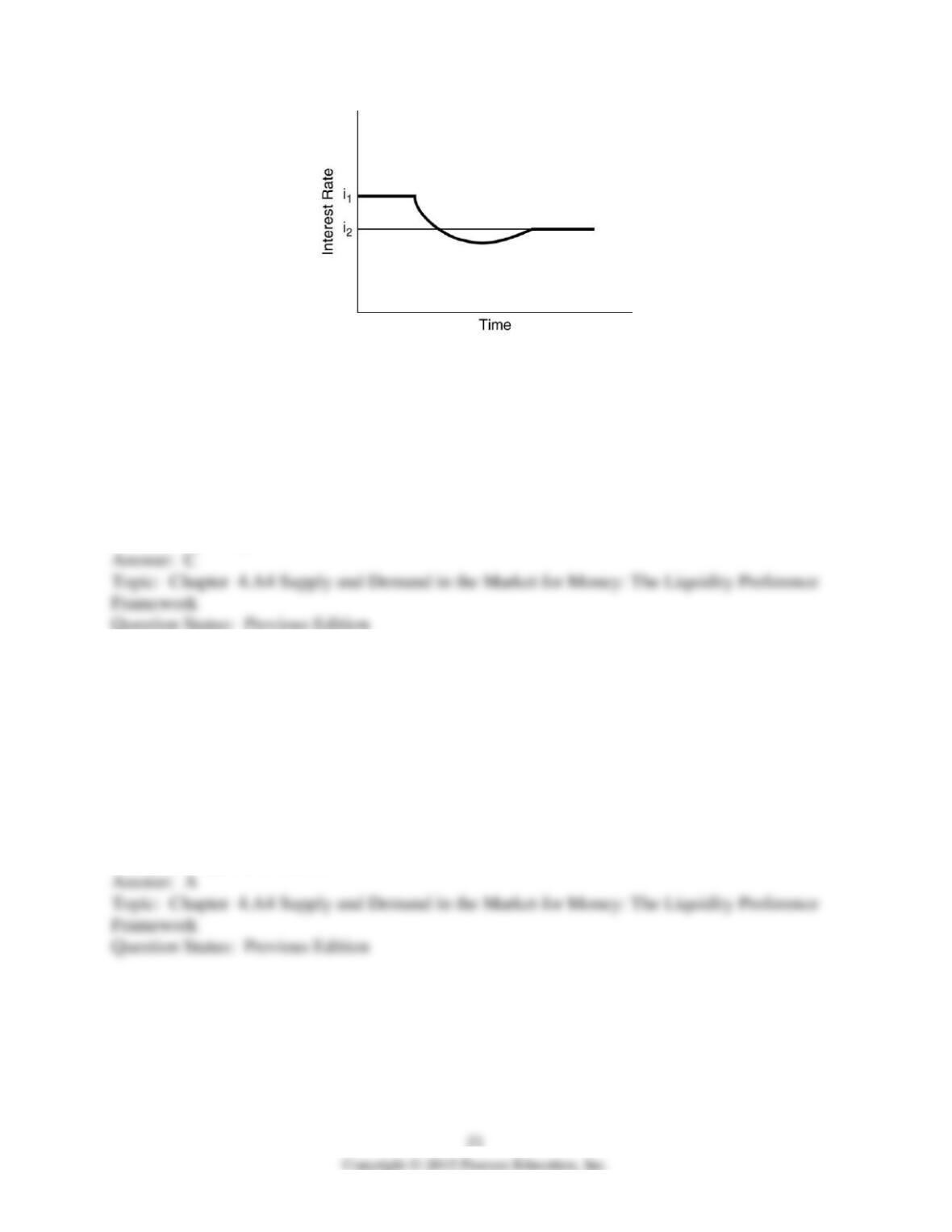
Figure 4.5
79) Figure 4.5 illustrates the effect of an increased rate of money supply growth. From the figure,
one can conclude that the liquidity effect is ________ than the expected inflation effect and
interest rates adjust ________ to changes in expected inflation.
A) smaller; quickly
B) larger; quickly
C) larger; slowly
D) smaller; slowly
80) Figure 4.5 illustrates the effect of an increased rate of money supply growth. From the figure,
one can conclude that the
A) Fisher effect is dominated by the liquidity effect and interest rates adjust slowly to changes in
expected inflation.
B) liquidity effect is dominated by the Fisher effect and interest rates adjust slowly to changes in
expected inflation.
C) liquidity effect is dominated by the Fisher effect and interest rates adjust quickly to changes in
expected inflation.
D) Fisher effect is smaller than the expected inflation effect and interest rates adjust quickly to
changes in expected inflation.
81) _______ is the total resources owned by an individual, including all assets.
A) Expected return
B) Wealth
C) Liquidity
D) Risk
82) A ________ prefers stock in a less risky asset than in a riskier asset.
A) risk preferrer
B) risk-averse person
C) risk lover
D) risk-favorable person
83) When the quantity of bonds demanded equals the quantity of bonds supplied, there is
A) excess supply.
B) excess demand.
C) a market equilibrium.
D) an asset market approach.
84) Determining asset prices using stocks of assets rather than flow is called
A) asset transformation.
B) expected return.
C) asset market approach.
D) market equilibrium.
85) What is the model whose equations are estimated using statistical procedures used in
forecasting interest rates called?
A) Econometric model
B) Liquidity preference framework
C) Market equilibrium
D) Fisher effect
86) As expected inflation increases for the coming year, we expected the price of gold to
________ due to a rightward shift the in ________ curve.
A) increase; demand
B) increase; supply
C) decrease; demand
D) decrease; supply
87) As expected inflation falls for the coming year, we expected the price of gold to ________
due to a leftward shift the in ________ curve.
A) increase; demand
B) increase; supply
C) decrease; demand
D) decrease; supply
1) When interest rates decrease, the demand curve for bonds shifts to the left.
2) When an economy grows out of a recession, normally the demand for bonds increases and the
supply of bonds increases.
3) When the federal government’s budget deficit decreases, the demand curve for bonds shifts to
the right.
4) Investors make their choices of which assets to hold by comparing the expected return,
liquidity, and risk of alternative assets.
5) A person who is risk averse prefers to hold assets that are more, not less, risky.
6) Interest rates are procyclical in that they tend to rise during business cycle expansions and fall
during recessions.
7) When income and wealth are rising, the demand for bonds rises and the demand curve shifts
to the right.
8) An increase in the inflation rate will cause the demand curve for bonds to shift to the right.
9) The Fisher Effect predicts that an increase in expected inflation will lower the interest rate on
bonds.
10) An increase in the federal government budget deficit will raise the interest rate on bonds.
11) Holding everything else constant, an increase in wealth lowers the quantity demanded of an
asset.
12) An increase in an asset’s expected return relative to that of an alternative asset, holding
everything else unchanged, raises the quantity demanded of the asset.
13) The more liquid an asset is relative to alternative assets, holding everything else unchanged,
the more desirable it is, and the greater the quantity demanded.
14) A movement along the demand (or supply) curve occurs when the quantity demanded (or
supplied) changes at each given price (or interest rate) of the bond in response to a change in
some other factor besides the bond’s price or interest rate.
1) Identify and explain the four factors that influence asset demand. Which of these factors affect
total asset demand and which influence investors to demand one asset over another?
2) How is the equilibrium interest rate determined in the bond market? Explain why the interest
rate will move toward equilibrium if it is temporarily above or below the equilibrium rate.
3) Use the bond demand and supply framework to explain the Fisher effect and why it occurs.
4) If investors perceive greater interest rate risk, what will happen to the equilibrium interest rate
in the bond market? Explain using the bond demand and supply framework.
5) How will a decrease in the federal government’s budget deficit affect the equilibrium interest
rate in the bond market? Explain using the bond demand and supply framework.
6) What is the expected return on a bond if the return is 9% two-thirds of the time and 3% one-
third of the time? What is the standard deviation of the returns on this bond? Would you prefer
this bond or one with an identical expected return and a standard deviation of 4.5? Why?
7) Identify and describe three factors that cause the supply curve for bonds to shift.
8) Explain why the marginal contribution of an asset to the risk of a portfolio does not depend on
the risk of the asset in isolation.
9) What is the difference between systematic and nonsystematic risk?
10) Explain the difference between the Capital Asset Pricing Model and the Arbitrage Pricing
Theory.
11) Explain how the price of gold should be positively related to expected inflation.
12) Explain how the loanable funds framework and the supply and demand for bonds are related.
13) Describe the factors that shift the demand and supply of money in the loanable funds
framework.
14) Explain the differences between the loanable funds framework and the liquidity preference
framework.