42) For the year ended December 31, 2014, a corporation had cash flow from operating activities
of -$10,000, cash flow from investment activities of $4,000, and cash flow from financing
activities of $9,000. The statement of cash flows would show a ________.
A) net decrease of $3,000 in cash and marketable securities
B) net decrease of $5,000 in cash and marketable securities
C) net increase of $3,000 in cash and marketable securities
D) net increase of $5,000 in cash and marketable securities
43) For the year ended December 31, 2014, a corporation had cash flow from operating activities
of $20,000, cash flow from investment activities of -$15,000, and cash flow from financing
activities of -$10,000. The statement of cash flows would show a ________.
A) net increase of $5,000 in cash and marketable securities
B) net decrease of $5,000 in cash and marketable securities
C) net decrease of $15,000 in cash and marketable securities
D) net increase of $25,000 in cash and marketable securities
44) For the year ended December 31, 2014, a corporation had cash flow from operating activities
of $12,000, cash flow from investment activities of – $10,000, and cash flow from financing
activities of $4,000. The statement of cash flows would show a ________.
A) net decrease of $18,000 in cash and marketable securities
B) net decrease of $6,000 in cash and marketable securities
C) net increase of $6,000 in cash and marketable securities
D) net increase of $2,000 in cash and marketable securities
45) A firm has just ended the calendar year making a sale in the amount of $200,000 of
merchandise purchased during the year at a total cost of $150,500. Although the firm paid in full
for the merchandise during the year, it has yet to collect at year end from the customer. One
possible problem this firm may face is ________.
A) low profitability
B) insolvency
C) inability to receive credit
D) high leverage
46) Calculate net operating profit after taxes (NOPAT) if a firm has sales of $1,000,000,
operating profit (EBIT) of $100,000, interest expense of $50,000, and a tax rate of 30%.
A) $35,000
B) $700,000
C) $70,000
D) $45,000
47) Calculate a firm’s free cash flow if it has net operating profit after taxes of $60,000,
depreciation expense of $10,000, net fixed asset investment requirement of $40,000, a net
current asset requirement of $30,000 and a tax rate of 30%.
A) $0
B) $30,000
C) -$30,000
D) $60,000
48) NICO Corporation had net fixed assets of $2,000,000 at the end of 2015 and $1,800,000 at
the end of 2014. In addition, the firm had a depreciation expense of $200,000 during 2015 and
$180,000 during 2014. Using this information, NICO’s net fixed asset investment for 2015 was
________.
A) $20,000
B) $0
C) $380,000
D) $400,000
49) NICO Corporation had net current assets of $2,000,000 at the end of 2015 and $1,800,000 at
the end of 2014. In addition, NICO had net spontaneous current liabilities of $1,000,000 in 2015
and $1,500,000 in 2014. Using this information, NICO’s net current asset investment for 2014
was ________.
A) $700,000
B) -$300,000
C) $300,000
D) -$700,000
50) During 2015, NICO Corporation had EBIT of $100,000, a change in net fixed assets of
$400,000, an increase in net current assets of $100,000, an increase in spontaneous current
liabilities of $400,000, a depreciation expense of $50,000, and a tax rate of 30%. Based on this
information, NICO’s free cash flow is ________.
A) -$630,000
B) -$50,000
C) $650,000
D) -$30,000
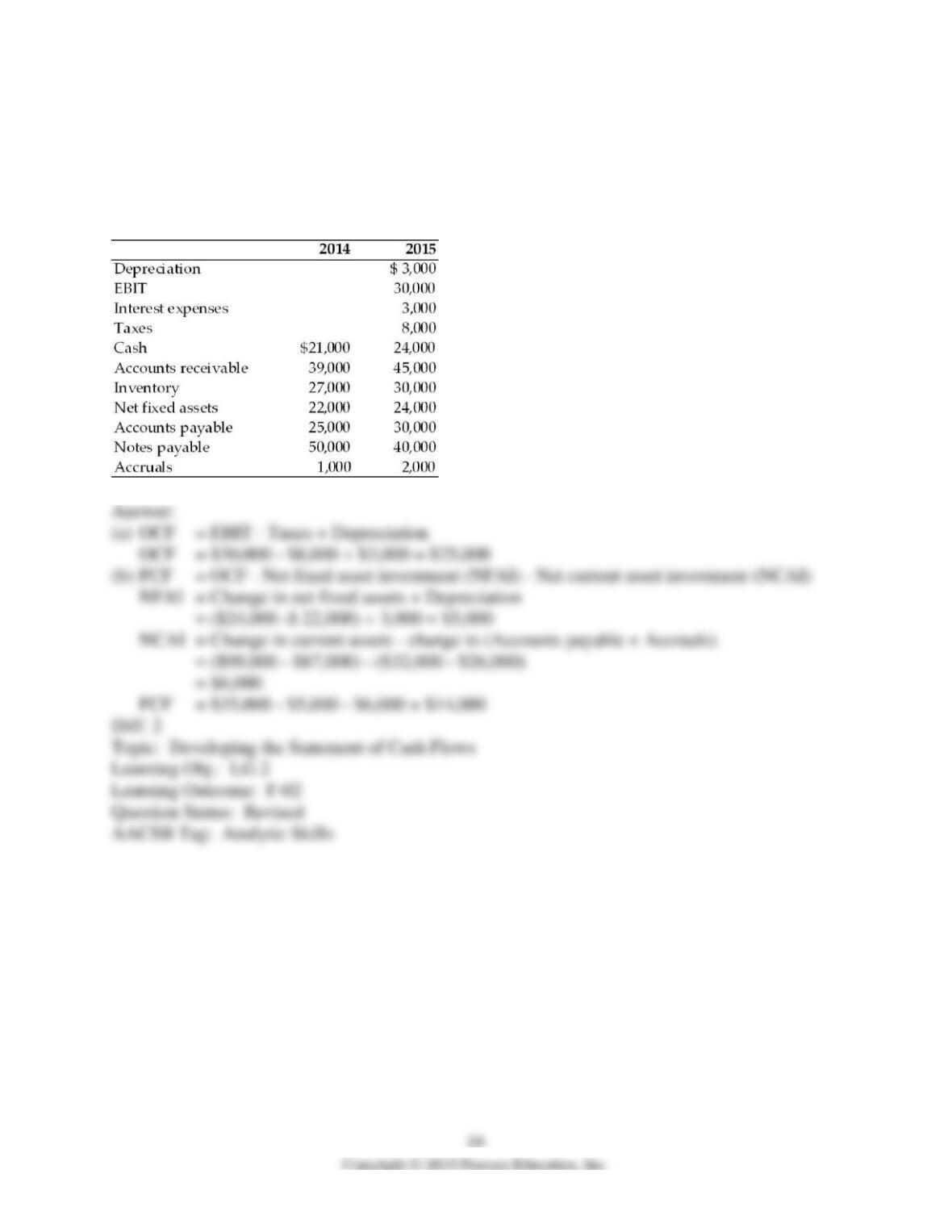
51) Given the financial data for New Electronic World, Inc. (NEW), compute the following
measures of cash flows for the NEW for the year ended December 31, 2015.
(a) Operating cash flow
(b) Free cash flow
For the year ended December 31,
52) Identify each expense or revenue as a cash flow from operating activities (O), a cash flow
from investment activities (I), or a cash flow from financing activities (F).
Administrative expenses
Rent payment
Interest on a note payable
Sale of equipment
Dividend payment
Stock repurchase
Sale of finished goods
Labor expense
Sale of a bond issue
Repayment of a long-term debt
Selling expenses
Depreciation expense
Sale of common stock
Purchase of fixed assets
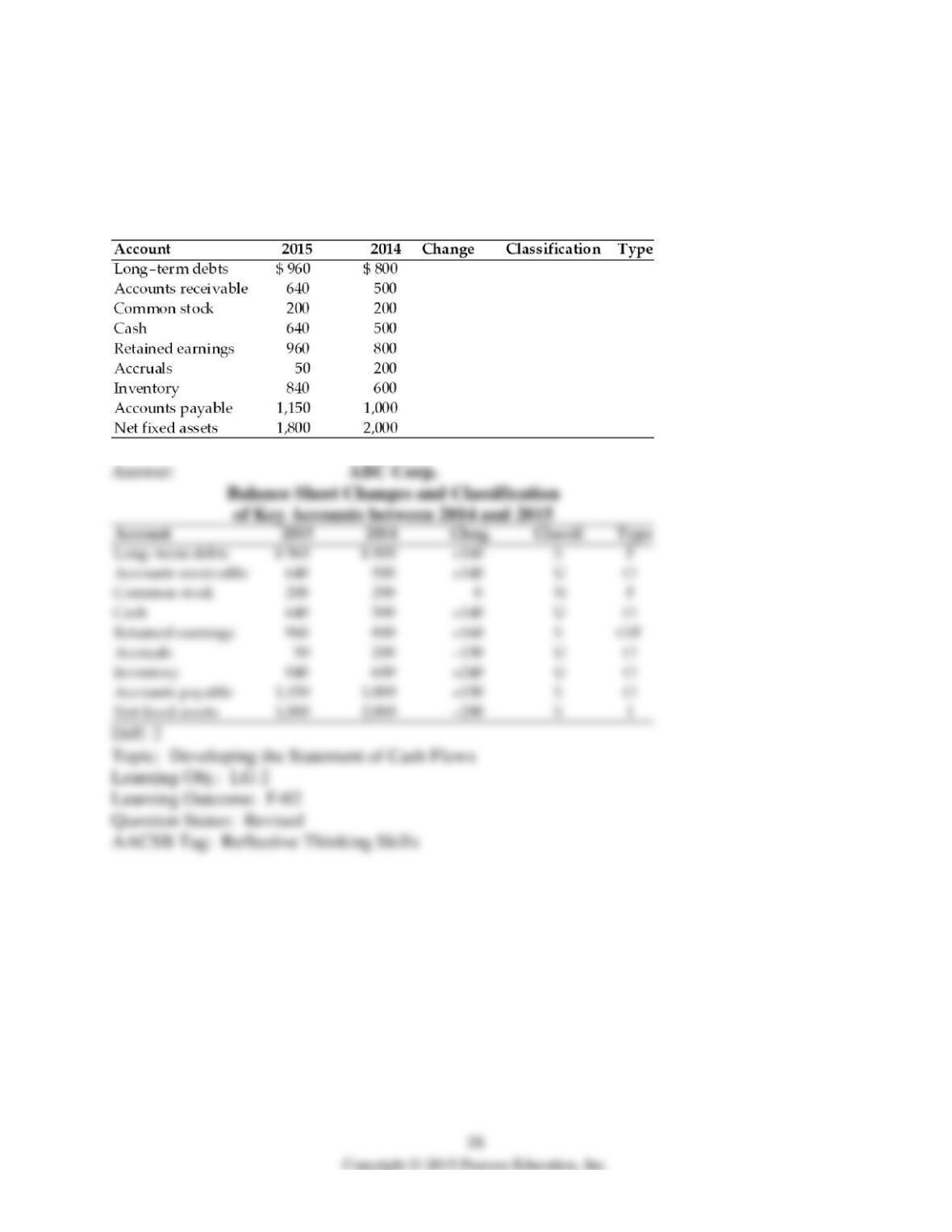
53) Calculate the change in the key balance sheet accounts between 2014 and 2015 and classify
each as a source (S), a use (U), or neither (N), and indicate which type of cash flow it is: an
operating cash flow (O), and investment cash flow (I) or a financing cash flow (F).
ABC Corp.
Balance Sheet Changes and Classification
of Key Accounts between 2014 and 2015
27
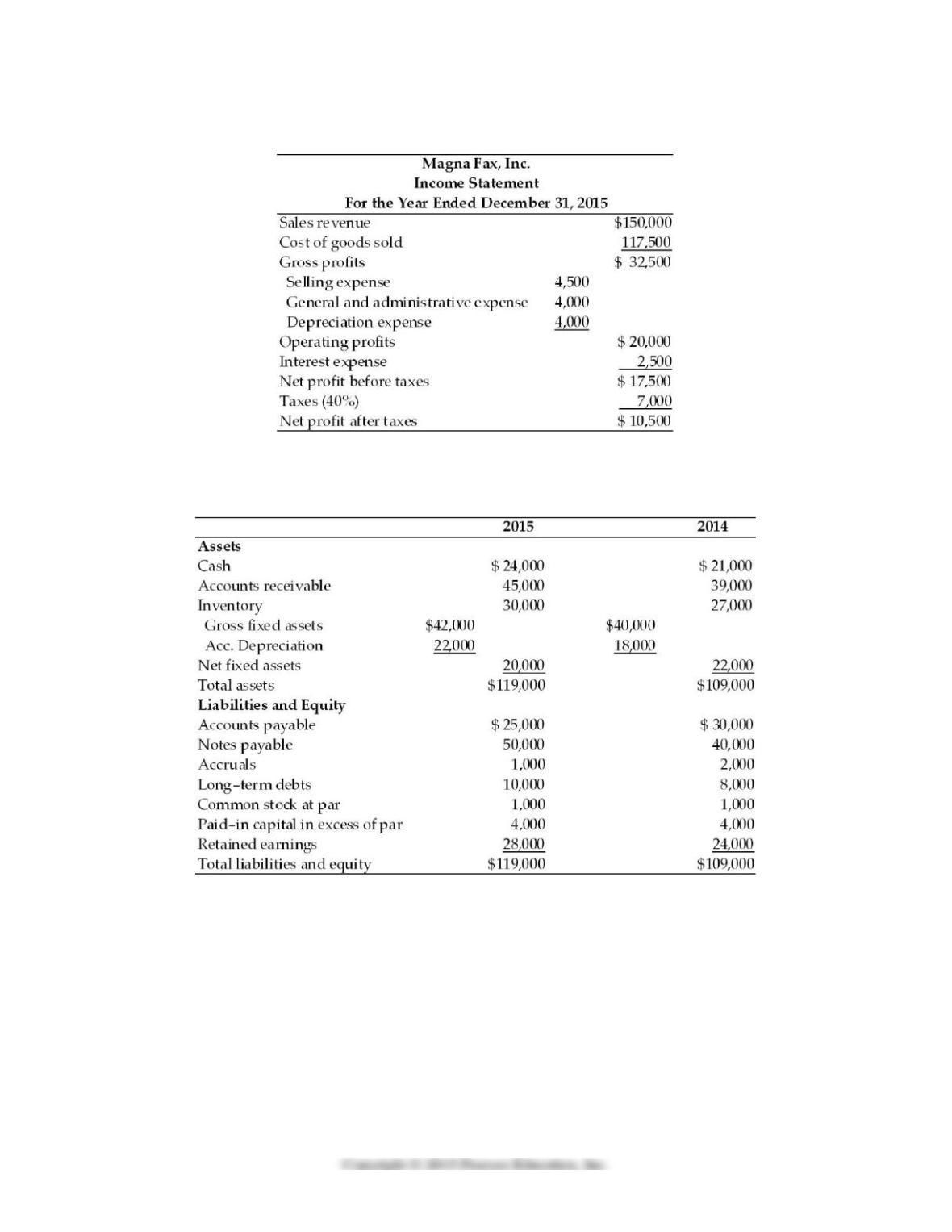
Table 4.2
Magna Fax, Inc.
Balance Sheet
For the Years Ended December 31, 2014 and 2015
54) The credit manager at First National Bank has just received the income statement and
balance sheet for Magna Fax, Inc. for the year ended December 31,2015. (See Table 4.2.) The
bank requires the firm to report its earnings performance and financial position quarterly as a
condition of a loan agreement. The bank’s credit manager must prepare two key financial
statements based on the information sent by Magna Fax, Inc. This will be passed on to the
commercial loan officer assigned to this account, so that he may review the financial condition of
the firm.
(a) Prepare a statement of retained earnings for the year ended December 31, 2015.
(b) Prepare a summary of cash inflows and cash outflows for the year ended December 31, 2015.
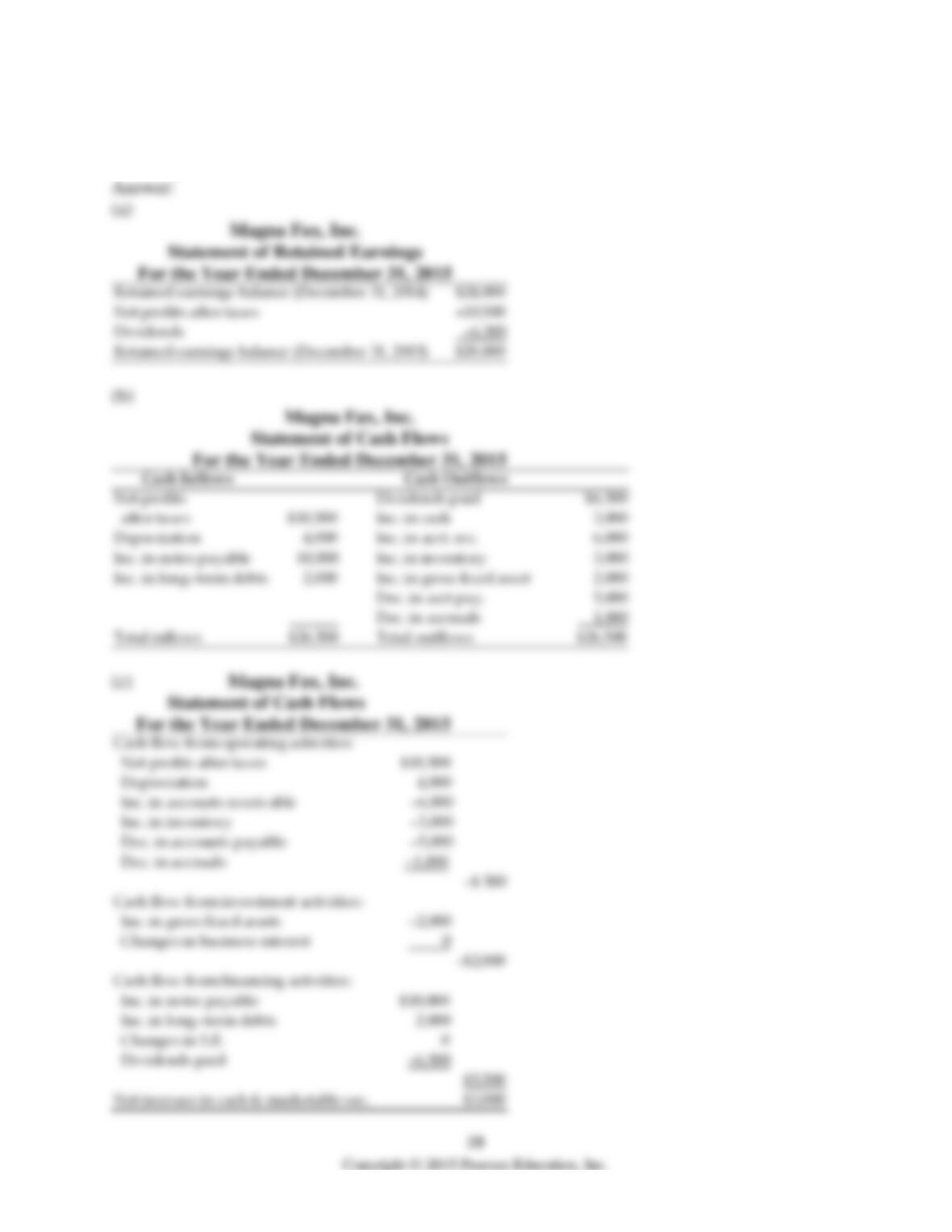
(c) Prepare a statement of cash flows for the year ended December 31, 2015, organized by cash
flow from operating activities, cash flow from investment activities, and cash flow from
financing activities.
4.3 Understand the financial planning process, including long-term (strategic) financial plans
and short-term (operating) financial plans.
1) Strategic financial plans are planned long-term financial actions and the anticipated financial
impact of those actions.
2) A financial planning process begins with short-term, or operating, plans and budgets that in
turn guide the formulation of long-term, or strategic, financial plans.
3) Operating financial plans are planned short-term financial actions and the anticipated financial
impact of those actions.
4) Generally, firms that are subject to high degrees of operating uncertainty, relatively short
production cycles, or both, tend to use shorter planning horizons.
5) The sales forecast and various forms of operating and financial data are the key outputs of the
short-run (operating) financial planning.
6) The financial planning process begins with ________ financial plans that in turn guide the
formation of ________ plans and budgets.
A) short-term; long-term
B) short-term; short-term
C) long-term; long-term
D) long-term; short-term
7) Short-term financial plans and long-term financial plans generally cover periods ranging from
________ years and ________ years, respectively.
A) one to two; two to ten
B) five to ten; ten to twenty
C) zero to one; five to ten
D) one to ten; ten to fifteen
8) The key aspects of a financial planning process are ________.
A) cash planning and investment planning
B) operations planning and investment planning
C) investment planning and profit planning
D) cash planning and profit planning
9) Pro forma financial statements are used for ________.
A) cash budgeting
B) preparing financial statements
C) profit planning
D) auditing
10) Which of the following would be the least likely to utilize a cash budget?
A) top management
B) middle management
C) public investors
D) lenders
11) The primary purpose in preparing pro forma financial statements is ________.
A) for cash planning
B) to ensure the ability to pay dividends
C) to reduce risk
D) for profit planning
12) ________ consider proposed fixed-asset outlays, research and development activities,
marketing and product development actions, capital structure, and major sources of financing.
A) Short-term financial plans
B) Long-term financial plans
C) Pro forma statements
D) Cash budgeting
13) ________ generally reflect(s) the anticipated financial impact of planned long-term actions.
A) A cash budget
B) Strategic financial plans
C) Operating financial plans
D) A pro forma income statement
14) In general, firms that are subject to a high degree of ________, relatively short production
cycles, or both, tend to use shorter planning horizons.
A) profitability
B) financial certainty
C) operating uncertainty
D) financial planning
15) The key outputs of the short-term financial planning process are the ________.
A) cash budget, pro forma income statement, and pro forma balance sheet
B) sales forecast and capital assets journal
C) sales forecast and schedule of changes in working capital
D) income statement, balance sheet, and source and use statement
16) Key inputs to short-term financial planning are ________.
A) cash flow statements and income statement
B) pro forma financial statements
C) sales forecasts, and operating and financial data
D) leverage analysis and pro forma income statement
17) Once sales are forecasted, ________ must be generated to estimate required raw materials.
A) a production plan
B) a cash budget
C) an operating budget
D) a pro forma statement
4.4 Discuss the cash-planning process and the preparation, evaluation, and use of the cash
budget.
1) The more seasonal and uncertain a firm’s cash flows, the greater the number of intervals and
the shorter time intervals.
2) An internal sales forecast is based on the relationships that can be observed between a firm’s
sales and certain key economic indicators such as the gross domestic product, new housing starts,
or disposable personal income.
3) The ________ is a financial projection of a firm’s short-term cash surpluses or shortages.
A) operating financial plan
B) cash budget
C) strategic financial journal
D) capital assets journal
4) The primary purpose in preparing a cash budget is ________.
A) to evaluate the intrinsic value of a financial assets
B) to estimate a firm’s short-term cash requirements
C) for risk analysis
D) to estimate sales
5) Cash budget is a statement of a firm’s planned inflows and outflows of cash that is used to
estimate its long-term cash requirement.
6) Cash planning involves the preparation of a firm’s cash budget. Without adequate cash—
regardless of the level of profits—any firm could fail.
7) Cash budgets and pro forma statements are useful not only for internal financial planning but
also are routinely required by the Internal Revenue Service (IRS).
8) A cash budget gives the financial manager a clear view of the timing of a firm’s expected
profitability over a given period.
9) Since depreciation and other noncash charges represent a scheduled write-off of an earlier
cash outflow, they should not be included in a cash budget.
10) In cash budgeting, the impact of depreciation is reflected in a reduction in tax payments.
11) In cash budgeting, other cash receipts are cash receipts expected to result from sources other
than sales.
12) A firm’s net cash flow is the mathematical difference between the firm’s beginning cash and
its cash disbursements in each period.
13) The excess cash balance is the amount available for investment by a firm if the desired
minimum cash balance is less than the period’s ending cash.
14) The required total financing figures in a cash budget refer to the monthly changes in
borrowing.
15) If the net cash flow is less than the minimum cash balance, financing is required.
16) If the ending cash is greater than the minimum cash balance, excess cash exists.
17) Using simulations, a firm can determine the amount of financing needed to protect it
adequately against a cash shortage.
18) As the typical cash budget shows cash flows only on a monthly basis, the information
provided by the cash budget is not necessarily adequate for ensuring solvency.
19) As the typical cash budget shows cash flows on a monthly basis, the information provided by
the cash budget is adequate for ensuring solvency.
20) An external sales forecast is based on ________.
A) the relationships between a firm’s sales and certain key economic indicators such as GDP and
consumer confidence
B) a buildup, or consensus of sales forecasts through a firm’s own sales channels
C) the prediction of a firm’s sales over a given period through the analysis of the sales trends of
its competitors
D) developing the pro forma income statement to forecast sales and then express the various
income statement items as percentage of projected sales
21) An internal forecast is based on ________.
A) a buildup, or consensus, of sales forecasts through a firm’s own sales channels, adjusted for
additional factors such as production capabilities
B) the relationships between a firm’s sales and certain economic indicators
C) the prediction of a firm’s sales over a given period through surveys sent to financial analysts
D) developing the pro forma income statement to forecast sales and then express the various
income statement items as percentage of projected sales
22) A firm’s final sales forecast is usually a function of ________.
A) its net income
B) the salesperson’s estimates of demand
C) internal and external factors in combination
D) its accounts receivable
23) The key input to the short-term financial planning process is ________.
A) the audit report
B) the pro forma balance sheet
C) the sales forecast
D) the pro forma income statement
24) A firm has projected sales in May, June, and July of $100, $200, and $300, respectively. The
firm makes 20 percent of sales for cash and collects the balance one month following the sale.
The firm’s total cash receipts in July is ________.
A) $220
B) $200
C) $180
D) $140
25) In preparing a cash budget, the ________ seasonal and uncertain a firm’s cash flows, the
________ the number of budgeting intervals it should use.
A) more; greater
B) more; fewer
C) less; greater
D) less; fewer