Economics of Money, Banking, and Financial Markets, 11e (Mishkin)
Web Chapter 4: Financial Derivatives
1) The payoffs for financial derivatives are linked to
A) securities that will be issued in the future.
B) the volatility of interest rates.
C) previously issued securities.
D) government regulations specifying allowable rates of return.
2) Which of the following is not a financial derivative?
A) stock
B) futures
C) options
D) forward contracts
3) By hedging a portfolio, a bank manager
A) reduces interest-rate risk.
B) increases reinvestment risk.
C) increases exchange-rate risk.
D) increases the probability of gains.
4) Hedging risk for a short position is accomplished by
A) taking a long position.
B) taking another short position.
C) taking additional long and short positions in equal amounts.
D) taking a neutral position.
5) Hedging risk for a long position is accomplished by
A) taking another long position.
B) taking a short position.
C) taking additional long and short positions in equal amounts.
D) taking a neutral position.
6) A contract that requires the investor to buy securities on a future date is called a
A) short contract.
B) long contract.
C) hedge.
D) cross.
7) A long contract requires that the investor
A) sell securities in the future.
B) buy securities in the future.
C) hedge in the future.
D) close out his position in the future.
8) A person who agrees to buy an asset at a future date is going
A) long.
B) short.
C) back.
D) ahead.
9) A short contract requires that the investor
A) sell securities in the future.
B) buy securities in the future.
C) hedge in the future.
D) close out his position in the future.
10) A contract that requires the investor to sell securities on a future date is called a
A) short contract.
B) long contract.
C) hedge.
D) micro hedge.
1) To say that the forward market lacks liquidity means that
A) forward contracts usually result in losses.
B) forward contracts cannot be turned into cash.
C) it may be difficult to make the transaction.
D) forward contracts cannot be sold for cash.
2) The advantage of forward contracts over future contracts is that they
A) are standardized.
B) have lower default risk.
C) are more liquid.
D) are more flexible
3) Suppose you are currently in the long position of a long-term bond. In this case, to hedge
against a capital loss, you would enter into a ________ contract to ________ a long-term bond in
the future.
A) interest-rate forward; sell
B) interest-rate forward; buy
C) exchange-rate forward; buy
D) exchange-rate forward; sell
1) Forward contracts are of limited usefulness to financial institutions because
A) of default risk.
B) it is impossible to hedge risk.
C) they are relatively inflexible.
D) of interest-rate risk.
2) Futures contracts are regularly traded on the
A) Chicago Board of Trade.
B) New York Stock Exchange.
C) American Stock Exchange.
D) Chicago Board of Options Exchange.
3) When interest rates fall, a bank that perfectly hedges its portfolio of Treasury securities in the
futures market
A) suffers a loss.
B) experiences a gain.
C) has no change in its income.
D) may either gain, lose or see no change in its income.
4) Parties who have bought a futures contract and thereby agreed to ________ (take delivery of)
the bonds are said to have taken a ________ position.
A) sell; short
B) buy; short
C) sell; long
D) buy; long
5) Parties who have sold a futures contract and thereby agreed to ________ (deliver) the bonds
are said to have taken a ________ position.
A) sell; short
B) buy; short
C) sell; long
D) buy; long
6) By taking the short position on a futures contract of $100,000 at a price of 115 you are
agreeing to ________ a ________ face value security for ________.
A) sell; $100,000; $115,000.
B) sell; $115,000; $100,000.
C) buy; $100,000; $115,000.
D) buy; $115,000; $100,000.
7) By taking the short position on a futures contract of $100,000 at a price of 96 you are agreeing
to ________ a ________ face value security for ________.
A) sell; $100,000; $96,000.
B) sell; $96,000; $100,000.
C) buy; $100,000; $96,000.
D) buy; $96,000; $100,000.
8) By taking the long position on a futures contract of $100,000 at a price of 115 you are
agreeing to ________ a ________ face value security for ________.
A) sell; $100,000; $115,000.
B) sell; $115,000; $100,000.
C) buy; $100,000; $115,000.
D) buy; $115,000; $100,000.
9) By taking the long position on a futures contract of $100,000 at a price of 96 you are agreeing
to ________ a ________ face value security for ________.
A) sell; $100,000; $96,000.
B) sell; $96,000; $100,000.
C) buy; $100,000; $96,000.
D) buy; $96,000; $100,000.
10) On the expiration date of a futures contract, the price of the contract converges to the
A) purchase price of the contract.
B) average price over the life of the contract.
C) price of the underlying asset.
D) average of the purchase price and the price of the underlying asset.
11) Elimination of riskless profit opportunities in the futures market is
A) hedging.
B) arbitrage.
C) speculation.
D) underwriting.
12) If you purchase a $100,000 interest-rate futures contract for 110, and the price of the
Treasury securities on the expiration date is 106, your ________ is ________.
A) profit; $4000
B) loss; $4000
C) profit; $6000
D) loss; $6000
13) If you purchase a $100,000 interest-rate futures contract for 105, and the price of the
Treasury securities on the expiration date is 108, your ________ is ________.
A) profit; $3000
B) loss; $3000
C) profit; $8000
D) loss; $8000
14) If you sell a $100,000 interest-rate futures contract for 110, and the price of the Treasury
securities on the expiration date is 106, your ________ is ________.
A) profit; $4000
B) loss; $4000
C) profit; $6000
D) loss; $6000
15) If you sell a $100,000 interest-rate futures contract for 105, and the price of the Treasury
securities on the expiration date is 108, your ________ is ________.
A) profit; $3000
B) loss; $3000
C) profit; $8000
D) loss; $8000
16) If you sold a short contract on financial futures you hope interest rates
A) rise.
B) fall.
C) are stable.
D) fluctuate.
17) If you bought a long contract on financial futures you hope that interest rates
A) rise.
B) fall.
C) are stable.
D) fluctuate.
18) If you bought a long futures contract you hope that bond prices
A) rise.
B) fall.
C) are stable.
D) fluctuate.
19) If you sold a short futures contract you will hope that bond prices
A) rise.
B) fall.
C) are stable.
D) fluctuate.
20) To hedge the interest rate risk on $4 million of Treasury bonds with $100,000 futures
contracts, you would need to purchase
A) 4 contracts.
B) 20 contracts.
C) 25 contracts.
D) 40 contracts.
21) If you sell twenty-five $100,000 futures contracts to hedge holdings of a Treasury security,
the value of the Treasury securities you are holding is
A) $250,000.
B) $1,000,000.
C) $2,500,000.
D) $5,000,000.
22) Assume you are holding Treasury securities and have sold futures to hedge against interest-
rate risk. If interest rates rise
A) the increase in the value of the securities equals the decrease in the value of the futures
contracts.
B) the decrease in the value of the securities equals the increase in the value of the futures
contracts.
C) both the securities and the futures contracts decrease in value.
D) both the securities and the futures contracts increase in value.
23) Assume you are holding Treasury securities and have sold futures to hedge against interest-
rate risk. If interest rates fall
A) the increase in the value of the securities equals the decrease in the value of the futures
contracts.
B) the decrease in the value of the securities equals the increase in the value of the futures
contracts.
C) both the securities and the futures contracts decrease in value.
D) both the securities and the futures contracts increase in value.
24) When a financial institution hedges the interest-rate risk for a specific asset, the hedge is
called a
A) macro hedge.
B) micro hedge.
C) cross hedge.
D) futures hedge.
25) When the financial institution is hedging interest-rate risk on its overall portfolio, then the
hedge is a
A) macro hedge.
B) micro hedge.
C) cross hedge.
D) futures hedge.
26) The number of futures contracts outstanding is called
A) turnover.
B) volume.
C) float.
D) open interest.
27) Futures differ from forwards because they are
A) used to hedge portfolios.
B) used to hedge individual securities.
C) used in both financial and foreign exchange markets.
D) a standardized contract.
28) If a firm is due to be paid in euros in two months, to hedge against exchange-rate risk the
firm should ________ foreign exchange futures ________.
A) sell; short
B) buy; long
C) sell; long
D) buy; short
29) If a firm must pay for goods it has ordered with foreign currency, it can hedge its foreign
exchange-rate risk by ________ foreign exchange futures ________.
A) selling; short
B) buying; long
C) buying; short
D) selling; long
30) What is arbitrage? Explain why arbitrage drives the contract price of futures to the price of
the underlying asset on the expiration date, for prices above and below the asset price.
31) Explain the margin requirement for financial futures and how marking to market affects the
margin account.
1) Options are contracts that give the purchasers the
A) option to buy or sell an underlying asset.
B) obligation to buy or sell an underlying asset.
C) right to hold an underlying asset.
D) right to switch payment streams.
2) The price specified on an option at which the holder can buy or sell the underlying asset is
called the
A) premium.
B) call.
C) strike price.
D) put.
3) The seller of an option has the
A) right to buy or sell the underlying asset.
B) obligation to buy or sell the underlying asset.
C) ability to reduce transaction risk.
D) right to exchange one payment stream for another.
4) The seller of an option has the ________ to buy or sell the underlying asset while the
purchaser of an option has the ________ to buy or sell the asset.
A) obligation; right
B) right; obligation
C) obligation; obligation
D) right; right
5) The amount paid for an option is the
A) strike price.
B) premium.
C) discount.
D) yield.
6) An option that can be exercised at any time up to maturity is called
A) a swap.
B) a stock option.
C) an European option.
D) an American option.
7) An option that can only be exercised at maturity is called
A) a swap.
B) a stock option.
C) an European option.
D) an American option.
8) Options on individual stocks are referred to as
A) stock options.
B) futures options.
C) American options.
D) individual options.
9) Options on futures contracts are referred to as
A) stock options.
B) futures options.
C) American options.
D) individual options.
10) An option that gives the owner the right to buy a financial instrument at the exercise price
within a specified period of time is a
A) call option.
B) put option.
C) American option.
D) European option.
11) A call option gives the owner the
A) right to sell the underlying security.
B) obligation to sell the underlying security.
C) right to buy the underlying security.
D) obligation to buy the underlying security.
12) A call option gives the seller the
A) right to sell the underlying security.
B) obligation to sell the underlying security.
C) right to buy the underlying security.
D) obligation to buy the underlying security.
13) An option allowing the holder to buy an asset in the future is a
A) put option.
B) call option.
C) swap.
D) forward contract.
14) An option that gives the owner the right to sell a financial instrument at the exercise price
within a specified period of time is a
A) call option.
B) put option.
C) American option.
D) European option.
15) A put option gives the owner the
A) right to sell the underlying security.
B) obligation to sell the underlying security.
C) right to buy the underlying security.
D) obligation to buy the underlying security.
16) A put option gives the seller the
A) right to sell the underlying security.
B) obligation to sell the underlying security.
C) right to buy the underlying security.
D) obligation to buy the underlying security.
17) An option allowing the owner to sell an asset at a future date is a
A) put option.
B) call option.
C) futures contract.
D) forward contract.
18) If you buy a call option on Treasury futures at 115, and at expiration the market price is 110,
the ________ will ________ exercised.
A) call; be
B) put; be
C) call; not be
D) put; not be
19) If you buy a call option on Treasury futures at 110, and at expiration the market price is 115,
the ________ will ________ exercised.
A) call; be
B) put; be
C) call; not be
D) put; not be
20) If you buy a put option on Treasury futures at 115, and at expiration the market price is 110,
the ________ will ________ exercised.
A) call; be
B) put; be
C) call; not be
D) put; not be
21) If you buy a put option on treasury futures at 110, and at expiration the market price is 115,
the ________ will ________ exercised.
A) call; be
B) put; be
C) call; not be
D) put; not be
22) If, for a $1000 premium, you buy a $100,000 call option on bond futures with a strike price
of 110, and at the expiration date the price is 114, your ________ is ________.
A) profit; $4000
B) loss; $4000
C) profit; $3000
D) loss; $3000
23) If, for a $1000 premium, you buy a $100,000 call option on bond futures with a strike price
of 114, and at the expiration date the price is 110, your ________ is ________.
A) profit; $1000
B) loss; $1000
C) profit; $3000
D) loss; $3000
24) If, for a $1000 premium, you buy a $100,000 put option on bond futures with a strike price
of 110, and at the expiration date the price is 114, your ________ is ________.
A) profit; $1000
B) loss; $1000
C) profit; $3000
D) loss; $3000
25) If, for a $1000 premium, you buy a $100,000 put option on bond futures with a strike price
of 114, and at the expiration date the price is 110, your ________ is ________.
A) profit; $4000
B) loss; $4000
C) profit; $3000
D) loss; $3000
26) The main advantage of using options on futures contracts rather than the futures contracts
themselves is that interest-rate risk is
A) controlled while preserving the possibility of gains.
B) controlled, while removing the possibility of losses.
C) not controlled, but the possibility of gains is preserved.
D) not controlled, but the possibility of gains is lost.
27) If a bank manager wants to protect the bank against losses that would be incurred on its
portfolio of treasury securities should interest rates rise, he could ________ options on financial
futures.
A) buy put
B) buy call
C) sell put
D) sell call
28) Hedging by buying an option
A) limits gains.
B) limits losses.
C) limits gains and losses.
D) has no limit on option premiums.
29) All other things held constant, premiums on call options will increase when the
A) exercise price falls.
B) volatility of the underlying asset falls.
C) term to maturity decreases.
D) futures price increases.
30) All other things held constant, premiums on options will increase when the
A) exercise price increases.
B) volatility of the underlying asset increases.
C) term to maturity decreases.
D) futures price increases.
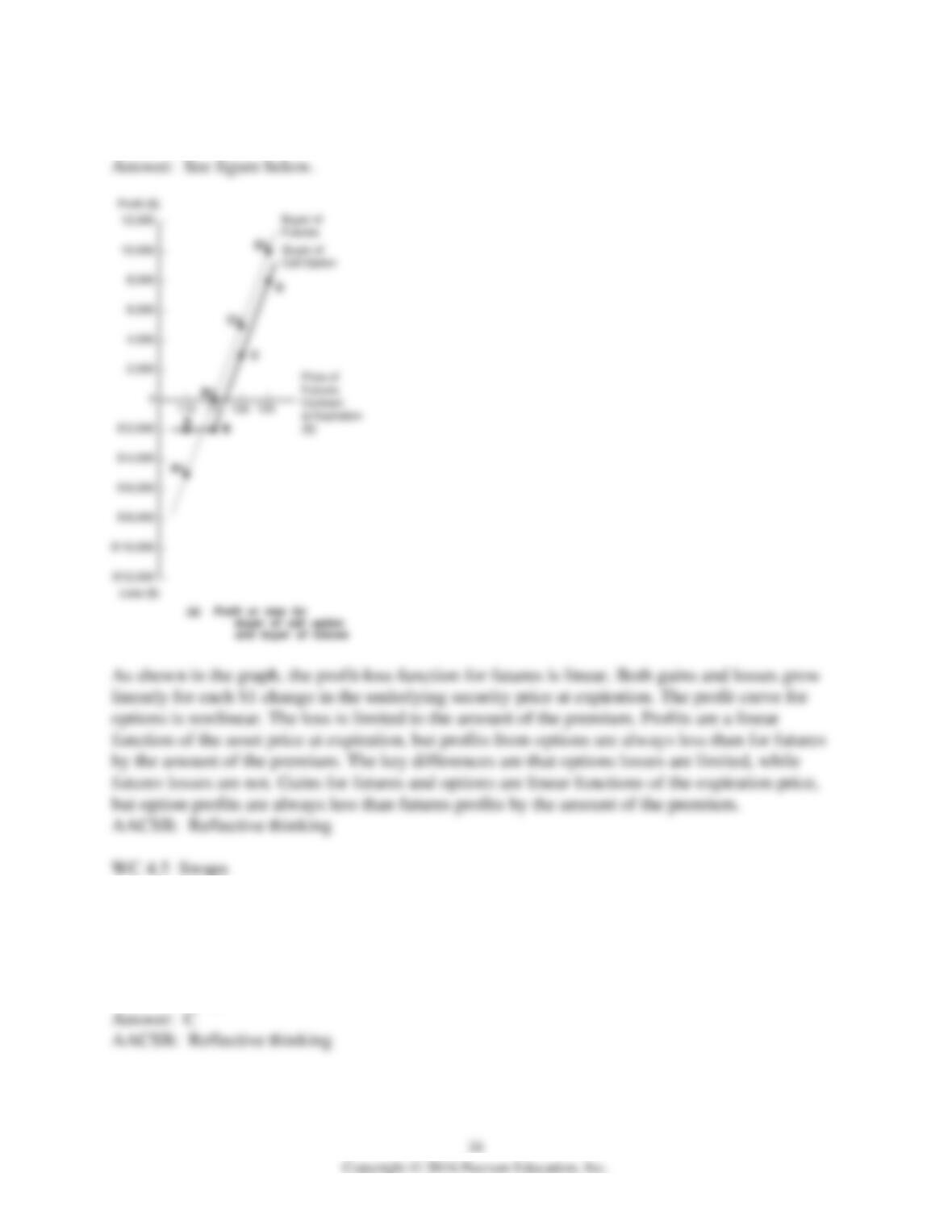
31) Show graphically and explain the profits and losses of buying futures relative to buying call
options.
1) A tool for managing interest-rate risk that requires exchange of payment streams is a
A) futures contract.
B) forward contract.
C) swap.
D) micro hedge.
2) A financial contract that obligates one party to exchange a set of payments it owns for another
set of payments owned by another party is called a
A) hedge.
B) call option.
C) put option.
D) swap.
3) A swap that involves the exchange of a set of payments in one currency for a set of payments
in another currency is
A) an interest-rate swap.
B) a currency swap.
C) a swaption.
D) an international swap.
4) A swap that involves the exchange of one set of interest payments for another set of interest
payments is called
A) an interest rate swap.
B) a currency swap.
C) a swaption.
D) an international swap.
5) A firm that sells goods to foreign countries on a regular basis can avoid exchange-rate risk by
A) buying stock options.
B) selling puts on financial futures.
C) using a foreign exchange swap.
D) buying swaptions.
6) The most common type of interest-rate swap is
A) the plain vanilla swap.
B) the basic swap.
C) the ordinary swap.
D) the notional swap.
7) If Second National Bank has more rate-sensitive assets than rate-sensitive liabilities, it can
reduce interest-rate risk with a swap that requires Second National to
A) pay fixed rate while receiving floating rate.
B) receive fixed rate while paying floating rate.
C) both receive and pay fixed rate.
D) both receive and pay floating rate.
8) If a bank has more rate-sensitive assets than rate-sensitive liabilities
A) it reduces interest rate risk by swapping rate-sensitive income for fixed rate income.
B) it reduces interest rate risk by swapping fixed rate income for rate-sensitive income.
C) it increases interest rate risk by swapping rate-sensitive income for fixed rate income.
D) it neutralizes interest rate risk by receiving and paying fixed-rate streams.
9) If Second National Bank has more rate-sensitive liabilities then rate-sensitive assets, it can
reduce interest rate risk with a swap that requires Second National to
A) pay fixed rate while receiving floating rate.
B) receive fixed rate while paying floating rate.
C) both receive and pay fixed rate.
D) both receive and pay floating rate.
10) One advantage of using swaps to eliminate interest-rate risk is that swaps
A) are less costly than futures.
B) are less costly than rearranging balance sheets.
C) are more liquid than futures.
D) have better accounting treatment than options.
11) A advantage of using swaps to hedge interest-rate risk is that swaps
A) are less costly than futures.
B) can be written for long horizons.
C) are not subject to default risk.
D) are more liquid than futures.
1) The credit derivative that, for a fee, gives the purchaser the right to receive profits that are tied
either to the price of an underlying security or to an interest rate is called a
A) credit option.
B) credit swap.
C) credit-linked note.
D) credit default swap.
2) Suppose that Wells Fargo Home Mortgage sells $10 million worth of mortgage payments to
GMAC in exchange for $10 million in auto loan payments. This type of transaction is called a
A) credit option.
B) credit swap.
C) credit-linked note.
D) credit default swap.
3) If one party pays a fixed fee on a regular basis in return for a contingent payment that is
triggered by a downgrading of a firm’s credit rating, that is called a
A) credit option.
B) credit swap.
C) credit-linked note.
D) credit default swap.
4) Suppose Ford Motor Company issues a 5% bond with a stipulation that if a national index of
SUV sales drops by 10%, then Ford can decrease the coupon rate to 3%. This security is called a
A) credit option.
B) credit swap.
C) credit-linked note.
D) credit default swap.