Principles of Managerial Finance, Brief, 7e (Gitman)
Chapter 4 Cash Flow and Financial Planning
4.1 Understand tax depreciation procedures and the effect of depreciation on the firm’s cash
flows.
1) Depreciation deductions, like any other business expenses, reduce the income that a firm
reports on its income statement.
2) Non-cash charges are expenses that involve an actual outlay of cash during the period but are
not deducted on the income statement.
3) Under the basic MACRS procedures, the depreciable value of an asset is its full cost,
including outlays for installation.
4) Business firms are permitted to systematically charge a portion of the market value of fixed
assets as depreciation against annual revenues.
5) Given a financial manager’s preference for faster receipt of cash flows, a longer depreciable
life is preferred to a shorter one.
6) For tax purposes, using MACRS recovery periods, assets in the first four property classes are
depreciated by the double-declining balance method using the half-year convention and
switching to straight line when advantageous.
7) The MACRS depreciation method requires use of the half-year convention. Assets are
assumed to be acquired in the middle of the year and only one-half of the first year’s depreciation
is recovered in the first year.
8) Allocation of the historic costs of fixed assets against the annual revenue they generate is
called ________.
A) arbitraging
B) securitization
C) depreciation
D) amortization
9) The Modified Accelerated Cost Recovery System (MACRS) is a depreciation method used for
________ purposes.
A) tax
B) financial reporting
C) budget
D) cost accounting
10) A corporation ________.
A) must use the straight-line depreciation method for tax purposes and double declining
depreciation method financial reporting purposes
B) can use straight-line depreciation method for tax purposes and MACRS depreciation method
financial reporting purposes
C) can use different depreciation methods for tax and financial reporting purposes
D) must use different depreciation method for tax purposes, but strictly mandated depreciation
methods for financial reporting purposes
11) The depreciable value of an asset, under MACRS, is the ________.
A) current cost
B) current cost minus salvage value
C) the original cost plus installation
D) the original cost plus installation costs, minus salvage value
MACRS RATE
Recovery year
3 years
5 years
7 years
10 years
1
33%
20%
14%
10%
2
45
32
25
18
3
15
19
18
14
4
7
12
12
12
5
12
9
9
6
5
9
8
7
9
7
8
4
6
9
6
10
6
11
4
12) Under MACRS, an asset which originally cost $10,000 is being depreciated using a 5-year
normal recovery period. What is the depreciation expense in year 3?
A) $1,900
B) $1,200
C) $1,500
D) $2,100
13) Under MACRS, an asset which originally cost $100,000 is being depreciated using a 10-year
normal recovery period. The depreciation expense in year 5 is ________.
A) $10,000
B) $12,000
C) $21,000
D) $ 9,000
14) Under MACRS, an asset which originally cost $100,000 is being depreciated using a 10-year
normal recovery period. The depreciation expense in year 11 is ________.
A) $3,000
B) $4,000
C) $0
D) $6,000
15) Given a financial manager’s preference for faster receipt of cash flows, ________.
A) a longer depreciable life is preferred to a shorter one
B) a shorter depreciable life is preferred to a longer one
C) the manager is not concerned with depreciable life, because depreciation is a noncash expense
D) the manager is not concerned with depreciable life, because once purchased, depreciation is
considered a sunk cost
16) In general, ________.
A) a longer depreciable life is preferred, because it will result in a faster receipt of cash flows
B) a shorter depreciable life is preferred, because it will result in a faster receipt of cash flows
C) a shorter depreciable life is preferred, because management can then purchase new assets, as
the old assets are written off
D) a longer depreciable life is preferred, because management can postpone purchasing new
assets, since the old assets still have a useful life
17) The depreciable value of an asset, under MACRS, is ________.
A) the full cost excluding installation costs
B) the full cost minus salvage value
C) the full cost including installation costs
D) the full cost including installation costs adjusted for the salvage value
MACRS RATE
Recovery year
3 years
5 years
7 years
10 years
1
33%
20%
14%
10%
2
45
32
25
18
3
15
19
18
14
4
7
12
12
12
5
12
9
9
6
5
9
8
7
9
7
8
4
6
9
6
10
6
11
4
18) Under MACRS, an asset which originally cost $100,000, incurred installation costs of
$10,000, and has an estimated salvage value of $25,000, is being depreciated using a 5-year
normal recovery period. What is the depreciation expense in year 1?
A) $15,000
B) $12,750
C) $11,250
D) $22,000
19) Darling Paper Container, Inc. purchased several machines at a total cost of $300,000. The
installation cost for this equipment was $25,000. The firm plans to depreciate the equipment
using the MACRS 5-year normal recovery period. Prepare a depreciation schedule showing the
depreciation expense for each year.
4.2 Discuss the firm’s statement of cash flows, operating cash flow, and free cash flow.
1) In the statement of cash flows, the cash flows from financing activities result from debt and
equity financing transactions; including incurrence and repayment of debt, cash inflow from the
sale of stock, and cash outflows to repurchase stock or pay cash dividends.
2) Free cash flow (FCF) is the cash flow a firm generates from its normal operations; calculated
as EBIT minus taxes plus depreciation.
3) A firm’s operating cash flow (OCF) is the cash flow it generates from its normal operations:
producing and selling its output of goods or services.
4) The net fixed asset investment (NFAI) is defined as the change in net fixed assets plus
depreciation.
5) The net current asset investment (NCAI) is defined as the change in current assets minus the
change in sum of the accounts payable and accruals.
6) A firm’s free cash flow (FCF) represents the amount of cash flow available to investors
(stockholders and bondholders) after the firm has met all operating needs and after having paid
for net fixed asset investments and net current asset investments.
7) A firm’s free cash flow (FCF) equals the sum of operating cash flows, financing cash flows,
and investing cash flows.
8) Operating cash flow (OCF) is equal to a firm’s net operating profits after taxes minus all non-
cash charges.
9) In the statement of cash flows, cash flows from operating activities are cash flows directly
related to purchase and sale of fixed assets.
10) Depreciation is considered to be an outflow of cash.
11) The statement of cash flows allows the financial manager and other interested parties to
analyze a firm’s past and possibly future profitability.
12) To assess whether any developments have occurred that are contrary to a company’s financial
policies, the financial manager should pay special attention to both the major categories of cash
flow and the individual items of cash inflow and outflow.
13) It would be correct to define operating cash flow (OCF) as net operating profit after taxes
plus depreciation.
14) Operating cash flow (OCF) is calculated by deducting depreciation from net operating profit
after taxes.
15) Net operating profit after taxes (NOPAT) represents a firm’s earnings before interest and
after taxes.
16) Net operating profit after taxes (NOPAT) represents a firm’s earnings after deducting both
interest and taxes.
17) A firm’s operating cash flow (OCF) is defined as ________.
A) gross profit minus operating expenses
B) gross profit minus depreciation
C) EBIT times one minus the tax rate plus depreciation
D) EBIT plus depreciation
18) Which of the following is an example of noncash charges?
A) depreciation
B) accruals
C) interest expense
D) dividends paid
19) Which of the following is a source of cash flows?
A) increase in marketable securities
B) increase in accounts payable
C) decrease in notes payable
D) repurchase of stock
20) ________ is a noncash charge.
A) Labor expense
B) Depreciation
C) Salaries
D) Rent
21) In the statement of cash flows, retained earnings are handled through the adjustment of
________.
A) “Revenue” and “Cost” accounts
B) “Current Assets” and “Current Liabilities” accounts
C) “Depreciation” and “Purchases” accounts
D) “Net Profits After Taxes” and “Dividends Paid” accounts
22) The cash flows from operating activities section of the statement of cash flows includes
________.
A) principal received
B) cost of raw materials
C) dividends paid
D) stock repurchases
23) The cash flows from operating activities section of the statement of cash flows includes
________.
A) labor expense
B) proceeds from the sale of fixed assets
C) principal paid
D) dividends paid
24) The cash flows from financing activities section of the statement of cash flows includes
________.
A) labour expense
B) cost of raw materials
C) purchase of long-term assets
D) dividends paid
25) The three categories of a firm’s statement of cash flows are ________.
A) cash flow from operating activities, cash flow from investment activities, and cash flow from
noncash activities
B) cash flow from operating activities, cash flow from noncash activities, and cash flow from
financing activities
C) cash flow from equity activities, cash flow from investment activities, and cash flow from
financing activities
D) cash flow from operating activities, cash flow from investment activities, and cash flow from
financing activities
26) Which of the following is a cash inflow?
A) a decrease in accounts payable
B) a decrease in accounts receivable
C) an increase in dividend payment
D) a decrease in accrued liabilities
27) Which of the following is a cash outflow?
A) an increase in accounts payable
B) a decrease in notes receivable
C) an increase in accounts receivable
D) an increase in accrued liabilities
28) Which of the following line items of the statement of cash flows must be obtained from the
income statement?
A) accruals in current liabilities
B) interest expenses
C) accounts receivable
D) cash dividends paid on both preferred and common stocks
29) Cash flows directly related to production and sale of a firm’s products and services are called
________.
A) cash flow from operating activities
B) cash flow from investment activities
C) cash flow from financing activities
D) cash flow from equity activities
30) Cash flows associated with the purchase and sale of fixed assets and business interests are
called cash flow from ________.
A) operating activities
B) investment activities
C) financing activities
D) equity activities
31) Cash flows that result from debt and equity financing transactions, including incurrence and
repayment of debt, cash inflows from the sale of stock, and cash outflows to pay cash dividends
or repurchase stock are called cash flow from ________.
A) operating activities
B) investment activities
C) financing activities
D) miscellaneous activities
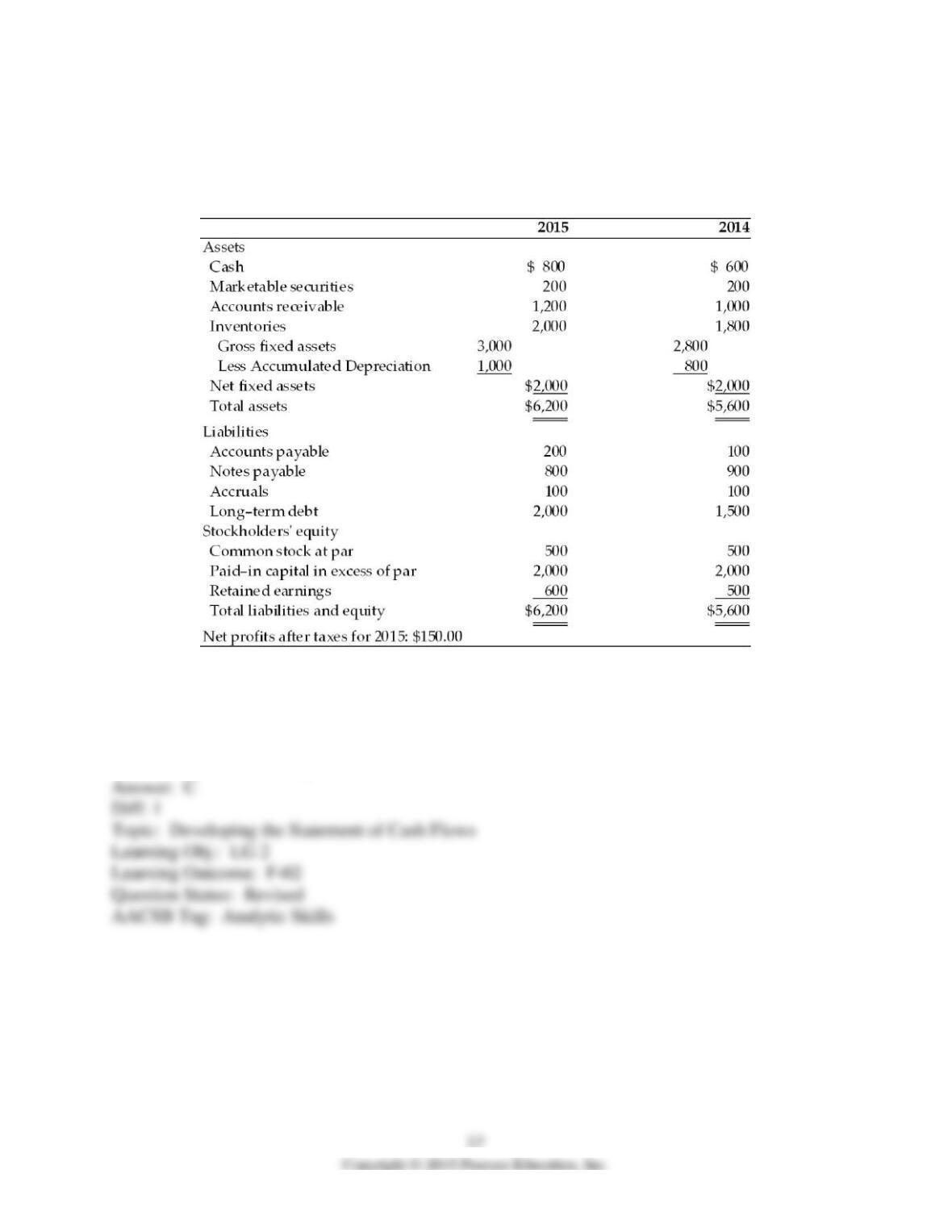
Table 4.1
True Sandpaper Co.
Balance Sheets
For the Years Ended 2014 and 2015
32) The largest single source of funds for the firm in 2015 is ________. (See Table 4.1)
A) an increase in net profits after taxes
B) an increase in notes payable
C) an increase in long-term debt
D) an increase in inventory
33) Common stock dividends paid in 2015 amounted to ________. (See Table 4.1)
A) $100
B) $50
C) $600
D) $150
34) The firm may have increased long-term debts to finance ________. (See Table 4.1)
A) an increase in net fixed assets
B) an increase in current assets
C) accounts receivable payments
D) an increase in dividends
35) The firm ________ fixed assets worth ________. (See Table 4.1)
A) purchased; $0
B) purchased; $200
C) sold; $0
D) sold; $200
36) The firm’s cash flow from operating activities is ________. (See Table 4.1)
A) $50
B) $350
C) $150
D) $200
37) The depreciation expense for 2015 is ________. (See Table 4.1)
A) $0
B) $200
C) $50
D) $1,000
38) A corporation sold a fixed asset for $100,000. This is ________.
A) an investment cash flow and a source of funds
B) an operating cash flow and a source of funds
C) an operating cash flow and a use of funds
D) an investment cash flow and a use of funds
39) A corporation raises $500,000 in long-term debt to acquire additional plant capacity. This is
considered as ________.
A) an investment cash flow
B) a financing cash flow
C) a financing cash flow and investment cash flow, respectively
D) a financing cash flow and operating cash flow, respectively
40) Which of the following is a cash flow from financing activities?
A) purchase of a long-term asset
B) decrease in accounts payable
C) increase in accounts payable
D) repurchasing stock
41) Which of the following represents a cash flow from operating activities?
A) dividends paid
B) increase or decrease in current liabilities
C) increase or decrease in fixed assets
D) repurchasing stock