Chapter 3—The Time Value of Money
MULTIPLE CHOICE
1. Which of the following cannot be calculated?
a.
Present value of an annuity.
b.
Future value of an annuity.
c.
Present value of a perpetuity.
d.
Future value of a perpetuity.
2. You have the choice between two investments that have the same maturity and the same nominal
return. Investment A pays SIMPLE interest, investment B pays compounded interest. Which one
should you pick?
a.
A, because it has a higher effective annual return.
b.
A and B offer the same return, thus they are equally as good.
c.
B, because it has higher effective annual return.
d.
Not enough information.
3. For a positive r,
a.
future value will always exceed present value.
b.
future and present will always be the same.
c.
present value will always exceed future value.
d.
None of the above is true.
4. Which of the following statements is TRUE?
a.
In an annuity due payments occur at the end of the period.
b.
In an ordinary annuity payments occur at the end of the period.
c.
A perpetuity will mature at some point in the future.
d.
One cannot calculate the present value of a perpetuity.
5. The Springfield Crusaders just signed their quarterback to a 10 year $50 million contract. Is this
contract really worth $50 million? (assume r >0)
a.
Yes, because the payments over time add up to $50 million.
b.
No, it is worth more because he can invest the money.
c.
No, it would only be worth $50 million if it were all paid out today.
d.
Yes, because his agent told him so.
6. Last national bank offers a CD paying 7% interest (compounded annually). If you invest $1,000 how
much will you have at the end of year 5.
a.
$712.99
b.
$1,402.55
c.
$1,350.00
d.
$1,000
7. You want to buy a house in 4 years and expect to need $25,000 for a down payment. If you have
$15,000 to invest, how much interest do you have to earn (compounded annually) to reach your goal?
a.
16.67%
b.
13.62%
c.
25.74%
d.
21.53%
8. You want to buy your dream car, but you are $5,000 short. If you could invest your entire savings of
$2,350 at an annual interest of 12%, how long would you have to wait until you have accumulated
enough money to buy the car?
a.
9.40 years
b.
3.48 years
c.
7.24 years
d.
6.66 years
9. How much do you have to invest today at an annual rate of 8%, if you need to have $5,000 six years
from today?
a.
$3,150.85
b.
$4,236.75
c.
$7,934.37
d.
$2,938.48
10. If you can earn 5% (compounded annually) on an investment, how long does it take for your money to
triple?
a.
14.40 years
b.
22.52 years
c.
19.48 years
d.
29.29 years
11. As a result of an injury settlement with your insurance you have the choice between
(1)
receiving $5,000 today or
(2)
$6,500 in three years.
If you could invest your money at 8% compounded annually, which option should you pick?
a.
(1), because it has a higher PV.
b.
You are indifferent between the two choices.
c.
(2), because it has a higher PV.
d.
You do not have enough information to make that decision.
12. What is the future value of cash flows 1-5 AT THE END YEAR 5, assuming a 6% interest rate
(compounded annually)?
End of year
Cash flow
1
$2,500
2
3,000
3
1,250
4
3,500
5
1,250
6
4,530
7
2,350
a.
$13,879.36
b.
$13,093.74
c.
$9,7844.40
d.
$11,548.48
13. What is the present value of these cash flows, if the discount rate is 10% annually?
End of year
Cash flow
1
$2,500
2
3,000
3
1,250
4
3,500
5
1,250
6
4,530
7
2,350
a.
$18,380.00
b.
$12,620.90
c.
$22,358.69
d.
$14,765.52
14. You are planning your retirement and you come to the conclusion that you need to have saved
$1,250,000 in 30 years. You can invest into an retirement account that guarantees you a 5% annual
return. How much do you have to put into your account at the end of each year to reach your
retirement goal?
a.
$81,314.29
b.
$18,814.30
c.
$23,346.59
d.
$12,382.37
15. You set up a college fund in which you pay $2,000 each year at the end of the year. How much money
will you have accumulated in the fund after 18 years, if your fund earns 7% compounded annually?
a.
$72,757.93
b.
$67,998.07
c.
$20,118.17
d.
$28,339.25
16. You set up a college fund in which you pay $2,000 each year at the BEGINNING of the year. How
much money will you have accumulated in the fund after 18 years, if your fund earns 7% compounded
annually?
a.
$72,757.93
b.
$67,998.07
c.
$20,118.17
d.
$28,339.25
17. When you retire you expect to live for another 30 years. During those 30 years you want to be able to
withdraw $45,000 at the BEGINNING of each year for living expenses. How much money do you
have to have in your retirement account to make this happen. Assume that you can earn 8% on your
investments.
a.
$1,350,000.00
b.
$506,600.25
c.
$547,128.27
d.
$723,745.49
18. You are offered a security that will pay you $2,500 at the end of the year forever. If your discount rate
is 8%, what is the most you are willing to pay for this security?
a.
$26,686
b.
$62,500
c.
$50,000
d.
$31,250
19. What is the effective annual rate of 12% compounded monthly?
a.
12%
b.
11.45%
c.
12.68%
d.
12.25%
20. Florida considers any loan of more than an APR compounded monthly to be usurious. What is the
usurious effective annual rate?
a.
18.00%
b.
19.25%
c.
19.56%
d.
22.25%
21. If you invested $2,000 in an account that pays 12% interest, compounded continuously, how much
would be in the account in 5 years?
a.
$3,524.68
b.
$3,644.24
c.
$3,581.70
d.
$3,200.00
22. You want to buy a new plasma television in 3 years, when you think prices will have gone down to a
more reasonable level. You anticipate that the television will cost you $2,500. If you can invest your
money at 8% compounded monthly, how much do you need to put aside today?
a.
$1,895.37
b.
$1,968.14
c.
$1,984.58
d.
$2,158.42
23. You found your dream house. It will cost you $175,000 and you will put down $35,000 as a down
payment. For the rest you get a 30-year 6.25% mortgage. What will be your monthly mortgage
payment (assume no early repayment)?
a.
$729
b.
$862
c.
$389
d.
$605
24. You want to buy a new car. The car you picked will cost you $32,000 and you decide to go with the
dealer’s financing offer of 5.9% compounded monthly for 60 months. Unfortunately, you can only
afford monthly loan payments of $300. However, the dealer allows you to pay off the rest of the loan
in a one time lump sum payment at the end of the loan. How much do you have to pay to the dealer
when the lump sum is due?
a.
$14,000.00
b.
$21,890.43
c.
$25,455.37
d.
$22,071.75
25. You are planning your retirement and you come to the conclusion that you need to have saved
$1,250,000 in 30 years. You can invest into an retirement account that guarantees you a 5% return.
How much do you have to put into your account at the end of every month to reach your retirement
goal?
a.
$1567.86
b.
$1,501.94
c.
$3,472.22
d.
$2,526.27
26. When you retire you expect to live for another 30 years. During those 30 years you want to be able to
withdraw $4,000 at the BEGINNING of every month for living expenses. How much money do you
have to have in your retirement account to make this happen. Assume that you can earn 8% on your
investments.
a.
$545,133.98
b.
$1,440,000.00
c.
$548,768.20
d.
$673,625.34
27. If you were to invest $120 for two years, while earning 8% compound interest, what is the TOTAL
AMOUNT OF INTEREST that you will earn?
a.
$139.97
b.
$139.20
c.
$19.20
d.
$19.97
28. If you were to invest $120 for two years, while earning 8% SIMPLE interest, what is the TOTAL
AMOUNT OF INTEREST that you will earn?
a.
$139.97
b.
$139.20
c.
$19.20
d.
$19.97
29. If the rate of interest that investors can earn on a 2-year investment is zero then
a.
you will repay the same amount of money at the conclusion of a loan that you borrowed at
the beginning of the 2 year loan.
b.
the “cost” of using money for 2 years is zero.
c.
you will receive the same amount of money at maturity that you invested at the beginning
of a 2 year investment.
d.
all of the above.
30. In the equation below, the exponent “3” represents
$133.10 = $100 ´ (1 + .1)3
a.
the future value of an investment.
b.
the present value of an investment.
c.
the annual rate of interest paid.
d.
the number of periods that the present value is left on deposit.
31. You are asked to choose between a 4-year investment that pays 10% compound interest and a similar
investment that pays 11.5% SIMPLE interest. Which investment will you choose?
a.
the 10% compound interest investment
b.
the 11.5% simple interest investment
c.
you are indifferent between the investment choices
d.
there is not enough information to answer the question
32. The amount that someone is willing to pay today, for a single cash flow in the future is
a.
the future value of the cash flow.
b.
the future value of the stream of cash flows.
c.
the present value of the cash flow.
d.
the present value of the annuity of cash flows
33. Pam is in need of cash right now and wants to sell the rights to a $1,000 cash flow that she will receive
5 years from today. If the discount rate for such a cash flow is 9.5%, then what is the fair price that
someone should be willing to pay Pam today for rights to that future cash flow?
a.
$1,574.24
b.
$635.23
c.
$260.44
d.
$913.24
34. Your father’s pension recently vested and he is told that if he never works another day in his life, he
will receive a lump sum of $1,500,000 on his 65th birthday (exactly 15 years from today). Assume that
your father needs to permanently retire today. What could he sell the rights to his lump sum for, today,
if the correct discount rate for such a calculation is 6%?
a.
$625,897.59
b.
$1,415,094.34
c.
$154,444.15
d.
none of the above
35. Your parents set up a trust for you that you will not have access to until your 30th birthday, which is
exactly 9 years from today. By prior arrangement, the trust will be worth exactly $200,000 on your
30th birthday. You need cash today and are willing to sell the rights to that trust today for a set
amount. If the discount rate for such a cash flow is 12%, what is the maximum amount that someone
should be willing to pay you today for the rights to the trust on your 30th birthday?
a.
$72,122.01
b.
$178,571.43
c.
$224,000.00
d.
$225,000.00
36. In the equation below, the number “100” represents
$75.13 = $100 / (1 + .1)3
a.
the present value a cash flow to be received at a later date.
b.
the future value a cash flow to be received at a later date.
c.
the discount rate for the future cash flow.
d.
the number of periods before the cash flow is to be received.
37. You will receive a stream of payments BEGINNING at the end of year 1 and the amount will increase
by $10 each year until the final payment at the end of year 5. If the first payment is $50, what amount
will you have at the end of year 5 if you can invest all amounts at a 7% interest rate?
a.
$350.00
b.
$374.50
c.
$394.79
d.
$422.43
38. You will receive a stream of $50 payments BEGINNING at the end of year 1 until the final payment at
the end of year 5. What amount will you have at the end of year 5 if you can invest all amounts at a 9%
interest rate?
a.
$194.48
b.
$200.00
c.
$228.67
d.
$299.24
39. You will receive a stream of annual $70 payments to begin at the end of year 0 until the final payment
at the end of year 5. What amount will you have at the end of year 5 if you can invest all amounts at a
11% interest rate?
a.
$350.00
b.
$420.00
c.
$553.90
d.
$614.83
40. You will receive a stream of annual $70 payments to begin at the end of year 0 until the final payment
at the BEGINNING of year 5. What amount will you have at the end of year 5 if you can invest all
amounts at an 11% interest rate?
a.
$350.00
b.
$435.95
c.
$483.90
d.
$614.83
41. You are trying to prepare a budget based upon the amount of cash flow that you will have available 5
years from now. You are initially promised a regular annuity of $50 with the first payment to be made
1 year from now and the last payment 5 years from now. However, you are actually going to receive
an annuity due with the same number of payments but where the first payment is to begin
immediately. How much (or less) cash will you have 5 years from now based upon that error if the rate
to invest funds is 10%?
a.
$50.00
b.
$38.58
c.
$30.52
d.
($30.52)
42. An annuity can best be described as
a.
a set of payments to be received during a period of time.
b.
a stream of payments to be received at a common interval over the life of the payments.
c.
an even stream of payments to be received at a common interval over the life of the
payments.
d.
the present value of a set of payments to be received during a future period of time.
43. Which of the following should have the greatest value if the discount rate applying to the cash flows is
a positive value?
a.
the present value of a $5 payment of to be received one year from today.
b.
the future value of a $5 payment received today but invested for one year.
c.
the present value of a stream of $5 payments to be received at the end of the next two
years.
d.
the future value of a stream of $5 payments to be received at the end of the next two years.
44. What is the present value of $25 to be received at the end of each year for the next 6 years if the
discount rate is 12%?
a.
$125.00
b.
$113.06
c.
$102.79
d.
none of the above
45. What is the present value of $25 to be received at the BEGINNING of each year for the next 6 years if
the discount rate is 12%?
a.
$125.00
b.
$126.63
c.
$115.12
d.
none of the above
46. Forever Insurance Company has offered to pay you or your heirs $100 per year at the end of each year
forever. If the correct discount rate for such a cash flow is 13%, what the amount that you would be
willing to pay Forever Insurance for this set of cash flows?
a.
$1,000.00
b.
$869.23
c.
$769.23
d.
$100
47. You would like to have $1,000 one year (365 days) from now and you find that the bank is paying 7%
compounded daily. How much will you have to deposit with the bank today to be able to have the
$1,000?
a.
$934.58
b.
$933.51
c.
$932.40
d.
none of the above
48. By increasing the number of compounding periods in a year, while holding the annual percentage rate
constant, you will
a.
decrease the annual percentage yield.
b.
increase the annual percentage yield.
c.
not effect the annual percentage yield.
d.
increase the dollar return on an investment but will decrease the annual percentage yield.
49. The ratio of interest to principal repayment on an amortizing loan
a.
increases as the loan gets older.
b.
decreases as the loan gets older.
c.
remains constant over the life of the loan.
d.
changes according to the level of market interest rates during the life of the loan.
50. You are trying to accumulate $2,000 at the end of 5 years by contributing a fixed amount at the end of
each year. You initially decide to contribute $300 per year but find that you are coming up short of the
$2,000 goal. What could you do to increase the value of the investment at the end of year 5?
a.
invest in an investment that has a lower rate of return.
b.
invest in an investment that has a higher rate of return.
c.
make a sixth year contribution.
d.
contribute a smaller amount each year.
51. If you hold the annual percentage rate constant while increasing the number of compounding periods
per year, then
a.
the effective interest rate will increase.
b.
the effective interest rate will decrease.
c.
the effective interest rate will not change.
d.
none of the above.
52. A young couple buys their dream house. After paying their down payment and closing costs, the
couple has borrowed $400,000 from the bank. The terms of the mortgage are 30 years of monthly
payments at an APR of 6% with monthly compounding. What is the monthly payment for the couple?
a.
$2,398.20
b.
$2,421.63
c.
$2,697.98
d.
$2,700.00
53. A young couple buys their dream house. After paying their down payment and closing costs, the
couple has borrowed $400,000 from the bank. The terms of the mortgage are 30 years of monthly
payments at an APR of 6% with monthly compounding. Suppose the couple wants to pay off their
mortgage early, and will make extra payments to accomplish this goal. Specifically, the couple will
pay an EXTRA $2,000 every 12 months (this extra amount is in ADDITION to the regular scheduled
mortgage payment). The first extra $2,000 will be paid after month 12. What will be the balance of the
loan after the first year of the mortgage?
a.
$392,940.44
b.
$393,087.95
c.
$394,090.84
d.
$397,601.80
54. Uncle Fester puts $50,000 into a bank account earning 6%. You can’t withdraw the money until the
balance has doubled. How long will you have to leave the money in the account?
a.
9 years
b.
10 years
c.
11 years
d.
12 years
55. Which of the following statements are TRUE?
Statement I:
As you increase the interest rate, the future value of an investment
increases.
Statement II:
As you increase the length of the investment (to receive some lump sum),
the present value of the investment increases.
Statement III:
The present value of an ordinary annuity is larger than the present value of
an annuity due. (all else equal)
a.
Statement I only
b.
Statements I and II
c.
Statement II only
d.
Statements I and III only
56. Consider the following set of cashflows to be received over the next 3 years:
Year
1
2
3
Cashflow
$100
$225
$300
If the discount rate is 10%, how would we write the formula to find the Future Value of this set of cash
flows at year 3?
a.
b.
$100 (1.10) + $225 (1.10) + $300 (1.10)
c.
$100 (1.10)3 + $225 (1.10)2 + $300 (1.10)
d.
$100 (1.10)2 + $225 (1.10) + $300
57. Which is NOT correct regarding an ordinary annuity and annuity due?
a.
An annuity is a series of equal payments.
b.
The present value of an ordinary annuity is less than the present value of an annuity due
(assuming interest rate is positive).
c.
As the interest rate increases, the present value of an annuity decreases.
d.
As the length of the annuity increases, the future value of the annuity decreases.
58. After graduating from college with a finance degree, you begin an ambitious plan to retire in 25 years.
To build up your retirement fund, you will make quarterly payments into a mutual fund that on
average will pay 12% APR compounded quarterly. To get you started, a relative gives you a
graduation gift of $5,000. Once retired, you plan on moving your investment to a money market fund
that will pay 6% APR with monthly compounding. As a young retiree, you believe you will live for 30
more years and will make monthly withdrawals of $10,000. To meet your retirement needs, what
quarterly payment should you make?
a.
$2,221.45
b.
$2,588.27
c.
$2,746.50
d.
$2,904.73
59. A bank account has a rate of 12% APR with quarterly compounding. What is the EAR for the account?
a.
3.00%
b.
12.00%
c.
12.36%
d.
12.55%
60. An investor puts $200 in a money market account TODAY that returns 3% per year with monthly
compounding. The investor plans to keep his money in the account for 2 years. What is the future
value of his investment when he closes the account two years from today?
a.
$215.00
b.
$212.35
c.
$206.08
d.
$188.37
61. Suppose you take out a loan from the local mob boss for $10,000. Being a generous banker, the mob
boss offers you an APR of 60% with monthly compounding. The length of the loan is 3 years with
monthly payments. However, you want to get out of this arrangement as quickly as possible. You
decide to pay off whatever balance remains after the first year of payments. What is your remaining
balance after one year?
a.
$8,124.46
b.
$8,339.13
c.
$9,233.06
d.
$9,342.47
62. Suppose you are ready to buy your first house. To buy the house, you will take out a $140,000
mortgage from the bank. The bank offers you the mortgage for 30 years at an APR of 6.0% with
interest compounded monthly. For your tenth monthly payment, what is the reduction in principal?
a.
$145.77
b.
$156.18
c.
$327.24
d.
$359.64
63. What is the future value of a 5-year ordinary annuity with annual payments of $250, evaluated at a 15
percent interest rate?
a.
$670.44
b.
$838.04
c.
$1,250
d.
$1,685.60
64. The present value of an ordinary annuity is $2,000. The annuity features monthly payments from an
account that pays 12% APR (with monthly compounding). If this was an annuity due, what would be
the present value? (assume that same interest rate and same payments)
a.
$1,785.71
b.
$1,980.20
c.
$2,020.00
d.
$2,080.00
65. Suppose that Hoosier Farms offers an investment that will pay $10 per year forever. How much is this
offer worth if you need a 8% return on your investment?
a.
$8
b.
$80
c.
$100
d.
$125
66. Suppose a professional sports team convinces a former player to come out of retirement and play for
three seasons. They offer the player $2 million in year 1, $3 million in year 2, and $4 million in year 3.
Assuming end of year payments of the salary, how would we find the value of his contract today if the
player has a discount rate of 12%?
a.
PV =
b.
PV =
c.
PV =
d.
PV =
67. Which statement is FALSE concerning the time value of money?
a.
The greater the compound frequency, the greater the EAR.
b.
The EAR is always greater than the APR.
c.
An account that pays simple interest will have a lower FV than an account that pays
compound interest.
d.
The stated interest rate is also referred to as the APR.
68. Suppose you made a $10,000 investment ten years ago in a speculative stock fund. Your investment
today is worth $100,000. What annual compounded return did you earn over the ten year period?
a.
10%
b.
15%
c.
25.89%
d.
27.54%
69. An athlete was offered the following contract for the next three years:
Year
1
2
3
Cashflow
$5 million
$7 million
$9 million
The athlete would rather have his salary in equal amounts at the END of each of the three years. If the
discount rate for the athlete is 10%, what yearly amount would she consider EQUIVALENT to the
offered contract?
a.
$5.37 million per year
b.
$5.70 million per year
c.
$6.71 million per year
d.
$6.87 million per year
70. Which of the following investment opportunities has the highest present value if the discount rate is
10%?
Investment A
Investment B
Investment C
Year 0
$200
$300
$400
Year 1
$300
$350
$350
Year 2
$400
$400
$300
Year 3
$400
$350
$250
Year 4
$400
$300
$200
a.
Investment A
b.
Investment B
c.
Investment C
d.
The present value of Investments A and C are equal and higher than the present value of
Investment B.
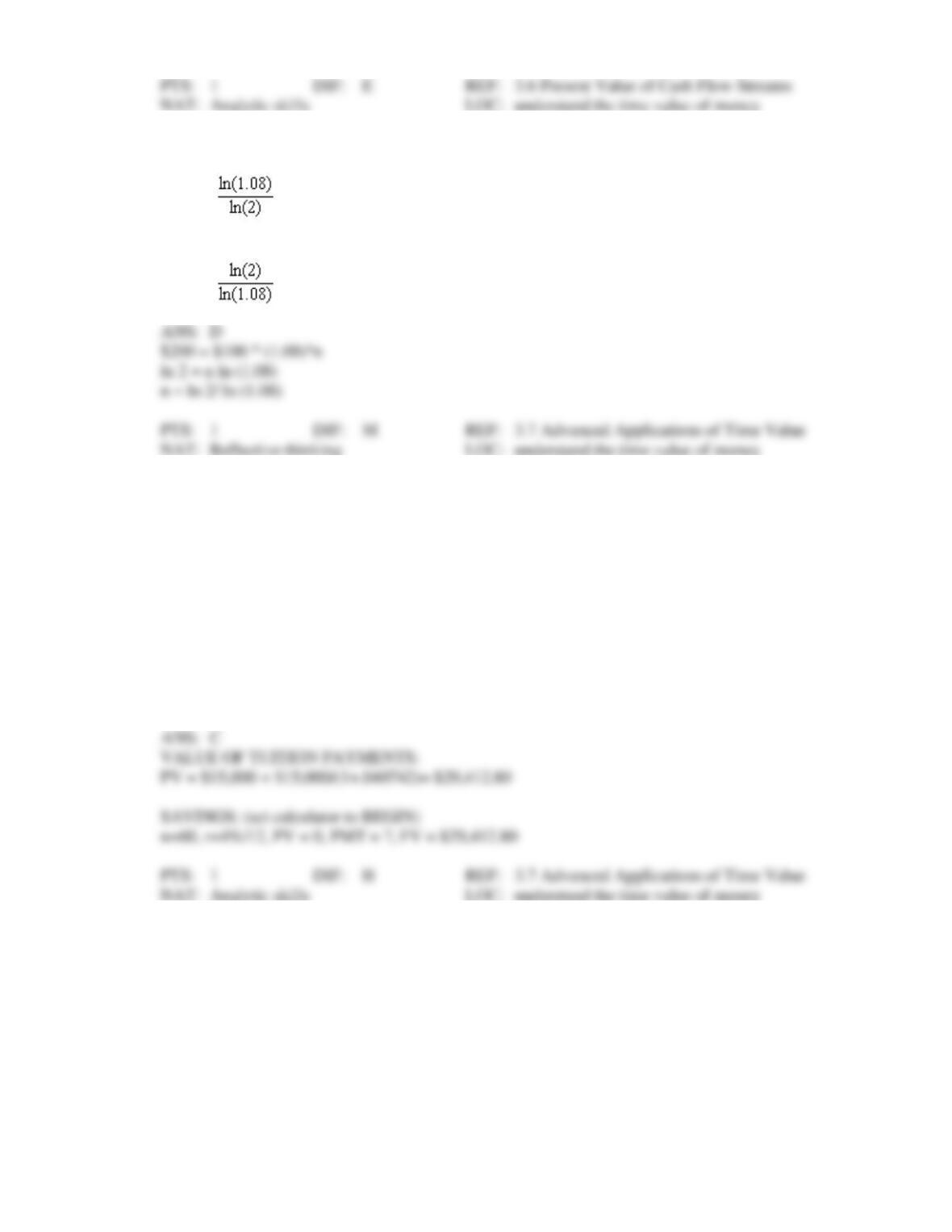
71. A bank is offering a new savings account that pays 8% per year. Which formula below shows the
calculation for determining how long it will take a $100 investment to double?
a.
n =
b.
n = 1.08ln(2)
c.
n = 2ln(1.08)
d.
n =
72. In five years, you plan on starting graduate school to earn your MBA. You know that graduate school
can be expensive and you expect you will need $15,000 per year for tuition and other school expenses.
These payments will be made at the BEGINNING of the school year. To have enough money to attend
graduate school, you decide to start saving TODAY by investing in a money market fund that pays 4%
APR with monthly compounding. You will make monthly deposits into the account starting TODAY
for the next five years. How much will you need to deposit each month to have enough savings for
graduate school? (Assume that money that is not withdrawn remains in the account during graduate
school and the MBA will take two years to complete.)
a.
$438.15
b.
$440.26
c.
$442.16
d.
$443.64
73. As a young graduate, you have plans on buying your dream car in three years. You believe the car will
cost $50,000. You have two sources of money to reach your goal of $50,000. First, you will save
money for the next three years in a money market fund that will return 8% annually. You plan on
making $5,000 annual payments to this fund. You will make yearly investments at the BEGINNING
of the year. The second source of money will be a car loan that you will take out on the day you buy
the car. You anticipate the car dealer to offer you a 6% APR loan with monthly compounding for a
term of 60 months. To buy your dream car, what monthly car payment will you anticipate?
a.
$483.99
b.
$540.15