
Test Bank Questions, Chapter 3
1. What is the first step in the financial planning process?
a. Gather data.
b. Communicate investment objectives to client.
c. Identify household spending.
d. Identify household goals and needs.
e. None of the above.
2. Behavioral finance can best be defined as:
a. How to improve people’s decision-making abilities so that they can more easily
achieve the goals they set.
b. The study of human actions in financial matters.
c. How to understand people’s decision-making abilities so that they can more
easily achieve the goals they set.
d. The study of how behavior is shaped by an individual’s financial well-being.
e. None of the above.
3. Understanding and improving people’s decision-making abilities so that they can
more easily achieve the goals they set is the objective of:
a. Personal financial planning.
b. Behavioral finance.
c. Behavioral financial planning.
d. Finance.
e. None of the above.
4. Peer groups are:
a. Households in a similar demographic category, against whom the advisor
measures a household’s financial health.
b. Analysts that review a household’s wealth from an objective and non-judgmental
perspective.
c. Analysts that review a household’s wealth from a subjective and behavioral
perspective.

d. Friends and associates with similar backgrounds, against whom we measure
ourselves.
e. None of the above
5. Life cycle stages include:
a. Young, middle aged, and senior.
b. Child, adult, and elderly.
c. Student, employed, unemployed, retired.
d. Infant, child, adolescent, young adult, adult, elderly.
e. None of the above.
6. Which of the following is typically not a characteristic of young clients?
a. They place great emphasis on their current standard of living.
b. Savings are given lower priority.
c. Low risk tolerance.
d. All of the above are typically characteristics of young clients.
e. None of the above is typically a characteristic of young clients.
7. Which of the following is typically not a characteristic of middle aged clients?
a. Debt as a percentage of assets declines.
b. Consistent cost of living.
c. Increased sums saved for retirement.
d. All of the above are typically characteristics of middle aged clients.
e. None of the above is typically a characteristic of middle aged clients.
8. Which of the following is typically not a characteristic of senior clients?
a. Focused on the accumulation of wealth.
b. High risk tolerance.
c. Increased cost of living regardless of medical and eldercare costs.
d. All of the above are typically characteristics of senior clients.
e. None of the above is typically a characteristic of senior clients.

9. Personality is relevant to personal financial planning. This is primarily because:
a. Personality affects our tolerance for risk which influences our planning actions.
b. The client’s salary and career success is typically determined by the client’s
personality.
c. Understanding the client’s personality allows the advisor to monitor the client for
emotional outbursts.
d. Investment decisions are based on behavioral factors.
e. None of the above.
10. Which of the following characterizes communication?
a. It is the ability to transmit a message successfully to another person.
b. It is required to demonstrate to others that we possess desirable traits.
c. It is necessary even if you are honest, knowledgeable, and concerned.
d. All of the above.
e. None of the above.
11. Transmitting our thoughts and emotions through the spoken word is:
a. Verbal communication.
b. A verbal message.
c. The only way to transmit a message.
d. Communicated through the tone of voice and intensity.
e. All of the above.
12. Which of the following is not a reason to communicate?
a. To express your opinion or feelings about a matter.
b. To convey specific facts.
c. To develop a relationship with another person.
d. To persuade someone to follow your advice.
e. All of the above are reasons to communicate.

13. Which of the following is not a rule that can help you become a more effective
listener?
a. Do more listening than talking.
b. Avoid trying to get into the other person’s way of thinking.
c. Keep your responses to the topic being discussed.
d. Focus your full attention.
e. All of the above are rules that can help you become a more effective listener.
14. What is empathy?
a. Speaking positively about another person’s strongly held beliefs.
b. Believing that you can rely on another person to perform as expected.
c. Trying to place oneself in another person’s position.
d. Trying not to be judgmental about another person’s position.
e. None of the above.
15. The purpose of the initial client interview is:
a. To establish goals.
b. To gather data.
c. To establish whether the client and advisor wish to work together.
d. All of the above.
e. Only b and c above.
16. Which of the following is not part of preplanning the interview process/?
a. Ensure that the interview room is neat and free from distraction.
b. Review background about the client.
c. Select topics to be discussed in advance.
d. Prepare an analysis of the client’s goals.
e. Prepare an outline of questions to be asked.
17. The substance of the client interview typically begins with:
a. Small talk.

b. A simple question.
c. Probing questions.
d. Paraphrasing the client’s questions.
e. None of the above.
18. The conclusion of the client interview typically includes:
a. The advisor indicating that the time is drawing to a close.
b. The advisor summing the points covered during the meeting.
c. The advisor establishing a date or other plan for action.
d. All of the above.
e. None of the above.
19. Financial counseling is best defined as:
a. Assisting clients in making their financial decisions.
b. Making financial decisions for clients.
c. The provision of legal advice related to financial matters.
d. The analysis of the client’s portfolio of investments.
e. None of the above.
20. Which of the following best describes the relation, in practice, between financial
counseling and financial advising?
a. Professionals choose to provide either financial counseling or financial advising,
and rarely combine the two.
b. Financial counseling and financial advising are often combined with little
distinction made between the two.
c. Professionals typically focus on financial counseling exclusively.
d. Professionals typically focus on financial advising exclusively.
e. None of the above.
21. Which of the following statements is applicable to financial planners?
a. They may view themselves as assisting people in making their decisions.

b. They may be extremely sensitive to people’s needs with financial rules taking a
backseat.
c. They may view themselves as experts whose advice is correct and should be
followed in all instances.
d. All of the above statements may be applicable to financial planners, with the
degree of applicability depending on personality.
e. None of the above statements are applicable to financial planners.
22. If clients show resistance to the financial planner’s advice, the financial planner may:
a. Try to persuade the clients that their ways of viewing the matter aren’t accurate.
b. Change the advice.
c. Try to persuade the clients that their ways of viewing the matter aren’t in their
interest.
d. All of the above.
e. None of the above.
23. Financial advisors should set aside judgments for the balance of the consultation
when:
a. The client expresses dismay over the advisor’s fee.
b. The advice extends beyond hard financial practices and the client’s wishes to the
advisor’s own preferences.
c. The advice does not maximize the advisor’s own interests.
d. All of the above.
e. None of the above.
24. Which discipline proposes that our goals are influenced by the way we were raised by
our families and other groups of people in our environment?
a. Biology.
b. Sociology.
c. Psychology.
d. None of the above.
e. Both sociology and psychology, exclusively.

25. Biologists argue that:
a. We are programmed through our genetic makeup to strive for certain objectives.
b. Our goals are influenced by the way we were raised by our families and other
groups of people in our environment.
c. The underlying goal of most human behavior is to have as many pleasurable
experiences as possible.
d. Goal oriented behavior is genetically limited to the pursuit of pleasure.
e. None of the above.
26. Economists quantify goals in:
a. Financial terms.
b. Utility terms.
c. Leisure terms.
d. Behavioral terms.
e. None of the above.
27. The disciplines of economics and finance translate human motivations into common
dollar terms as:
a. Stripping emotion from decisions maximizes objectivity.
b. The disciplines of economics and finance are exclusively focused on rational
decision making.
c. Dollar terms permit scientific measurement.
d. Most students of economics and finance are primarily interested in money.
e. None of the above.
28. In strict finance parlance, we obtain the highest possible standard of living through:
a. Striving for an attractive balance of life’s factors.
b. Extending our objectives beyond just acquiring material items.
c. Striving to make the most money possible.
d. All of the above.
e. None of the above.

29. Which of the following needs did the psychologist Abraham Maslow believe that
people first try to satisfy?
a. Self-esteem needs.
b. Basic or physiological needs.
c. The need for safety.
d. The need for belonging.
e. None of the above.
30. Long-term goals are those you expect to accomplish in:
a. Five years or more.
b. Ten years or more.
c. Twelve years or more.
d. Fifteen years or more.
e. Upon retirement.
Answer: a
31. The life value of being seen as successful and receiving acknowledgement for
achievement is:
a. Pleasure.
b. Autonomy.
c. Recognition.
d. Friendship.
e. None of the above.
32. For which type of planning do we require current projected income and expenses?
a. Income tax planning.
b. Cash flow planning.
c. Estate planning.
d. Specialized planning.
e. None of the above.
Essay questions:
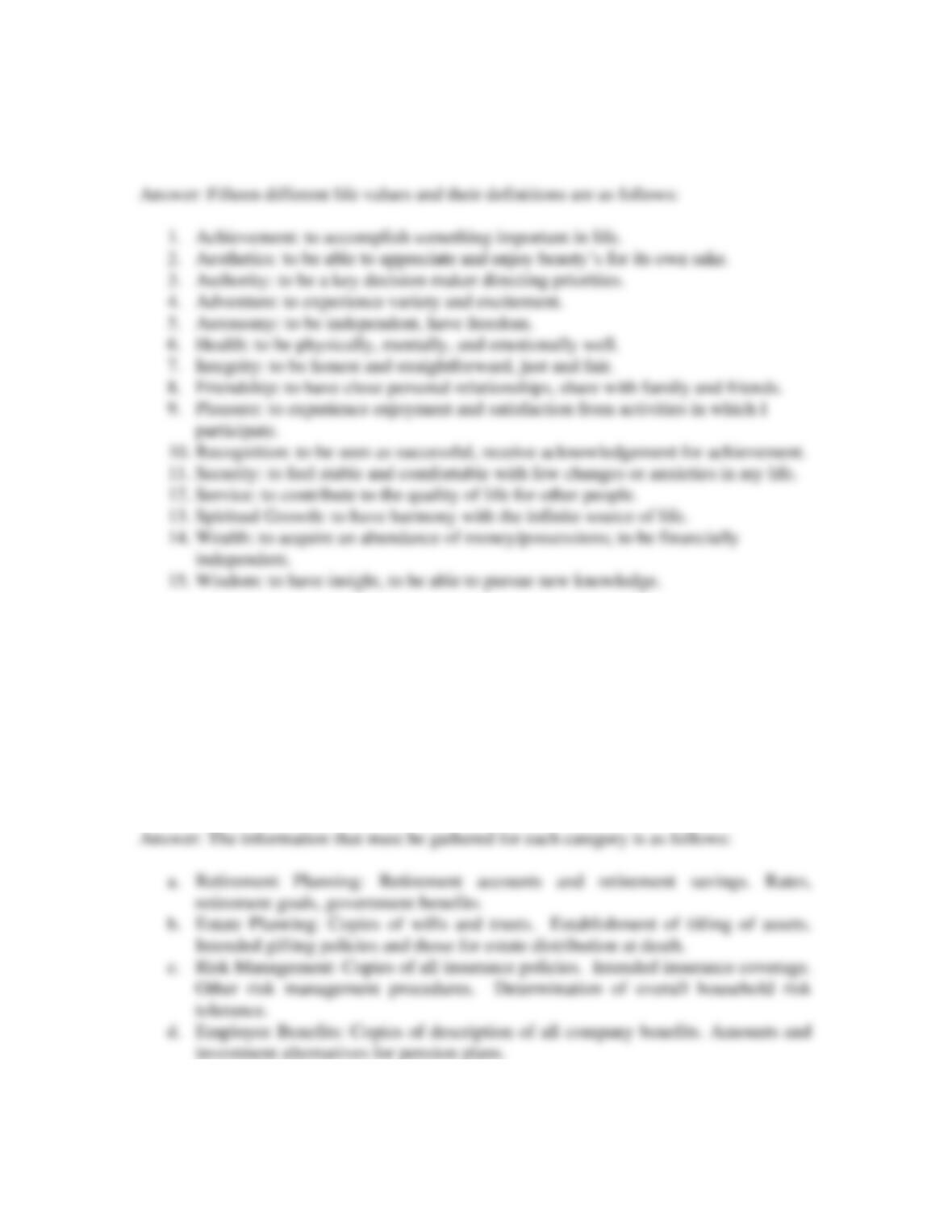
33. Please list and define fifteen different life values.
34. For each of the following categories of information required for a comprehensive
financial plan, please detail the information that must be gathered:
a. Retirement Planning
b. Estate Planning
c. Risk Management
d. Employee Benefits
e. Family Planning
f. Educational Planning