CHAPTER 3—RISK AND RETURN: PART II
1. The slope of the SML is determined by the value of beta.
a.
True
b.
False
False
2. If you plotted the returns of Selleck & Company against those of the market and found that the slope of your line was
negative, the CAPM would indicate that the required rate of return on Selleck’s stock should be less than the risk-free rate
for a well-diversified investor, assuming that the observed relationship is expected to continue in the future.
a.
True
b.
False
True
3. If the returns of two firms are negatively correlated, then one of them must have a negative beta.
a.
True
b.
False
True
4. A stock with a beta equal to −1.0 has zero systematic (or market) risk.
a.
True
b.
False
CHAPTER 3—RISK AND RETURN: PART II
False
5. It is possible for a firm to have a positive beta, even if the correlation between its returns and those of another firm are
negative.
a.
True
b.
False
True
6. In portfolio analysis, we often use ex post (historical) returns and standard deviations, despite the fact that we are
interested in ex ante (future) data.
a.
True
b.
False
True
7. If investors are risk averse and hold only one stock, we can conclude that the required rate of return on a stock whose
standard deviation is 0.21 will be greater than the required return on a stock whose standard deviation is 0.10. However, if
stocks are held in portfolios, it is possible that the required return could be higher on the low standard deviation stock.
a.
True
b.
False
True
CHAPTER 3—RISK AND RETURN: PART II
8. The CAPM is a multi-period model which takes account of differences in securities’ maturities, and it can be used to
determine the required rate of return for any given level of systematic risk.
a.
True
b.
False
False
CAPM
9. The SML relates required returns to firms’ systematic (or market) risk. The slope and intercept of this line can be
influenced by managerial actions.
a.
True
b.
False
False
10. The Y-axis intercept of the SML indicates the return on an individual asset when the realized return on an average (b =
1) stock is zero.
a.
True
b.
False
False
CHAPTER 3—RISK AND RETURN: PART II
11. We will almost always find that the beta of a diversified portfolio is less stable over time than the beta of a single
security.
a.
True
b.
False
False
12. Arbitrage pricing theory is based on the premise that more than one factor affects stock returns, and the factors are
specified to be (1) market returns, (2) dividend yields, and (3) changes in inflation.
a.
True
b.
False
False
13. You have the following data on three stocks:
Stock
Standard Deviation
Beta
A
0.15
0.79
B
0.25
0.61
C
0.20
1.29
As a risk minimizer, you would choose Stock ____ if it is to be held in isolation and Stock ____ if it is to be held as part
of a well-diversified portfolio.
CHAPTER 3—RISK AND RETURN: PART II
a.
A; B.
b.
B; C.
c.
C; A.
d.
C; B.
e.
A; A.
Difficulty: Easy
INTE.GENE.16.13 – LO: 3-5
United States – BUSPROG: Analytic
United States – AK – DISC: Risk and return
United States – OH – Default City – TBA
Risk aversion
TYPE: Multiple Choice: Conceptual
14. Which is the best measure of risk for an asset held in isolation, and which is the best measure for an asset held in a
diversified portfolio?
a.
Standard deviation; correlation coefficient.
b.
Beta; variance.
c.
Coefficient of variation; beta.
d.
Beta; beta.
e.
Variance; correlation coefficient.
Difficulty: Easy
INTE.GENE.16.13 – LO: 3-5
United States – BUSPROG: Analytic
United States – AK – DISC: Risk and return
United States – OH – Default City – TBA
Risk measures
TYPE: Multiple Choice: Conceptual
15. Which of the following is NOT a potential problem with beta and its estimation?
a.
Sometimes, during a period when the company is undergoing a change such as toward more leverage or riskier
assets, the calculated beta will be drastically different than the “true” or “expected future” beta.
b.
The beta of “the market,” can change over time, sometimes drastically.
c.
Sometimes the past data used to calculate beta do not reflect the likely risk of the firm for the future because
conditions have changed.
d.
There is a wide confidence interval around a typical stock’s estimated beta.
e.
Sometimes a security or project does not have a past history which can be used as a basis for calculating beta.
CHAPTER 3—RISK AND RETURN: PART II
16. Stock A’s beta is 1.5 and Stock B’s beta is 0.5. Which of the following statements must be true about these securities?
(Assume market equilibrium.)
a.
Stock B must be a more desirable addition to a portfolio than Stock A.
b.
Stock A must be a more desirable addition to a portfolio than Stock B.
c.
The expected return on Stock A should be greater than that on Stock B.
d.
The expected return on Stock B should be greater than that on Stock A.
e.
When held in isolation, Stock A has greater risk than Stock B.
Difficulty: Easy
INTE.GENE.16.13 – LO: 3-5
United States – BUSPROG: Analytic
United States – AK – DISC: Risk and return
United States – OH – Default City – TBA
Beta coefficients
TYPE: Multiple Choice: Conceptual
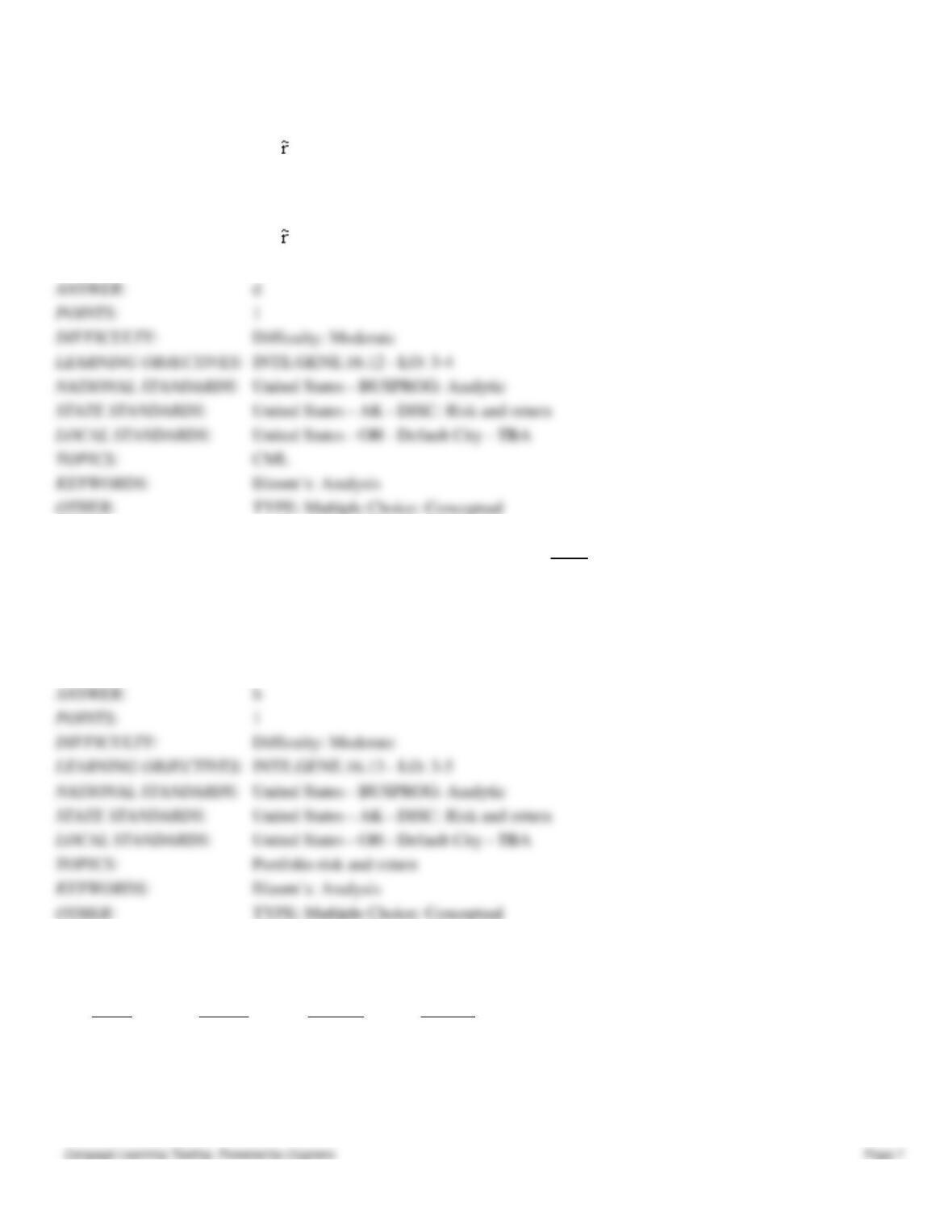
17. For markets to be in equilibrium (that is, for there to be no strong pressure for prices to depart from their current
levels),
a.
The past realized rate of return must be equal to the expected rate of return; that is, .
b.
The required rate of return must equal the realized rate of return; that is, r = .
c.
All companies must pay dividends.
d.
No companies can be in danger of declaring bankruptcy.
e.
The expected rate of return must be equal to the required rate of return; that is, = r.
Difficulty: Moderate
INTE.GENE.16.14 – LO: 3-2
United States – BUSPROG: Analytic
United States – AK – DISC: Risk and return
United States – OH – Default City – TBA
Market equilibrium
TYPE: Multiple Choice: Conceptual
Difficulty: Easy
INTE.GENE.16.13 – LO: 3-5
United States – BUSPROG: Analytic
United States – AK – DISC: Risk and return
United States – OH – Default City – TBA
Beta coefficients
TYPE: Multiple Choice: Conceptual
CHAPTER 3—RISK AND RETURN: PART II
18. Which of the following statements is CORRECT?
a.
The slope of the CML is ( M − rRF)/bM.
b.
All portfolios that lie on the CML to the right of σM are inefficient.
c.
All portfolios that lie on the CML to the left of σM are inefficient.
d.
The slope of the CML is ( M − rRF)/σM.
e.
The Capital Market Line (CML) is a curved line that connects the risk-free rate and the market portfolio.
Difficulty: Moderate
INTE.GENE.16.12 – LO: 3-4
United States – BUSPROG: Analytic
United States – AK – DISC: Risk and return
United States – OH – Default City – TBA
TYPE: Multiple Choice: Conceptual
19. In a portfolio of three different stocks, which of the following could NOT be true?
a.
The riskiness of the portfolio is greater than the riskiness of one or two of the stocks.
b.
The beta of the portfolio is less than the betas of each of the individual stocks.
c.
The beta of the portfolio is greater than the beta of one or two of the individual stocks’ betas.
d.
The beta of the portfolio cannot be equal to 1.
e.
The riskiness of the portfolio is less than the riskiness of each of the stocks if they were held in isolation.
Difficulty: Moderate
INTE.GENE.16.13 – LO: 3-5
United States – BUSPROG: Analytic
United States – AK – DISC: Risk and return
United States – OH – Default City – TBA
Portfolio risk and return
TYPE: Multiple Choice: Conceptual
20. You have the following data on (1) the average annual returns of the market for the past 5 years and (2) similar
information on Stocks A and B. Which of the possible answers best describes the historical betas for A and B?
Years
Market
Stock A
Stock B
1
0.03
0.16
0.05
2
−0.05
0.20
0.05
3
0.01
0.18
0.05
4
−0.10
0.25
0.05
5
0.06
0.14
0.05
a.
bA > +1; bB = 0.
CHAPTER 3—RISK AND RETURN: PART II
b.
bA = 0; bB = −1.
c.
bA < 0; bB = 0.
d.
bA < −1; bB = 1.
e.
bA > 0; bB = 1.
Difficulty: Moderate
INTE.GENE.16.13 – LO: 3-5
United States – BUSPROG: Analytic
United States – AK – DISC: Risk and return
United States – OH – Default City – TBA
Beta coefficients
TYPE: Multiple Choice: Conceptual
21. Which of the following statements is CORRECT?
a.
The typical R2 for a stock is about 0.94 and the typical R2 for a portfolio is about 0.6.
b.
The typical R2 for a stock is about 0.3 and the typical R2 for a large portfolio is about 0.94.
c.
The typical R2 for a stock is about 0.94 and the typical R2 for a portfolio is also about 0.94.
d.
The typical R2 for a stock is about 0.6 and the typical R2 for a portfolio is also about 0.6.
e.
The typical R2 for a stock is about 0.3 and the typical R2 for a portfolio is also about 0.3.
Difficulty: Moderate
INTE.GENE.16.13 – LO: 3-5
United States – BUSPROG: Analytic
United States – AK – DISC: Risk and return
United States – OH – Default City – TBA
Beta calculation
TYPE: Multiple Choice: Conceptual
22. Which of the following statements is CORRECT?
a.
The characteristic line is the regression line that results from plotting the returns on a particular stock versus
the returns on a stock from a different industry.
b.
The slope of the characteristic line is the stock’s standard deviation.
c.
The distance of the plot points from the characteristic line is a measure of the stock’s market risk.
d.
The distance of the plot points from the characteristic line is a measure of the stock’s diversifiable risk.
e.
“Characteristic line” is another name for the Security Market Line.
CHAPTER 3—RISK AND RETURN: PART II
Difficulty: Moderate
INTE.GENE.16.13 – LO: 3-5
United States – BUSPROG: Analytic
United States – AK – DISC: Risk and return
United States – OH – Default City – TBA
Characteristic line
TYPE: Multiple Choice: Conceptual
23. Which of the following statements is CORRECT?
a.
Richard Roll has argued that it is possible to test the CAPM to see if it is correct.
b.
Tests have shown that the risk/return relationship appears to be linear, but the slope of the relationship is
greater than that predicted by the CAPM.
c.
Tests have shown that the betas of individual stocks are stable over time, but that the betas of large portfolios
are much less stable.
d.
The most widely cited study of the validity of the CAPM is one performed by Modigliani and Miller.
e.
Tests have shown that the betas of individual stocks are unstable over time, but that the betas of large
portfolios are reasonably stable over time.
Difficulty: Moderate
United States – BUSPROG: Analytic
United States – AK – DISC: Risk and return
United States – OH – Default City – TBA
Tests of the CAPM
TYPE: Multiple Choice: Conceptual
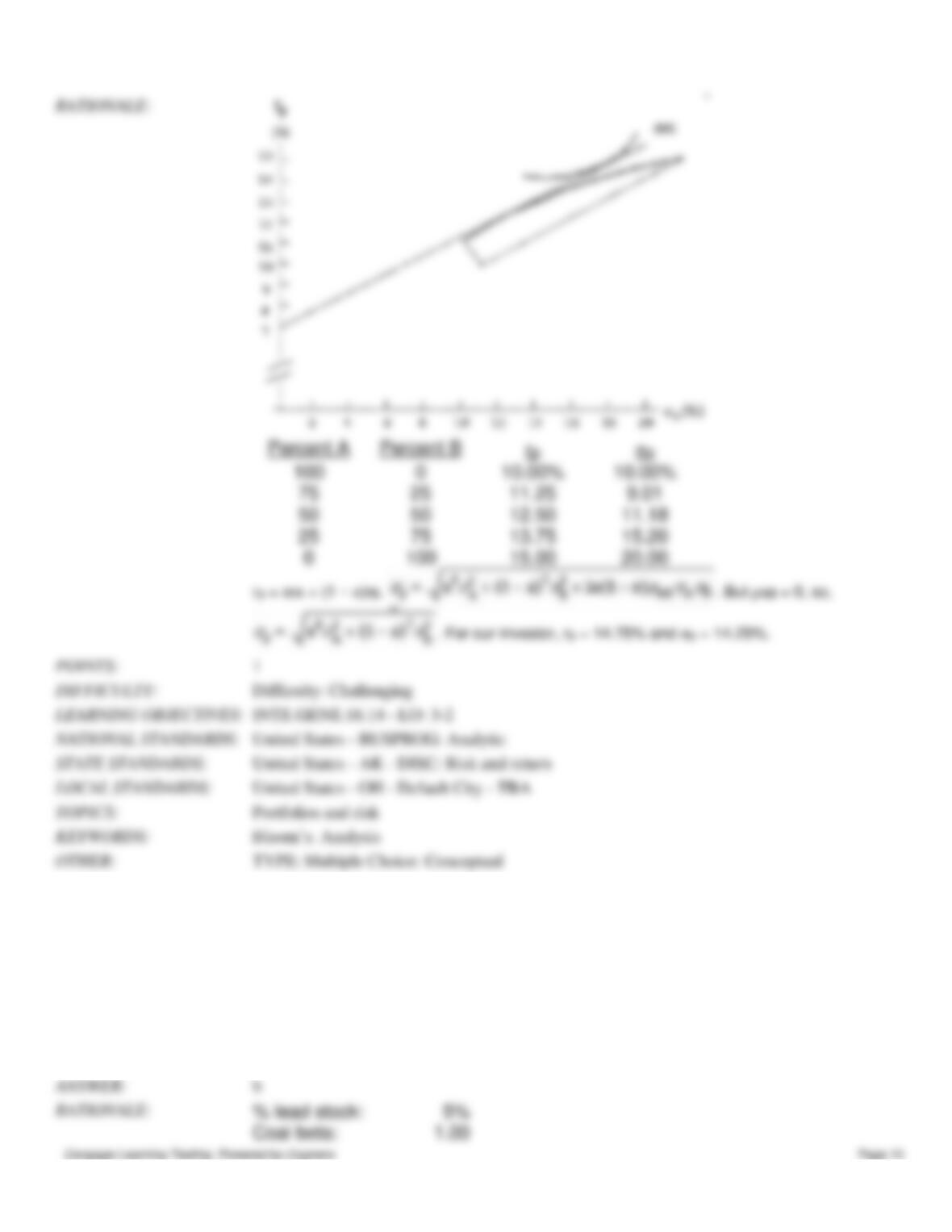
24. Assume an economy in which there are three securities: Stock A with rA = 10% and σA = 10%; Stock B with rB =
15% and σB = 20%; and a riskless asset with rRF = 7%. Stocks A and B are uncorrelated (rAB = 0). Which of the
following statements is most CORRECT?
a.
The expected return on the investor’s portfolio will probably have an expected return that is somewhat below
10% and a standard deviation (SD) of approximately 10%.
b.
The expected return on the investor’s portfolio will probably have an expected return that is somewhat below
15% and a standard deviation (SD) that is between 10% and 20%.
c.
The investor’s risk/return indifference curve will be tangent to the CML at a point where the expected return is
in the range of 7% to 10%.
d.
Since the two stocks have a zero correlation coefficient, the investor can form a riskless portfolio whose
expected return is in the range of 10% to 15%.
e.
The expected return on the investor’s portfolio will probably have an expected return that is somewhat above
15% and a standard deviation (SD) of approximately 20%.
CHAPTER 3—RISK AND RETURN: PART II
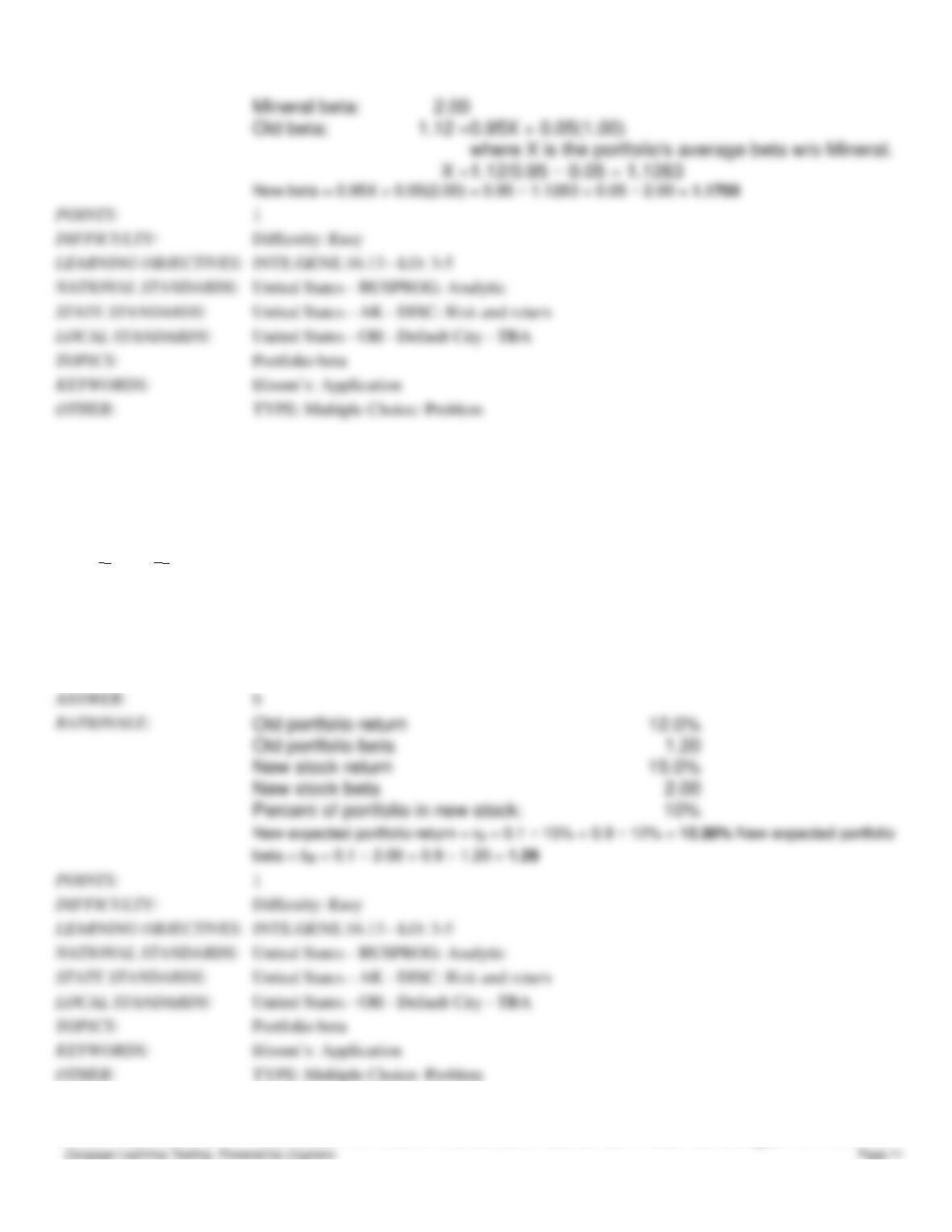
25. You hold a portfolio consisting of a $5,000 investment in each of 20 different stocks. The portfolio beta is equal to
1.12. You have decided to sell a coal mining stock (b = 1.00) at $5,000 net and use the proceeds to buy a like amount of a
mineral rights company stock (b = 2.00). What is the new beta of the portfolio?
a.
1.1139
b.
1.1700
c.
1.2311
d.
1.2927
e.
1.3573
CHAPTER 3—RISK AND RETURN: PART II
26. Your mother’s well-diversified portfolio has an expected return of 12.0% and a beta of 1.20. She is in the process of
buying 100 shares of Safety Corp. at $10 a share and adding it to her portfolio. Safety has an expected return of 15.0%
and a beta of 2.00. The total value of your current portfolio is $9,000. What will the expected return and beta on the
portfolio be after the purchase of the Safety stock?
rp bp
a.
11.69%; 1.22
b.
12.30%; 1.28
c.
12.92%; 1.34
d.
13.56%; 1.41
e.
14.24%; 1.48
Difficulty: Easy
INTE.GENE.16.13 – LO: 3-5
United States – BUSPROG: Analytic
United States – AK – DISC: Risk and return
United States – OH – Default City – TBA
Portfolio beta
27. Suppose that (1) investors expect a 4.0% rate of inflation in the future, (2) the real risk-free rate is 3.0%, (3) the
market risk premium is 5.0%, (4) Talcott Inc.’s beta is 1.00, and (5) its realized rate of return has averaged 15.0% over the
Difficulty: Easy
INTE.GENE.16.13 – LO: 3-5
United States – BUSPROG: Analytic
United States – AK – DISC: Risk and return
United States – OH – Default City – TBA
Portfolio beta
TYPE: Multiple Choice: Problem