25) The ________ ratio may indicate poor collections procedures or a relaxed credit policy.
A) average payment period
B) inventory turnover
C) average collection period
D) quick
26) ABC Corp. extends credit terms of 45 days to its customers. Its credit collection would likely
be considered poor if its average collection period was ________.
A) 30 days
B) 36 days
C) 44 days
D) 57 days
27) Which of the following ratios is difficult for the creditors of a firm to analyze from the
published financial statements?
A) debt equity ratio
B) average payment period
C) quick ratio
D) total asset turnover
28) Nico Corporation has annual purchases of $300,000 and accounts payable of $30,000, then
average purchases per day are ________ and the average payment period is ________.
A) 36.5; 821.9
B) 36.0; 833.3
C) 821.9; 36.5
D) 833.3; 36.0
29) ________ are especially interested in the average payment period, since it provides them
with a sense of the bill-paying patterns of the firm.
A) Employees
B) Stockholders
C) Lenders and suppliers
D) Auditors
30) The ________ ratio indicates the efficiency with which a firm uses its assets to generate
sales.
A) inventory turnover
B) total asset turnover
C) quick
D) current asset turnover
31) A firm’s total asset turnover increased from 0.75 to 0.90. Which of the following is true
about the given data?
A) Its assets have been efficiently used to derive the optimum level of sales.
B) Its assets have been efficiently used to derive the optimum level of net income.
C) Its assets have been efficiently used to derive the minimum level of net income.
D) Its assets have been efficiently used to derive the minimum level of gross profit.
32) A firm with a total asset turnover that is lower than industry standard but with a current ratio
that meets industry standard must have excessive ________.
A) fixed assets
B) inventory
C) accounts receivable
D) debt
33) A firm with a total asset turnover lower than industry standard may have ________.
A) excessive debt
B) excessive interest costs
C) insufficient sales
D) insufficient fixed assets
3.4 Discuss the relationship between debt and financial leverage and the ratios used to analyze a
firm’s debt.
1) The magnification of risk and return introduced through the use of fixed-cost financing, such
as debt and preferred stock is called financial leverage.
2) The less fixed-cost debt (financial leverage) a firm uses, the greater will be its risk and return.
3) In general, the more debt a firm uses, the smaller its financial leverage.
4) The lower the fixed-payment coverage ratio, the lower is the firm’s financial leverage.
5) Higher the debt ratio, more the financial leverage a firm has and thus, the greater will be its
risk and return.
6) Typically, higher coverage ratios are preferred, but a very high ratio may indicate under-
utilization of fixed-payment obligations, which may result in unnecessarily low risk and return.
7) Higher the value of the times interest earned ratio, higher is the proportion of the firm’s
interest income compared to its contractual interest payments.
8) ________ is a term used to describe the magnification of risk and return introduced through
the use of fixed-cost financing, such as preferred stock and debt.
A) Financial leverage
B) Operating leverage
C) Fixed-payment coverage
D) Benchmarking
9) ________ ratio measures the proportion of total assets financed by the firm’s creditors.
A) Total asset turnover
B) Inventory turnover
C) Current
D) Debt
10) ________ ratio measures a firm’s ability to pay contractual interest payments.
A) Times interest earned
B) Fixed-payment coverage
C) Debt
D) Average payment period
11) ________ ratio indicates that a firm will be able to meet interest obligations due on
outstanding debt.
A) Debt-to-equity
B) Interest turnover
C) Total assets turnover
D) Times interest earned
12) The higher, the value of ________ ratio, the better able a firm is to fulfill its interest
obligations.
A) dividend payout
B) average collection period
C) times interest earned
D) average payment period
13) When assessing the fixed-payment coverage ratio, ________.
A) the lower its value the more risky is the firm
B) the lower its value, the higher is the firm’s financial leverage
C) preferred stock dividend payments can be disregarded
D) the higher its value, lesser is its reliability to pay up the debts
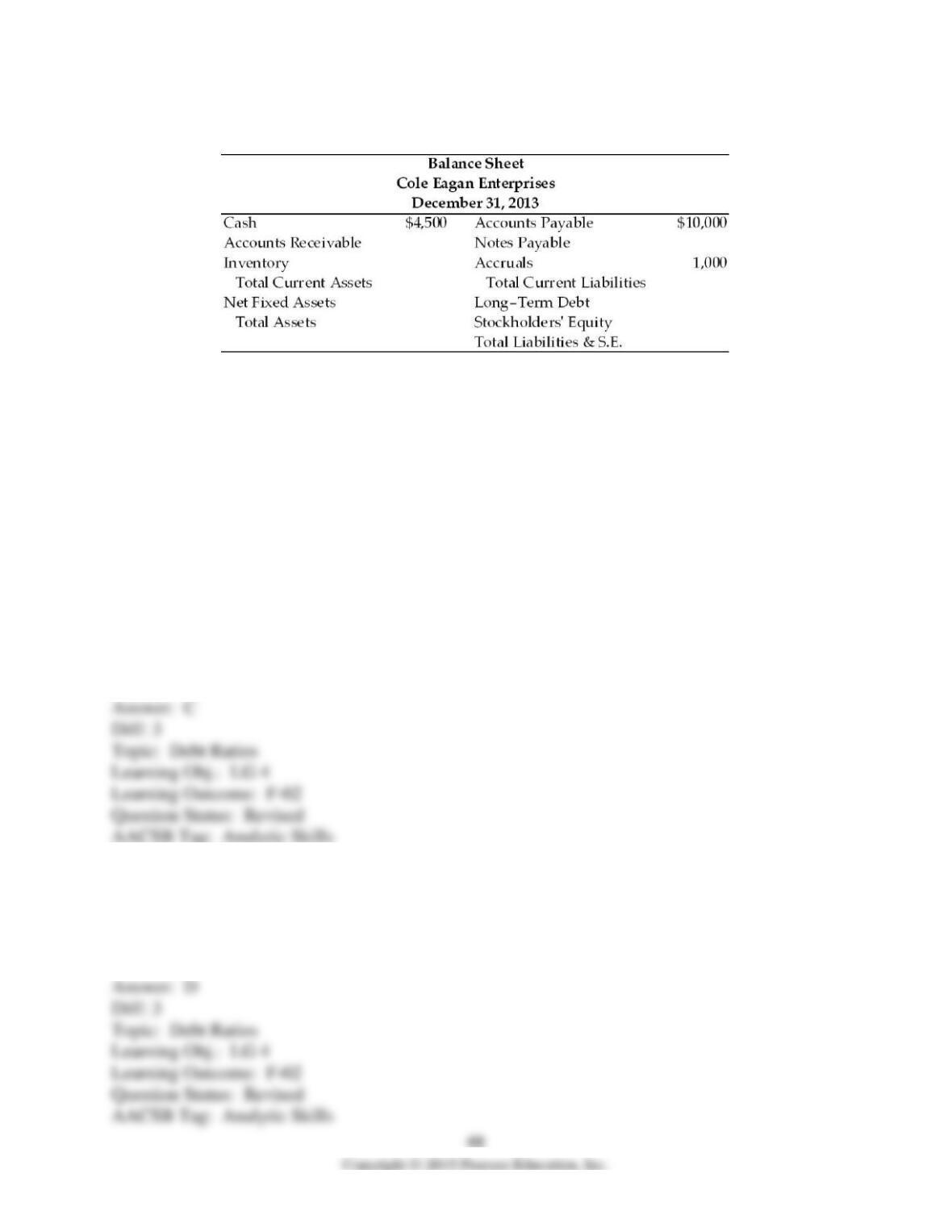
Table 3.1
Information (2013 values)
1. Sales totaled $110,000
2. The gross profit margin was 25 percent.
3. Inventory turnover was 3.0.
4. There are 360 days in the year.
5. The average collection period was 65 days.
6. The current ratio was 2.40.
7. The total asset turnover was 1.13.
8. The debt ratio was 53.8 percent.
14) Inventory for CEE in 2013 was ________. (See Table 3.1)
A) $36,667
B) $32,448
C) $27,500
D) $ 9,167
15) Notes payable for CEE in 2013 was ________. (See Table 3.1)
A) $113,466
B) $ 52,372
C) $ 41,372
D) $ 10,609
16) Accounts receivable for CEE in 2013 was ________. (See Table 3.1)
A) $14,056
B) $19,861
C) $14,895
D) $18,333
17) Net fixed assets for CEE in 2013 were ________. (See Table 3.1)
A) $45,484
B) $48,975
C) $54,511
D) $69,341
18) Total assets for CEE in 2013 were ________. (See Table 3.1)
A) $ 45,895
B) $124,300
C) $ 58,603
D) $ 97,345
19) Long-term debt for CEE in 2013 was ________. (See Table 3.1)
A) $30,763
B) $52,372
C) $10,608
D) $41,372
3.5 Use ratios to analyze a firm’s profitability and its market value.
1) Gross profit margin measures the percentage of each sales dollar left after a firm has paid for
its goods and operating expenses.
2) Net profit margin measures the percentage of each sales dollar remaining after all costs and
expenses, including interest, taxes, and common stock dividends, have been deducted.
3) Earnings per share represents the dollar amount earned and distributed to shareholders.
4) Return on total assets (ROA) measures the overall effectiveness of management in generating
profits with its available assets.
5) The price/earnings (P/E) ratio represents the degree of confidence that investors have in a
firm’s future performance.
6) Two frequently cited ratios of profitability that can be read directly from the common-size
income statement are ________.
A) the earnings per share and the return on total assets
B) the gross profit margin and the earnings per share
C) the gross profit margin and the return on total assets
D) the gross profit margin and the net profit margin
7) The ________ is a popular approach for evaluating profitability in relation to sales by
expressing each item on the income statement as a percent of sales.
A) retained earnings statement
B) common-size balance sheet
C) common-size income statement
D) profit and loss statement
8) ________ indicates the percentage of each sales dollar remaining after the firm has paid for its
goods.
A) Net profit margin
B) Operating profit margin
C) Gross profit margin
D) Earnings available to common shareholders
9) ________ measures the percentage of profit earned on each sales dollar before interest and
taxes but after all costs and expenses.
A) Net profit margin
B) Operating profit margin
C) Gross profit margin
D) Earnings available to common shareholders
10) A firm with a gross profit margin which meets industry standard and a net profit margin
which is below industry standard must have excessive ________.
A) general and administrative expenses
B) cost of goods sold
C) dividend payments
D) principal payments
11) ________ measures the percentage of each sales dollar remaining after all costs and
expenses, including interest, taxes, and preferred stock dividends, have been deducted.
A) Net profit margin
B) Operating profit margin
C) Gross profit margin
D) Earnings available to common shareholders
12) ________ measures the overall effectiveness of management in generating profits with its
available assets.
A) Total asset turnover
B) Price/earnings ratio
C) Return on equity
D) Return on total assets
13) ________ measures the return earned on the common stockholders’ investment in the firm.
A) Net profit margin
B) Price/earnings ratio
C) Return on equity
D) Return on total assets
14) A firm with sales of $1,000,000, net profits after taxes of $30,000, total assets of $1,500,000,
and common stockholders’ investment of $750,000 has a return on equity of ________.
A) 20 percent
B) 15 percent
C) 3 percent
D) 4 percent
15) A ________ ratio is commonly used to assess owners’ appraisal of the share value.
A) debt
B) price/earnings
C) return on equity
D) return on total assets
16) P/E ratio measures the ________.
A) market value of the stock to earnings per share
B) intrinsic value of the stock to earnings per share
C) book value of the stock to earnings per share
D) market price of the stock to retained earnings
17) Book value per share is the ratio of ________.
A) common stock equity to number of outstanding common shares
B) retained earnings to number of outstanding common shares
C) fixed assets to number of outstanding common shares
D) total liabilities to number of outstanding common shares
56
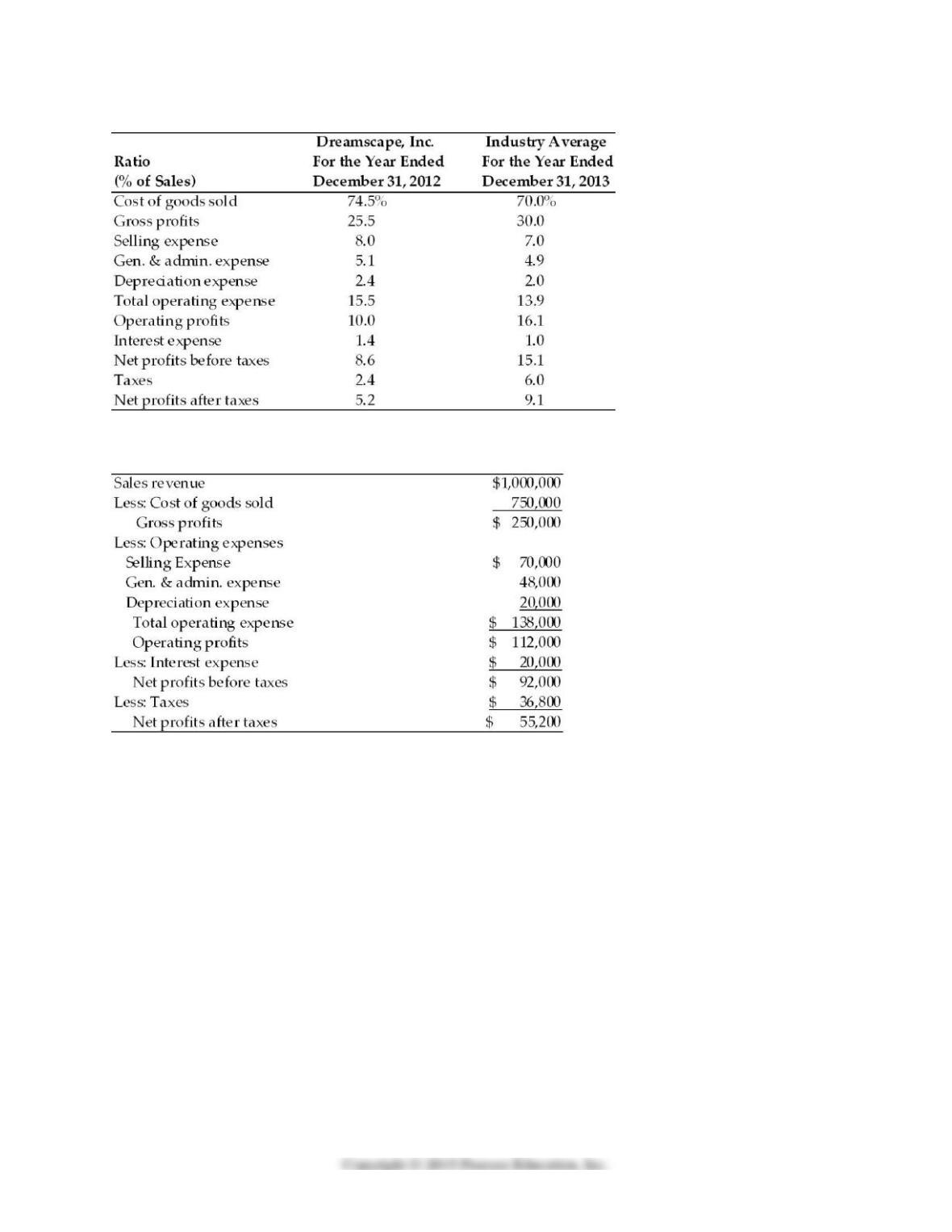
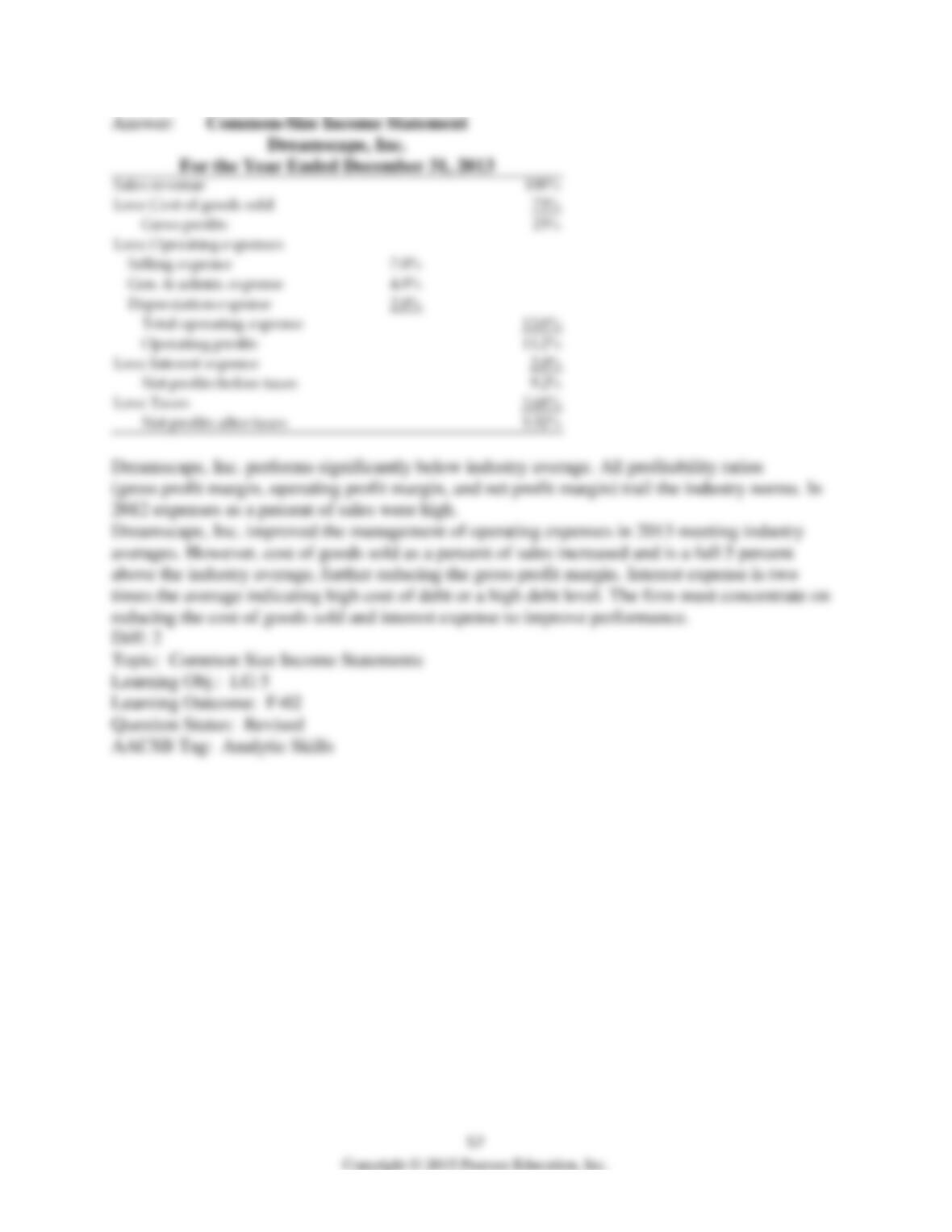
18) Key Financial Data
Income Statement, Dreamscape, Inc.
For the Year Ended December 31, 2013
Prepare a common-size income statement for Dreamscape, Inc. for the year ended December 31,
2013. Evaluate the company’s performance against industry average ratios and against last year’s
results.
3.6 Use a summary of financial ratios and the DuPont system of analysis to perform a complete
ratio analysis.
1) The financial leverage multiplier is the ratio of a firm’s total assets to common stock equity.
2) The DuPont formula allows a firm to break down its return into the net profit margin, which
measures the firm’s profitability on sales, and its total asset turnover, which indicates how
efficiently the firm has used its assets to generate sales.
3) The DuPont system allows a firm to break its return on equity into a profit-on-sales
component, an efficiency-of-asset-use component, and a use-of-operating leverage component.
4) The DuPont system merges the income statement and balance sheet into two summary
measures of profitability, ________.
A) net profit margin, and return on total assets
B) net profit margin, and return on equity
C) return on total assets, and return on common equity
D) net profit margin, and price/earning ratio