Chapter 03: Analysis of Financial Statements
b. False
38. The times-interest-earned ratio is one, but not the only, indication of a firm’s ability to meet its long-term and short-
term debt obligations.
a. True
b. False
39. Suppose a firm wants to maintain a specific TIE ratio. It knows the amount of its debt, the interest rate on that debt,
the applicable tax rate, and its operating costs. With this information, the firm can calculate the amount of sales required
to achieve its target TIE ratio.
a. True
b. False
Chapter 03: Analysis of Financial Statements
40. If a bank loan officer were considering a company’s request for a loan, which of the following statements would you
consider to be CORRECT?
a. Other things held constant, the lower the current ratio, the lower the interest rate the bank would charge the firm.
b. The lower the company’s EBITDA coverage ratio, other things held constant, the lower the interest rate the bank
would charge the firm.
c. Other things held constant, the higher the debt ratio, the lower the interest rate the bank would charge the firm.
d. Other things held constant, the lower the debt ratio, the lower the interest rate the bank would charge the firm.
e. The lower the company’s TIE ratio, other things held constant, the lower the interest rate the bank would charge
the firm.
41. Which of the following statements is CORRECT?
a. If two firms differ only in their use of debt⎯i.e., they have identical assets, sales, operating costs, and tax rates⎯but
one firm has a higher debt ratio, the firm that uses more debt will have a higher profit margin on sales.
b. If one firm has a higher debt ratio than another, we can be certain that the firm with the higher debt ratio will have
the lower TIE ratio, as that ratio depends entirely on the amount of debt a firm uses.
c. A firm’s use of debt will have no effect on its profit margin on sales.
d. If two firms differ only in their use of debt⎯i.e., they have identical assets, sales, operating costs, interest rates on
their debt, and tax rates⎯but one firm has a higher debt ratio, the firm that uses more debt will have a lower profit margin
on sales.
e. The debt ratio as it is generally calculated makes an adjustment for the use of assets leased under operating leases,
so the debt ratios of firms that lease different percentages of their assets are still comparable.
Chapter 03: Analysis of Financial Statements
42. Hutchinson Corporation has zero debt⎯it is financed only with common equity. Its total assets are $410,000. The new
CFO wants to employ enough debt to bring the debt/assets ratio to 40%, using the proceeds from the borrowing to buy
back common stock at its book value. How much must the firm borrow to achieve the target debt ratio?
a. $155,800
b. $164,000
c. $172,200
d. $180,810
e. $189,851
43. Orono Corp.’s sales last year were $435,000, its operating costs were $362,500, and its interest charges were $12,500.
What was the firm’s times interest earned (TIE) ratio?
a. 4.72
b. 4.97
c. 5.23
d. 5.51
e. 5.80
Chapter 03: Analysis of Financial Statements
44. Bostian, Inc. has total assets of $625,000. Its total debt outstanding is $185,000. The Board of Directors has directed
the CFO to move towards a debt-to-assets ratio of 55%. How much debt must the company add or subtract to achieve the
target debt ratio?
a. $158,750
b. $166,688
c. $175,022
d. $183,773
e. $192,962
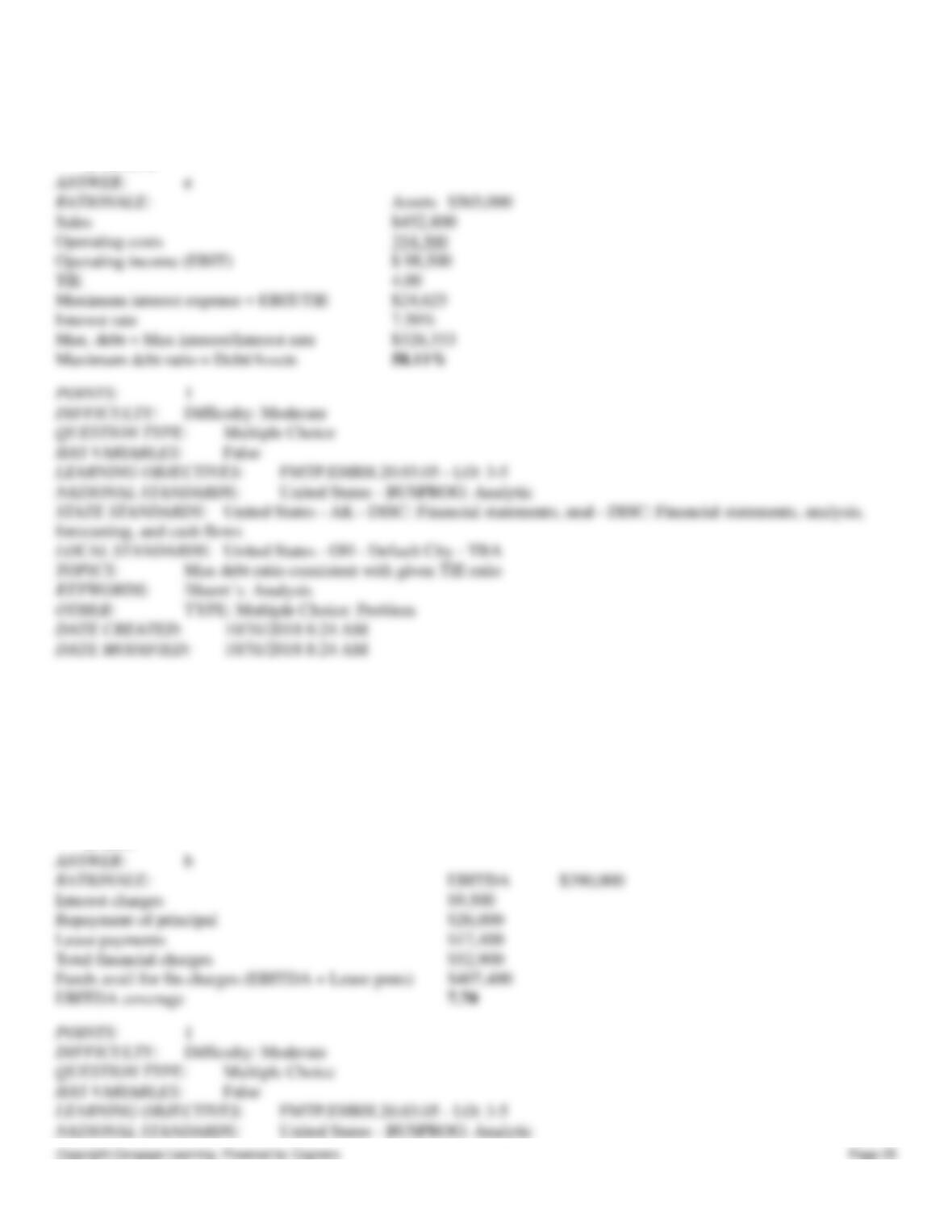
45. A new firm is developing its business plan. It will require $565,000 of assets, and it projects $452,800 of sales and
$354,300 of operating costs for the first year. Management is quite sure of these numbers because of contracts with its
customers and suppliers. It can borrow at a rate of 7.5%, but the bank requires it to have a TIE of at least 4.0, and if the
TIE falls below this level the bank will call in the loan and the firm will go bankrupt. What is the maximum debt-to-assets
ratio the firm can use? (Hint: Find the maximum dollars of interest, then the debt that produces that interest, and then the
related debt ratio.)
a. 47.33%
Chapter 03: Analysis of Financial Statements
b. 49.82%
c. 52.45%
d. 55.21%
e. 58.11%
46. Ziebart Corp.’s EBITDA last year was $390,000 ( = EBIT + depreciation + amortization), its interest charges were
$9,500, it had to repay $26,000 of long-term debt, and it had to make a payment of $17,400 under a long-term lease. The
firm had no amortization charges. What was the EBITDA coverage ratio?
a. 7.32
b. 7.70
c. 8.09
d. 8.49
e. 8.92

Chapter 03: Analysis of Financial Statements
Pettijohn Inc.
The balance sheet and income statement shown below are for Pettijohn Inc. Note that the firm has no amortization
charges, it does not lease any assets, none of its debt must be retired during the next 5 years, and the notes payable will be
rolled over.
Balance Sheet (Millions of $)
Assets 2016
Cash and securities $ 1,554.0
Accounts receivable 9,660.0
Inventories 13,440.0
Total current assets $24,654.0
Net plant and equipment 17,346.0
Total assets $42,000.0
Liabilities and Equity
Accounts payable $ 7,980.0
Notes payable 5,880.0
Accruals 4,620.0
Total current liabilities $18,480.0
Long-term bonds 10,920.0
Total liabilities $29,400.0
Common stock 3,360.0
Retained earnings 9,240.0
Total common equity $12,600.0
Total liabilities and equity $42,000.0
Income Statement (Millions of $) 2016
Net sales $58,800.0
Operating costs except depr’n $55,274.0
Depreciation $ 1,029.0
Earnings bef int and taxes (EBIT) $ 2,497.0
Less interest 1,050.0
Earnings before taxes (EBT) $ 1,447.0
Taxes $ 314.0
Net income $ 1,133.0
Other data:
Shares outstanding (millions) 175.00
Common dividends $ 509.83
Int rate on notes payable & L-T bonds 6.25%
Federal plus state income tax rate 21.7%
Year-end stock price $77.69
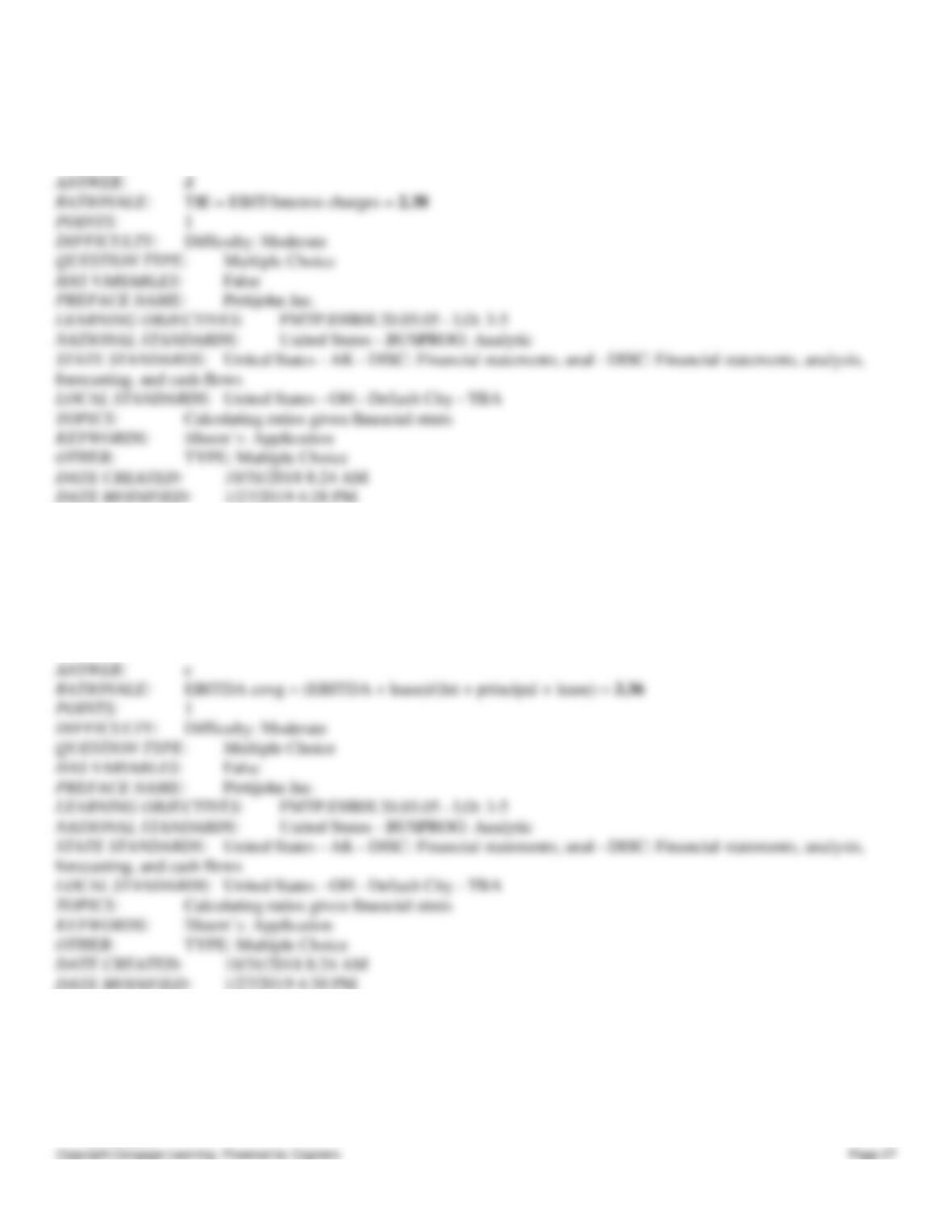
47. Refer to the data for Pettijohn Inc. What is the firm’s TIE?
a. 1.73
Chapter 03: Analysis of Financial Statements
b. 1.93
c. 2.14
d. 2.38
e. 2.62
48. Refer to the data for Pettijohn Inc. What is the firm’s EBITDA coverage?
a. 3.03
b. 3.19
c. 3.36
d. 3.53
e. 3.70
49. Refer to the data for Pettijohn Inc. What is the firm’s debt ratio (i.e., debt-to-assets ratio)?
a. 33.87%
b. 35.00%
c. 36.40%
d. 38.00%
e. 40.00%
Chapter 03: Analysis of Financial Statements
50. Profitability ratios show the combined effects of liquidity, asset management, and debt management on operating
results.
a. True
b. False
51. The basic earning power ratio (BEP) reflects the earning power of a firm’s assets after giving consideration to financial
leverage and tax effects.
a. True
b. False
Chapter 03: Analysis of Financial Statements
52. Since the ROA measures the firm’s effective utilization of assets (without considering how these assets are financed),
two firms with the same EBIT must have the same ROA.
a. True
b. False
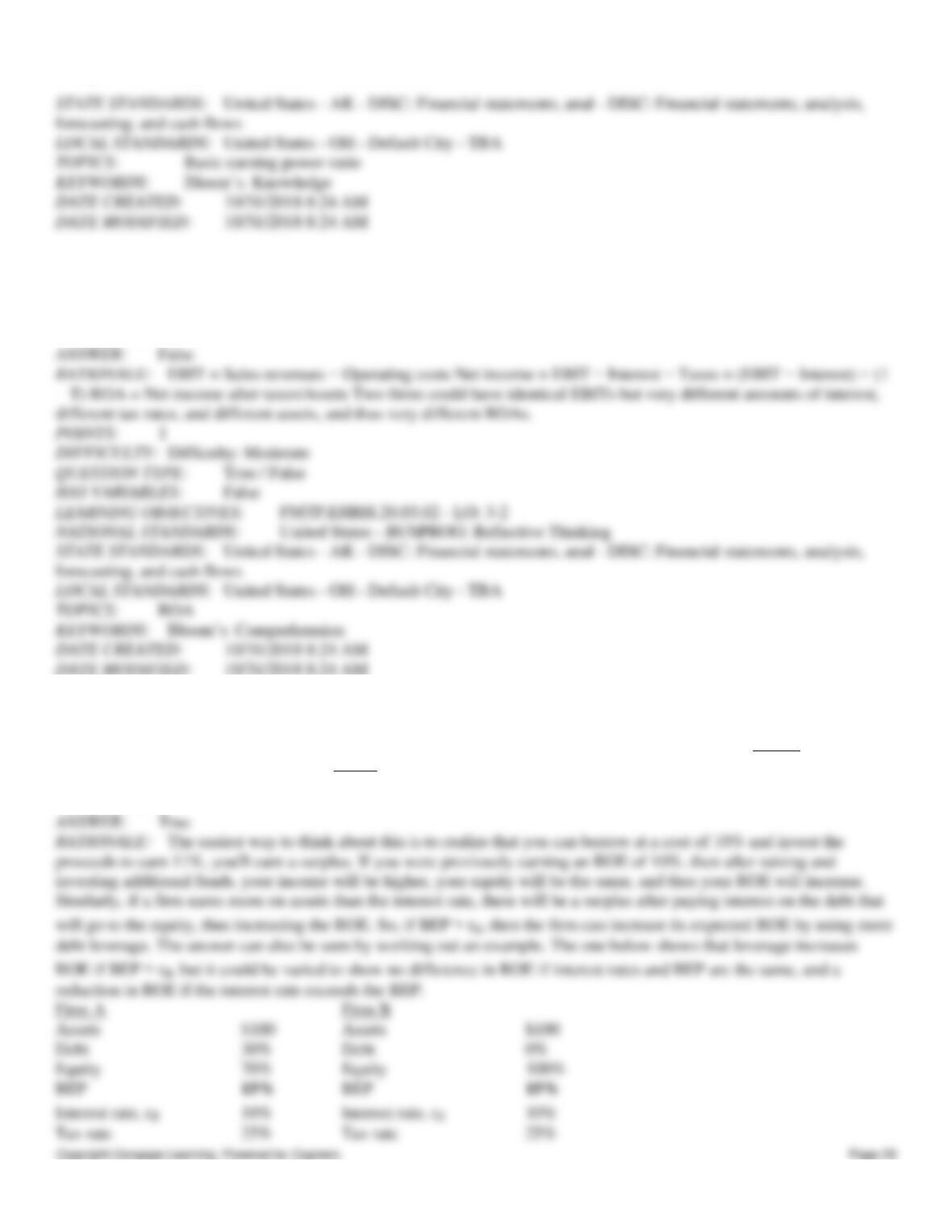
53. Suppose Firms A and B have the same amount of assets, pay the same interest rate on their debt, have the same basic
earning power (BEP), and have the same tax rate. However, Firm A has a higher debt ratio. If BEP is greater than the
interest rate on debt, Firm A will have a higher ROE as a result of its higher debt ratio.
a. True
b. False
Chapter 03: Analysis of Financial Statements
54. A firm’s new president wants to strengthen the company’s financial position. Which of the following actions would
make it financially stronger?
a. Increase inventories while holding sales and cost of goods sold constant.
b. Increase accounts receivable while holding sales constant.
c. Increase EBIT while holding sales constant.
d. Increase accounts payable while holding sales constant.
e. Increase notes payable while holding sales constant.
55. If the CEO of a large, diversified, firm were filling out a fitness report on a division manager (i.e., “grading” the
manager), which of the following situations would be likely to cause the manager to receive a better grade? In all cases,
assume that other things are held constant.
a. The division’s DSO (days’ sales outstanding) is 40, whereas the average for its competitors is 30.
b. The division’s basic earning power ratio is above the average of other firms in its industry.
c. The division’s total assets turnover ratio is below the average for other firms in its industry.
d. The division’s debt ratio is above the average for other firms in the industry.
e. The division’s inventory turnover is 6, whereas the average for its competitors is 8.
Chapter 03: Analysis of Financial Statements
56. Which of the following would indicate an improvement in a company’s financial position, holding other things
constant?
a. The current and quick ratios both increase.
b. The inventory and total assets turnover ratios both decline.
c. The debt ratio increases.
d. The profit margin declines.
e. The EBITDA coverage ratio declines.
57. Cordelion Communications is considering issuing new common stock and using the proceeds to reduce its outstanding
debt. The stock issue would have no effect on total assets, the interest rate Cordelion pays, EBIT, or the tax rate. Which of
the following is likely to occur if the company goes ahead with the stock issue?
a. The times interest earned ratio will decrease.
b. The ROA will decline.
c. Taxable income will decrease.
d. The tax bill will increase.
e. Net income will decrease.
Chapter 03: Analysis of Financial Statements
58. Which of the following statements is CORRECT?
a. An increase in a firm’s debt ratio, with no changes in its sales or operating costs, could be expected to lower the
profit margin.
b. The ratio of long-term debt to total capital is more likely to experience seasonal fluctuations than is either the
DSO or the inventory turnover ratio.
c. If two firms have the same ROA, the firm with the most debt can be expected to have the lower ROE.
d. An increase in the DSO, other things held constant, could be expected to increase the total assets turnover ratio.
e. An increase in the DSO, other things held constant, could be expected to increase the ROE.
59. Companies Heidee and Leaudy have the same total assets, sales, operating costs, and tax rates, and they pay the same
interest rate on their debt. However, company Heidee has a higher debt ratio. Which of the following statements is
CORRECT?
a. If the interest rate the companies pay on their debt is less than their basic earning power (BEP), then Company
Heidee will have the higher ROE.
b. Given this information, Leaudy must have the higher ROE.
c. Company Leaudy has a higher basic earning power ratio (BEP).
Chapter 03: Analysis of Financial Statements
d. Company Heidee has a higher basic earning power ratio (BEP).
e. If the interest rate the companies pay on their debt is more than their basic earning power (BEP), then Company
Heidee will have the higher ROE.
60. Rappaport Corp.’s sales last year were $320,000, and its net income after taxes was $23,000. What was its profit
margin on sales?
a. 6.49%
b. 6.83%
c. 7.19%
d. 7.55%
e. 7.92%
61. Branch Corp.’s total assets at the end of last year were $315,000 and its net income after taxes was $22,750. What was
its return on total assets?
a. 7.22%
b. 7.58%
Chapter 03: Analysis of Financial Statements
c. 7.96%
d. 8.36%
e. 8.78%
62. Chambliss Corp.’s total assets at the end of last year were $305,000 and its EBIT was 62,500. What was its basic
earning power (BEP)?
a. 18.49%
b. 19.47%
c. 20.49%
d. 21.52%
e. 22.59%
63. Nikko Corp.’s total common equity at the end of last year was $305,000 and its net income after taxes was $60,000.
What was its ROE?
Chapter 03: Analysis of Financial Statements
a. 16.87%
b. 17.75%
c. 18.69%
d. 19.67%
e. 20.66%
64. An investor is considering starting a new business. The company would require $475,000 of assets, and it would be
financed entirely with common stock. The investor will go forward only if she thinks the firm can provide a 13.5% return
on the invested capital, which means that the firm must have an ROE of 13.5%. How much net income must be expected
to warrant starting the business?
a. $52,230
b. $54,979
c. $57,873
d. $60,919
e. $64,125
Chapter 03: Analysis of Financial Statements
65. LeCompte Corp. has $312,900 of assets, and it uses only common equity capital (zero debt). Its sales for the last year
were $620,000, and its net income after taxes was $24,655. Stockholders recently voted in a new management team that
has promised to lower costs and get the return on equity up to 15%. What profit margin would LeCompte need in order to
achieve the 15% ROE, holding everything else constant?
a. 7.57%
b. 7.95%
c. 8.35%
d. 8.76%
e. 9.20%
66. Last year Urbana Corp. had $197,500 of assets, $307,500 of sales, $19,575 of net income, and a debt-to-total-assets
ratio of 37.5%. The new CFO believes a new computer program will enable it to reduce costs and thus raise net income to
$33,000. Assets, sales, and the debt ratio would not be affected. By how much would the cost reduction improve the
ROE?
a. 9.32%
b. 9.82%
c. 10.33%
d. 10.88%
e. 11.42%
Chapter 03: Analysis of Financial Statements
67. Last year Altman Corp. had $205,000 of assets, $303,500 of sales, $18,250 of net income, and a debt-to-total-assets
ratio of 41%. The new CFO believes the firm has excessive fixed assets and inventory that could be sold, enabling it to
reduce its total assets to $152,500. Sales, costs, and net income would not be affected, and the firm would maintain the
41% debt ratio. By how much would the reduction in assets improve the ROE?
a. 4.69%
b. 4.93%
c. 5.19%
d. 5.45%
e. 5.73%
Chapter 03: Analysis of Financial Statements
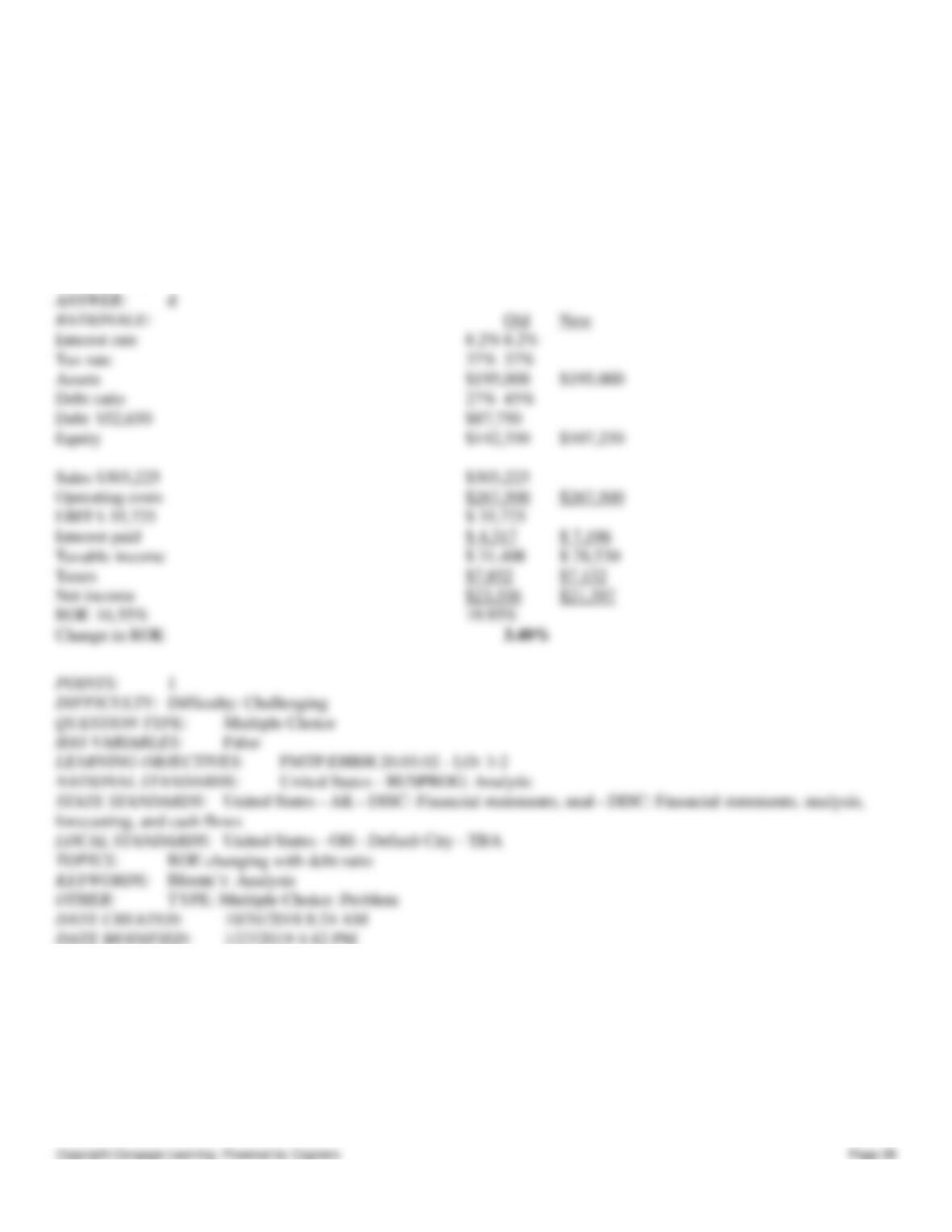
68. Last year Swensen Corp. had sales of $303,225, operating costs of $267,500, and year-end assets of $195,000. The
debt-to-total-assets ratio was 27%, the interest rate on the debt was 8.2%, and the firm’s tax rate was 25%. The new CFO
wants to see how the ROE would have been affected if the firm had used a 45% debt ratio. Assume that sales and total
assets would not be affected, and that the interest rate and tax rate would both remain constant. By how much would the
ROE change in response to the change in the capital structure?
a. 2.48%
b. 2.76%
c. 3.06%
d. 3.40%
e. 3.74%
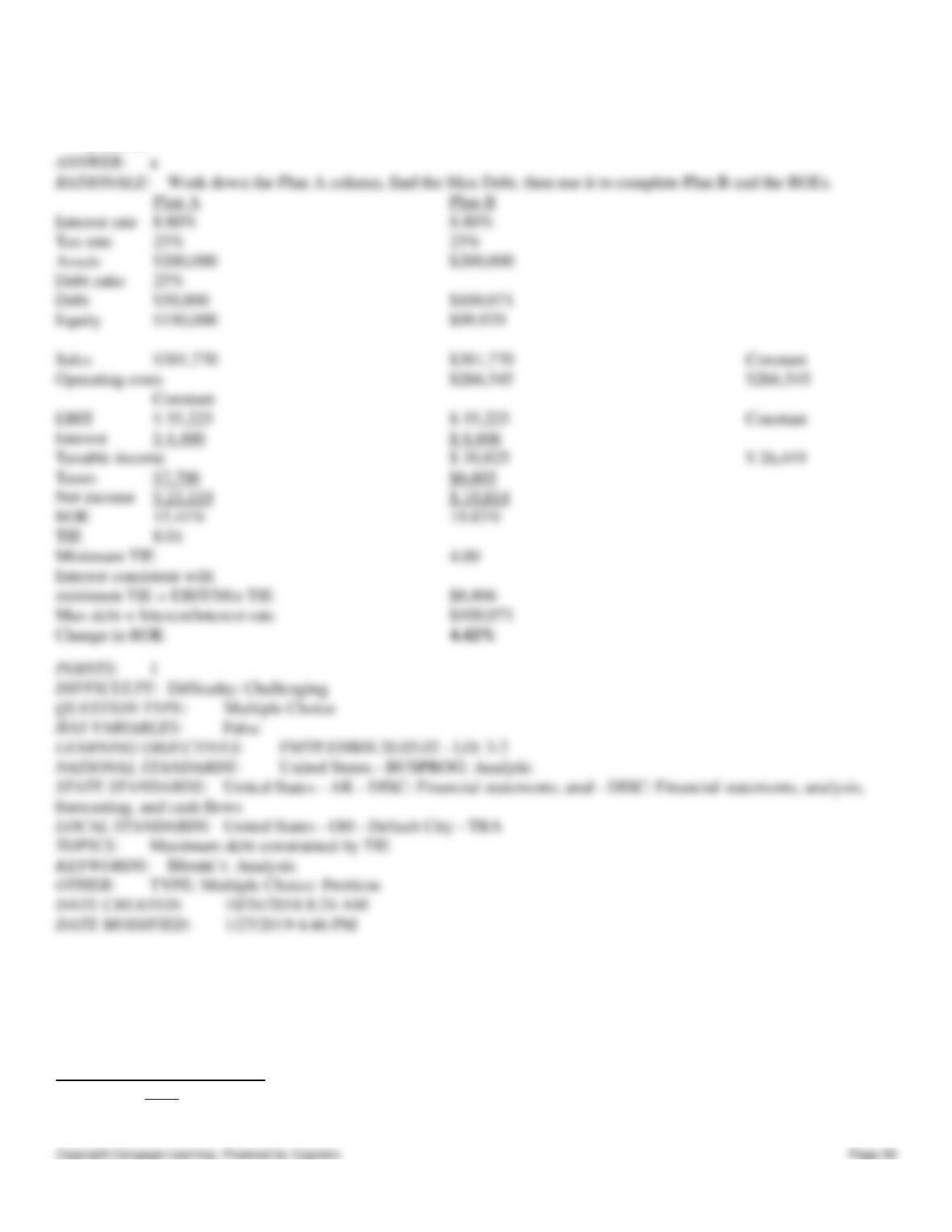
69. For the coming year, Crane Inc. is considering two financial plans. Management expects sales to be $301,770,
operating costs to be $266,545, assets to be $200,000, and its tax rate to be 25%. Under Plan A it would use 25% debt and
75% common equity. The interest rate on the debt would be 8.8%, but the TIE ratio would have to be kept at 4.00 or
more. Under Plan B the maximum debt that met the TIE constraint would be employed. Assuming that sales, operating
costs, assets, the interest rate, and the tax rate would all remain constant, by how much would the ROE change in response
to the change in the capital structure?
a. 4.42%
b. 4.64%
Chapter 03: Analysis of Financial Statements
c. 4.87%
d. 5.11%
e. 5.37%
Pettijohn Inc.
The balance sheet and income statement shown below are for Pettijohn Inc. Note that the firm has no amortization
charges, it does not lease any assets, none of its debt must be retired during the next 5 years, and the notes payable will be
rolled over.
Balance Sheet (Millions of $)
Assets 2016
Cash and securities $ 1,554.0
Accounts receivable 9,660.0

Chapter 03: Analysis of Financial Statements
Inventories 13,440.0
Total current assets $24,654.0
Net plant and equipment 17,346.0
Total assets $42,000.0
Liabilities and Equity
Accounts payable $ 7,980.0
Notes payable 5,880.0
Accruals 4,620.0
Total current liabilities $18,480.0
Long-term bonds 10,920.0
Total liabilities $29,400.0
Common stock 3,360.0
Retained earnings 9,240.0
Total common equity $12,600.0
Total liabilities and equity $42,000.0
Income Statement (Millions of $) 2016
Net sales $58,800.0
Operating costs except depr’n $55,274.0
Depreciation $ 1,029.0
Earnings bef int and taxes (EBIT) $ 2,497.0
Less interest 1,050.0
Earnings before taxes (EBT) $ 1,447.0
Taxes $ 314.0
Net income $ 1,133.0
Other data:
Shares outstanding (millions) 175.00
Common dividends $ 509.83
Int rate on notes payable & L-T bonds 6.25%
Federal plus state income tax rate 21.7%
Year-end stock price $77.69
70. Refer to the data for Pettijohn Inc. What is the firm’s ROA?
a. 2.70%
b. 2.97%
c. 3.26%
d. 3.59%
e. 3.95%