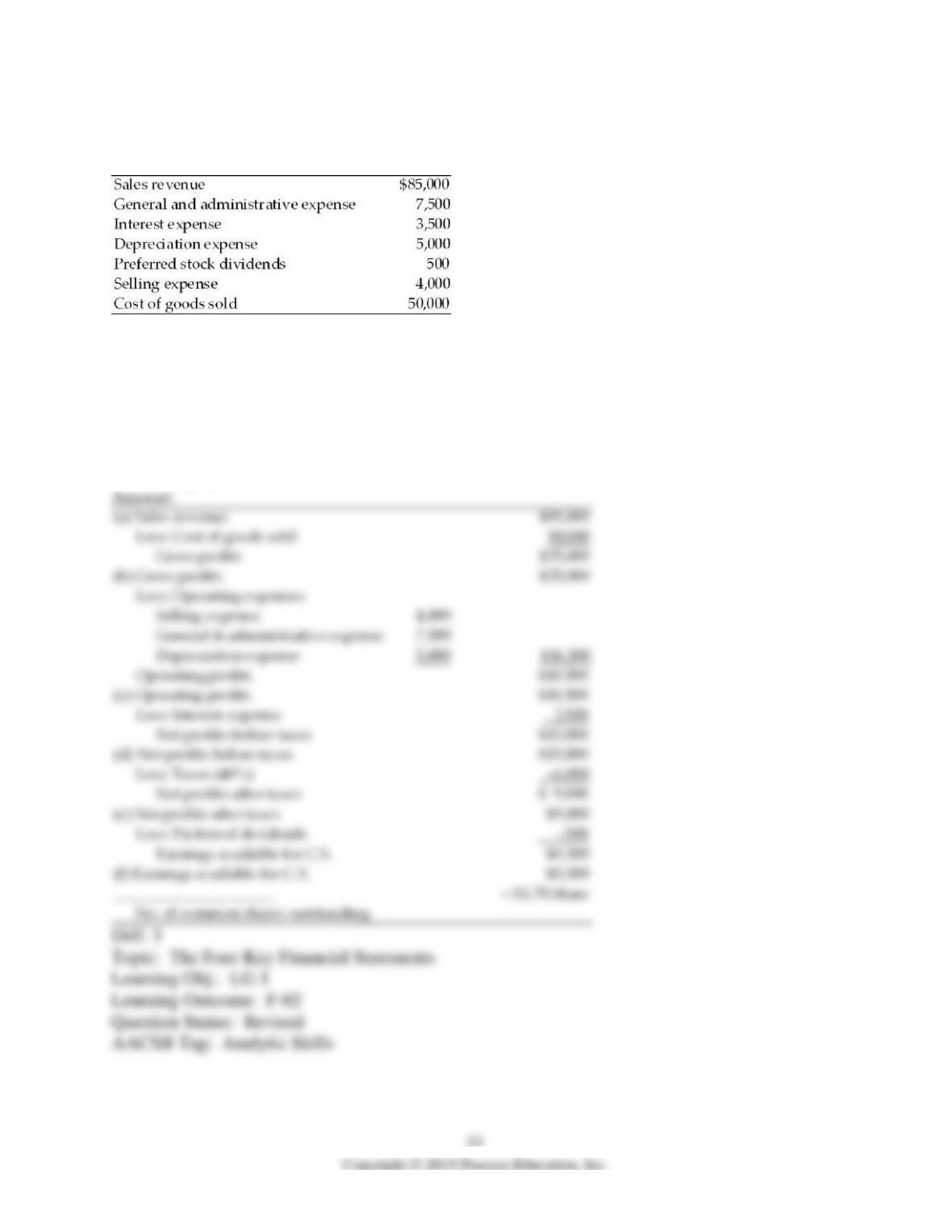
65) Reliable Auto Parts has 5,000 shares of common stock outstanding. The company also has
the following amounts in revenue and expense accounts.
Calculate
(a) gross profits.
(b) operating profits.
(c) net profits before taxes.
(d) net profits after taxes (assume a 40 percent tax rate).
(e) earnings available to common stockholders.
(f) earnings per share.
66) Colonial Furniture’s net profits before taxes for 2015 totaled $354,000. The company’s total
retained earnings were $338,000 for 2014 year-end and $389,000 for 2015 year-end. Colonial is
subject to a 26 percent tax rate. What was the cash dividend declared by Colonial Furniture in
2015?
67) On December 31, 2014, Bradshaw Corporation had $485,000 as an ending balance for its
retained earnings account. During 2015, the corporation declared a $3.50/share dividend to its
stockholders. The company has 35,000 shares of common stock outstanding. When the books
were closed for 2015 year end, the corporation had a final retained earnings balance of $565,000.
What was the net profit earned by Bradshaw Corporation during 2015?
68) Ag Silver Mining, Inc. has $500,000 of earnings before interest and taxes at the year end.
Interest expenses for the year were $10,000. The firm expects to distribute $100,000 in
dividends. Calculate the earnings after taxes for the firm assuming a 40 percent tax on ordinary
income.
69) Sunshine Corporation had a retained earnings balance of $850,000 at the beginning of 2015.
By the end of 2015, the company’s retained earnings balance stood at $950,000. During 2015, the
company earned $245,000 as net profits after paying its taxes. The company was then able to pay
its preferred stockholders a sum of $45,000. Compute the common stock dividend per share in
2015 assuming 10,000 shares of common stock outstanding.
1) The basic inputs to an effective financial analysis are a firm’s income statement and the
balance sheet.
2) Both current and prospective shareholders are interested in the firm’s current and future level
of risk and return, which directly affect share price.
3) Creditors are primarily interested in short-term liquidity of the company and its ability to
make interest and principal payments.
4) Time-series analysis is the evaluation of a firm’s financial performance in comparison to other
firm(s) at the same point in time.
5) Cross-sectional analysis involves the comparison of different firms’ financial ratios at the
same point in time.
6) Benchmarking is a type of cross-sectional analysis in which a firm’s ratios are compared to a
key competitor firm within the same industry, primarily to identify areas for improvement.
7) Time-series analysis evaluates the performance of various firms at the same point in time
using financial ratios.
8) Benchmarking is a type of time-series analysis in which the firm’s ratio values are compared
to those of a key competitor or group of competitors, primarily to isolate areas of opportunity for
improvement.
9) Ratios merely direct an analyst to potential areas of concern and it does not provide conclusive
evidence as to the existence of a problem.
10) A single key ratio of a firm provides all the information required to judge the overall
performance of the firm.
11) Due to inflationary effects, inventory costs and depreciation write-offs can differ from their
true values, thereby distorting profits.
12) In ratio analysis, the financial statements being used for comparison should be dated at the
same point in time during the year. If not, the effect of seasonality may produce erroneous
conclusions and decisions.
13) The use of the unaudited financial statements for ratio analysis is preferable because it
reflects the firm’s true financial condition.
14) The use of differing accounting treatments—especially relative to inventory and
depreciation—can distort the results of ratio analysis, regardless of whether cross-sectional or
time-series analysis is used.
15) Market ratios only measure the risk.
16) Profitability ratios capture both risk and return.
17) The liquidity of a firm is measured by its ability to satisfy its short-term obligations as they
come due.
18) Ratios provide a ________ measure of a company’s performance and condition.
A) definitive
B) gross
C) relative
D) absolute
19) Present and prospective shareholders are mainly concerned with a firm’s ________.
A) risk and return
B) profitability
C) leverage
D) liquidity
20) The primary concern of creditors when assessing the strength of a firm is its ________.
A) profitability
B) leverage
C) short-term liquidity
D) share price
21) ________ analysis involves the comparison of different firms’ financial ratios at the same
point in time.
A) Time-series
B) Cross-sectional
C) Marginal
D) Technical
22) ________ analysis involves comparison of current to past performance and the evaluation of
developing trends.
A) Time-series
B) Cross-sectional
C) Marginal
D) Break-even
23) Which of the following is used to analyze a firm’s financial performance over different
years?
A) time-series analysis
B) break-even analysis
C) gap analysis
D) marginal analysis
24) Which of the following is true of benchmarking?
A) It is an analysis in which a firm’s ratio values are analyzed to project the fundamental values
of the assets for upcoming years or business cycle.
B) It is an analysis in which a firm’s ratio values are compared with those of a key competitor or
with a group of competitors that it wishes to emulate.
C) It is an analysis in which a firm’s financial performance over time is evaluated using financial
ratio analysis.
D) It is a financial statement analysis technique which combines cross-sectional and time-series
analyses.
25) Cross-sectional ratio analysis is used to ________.
A) correct expected problems in operations
B) isolate the causes of problems
C) provide conclusive evidence of the existence of a problem
D) measure relative performance of a firm with its peers
26) Time-series analysis is often used to ________.
A) assess developing trends
B) correct errors of judgment
C) evaluate the value of a firm or its assets
D) standardize results
27) In ratio analysis, a comparison to a standard industry ratio is made to isolate ________
deviations from the norm.
A) greater than average
B) negative
C) marginal
D) standard
28) Which of the following is a limitation of ratio analysis?
A) Financial ratios cannot reveal certain specific aspects of a firm’s financial position.
B) Ratios that reveal large deviations from the norm merely indicate the possibility of a problem.
C) It is difficult to access audited financial statements for ratio analysis.
D) Ratio analysis assumes that inflation has no effect on a firm’s business.
29) An analyst should be careful when conducting ratio analysis to ensure that ________.
A) the overall performance of a firm is not judged on a single ratio
B) the role of inflation is ignored
C) ratios being compared should be calculated using financial statements dated at different points
in time during the year
D) different accounting procedures are used
30) The analyst should be careful when analyzing ratios that ________.
A) pre-audited statements are used
B) right interpretation of the ratio value is made
C) financial data being compared need not be uniform
D) inflation will not affect while comparing older to newer firms
31) Inflation can distort ________.
A) book value of inventory costs
B) market value of revenue
C) market value of sales
D) book value of revenue
32) Without adjustment, inflation may tend to cause ________ firms to appear more efficient and
profitable than ________ firms.
A) larger; smaller
B) older; newer
C) smaller; larger
D) newer; older
33) Which of the following groups of ratios primarily measure risk?
A) liquidity, activity, and profitability
B) liquidity, profitability, and market
C) liquidity, activity, and debt
D) activity, debt, and profitability
34) The ________ ratios are primarily used as measures of return.
A) liquidity
B) activity
C) debt
D) profitability
35) Discuss the limitations of ratio analysis and the cautions which must be taken when
reviewing a cross-sectional and time-series analysis.
3.3 Use ratios to analyze a firm’s liquidity and activity.
1) The liquidity of a business firm refers to the solvency of the firm’s overall financial position.
2) The two basic measures of liquidity are the debt-to-equity ratio and the asset turnover ratio.
3) The liquidity of a business firm is measured by its ability to satisfy its long-term obligations as
they come due.

4) Current ratio provides a firm’s ability to meet its long-term obligations.
5) Average age of inventory is viewed as the average length of time inventory is held by a firm
or as the average number of days’ sales in inventory.
6) Average age of inventory can be calculated as inventory divided by 365.
7) Average age of inventory can be calculated as inventory turnover divided by 365.
8) Average age of inventory can be calculated as 365 divided by inventory turnover.
9) Average payment period can be calculated as accounts payable divided by average sales per
day.
10) Average payment period can be calculated as accounts payable divided by average purchases
per day.
11) Total asset turnover commonly measures the liquidity of a firm’s total assets.
12) The ________ of a business firm is measured by its ability to satisfy its short-term
obligations as they come due.
A) activity
B) liquidity
C) debt
D) profitability
13) The two categories of ratios that should be utilized to assess a firm’s true liquidity are the
________.
A) liquidity and market ratios
B) liquidity and profitability ratios
C) market and debt ratios
D) liquidity and activity ratios
14) The two basic measures of liquidity are ________.
A) inventory turnover and current ratio
B) current ratio and quick ratio
C) gross profit margin and ROE
D) current ratio and total asset turnover
15) A firm has a current ratio of 1; in order to improve its liquidity ratios, this firm might
________.
A) improve its collection practices by providing extended credit policy
B) improve its collection practices and pay accounts payable, thereby decreasing current
liabilities and decreasing the current and quick ratios
C) decrease current liabilities by utilizing more long-term debt, thereby increasing the current
and quick ratios
D) increase inventory, thereby increasing current assets and the current and quick ratios

16) If the only information you are given about Ryan Corporation, a large public company in
business for many years, is that it has a current ratio of 2.9, what could you infer from this?
A) It can meet the short-term obligations without any difficulty.
B) You could determine that Ryan has a liquidity problem because Ryan’s current ratio is greater
than 2 which is the rule of thumb for the current ratio.
C) Nothing, you would also need the current ratio’s from the last few years of the S&P 500
Index.
D) You could determine that Ryan has an activity problem because Ryan’s current ratio is greater
than 2 which is the rule of thumb for the current ratio.
17) Which of the following is true of current ratio?
A) The more predictable a firm’s cash flows, the higher the acceptable current ratio.
B) A higher current ratio indicates a higher return on equity.
C) The more predictable a firm’s current ratio, the higher the current liabilities.
D) A higher current ratio indicates a greater degree of liquidity.
18) Which of the following is excluded when calculating quick ratio?
A) accounts receivable
B) accounts payable
C) cash
D) inventory
19) ________ ratios are a measure of the speed with which various accounts are converted into
sales or cash.
A) Activity
B) Liquidity
C) Debt
D) Profitability
20) Nico Corporation has cost of goods sold of $300,000 and inventory of $30,000, then the
inventory turnover is ________ and the average age of inventory is ________.
A) 36.5; 10
B) 10; 36.5
C) 36.0; 10
D) 30; 36.0
21) ________ may indicate a firm is experiencing stockouts and lost sales.
A) Average payment period
B) Inventory turnover ratio
C) Average collection period
D) Quick
22) If an inventory turnover is divided into 365, it becomes a measure of ________.
A) financial efficiency
B) the average age of the inventory
C) sales turnover
D) the average collection period
23) The ________ measures the activity, or liquidity, of a firm’s stock of goods.
A) average collection period
B) inventory turnover ratio
C) average payment period
D) total asset turnover ratio
24) A(n) ________ is useful in evaluating credit policies.
A) average payment period
B) current ratio
C) average collection period
D) inventory turnover ratio