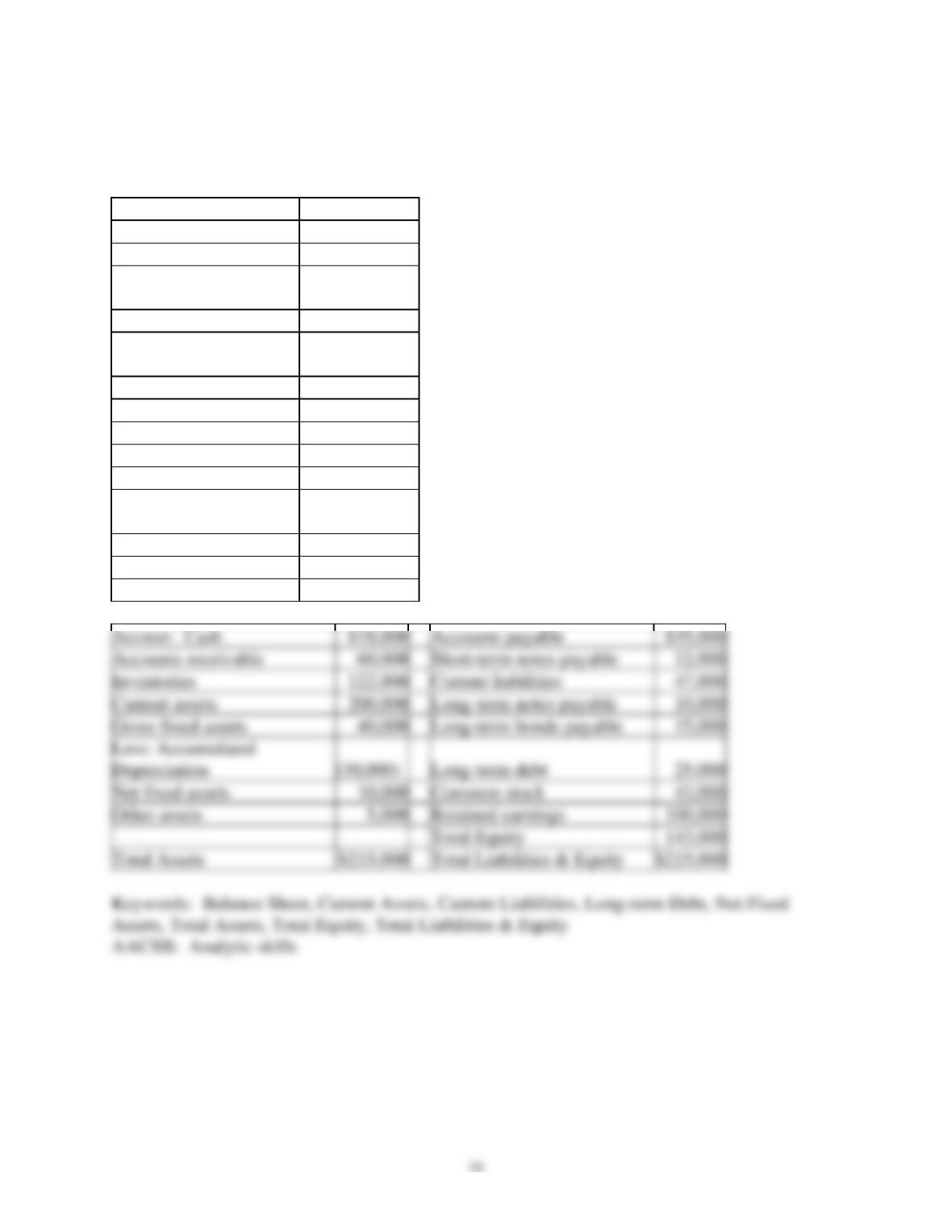
47) Prepare a balance sheet using the information given below. Make sure to identify current
assets, net fixed assets, total assets, current liabilities, long-term debt, total equity, and total
liabilities and equity.
Gross fixed assets
$40,000
Cash
$18,000
Other assets
$5,000
Accumulated
depreciation
$30,000
Common stock
$43,000
Short-term notes
payable
$12,000
Accounts payable
$35,000
Inventories
$122,000
Retained earnings
$100,000
Accounts receivable
$60,000
Long-term notes payable
$10,000
Long-term bonds
payable
$15,000
Sales
$300,000
Cost of goods sold
$150,000
Depreciation expense
$3,000
Answer: Cash
Accounts payable
Accounts receivable
Short-term notes payable
Inventories
Current liabilities
Current assets
Long-term notes payable
Gross fixed assets
Long-term bonds payable
Less: Accumulated
Depreciation
(30,000)
Long-term debt
Net fixed assets
Common stock
Other assets
Retained earnings
Total Equity
Total Assets
Total Liabilities & Equity
$215,000
3.3 Learning Objective 3
1) Generally accepted accounting principles (GAAP) require finance statements prepared on a
cash basis because these statements are most useful for investors and managers.
2) A company with negative net income will also have negative operating cash flow.
3) According to accrual accounting, revenues are recognized when earned and expenses are
recognized when incurred.
4) In order to be conservative, accrual accounting requires that expenses be recorded when
incurred, but revenues are recorded only after the cash has been received.
5) The statement of cash flow explains the changes that took place in the firm’s cash balance over
the period of interest.
6) What financial statement explains the changes that took place in the firm’s cash balance over a
period?
A) statement of cash flow
B) balance sheet
C) income statement
D) reconciliation of free cash flow
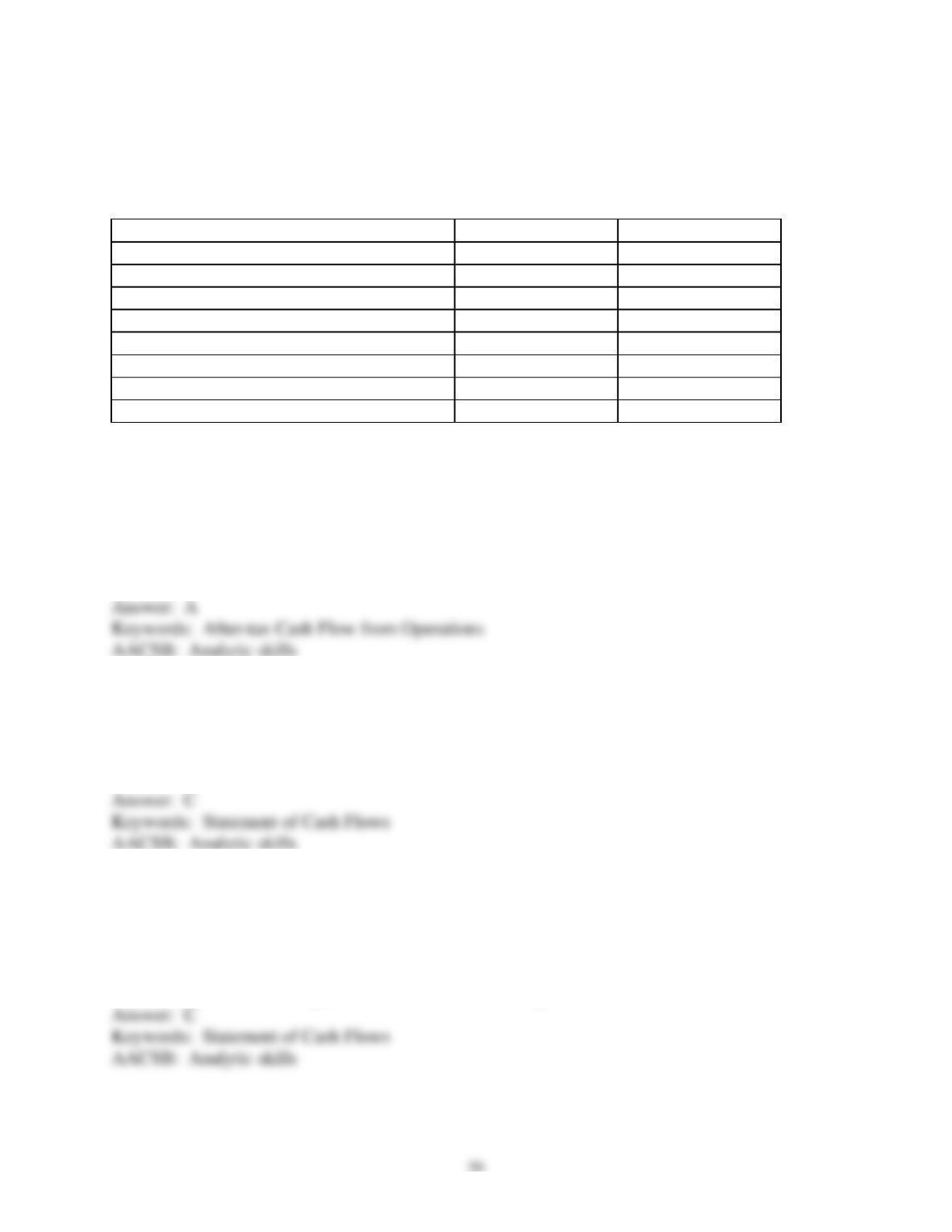
Please refer to Table 3-1 for the following questions.
Table 3-1
Jones Company
Financial Information
December 2009
December 2010
Net Income
$2,000
$4,000
Accounts receivable
750
950
Accumulated depreciation
1,000
1,500
Common stock
4,500
5000
Paid-in capital
7,500
8500
Retained earnings
1,500
3,500
Accounts payable
750
750
7) Based on the information in Table 3-1, calculate the after tax cash flow from operations for
2008 (no assets were disposed of during the year, and there was no change in interest payable or
taxes payable).
A) $4,300
B) $1,450
C) $5,500
D) $6,250
8) Based on the information in Table 3-1, the change in cash for 2010 is
A) $4,000.
B) $4,950.
C) $5,800.
D) $5,500.
9) A company borrows $2,000,000 and uses the money to purchase high technology machinery
for its operations. These are examples of
A) cash flow from financing and cash flow from operations.
B) cash flow from investing and cash flow from operations.
C) cash flow from financing and cash flow from investing.
D) cash flow from investing and cash flow from financing.
10) Two companies have identical assets and operating activities. Which of the follow statements
is true?
A) Both companies have the same net income.
B) The company with more debt will have lower operating income due to interest expense.
C) The company with more debt will have higher operating income due to leverage.
D) The company with more debt will have lower net income due to interest expense.
11) Jones Finance Company had a cash balance of $3 million at the beginning of 2010. During
2010, Sales were $8 million and expenses were $7 million. Therefore,
A) the cash balance at the end of 2010 is $4 million.
B) the cash balance at the end of 2010 must be greater than $3 million.
C) the cash balance at the end of 2010 must be less than $11 million.
D) the cash balance at the end of 2010 cannot be determined from the information given.
12) A corporation has annual sales of $18 million, total assets of $4 million, a debt ratio of 40%,
depreciation expense of $200,000, and a tax rate of 40%. The corporation’s total stockholders’
equity is equal to
A) $5,600,000.
B) $2,800,000.
C) $2,400,000.
D) $1,800,000.
13) Use the following information to calculate the change in the company’s cash balance for the
year.
Credit Sales
$800,000
Cash Sales
$500,000
Operating Expenses on Credit
$200,000
Cash Operating Expenses
$700,000
Accounts Receivable (Beg. of
Year)
$50,000
Accounts Receivable (End of
Year)
$80,000
Accounts Payable (Beg. of Year)
$50,000
Accounts Payable (End of Year)
$100,000
Income Taxes Paid
$160,000
A) $145,000
B) $180,000
C) $260,000
D) $365,000
14) Given the following financial statements for ACME Corporation, what is the company’s
after-tax cash flow from operations?
Income Statement
Balance Sheet
Year Ended 12/31/10
12/31/2010
12/31/2009
Sales
$1,300,000
Current Assets
$50,000
$45,000
Cost of Goods Sold
750,000
Fixed Assets
430,000
350,000
Operating Expenses
200,000
Total Assets
$480,000
$395,000
Depreciation
100,000
EBIT
250,000
Current Liabilities
$35,000
$50,000
Interest Expense
50,000
Long-term Debt
330,000
270,000
EBT
200,000
Common Stock
5,000
5,000
Taxes
80,000
Retained Earnings
110,000
70,000
Net Income
$120,000
Total Liabilities & Equity
$480,000
$395,000
A) $10,000
B) $270,000
C) $120,000
D) $295,000
15) Given the following financial statements for ACME Corporation, and assuming that ACME
paid a common dividend of $80,000 in 2010, what is the company’s financing cash flow for
2010?
Income Statement
Balance Sheet
Year Ended 12/31/10
12/31/2010
12/31/2009
Sales
$1,300,000
Current Assets
$50,000
$45,000
Cost of Goods Sold
750,000
Gross Fixed Assets
880,000
650,000
Operating Expenses
200,000
Less Accumulated
Depreciation
450,000
350,000
Depreciation Expense
100,000
Fixed Assets
430,000
350,000
EBIT
250,000
Total Assets
$480,000
$395,000
Interest Expense
50,000
EBT
200,000
Current Liabilities
$35,000
$50,000
Taxes
80,000
Long-term Debt
330,000
270,000
Net Income
$120,000
Common Stock
5,000
5,000
Retained Earnings
110,000
70,000
Total Liabilities & Equity
$480,000
$395,000
A) -$10,000
B) -$15,000
C) -$65,000
D) -$70,000
16) Racing Horse Corporation reported net income for 2010 of $200,000, sales of $540,000,
expenses (excluding depreciation) of $180,000, and depreciation expense of $60,000. The
company’s accounts receivable balance increased by $40,000 during the year and its accounts
payable balance remained the same. The company’s change in cash for the year is estimated to
be
A) $100,000.
B) $160,000.
C) $220,000.
D) $380,000.
17) Examples of uses of cash include
A) paying cash dividends to stockholders.
B) borrowing an additional amount using a secured loan.
C) selling machinery.
D) all of the above
18) Baron, Inc. has total current assets of $1,200,000; total current liabilities of $500,000; and
long-term assets of $800,000. How much is the firm’s Total Liabilities & Equity?
A) $2,500,000
B) $1,300,000
C) $2,000,000
D) $1,800,000
19) Baron, Inc. has total current assets of $1,200,000; total current liabilities of $500,000; long-
term assets of $800,000; and long-term debt of $600,000. How much is the firm’s total equity?
A) $1,200,000
B) $800,000
C) $900,000
D) $2,000,000
20) What information does a firm’s statement of cash flows provide to the viewing public?
A) a report of investments made and their cost for a specific period of time
B) a report documenting a firm’s cash inflows and cash outflows from operating, financing, and
investing activities for a defined period of time
C) a report of revenues and expenses for a defined period of time
D) an itemization of all of a firm’s assets, liabilities, and equity for a defined period of time
21) Which of the following best describes cash flow from financing activities?
A) Interest income, plus dividend income, minus taxes
B) Interest expense, minus dividends paid
C) Interest paid, plus dividends paid, plus increase (or minus decrease) in stock, plus increase (or
minus decrease) in debt
D) Increase (or minus decrease) in stock, plus increase (or minus decrease) in debt, minus
interest paid, minus dividends paid.
Please refer to Table 3-2 for the following questions.
Table 3-2
Enigma has the following financial information:
Net Income
$70,000
Taxable Income (EBT)
$100,000
Interest Expense
$20,000
Depreciation Expense
$15,000
Tax Expense
$30,000
Increase in Current Assets
$20,000
Increase in A/P and Accruals
$10,000
Decrease in Gross Fixed
Assets
$100,000
No changes were made in interest payable or taxes payable.
22) Based on the information in Table 3-2, what is Enigma’s cash flow from operations?
A) $85,000
B) $100,000
C) $105,000
D) $75,000
23) A firm has after-tax cash flow from operations equal to $100,000. Operating working capital
increased by $20,000, and the firm purchased $30,000 of fixed assets. The firm’s free cash flow
was:
A) $50,000.
B) $90,000.
C) $110,000.
D) $150,000.
24) A firm paid dividends of $10,000, paid interest of $20,000, reduced debt principal
outstanding (paid off debt) in the amount of $100,000, and sold new stock for $150,000. What
was the firm’s cash flow from financing activities?
A) +$20,000 ($20,000 flowed into the firm)
B) -$20,000 ($20,000 flowed out of the firm)
C) +$280,000 ($280,000 flowed into the firm)
D) -$280,000 ($280,000 flowed out of the firm)
25) Table 3-3
Marlett Company
Financial Information
December 2009
December 2010
Net Income
$2,000
$4,000
Accounts receivable
750
1,250
Accumulated depreciation
1,000
1,400
Common stock
4,500
5500
Paid-in capital
7,500
8500
Retained earnings
1,500
3,500
Accounts payable
750
950
Based on the information in Table 3-3, prepare a statement of cash flows for 2010. Assume that
there were no changes in any other asset or liability accounts, and that the ending cash balance
for 2009 was $100.
For the Year Ended Dec. 31, 2008
Operating Activities
Net Income
$4,000
Depreciation Expense
400
Increase in Accounts Receivable
(500)
Increase in Accounts Payable
Cash Flow from Operations
Investing Activities
Cash Flow from Investing Activities
$0
Financing Activities
Increase in Common Stock
$1,000
Increase in Paid-in-Capital
1,000
Dividends Paid
Cash Flow from Financing Activities
Change in Cash
$4,100
Beginning Cash Balance
100
Ending Cash Balance
29
26) Is it possible for a company that has negative net income and negative operating cash flow to
end the year with an increase in cash and an increase in stock price? Explain your answer.
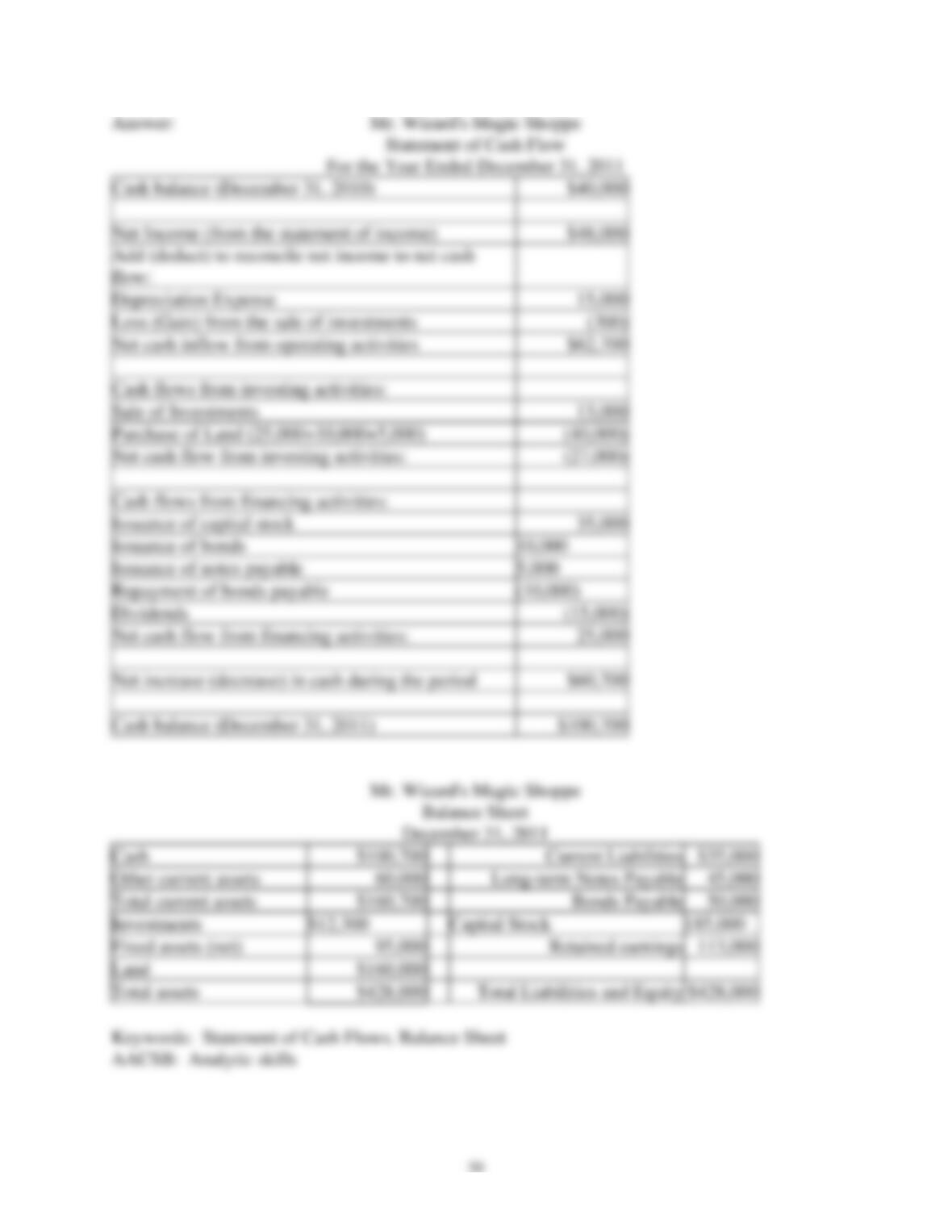
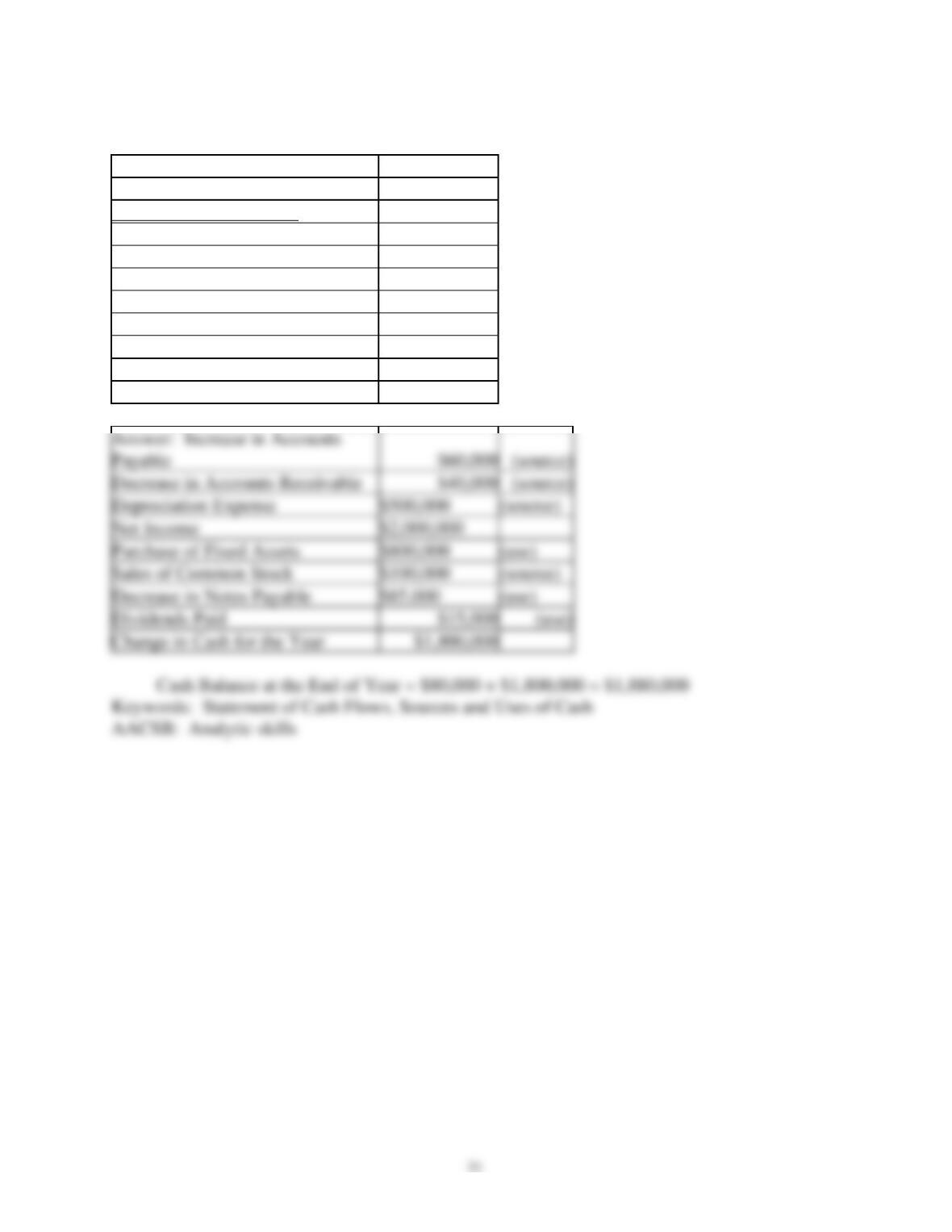
27) Mr. Wizard’s Magic Shoppe had the following condensed balance sheet at the end of
operation for 2010:
Mr. Wizard’s Magic Shoppe
Balance Sheet
December 31, 2010
Cash
$40,000
Current Liabilities
$35,000
Other current assets
60,000
Long-term Notes Payable
40,000
Total current assets
$100,000
Bonds Payable
50,000
Investments
$25,000
Capital Stock
150,000
Fixed assets (net)
110,000
Retained earnings
80,000
Land
$120,000
Total assets
$355,000
Total Liabilities and Equity
$355,000
During 2011, the following occurred
a. Mr. Wizard’s sold some of its investments for $13,000 which resulted in a gain of $300
after taxes. The gain (net of taxes) has been included in the company’s 2011 net income.
b. Additional land for a plant expansion was purchased for $25,000.
c. Bonds payable were paid in the amount of $10,000.
d. An additional $35,000 in capital stock was issued.
e. Dividends of $15,000 were paid to stockholders.
f. Net income for 2011 was $48,000 after allowing for $15,000 in depreciation.
g. A second parcel of land was purchased through the issuance of $10,000 in bonds, and
$5,000 in long-term notes payable.
Required:
a. Prepare a statement of cash flows for the year ended 12/31/2011. (check figure: ending
cash balance = $72,500)
b. Prepare a condensed balance sheet for Mr. Wizard’s at December 31, 2011.
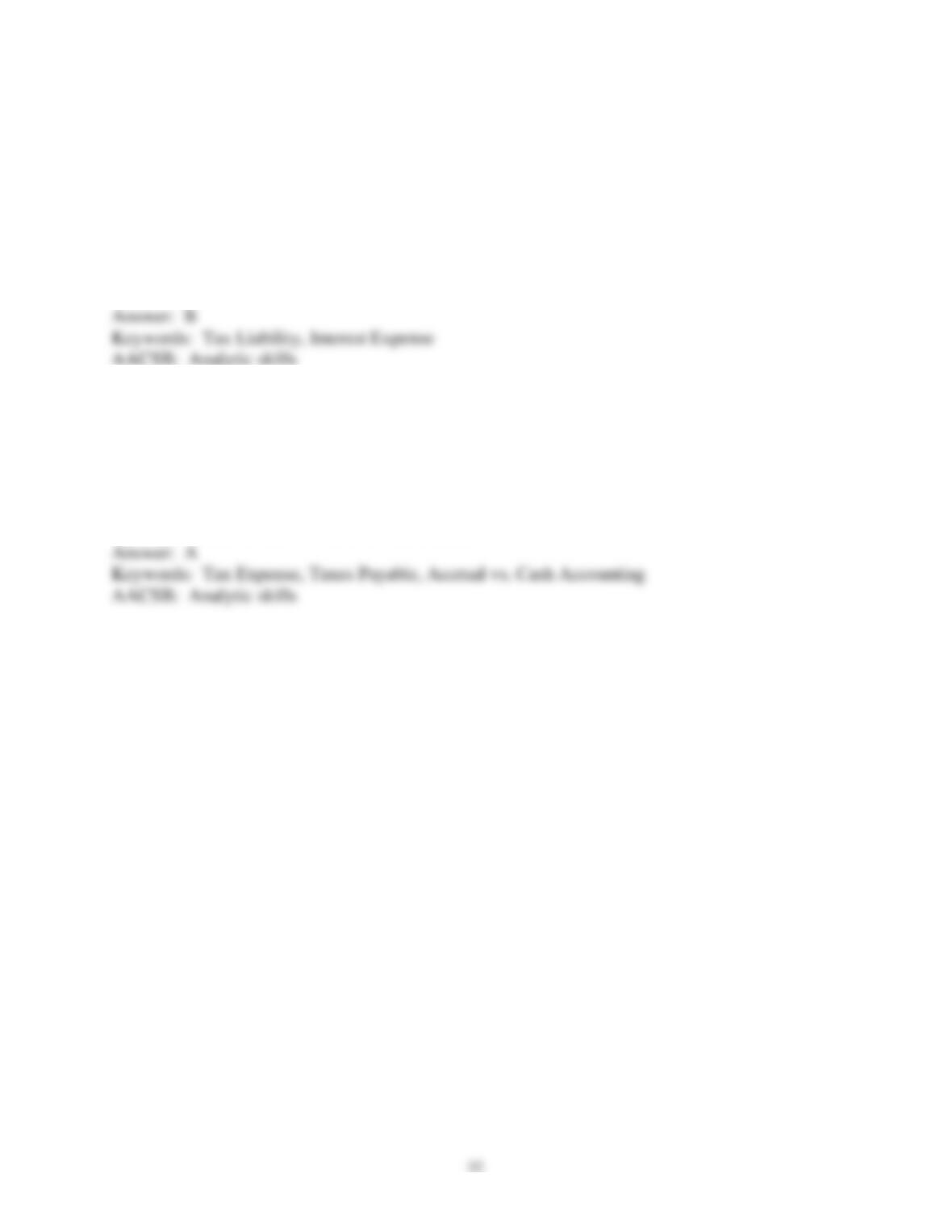
28) Given the information below, calculate the company’s cash balance at the end of the year.
Cash Balance at Beginning of Year
$80,000
Activity During the Year
Increase in Accounts Payable
$60,000
Decrease in Accounts Receivable
$40,000
Depreciation Expense
$500,000
Net Income
$2,000,000
Purchase of Fixed Assets
$800,000
Sales of Common Stock
$100,000
Decrease in Notes Payable
$85,000
Dividends Paid
$15,000
Payable
$60,000
Decrease in Accounts Receivable
$40,000
Depreciation Expense
$500,000
(source)
Net Income
$2,000,000
Purchase of Fixed Assets
$800,000
(use)
Sales of Common Stock
$100,000
(source)
Decrease in Notes Payable
$85,000
(use)
Dividends Paid
$15,000
3.4 Learning Objective 4
1) PDQ Corp. has sales of $4,000,000; the firm’s cost of goods sold is $2,500,000; and its total
operating expenses are $600,000. The firm’s interest expense is $250,000, and the corporate tax
rate is 40%. What is PDQ’s tax liability?
A) $258,000
B) $260,000
C) $360,000
D) $600,000
2) The income statement for Brit, Inc. indicates that tax expense was $20,000. The balance sheet
indicates that taxes payable for the same year increased by $5,000. What amount did Brit, Inc.
actually pay in taxes during this year?
A) $15,000
B) $20,000
C) $25,000
D) Cannot be determined without the cash balance
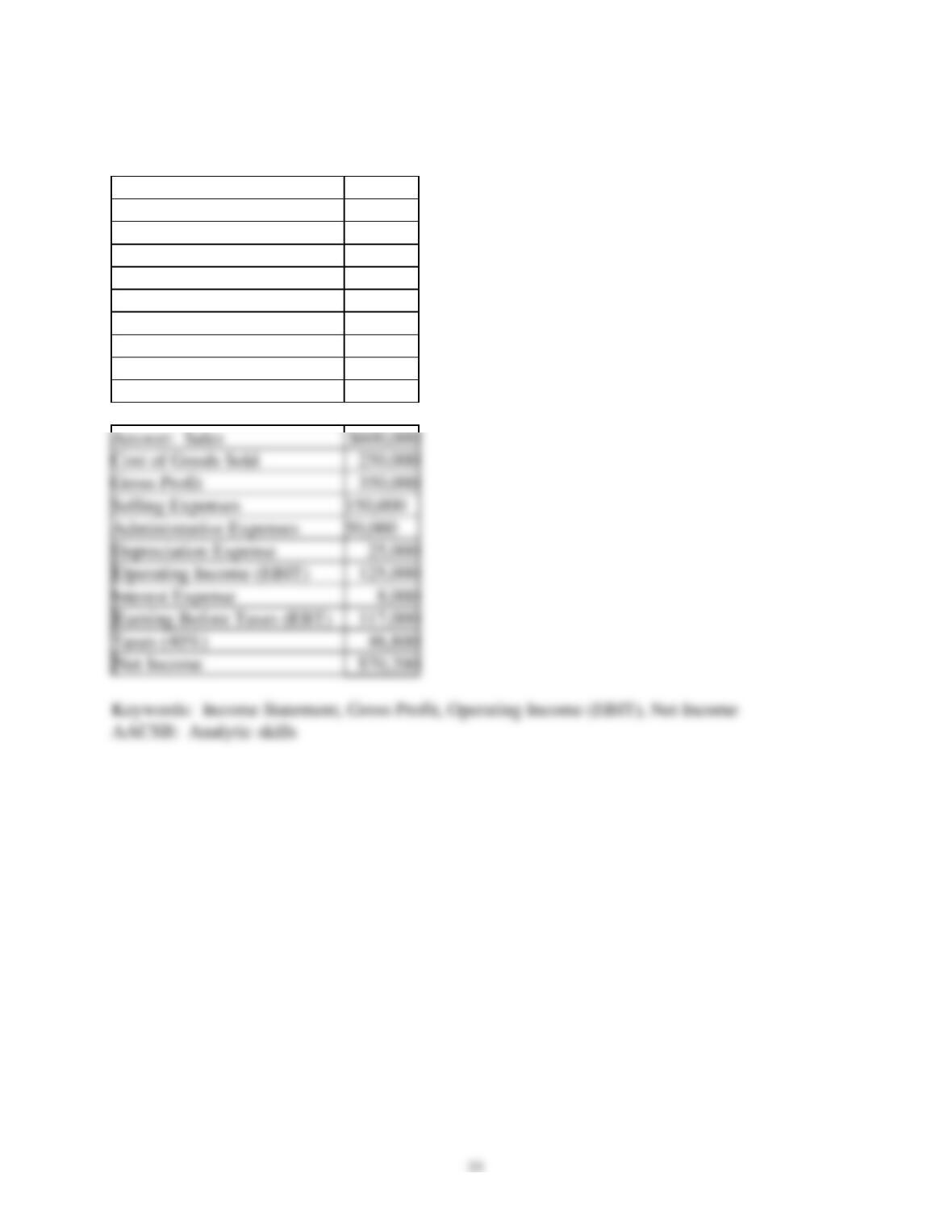
3) Prepare an income statement using the information given below. Make sure to identify gross
profit, operating income, and net income.
Inventories
$50,000
Cost of Goods Sold
$250,000
Administrative Expenses
$50,000
Accumulated Depreciation
$150,000
Sales
$600,000
Depreciation Expense
$25,000
Selling Expenses
$150,000
Common Stock Dividends
$8,000
Interest Expense
$8,000
Corporate Tax Rate
40%
Answer: Sales
$600,000
Cost of Goods Sold
250,000
Gross Profit
350,000
Selling Expenses
150,000
Administrative Expenses
50,000
Depreciation Expense
Operating Income (EBIT)
125,000
Interest Expense
Earning Before Taxes (EBT)
117,000
Net Income
$70,200