Foundations of Finance, 7e (Keown/Martin/Petty)
Chapter 3 Understanding Financial Statements and Cash Flows
3.1 Learning Objective 1
1) An income statement reports a firm’s cumulative revenues and expenses from the inception of
the firm through the income statement date.
2) Owners equity increases each period by the amount of the corporation’s positive net cash flow.
3) If two companies have the same revenues and operating expenses, their net incomes will still
be different if one company finances its assets with more debt and the other company with more
equity.
4) Common-sized income statements are used to compare companies that have the same amount
of revenues.
5) Common-sized income statements restate the numbers in the income statement as a
percentage of sales to assist in the comparison of a firm’s financial performance across time and
with competitors.
6) Net profit margin is equal to the gross profit margin times the operating profit margin.
7) Earnings before taxes, or taxable income, is equal to operating income minus financing costs.
8) The more debt a company uses to finance its assets, the lower will be its operating income due
to higher interest expense.
9) Changes in depreciation expense do not affect operating income because depreciation is a
non-cash expense.
10) Earnings available to common shareholders represents income that may be reinvested in the
firm or distributed to its owners.
11) Earnings available to common shareholders is equal to a corporation’s positive net cash flow
over a given period, typically one year.
12) Profits-to-Sales relationships are defined as profit margins.
13) Company A and Company B both report the same level of sales and net income. Therefore,
A) both A and B will report the same Earnings Per Share.
B) both A and B will report the same Gross Profit Margin.
C) both A and B will report the same Net Profit Margin.
D) both A and C are true.
14) The A corporation has an operating profit margin of 20%, operating expenses of $500,000,
and financing costs of $15,000. Therefore,
A) the corporation’s gross profit margin is less than 20%.
B) the corporation’s net profit margin is greater than 20%.
C) the corporation’s gross profit margin is greater than 20%.
D) the corporation’s gross profit margin is equal to 20% because gross profit is not affected by
operating expenses or financing costs.
15) The basic format of an income statement is
A) Sales – Expenses = Profits.
B) Income – Expenses = EBIT.
C) Sales – Liabilities = Profits.
D) Assets – Liabilities = Profits.
16) Li Retailing reported the following items for the current year: Sales = $3,000,000; Cost of
Goods Sold = $1,500,000; Depreciation Expense = $170,000; Administrative Expenses =
$150,000; Interest Expense = $30,000; Marketing Expenses = $80,000; and Taxes = $300,000.
Li’s gross profit is equal to
A) $770,000.
B) $1,070,000.
C) $1,100,000.
D) $1,500,000.
17) Li Retailing reported the following items for the current year: Sales = $3,000,000; Cost of
Goods Sold = $1,500,000; Depreciation Expense = $170,000; Administrative Expenses =
$150,000; Interest Expense = $30,000; Marketing Expenses = $80,000; and Taxes = $300,000.
Li’s operating income is equal to
A) $770,000.
B) $1,070,000.
C) $1,100,000.
D) $1,500,000.
18) Li Retailing reported the following items for the current year: Sales = $3,000,000; Cost of
Goods Sold = $1,500,000; Depreciation Expense = $170,000; Administrative Expenses =
$150,000; Interest Expense = $30,000; Marketing Expenses = $80,000; and Taxes = $300,000.
Li’s net profit margin is equal to
A) 25.67%.
B) 35.67%.
C) 36.67%.
D) 50.00%.
19) Li Retailing reported the following items for the current year: Sales = $3,000,000; Cost of
Goods Sold = $1,500,000; Depreciation Expense = $170,000; Administrative Expenses =
$150,000; Interest Expense = $30,000; Marketing Expenses = $80,000; and Taxes = $300,000;
Li’s operating profit margin is equal to
A) 25.67%
B) 35.67%
C) 36.67%
D) 50.00%
20) Use the following information to calculate the company’s accounting net income for the year.
Credit Sales
$800,000
Cash Sales
$500,000
Operating Expenses on Credit
$200,000
Cash Operating Expenses
$700,000
Accounts Receivable (Beg. of
Year)
$50,000
Accounts Receivable (End of
Year)
$80,000
Accounts Payable (Beg. of Year)
$50,000
Accounts Payable (End of Year)
$100,000
Corporate Tax Rate
40%
A) $300,000
B) $240,000
C) $125,000
D) $120,000
21) A corporation’s operating profit margin is equal to
A) Net Income divided by Sales.
B) EBIT divided by Sales.
C) EBIT divided by Net Income.
D) Sales divided by EBIT.
22) Which of the following statements concerning net income is most correct?
A) Net income represents cash available to pay dividends.
B) Net income represents sales minus operating expenses at a specific point in time.
C) Negative net income reduces a company’s cash balance.
D) Net income represents income that may be reinvested in the firm or distributed to its owners.
23) Which of the following represents an attempt to measure the net results of the firm’s
operations (revenues versus expenses) over a given time period?
A) Balance Sheet
B) Statement of Cash Flows
C) Income Statement
D) Sources and Uses of Funds Statement
24) What information does a firm’s income statement provide to the viewing public?
A) an itemization of all of a firm’s assets and liabilities for a defined period of time
B) a complete listing of all of a firm’s cash receipts and cash expenditures for a defined period of
time
C) a report of revenues and expenses for a defined period of time
D) a report of investments made and their cost for a specific period of time
25) PDQ Corp. has sales of $4,000,000; the firm’s cost of goods sold is $2,500,000; and its total
operating expenses are $600,000. What is PDQ’s EBIT?
A) $850,000
B) $875,000
C) $900,000
D) $1,300,000
26) PDQ Corp. has sales of $4,000,000; the firm’s cost of goods sold is $2,500,000; and its total
operating expenses are $600,000. The firm’s interest expense is $250,000, and the corporate tax
rate is 40%. What is PDQ’s net income?
A) $288,000
B) $350,000
C) $377,000
D) $390,000
27) Corporation B reported earnings per share of $10. Corporation B has 100,000 shares of
common stock outstanding and reported an increase in owners equity of $400,000 for the period.
Corporation B paid $50,000 in interest expense during the period. Corporation B paid dividends
per share of
A) $6.00.
B) $5.50.
C) $6.50.
D) $14.003.
28) The increase in owners equity for a given period is equal to
A) positive net cash flow minus dividends.
B) net income minus dividends.
C) sales minus dividends.
D) gross profit minus distributions to shareholders.
29) A firm’s financing costs include
A) depreciation expense.
B) interest exposure.
C) costs of goods sold.
D) both A and B.
30) Corporation A decides to borrow $1,000,000 and use the money to buy back $1,000,000 of
its common stock. The corporation pays 6% interest on its borrowed funds which exactly equals
the amount of the dividend it used to pay on the common stock it repurchased. Therefore,
A) Corporation A’s operating income will decrease due to higher interest expense.
B) Corporation A’s net income will increase due to the tax deductibility of interest expense.
C) Corporation A will have no change in its operating income since the interest expense exactly
offsets the prior dividend payment.
D) Corporation A’s gross profit will decrease.
31) Gross profit is equal to
A) profits plus depreciation.
B) revenues – expenses.
C) earnings before taxes minus taxes payable.
D) sales – cost of goods sold.
32) An income statement may be represented as follows:
A) Sales – Liabilities = Profits.
B) Revenues – Liabilities = Net Income.
C) Sales – Expenses = Retained Earnings.
D) Sales – Expenses = Profits.
3.2 Learning Objective 2
1) Common-sized balance sheets show each account as a percentage of total sales to help
analysts in comparing companies of difference sizes.
2) The balance sheet equation is Total Assets = Total Revenues – Total Liabilities.
3) The accounting book value of an asset represents the historical cost of the asset rather than its
current market value or replacement cost.
5) Additional Paid in Capital on the balance sheet equals the amount paid by investors for the
company’s common stock that exceeds the market price of the stock at the time of purchase.
6) A firm’s income statement reports the results from operating the business for a period of time,
while the firm’s balance sheet provides a snapshot of the firm’s financial position at a specific
point in time.
7) If a company’s cash balance increases during the year, and the company also reports positive
net income, then the company’s retained earnings balance must increase.
8) Fixed assets are assets whose balances will remain the same throughout the year.
9) Inventories are considered fixed assets because inventory levels remain fairly constant
throughout the year.
10) Finished goods held for sale are inventory, but raw materials to be used in the production
process are considered other assets.
11) Accounting rules specify that assets on the balance sheet must be reported at current market
value, because this is the valuation most useful to potential investors.
12) The retained earnings balance on IBM’s balance sheet at the end of 2010 is equal to IBM’s
2010 net income minus dividends paid in 2010.
13) Financing activities have no impact on the income statement, but rather are reflected in
changes in long-term debt and short-term debt on the balance sheet.
14) Common stockholders’ equity equals common stock issued minus treasury stock.
15) An income statement reports the firm’s revenues and expenses for a specific period of time
such as one year.
16) A balance sheet is a statement of the financial position of the firm on a given date, including
its asset holdings, liabilities, and equity.
17) The profit and loss (income) statement is compiled on a cash basis.
18) The income statement describes the financial position of a firm on a given date.
19) Under current accounting rules, the plant and equipment account shows the historical cost
(purchase price) of, plus any subsequent improvements to, the plant and equipment.
20) On an accrual basis income statement, revenues equal cash receipts and expenses equal cash
expenditures.
21) A balance sheet reflects the current market value of a firm’s assets and liabilities.
22) Net working capital is equal to gross working capital minus depreciation.
23) The balance sheet reflects the accounting equation: Assets = Liabilities + Owners’ Equity.
Please refer to Table 3-1 for the following questions.
Table 3-1
Jones Company
Financial Information
December 2009
December 2010
Net Income
$2,000
$4,000
Accounts receivable
750
950
Accumulated depreciation
1,000
1,500
Common stock
4,500
5000
Paid-in capital
7,500
8500
Retained earnings
1,500
3,500
Accounts payable
750
750
24) Based on the information in Table 3-1, calculate the amount of dividends paid by Jones
Company in 2010 (no assets were disposed of during the year, and there was no change in
interest payable or taxes payable).
A) $2,000
B) $2,500
C) $3,500
D) $4,000
25) Based on the information in Table 3-1, assuming that no assets were disposed of during
2010, the amount of depreciation expense was
A) $375.
B) $500.
C) $2,500.
D) $3,500.
26) Based on the information in Table 3-1, assuming that no common stock was repurchased
during the year, the firm issued how much new common stock during 2010?
A) $500
B) $1,000
C) $1,500
D) $2,000
27) The December 31, 2009 balance sheet shows net fixed assets of $150,000 and the December
31, 2010 balance sheet shows net fixed assets of $250,000. Depreciation expense for 2009 is
$25,000 and depreciation expense for 2010 is $35,000. Based on this information, the cost of
fixed assets purchased during 2010 is
A) $100,000.
B) $110,000.
C) $135,000.
D) $160,000.
28) All of the following would result in an increase in stockholders equity except:
A) the company sold common stock at par value.
B) the company sold common stock above par value.
C) the company purchased treasury stock.
D) the company had positive net income greater than dividends paid.
29) Wheeler Corporation had retained earnings as of 12/31/10 of $15 million. During 2011,
Wheeler’s net income was $7 million. The retained earnings balance at the end of 2011 was
equal to $20 million. Therefore,
A) Wheeler paid a dividend in 2010 of $5 million.
B) Wheeler paid a dividend in 2010 of $2 million.
C) Wheeler sold common stock during 2010 for $5 million.
D) Wheeler purchased treasury stock in 2010 for $2 million.
30) All of the following are equity accounts on a balance sheet except:
A) retained earnings.
B) cash.
C) common stock.
D) paid-in capital.
31) The two principal sources of financing for corporations are
A) debt and accounts payable.
B) debt and equity.
C) common equity and preferred equity.
D) cash and common equity.
32) Net working capital is equal to
A) total assets minus total liabilities.
B) current assets minus total liabilities.
C) total operating capital minus net income.
D) current assets minus current liabilities.
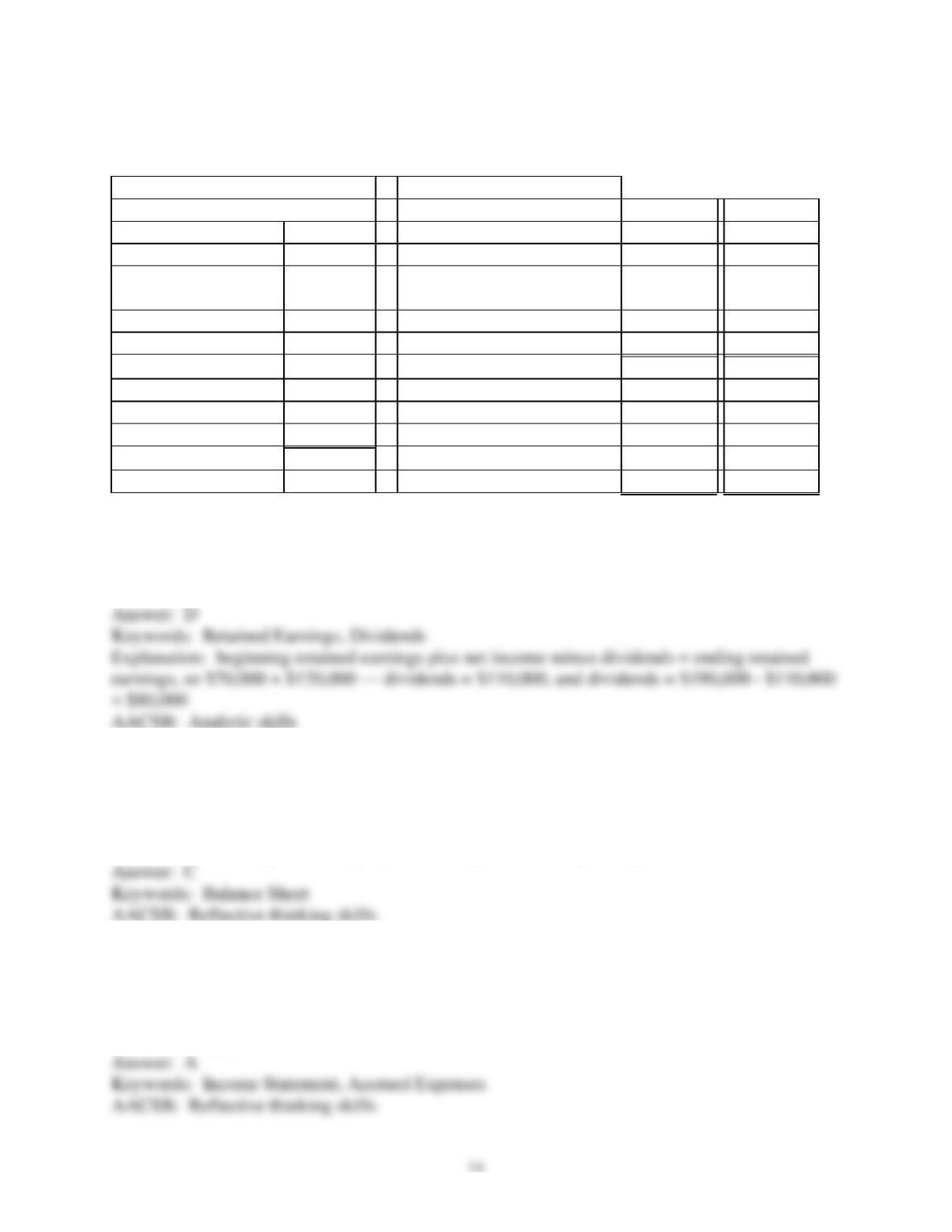
33) Given the following financial statements for ACME Corporation, what amount did the
company pay in dividends for 2010?
Income Statement
Balance Sheet
Year Ended 12/31/10
12/31/2010
12/31/2009
Sales
$1,300,000
Current Assets
$50,000
$45,000
Cost of Goods Sold
750,000
Gross Fixed Assets
880,000
650,000
Operating Expenses
200,000
Less Accumulated
Depreciation
450,000
350,000
Depreciation Expense
100,000
Fixed Assets
430,000
350,000
EBIT
250,000
Total Assets
$480,000
$395,000
Interest Expense
50,000
EBT
200,000
Current Liabilities
$35,000
$50,000
Taxes
80,000
Long-term Debt
330,000
270,000
Net Income
$120,000
Common Stock
5,000
5,000
Retained Earnings
110,000
70,000
Total Liabilities & Equity
$480,000
$395,000
A) $45,000
B) $25,000
C) $100,000
D) $80,000
34) All of the following statements about balance sheets are true except:
A) Assets – Liabilities = Shareholders’ Equity.
B) assets are reported at historical cost.
C) balance sheets show average asset balances over a one-year period.
D) a balance sheet reports a company’s financial position at a specific point in time.
35) All of the following are income statement items except:
A) accrued expenses.
B) depreciation expense.
C) cost of goods sold.
D) interest expense.
36) PDQ Corp. has sales of $4,000,000; the firm’s cost of goods sold is $2,500,000; and its total
operating expenses are $600,000. The firm’s interest expense is $250,000, and the corporate tax
rate is 40%. The firm paid dividends to preferred stockholders of $40,000, and the firm
distributed $60,000 in dividend payments to common stockholders. What is PDQ’s “Addition to
Retained Earnings?”
A) $650,000
B) $390,000
C) $330,000
D) $290,000
37) What information does a firm’s balance sheet provide to the viewing public?
A) a report of investments made and their cost for a specific period of time
B) a complete listing of all of a firm’s cash receipts and cash expenditures for a defined period of
time
C) a report of revenues and expenses for a defined period of time
D) an itemization of all of a firm’s assets, liabilities, and equity as of the balance sheet date
38) Which of the following accounts belongs on the asset side of a balance sheet?
A) depreciation expense
B) accounts payable
C) inventory
D) accruals
39) Which of the following accounts does not belong on the asset side of a balance sheet?
A) accounts receivable
B) marketable securities
C) cash
D) common stock
40) Which of the following accounts does not belong on the asset side of a balance sheet?
A) accounts receivable
B) accumulated depreciation
C) cash
D) accruals
41) Which of the following accounts belong in the liability section of a balance sheet?
A) interest expense
B) accumulated depreciation
C) accounts payable
D) preferred stock
42) Which of the following accounts does not belong in the liability section of a balance sheet?
A) accruals
B) short-term debt
C) additional paid-in capital
D) long-term debt
43) Which of the following accounts belongs in the equity section of a balance sheet?
A) retained earnings
B) cash
C) long-term debt
D) dividends
44) Which of the following accounts does not belong in the equity section of a balance sheet?
A) retained earnings
B) paid-in-Surplus
C) long-term debt
D) preferred stock
45) Baron, Inc. has total current assets of $1,200,000; long-term debt of $600,000; total current
liabilities of $500,000; and long-term assets of $800,000. How much is the firm’s net working
capital?
A) $1,000,000
B) $900,000
C) $600,000
D) $700,000
46) Global.Com has cash of $75,000; short-term notes payable of $100,000; accounts receivables
of $275,000; accounts payable of $135,000: inventories of $350,000; and accrued expenses of
$75,000. What is Global’s net working capital?
A) $390,000
B) $175,000
C) $700,000
D) $210,000