Chapter 03: Analysis of Financial Statements
1. Ratio analysis involves analyzing financial statements in order to appraise a firm’s financial position and strength.
a. True
b. False
2. The “apparent,” but not the “true,” financial position of a company whose sales are seasonal can differ dramatically,
depending on the time of year when the financial statements are constructed.
a. True
b. False
3. Significant variations in accounting methods among firms make meaningful ratio comparisons between firms more
difficult than if all firms used similar accounting methods.
a. True
b. False
Chapter 03: Analysis of Financial Statements
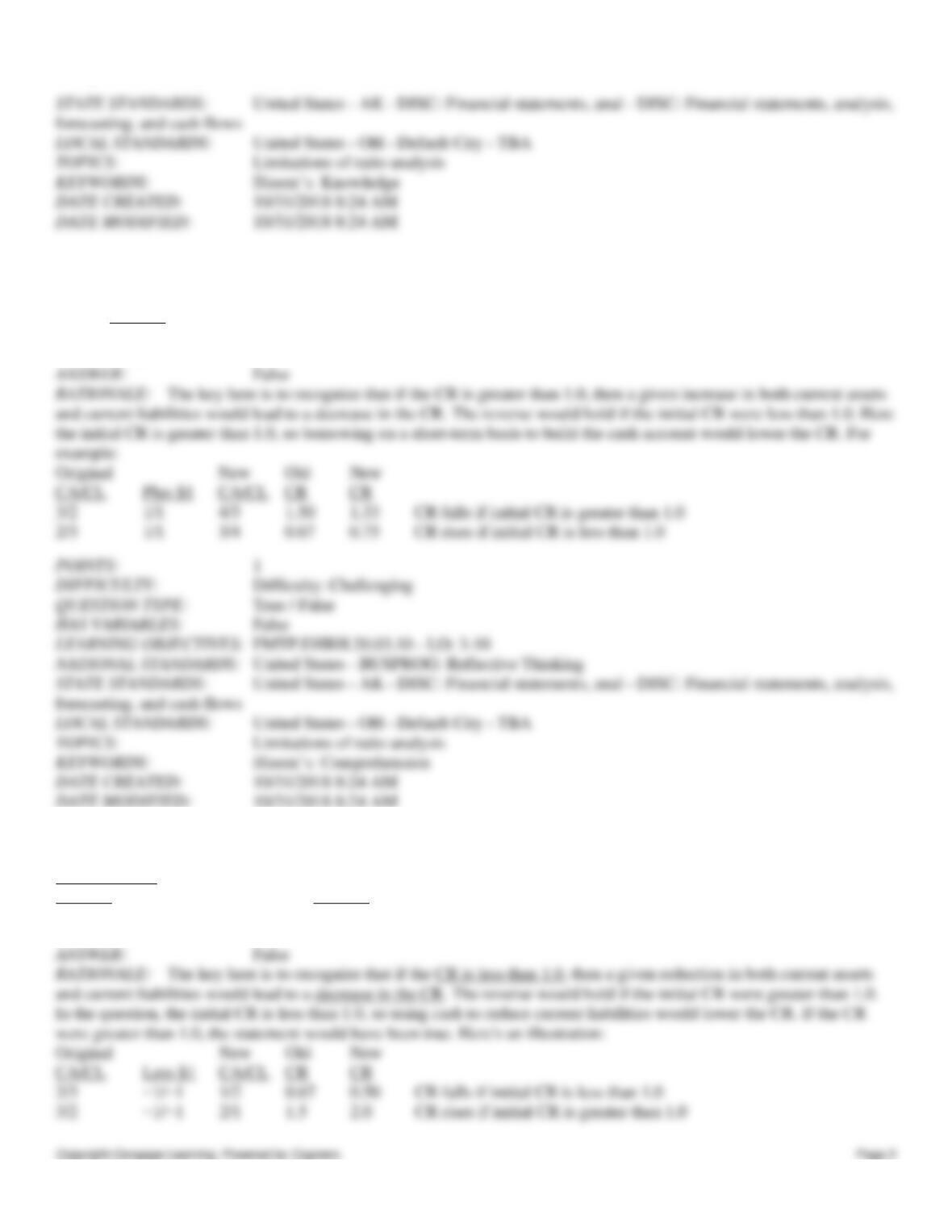
4. One problem with ratio analysis is that relationships can be manipulated. For example, if our current ratio is greater
than 1.5, then borrowing on a short-term basis and using the funds to build up our cash account would cause the current
ratio to increase.
a. True
b. False
5. One problem with ratio analysis is that relationships can be manipulated. For example, we know that if our current ratio
is less than 1.0, then using some of our cash to pay off some of our current liabilities would cause the current ratio to
increase and thus make the firm look stronger.
a. True
b. False
Chapter 03: Analysis of Financial Statements
6. Which of the following statements is CORRECT?
a. “Window dressing” is any action that improves a firm’s fundamental, long-run position and thus increases its
intrinsic value.
b. Borrowing by using short-term notes payable and then using the proceeds to retire long-term debt is an example
of “window dressing.” Offering discounts to customers who pay with cash rather than buy on credit and then using the
funds that come in quicker to purchase additional inventories is another example of “window dressing.”
c. Borrowing on a long-term basis and using the proceeds to retire short-term debt would improve the current ratio
and thus could be considered to be an example of “window dressing.”
d. Offering discounts to customers who pay with cash rather than buy on credit and then using the funds that come
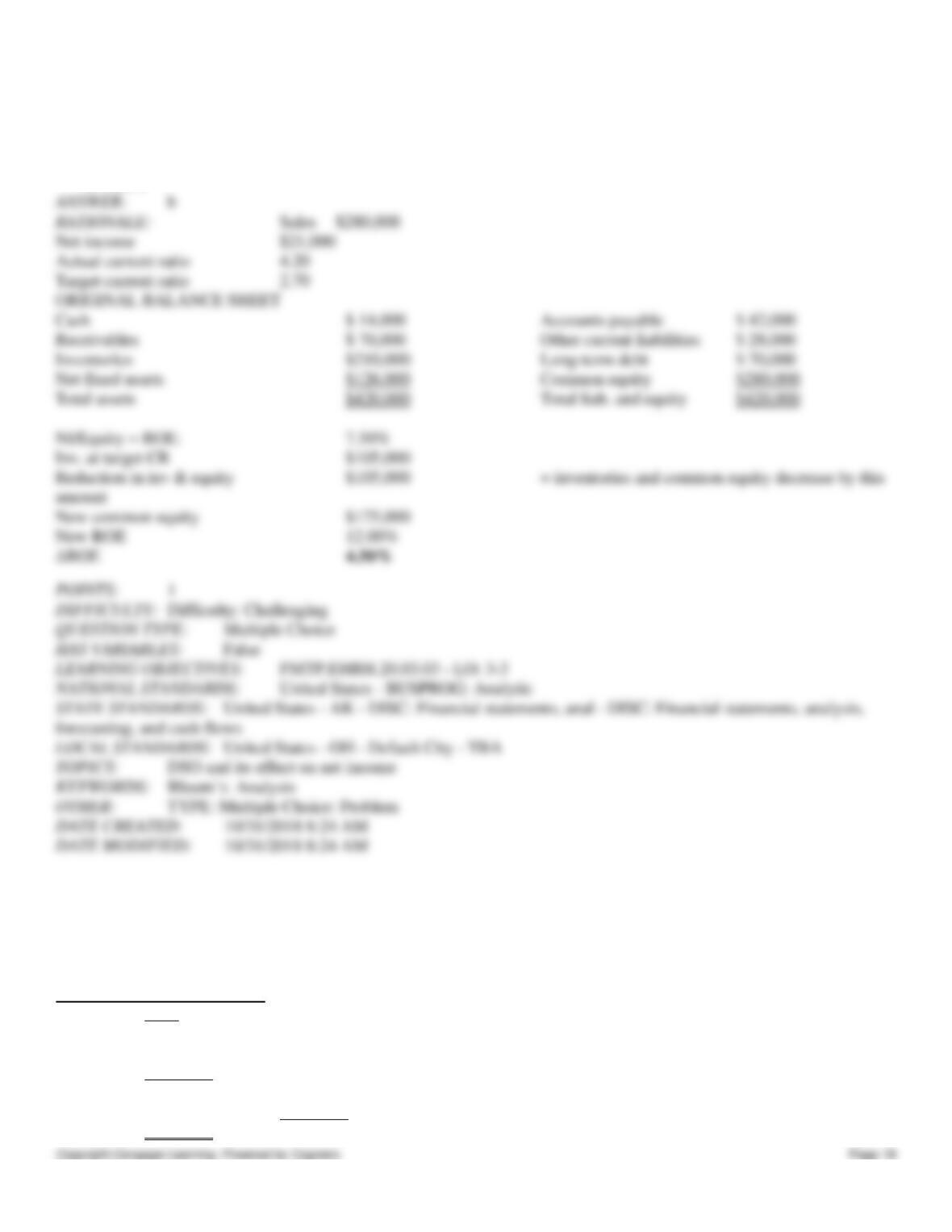
in quicker to purchase additional inventories is an example of “window dressing.”
e. Using some of the firm’s cash to reduce long-term debt is an example of “window dressing.”
7. The current ratio and inventory turnover ratios both help us measure the firm’s liquidity. The current ratio measures the
relationship of a firm’s current assets to its current liabilities, while the inventory turnover ratio gives us an indication of
how long it takes the firm to convert its inventory into cash.
a. True
b. False
Chapter 03: Analysis of Financial Statements
8. Although a full liquidity analysis requires the use of a cash budget, the current and quick ratios provide fast and easy-
to-use measures of a firm’s liquidity position.
a. True
b. False
9. High current and quick ratios always indicate that a firm is managing its liquidity position well.
a. True
b. False
10. Even though Firm A’s current ratio exceeds that of Firm B, Firm B’s quick ratio might exceed that of A. However, if
A’s quick ratio exceeds B’s, then we can be certain that A’s current ratio is also larger than that of B.
a. True
b. False
Chapter 03: Analysis of Financial Statements
11. Firms A and B have the same current ratio, 0.75, the same amount of sales and cost of goods sold, and the same
amount of current liabilities. However, Firm A has a higher inventory turnover ratio than B. Therefore, we can conclude
that A’s quick ratio must be smaller than B’s.
a. True
b. False
Chapter 03: Analysis of Financial Statements
12. Considered alone, which of the following would increase a company’s current ratio?
a. An increase in accounts payable.
b. An increase in net fixed assets.
c. An increase in accrued liabilities.
d. An increase in notes payable.
e. An increase in accounts receivable.
13. Which of the following would, generally, indicate an improvement in a company’s financial position, holding other
things constant?
a. The total assets turnover decreases.
b. The TIE declines.
c. The DSO increases.
d. The EBITDA coverage ratio increases.
e. The current and quick ratios both decline.
14. A firm wants to strengthen its financial position. Which of the following actions would increase its current ratio?
Chapter 03: Analysis of Financial Statements
a. Use cash to increase inventory holdings.
b. Reduce the company’s days’ sales outstanding to the industry average and use the resulting cash savings to
purchase plant and equipment.
c. Use cash to repurchase some of the company’s own stock.
d. Borrow using short-term debt and use the proceeds to repay debt that has a maturity of more than one year.
e. Issue new stock and then use some of the proceeds to purchase additional inventory and hold the remainder as
cash.
15. A firm wants to strengthen its financial position. Which of the following actions would increase its quick ratio?
a. Issue new common stock and use the proceeds to acquire additional fixed assets.
b. Offer price reductions along with generous credit terms that would (1) enable the firm to sell some of its excess
inventory and (2) lead to an increase in accounts receivable.
c. Issue new common stock and use the proceeds to increase inventories.
d. Speed up the collection of receivables and use the cash generated to increase inventories.
e. Use some of its cash to purchase additional inventories.
16. Amram Company’s current ratio is 1.9. Considered alone, which of the following actions would reduce the company’s
current ratio?
a. Use cash to reduce accounts payable.
b. Borrow using short-term notes payable and use the proceeds to reduce accruals.
c. Borrow using short-term notes payable and use the proceeds to reduce long-term debt.
d. Use cash to reduce accruals.
Chapter 03: Analysis of Financial Statements
e. Use cash to reduce short-term notes payable.
17. Lincoln Industries’ current ratio is 0.5. Considered alone, which of the following actions would increase the company’s
current ratio?
a. Use cash to reduce long-term bonds outstanding.
b. Borrow using short-term notes payable and use the cash to increase inventories.
c. Use cash to reduce accruals.
d. Use cash to reduce accounts payable.
e. Use cash to reduce short-term notes payable.
Chapter 03: Analysis of Financial Statements
18. Lofland’s has $20 million in current assets and $10 million in current liabilities, while Smaland’s current assets are $10
million versus $20 million of current liabilities. Both firms would like to “window dress” their end-of-year financial
statements, and to do so each plans to borrow $10 million on a short-term basis and to then hold the borrowed funds in
their cash accounts. Which of the statements below best describes the results of these transactions?
a. The transaction would improve both firms’ financial strength as measured by their current ratios.
b. The transactions would raise Lofland’s financial strength as measured by its current ratio but lower Smaland’s
current ratio.
c. The transactions would lower Lofland’s financial strength as measured by its current ratio but raise Smaland’s
current ratio.
d. The transaction would have no effect on the firm’ financial strength as measured by their current ratios.
e. The transaction would lower both firm’ financial strength as measured by their current ratios.
Pettijohn Inc.
The balance sheet and income statement shown below are for Pettijohn Inc. Note that the firm has no amortization
charges, it does not lease any assets, none of its debt must be retired during the next 5 years, and the notes payable will be
rolled over.
Balance Sheet (Millions of $)
Assets 2016
Cash and securities $ 1,554.0
Accounts receivable 9,660.0
Inventories 13,440.0
Total current assets $24,654.0
Net plant and equipment 17,346.0
Total assets $42,000.0
Liabilities and Equity

Chapter 03: Analysis of Financial Statements
Accounts payable $ 7,980.0
Notes payable 5,880.0
Accruals 4,620.0
Total current liabilities $18,480.0
Long-term bonds 10,920.0
Total liabilities $29,400.0
Common stock 3,360.0
Retained earnings 9,240.0
Total common equity $12,600.0
Total liabilities and equity $42,000.0
Income Statement (Millions of $) 2016
Net sales $58,800.0
Operating costs except depr’n $55,274.0
Depreciation $ 1,029.0
Earnings bef int and taxes (EBIT) $ 2,497.0
Less interest 1,050.0
Earnings before taxes (EBT) $ 1,447.0
Taxes $ 314.0
Net income $ 1,133.0
Other data:
Shares outstanding (millions) 175.00
Common dividends $ 509.83
Int rate on notes payable & L-T bonds 6.25%
Federal plus state income tax rate 21.7%
Year-end stock price $77.69
19. Refer to the data for Pettijohn Inc.What is the firm’s current ratio?
a. 0.97
b. 1.08
c. 1.20
d. 1.33
e. 1.47
20. Refer to the data for Pettijohn Inc. What is the firm’s quick ratio?
Chapter 03: Analysis of Financial Statements
a. 0.49
b. 0.61
c. 0.73
d. 0.87
e. 1.05
21. The inventory turnover ratio and days sales outstanding (DSO) are two ratios that are used to assess how effectively a
firm is managing its assets.
a. True
b. False
22. A decline in a firm’s inventory turnover ratio suggests that it is managing its inventory more efficiently and also that
its liquidity position is improving, i.e., it is becoming more liquid.
a. True
b. False
Chapter 03: Analysis of Financial Statements
23. The inventory turnover and current ratio are related. The combination of a high current ratio and a low inventory
turnover ratio, relative to industry norms, suggests that the firm has an above-average inventory level and/or that part of
the inventory is obsolete or damaged.
a. True
b. False
24. It is appropriate to use the fixed assets turnover ratio to appraise firms’ effectiveness in managing their fixed assets if
and only if all the firms being compared have the same proportion of fixed assets to total assets.
a. True
b. False
Chapter 03: Analysis of Financial Statements
25. Which of the following statements is CORRECT?
a. If a firm increases its sales and cost of goods sold while holding its inventories constant, then, other things held
constant, its inventory turnover ratio will decrease.
b. A reduction in inventories held would have no effect on the current ratio.
c. An increase in inventories would have no effect on the current ratio.
d. If a firm increases its sales and cost of goods sold while holding its inventories constant, then, other things held
constant, its inventory turnover ratio will increase.
e. A reduction in the inventory turnover ratio will generally lead to an increase in the ROE.
26. Which of the following statements is CORRECT?
a. If a firm increases its sales while holding its accounts receivable constant, then, other things held constant, its
days’ sales outstanding will decline.
b. If a security analyst saw that a firm’s days’ sales outstanding (DSO) was higher than the industry average and was
also increasing and trending still higher, this would be interpreted as a sign of strength.
c. If a firm increases its sales while holding its accounts receivable constant, then, other things held constant, its
days’ sales outstanding (DSO) will increase.
d. There is no relationship between the days’ sales outstanding (DSO) and the average collection period (ACP).
These ratios measure entirely different things.
e. A reduction in accounts receivable would have no effect on the current ratio, but it would lead to an increase in
the quick ratio.
Chapter 03: Analysis of Financial Statements
27. Other things held constant, which of the following alternatives would increase a company’s cash flow for the current
year?
a. Increase the number of years over which fixed assets are depreciated for tax purposes.
b. Pay down the accounts payables.
c. Reduce the days’ sales outstanding (DSO) without affecting sales or operating costs.
d. Pay workers more frequently to decrease the accrued wages balance.
e. Reduce the inventory turnover ratio without affecting sales or operating costs.
28. Arshadi Corp.’s sales last year were $52,000, and its total assets were $22,000. What was its total assets turnover ratio
(TATO)?
a. 2.03
b. 2.13
c. 2.25
d. 2.36
e. 2.48
Chapter 03: Analysis of Financial Statements
29. Aziz Industries has sales of $100,000 and accounts receivable of $11,500, and it gives its customers 30 days to pay.
The industry average DSO is 27 days, based on a 365-day year. If the company changes its credit and collection policy
sufficiently to cause its DSO to fall to the industry average, and if it earns 8.0% on any cash freed-up by this change, how
would that affect its net income, assuming other things are held constant?
a. $267.34
b. $281.41
c. $296.22
d. $311.81
e. $328.22
30. Heaton Corp. sells on terms that allow customers 45 days to pay for merchandise. Its sales last year were $425,000,
and its year-end receivables were $60,000. If its DSO is less than the 45-day credit period, then customers are paying on
time. Otherwise, they are paying late. By how much are customers paying early or late? Base your answer on this
equation: DSO − Credit period = days early or late, and use a 365-day year when calculating the DSO. A positive answer
indicates late payments, while a negative answer indicates early payments.
a. 6.20
Chapter 03: Analysis of Financial Statements
b. 6.53
c. 6.86
d. 7.20
e. 7.56
31. Harper Corp.’s sales last year were $395,000, and its year-end receivables were $42,500. Harper sells on terms that
call for customers to pay 30 days after the purchase, but many delay payment beyond Day 30. On average, how many
days late do customers pay? Base your answer on this equation: DSO − Allowed credit period = Average days late, and
use a 365-day year when calculating the DSO.
a. 7.95
b. 8.37
c. 8.81
d. 9.27
e. 9.74
Chapter 03: Analysis of Financial Statements
32. Bonner Corp.’s sales last year were $415,000, and its year-end total assets were $355,000. The average firm in the
industry has a total assets turnover ratio (TATO) of 2.4. Bonner’s new CFO believes the firm has excess assets that can be
sold so as to bring the TATO down to the industry average without affecting sales. By how much must the assets be
reduced to bring the TATO to the industry average, holding sales constant?
a. $164,330
b. $172,979
c. $182,083
d. $191,188
e. $200,747
33. Muscarella Inc. has the following balance sheet and income statement data:
Cash $ 14,000 Accounts payable $ 42,000
Receivables 70,000 Other current liabilities 28,000
Inventories 210,000 Total CL $ 70,000
Total CA $294,000 Long-term debt 70,000
Net fixed assets 126,000 Common equity 280,000
Total assets $420,000 Total liab. and equity $420,000
Sales $280,000
Net income $ 21,000
The new CFO thinks that inventories are excessive and could be lowered sufficiently to cause the current ratio to equal the
industry average, 2.70, without affecting either sales or net income. Assuming that inventories are sold off and not
replaced to get the current ratio to the target level, and that the funds generated are used to buy back common stock at
book value, by how much would the ROE change?
Chapter 03: Analysis of Financial Statements
a. 4.28%
b. 4.50%
c. 4.73%
d. 4.96%
e. 5.21%
Pettijohn Inc.
The balance sheet and income statement shown below are for Pettijohn Inc. Note that the firm has no amortization
charges, it does not lease any assets, none of its debt must be retired during the next 5 years, and the notes payable will be
rolled over.
Balance Sheet (Millions of $)
Assets 2016
Cash and securities $ 1,554.0
Accounts receivable 9,660.0
Inventories 13,440.0
Total current assets $24,654.0
Net plant and equipment 17,346.0
Total assets $42,000.0

Chapter 03: Analysis of Financial Statements
Liabilities and Equity
Accounts payable $ 7,980.0
Notes payable 5,880.0
Accruals 4,620.0
Total current liabilities $18,480.0
Long-term bonds 10,920.0
Total liabilities $29,400.0
Common stock 3,360.0
Retained earnings 9,240.0
Total common equity $12,600.0
Total liabilities and equity $42,000.0
Income Statement (Millions of $) 2016
Net sales $58,800.0
Operating costs except depr’n $55,274.0
Depreciation $ 1,029.0
Earnings bef int and taxes (EBIT) $ 2,497.0
Less interest 1,050.0
Earnings before taxes (EBT) $ 1,447.0
Taxes $ 314.0
Net income $ 1,133.0
Other data:
Shares outstanding (millions) 175.00
Common dividends $ 509.83
Int rate on notes payable & L-T bonds 6.25%
Federal plus state income tax rate 21.7%
Year-end stock price $77.69
34. Refer to the data for Pettijohn Inc. What is the firm’s days sales outstanding? Assume a 360-day year for this
calculation.
a. 48.17
b. 50.71
c. 53.38
d. 56.19
e. 59.14
Chapter 03: Analysis of Financial Statements
35. Refer to the data for Pettijohn Inc. What is the firm’s total assets turnover?
a. 0.90
b. 1.12
c. 1.40
d. 1.68
e. 2.02
36. Refer to the data for Pettijohn Inc. What is the firm’s inventory turnover ratio?
a. 4.19
b. 4.40
c. 4.62
d. 4.85
e. 5.09
37. Debt management ratios show the extent to which a firm’s managers are attempting to magnify returns on owners’
capital through the use of financial leverage.
a. True