WEB CHAPTER 29—BASIC FINANCIAL TOOLS
c.
The portfolio’s beta is greater than 1.2.
d.
The portfolio’s standard deviation is 20%.
e.
The portfolio’s beta is less than 1.2.
Difficulty: Moderate
INTE.GENE.16.206 – LO: 29-3
United States – BUSPROG: Analytic
United States – TN – DISC: Risk and return
United States – OH – Default City – TBA
Portfolio risk and return
Bloom’s: Analysis
TYPE: Multiple Choice: Conceptual
97. Stock A has a beta of 0.8, Stock B has a beta of 1.0, and Stock C has a beta of 1.2. Portfolio P has 1/3 of its value
invested in each stock. Each stock has a standard deviation of 25%, and their returns are independent of one another, i.e.,
the correlation coefficients between each pair of stocks is zero. Assuming the market is in equilibrium, which of the
following statements is CORRECT?
a.
Portfolio P’s expected return is equal to the expected return on Stock A.
b.
Portfolio P’s expected return is less than the expected return on Stock B.
c.
Portfolio P’s expected return is equal to the expected return on Stock B.
d.
Portfolio P’s expected return is greater than the expected return on Stock C.
e.
Portfolio P’s expected return is greater than the expected return on Stock B.
Difficulty: Moderate
INTE.GENE.16.206 – LO: 29-3
United States – BUSPROG: Analytic
United States – TN – DISC: Risk and return
United States – OH – Default City – TBA
Portfolio risk and return
Bloom’s: Analysis
TYPE: Multiple Choice: Conceptual
98. Stock A has an expected return of 12%, a beta of 1.2, and a standard deviation of 20%. Stock B also has a beta of 1.2,
but its expected return is 10% and its standard deviation is 15%. Portfolio AB has $300,000 invested in Stock A and
$100,000 invested in Stock B. The correlation between the two stocks’ returns is zero (that is, rA,B = 0). Which of the
following statements is CORRECT?
a.
The stocks are not in equilibrium based on the CAPM; if A is valued correctly, then B is overvalued.
WEB CHAPTER 29—BASIC FINANCIAL TOOLS
b.
The stocks are not in equilibrium based on the CAPM; if A is valued correctly, then B is undervalued.
c.
Portfolio AB’s expected return is 11.0%.
d.
Portfolio AB’s beta is less than 1.2.
e.
Portfolio AB’s standard deviation is 17.5%.
Difficulty: Moderate
INTE.GENE.16.206 – LO: 29-3
United States – BUSPROG: Analytic
United States – TN – DISC: Risk and return
United States – OH – Default City – TBA
Port. risk & ret. relationships
Bloom’s: Analysis
TYPE: Multiple Choice: Conceptual
99. You have a portfolio P that consists of 50% Stock X and 50% Stock Y. Stock X has a beta of 0.7 and Stock Y has a
beta of 1.3. The standard deviation of each stock’s returns is 20%. The stocks’ returns are independent of each other, i.e.,
the correlation coefficient, r, between them is zero. Given this information, which of the following statements is
CORRECT?
a.
The required return on Portfolio P is equal to the market risk premium (rM − rRF).
b.
Portfolio P has a beta of 0.7.
c.
Portfolio P has a beta of 1.0 and a required return that is equal to the riskless rate, rRF.
d.
Portfolio P has the same required return as the market (rM).
e.
Portfolio P has a standard deviation of 20%.
Difficulty: Moderate
INTE.GENE.16.206 – LO: 29-3
United States – BUSPROG: Analytic
United States – TN – DISC: Risk and return
United States – OH – Default City – TBA
Port. risk & ret. relationships
Bloom’s: Knowledge
TYPE: Multiple Choice: Conceptual
for this question.
100. The risk-free rate is 6%; Stock A has a beta of 1.0; Stock B has a beta of 2.0; and the market risk premium, rM − rRF,
is positive. Which of the following statements is CORRECT?
a.
Stock B’s required rate of return is twice that of Stock A.
WEB CHAPTER 29—BASIC FINANCIAL TOOLS
b.
If Stock A’s required return is 11%, then the market risk premium is 5%.
c.
If Stock B’s required return is 11%, then the market risk premium is 5%.
d.
If the risk-free rate remains constant but the market risk premium increases, Stock A’s required return will
increase by more than Stock B’s.
e.
If the risk-free rate increases but the market risk premium stays unchanged, Stock B’s required return will
increase by more than Stock A’s.
b
1
CAPM
101. Assume that the risk-free rate is 5%. Which of the following statements is CORRECT?
a.
If a stock’s beta doubled, its required return under the CAPM would also double.
b.
If a stock’s beta doubled, its required return under the CAPM would more than double.
c.
If a stock’s beta were 1.0, its required return under the CAPM would be 5%.
d.
If a stock’s beta were less than 1.0, its required return under the CAPM would be less than 5%.
e.
If a stock has a negative beta, its required return under the CAPM would be less than 5%.
e
1
102. Portfolio P has equal amounts invested in each of the three stocks, A, B, and C. Stock A has a beta of 0.8, Stock B
has a beta of 1.0, and Stock C has a beta of 1.2. Each of the stocks has a standard deviation of 25%. The returns on the
three stocks are independent of one another (i.e., the correlation coefficients all equal zero). Assume that there is an
increase in the market risk premium, but the risk-free rate remains unchanged. Which of the following statements is
CORRECT?
WEB CHAPTER 29—BASIC FINANCIAL TOOLS
a.
The required return on Stock A will increase by less than the increase in the market risk premium, while the
required return on Stock C will increase by more than the increase in the market risk premium.
b.
The required return on the average stock will remain unchanged, but the returns of riskier stocks (such as
Stock C) will increase while the returns of safer stocks (such as Stock A) will decrease.
c.
The required returns on all three stocks will increase by the amount of the increase in the market risk premium.
d.
The required return on the average stock will remain unchanged, but the returns on riskier stocks (such as
Stock C) will decrease while the returns on safer stocks (such as Stock A) will increase.
e.
The required return of all stocks will remain unchanged since there was no change in their betas.
1
Difficulty: Moderate
INTE.GENE.16.206 – LO: 29-3
United States – BUSPROG: Analytic
United States – TN – DISC: Risk and return
United States – OH – Default City – TBA
CAPM and required return
Bloom’s: Comprehension
TYPE: Multiple Choice: Conceptual
for this question.
103. Assume that the risk-free rate is 6% and the market risk premium is 5%. Given this information, which of the
following statements is CORRECT?
a.
If a stock has a negative beta, its required return must also be negative.
b.
An index fund with beta = 1.0 should have a required return less than 11%.
c.
If a stock’s beta doubles, its required return must also double.
d.
An index fund with beta = 1.0 should have a required return greater than 11%.
e.
An index fund with beta = 1.0 should have a required return of 11%.
1
Difficulty: Moderate
INTE.GENE.16.206 – LO: 29-3
United States – BUSPROG: Analytic
United States – TN – DISC: Risk and return
United States – OH – Default City – TBA
CAPM, beta, and req. return
Bloom’s: Comprehension
TYPE: Multiple Choice: Conceptual
104. Which of the following statements is CORRECT?
a.
If the risk-free rate rises, then the market risk premium must also rise.
WEB CHAPTER 29—BASIC FINANCIAL TOOLS
b.
If a company’s beta is halved, then its required return will also be halved.
c.
If a company’s beta doubles, then its required return will also double.
d.
The slope of the security market line is equal to the market risk premium, (rM − rRF).
e.
Beta is measured by the slope of the security market line.
1
Difficulty: Moderate
INTE.GENE.16.206 – LO: 29-3
United States – BUSPROG: Analytic
United States – TN – DISC: Risk and return
United States – OH – Default City – TBA
Bloom’s: Comprehension
TYPE: Multiple Choice: Conceptual
105. Dixon Food’s stock has a beta of 1.4, while Clark Café’s stock has a beta of 0.7. Assume that the risk-free rate, rRF, is
5.5% and the market risk premium, (rM − rRF), equals 4%. Which of the following statements is CORRECT?
a.
If the market risk premium increases but the risk-free rate remains unchanged, Dixon’s required return will
increase because it has a beta greater than 1.0 but Clark’s required return will decline because it has a beta less
than 1.0.
b.
Since Dixon’s beta is twice that of Clark’s, its required rate of return will also be twice that of Clark’s.
c.
If the risk-free rate increases while the market risk premium remains constant, then the required return on an
average stock will increase.
d.
If the market risk premium decreases but the risk-free rate remains unchanged, Dixon’s required return will
decrease because it has a beta greater than 1.0 and Clark’s will also decrease, but by more than Dixon’s
because it has a beta less than 1.0.
e.
If the risk-free rate increases but the market risk premium remains unchanged, the required return will increase
for both stocks but the increase will be larger for Dixon since it has a higher beta.
1
Difficulty: Moderate
INTE.GENE.16.206 – LO: 29-3
United States – BUSPROG: Analytic
United States – TN – DISC: Risk and return
United States – OH – Default City – TBA
Bloom’s: Analysis
TYPE: Multiple Choice: Conceptual
for this question.
WEB CHAPTER 29—BASIC FINANCIAL TOOLS
106. Stock A has a beta of 0.8 and Stock B has a beta of 1.2. 50% of Portfolio P is invested in Stock A and 50% is
invested in Stock B. If the market risk premium (rM − rRF) were to increase but the risk-free rate (rRF) remained constant,
which of the following would occur?
a.
The required return would decrease by the same amount for both Stock A and Stock B.
b.
The required return would increase for Stock A but decrease for Stock B.
c.
The required return on Portfolio P would remain unchanged.
d.
The required return would increase for Stock B but decrease for Stock A.
e.
The required return would increase for both stocks but the increase would be greater for Stock B than for
Stock A.
Difficulty: Moderate
INTE.GENE.16.206 – LO: 29-3
United States – BUSPROG: Analytic
United States – TN – DISC: Risk and return
United States – OH – Default City – TBA
Bloom’s: Analysis
TYPE: Multiple Choice: Conceptual
for this question.
107. Assume that the risk-free rate remains constant, but the market risk premium declines. Which of the following is
most likely to occur?
a.
The required return on a stock with beta > 1.0 will increase.
b.
The return on “the market” will remain constant.
c.
The return on “the market” will increase.
d.
The required return on a stock with beta < 1.0 will decline.
e.
The required return on a stock with beta = 1.0 will not change.
Difficulty: Moderate
INTE.GENE.16.206 – LO: 29-3
United States – BUSPROG: Analytic
United States – TN – DISC: Risk and return
United States – OH – Default City – TBA
Bloom’s: Comprehension
TYPE: Multiple Choice: Conceptual
108. Assume that the risk-free rate, rRF, increases but the market risk premium, (rM − rRF), declines, with the net effect
WEB CHAPTER 29—BASIC FINANCIAL TOOLS
being that the overall required return on the market, rM, remains constant. Which of the following statements is
CORRECT?
a.
The required return will decline for stocks that have a beta less than 1.0 but will increase for stocks that have a
beta greater than 1.0.
b.
Since the overall return on the market stays constant, the required return on each individual stock will also
remain constant.
c.
The required return will increase for stocks that have a beta less than 1.0 but decline for stocks that have a beta
greater than 1.0.
d.
The required return of all stocks will fall by the amount of the decline in the market risk premium.
e.
The required return of all stocks will increase by the amount of the increase in the risk-free rate.
1
Difficulty: Moderate
INTE.GENE.16.206 – LO: 29-3
United States – BUSPROG: Analytic
United States – TN – DISC: Risk and return
United States – OH – Default City – TBA
Bloom’s: Analysis
TYPE: Multiple Choice: Conceptual
109. Which of the following statements is CORRECT?
a.
The slope of the Security Market Line is beta.
b.
Any stock with a negative beta must in theory have a negative required rate of return, provided rRF is positive.
c.
If a stock’s beta doubles, its required rate of return must also double.
d.
If a stock’s returns are negatively correlated with returns on most other stocks, the stock’s beta will be
negative.
e.
If a stock has a beta of to 1.0, its required rate of return will be unaffected by changes in the market risk
premium.
d
1
Difficulty: Moderate
INTE.GENE.16.206 – LO: 29-3
United States – BUSPROG: Analytic
United States – TN – DISC: Risk and return
United States – OH – Default City – TBA
Bloom’s: Knowledge
TYPE: Multiple Choice: Conceptual
for this question.
WEB CHAPTER 29—BASIC FINANCIAL TOOLS
110. Which of the following statements is CORRECT?
a.
Portfolio diversification reduces the variability of returns on an individual stock.
b.
Risk refers to the chance that some unfavorable event will occur, and a probability distribution is completely
described by a listing of the likelihoods of unfavorable events.
c.
The SML relates a stock’s required return to its market risk. The slope and intercept of this line cannot be
controlled by the firms’ managers, but managers can influence their firms’ positions on the line by such actions
as changing the firm’s capital structure or the type of assets it employs.
d.
A stock with a beta of −1.0 has zero market risk if held in a 1-stock portfolio.
e.
When diversifiable risk has been diversified away, the inherent risk that remains is market risk, which is
constant for all stocks in the market.
Difficulty: Moderate
INTE.GENE.16.206 – LO: 29-3
United States – BUSPROG: Analytic
United States – TN – DISC: Risk and return
United States – OH – Default City – TBA
Risk concepts
Bloom’s: Comprehension
TYPE: Multiple Choice: Conceptual
Students may be able to correctly determine the answer to this question without [many]
calculations. Please see the “Answers & Solutions” section to see calculation requirements
for this question.
111. Which of the following statements is CORRECT?
a.
Two firms with the same expected dividend and growth rates must also have the same stock price.
b.
It is appropriate to use the constant growth model to estimate a stock’s value even if its growth rate is never
expected to become constant.
c.
If a stock has a required rate of return rs = 12%, and if its dividend is expected to grow at a constant rate of
5%, this implies that the stock’s dividend yield is also 5%.
d.
The price of a stock is the present value of all expected future dividends, discounted at the dividend growth
rate.
e.
The constant growth model takes into consideration the capital gains investors expect to earn on a stock.
Difficulty: Moderate
INTE.GENE.16.207 – LO: 29-4
United States – BUSPROG: Analytic
United States – TN – DISC: Stocks and bonds
United States – OH – Default City – TBA
Constant growth model
Bloom’s: Comprehension
WEB CHAPTER 29—BASIC FINANCIAL TOOLS
112. A stock is expected to pay a year-end dividend of $2.00, i.e., D1 = $2.00. The dividend is expected to decline at a rate
of 5% a year forever (g = −5%). If the company is in equilibrium and its expected and required rate of return is 15%,
which of the following statements is CORRECT?
a.
The company’s dividend yield 5 years from now is expected to be 10%.
b.
The constant growth model cannot be used because the growth rate is negative.
c.
The company’s expected capital gains yield is 5%.
d.
The company’s expected stock price at the beginning of next year is $9.50.
e.
The company’s current stock price is $20.
Difficulty: Moderate
INTE.GENE.16.207 – LO: 29-4
United States – BUSPROG: Analytic
United States – TN – DISC: Stocks and bonds
United States – OH – Default City – TBA
Declining constant growth
TYPE: Multiple Choice: Conceptual
113. If a stock’s dividend is expected to grow at a constant rate of 5% a year, which of the following statements is
CORRECT? The stock is in equilibrium.
a.
The stock’s dividend yield is 5%.
b.
The price of the stock is expected to decline in the future.
c.
The stock’s required return must be equal to or less than 5%.
d.
The stock’s price one year from now is expected to be 5% above the current price.
e.
The expected return on the stock is 5% a year.
Statement d is true, because the stock price is expected to grow at the dividend growth rate.
Difficulty: Moderate
INTE.GENE.16.207 – LO: 29-4
United States – BUSPROG: Analytic
United States – TN – DISC: Stocks and bonds
United States – OH – Default City – TBA
Constant growth stock
TYPE: Multiple Choice: Conceptual
for this question.
WEB CHAPTER 29—BASIC FINANCIAL TOOLS
114. Stocks A and B have the following data. Assuming the stock market is efficient and the stocks are in equilibrium,
which of the following statements is CORRECT?
A
B
Required return
10%
12%
Market price
$25
$40
Expected growth
7%
9%
a.
These two stocks must have the same dividend yield.
b.
These two stocks should have the same expected return.
c.
These two stocks must have the same expected capital gains yield.
d.
These two stocks must have the same expected year-end dividend.
e.
These two stocks should have the same price.
a
1
Difficulty: Moderate
INTE.GENE.16.207 – LO: 29-4
United States – BUSPROG: Analytic
United States – TN – DISC: Stocks and bonds
United States – OH – Default City – TBA
Expected and required returns
Bloom’s: Comprehension
TYPE: Multiple Choice: Conceptual
115. Stocks A and B have the following data. Assuming the stock market is efficient and the stocks are in equilibrium,
which of the following statements is CORRECT?
A
B
Price
$25
$40
Expected growth
7%
9%
Expected return
10%
12%
a.
The two stocks could not be in equilibrium with the numbers given in the question.
b.
A’s expected dividend is $0.50.
c.
B’s expected dividend is $0.75.
d.
A’s expected dividend is $0.75 and B’s expected dividend is $1.20.
Bloom’s: Knowledge
TYPE: Multiple Choice: Conceptual
for this question.
WEB CHAPTER 29—BASIC FINANCIAL TOOLS
e.
The two stocks should have the same expected dividend.
Difficulty: Moderate
INTE.GENE.16.207 – LO: 29-4
United States – BUSPROG: Analytic
United States – TN – DISC: Stocks and bonds
United States – OH – Default City – TBA
Expected and required returns
Bloom’s: Comprehension
TYPE: Multiple Choice: Conceptual
for this question.
116. Stocks A and B have the following data. Assuming the stock market is efficient and the stocks are in equilibrium,
which of the following statements is CORRECT?
A
B
Price
$25
$25
Expected growth (constant)
10%
5%
Required return
15%
15%
a.
Stock A has a higher dividend yield than Stock B.
b.
Currently the two stocks have the same price, but over time Stock B’s price will pass that of A.
c.
Since Stock A’s growth rate is twice that of Stock B, Stock A’s future dividends will always be twice as high
as Stock B’s.
d.
The two stocks should not sell at the same price. If their prices are equal, then a disequilibrium must exist.
e.
Stock A’s expected dividend at t = 1 is only half that of Stock B.
e
Difficulty: Moderate
WEB CHAPTER 29—BASIC FINANCIAL TOOLS
117. Stocks X and Y have the following data. Assuming the stock market is efficient and the stocks are in equilibrium,
which of the following statements is CORRECT?
X
Y
Price
$30
$30
Expected growth (constant)
6%
4%
Required return
12%
10%
a.
Stock Y has a higher dividend yield than Stock X.
b.
One year from now, Stock X’s price is expected to be higher than Stock Y’s price.
c.
Stock X has the higher expected year-end dividend.
d.
Stock Y has a higher capital gains yield.
e.
Stock X has a higher dividend yield than Stock Y.
Difficulty: Moderate
INTE.GENE.16.207 – LO: 29-4
United States – BUSPROG: Analytic
United States – TN – DISC: Stocks and bonds
United States – OH – Default City – TBA
Expected and required returns
Bloom’s: Comprehension
TYPE: Multiple Choice: Conceptual
for this question.
118. Stock X has the following data. Assuming the stock market is efficient and the stock is in equilibrium, which of the
following statements is CORRECT?
Expected dividend, D1
$3.00
Current Price, P0
$50
Expected constant growth rate
6.0%
a.
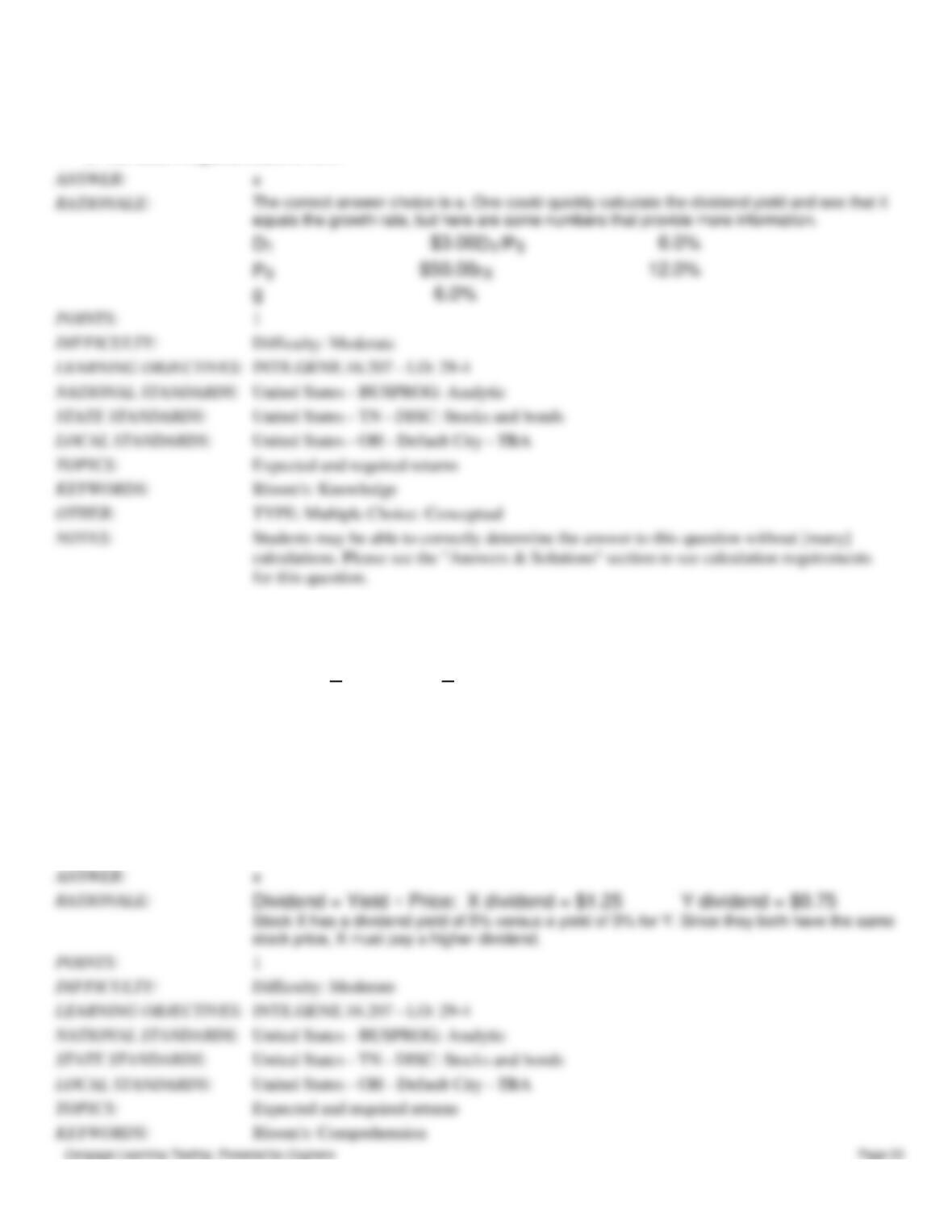
The stock’s expected dividend yield and growth rate are equal.
b.
The stock’s expected dividend yield is 5%.
INTE.GENE.16.207 – LO: 29-4
United States – BUSPROG: Analytic
United States – TN – DISC: Stocks and bonds
United States – OH – Default City – TBA
Expected and required returns
Bloom’s: Comprehension
TYPE: Multiple Choice: Conceptual
for this question.
WEB CHAPTER 29—BASIC FINANCIAL TOOLS
c.
The stock’s expected capital gains yield is 5%.
d.
The stock’s expected price 10 years from now is $100.00.
e.
The stock’s required return is 10%.
a
Difficulty: Moderate
INTE.GENE.16.207 – LO: 29-4
United States – BUSPROG: Analytic
United States – TN – DISC: Stocks and bonds
United States – OH – Default City – TBA
Expected and required returns
Bloom’s: Knowledge
TYPE: Multiple Choice: Conceptual
119. Stocks X and Y have the following data. Assuming the stock market is efficient and the stocks are in equilibrium,
which of the following statements is CORRECT?
X
Y
Price
$25
$25
Expected dividend yield
5%
3%
Required return
12%
10%
a.
Stock X pays a higher dividend per share than Stock Y.
b.
One year from now, Stock X should have the higher price.
c.
Stock Y has a lower expected growth rate than Stock X.
d.
Stock Y has the higher expected capital gains yield.
e.
Stock Y pays a higher dividend per share than Stock X.
a
Difficulty: Moderate
INTE.GENE.16.207 – LO: 29-4
United States – BUSPROG: Analytic
United States – TN – DISC: Stocks and bonds
United States – OH – Default City – TBA
Expected and required returns
Bloom’s: Comprehension
WEB CHAPTER 29—BASIC FINANCIAL TOOLS
120. Merrell Enterprises’ stock has an expected return of 14%. The stock’s dividend is expected to grow at a constant rate
of 8%, and it currently sells for $50 a share. Which of the following statements is CORRECT?
a.
The stock’s dividend yield is 8%.
b.
The current dividend per share is $4.00.
c.
The stock price is expected to be $54 a share one year from now.
d.
The stock price is expected to be $57 a share one year from now.
e.
The stock’s dividend yield is 7%.
Difficulty: Moderate
INTE.GENE.16.207 – LO: 29-4
United States – BUSPROG: Analytic
United States – TN – DISC: Stocks and bonds
United States – OH – Default City – TBA
Expected and required returns
Bloom’s: Knowledge
TYPE: Multiple Choice: Conceptual
121. Stocks A and B have the same price and are in equilibrium, but Stock A has the higher required rate of return. Which
of the following statements is CORRECT?
a.
Stock B must have a higher dividend yield than Stock A.
b.
Stock A must have a higher dividend yield than Stock B.
c.
If Stock A has a higher dividend yield than Stock B, its expected capital gains yield must be lower than Stock
B’s.
d.
Stock A must have both a higher dividend yield and a higher capital gains yield than Stock B.
e.
If Stock A has a lower dividend yield than Stock B, its expected capital gains yield must be higher than Stock
B’s.
Difficulty: Moderate
INTE.GENE.16.207 – LO: 29-4
United States – BUSPROG: Analytic
United States – TN – DISC: Stocks and bonds
United States – OH – Default City – TBA
TYPE: Multiple Choice: Conceptual
for this question.
WEB CHAPTER 29—BASIC FINANCIAL TOOLS
122. Two constant growth stocks are in equilibrium, have the same price, and have the same required rate of return.
Which of the following statements is CORRECT?
a.
If one stock has a higher dividend yield, it must also have a lower dividend growth rate.
b.
If one stock has a higher dividend yield, it must also have a higher dividend growth rate.
c.
The two stocks must have the same dividend growth rate.
d.
The two stocks must have the same dividend yield.
e.
The two stocks must have the same dividend per share.
1
Difficulty: Moderate
INTE.GENE.16.207 – LO: 29-4
United States – BUSPROG: Analytic
United States – TN – DISC: Stocks and bonds
United States – OH – Default City – TBA
Dividend yield and g
Bloom’s: Comprehension
123. Which of the following statements is CORRECT, assuming stocks are in equilibrium?
a.
Assume that the required return on a given stock is 13%. If the stock’s dividend is growing at a constant rate of
5%, its expected dividend yield is 5% as well.
b.
A stock’s dividend yield can never exceed its expected growth rate.
c.
A required condition for one to use the constant growth model is that the stock’s expected growth rate exceeds
its required rate of return.
d.
Other things held constant, the higher a company’s beta coefficient, the lower its required rate of return.
e.
The dividend yield on a constant growth stock must equal its expected total return minus its expected capital
gains yield.
1
Difficulty: Moderate
INTE.GENE.16.207 – LO: 29-4
United States – BUSPROG: Analytic
United States – TN – DISC: Stocks and bonds
United States – OH – Default City – TBA
Dividend yield and g
Dividend yield and g
Bloom’s: Comprehension
TYPE: Multiple Choice: Conceptual
WEB CHAPTER 29—BASIC FINANCIAL TOOLS
Bloom’s: Comprehension
TYPE: Multiple Choice: Conceptual
for this question.
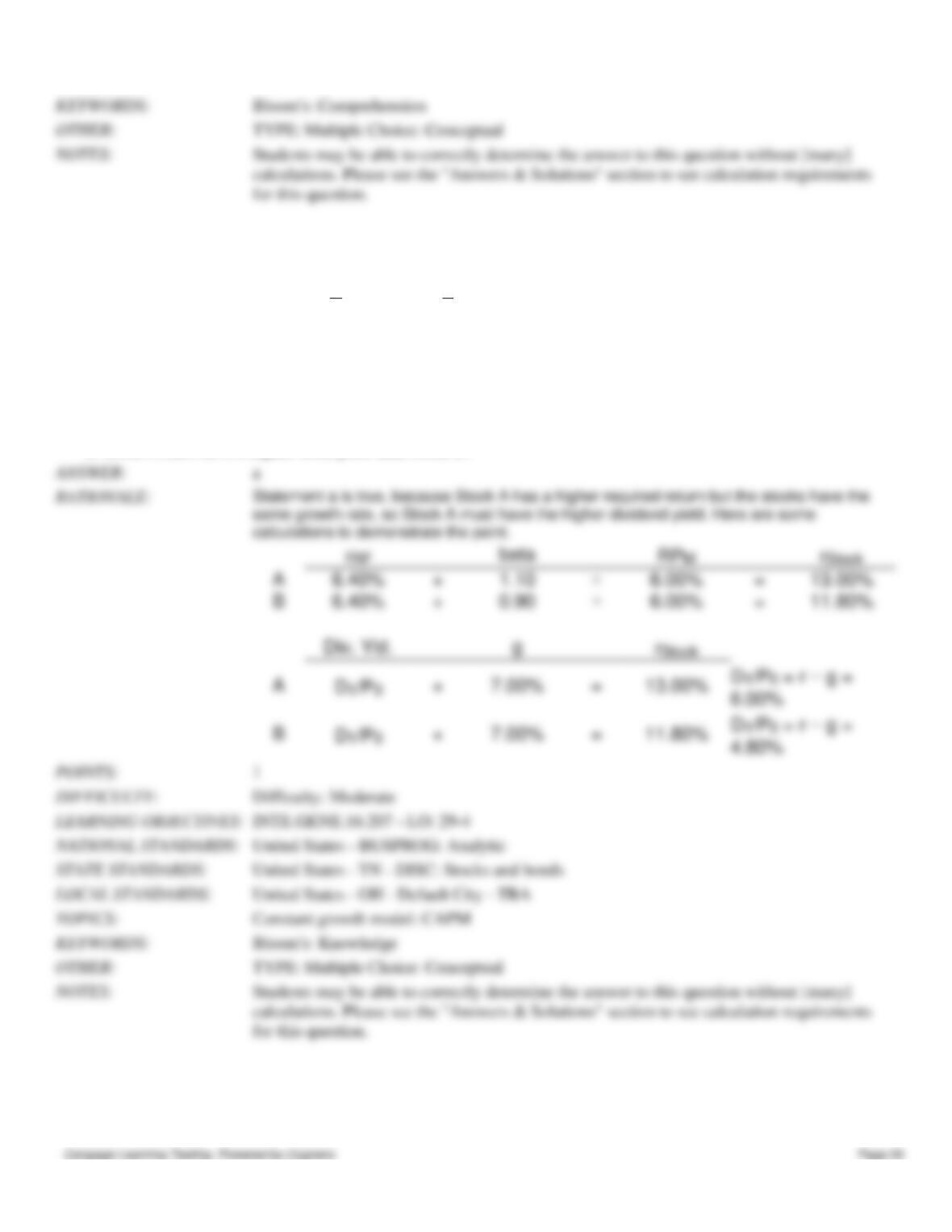
124. Stocks A and B have the following data. The market risk premium is 6.0% and the risk-free rate is 6.4%. Assuming
the stock market is efficient and the stocks are in equilibrium, which of the following statements is CORRECT?
A
B
Beta
1.10
0.90
Constant growth rate
7.00%
7.00%
a.
Stock A must have a higher dividend yield than Stock B.
b.
Stock B’s dividend yield equals its expected dividend growth rate.
c.
Stock B must have the higher required return.
d.
Stock B could have the higher expected return.
e.
Stock A must have a higher stock price than Stock B.
a
1
Difficulty: Moderate
INTE.GENE.16.207 – LO: 29-4
United States – BUSPROG: Analytic
United States – TN – DISC: Stocks and bonds
United States – OH – Default City – TBA
Constant growth model: CAPM
Bloom’s: Knowledge
TYPE: Multiple Choice: Conceptual
125. Which of the following statements is CORRECT?
a.
If CF0 is positive and all the other CFs are negative, then you cannot solve for I.
b.
If you have a series of cash flows, each of which is positive, you can solve for I, where the solution value of I
WEB CHAPTER 29—BASIC FINANCIAL TOOLS
causes the PV of the cash flows to equal the cash flow at Time 0.
c.
If you have a series of cash flows, and CF0 is negative but each of the following CFs is positive, you can solve
for I, but only if the sum of the undiscounted cash flows exceeds the cost.
d.
To solve for I, one must identify the value of I that causes the PV of the positive CFs to equal the absolute
value of the PV of the negative CFs. This is, essentially, a trial-and-error procedure that is easy with a
computer or financial calculator but quite difficult otherwise.
e.
If you solve for I and get a negative number, then you must have made a mistake.
d
1
Difficulty: Challenging
INTE.GENE.16.204 – LO: 29-1
United States – BUSPROG: Analytic
United States – TN – DISC: Time value of money
United States – OH – Default City – TBA
Solving for I: uneven CFs
Bloom’s: Knowledge
TYPE: Multiple Choice: Conceptual
for this question.
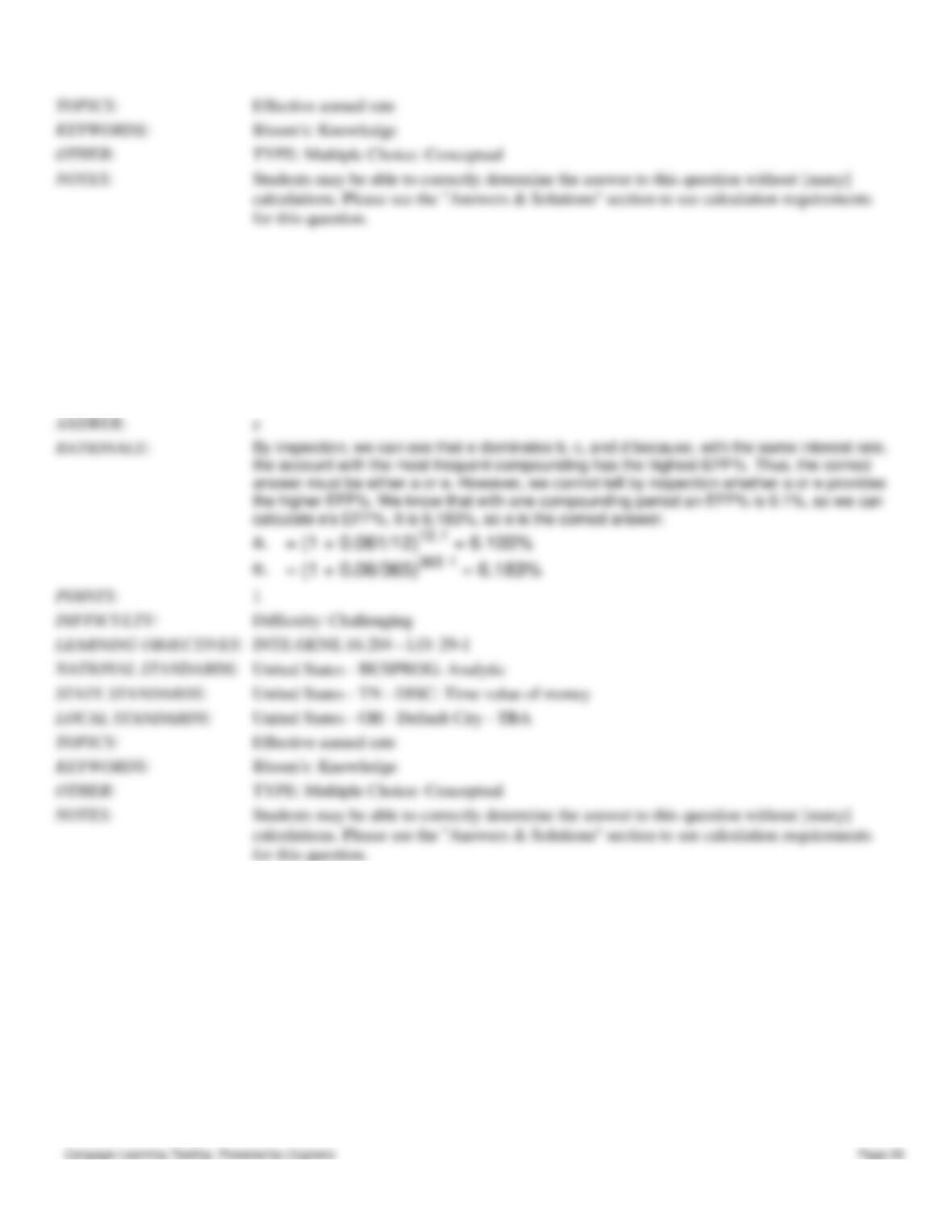
126. Which of the following bank accounts has the highest effective annual return?
a.
An account that pays 8% nominal interest with daily (365-day) compounding.
b.
An account that pays 8% nominal interest with monthly compounding.
c.
An account that pays 8% nominal interest with annual compounding.
d.
An account that pays 7% nominal interest with daily (365-day) compounding.
e.
An account that pays 7% nominal interest with monthly compounding.
1
Difficulty: Challenging
INTE.GENE.16.204 – LO: 29-1
United States – BUSPROG: Analytic
United States – TN – DISC: Time value of money
United States – OH – Default City – TBA
WEB CHAPTER 29—BASIC FINANCIAL TOOLS
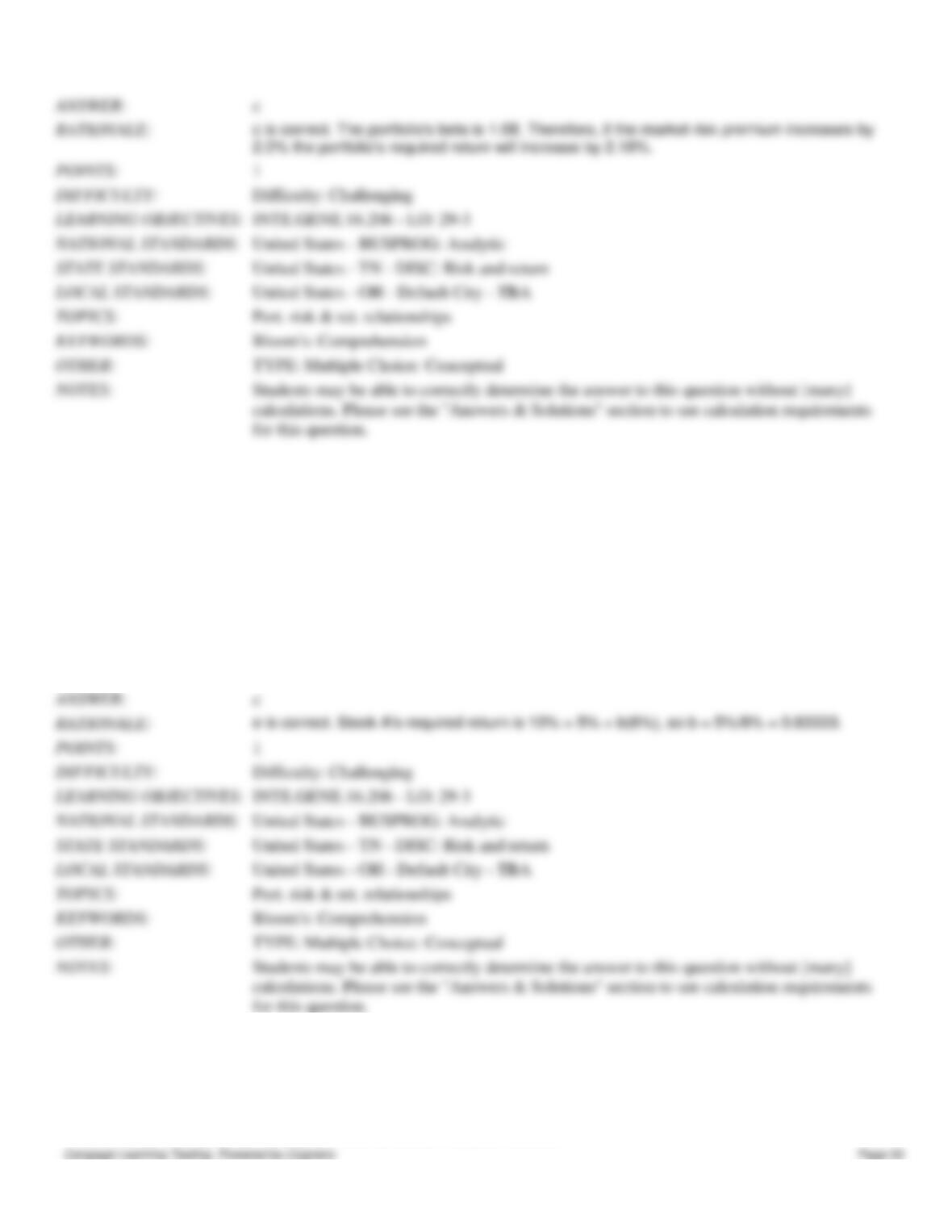
127. You plan to invest some money in a bank account. Which of the following banks provides you with the highest
effective rate of interest?
a.
Bank 1; 6.1% with annual compounding.
b.
Bank 2; 6.0% with monthly compounding.
c.
Bank 3; 6.0% with annual compounding.
d.
Bank 4; 6.0% with quarterly compounding.
e.
Bank 5; 6.0% with daily (365-day) compounding.
Difficulty: Challenging
United States – BUSPROG: Analytic
United States – TN – DISC: Time value of money
United States – OH – Default City – TBA
Effective annual rate
Bloom’s: Knowledge
TYPE: Multiple Choice: Conceptual
for this question.
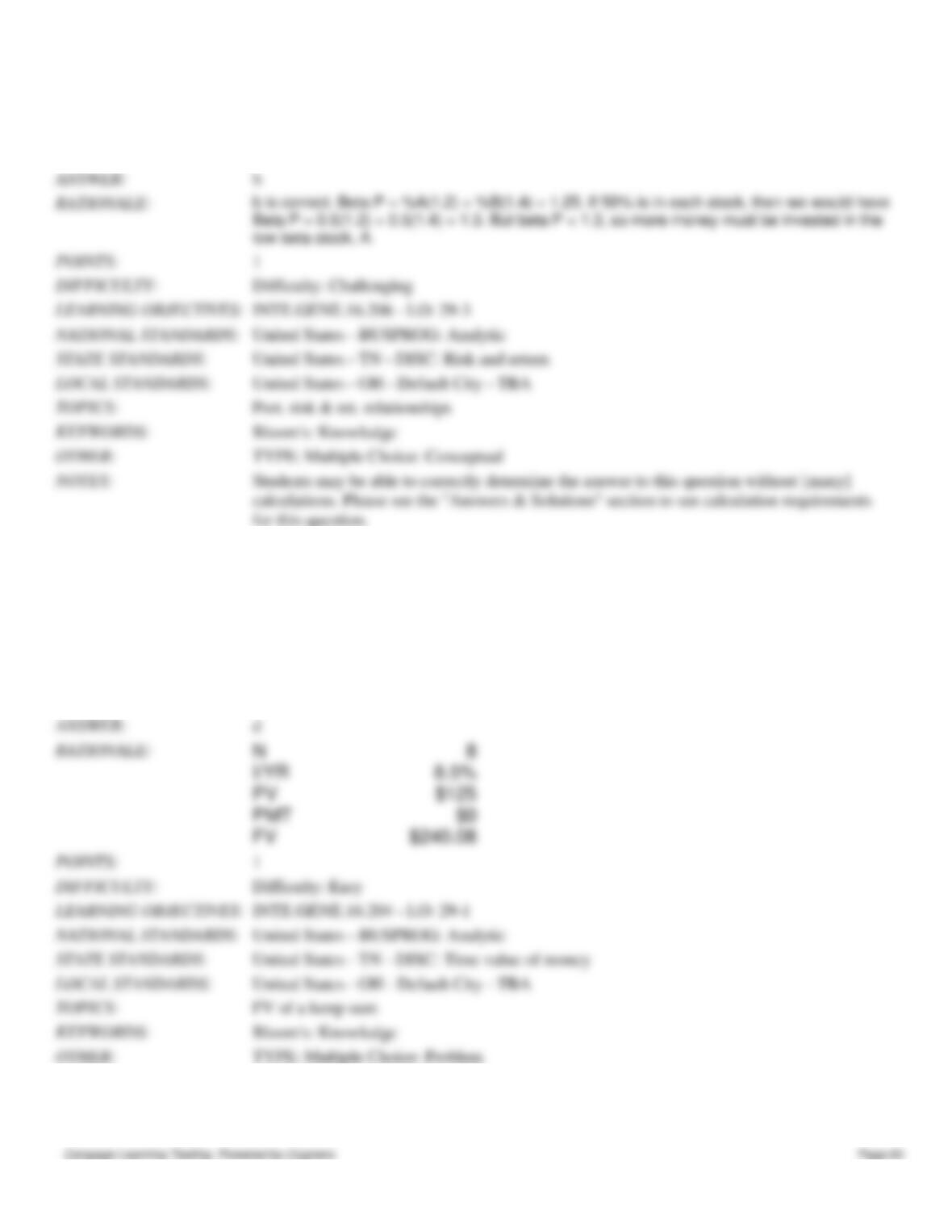
128. Gretta’s portfolio consists of $700,000 invested in a stock that has a beta of 1.2 and $300,000 invested in a stock that
has a beta of 0.8. The risk-free rate is 6% and the market risk premium is 5%. Which of the following statements is
CORRECT?
a.
The required return on the market is 10%.
b.
The portfolio’s required return is less than 11%.
c.
If the risk-free rate remains unchanged but the market risk premium increases by 2%, Gretta’s portfolio’s
required return will increase by more than 2%.
d.
If the market risk premium remains unchanged but expected inflation increases by 2%, Gretta’s portfolio’s
required return will increase by more than 2%.
e.
If the stock market is efficient, Gretta’s portfolio’s expected return should equal the expected return on the
market, which is 11%.
Effective annual rate
Bloom’s: Knowledge
TYPE: Multiple Choice: Conceptual
WEB CHAPTER 29—BASIC FINANCIAL TOOLS
Difficulty: Challenging
INTE.GENE.16.206 – LO: 29-3
United States – BUSPROG: Analytic
United States – TN – DISC: Risk and return
United States – OH – Default City – TBA
Port. risk & ret. relationships
Bloom’s: Comprehension
TYPE: Multiple Choice: Conceptual
129. Assume that the market is in equilibrium and that Portfolio AB has 50% invested in Stock A and 50% invested in
Stock B. Stock A has an expected return of 10% and a standard deviation of 20%. Stock B has an expected return of 13%
and a standard deviation of 30%. The risk-free rate is 5% and the market risk premium, rM − rRF, is 6%. The returns of
Stock A and Stock B are independent of one another, i.e., the correlation coefficient between them is zero. Which of the
following statements is CORRECT?
a.
Since the two stocks have zero correlation, Portfolio AB is riskless.
b.
Stock B’s beta is 1.0000.
c.
Portfolio AB’s required return is 11%.
d.
Portfolio AB’s standard deviation is 25%.
e.
Stock A’s beta is 0.8333.
e is correct. Stock A’s required return is 10% = 5% + b(6%), so b = 5%/6% = 0.83333.
Difficulty: Challenging
INTE.GENE.16.206 – LO: 29-3
United States – BUSPROG: Analytic
United States – TN – DISC: Risk and return
United States – OH – Default City – TBA
Port. risk & ret. relationships
Bloom’s: Comprehension
TYPE: Multiple Choice: Conceptual
130. Portfolio AB was created by investing in a combination of Stocks A and B. Stock A has a beta of 1.2 and a standard
deviation of 25%. Stock B has a beta of 1.4 and a standard deviation of 20%. Portfolio AB has a beta of 1.25 and a
standard deviation of 18%. Which of the following statements is CORRECT?
a.
Stock A has more market risk than Stock B but less stand-alone risk.
b.
Portfolio AB has more money invested in Stock A than in Stock B.
WEB CHAPTER 29—BASIC FINANCIAL TOOLS
c.
Portfolio AB has the same amount of money invested in each of the two stocks.
d.
Portfolio AB has more money invested in Stock B than in Stock A.
e.
Stock A has more market risk than Portfolio AB.
Difficulty: Challenging
INTE.GENE.16.206 – LO: 29-3
United States – BUSPROG: Analytic
United States – TN – DISC: Risk and return
United States – OH – Default City – TBA
Port. risk & ret. relationships
Bloom’s: Knowledge
TYPE: Multiple Choice: Conceptual
131. Ellen now has $125. How much would she have after 8 years if she leaves it invested at 8.5% with annual
compounding?
a.
$205.83
b.
$216.67
c.
$228.07
d.
$240.08
e.
$252.08
Difficulty: Easy
INTE.GENE.16.204 – LO: 29-1
United States – BUSPROG: Analytic
United States – TN – DISC: Time value of money
United States – OH – Default City – TBA
Bloom’s: Knowledge
TYPE: Multiple Choice: Problem
132. JG Asset Services is recommending that you invest $1,500 in a 5-year certificate of deposit (CD) that pays 3.5%
interest, compounded annually. How much will you have when the CD matures?