CHAPTER 28—TIME VALUE OF MONEY
United States – BUSPROG: Analytic
United States – AK – DISC: Time value of money
United States – OH – Default City – TBA
Amortization
TYPE: Multiple Choice: Conceptual
for this question.
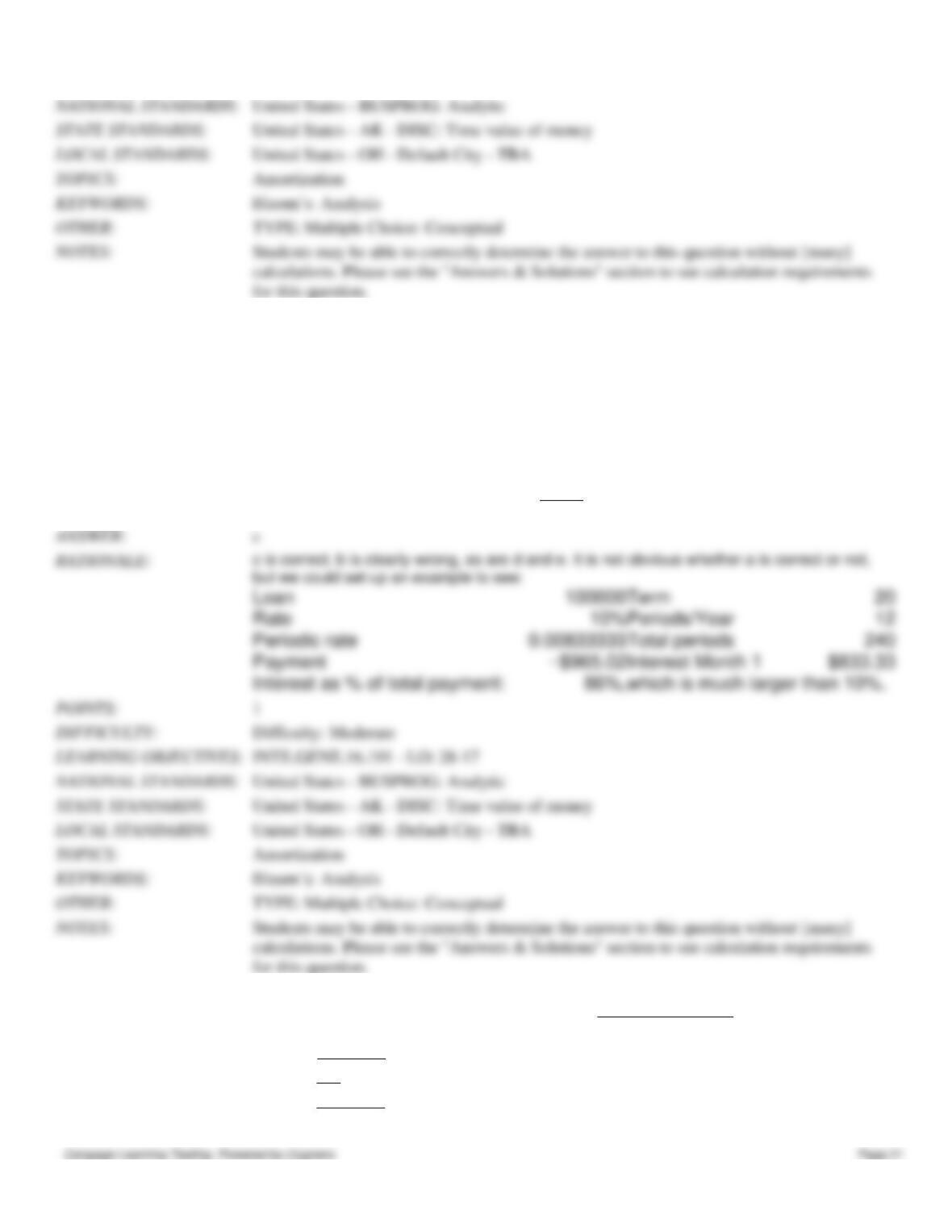
52. Which of the following statements regarding a 20-year monthly payment amortized mortgage with a nominal interest
rate of 10% is CORRECT?
a.
Exactly 10% of the first monthly payment represents interest.
b.
The monthly payments will increase over time.
c.
A larger proportion of the first monthly payment will be interest, and a smaller proportion will be principal,
than for the last monthly payment.
d.
The total dollar amount of interest being paid off each month gets larger as the loan approaches maturity.
e.
The amount representing interest in the first payment would be higher if the nominal interest rate were 7%
rather than 10%.
c
Difficulty: Moderate
INTE.GENE.16.191 – LO: 28–17
United States – BUSPROG: Analytic
United States – AK – DISC: Time value of money
United States – OH – Default City – TBA
Amortization
TYPE: Multiple Choice: Conceptual
for this question.
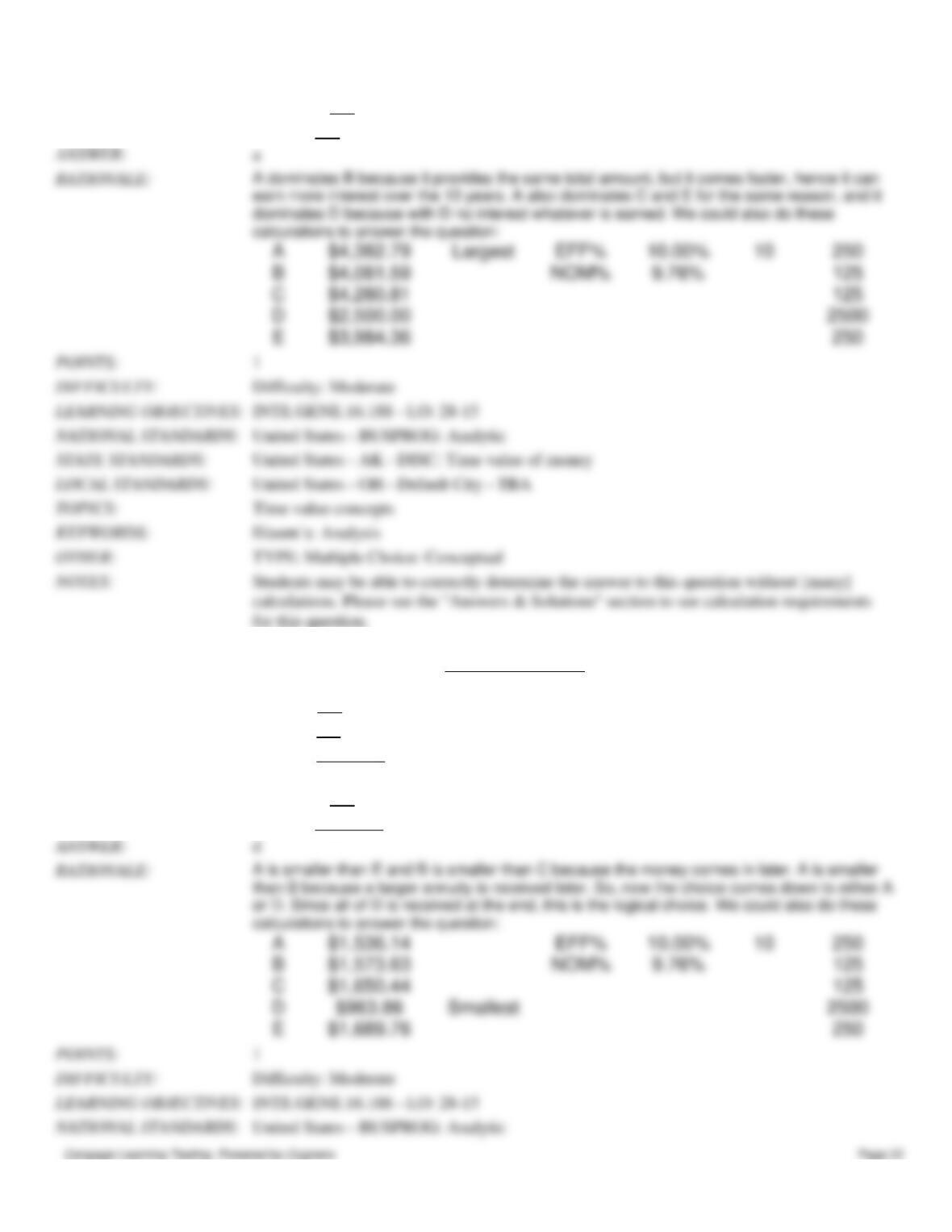
53. At the end of 10 years, which of the following investments would have the highest future value? Assume that the
effective annual rate for all investments is the same and is greater than zero.
a.
Investment A pays $250 at the beginning of every year for the next 10 years (a total of 10 payments).
b.
Investment B pays $125 at the end of every 6-month period for the next 10 years (a total of 20 payments).
c.
Investment C pays $125 at the beginning of every 6-month period for the next 10 years (a total of 20
payments).
CHAPTER 28—TIME VALUE OF MONEY
d.
Investment D pays $2,500 at the end of 10 years (just one payment).
e.
Investment E pays $250 at the end of every year for the next 10 years (a total of 10 payments).
a
Difficulty: Moderate
INTE.GENE.16.188 – LO: 28–15
United States – BUSPROG: Analytic
United States – AK – DISC: Time value of money
United States – OH – Default City – TBA
Time value concepts
TYPE: Multiple Choice: Conceptual
calculations. Please see the “Answers & Solutions” section to see calculation requirements
54. Of the following investments, which would have the lowest present value? Assume that the effective annual rate for
all investments is the same and is greater than zero.
a.
Investment A pays $250 at the end of every year for the next 10 years (a total of 10 payments).
b.
Investment B pays $125 at the end of every 6-month period for the next 10 years (a total of 20 payments).
c.
Investment C pays $125 at the beginning of every 6-month period for the next 10 years (a total of 20
payments).
d.
Investment D pays $2,500 at the end of 10 years (just one payment).
e.
Investment E pays $250 at the beginning of every year for the next 10 years (a total of 10 payments).
Difficulty: Moderate
INTE.GENE.16.188 – LO: 28–15
United States – BUSPROG: Analytic
CHAPTER 28—TIME VALUE OF MONEY
55. A U.S. Treasury bond will pay a lump sum of $1,000 exactly 3 years from today. The nominal interest rate is 6%,
semiannual compounding. Which of the following statements is CORRECT?
a.
The PV of the $1,000 lump sum has a higher present value than the PV of a 3-year, $333.33 ordinary annuity.
b.
The periodic interest rate is greater than 3%.
c.
The periodic rate is less than 3%.
d.
The present value would be greater if the lump sum were discounted back for more periods.
e.
The present value of the $1,000 would be smaller if interest were compounded monthly rather than
semiannually.
e
Difficulty: Moderate
INTE.GENE.16.188 – LO: 28–15
United States – BUSPROG: Analytic
United States – AK – DISC: Time value of money
United States – OH – Default City – TBA
Time value concepts
TYPE: Multiple Choice: Conceptual
56. A U.S. Treasury bond will pay a lump sum of $1,000 exactly 3 years from today. The nominal interest rate is 6%,
semiannual compounding. Which of the following statements is CORRECT?
a.
The PV of the $1,000 lump sum has a smaller present value than the PV of a 3-year, $333.33 ordinary annuity.
b.
The periodic interest rate is greater than 3%.
c.
The periodic rate is less than 3%.
d.
The present value would be greater if the lump sum were discounted back for more periods.
e.
The present value of the $1,000 would be larger if interest were compounded monthly rather than
semiannually.
a
Difficulty: Moderate
INTE.GENE.16.188 – LO: 28–15
United States – BUSPROG: Analytic
United States – AK – DISC: Time value of money
United States – AK – DISC: Time value of money
United States – OH – Default City – TBA
Time value concepts
TYPE: Multiple Choice: Conceptual
CHAPTER 28—TIME VALUE OF MONEY
57. Which of the following statements is CORRECT, assuming positive interest rates and holding other things constant?
a.
Banks A and B offer the same nominal annual rate of interest, but A pays interest quarterly and B pays
semiannually. Deposits in Bank B will provide the higher future value if you leave your funds on deposit.
b.
The present value of a 5-year, $250 annuity due will be lower than the PV of a similar ordinary annuity.
c.
A 30-year, $150,000 amortized mortgage will have larger monthly payments than an otherwise similar 20-year
mortgage.
d.
A bank loan’s nominal interest rate will always be equal to or less than its effective annual rate.
e.
If an investment pays 10% interest, compounded annually, its effective annual rate will be less than 10%.
Difficulty: Moderate
INTE.GENE.16.188 – LO: 28–15
United States – BUSPROG: Analytic
United States – AK – DISC: Time value of money
United States – OH – Default City – TBA
Time value concepts
TYPE: Multiple Choice: Conceptual
for this question.
58. Which of the following statements is CORRECT, assuming positive interest rates and holding other things constant?
a.
Banks A and B offer the same nominal annual rate of interest, but A pays interest quarterly and B pays
semiannually. Deposits in Bank B will provide the higher future value if you leave your funds on deposit.
b.
The present value of a 5-year, $250 annuity due will be lower than the PV of a similar ordinary annuity.
c.
A 30-year, $150,000 amortized mortgage will have larger monthly payments than an otherwise similar 20-year
mortgage.
d.
A bank loan’s nominal interest rate will always be equal to or greater than its effective annual rate.
e.
If an investment pays 10% interest, compounded quarterly, its effective annual rate will be greater than 10%.
Difficulty: Moderate
INTE.GENE.16.188 – LO: 28–15
United States – BUSPROG: Analytic
United States – AK – DISC: Time value of money
United States – OH – Default City – TBA
United States – OH – Default City – TBA
Time value concepts
TYPE: Multiple Choice: Conceptual
CHAPTER 28—TIME VALUE OF MONEY
59. Which of the following statements is CORRECT?
a.
An investment that has a nominal rate of 6% with semiannual payments will have an effective rate that is
smaller than 6%.
b.
The present value of a 3-year, $150 annuity due will exceed the present value of a 3-year, $150 ordinary
annuity.
c.
If a loan has a nominal annual rate of 8%, then the effective rate can never be greater than 8%.
d.
If a loan or investment has annual payments, then the effective, periodic, and nominal rates of interest will all
be different.
e.
The proportion of the payment that goes toward interest on a fully amortized loan increases over time.
Difficulty: Moderate
INTE.GENE.16.188 – LO: 28–15
United States – BUSPROG: Analytic
United States – AK – DISC: Time value of money
United States – OH – Default City – TBA
Time value concepts
TYPE: Multiple Choice: Conceptual
for this question.
60. Which of the following statements is CORRECT?
a.
An investment that has a nominal rate of 6% with semiannual payments will have an effective rate that is
smaller than 6%.
b.
The present value of a 3-year, $150 ordinary annuity will exceed the present value of a 3-year, $150 annuity
due.
c.
If a loan has a nominal annual rate of 7%, then the effective rate will never be less than 7%.
d.
If a loan or investment has annual payments, then the effective, periodic, and nominal rates of interest will all
be different.
e.
The proportion of the payment that goes toward interest on a fully amortized loan increases over time.
Difficulty: Moderate
INTE.GENE.16.188 – LO: 28–15
United States – BUSPROG: Analytic
United States – AK – DISC: Time value of money
Time value concepts
TYPE: Multiple Choice: Conceptual
CHAPTER 28—TIME VALUE OF MONEY
61. You are considering two equally risky annuities, each of which pays $15,000 per year for 20 years. Investment ORD
is an ordinary (or deferred) annuity, while Investment DUE is an annuity due. Which of the following statements is
CORRECT?
a.
If the going rate of interest decreases from 10% to 0%, the difference between the present value of ORD and
the present value of DUE would remain constant.
b.
The present value of ORD must exceed the present value of DUE, but the future value of ORD may be less
than the future value of DUE.
c.
The present value of DUE exceeds the present value of ORD, while the future value of DUE is less than the
future value of ORD.
d.
The present value of ORD exceeds the present value of DUE, and the future value of ORD also exceeds the
future value of DUE.
e.
The present value of DUE exceeds the present value of ORD, and the future value of DUE also exceeds the
future value of ORD.
Difficulty: Moderate
INTE.GENE.16.190 – LO: 28-9
United States – BUSPROG: Analytic
United States – AK – DISC: Time value of money
United States – OH – Default City – TBA
TYPE: Multiple Choice: Conceptual
calculations. Please see the “Answers & Solutions” section to see calculation requirements
for this question.
62. You are considering two equally risky annuities, each of which pays $25,000 per year for 10 years. Investment ORD
is an ordinary (or deferred) annuity, while Investment DUE is an annuity due. Which of the following statements is
CORRECT?
a.
If the going rate of interest decreases from 10% to 0%, the difference between the present value of ORD and
the present value of DUE would remain constant.
b.
A rational investor would be willing to pay more for DUE than for ORD, so their market prices should differ.
c.
The present value of DUE exceeds the present value of ORD, while the future value of DUE is less than the
future value of ORD.
d.
The present value of ORD exceeds the present value of DUE, and the future value of ORD also exceeds the
future value of DUE.
e.
The present value of ORD exceeds the present value of DUE, while the future value of DUE exceeds the
future value of ORD.
United States – OH – Default City – TBA
Time value concepts
TYPE: Multiple Choice: Conceptual
for this question.
CHAPTER 28—TIME VALUE OF MONEY
63. Which of the following statements is CORRECT?
a.
If CF0 is positive and all the other CFs are negative, then you cannot solve for I.
b.
If you have a series of cash flows, each of which is positive, you can solve for I, where the solution value of I
causes the PV of the cash flows to equal the cash flow at Time 0.
c.
If you have a series of cash flows, and CF0 is negative but each of the following CFs is positive, you can solve
for I, but only if the sum of the undiscounted cash flows exceeds the cost.
d.
To solve for I, one must identify the value of I that causes the PV of the positive CFs to equal the absolute
value of the PV of the negative CFs. This is, essentially, a trial-and-error procedure that is easy with a
computer or financial calculator but quite difficult otherwise.
e.
If you solve for I and get a negative number, then you must have made a mistake.
64. Which of the following statements is CORRECT?
a.
If CF0 is positive and all the other CFs are negative, then you can still solve for I.
b.
If you have a series of cash flows, each of which is positive, you can solve for I, where the solution value of I
causes the PV of the cash flows to equal the cash flow at Time 0.
c.
If you have a series of cash flows, and CF0 is negative but each of the following CFs is positive, you can solve
for I, but only if the sum of the undiscounted cash flows exceeds the cost.
d.
To solve for I, one must identify the value of I that causes the PV of the positive CFs to equal the absolute
CHAPTER 28—TIME VALUE OF MONEY
value of the FV of the negative CFs. It is impossible to find the value of I without a computer or financial
calculator.
e.
If you solve for I and get a negative number, then you must have made a mistake.
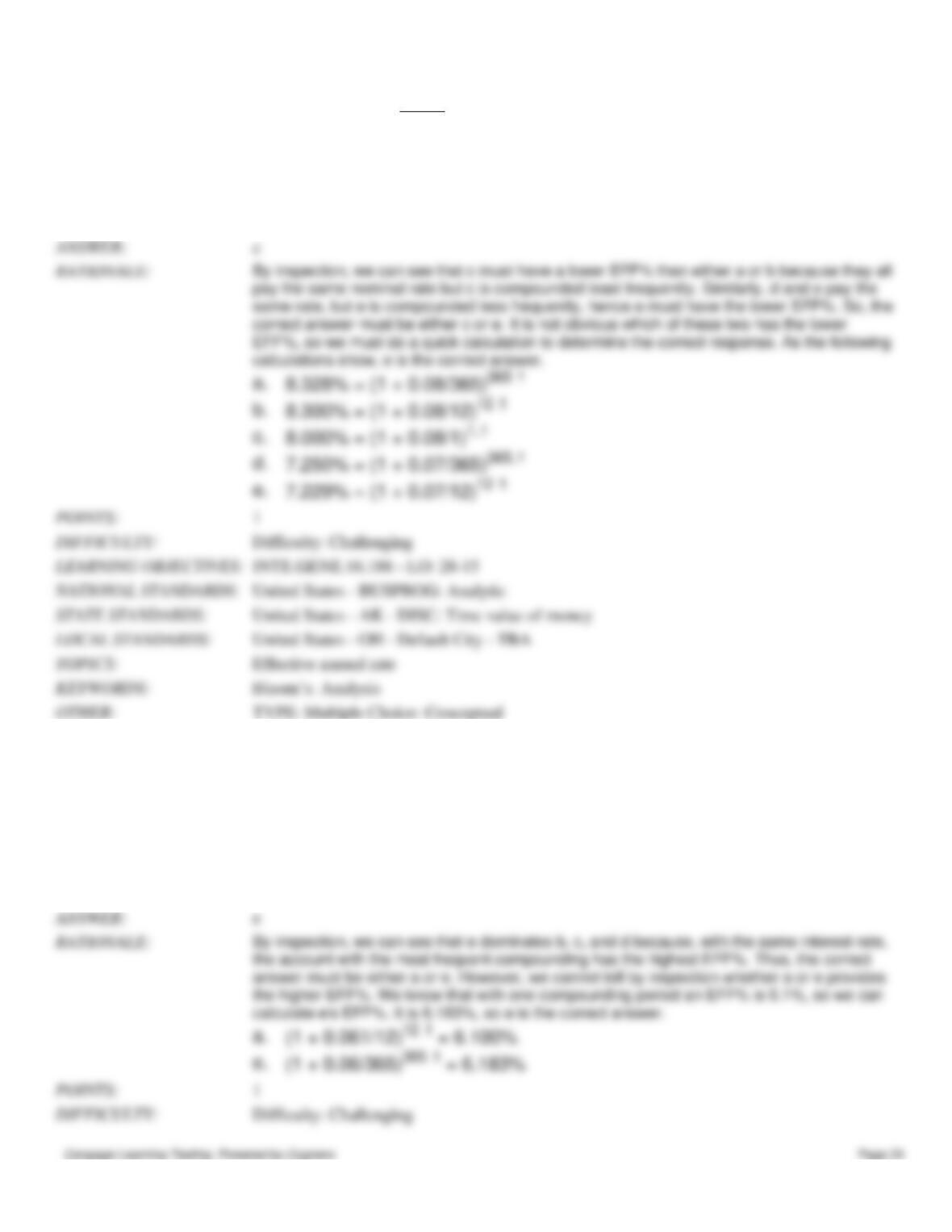
65. Which of the following bank accounts has the highest effective annual return?
a.
An account that pays 8% nominal interest with daily (365-day) compounding.
b.
An account that pays 8% nominal interest with monthly compounding.
c.
An account that pays 8% nominal interest with annual compounding.
d.
An account that pays 7% nominal interest with daily (365-day) compounding.
e.
An account that pays 7% nominal interest with monthly compounding.
CHAPTER 28—TIME VALUE OF MONEY
66. Which of the following bank accounts has the lowest effective annual return?
a.
An account that pays 8% nominal interest with daily (365-day) compounding.
b.
An account that pays 8% nominal interest with monthly compounding.
c.
An account that pays 8% nominal interest with annual compounding.
d.
An account that pays 7% nominal interest with daily (365-day) compounding.
e.
An account that pays 7% nominal interest with monthly compounding.
Difficulty: Challenging
INTE.GENE.16.188 – LO: 28–15
United States – BUSPROG: Analytic
United States – AK – DISC: Time value of money
United States – OH – Default City – TBA
Effective annual rate
TYPE: Multiple Choice: Conceptual
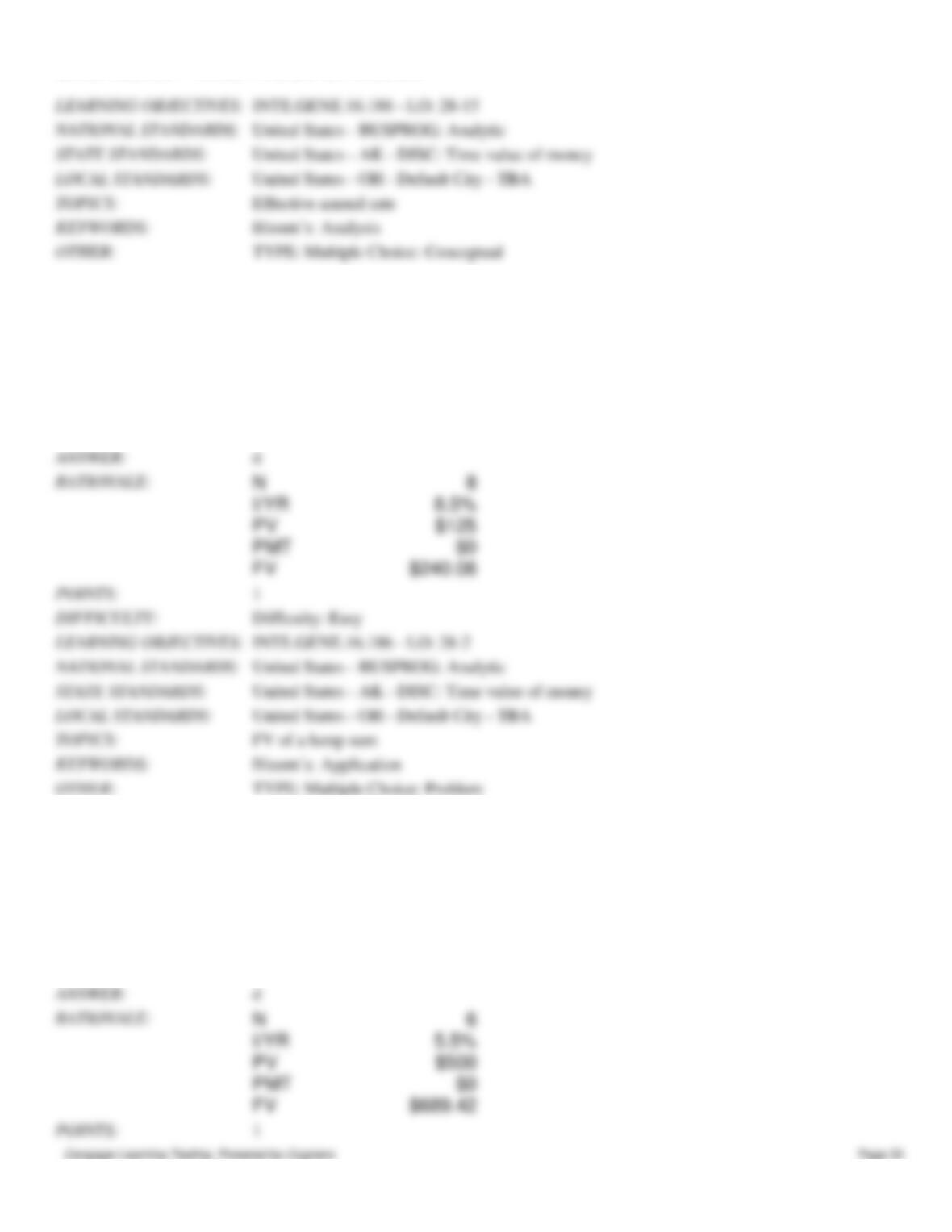
67. You plan to invest some money in a bank account. Which of the following banks provides you with the highest
effective rate of interest?
a.
Bank 1; 6.1% with annual compounding.
b.
Bank 2; 6.0% with monthly compounding.
c.
Bank 3; 6.0% with annual compounding.
d.
Bank 4; 6.0% with quarterly compounding.
e.
Bank 5; 6.0% with daily (365-day) compounding.
Difficulty: Challenging
CHAPTER 28—TIME VALUE OF MONEY
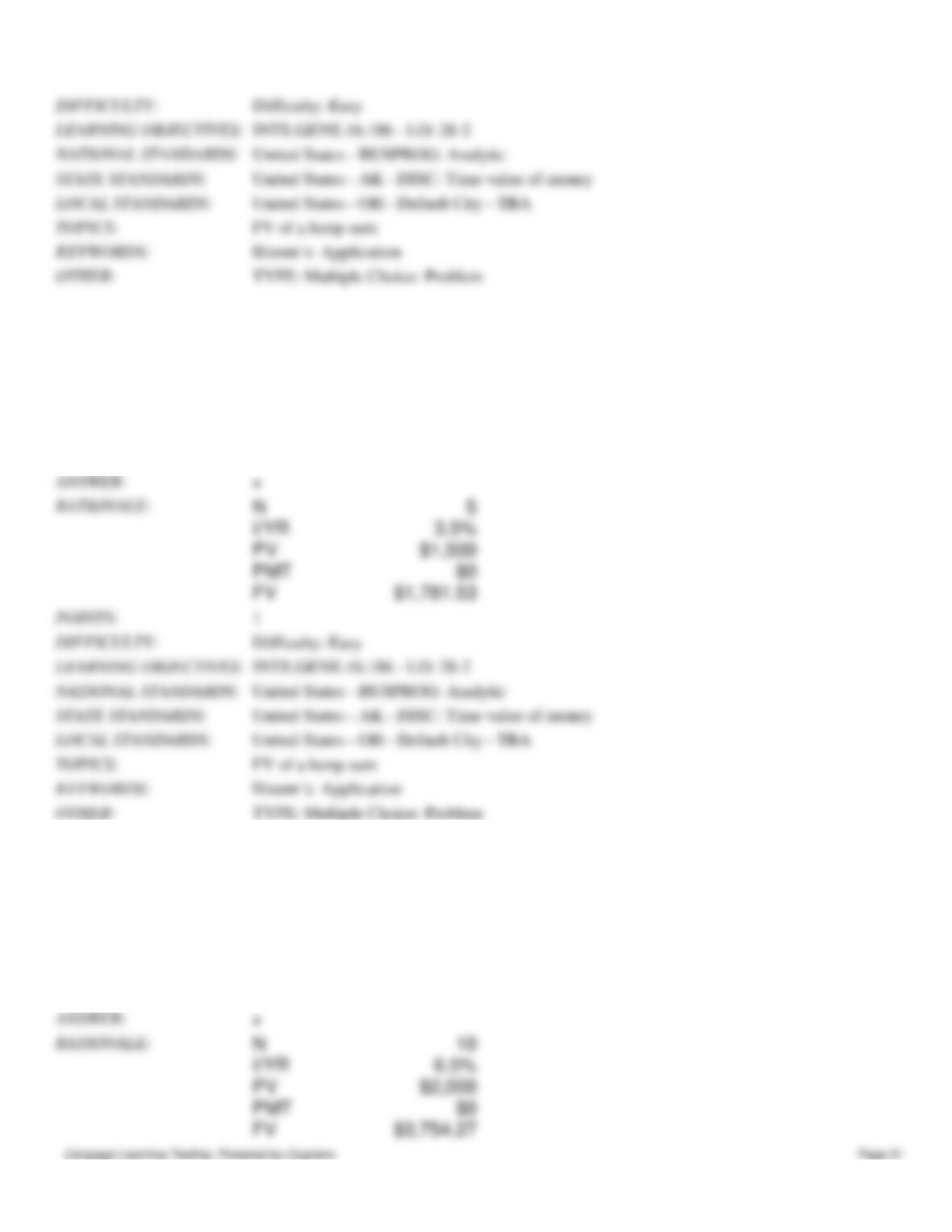
68. Ellen now has $125. How much would she have after 8 years if she leaves it invested at 8.5% with annual
compounding?
a.
$205.83
b.
$216.67
c.
$228.07
d.
$240.08
e.
$252.08
69. How much would Roderick have after 6 years if he has $500 now and leaves it invested at 5.5% with annual
compounding?
a.
$591.09
b.
$622.20
c.
$654.95
d.
$689.42
e.
$723.89
CHAPTER 28—TIME VALUE OF MONEY
70. JG Asset Services is recommending that you invest $1,500 in a 5-year certificate of deposit (CD) that pays 3.5%
interest, compounded annually. How much will you have when the CD matures?
a.
$1,781.53
b.
$1,870.61
c.
$1,964.14
d.
$2,062.34
e.
$2,165.46
a
71. Your bank offers a 10-year certificate of deposit (CD) that pays 6.5% interest, compounded annually. If you invest
$2,000 in the CD, how much will you have when it matures?
a.
$3,754.27
b.
$3,941.99
c.
$4,139.09
d.
$4,346.04
e.
$4,563.34
a
CHAPTER 28—TIME VALUE OF MONEY
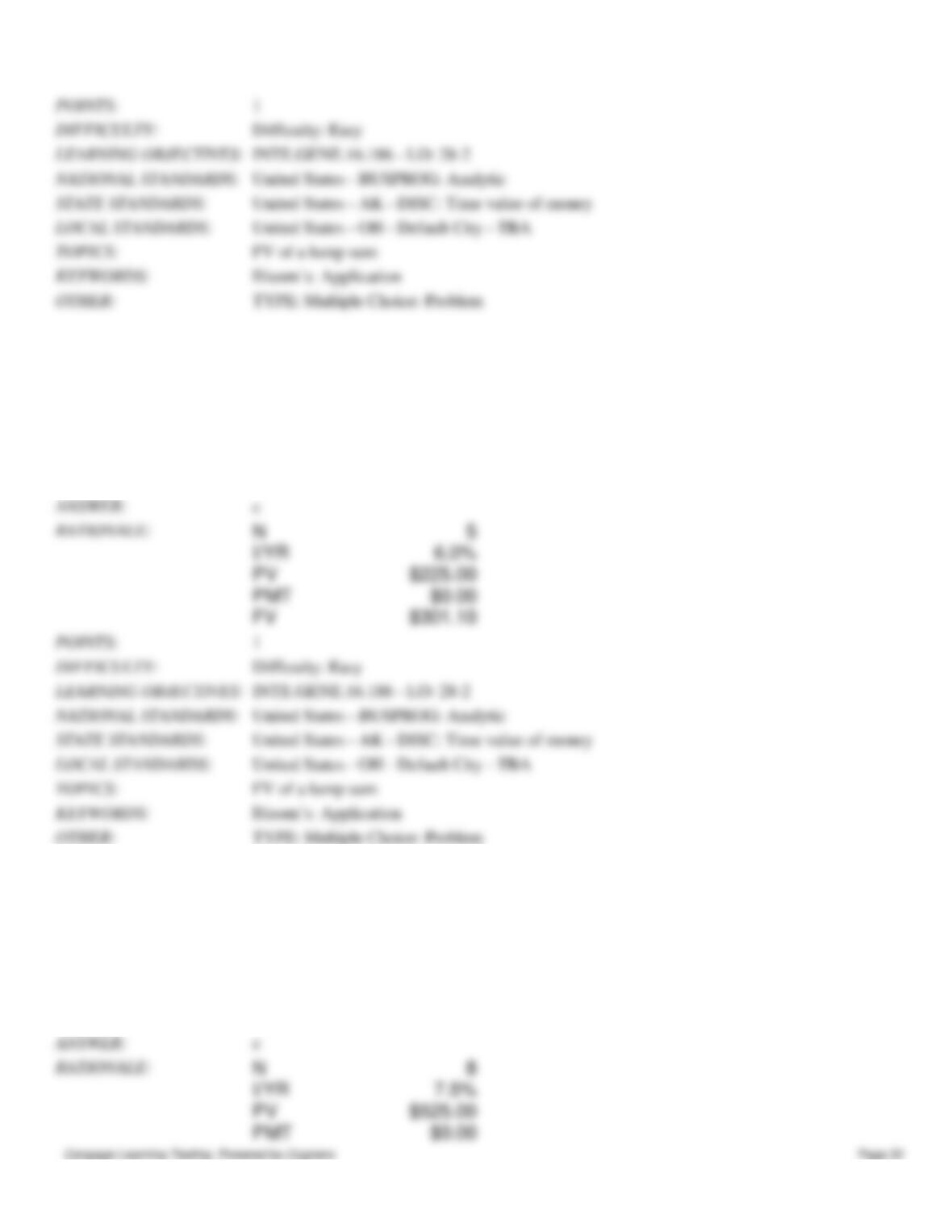
72. Cyberhost Corporation’s sales were $225 million last year. If sales grow at 6% per year, how large (in millions) will
they be 5 years later?
a.
$271.74
b.
$286.05
c.
$301.10
d.
$316.16
e.
$331.96
c
73. Cochrane Associate’s net sales last year were $525 million. If sales grow at 7.5% per year, how large (in millions) will
they be 8 years later?
a.
$845.03
b.
$889.51
c.
$936.33
d.
$983.14
e.
$1,032.30
c
CHAPTER 28—TIME VALUE OF MONEY
74. How much would $1, growing at 3.5% per year, be worth after 75 years?
a.
$12.54
b.
$13.20
c.
$13.86
d.
$14.55
e.
$15.28
75. How much would $100, growing at 5% per year, be worth after 75 years?
a.
$3,689.11
b.
$3,883.27
c.
$4,077.43
d.
$4,281.30
e.
$4,495.37
CHAPTER 28—TIME VALUE OF MONEY
76. Your bank offers a savings account that pays 3.5% interest, compounded annually. If you invest $1,000 in the account,
then how much will it be worth at the end of 25 years?
a.
$2,245.08
b.
$2,363.24
c.
$2,481.41
d.
$2,605.48
e.
$2,735.75
77. Your bank offers a savings account that pays 3.5% interest, compounded annually. How much will $500 invested
today be worth at the end of 25 years?
a.
$1,122.54
b.
$1,181.62
c.
$1,240.70
d.
$1,302.74
e.
$1,367.88
CHAPTER 28—TIME VALUE OF MONEY
78. Suppose a State of North Carolina bond will pay $1,000 ten years from now. If the going interest rate on these 10-year
bonds is 5.5%, how much is the bond worth today?
a.
$585.43
b.
$614.70
c.
$645.44
d.
$677.71
e.
$711.59
a
79. Suppose a State of New Mexico bond will pay $1,000 eight years from now. If the going interest rate on these 8-year
bonds is 5.5%, how much is the bond worth today?
a.
$651.60
b.
$684.18
c.
$718.39
d.
$754.31
e.
$792.02
a
CHAPTER 28—TIME VALUE OF MONEY
80. How much would $20,000 due in 50 years be worth today if the discount rate were 7.5%?
a.
$438.03
b.
$461.08
c.
$485.35
d.
$510.89
e.
$537.78
e
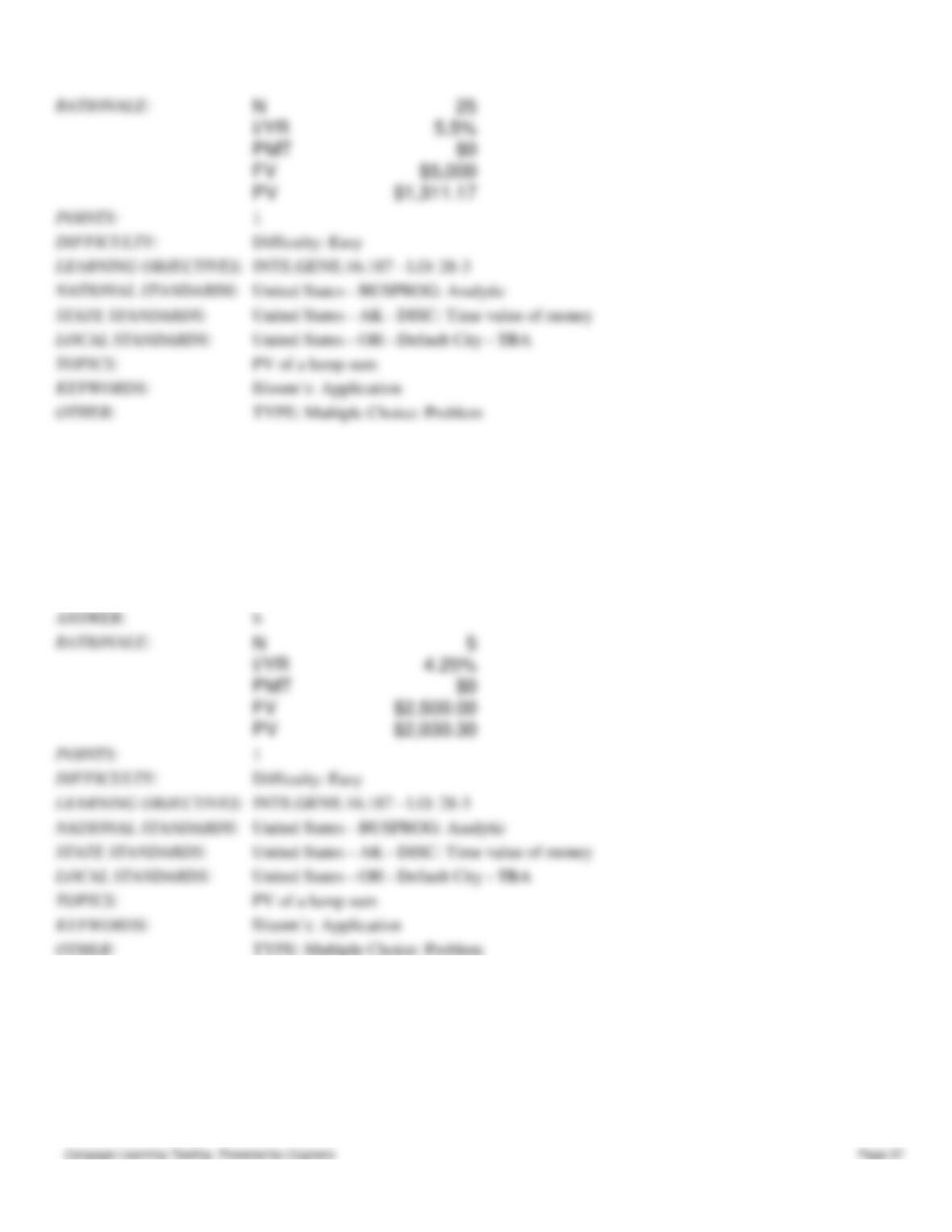
81. You expect to receive $5,000 in 25 years. How much is it worth today if the discount rate is 5.5%?
a.
$1,067.95
b.
$1,124.16
c.
$1,183.33
d.
$1,245.61
e.
$1,311.17
e
CHAPTER 28—TIME VALUE OF MONEY
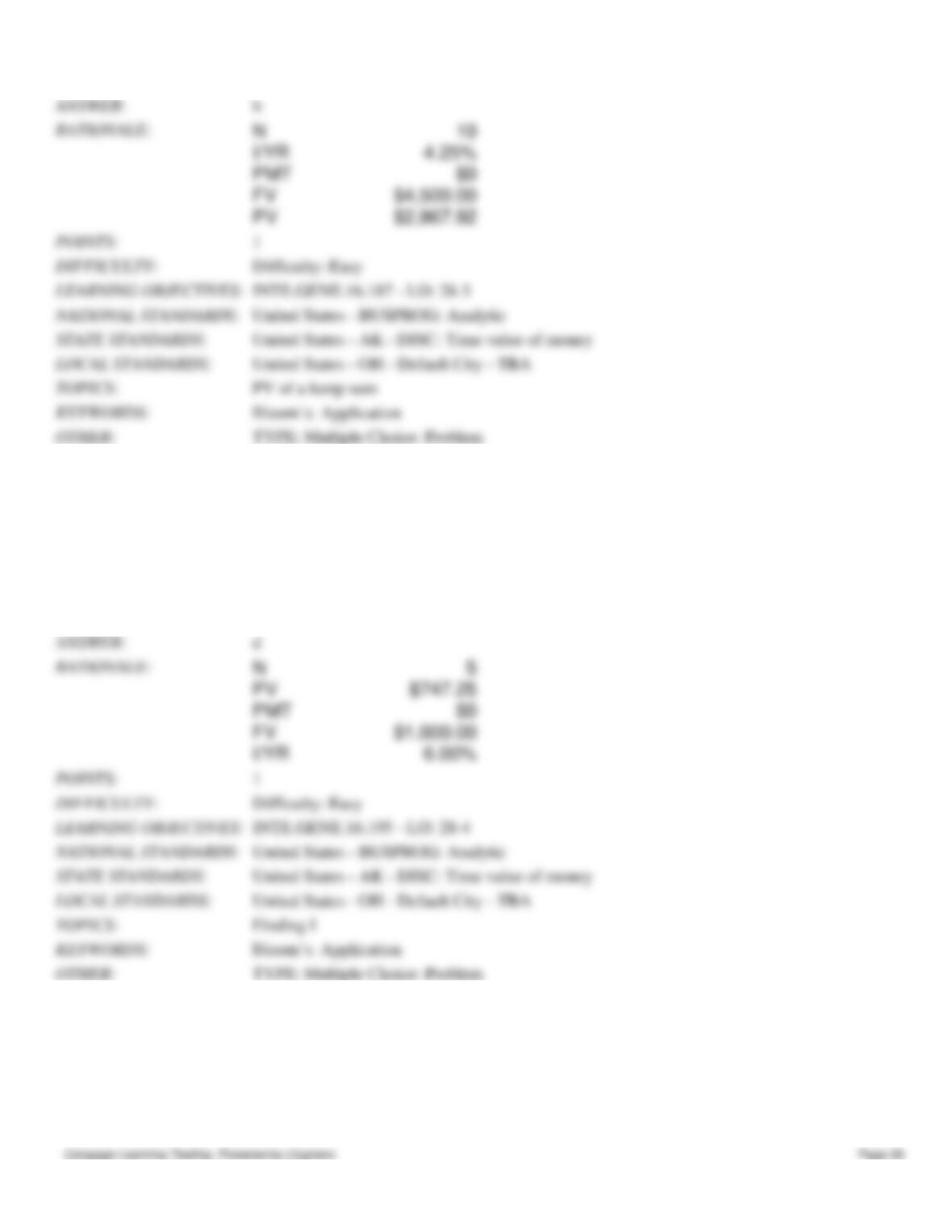
82. The going rate of interest on a 5-year treasury bond is 4.25%. You have one that will pay $2,500 five years from now.
How much is the bond worth today?
a.
$1,928.78
b.
$2,030.30
c.
$2,131.81
d.
$2,238.40
e.
$2,350.32
83. Suppose a Google.com bond will pay $4,500 ten years from now. If the going interest rate on safe 10-year bonds is
4.25%, how much is the bond worth today?
a.
$2,819.52
b.
$2,967.92
c.
$3,116.31
d.
$3,272.13
e.
$3,435.74
CHAPTER 28—TIME VALUE OF MONEY
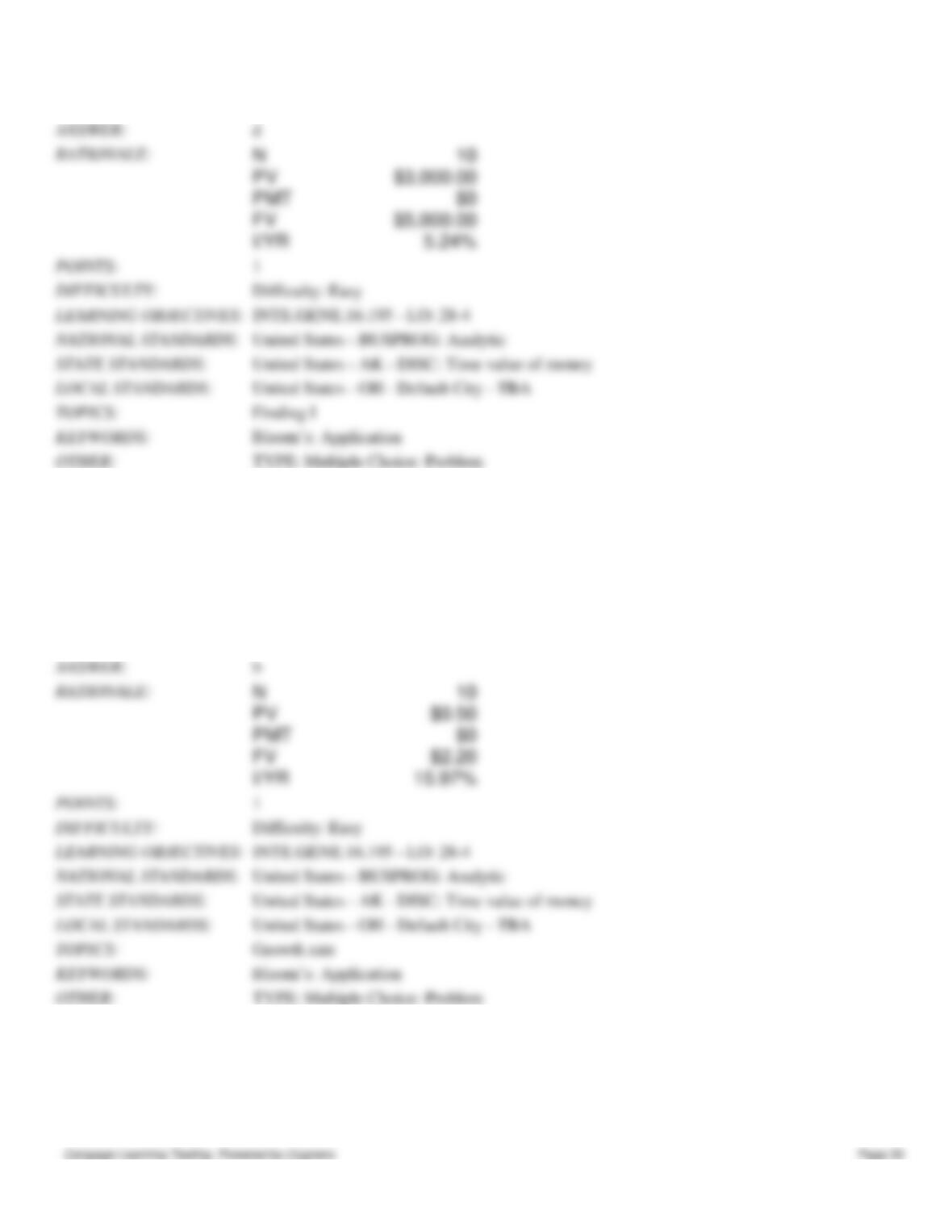
84. You have just purchased a U.S. Treasury bond for $747.25. No payments will be made until the bond matures 5 years
from now, at which time it will be redeemed for $1,000. What interest rate will you earn on this bond?
a.
4.37%
b.
4.86%
c.
5.40%
d.
6.00%
e.
6.60%
85. You have purchased a U.S. Treasury bond for $3,000. No payments will be made until the bond matures 10 years
from now, at which time it will be redeemed for $5,000. What interest rate will you earn on this bond?
a.
3.82%
b.
4.25%
c.
4.72%
d.
5.24%
CHAPTER 28—TIME VALUE OF MONEY
e.
5.77%
86. Ten years ago, Kronan Corporation earned $0.50 per share. Its earnings this year were $2.20. What was the growth
rate in earnings per share (EPS) over the 10-year period?
a.
15.17%
b.
15.97%
c.
16.77%
d.
17.61%
e.
18.49%
87. Wildwoods, Inc. earned $1.50 per share five years ago. Its earnings this year were $3.20. What was the growth rate in
earnings per share (EPS) over the 5-year period?
a.
15.54%
b.
16.36%
c.
17.18%
CHAPTER 28—TIME VALUE OF MONEY
d.
18.04%
e.
18.94%
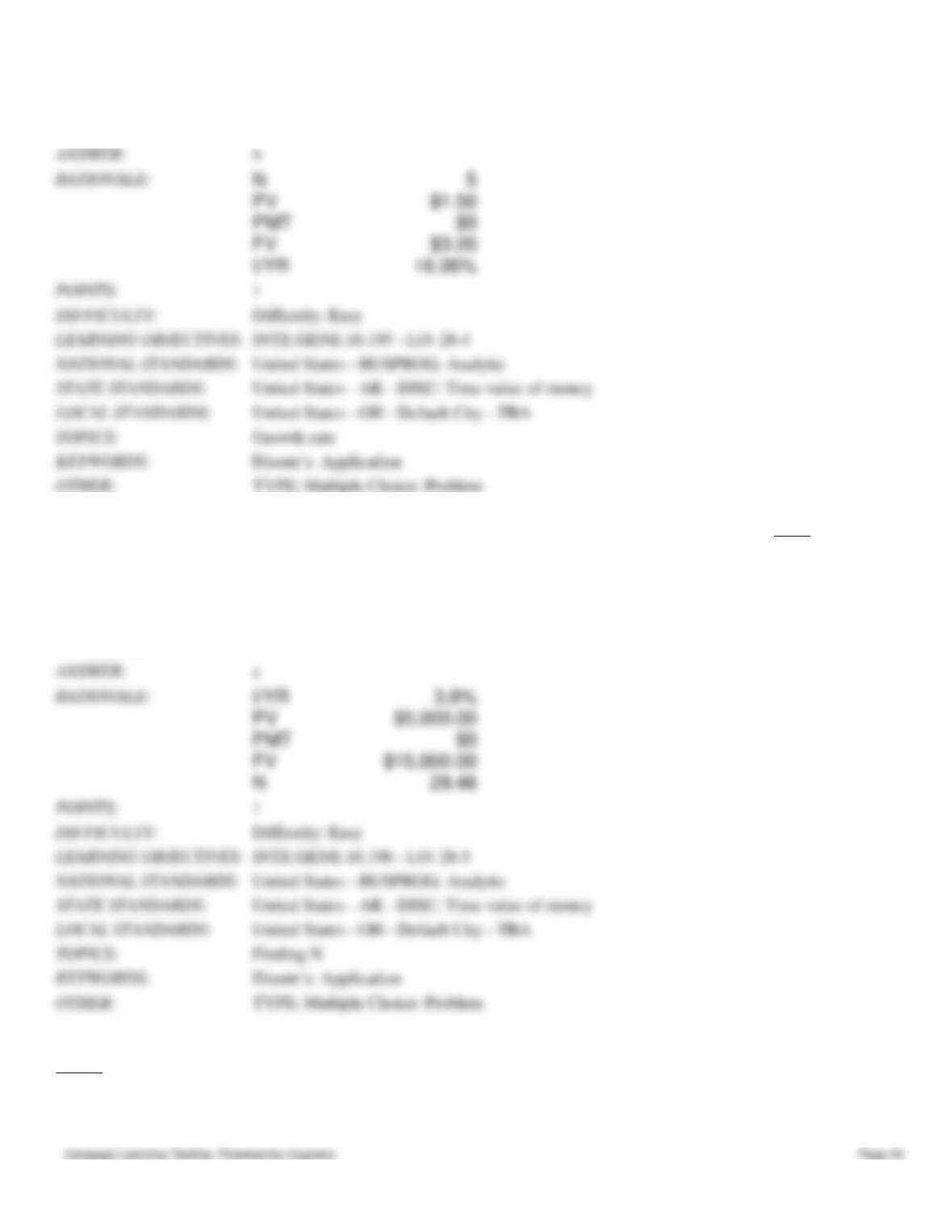
88. You have $5,000 invested in a bank that pays 3.8% annually. How long will it take for your funds to triple?
a.
23.99
b.
25.26
c.
26.58
d.
27.98
e.
29.46
e
89. Your bank pays 4% interest annually. You have $2,500 invested in the bank. How long will it take for your funds to
double?
a.
14.39
b.
15.15
c.
15.95