CHAPTER 27—MULTINATIONAL FINANCIAL MANAGEMENT
32. Suppose a foreign investor who holds tax-exempt Eurobonds paying 9% is considering investing in an equivalent-risk
domestic bond in a country with a 28% withholding tax on interest paid to foreigners. If 9% after-tax is the investor’s
required return, what before-tax rate would the domestic bond need to pay to provide the required after-tax return?
a.
9.00%
b.
10.20%
c.
11.28%
d.
12.50%
e.
13.57%
33. Suppose Yates Inc., a U.S. exporter, sold a consignment of antique American muscle-cars to a Japanese customer at a
price of 143.5 million yen, when the exchange rate was 140 yen per dollar. In order to close the sale, Yates agreed to
make the bill payable in yen, thus agreeing to take some exchange rate risk for the transaction. The terms were net 6
months. If the yen fell against the dollar such that one dollar would buy 154.4 yen when the invoice was paid, what dollar
amount would Yates actually receive after it exchanged yen for U.S. dollars?
a.
$1,075,958
b.
$1,025,000
c.
$1,000,000
d.
$975,610
e.
$929,404
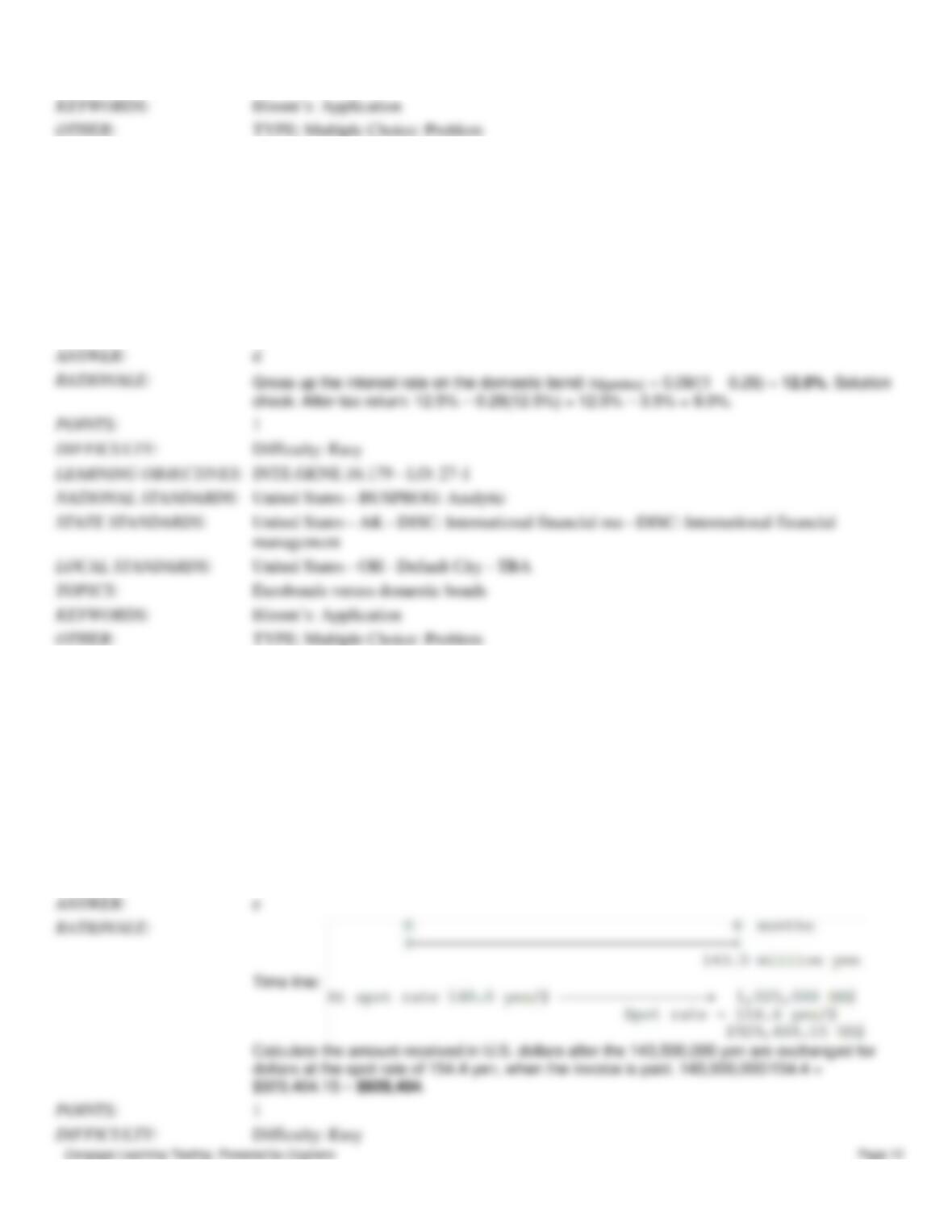
e
CHAPTER 27—MULTINATIONAL FINANCIAL MANAGEMENT
34. Suppose the exchange rate between U.S. dollars and Swiss francs is SF 1.41 = $1.00, and the exchange rate between
the U.S. dollar and the euro is $1.00 = 1.64 euros. What is the cross-rate of Swiss francs to euros?
a.
0.43
b.
0.86
c.
1.41
d.
1.64
e.
2.27
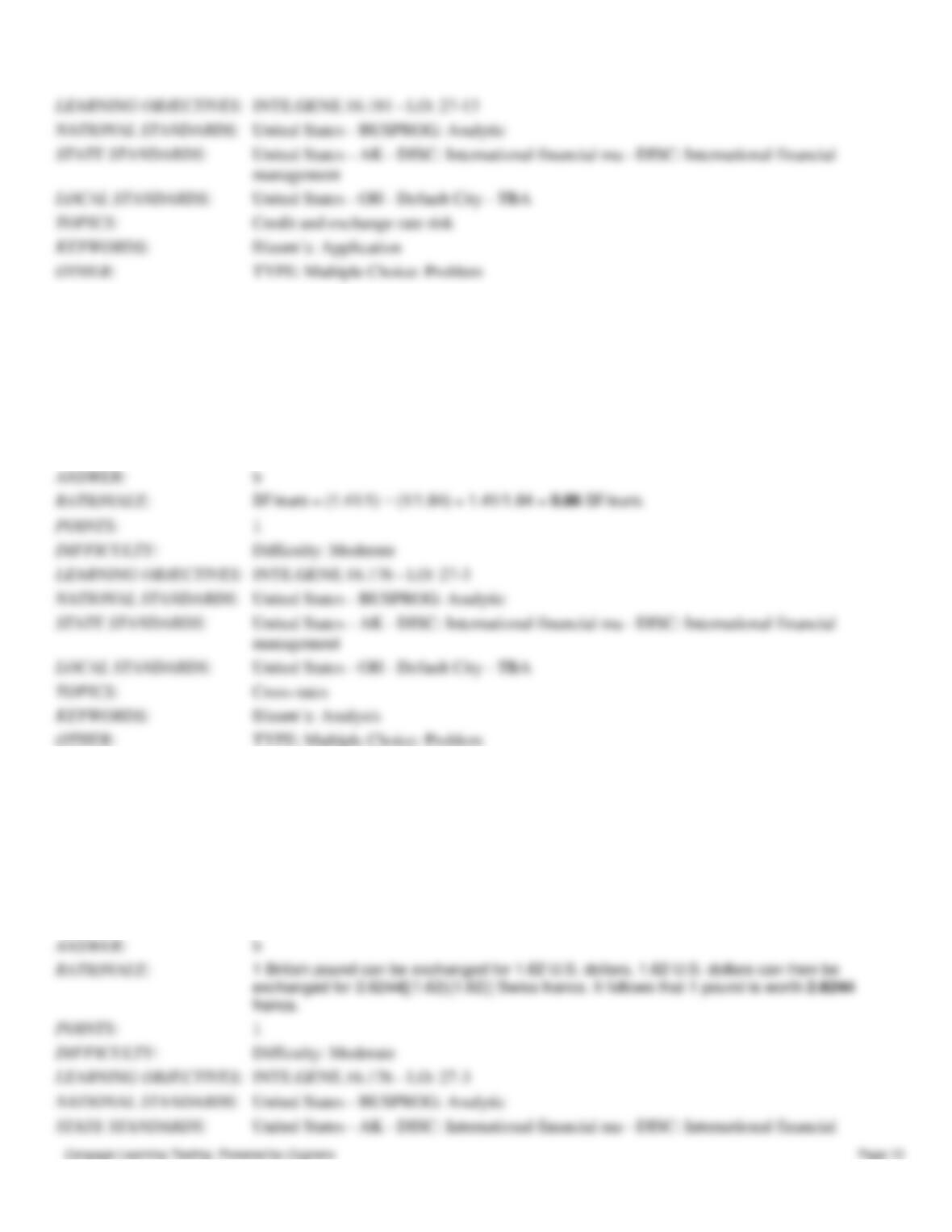
SF/euro = (1.41/1) × (1/1.64) = 1.41/1.64 = 0.86 SF/euro.
Difficulty: Moderate
INTE.GENE.16.176 – LO: 27-3
United States – BUSPROG: Analytic
United States – OH – Default City – TBA
Cross rates
TYPE: Multiple Choice: Problem
35. Suppose that 1 British pound currently equals 1.62 U.S. dollars and 1 U.S. dollar equals 1.62 Swiss francs. What is the
cross exchange rate between the pound and the franc?
a.
1 British pound equals 3.2400 Swiss francs
b.
1 British pound equals 2.6244 Swiss francs
c.
1 British pound equals 1.8588 Swiss francs
d.
1 British pound equals 1.0000 Swiss francs
e.
1 British pound equals 0.3810 Swiss francs
Difficulty: Moderate
United States – BUSPROG: Analytic
United States – AK – DISC: International financial ma – DISC: International financial
INTE.GENE.16.181 – LO: 27–13
United States – BUSPROG: Analytic
United States – OH – Default City – TBA
Credit and exchange rate risk
TYPE: Multiple Choice: Problem
CHAPTER 27—MULTINATIONAL FINANCIAL MANAGEMENT
36. If the spot rate of the Israeli shekel is 5.51 shekels per dollar and the 180-day forward rate is 5.97 shekels per dollar,
then the forward rate for the Israeli shekel is selling at a ____ to the spot rate.
a.
premium of 8%
b.
premium of 18%
c.
discount of 18%
d.
discount of 8%
e.
premium of 16%
Difficulty: Moderate
INTE.GENE.16.176 – LO: 27-3
United States – BUSPROG: Analytic
United States – OH – Default City – TBA
Forward exchange rates–nonalgorithmic
TYPE: Multiple Choice: Problem
37. In 1985, a given Japanese imported automobile sold for 1,476,000 yen, or $8,200. If the car still sold for the same
amount of yen today but the current exchange rate is 144 yen per dollar, what would the car be selling for today in U.S.
dollars?
a.
$5.964
b.
$8,200
c.
$10,250
d.
$12,628
e.
$13,525
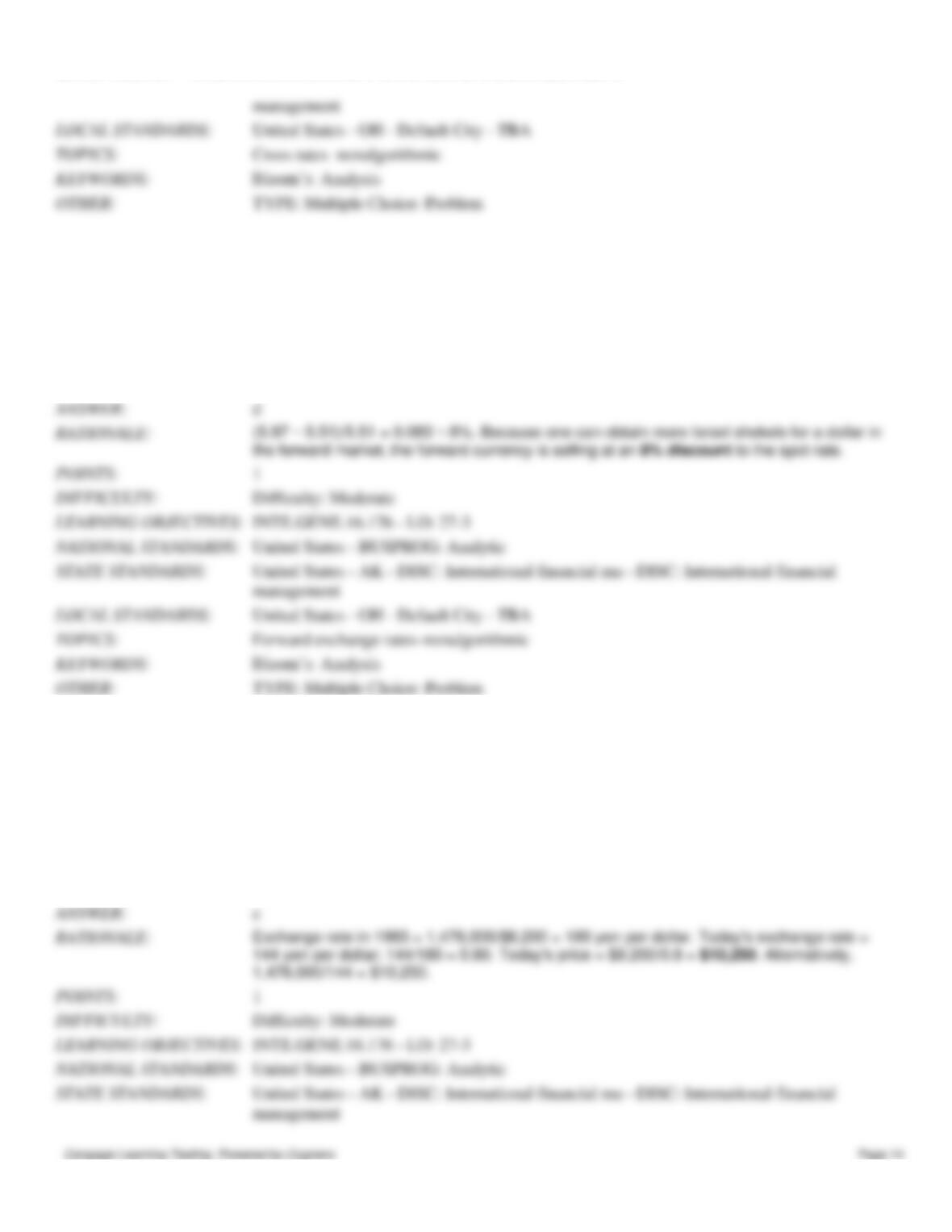
c
Difficulty: Moderate
INTE.GENE.16.176 – LO: 27-3
management
management
United States – OH – Default City – TBA
Cross rates–nonalgorithmic
TYPE: Multiple Choice: Problem
CHAPTER 27—MULTINATIONAL FINANCIAL MANAGEMENT
38. Suppose it takes 1.82 U.S. dollars today to purchase one British pound in the foreign exchange market, and currency
forecasters predict that the U.S. dollar will depreciate by 12.0% against the pound over the next 30 days. How many
dollars will a pound buy in 30 days?
a.
1.12
b.
1.63
c.
1.82
d.
2.04
e.
3.64
39. A U.S.-based importer, Zarb Inc., makes a purchase of crystal glassware from a firm in Switzerland for 39,960 Swiss
francs, or $24,000, at the spot rate of 1.665 francs per dollar. The terms of the purchase are net 90 days, and the U.S. firm
wants to cover this trade payable with a forward market hedge to eliminate its exchange rate risk. Suppose the firm
completes a forward hedge at the 90-day forward rate of 1.682 francs. If the spot rate in 90 days is actually 1.638 francs,
how much will the U.S. firm have saved or lost in U.S. dollars by hedging its exchange rate exposure?
a.
−$396
b.
−$243
c.
$0
d.
$243
e.
$638
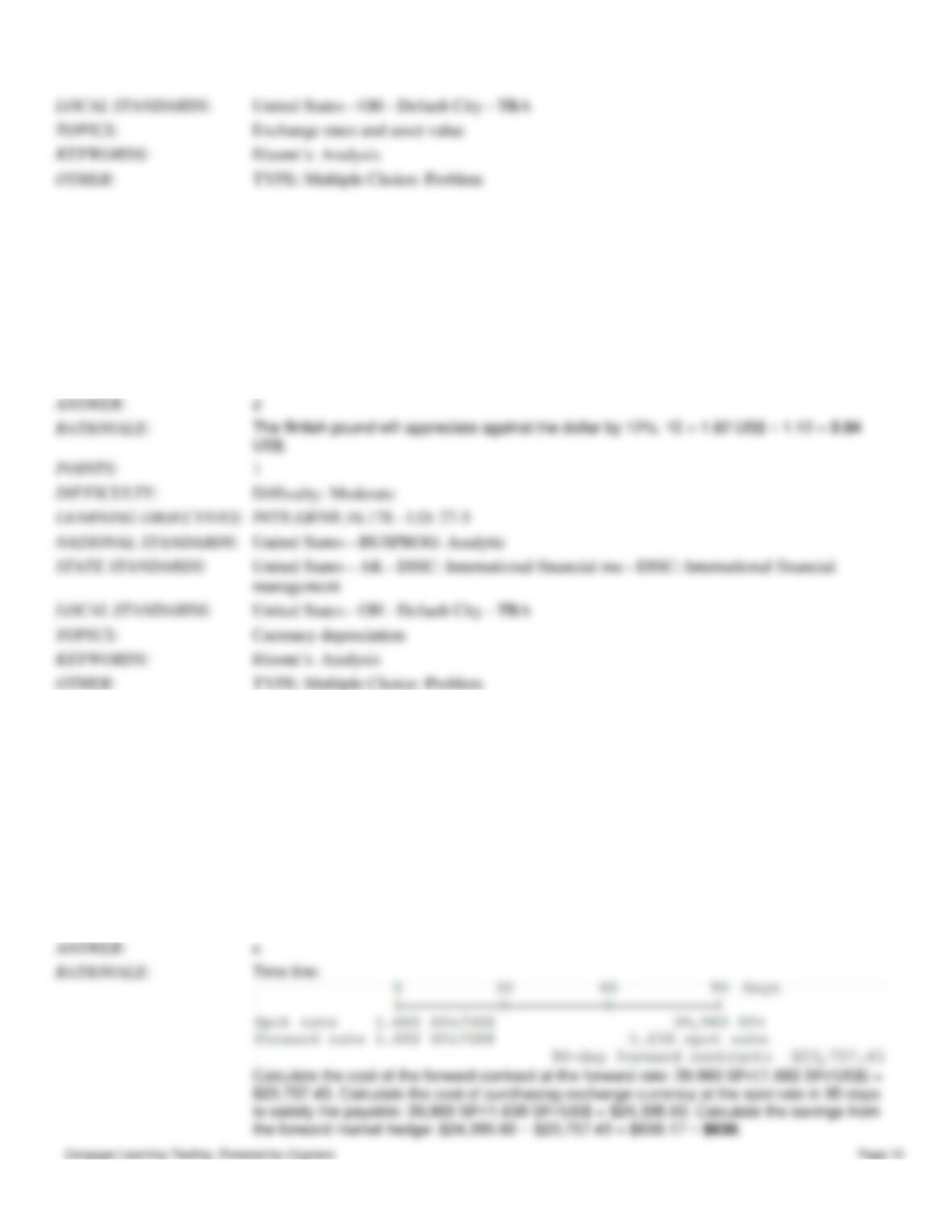
e
CHAPTER 27—MULTINATIONAL FINANCIAL MANAGEMENT
40. Suppose 90-day investments in Britain have a 6% annualized return and a 1.5% quarterly (90-day) return. In the U.S.,
90-day investments of similar risk have a 4% annualized return and a 1% quarterly (90-day) return. In the 90-day forward
market, 1 British pound equals $1.65. If interest rate parity holds, what is the spot exchange rate?
a.
1 pound = $1.8000
b.
1 pound = $1.6582
c.
1 pound = $1.0000
d.
1 pound = $0.8500
e.
1 pound = $0.6031
Difficulty: Moderate
INTE.GENE.16.184 – LO: 27-7
United States – BUSPROG: Analytic
United States – OH – Default City – TBA
Interest rate parity
TYPE: Multiple Choice: Problem
41. Suppose 1 U.S. dollar equals 1.60 Canadian dollars in the spot market. 6-month Canadian securities have an
annualized return of 6% (and thus a 6-month periodic return of 3%). 6-month U.S. securities have an annualized return of
6.5% and a periodic return of 3.25%. If interest rate parity holds, what is the U.S. dollar-Canadian dollar exchange rate in
the 180-day forward market?
a.
1 U.S. dollar = 0.6235 Canadian dollars
b.
1 U.S. dollar = 0.6265 Canadian dollars
c.
1 U.S. dollar = 1.0000 Canadian dollars
d.
1 U.S. dollar = 1.5961 Canadian dollars
Difficulty: Moderate
INTE.GENE.16.182 – LO: 27-6
United States – BUSPROG: Analytic
United States – OH – Default City – TBA
Forward market hedge
TYPE: Multiple Choice: Problem
CHAPTER 27—MULTINATIONAL FINANCIAL MANAGEMENT
e.
1 U.S. dollar = 1.6039 Canadian dollars
Difficulty: Moderate
INTE.GENE.16.184 – LO: 27-7
United States – BUSPROG: Analytic
United States – OH – Default City – TBA
Interest rate parity
TYPE: Multiple Choice: Problem
42. A product sells for $750 in the United States. The exchange rate is $1 to 1.65 Swiss francs. If purchasing power parity
(PPP) holds, what is the price of the product in Switzerland?
a.
123.75 Swiss francs
b.
454.55 Swiss francs
c.
750.00 Swiss francs
d.
1,237.50 Swiss francs
e.
1,650.00 Swiss francs
Difficulty: Moderate
INTE.GENE.16.185 – LO: 27-8
United States – BUSPROG: Analytic
United States – OH – Default City – TBA
Purchasing power parity
TYPE: Multiple Choice: Problem
43. Suppose a carton of hockey pucks sell in Canada for 105 Canadian dollars, and 1 Canadian dollar equals 0.71 U.S.
CHAPTER 27—MULTINATIONAL FINANCIAL MANAGEMENT
dollars. If purchasing power parity (PPP) holds, what is the price of hockey pucks in the United States?
a.
$14.79
b.
$63.00
c.
$74.55
d.
$85.88
e.
$147.88
c
Difficulty: Moderate
INTE.GENE.16.185 – LO: 27-8
United States – BUSPROG: Analytic
management
United States – OH – Default City – TBA
Purchasing power parity
TYPE: Multiple Choice: Problem
44. A box of chocolate candy costs 28.80 Swiss francs in Switzerland and $20 in the United States. Assuming that
purchasing power parity (PPP) holds, what is the current exchange rate?
a.
1 U.S. dollar equals 0.69 Swiss francs
b.
1 U.S. dollar equals 0.85 Swiss francs
c.
1 U.S. dollar equals 1.21 Swiss francs
d.
1 U.S. dollar equals 1.29 Swiss francs
e.
1 U.S. dollar equals 1.44 Swiss francs
e
Difficulty: Moderate
INTE.GENE.16.185 – LO: 27-8
United States – BUSPROG: Analytic
United States – OH – Default City – TBA
Purchasing power parity–nonalgorithmic
TYPE: Multiple Choice: Problem
45. Suppose 6 months ago a Swiss investor bought a 6-month U.S. Treasury bill at a price of $9,708.74, with a maturity
value of $10,000. The exchange rate at that time was 1.420 Swiss francs per dollar. Today, at maturity, the exchange rate
is 1.324 Swiss francs per dollar. What is the annualized rate of return to the Swiss investor?
a.
−7.92%
CHAPTER 27—MULTINATIONAL FINANCIAL MANAGEMENT
b.
−4.13%
c.
6.00%
d.
8.25%
e.
12.00%
a
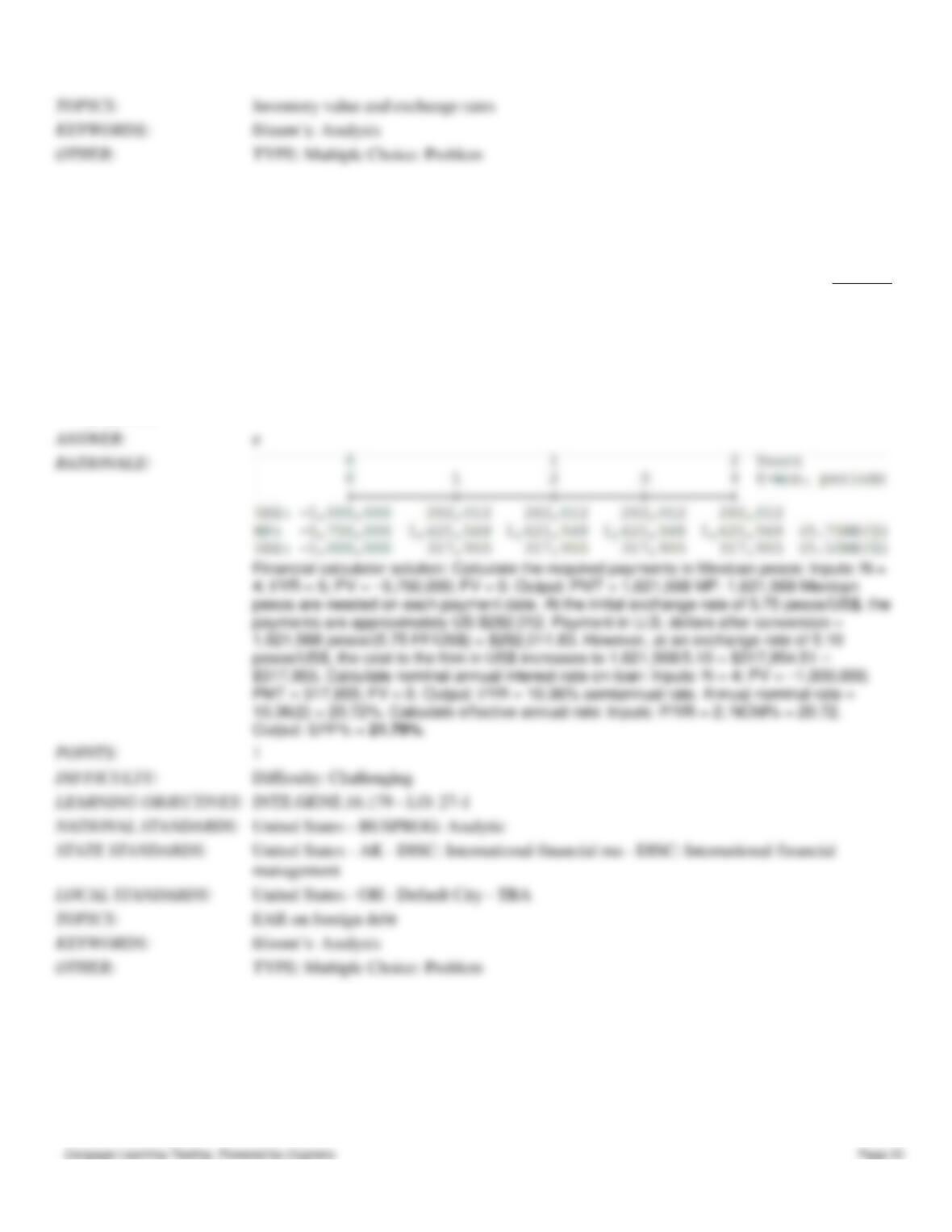
46. Suppose Stackpool Inc. had inventory in Britain valued at 240,000 pounds one year ago. The exchange rate for dollars
to pounds was 1£ = 2 U.S. dollars. This year the exchange rate is 1£ = 1.82 U.S. dollars. The inventory in Britain is still
valued at 240,000 pounds. What is the gain or loss in inventory value in U.S. dollars as a result of the change in exchange
rates?
a.
−$240,000
b.
−$43,200
c.
$0
d.
$43,200
e.
$47,473
CHAPTER 27—MULTINATIONAL FINANCIAL MANAGEMENT
47. A U.S.-based company, Stewart, Inc., arranged a 2-year, $1,000,000 loan to fund a project in Mexico. The loan is
denominated in Mexican pesos, carries a 10.0% nominal rate, and requires equal semiannual payments. The exchange rate
at the time of the loan was 5.75 pesos per dollar, but it dropped to 5.10 pesos per dollar before the first payment came due.
The loan was not hedged in the foreign exchange market. Thus, Stewart must convert U.S. funds to Mexican pesos to
make its payments. If the exchange rate remains at 5.10 pesos per dollar through the end of the loan period, what effective
interest rate will Stewart end up paying on the loan?
a.
10.36%
b.
11.50%
c.
17.44%
d.
20.00%
e.
21.79%
e
Difficulty: Challenging
INTE.GENE.16.179 – LO: 27-1
United States – BUSPROG: Analytic
United States – OH – Default City – TBA
EAR on foreign debt
TYPE: Multiple Choice: Problem
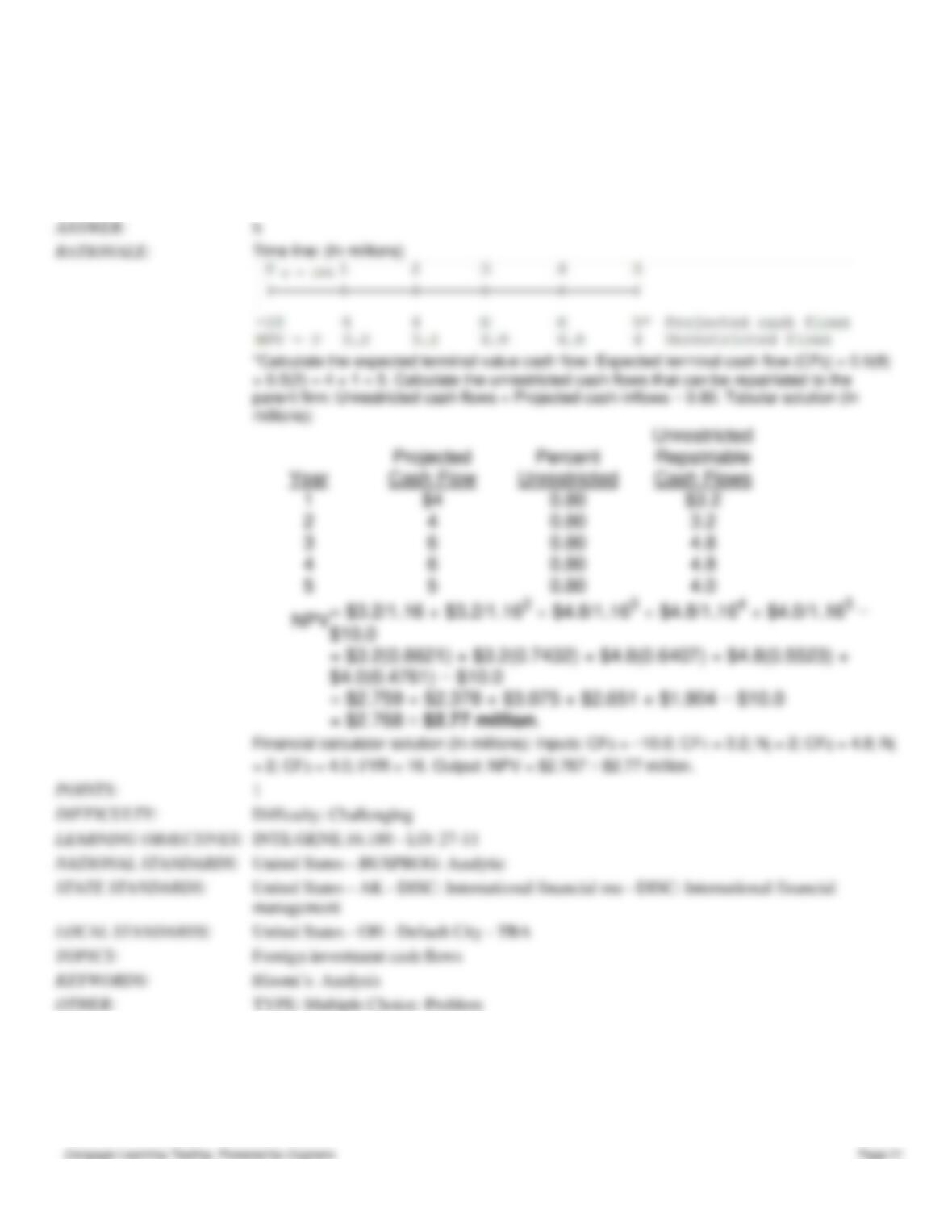
48. Tashakori Trucking, a U.S.-based company, is considering expanding its operations into a foreign country. The
required investment at Time = 0 is $10 million. The firm forecasts total cash inflows of $4 million per year for 2 years, $6
million for the next 2 years, and then a possible terminal value of $8 million. In addition, due to political risk factors,
Tashakori believes that there is a 50% chance that the gross terminal value will be only $2 million and a 50% chance that
it will be $8 million. However, the government of the host country will block 20% of all cash flows. Thus, cash flows that
can be repatriated are 80% of those projected. Tashakori’s cost of capital is 15%, but it adds one percentage point to all
foreign projects to account for exchange rate risk. Under these conditions, what is the project’s NPV?
Inventory value and exchange rates
TYPE: Multiple Choice: Problem
CHAPTER 27—MULTINATIONAL FINANCIAL MANAGEMENT
a.
$1.01 million
b.
$2.77 million
c.
$3.09 million
d.
$5.96 million
e.
$7.39 million
Difficulty: Challenging
INTE.GENE.16.180 – LO: 27–11
United States – BUSPROG: Analytic
United States – OH – Default City – TBA
Foreign investment cash flows
TYPE: Multiple Choice: Problem
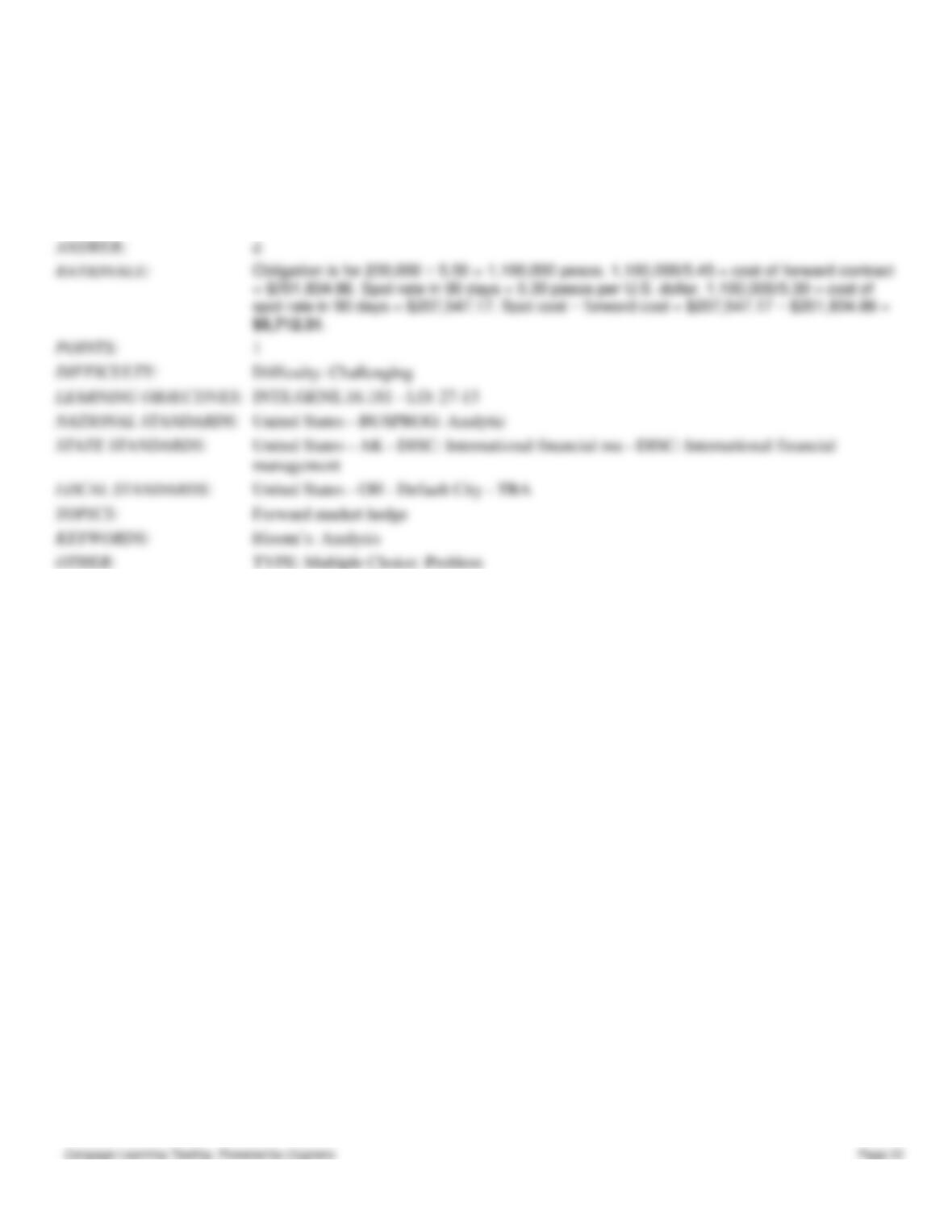
49. Suppose a U.S. firm buys $200,000 worth of stereo speaker wire from a Mexican manufacturer for delivery in 60 days
with payment to be made in 90 days (30 days after the goods are received). The rising U.S. deficit has caused the dollar to
depreciate against the peso recently. The current exchange rate is 5.50 pesos per U.S. dollar. The 90-day forward rate is
5.45 pesos/dollar. The firm goes into the forward market today and buys enough Mexican pesos at the 90-day forward rate
to completely cover its trade obligation. Assume the spot rate in 90 days is 5.30 Mexican pesos per U.S. dollar. How
CHAPTER 27—MULTINATIONAL FINANCIAL MANAGEMENT
much in U.S. dollars did the firm save by eliminating its foreign exchange currency risk with its forward market hedge?
a.
$0
b.
$1,834.86
c.
$4,517.26
d.
$5,712.31
e.
$7,547.17