Ch 27 Providing and Obtaining Credit
True / False
1. The credit period is the amount of time it takes to do a credit search on a potential customer.
a.
True
b.
False
False
Difficulty: Moderate
True / False
False
FMTP.EHRH.17.22.01 – LO: 22-1
United States – BUSPROG: Reflective Thinking
capital
United States – OH – Default City – TBA
Credit period
8/26/2015 10:48 AM
8/26/2015 10:48 AM
JFND-GO4G-EO4R-RQB1
2. Credit standards refer to the financial strength and importance of a potential customer to the firm required in order to
qualify for credit.
a.
True
b.
False
False
Difficulty: Moderate
True / False
False
FMTP.EHRH.17.22.01 – LO: 22-1
United States – BUSPROG: Reflective Thinking
United States – OH – Default City – TBA
Credit standards
8/26/2015 10:48 AM
8/26/2015 10:48 AM
JFND-GO4G-EO4R-RQBT
GCID-E7BW-1TBP-CEAS-R3MF-8BUD-O3UD-CE4N-4QMN-GPTN-4PT3-GR4N-4QJ3–
Ch 27 Providing and Obtaining Credit
3. The collection process, although sometimes difficult, is a fairly inexpensive component of doing business.
a.
True
b.
False
False
False
JFND-GO4G-EO4R-RQBO
4. The collection process, although sometimes difficult, is also expensive in terms of out–of-pocket expenses.
a.
True
b.
False
True
False
JFND-GO4G-EO4R-RQBZ
GO4W-NQNBEE

Ch 27 Providing and Obtaining Credit
5. Cash discounts are mostly used to get new customers in the door since existing customers almost always use the
delayed payment terms.
a.
True
b.
False
False
False
JFND-GO4G-EO4R-RQBI
6. When deciding whether to offer a discount for cash payment, a firm must balance the profits from additional sales with
the lost revenues from the discount.
a.
True
b.
False
True
False
Ch 27 Providing and Obtaining Credit
7. The primary reason to monitor aggregate accounts receivable is to see if customers, on average, are paying more
slowly.
a.
True
b.
False
True
False
JFND-GO4G-EO4R-RQKN
8. DSO analysis of accounts receivable is the most robust way to see if customers are, on average, paying more slowly,
because it is unaffected by seasonal changes in sales.
a.
True
b.
False
False
False
capital
JFND-GO4G-EO4R-RQBW
Ch 27 Providing and Obtaining Credit
9. If sales are seasonal, the days sales outstanding will fluctuate from month to month, even if the amount of time
customers take to pay remains unchanged.
a.
True
b.
False
True
False
JFND-GO4G-EO4R-RQJA
10. The percentage aging schedule of accounts receivable is the most robust way to see if customers are, on average,
paying more slowly, because it is unaffected by seasonal changes in sales.
a.
True
b.
False
False
False
JFND-GO4G-EO4R-RQKB
Ch 27 Providing and Obtaining Credit
11. The uncollected balances schedule is constructed at the end of a quarter by dividing the dollar amount of remaining
receivables from each month in that quarter by that month’s sales.
a.
True
b.
False
True
Difficulty: Moderate
True / False
False
FMTP.EHRH.17.22.08 – LO: 22-8
United States – BUSPROG: Reflective Thinking
United States – AK – DISC: Capital budgeting and cost – DISC: Capital budgeting and cost of
capital
United States – OH – Default City – TBA
Uncollected balances schedule
8/26/2015 10:48 AM
8/26/2015 10:48 AM
JFND-GO4G-EO4R-RQKF
Multiple Choice
12. Which of the following is not correct?
a.
A more aggressive collection policy will reduce bad debt expenses, but may also decrease sales.
b.
Collection policy usually has little impact on sales since collecting past-due accounts occurs only after the
customer has already purchased.
c.
Typically a firm will turn over an account to a collection agency only after it has tried several times on its own
to collect the account.
United States – BUSPROG: Reflective Thinking
United States – OH – Default City – TBA
Payments pattern approach
8/26/2015 10:48 AM
8/26/2015 10:48 AM
JFND-GO4G-EO4R-RQKG
GO4W-NQNBEE
Ch 27 Providing and Obtaining Credit
d.
A lax collection policy will frequently lead to an increase in accounts receivable.
e.
Collection policy is how a firm goes about collecting past-due accounts.
Difficulty: Moderate
Multiple Choice
FMTP.EHRH.17.22.03 – LO: 22-3
United States – BUSPROG: Analytic
United States – OH – Default City – TBA
Collection policy
TYPE: Multiple Choice: Conceptual
8/26/2015 10:48 AM
8/26/2015 10:48 AM
13. Which of the following is not correct for a firm with seasonal sales and customers who all pay promptly at the end of
30 days?
a.
The quarterly uncollected balances schedule will be the same in each quarter.
b.
The level of accounts receivable will be constant from month to month.
c.
The ratio of accounts receivable to sales will vary from month to month.
d.
The level of accounts receivable at the end of each quarter will be the same.
e.
DSO will vary from month to month.
Difficulty: Moderate
Multiple Choice
FMTP.EHRH.17.22.06 – LO: 22-6
United States – BUSPROG: Analytic
United States – OH – Default City – TBA
Payments pattern approach
TYPE: Multiple Choice: Conceptual
8/26/2015 10:48 AM
Ch 27 Providing and Obtaining Credit
14. A firm’s credit policy consists of which of the following items?
a.
Credit period, cash discounts, credit standards, collection policy.
b.
Credit period, cash discounts, receivables monitoring, collection policy.
c.
Cash discounts, credit standards, receivables monitoring, collection policy.
d.
Credit period, receivables monitoring, credit standards, collection policy.
e.
Credit period, cash discounts, credit standards, receivables monitoring.
Difficulty: Moderate
Multiple Choice
FMTP.EHRH.17.22.08 – LO: 22-8
United States – BUSPROG: Analytic
United States – OH – Default City – TBA
Credit policy
TYPE: Multiple Choice: Conceptual
8/26/2015 10:48 AM
8/26/2015 10:48 AM
15. Which of the following statements is most correct?
a.
It is possible for a firm to overstate profits by offering very lenient credit terms which encourage additional
sales to financially “weak” firms. A major disadvantage of such a policy is that it is likely to increase
uncollectible accounts.
b.
A firm with excess production capacity and relatively low variable costs would not be inclined to extend more
liberal credit terms to its customers than a firm with similar costs that is operating close to capacity.
c.
Firms use seasonal dating primarily to decrease their DSO.
d.
Seasonal dating with terms 2/15, net 30 days, with April 1 dating, means that if the original sale took place on
February 1st, the customer can take the discount up until March 15th, but must pay the net invoice amount by
April 1st.
e.
If credit sales as a percentage of a firm’s total sales increases, and the volume of credit sales also increases,
then the firm’s accounts receivable will automatically increase.
8/26/2015 10:48 AM
Ch 27 Providing and Obtaining Credit
a
Difficulty: Moderate
Multiple Choice
False
FMTP.EHRH.17.22.08 – LO: 22-8
United States – BUSPROG: Analytic
United States – AK – DISC: Capital budgeting and cost – DISC: Capital budgeting and cost of
United States – OH – Default City – TBA
Credit policy and seasonal dating
TYPE: Multiple Choice: Conceptual
8/26/2015 10:48 AM
8/26/2015 10:48 AM
JFND-GO4G-EO4R-RQKD
Exhibit 27.2
Reese Brothers Publishers Inc (RBP) expects to have sales this year of $15 million under its current credit policy. The
present terms are net 30; the days sales outstanding (DSO) is 60 days; and the bad debt loss percentage is 5 percent. Since
RBP wants to improve its profitability, the treasurer has proposed that the credit period be shortened to 15 days. This
change would reduce expected sales by $500,000, but it would also shorten the DSO on the remaining sales to 30 days.
Expected bad debt losses on the remaining sales would fall to 3 percent. The variable cost percentage is 60 percent, and
the cost of capital is 15 percent.
16. Refer to Exhibit 27.2. What would be the incremental bad losses if the change were made?
a.
$315,000
b.
$260,500
c.
−$260,500 (bad debt losses would decline)
d.
−$315,000 (Bad debt losses would decline)
e.
$0 (no change would occur)
Bad debt losses old:
(.05)($15,000,000) = $750,000.
Bad debt losses new:
(.03)($14,500,000) = $435,000.
Change in bad debt losses = $435,000 − $750,000 = −$315,000.
Difficulty: Moderate
Multiple Choice
False
Exhibit 27.2
FMTP.EHRH.17.22.08 – LO: 22-8
United States – BUSPROG: Analytic
Ch 27 Providing and Obtaining Credit
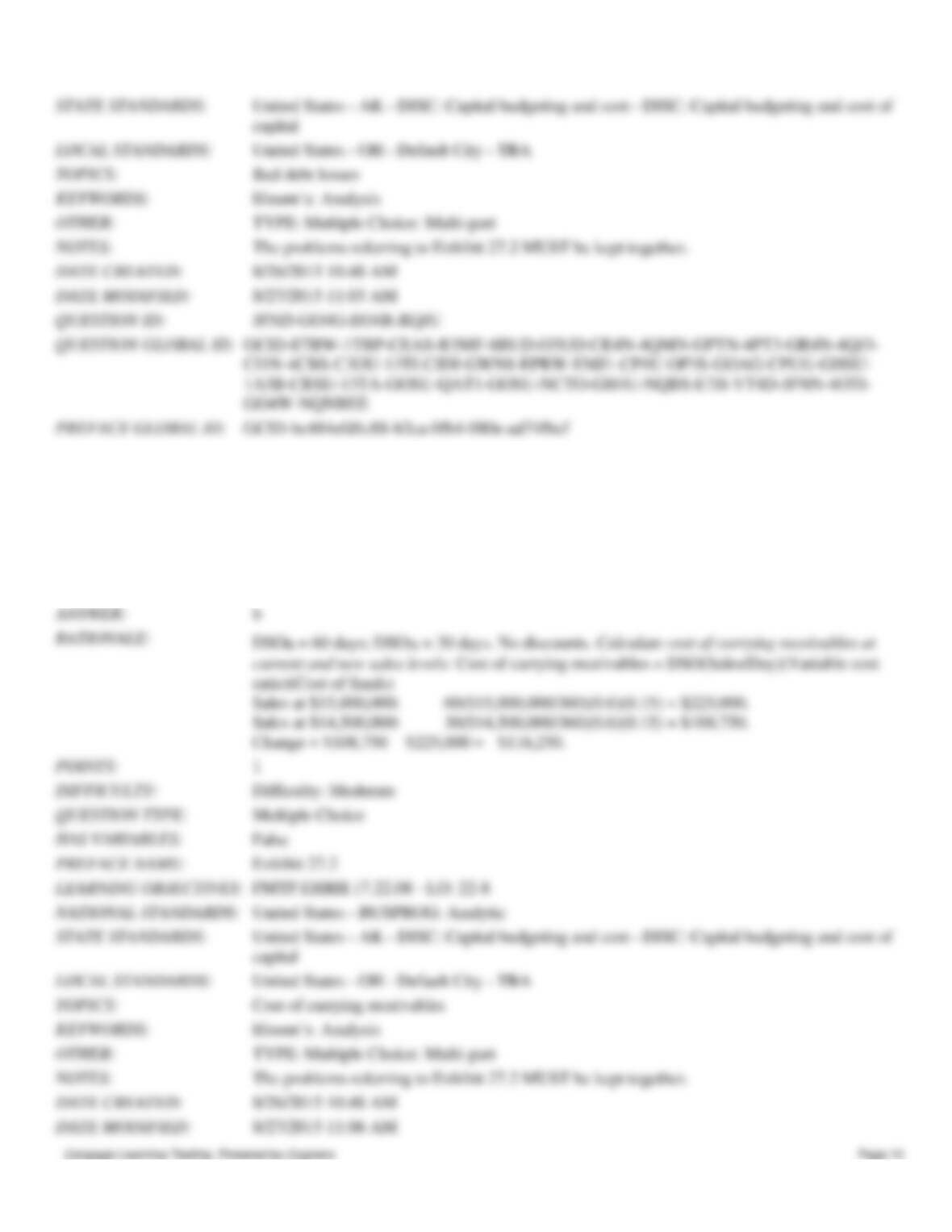
17. Refer to Exhibit 27.2. What would be the incremental cost of carrying receivables if this change were made?
a.
$108,750
b.
−$116,250 (carrying costs would decline)
c.
$157,900
d.
−$225,000 (carrying costs would decline)
e.
$260,500
False
JFND-GO4G-EO4R-RQJU
GCID-bc484efd1c88-b2ca-0fb4-080e-ad74fbcf
Ch 27 Providing and Obtaining Credit
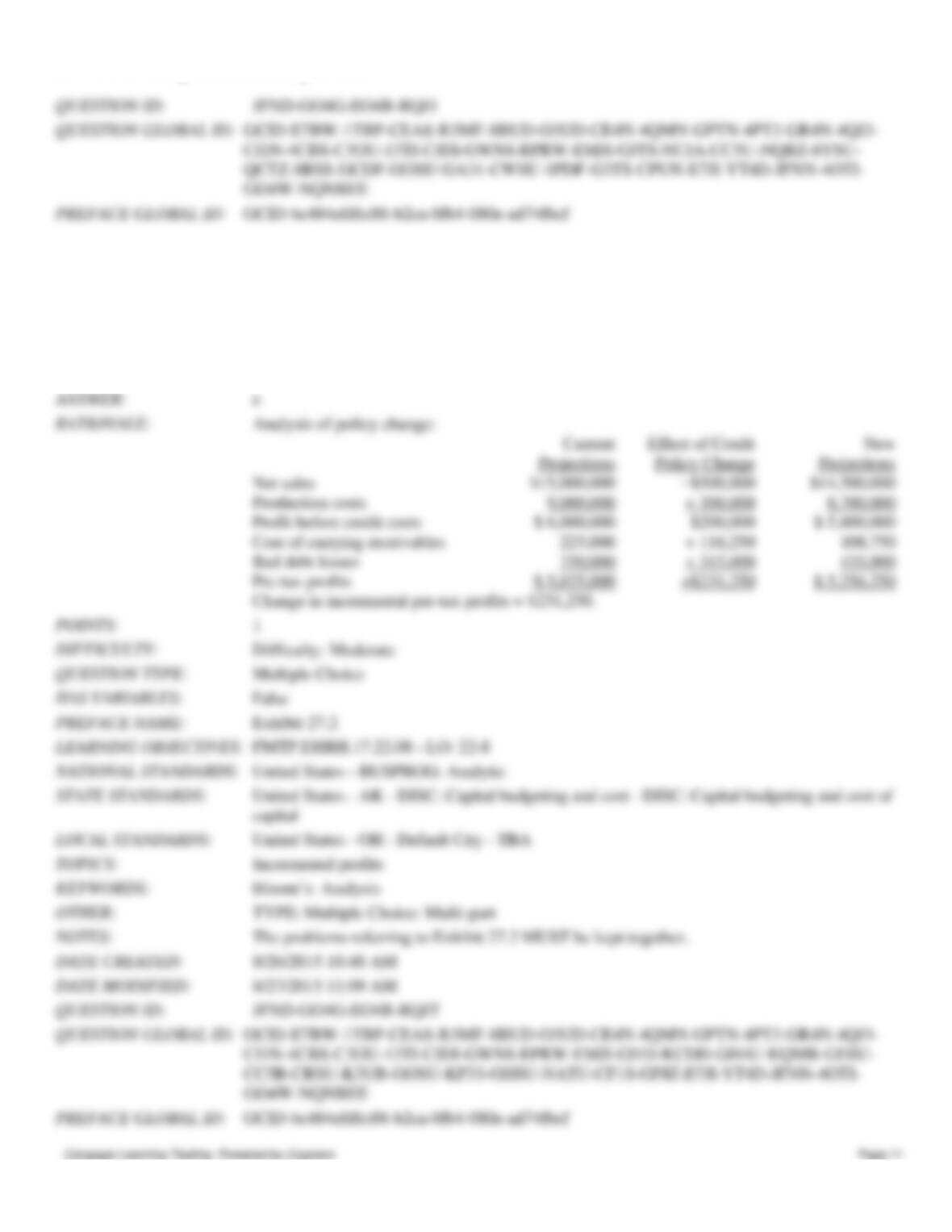
18. Refer to Exhibit 27.2. What are the incremental pre-tax profits from this proposal?
a.
$181,250
b.
$271,750
c.
$256,250
d.
$206,500
e.
$231,250
e
False
capital
JFND-GO4G-EO4R-RQJT
GCID-bc484efd1c88-b2ca-0fb4-080e-ad74fbcf
JFND-GO4G-EO4R-RQJ1
GCID-bc484efd1c88-b2ca-0fb4-080e-ad74fbcf
Ch 27 Providing and Obtaining Credit
Exhibit 27.3
Van Doren Housing expects to have sales this year of $15 million under its current credit policy. The present terms are
net 30; the days dales outstanding (DSO) is 60 days; and the bad debt loss percentage is 5 percent. Also, Van Doren’s cost
of capital is 15 percent, and its variable costs total 60 percent of sales. Since Van Doren wants to improve its profitability,
a proposal has been made to offer a 2 percent discount for payment within 10 days; that is, change the credit terms to 2/10,
net 30. The consultants predict that sales would increase by $500,000, and that 50 percent of all customers would take the
discount. The new DSO would be 30 days, and the bad debt loss percentage on all sales would fall to 4 percent.
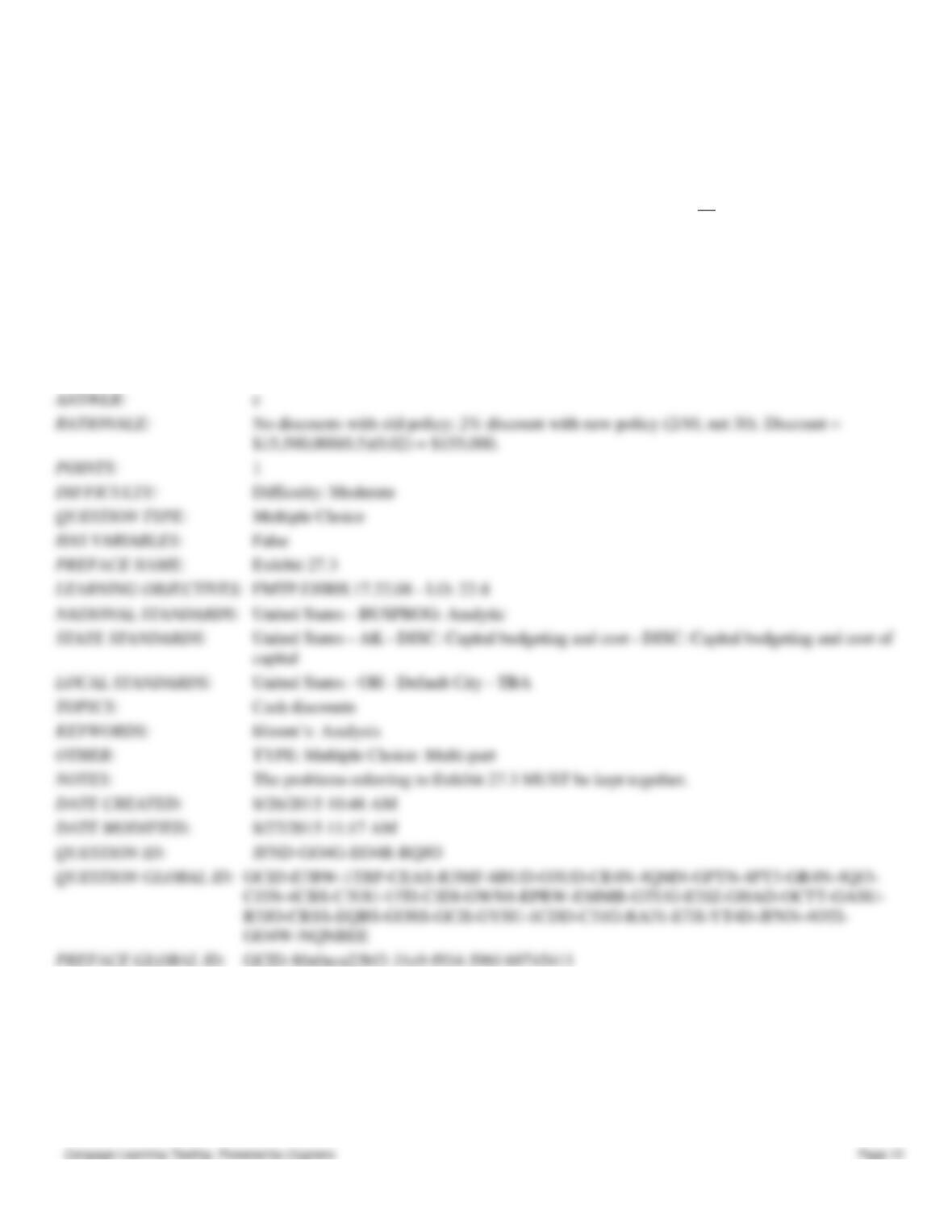
19. Refer to Exhibit 27.3. What would be the cost to Van Doren of the discounts taken?
a.
$116,750
b.
−$108,750
c.
$155,000
d.
$225,000
e.
$260,500
c
Difficulty: Moderate
Multiple Choice
False
Exhibit 27.3
FMTP.EHRH.17.22.08 – LO: 22-8
United States – BUSPROG: Analytic
United States – AK – DISC: Capital budgeting and cost – DISC: Capital budgeting and cost of
United States – OH – Default City – TBA
Cash discounts
TYPE: Multiple Choice: Multi-part
The problems referring to Exhibit 27.3 MUST be kept together.
8/26/2015 10:48 AM
8/27/2015 11:17 AM
JFND-GO4G-EO4R-RQJO
GO4W-NQNBEE
GCID-80a0aca23bf3-31e9-f934-596f-69745411
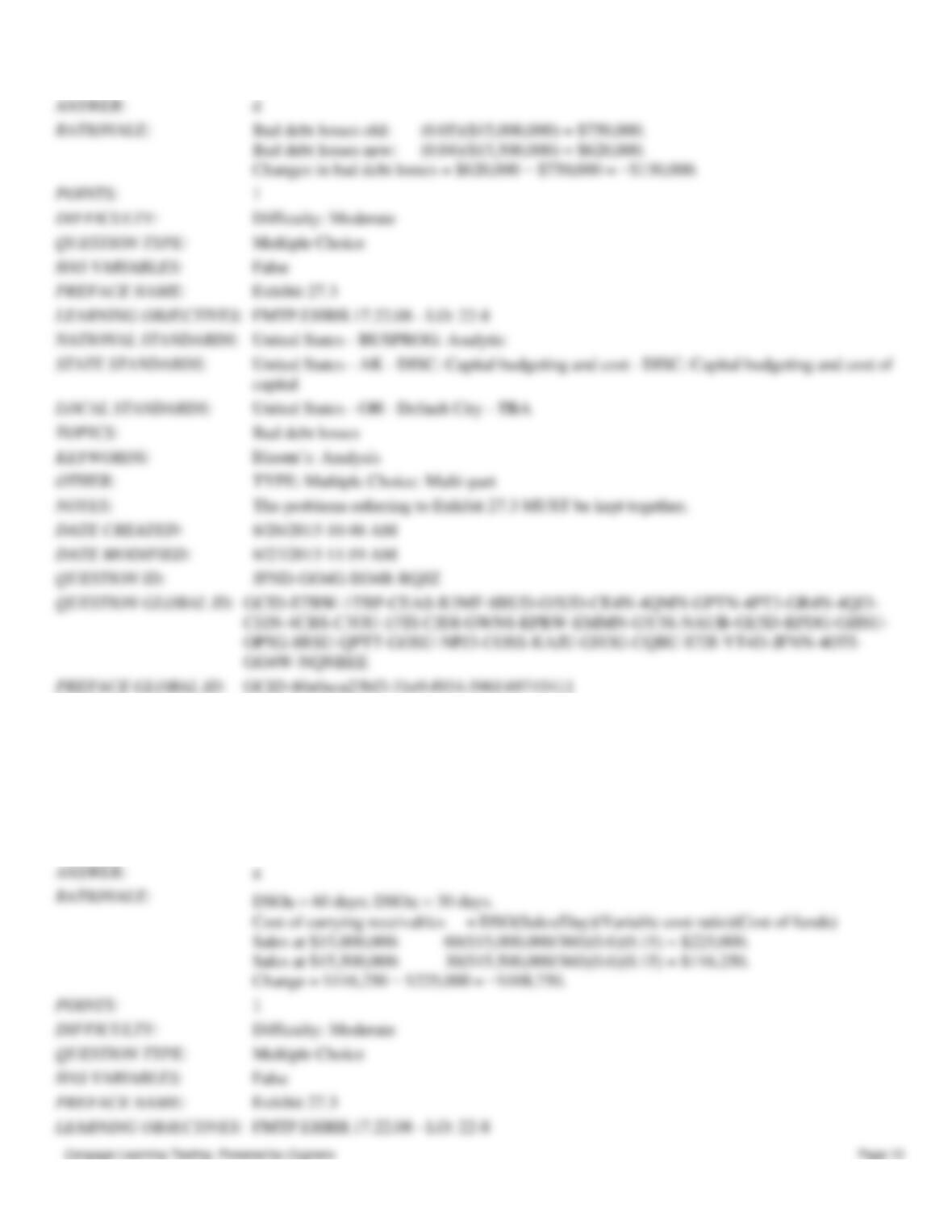
20. Refer to Exhibit 27.3. What would be the incremental bad debt losses if the change were made?
a.
$130,000
b.
$250,000
c.
−$250,000 (bad debt losses would decline)
d.
−$130,000 (bad debt losses would decline)
e.
$620,000
Ch 27 Providing and Obtaining Credit
False
JFND-GO4G-EO4R-RQJZ
GCID-80a0aca23bf3-31e9-f934-596f-69745411
21. Refer to Exhibit 27.3. What would be the incremental cost of carrying receivables if the change were made?
a.
−$108,750 (carrying costs would decline)
b.
$116,250
c.
$157,900
d.
−$225,000 (carrying costs would decline)
e.
$260,000
a
Ch 27 Providing and Obtaining Credit
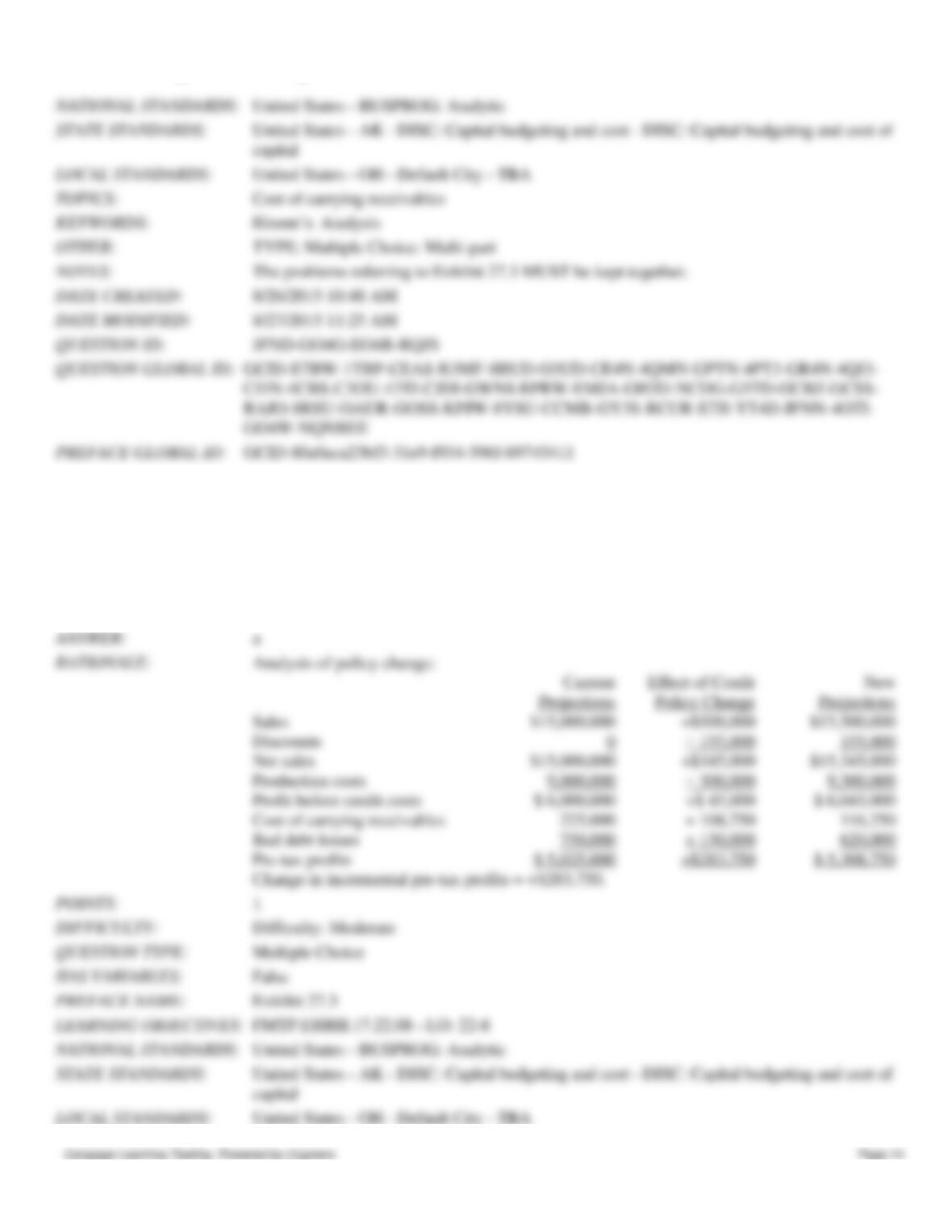
22. Refer to Exhibit 27.3. What are the incremental pre-tax profits from this proposal?
a.
$283,750
b.
$250,500
c.
$303,250
d.
$493,750
e.
$288,250
a
Sales
Discounts
False
capital
JFND-GO4G-EO4R-RQJS
GCID-80a0aca23bf3-31e9-f934-596f-69745411