58.
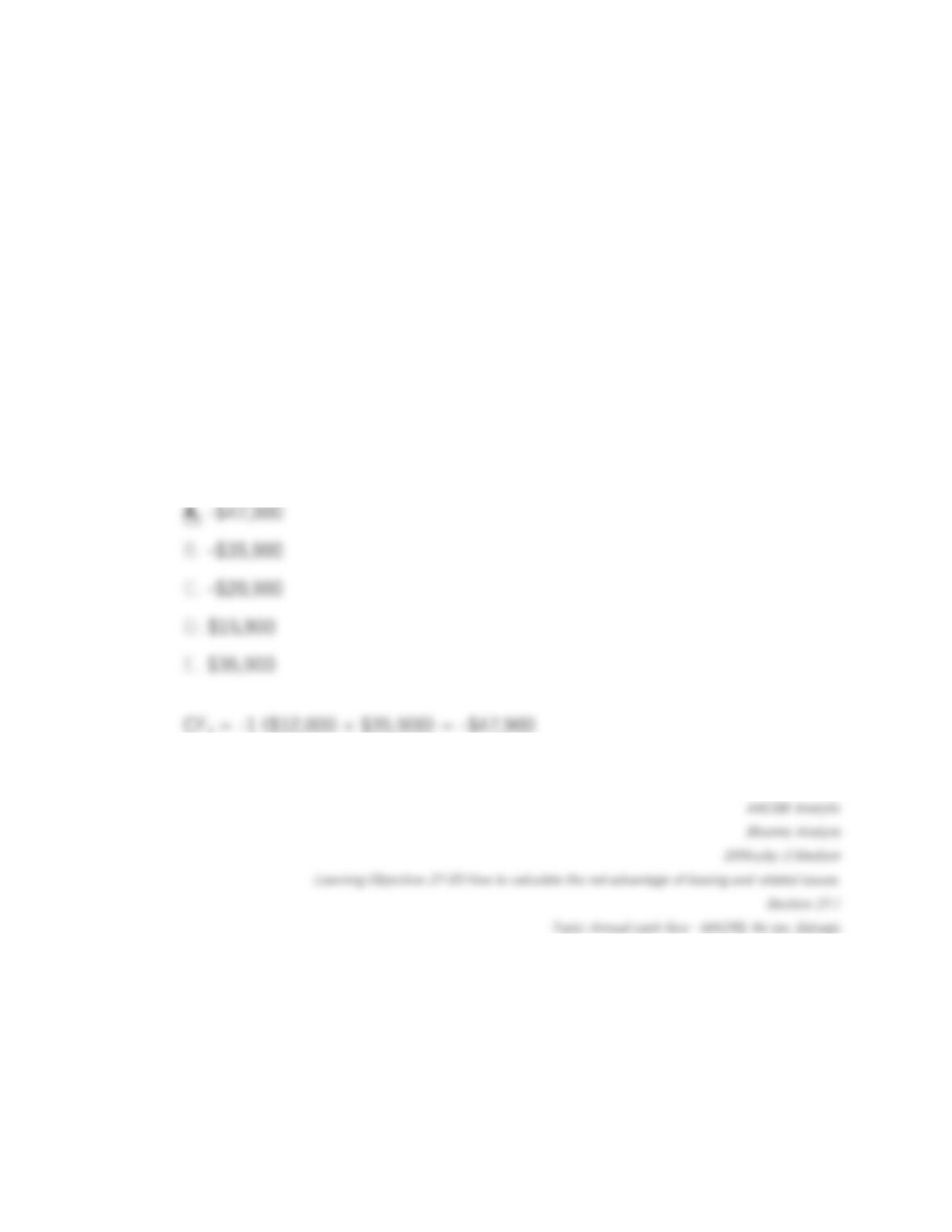
Frank’s Auto Repair can purchase a new machine for $136,000. The
machine has a 4-year life and can be sold at the end of year 4 for $12,000.
Frank’s uses MACRS depreciation which allows for 33.33 percent, 44.44
percent, 14.82 percent, and 7.41 percent depreciation over years 1 to 4,
respectively. The equipment can be leased for $35,900 a year. The firm can
borrow money at 7.5 percent and has a 32 percent tax rate. The company
does not expect to owe any taxes for at least the next 4 years due to net
operating losses. What is the incremental annual cash flow for year 4 if the
company decides to lease rather than purchase the equipment?
59.
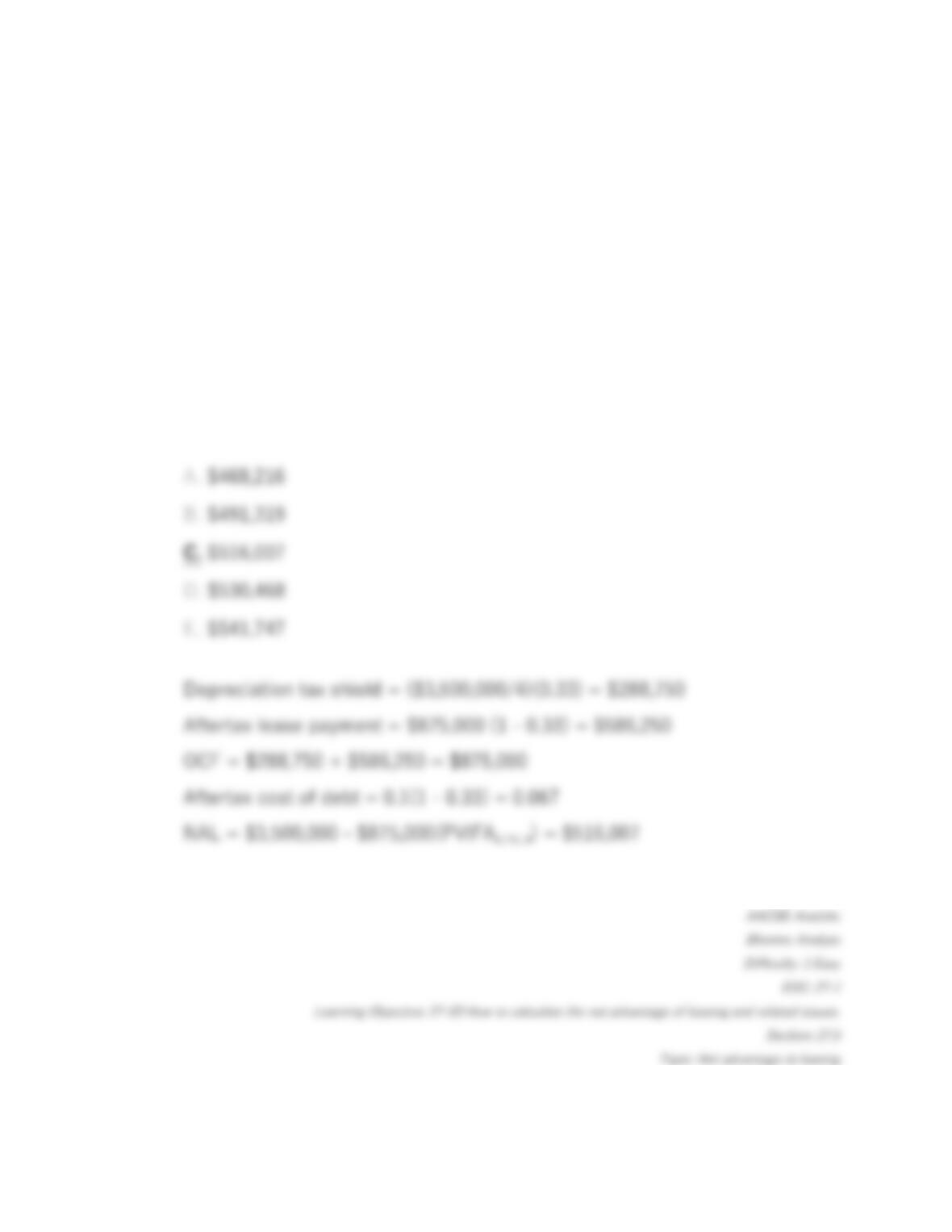
You work for a nuclear research laboratory that is contemplating leasing a
diagnostic scanner (leasing is a very common practice with expensive, high–
tech equipment). The scanner costs $3.5 million and it would be
depreciated straight-line to zero over 4 years. Because of radiation
contamination, it will actually be completely valueless in 4 years. You can
lease it for $875,000 per year for 4 years. Assume the tax rate is 33 percent.
You can borrow at 10 percent before taxes. What is the net advantage to
leasing from your company’s standpoint?
60.
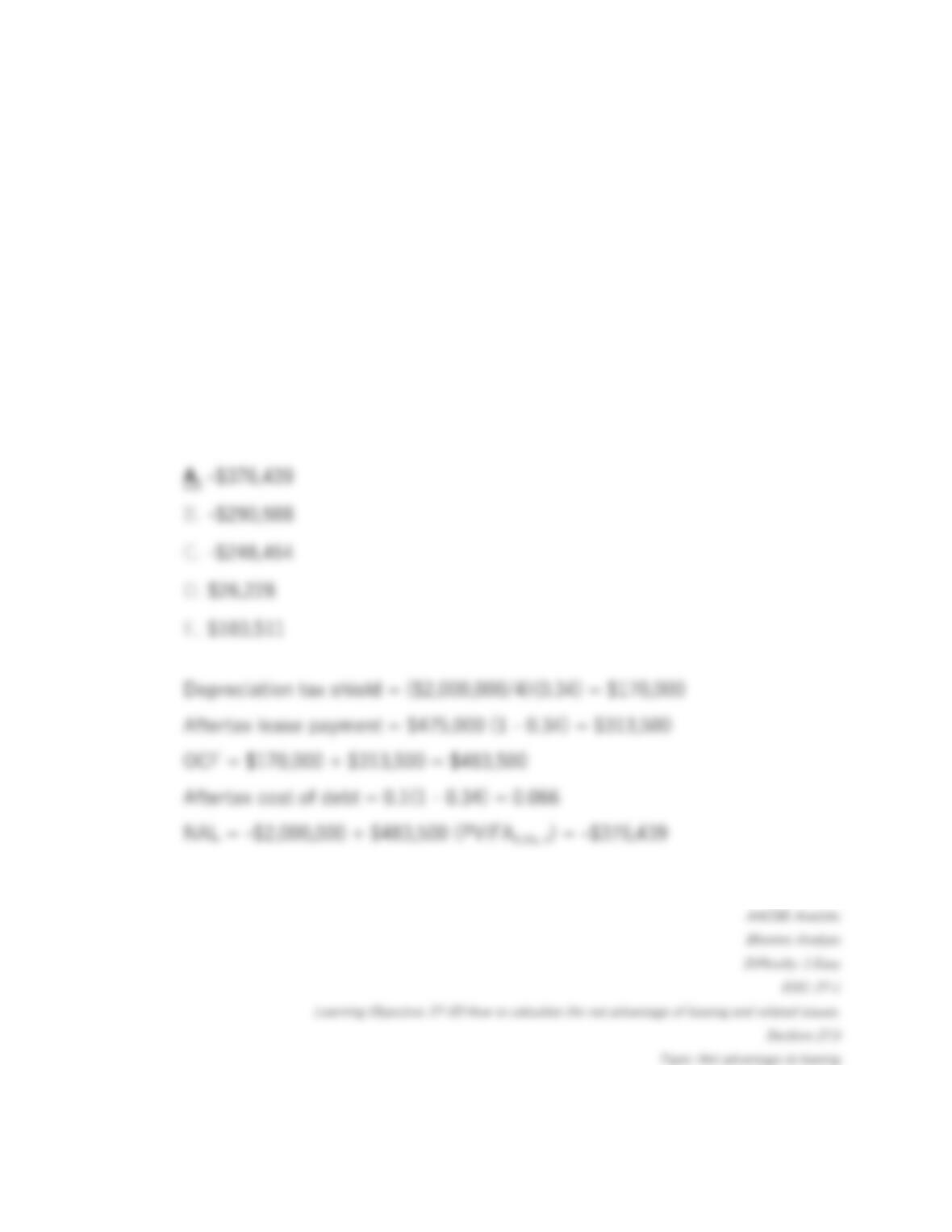
You work for a nuclear research laboratory that is contemplating leasing a
diagnostic scanner (leasing is a very common practice with expensive, high–
tech equipment). The scanner costs $2 million and it would be depreciated
straight-line to zero over 4 years. Because of radiation contamination, it will
actually be completely valueless in 4 years. You can lease it for $475,000
per year for 4 years. Assume the tax rate is 34 percent. You can borrow at
10 percent before taxes. What is the net advantage to leasing from the
lessor’s viewpoint?
61.
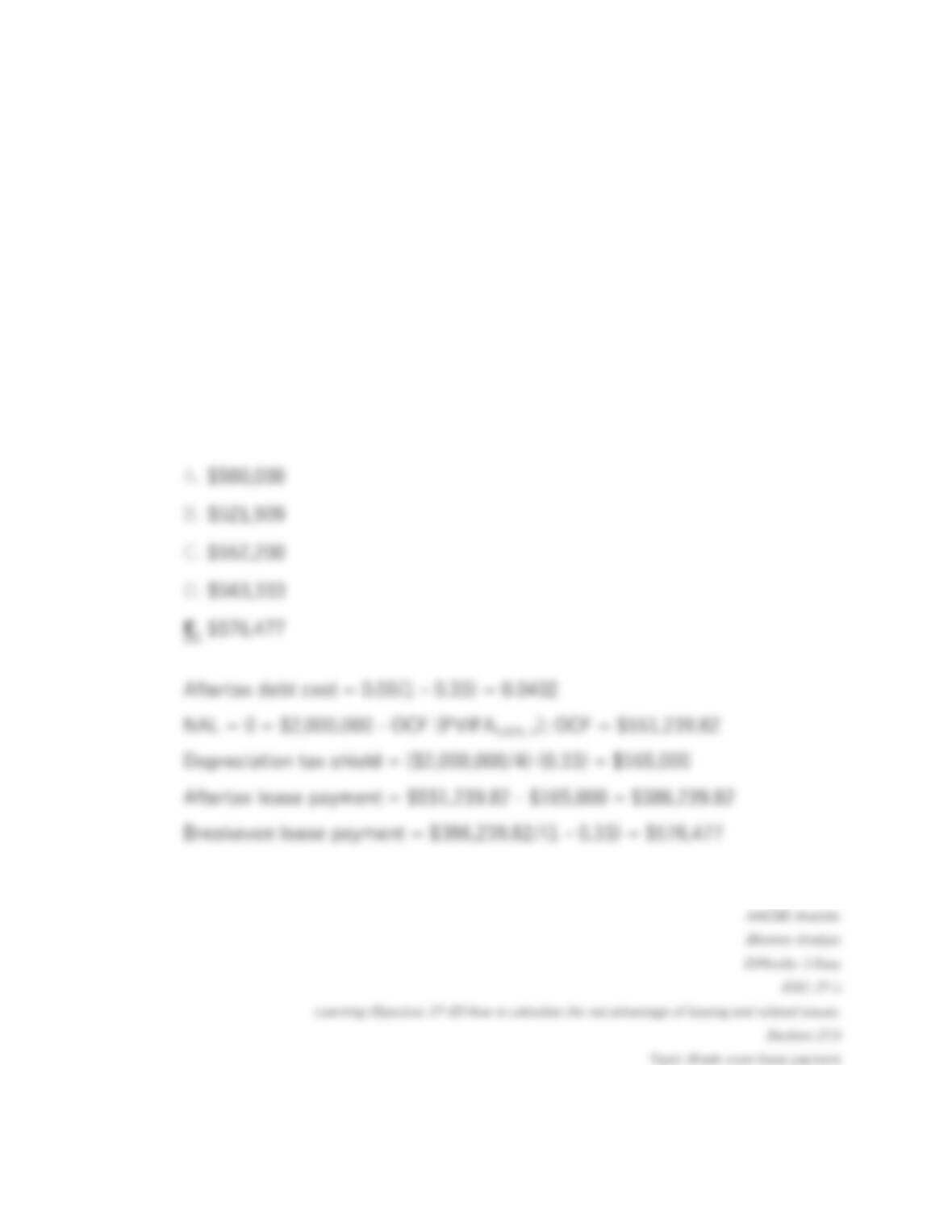
You work for a nuclear research laboratory that is contemplating leasing a
diagnostic scanner (leasing is a very common practice with expensive, high–
tech equipment). The scanner costs $2 million and it would be depreciated
straight-line to zero over 4 years. Because of radiation contamination, it will
actually be completely valueless in 4 years. Assume the tax rate is 33
percent. You can borrow at 6 percent before taxes. How much would the
lease payment have to be in order for both the lessor and the lessee to be
indifferent about the lease?
62.
You work for a nuclear research laboratory that is contemplating leasing a
diagnostic scanner (leasing is a very common practice with expensive, high–
tech equipment). The scanner costs $2.2 million and it would be
depreciated straight-line to zero over 4 years. Because of radiation
contamination, it will actually be completely valueless in 4 years. You can
lease it for $600,000 per year for 4 years. Assume your company does not
contemplate paying taxes for the next several years. You can borrow at 6
percent before taxes. What is the net advantage to leasing from your
company’s standpoint?
63.
You work for a nuclear research laboratory that is contemplating leasing a
diagnostic scanner (leasing is a very common practice with expensive, high–
tech equipment). The scanner costs $3 million and it would be depreciated
straight-line to zero over 4 years. Because of radiation contamination, it will
actually be completely valueless in 4 years. You can lease it for $750,000
per year for 4 years. Assume the tax rate is 31 percent. You can borrow at 8
percent before taxes. Your company does not expect to pay taxes for the
next several years, but the leasing company will pay taxes. What range of
lease payments will allow the lease to be profitable for both parties?

64.
The Wildcat Oil Company is trying to decide whether to lease or buy a new
computer-assisted drilling system for its oil exploration business.
Management has decided that it must use the system to stay competitive; it
will provide $850,000 in annual pretax cost savings. The system costs $8
million and will be depreciated straight-line to zero over 5 years. Wildcat’s
tax rate is 34 percent, and the firm can borrow at 8 percent. Lambert
Leasing Company has offered to lease the drilling equipment to Wildcat for
payments of $2,040,000 per year. Lambert’s policy is to require its lessees
to make payments at the start of the year. What is the maximum lease
payment that would be acceptable to the company?

65.
The Wildcat Oil Company is trying to decide whether to lease or buy a new
computer-assisted drilling system for its oil exploration business.
Management has decided that it must use the system to stay competitive; it
will provide $550,000 in annual pretax cost savings. The system costs $3
million and will be depreciated straight-line to zero over 4 years. It is
estimated that the equipment will have an aftertax residual value of
$500,000 at then end of the lease. Wildcat’s tax rate is 31 percent, and the
firm can borrow at 10 percent. Lambert Leasing Company has offered to
lease the drilling equipment to Wildcat for payments of $940,000 per year.
Lambert’s policy is to require its lessees to make payments at the start of
the year. What is the maximum lease payment that would be acceptable to
the company?
66.
The Wildcat Oil Company is trying to decide whether to lease or buy a new
computer-assisted drilling system for its oil exploration business.
Management has decided that it must use the system to stay competitive; it
will provide $1.2 million in annual pretax cost savings. The system costs
$6.7 million and will be depreciated straight-line to zero over 4 years.
Wildcat’s tax rate is 35 percent, and the firm can borrow at 11 percent.
Lambert Leasing Company has offered to lease the drilling equipment to
Wildcat for payments of $1,700,000 per year. Lambert’s policy is to require
its lessees to make payments at the start of the year. Lambert requires
Wildcat to pay a $270,000 security deposit at the inception of the lease.
What is the NAL of leasing the equipment?
67.
An asset costs $420,000 and will be depreciated in a straight-line manner
over its 3-year life. It will have no salvage value. The corporate tax rate is 32
percent, and the cost of borrowing is 8 percent. What lease payment
amount will make the lessee and the lessor equally well off?

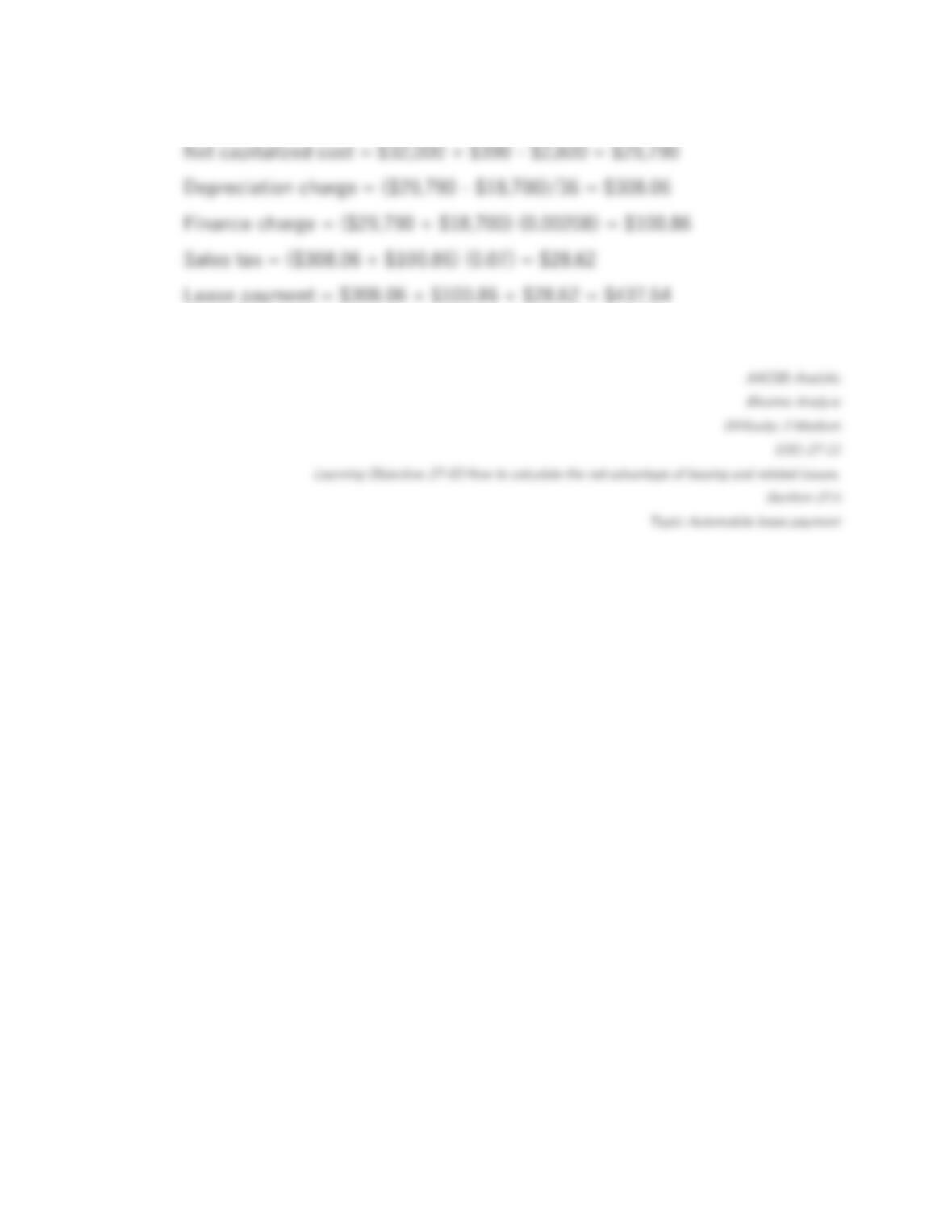
68.
Automobiles are often leased, and several terms are unique to auto leases.
Suppose you are considering leasing a car. The price you and the dealer
agree on for the car is $32,000. This is the base capitalized cost. Other
costs added to the capitalized cost price include the acquisition (bank) fee,
insurance, or extended warranty. Assume these costs are $390.
Capitalization cost reductions include any down payment, credit of trade-in,
or dealer rebate. Assume you make a down payment of $2,600, and there is
no trade-in or rebate. If you drive 11,000 miles per year, the lease-end
residual value for this car will be $18,700 after three years. The lease factor,
which is the interest rate on the loan, is the APR of the loan divided by
2,400. (We’re not really sure where the 2,400 comes from, either.) The lease
factor the dealer quotes you is 0.00208. The monthly lease payment
consists of three parts; a depreciation fee, a finance fee, and sales tax. The
depreciation fee is the net capitalization cost minus the residual value,
divided by the term of the lease. The net capitalization cost is the cost of
the car minus any cost reductions plus any additional costs. The finance fee
is the net capitalization cost plus the residual, times the money factor, and
the monthly sales tax is simply the monthly lease payments times the tax
rate. What is your monthly lease payment for a 36-month lease if the sales
tax is 7 percent?
Essay Questions
69.
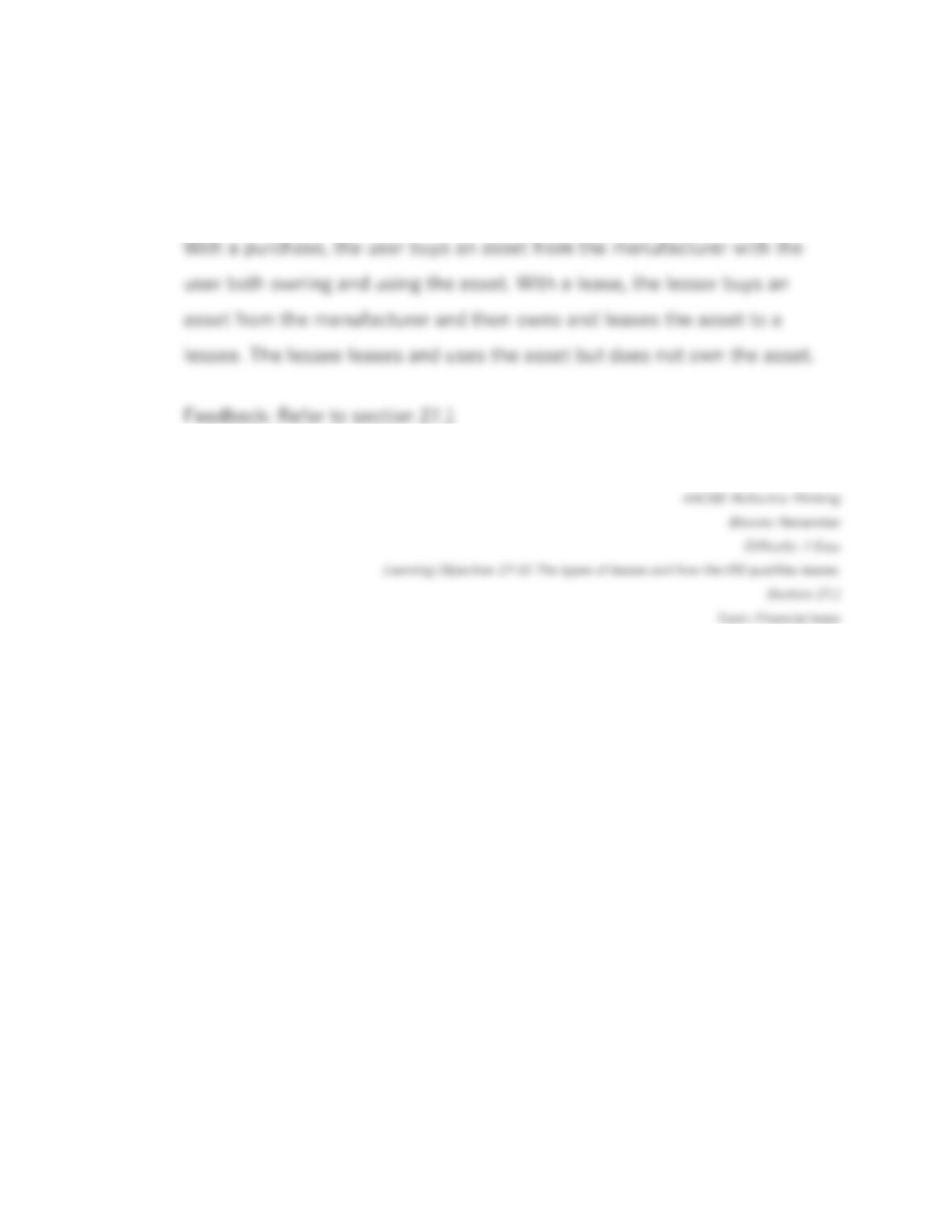
Explain the differences between purchasing an asset and leasing an asset.
70.
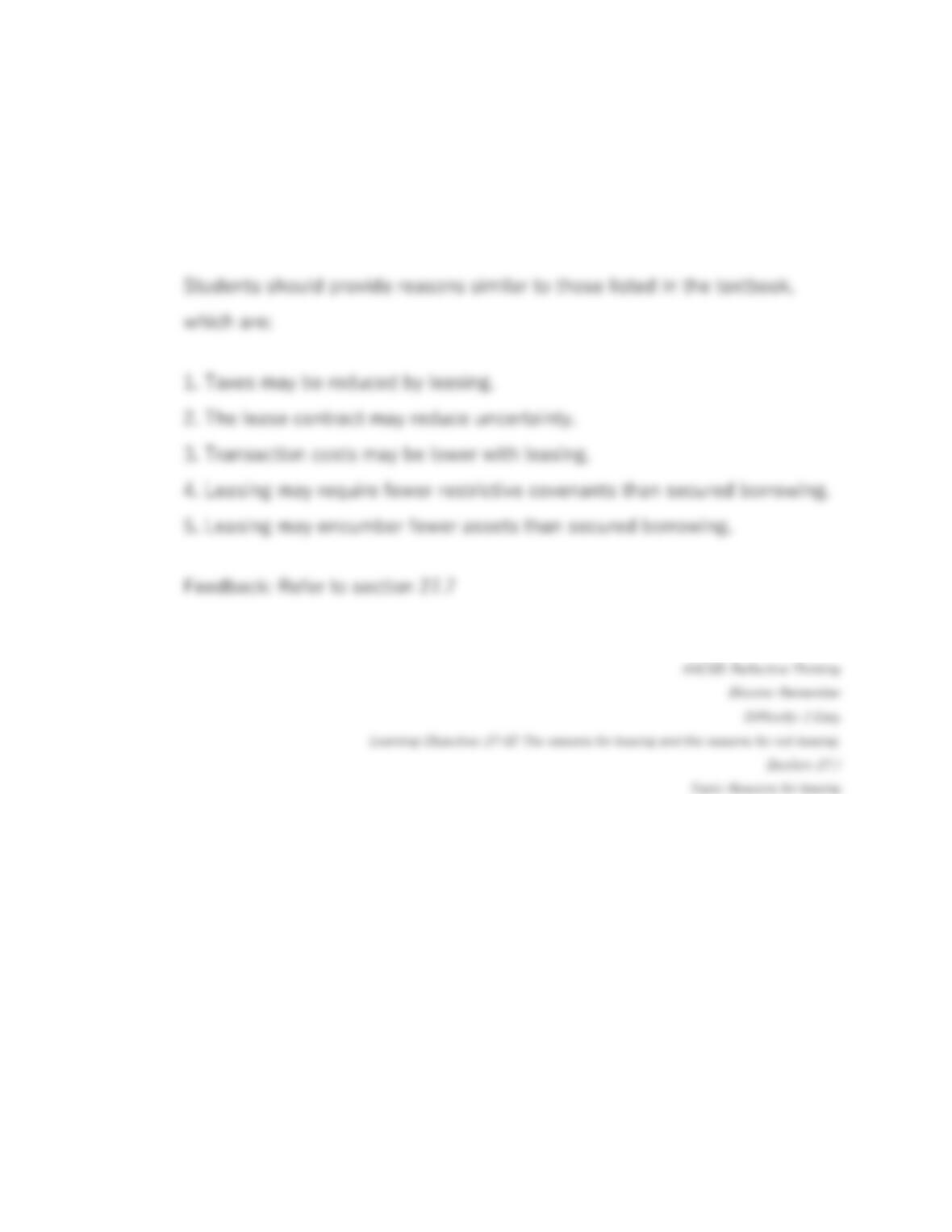
What are some “good” reasons for opting to lease rather than purchase an
asset?
71.
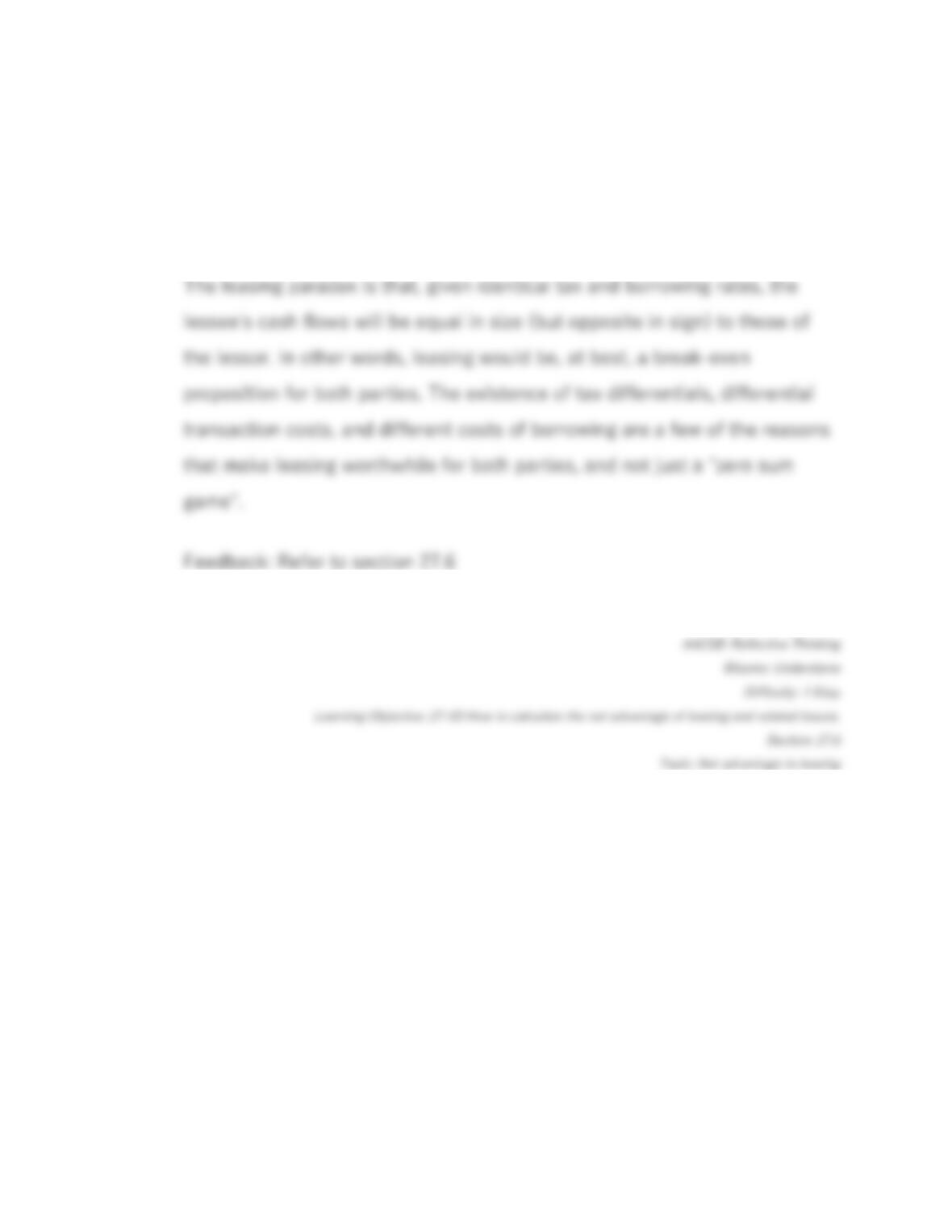
Explain the “leasing paradox” and also explain why leasing is or is not a
“zero sum game”.
72.
Why might a firm opt to sell and leaseback an asset which it currently
owns?