Chapter 27: Providing and Obtaining Credit
24. Which one of the following aspects of banks is considered most relevant to businesses when choosing a bank?
a. Competitive cost of services provided.
b. Size of the bank’s deposits.
c. Experience of personnel.
d. Loyalty and willingness to assume lending risks.
e. Convenience of location.
Exhibit Brother‘s Loan
Your brother has just taken out a loan for $75,000. The stated (simple) interest rate on this loan is 10 percent, and the bank
requires him to maintain a compensating balance equal to 15 percent of the initial face amount of the loan. He currently
has $20,000 in his checking account, and he plans to maintain this balance. The loan is an add-on installment loan which
he will repay in 12 equal monthly installments, beginning at the end of the first month.
25. Refer to Exhibit Brother’s Loan. How large are your brother’s monthly payments?
a. $6,250
b. $7,000
c. $7,500
d. $5,250
e. $6,875
Chapter 27: Providing and Obtaining Credit
26. Refer to Exhibit Brother’s Loan. What is the nominal annual add-on interest rate on this loan?
a. 10.00%
b. 16.47%
c. 18.83%
d. 20.00%
e. 24.00%
27. Suppose that you’re planning a vacation and borrow $2,000 from a bank for one year at a stated annual interest rate of
14 percent, with interest prepaid (a discounted loan). Also, assume that the bank requires you to maintain a compensating
balance equal to 20 percent of the initial loan value. What effective annual interest rate are you being charged?
a. 14.00%
b. 8.57%
c. 16.28%
d. 21.21%
e. 28.00%
Chapter 27: Providing and Obtaining Credit
28. Faircross Farms harvests its crops four times annually and receives payment for its crop 90 days after it is picked and
shipped. However, planting, irrigating, and harvesting must be done on a nearly continual schedule. The firm uses 90-day
bank notes to finance its operations. The firm arranges an 11 percent discount interest loan with a 20 percent
compensating balance four times annually. What is the effective annual interest rate of these discount loans?
a. 11.00%
b. 15.94%
c. 11.46%
d. 13.75%
e. 12.72%
29. Gladys Turner borrowed $12,000 from the bank using a 10.19 percent “add-on“, one-year installment loan, payable in
four equal quarterly payments. What is the effective annual rate of interest?
Chapter 27: Providing and Obtaining Credit
a. 9.50%
b. 10.19%
c. 15.99%
d. 16.98%
e. 20.38%
30. The Arthos Group needs to borrow $200,000 from its bank. The bank has offered the company a 12-month installment
loan (monthly payments) with 9 percent add-on interest. What is the effective annual rate (EAR) of this loan?
a. 16.22%
b. 17.97%
c. 17.48%
d. 18.67%
e. 18.00%
Chapter 27: Providing and Obtaining Credit
31. The Somerset Bank offered Blakemore Inc. the following loan alternatives in response to its request for a $75,000, 1-
year loan.
Alternative 1: 7 percent discount interest, with a 10 percent compensating balance.
Alternative 2: 8 percent simple interest, with interest paid monthly.
What is the effective annual rate on the cheaper loan?
a. 8.00%
b. 7.23%
c. 7.67%
d. 8.43%
e. 8.30%
32. Harris Flooring Inc. is planning to borrow $12,000 from the bank for new sanding machines. The bank offers the
choice of a 12 percent discount interest loan or a 10.19 percent add-on, one-year installment loan, payable in 4 equal
quarterly payments. What is the effective rate of interest on the 12 percent discounted loan?
a. 10.7%
b. 12.0%
c. 12.5%
d. 13.6%
e. 14.1%
Chapter 27: Providing and Obtaining Credit
33. Maxwell Gardens requires a $100,000 annual loan in order to pay laborers to tend and harvest its organic vegetable
crop. Maxwell borrows on a discount interest basis at a nominal annual rate of 11 percent. If Maxwell must actually
receive $100,000 net proceeds to finance its crop, then what must be the face value of the note?
a. $111,000
b. $100,000
c. $112,360
d. $89,000
e. $108,840
Chapter 27: Providing and Obtaining Credit
34. Sunnydale Organics, Inc. harvests crops in roughly 90-day cycles based on a 360-day year. The firm receives payment
from its harvests sometime after shipment. Due in part to the firm’s rapid growth, it has been borrowing to finance its
harvests using 90-day bank notes on which the firm pays 12 percent discount interest. If the firm requires $60,000 in
proceeds from each note, what must be the face value of each note?
a. $61,856
b. $67,531
c. $60,000
d. $68,182
e. $67,423
35. Danby Design Inc. has approached the bank with its plan to borrow $12,000. The bank offers the choice of a 12
percent discount interest loan or a 10.19 percent add-on, one-year installment loan, payable in 4 equal quarterly payments.
What is the approximate (nominal) rate of interest on the 10.19 percent add-on loan?
a. 5.10%
b. 10.19%
c. 12.00%
d. 20.38%
e. 30.57%
Chapter 27: Providing and Obtaining Credit
36. Darren’s Hair Products, Inc. purchases supplies from a single supplier on terms of 1/10, net 20. Currently, Darren takes
the discount, but she believes she could extend the payment to 40 days without any adverse effects if she decided not to
take the discount. Darren needs an additional $50,000 to support an expansion of fixed assets. This amount could be
raised by making greater use of trade credit or by arranging a bank loan. The banker has offered to loan the money at 12
percent discount interest. Additionally, the bank requires an average compensating balance of 20 percent of the loan
amount. Darren already has a commercial checking account at this bank that could be counted toward the compensating
balance, but the required compensating balance amount is twice the amount that Darren would otherwise keep in the
account. Which of the following statements is most correct?
a. The cost of using additional trade credit is approximately 36 percent.
b. Considering only the explicit costs, Darren should finance the expansion with the bank loan.
c. The cost of expanding trade credit using the approximation formula is less than the cost of the bank loan.
However, the true cost of the trade credit when compounding is considered is greater than the cost of the bank loan.
d. The effective cost of the bank loan is decreased from 17.65 percent to 15.38 percent because Darren would hold a
cash balance of one-half the compensating balance amount even if the loan were not taken.
e. If Darren had transaction balances that exceeded the compensating balance requirement, the effective cost of the
bank loan would be 12.00 percent.
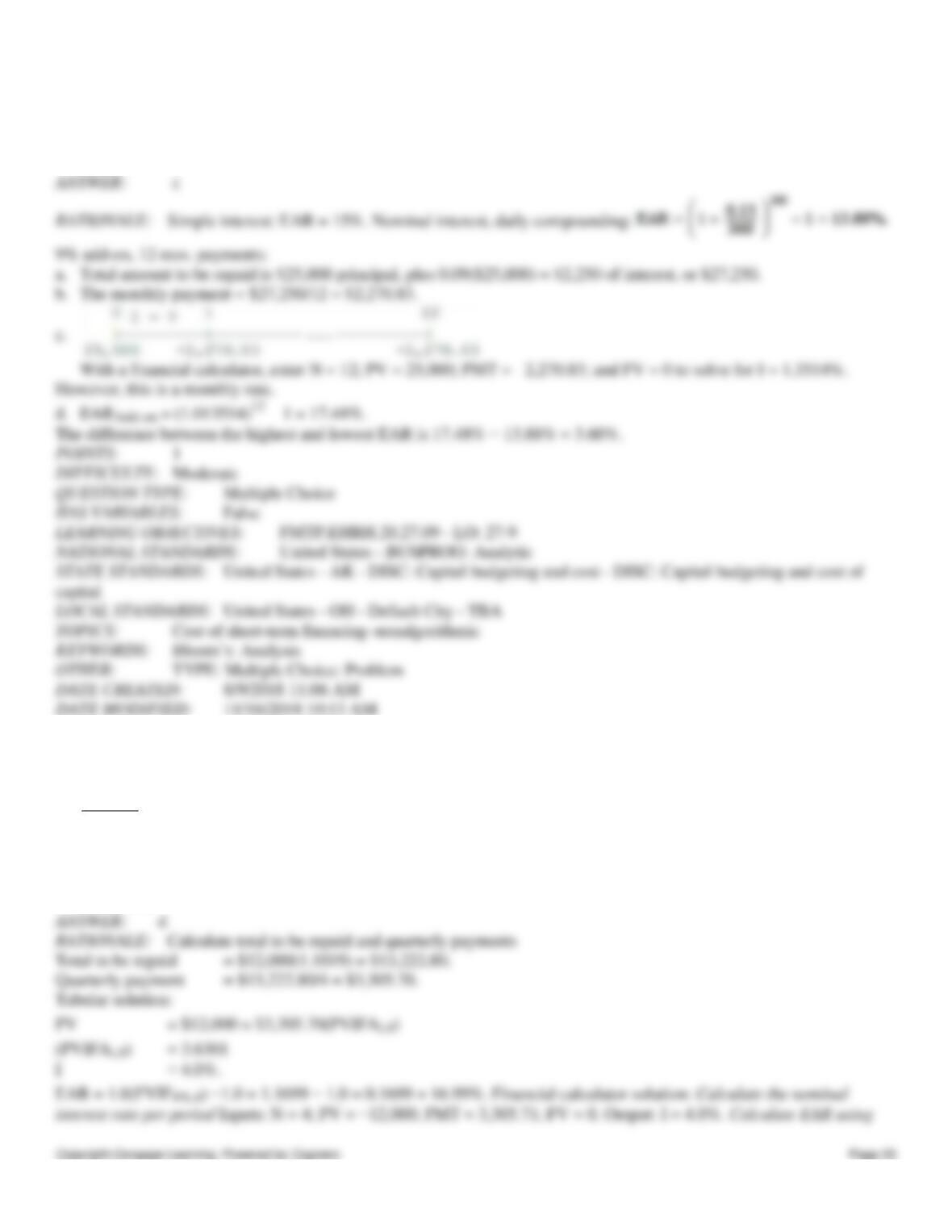
37. Tillyard Inc. requires a $25,000 1-year loan. The bank offers to make the loan, and it offers you three choices: (1) 15
percent simple interest, annual compounding; (2) 13 percent nominal interest, daily compounding (360-day year); (3) 9
percent add-on interest, 12 end-of-month payments. The first two loans would require a single payment at the end of the
year, the third would require 12 equal monthly payments beginning at the end of the first month. What is the difference
between the highest and lowest effective annual rates?
a. 1.12%
Chapter 27: Providing and Obtaining Credit
b. 2.48%
c. 3.60%
d. 4.25%
e. 5.00%
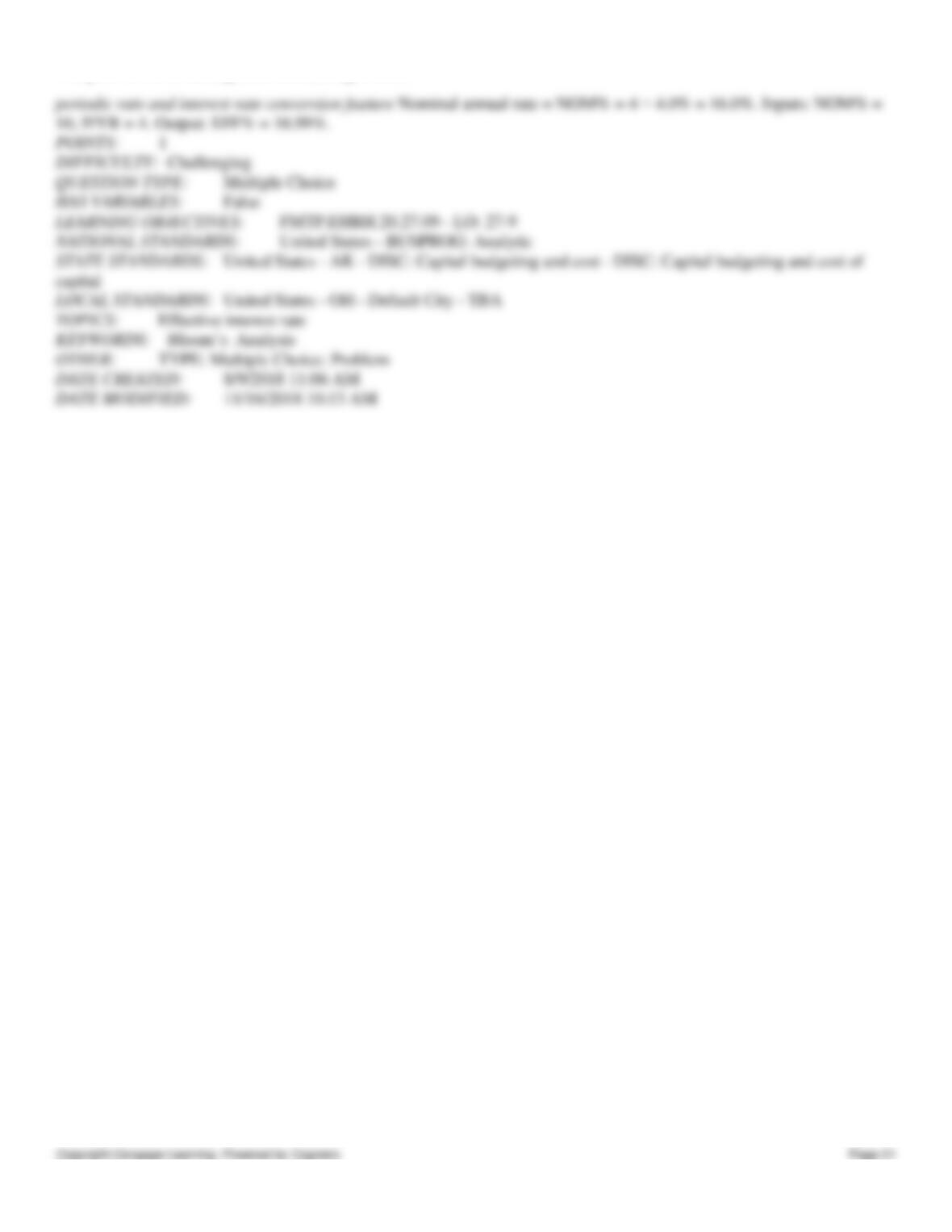
38. No Tree Too Tall, Inc. is planning to borrow $12,000 from the bank. The bank offers the choice of a 12 percent
discount interest loan or a 10.19 percent add-on, one-year installment loan, payable in 4 equal quarterly payments. What is
the effective rate of interest on the 10.19 percent add-on loan?
a. 9.50%
b. 10.19%
c. 15.22%
d. 16.99%
e. 22.05%
Chapter 27: Providing and Obtaining Credit