Chapter 25: Portfolio Theory and Asset Pricing Models
28. Assume that the market is in equilibrium and that stock betas can be estimated with historical data. The returns on the
market, the returns on United Fund (UF), the risk-free rate, and the required return on the United Fund are shown below.
Based on this information, what is the required return on the market, rM?
Year Market UF
2011 −9% −14%
2012 11% 16%
2013 15% 22%
2014 5% 7%
2015 −1% −2%
rRF: 7.00%; rUnited: 15.00%
a. 10.57%
b. 11.13%
c. 11.72%
d. 12.33%
e. 12.95%
Chapter 25: Portfolio Theory and Asset Pricing Models
29. You are given the following returns on “the market” and Stock F during the last three years. We could calculate beta
using data for Years 1 and 2 and then, after Year 3, calculate a new beta for Years 2 and 3. How different are those two
betas, i.e., what’s the value of beta 2 − beta 1? (Hint: You can find betas using the Rise-Over-Run method, or using your
calculator’s regression function.)
Year Market Stock F
1 6.10% 6.50%
2 12.90% −3.70%
3 16.20% 21.71%
Chapter 25: Portfolio Theory and Asset Pricing Models
a. 7.89
b. 8.30
c. 8.74
d. 9.20
e. 9.66
30. For markets to be in equilibrium (that is, for there to be no strong pressure for prices to depart from their current
levels),
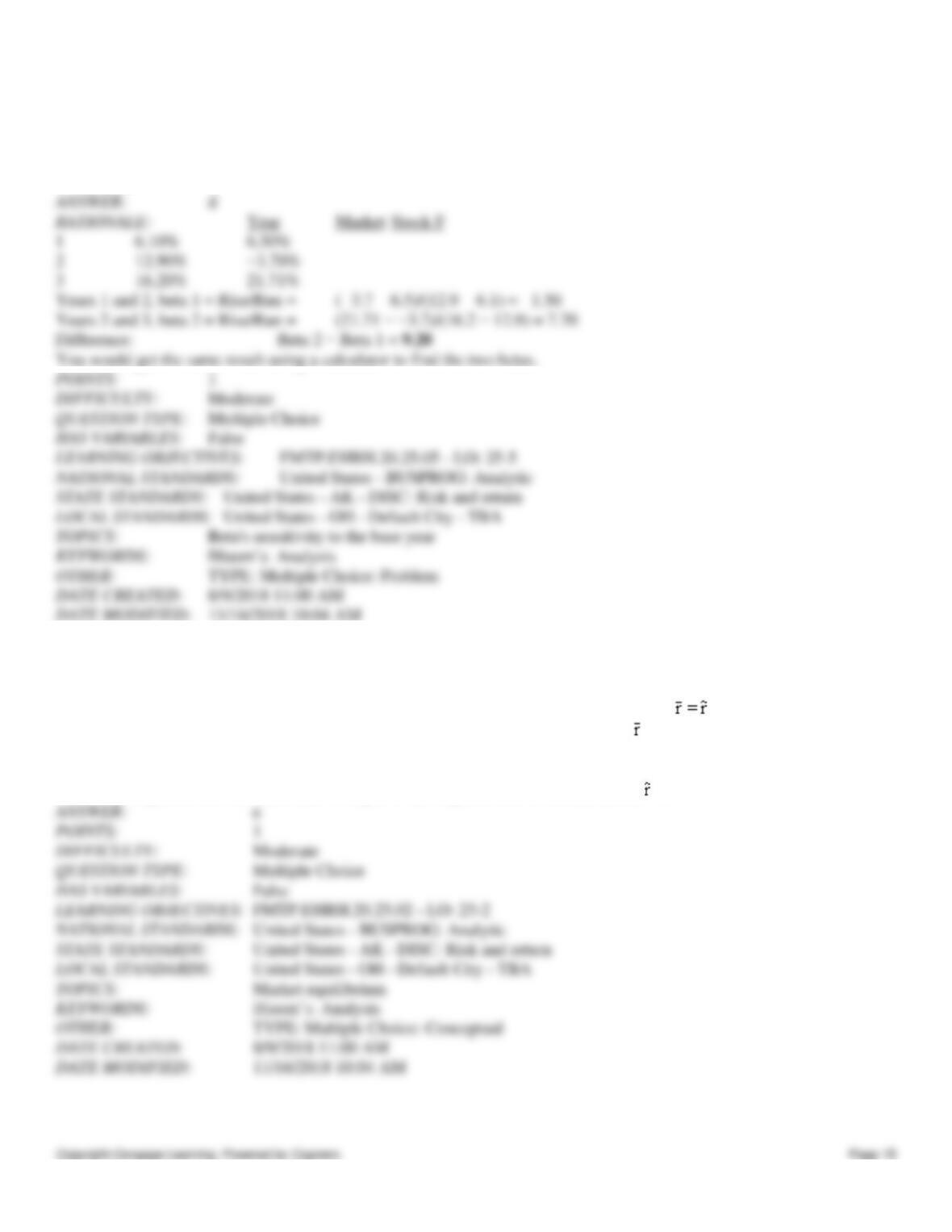
a. The past realized rate of return must be equal to the expected rate of return; that is, .
b. The required rate of return must equal the realized rate of return; that is, r = .
c. All companies must pay dividends.
d. No companies can be in danger of declaring bankruptcy.
e. The expected rate of return must be equal to the required rate of return; that is, = r.
Chapter 25: Portfolio Theory and Asset Pricing Models
31. Assume an economy in which there are three securities: Stock A with rA = 10% and σA = 10%; Stock B with rB =
15% and σB = 20%; and a riskless asset with rRF = 7%. Stocks A and B are uncorrelated (rAB = 0). Which of the
following statements is most CORRECT?
a. The expected return on the investor’s portfolio will probably have an expected return that is somewhat below 10%
and a standard deviation (SD) of approximately 10%.
b. The expected return on the investor’s portfolio will probably have an expected return that is somewhat below 15%
and a standard deviation (SD) that is between 10% and 20%.
c. The investor’s risk/return indifference curve will be tangent to the CML at a point where the expected return is in
the range of 7% to 10%.
d. Since the two stocks have a zero correlation coefficient, the investor can form a riskless portfolio whose expected
return is in the range of 10% to 15%.
e. The expected return on the investor’s portfolio will probably have an expected return that is somewhat above 15%
and a standard deviation (SD) of approximately 20%.
Chapter 25: Portfolio Theory and Asset Pricing Models
32. Which of the following statements is CORRECT?
a. Richard Roll has argued that it is possible to test the CAPM to see if it is correct.
b. Tests have shown that the risk/return relationship appears to be linear, but the slope of the relationship is greater
than that predicted by the CAPM.
c. Tests have shown that the betas of individual stocks are stable over time, but that the betas of large portfolios are
much less stable.
d. The most widely cited study of the validity of the CAPM is one performed by Modigliani and Miller.
e. Tests have shown that the betas of individual stocks are unstable over time, but that the betas of large portfolios
are reasonably stable over time.
Subjective Short Answer
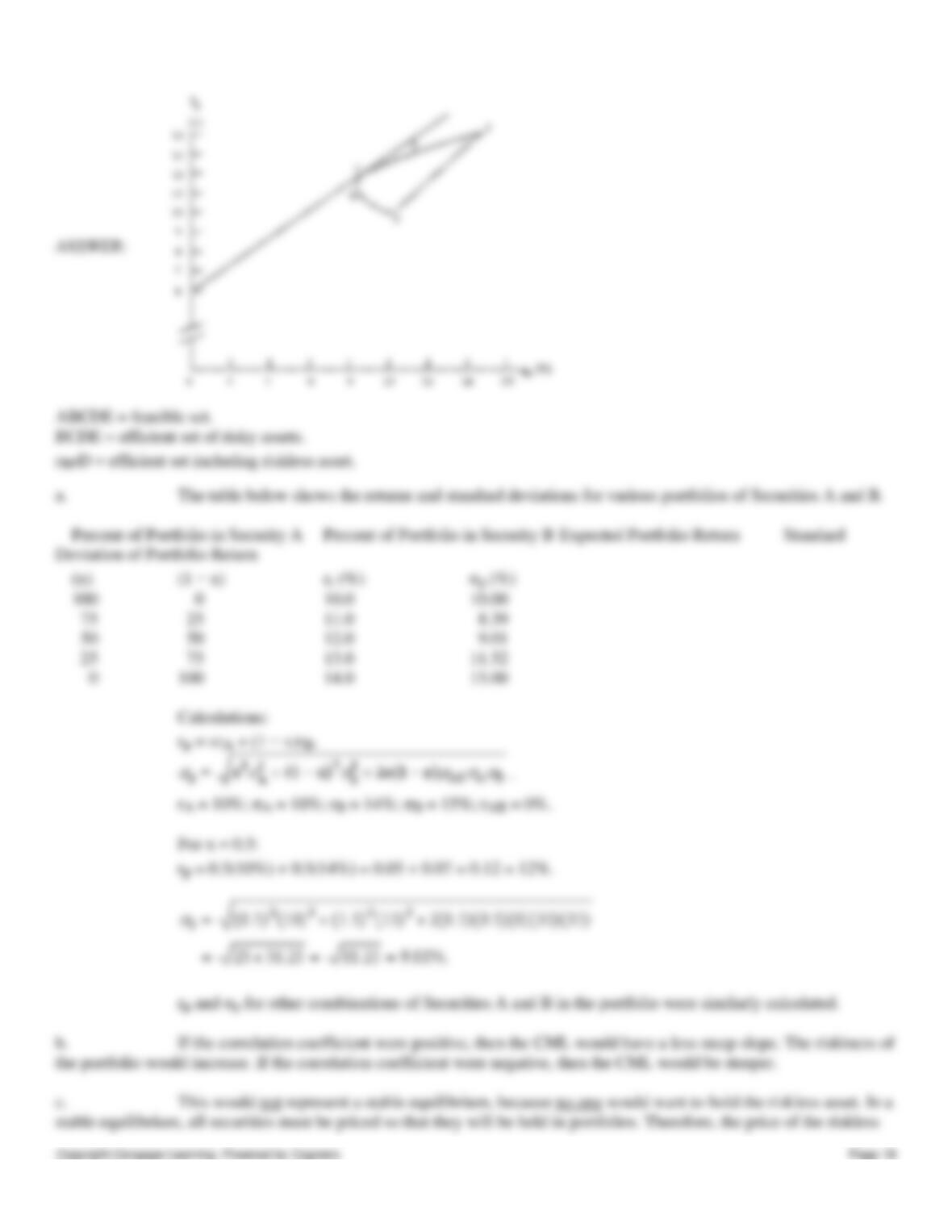
33. Stock A has an expected return rA = 10% and σA = 10%. Stock B has rB = 14% and σB = 15%. rAB = 0. The rate of
return on riskless assets is 6%.
a. Construct a graph that shows the feasible and efficient sets, giving consideration to the existence of the riskless asset.
b. Explain what would happen to the CML if the two stocks had (a) a positive correlation coefficient or (b) a negative
correlation coefficient.
c. Suppose these were the only three securities (A, B, and riskless) in the economy, and everyone’s indifference curves
were such that they were tangent to the CML to the right of the point where the CML was tangent to the efficient set of
risky assets. Would this represent a stable equilibrium? If not, how would an equilibrium be produced?
Chapter 25: Portfolio Theory and Asset Pricing Models
Chapter 25: Portfolio Theory and Asset Pricing Models
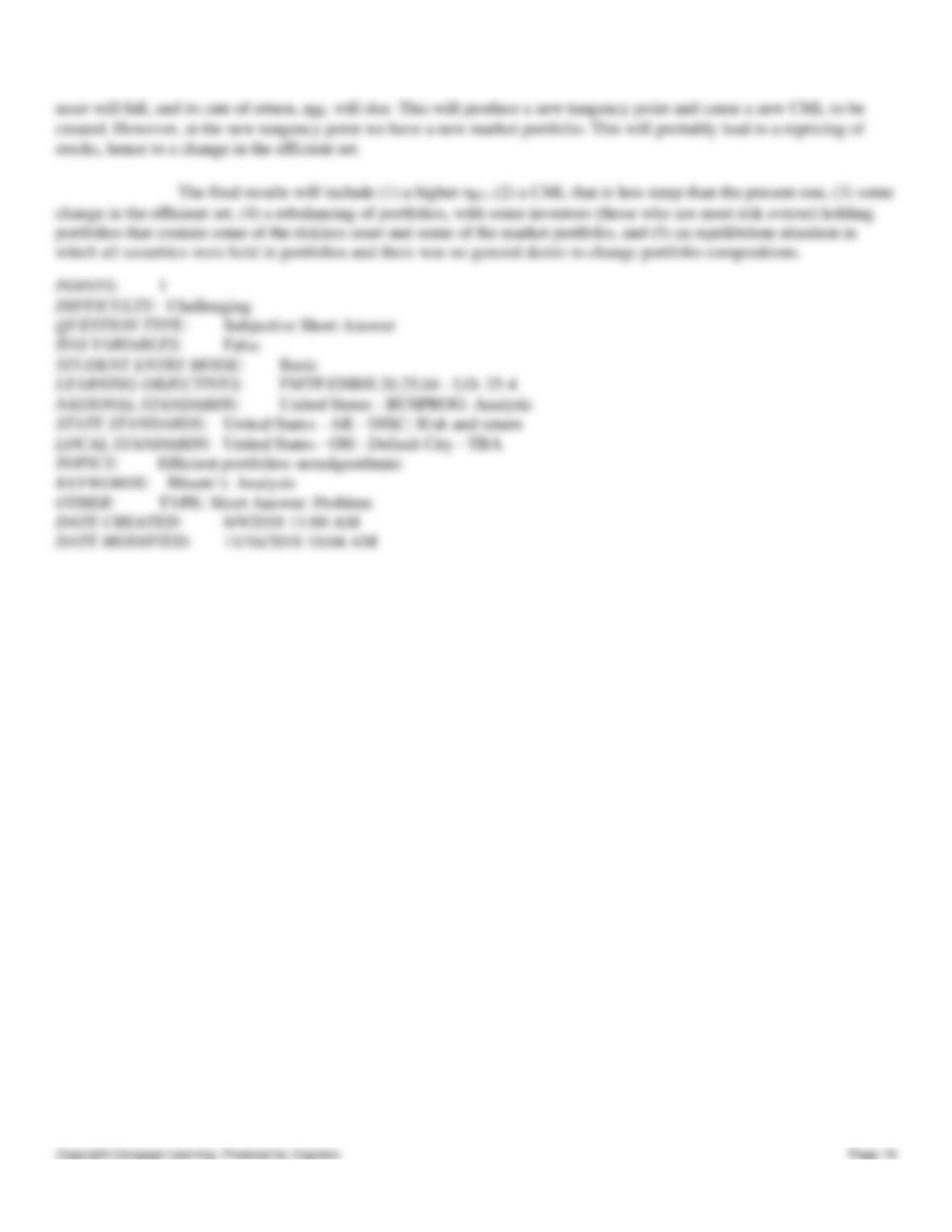
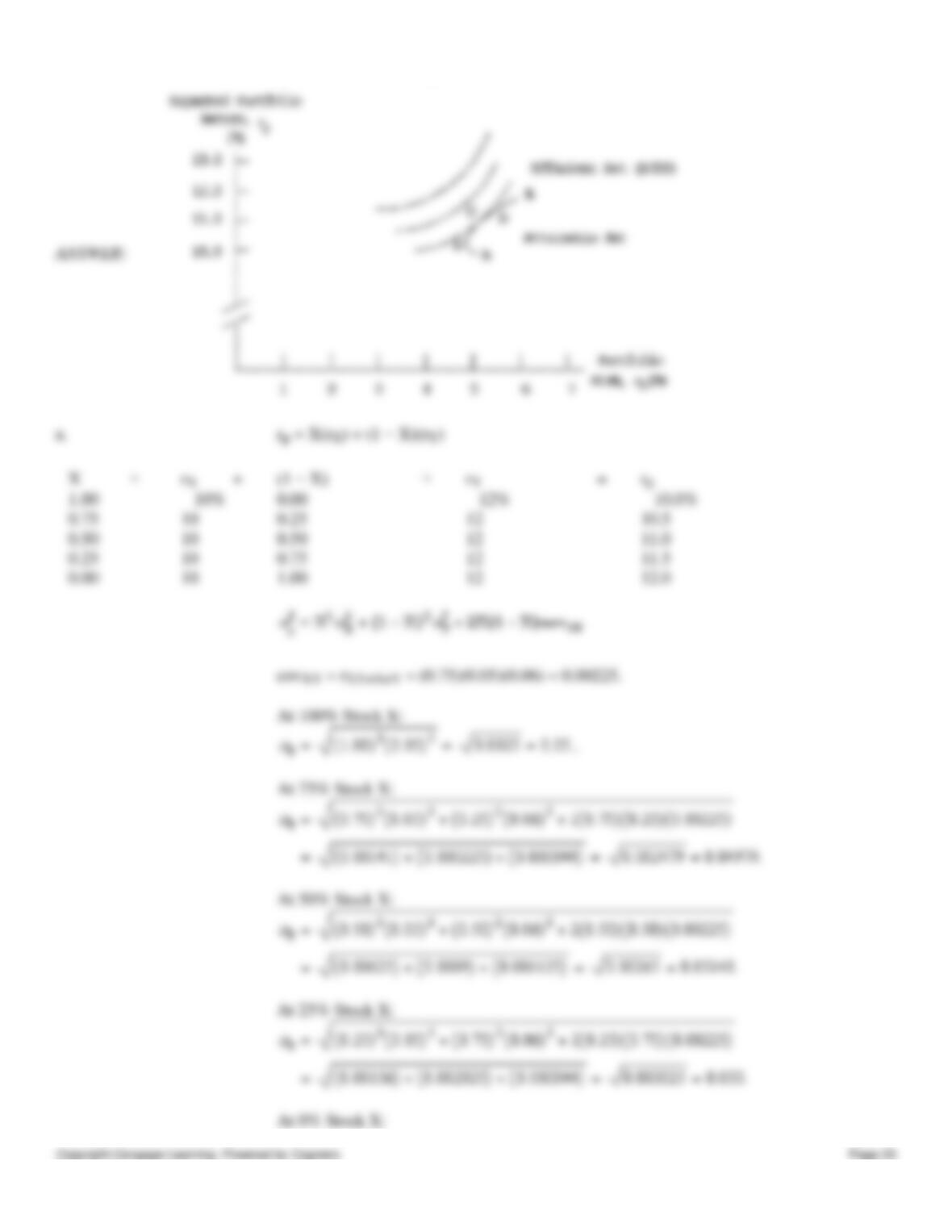
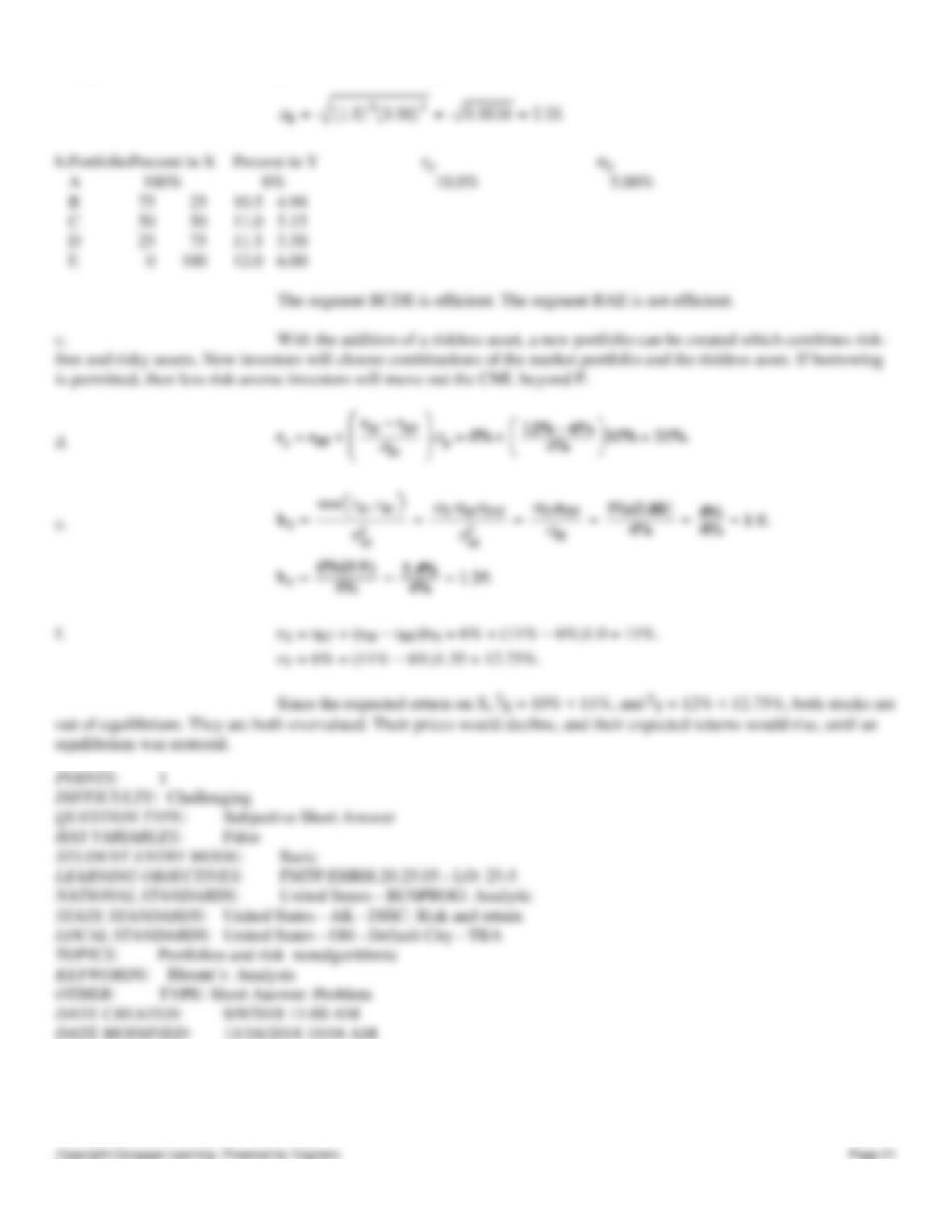
34. You plan to invest in Stock X, Stock Y, or some combination of the two. The expected return for X is 10% and σX =
5%. The expected return for Y is 12% and σY = 6%. The correlation coefficient, rXY, is 0.75.
a. Calculate rp and σp for 100%, 75%, 50%, 25%, and 0% in Stock X.
b. Use the values you calculated for rp and σp to graph the attainable set of portfolios. Which part of the attainable set is
efficient? Also, draw in a set of hypothetical indifference curves to show how an investor might select a portfolio
comprised of Stocks X and Y. Let an indifference curve be tangent to the efficient set at the point where rp = 11%.
c. Now suppose we add a riskless asset to the investment possibilities. What effects will this have on the construction of
portfolios?
d. Suppose rM = 12%, σM = 4%, and rRF = 6%. What would be the required and expected return on a portfolio with σP
= 10%?
e. Suppose the correlation of Stock X with the market, rXM, is 0.8, while rYM = 0.9. Use this information, along with
data given previously, to determine Stock X’s and Stock Y’s beta coefficients.
f. What is the required rate of return on Stocks X and Y? Do these stocks appear to be in equilibrium? If not, what
would happen to bring about an equilibrium?
Chapter 25: Portfolio Theory and Asset Pricing Models
Chapter 25: Portfolio Theory and Asset Pricing Models
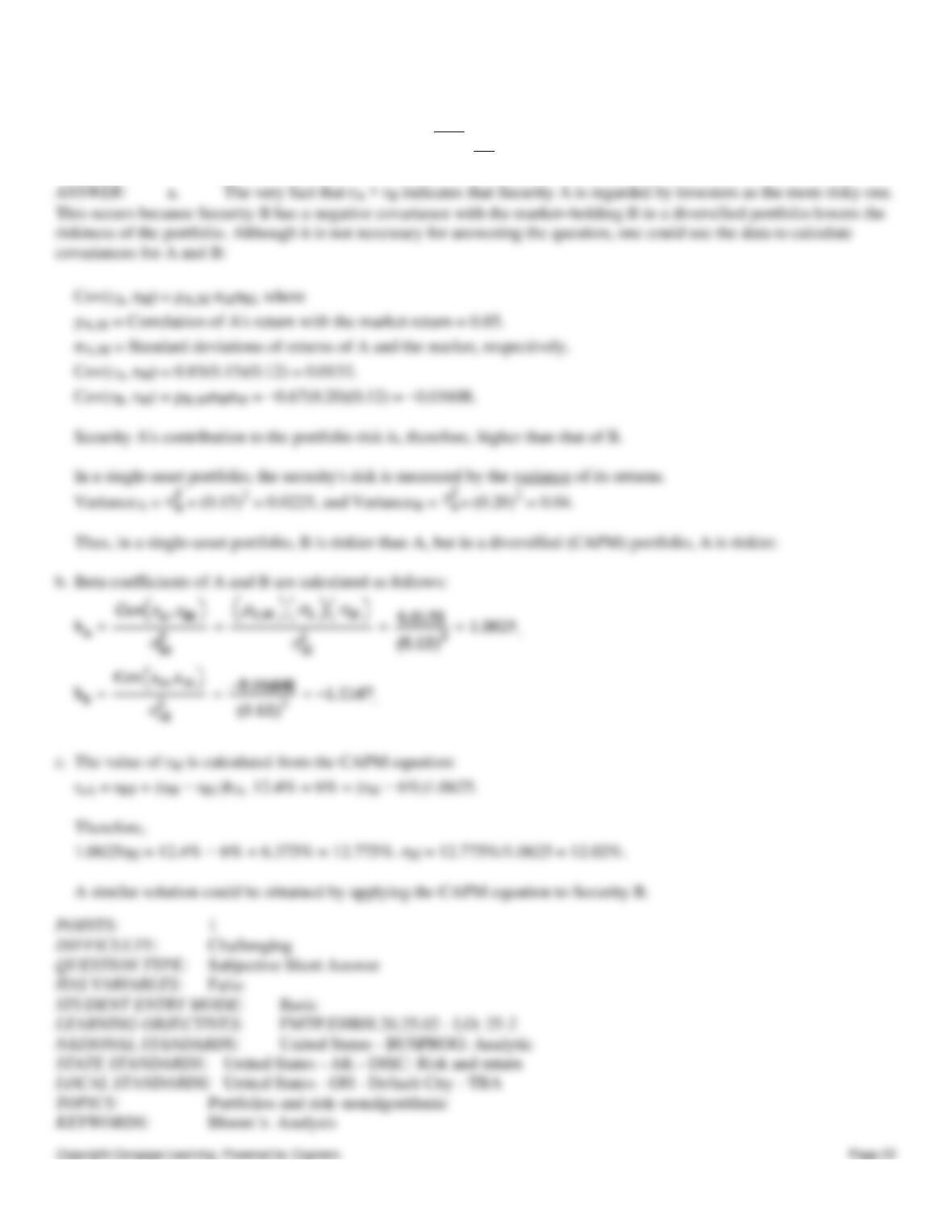
35. Security A has an expected return of 12.4% with a standard deviation of 15%, and a correlation with the market of
0.85. Security B has an expected return of −0.73% with a standard deviation of 20%, and a correlation with the market of
−0.67. The standard deviation of rM is 12%.
Chapter 25: Portfolio Theory and Asset Pricing Models
a. To someone who acts in accordance with the CAPM, which security is more risky, A or B? Why? (Hint: No
calculations are necessary to answer this question; it is easy.)
b. What are the beta coefficients of A and B? Calculations are necessary.
c. If the risk-free rate is 6%, what is the value of rM?

Chapter 25: Portfolio Theory and Asset Pricing Models