Test Bank for Accounting, Tools for Business Decision Making Fifth Edition
24–40
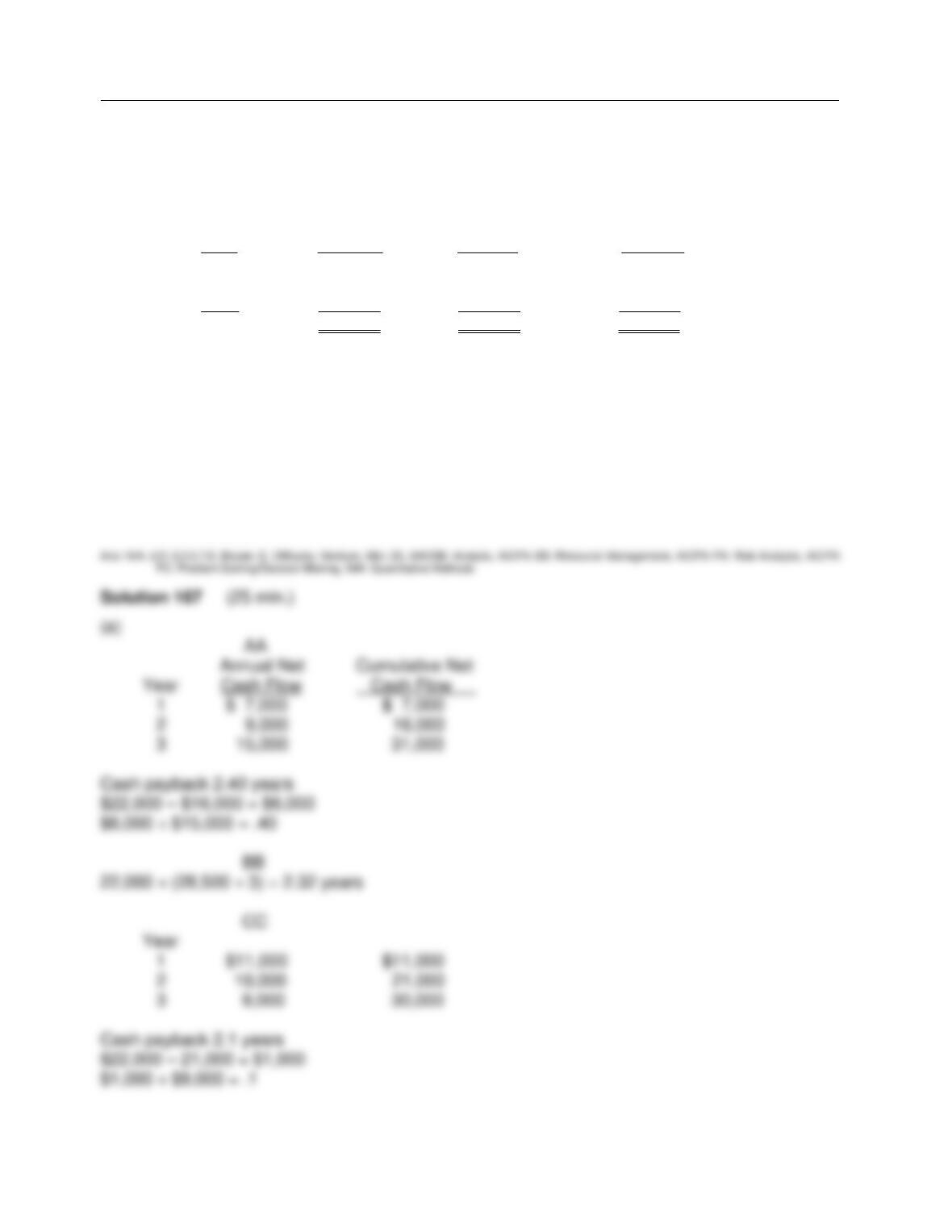
Ex. 167
Cepeda Manufacturing Company is considering three new projects, each requiring an equipment
investment of $22,000. Each project will last for 3 years and produce the following cash inflows.
Year AA BB CC
1 $ 7,000 $ 9,500 $11,000
2 9,000 9,500 10,000
3 15,000 9,500 9,000
Total $31,000 $28,500 $30,000
The equipment’s salvage value is zero. Cepeda uses straight-line depreciation. Cepeda will not
accept any project with a payback period over 2 years. Cepeda’s minimum required rate of return
is 12%.
Instructions
(a) Compute each project’s payback period, indicating the most desirable project and the least
desirable project using this method. (Round to two decimals.)
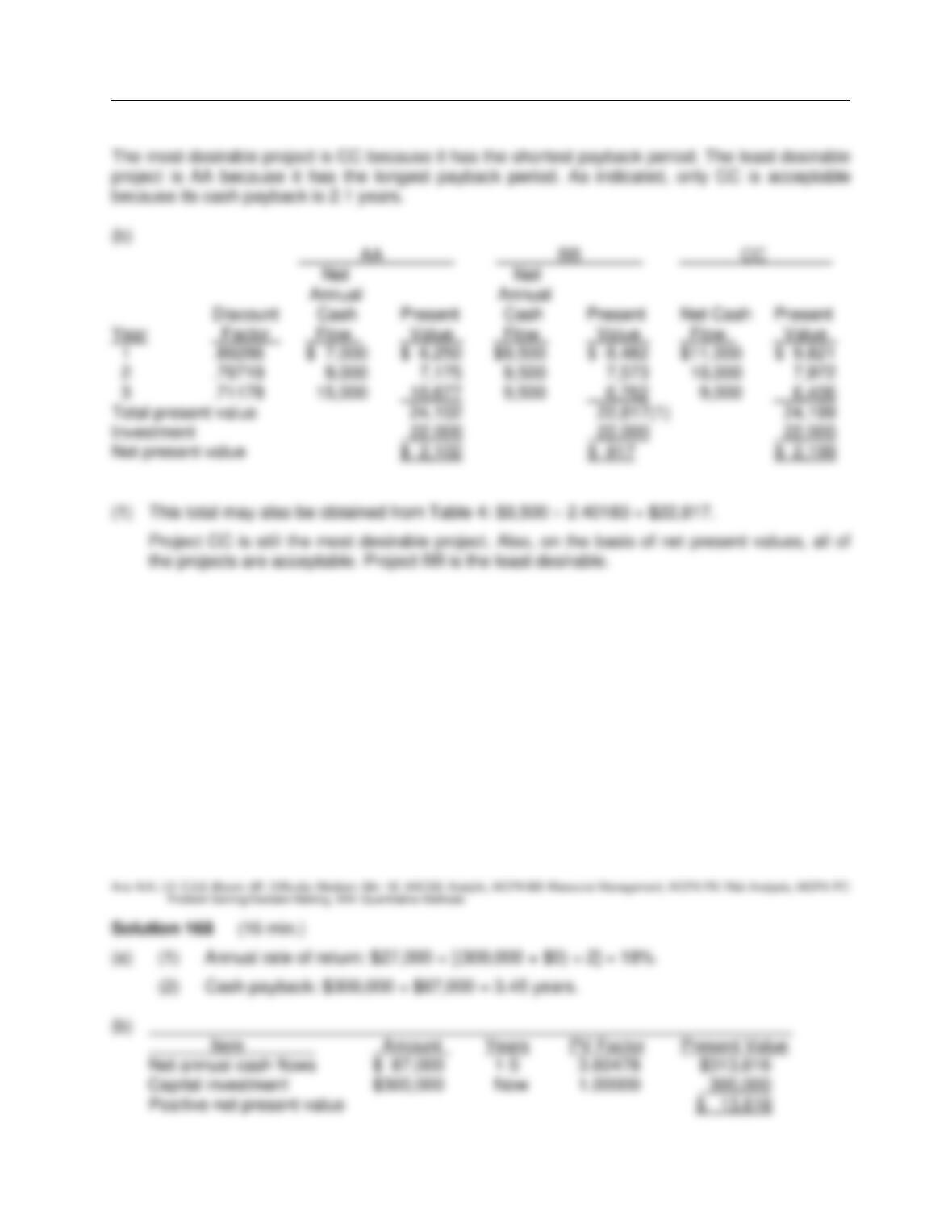
(b) Compute the net present value of each project. Does your evaluation change? (Round to
nearest dollar.)
Planning for Capital Investments 24–41
Solution 167 (Cont.)
Ex. 168
Gantner Company is considering a capital investment of $300,000 in additional productive
facilities. The new machinery is expected to have a useful life of 5 years with no salvage value.
Depreciation is computed by the straight-line method. During the life of the investment, annual net
income and cash inflows are expected to be $27,000 and $87,000, respectively. Gantner has a
12% cost of capital rate, which is the minimum acceptable rate of return on the investment.
Instructions
(Round to two decimals.)
(a) Compute (1) the annual rate of return and (2) the cash payback period on the proposed
capital expenditure.
(b) Using the discounted cash flow technique, compute the net present value.
Test Bank for Accounting, Tools for Business Decision Making Fifth Edition
24–42
Ex. 169
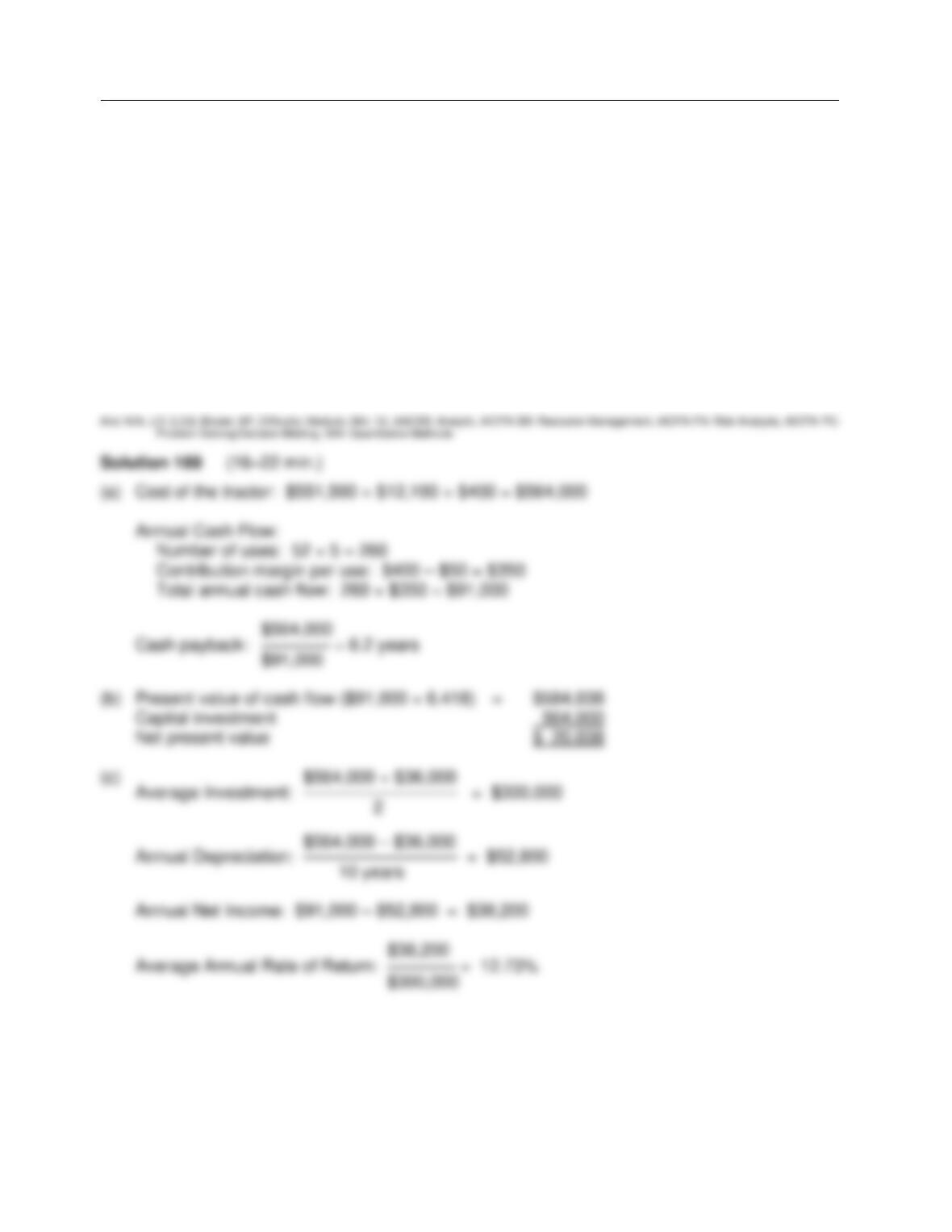
Top Growth Farms, a farming cooperative, is considering purchasing a tractor for $551,500. The
machine has a 10-year life and an estimated salvage value of $36,000. Delivery costs and set-up
charges will be $12,100 and $400, respectively. Top Growth uses straight-line depreciation.
Top Growth estimates that the tractor will be used five times a week with the average charge to
the individual farmers of $400. Fuel is $50 for each use of the tractor. The present value of an
annuity of 1 for 10 years at 9% is 6.418.
Instructions
For the new tractor, compute the:
(a) cash payback period.
(b) net present value.
(c) annual rate of return.
Planning for Capital Investments 24–43
Ex. 170
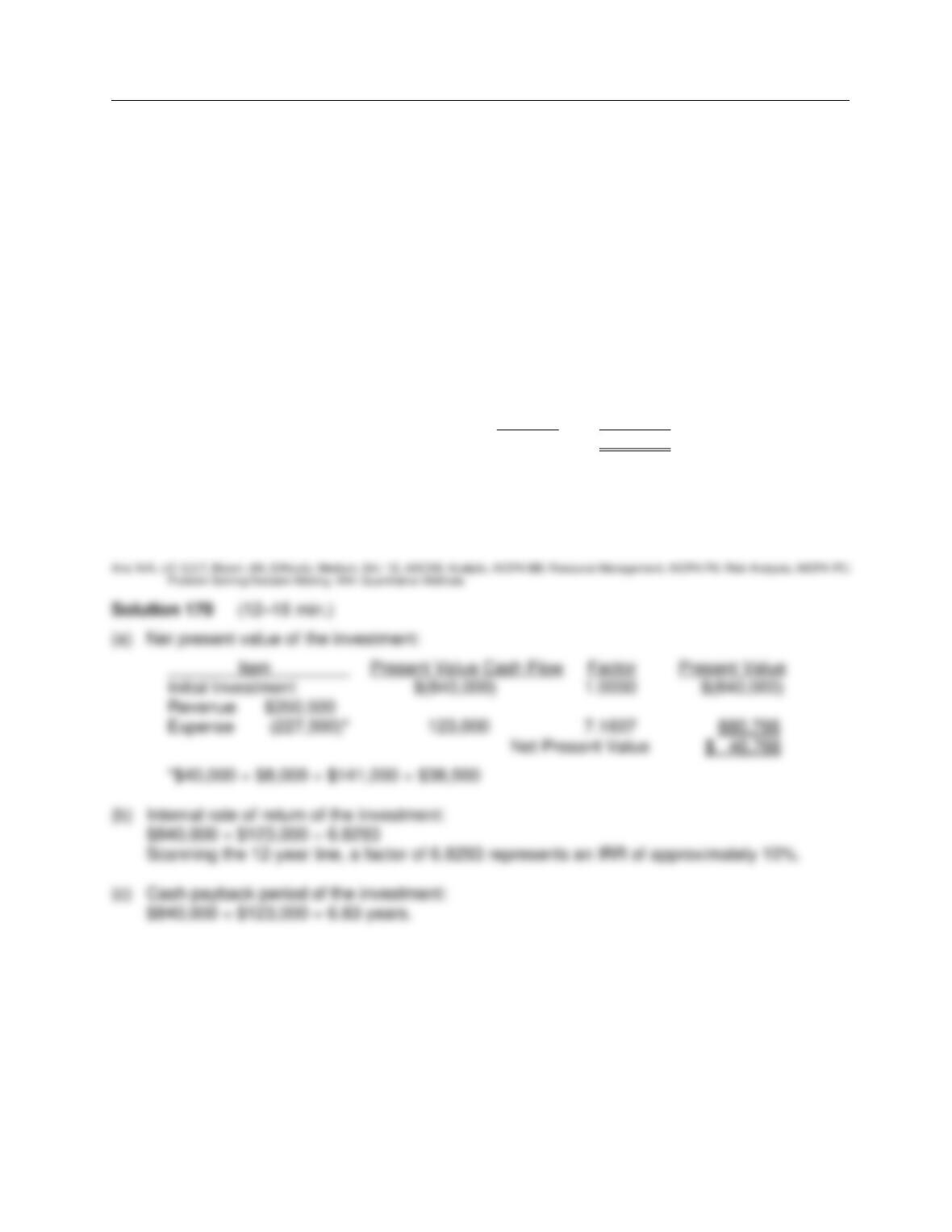
Tom Bat became a baseball enthusiast at a very early age. All of his baseball experience has
provided him valuable knowledge of the sport, and he is thinking about going into the batting cage
business. He estimates the construction of a state–of-the-art building and the purchase of
necessary equipment will cost $840,000. Both the facility and the equipment will be depreciated
over 12 years using the straight-line method and are expected to have zero salvage values. His
required rate of return is 9% (present value factor of 7.1607). Estimated annual net income and
cash flows are as follows:
Revenue $350,500
Less:
Utility cost 40,000
Supplies 8,000
Labor 141,000
Depreciation 70,000
Other 38,500 297,500
Net income $ 53,000
Instructions
For this investment, calculate:
(a) The net present value.
(b) The internal rate of return.
(c) The cash payback period.

Test Bank for Accounting, Tools for Business Decision Making Fifth Edition
24–44
Ex. 171
Mimi Company is considering a capital investment of $275,000 in new equipment. The equipment
is expected to have a 5-year useful life with no salvage value. Depreciation is computed by the
straight-line method. During the life of the investment, annual net income and cash inflows are
expected to be $25,000 and $80,000, respectively. Mimi’s minimum required rate of return is
10%. The present value of 1 for 5 periods at 10% is .621 and the present value of an annuity of 1
for 5 periods at 10% is 3.791.
Instructions
Compute each of the following:
(a) cash payback period.
(b) net present value.
(c) annual rate of return.
Ex. 172
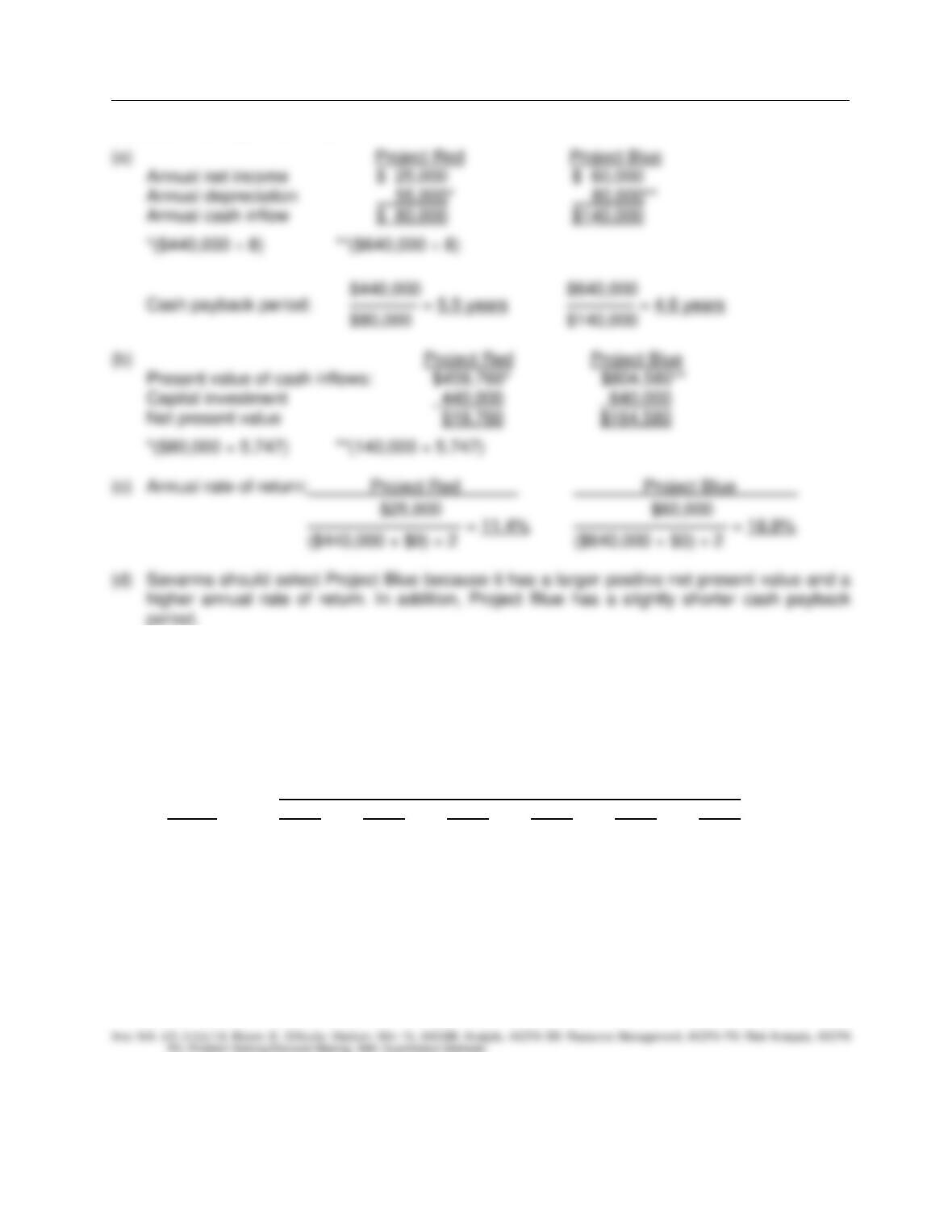
Savanna Company is considering two capital investment proposals. Relevant data on each
project are as follows:
Project Red Project Blue
Capital investment $440,000 $640,000
Annual net income 25,000 60,000
Estimated useful life 8 years 8 years
Depreciation is computed by the straight-line method with no salvage value. Savanna requires an
8% rate of return on all new investments. The present value of 1 for 8 periods at 8% is .540 and
the present value of an annuity of 1 for 8 periods is 5.747.
Instructions
(a) Compute the cash payback period for each project.
(b) Compute the net present value for each project.
(c) Compute the annual rate of return for each project.
(d) Which project should Savanna select?
Planning for Capital Investments 24–45
Solution 172 (14–18 min.)
Ex. 173
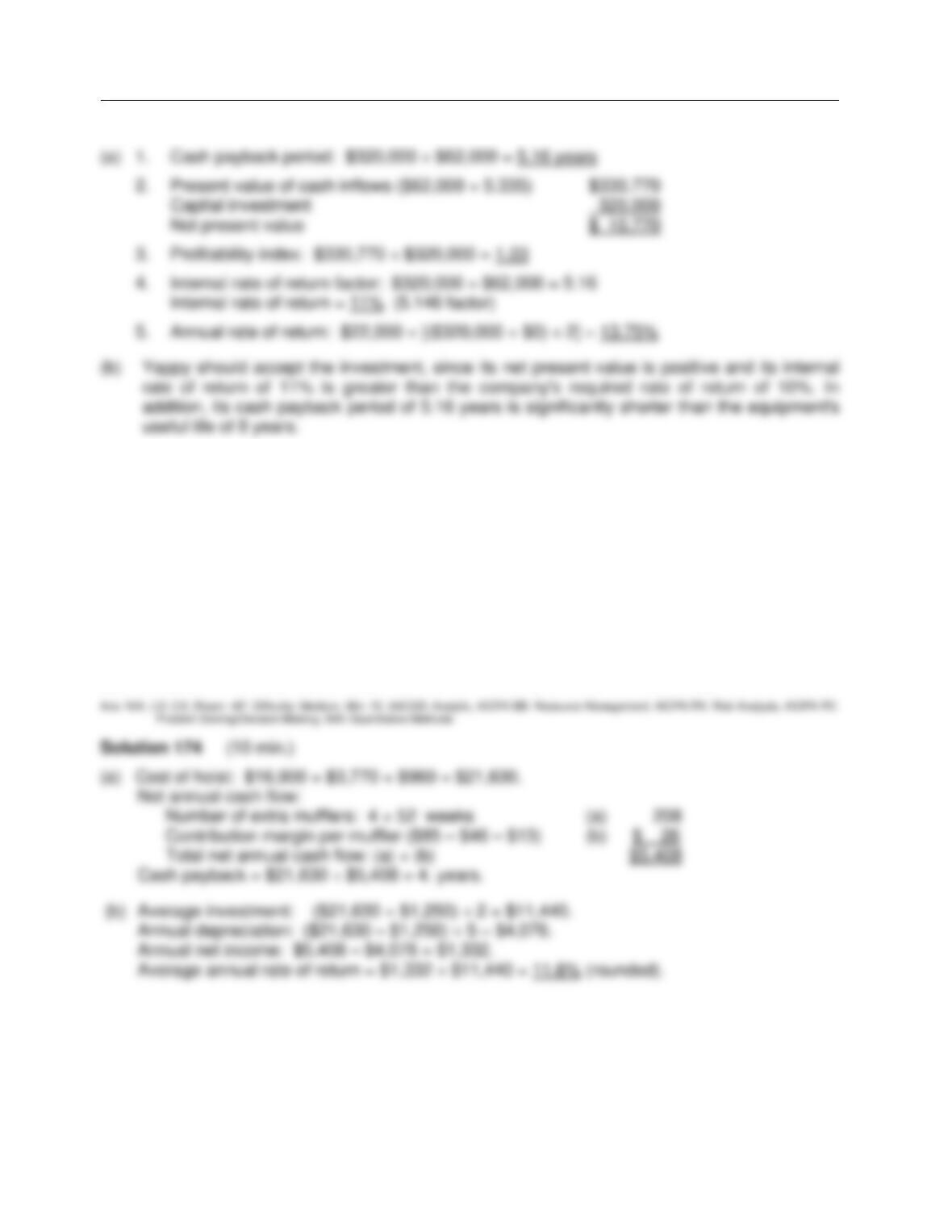
Yappy Company is considering a capital investment of $320,000 in additional equipment. The
new equipment is expected to have a useful life of 8 years with no salvage value. Depreciation is
computed by the straight-line method. During the life of the investment, annual net income and
cash inflows are expected to be $22,000 and $62,000, respectively. Yappy requires a 10% return
on all new investments.
Present Value of an Annuity of 1
Period 8% 9% 10% 11% 12% 15%
8 5.747 5.535 5.335 5.146 4.968 4.487
Instructions
(a) Compute each of the following:
1. Cash payback period.
2. Net present value.
3. Profitability index.
4 Internal rate of return.
5. Annual rate of return.
(b) Indicate whether the investment should be accepted or rejected.
Test Bank for Accounting, Tools for Business Decision Making Fifth Edition
24–46
Solution 173 (15–20 min.)
Ex. 174
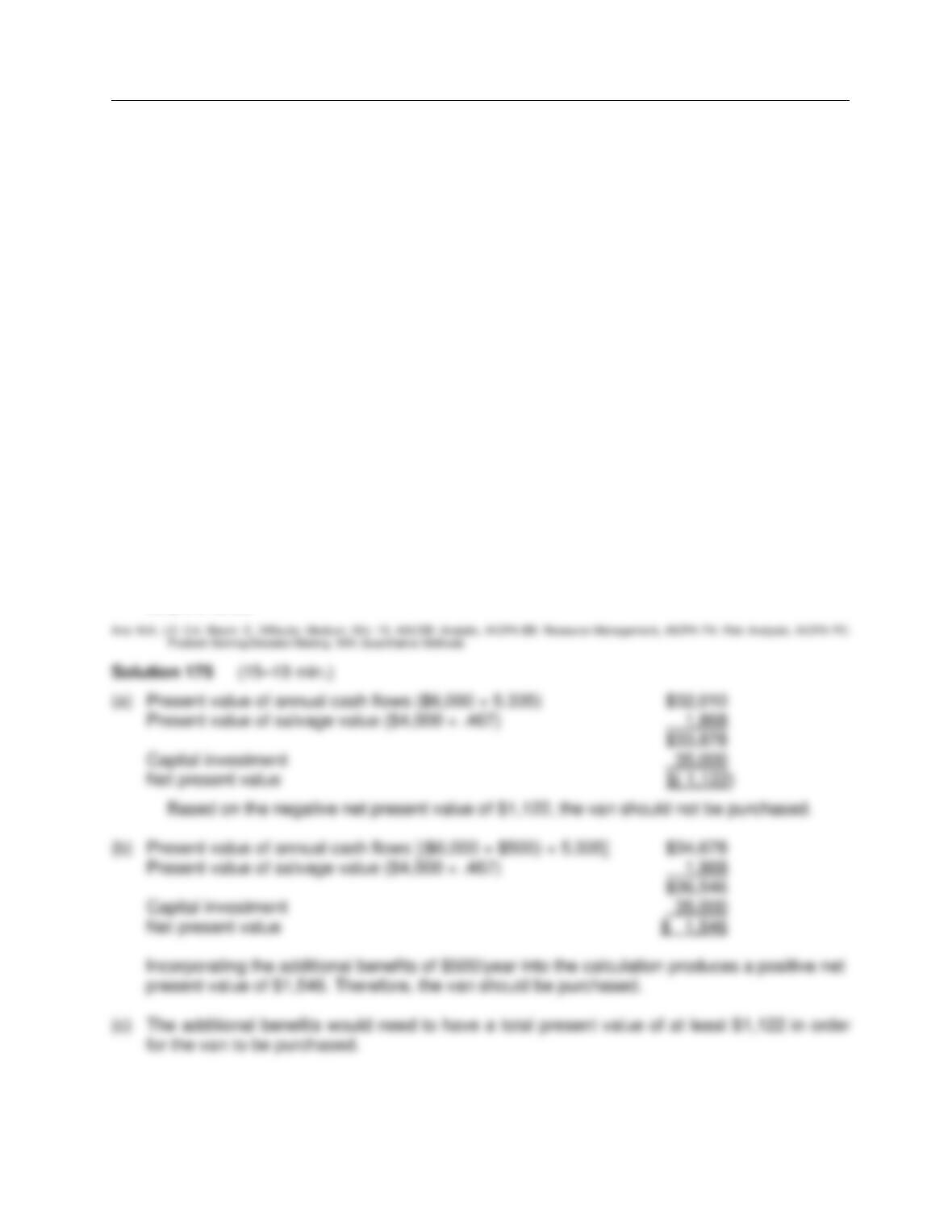
Laramie Service Center just purchased an automobile hoist for $16,900. The hoist has a 5-year
life and an estimated salvage value of $1,250. Installation costs were $3,770, and freight charges
were $960. Laramie uses straight-line depreciation.
The new hoist will be used to replace mufflers and tires on automobiles. Laramie estimates
that the new hoist will enable his mechanics to replace four extra mufflers per week. Each muffler
sells for $85 installed. The cost of a muffler is $46, and the labor cost to install a muffler is $13.
Instructions
(a) Compute the payback period for the new hoist.
(b) Compute the annual rate of return for the new hoist. (Round to one decimal.)
Planning for Capital Investments 24–47
Ex. 175
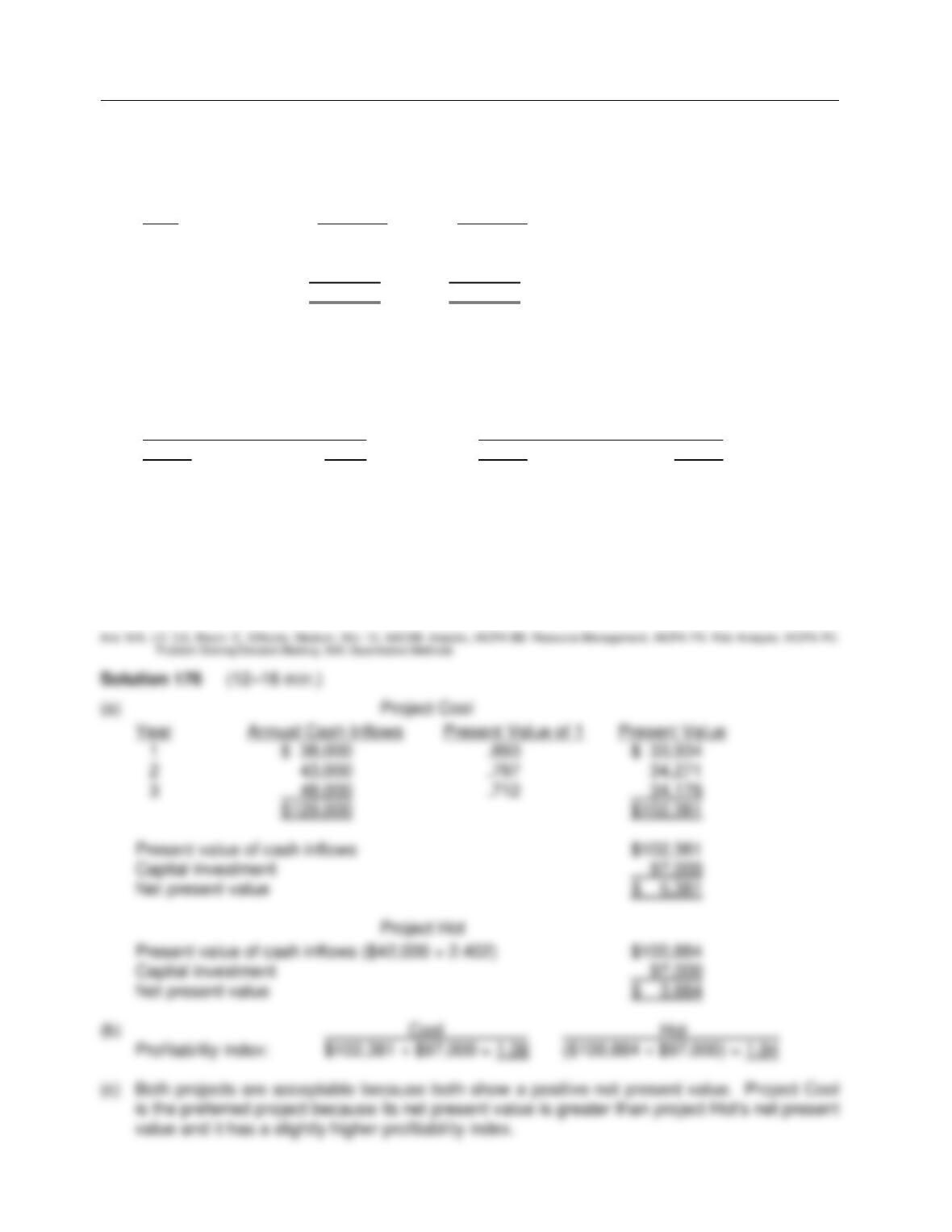
Sophie’s Pet Shop is considering the purchase of a new delivery van. Sophie Smith, owner of the
shop, has compiled the following estimates in trying to determine whether the delivery van should
be purchased:
Cost of the van $35,000
Annual net cash flows 6,000
Salvage value 4,000
Estimated useful life 8 years
Cost of capital 10%
Present value of an annuity of 1 5.335
Present value of 1 .467
Sophie’s assistant manager is trying to convince Sophie that the van has other benefits that she
hasn’t considered in the initial estimates. These additional benefits, including the free advertising
the store’s name painted on the van’s doors will provide, are expected to increase net cash flows
by $500 each year.
Instructions
(a) Calculate the net present value of the van, based on the initial estimates. Should the van be
purchased?
(b) Calculate the net present value, incorporating the additional benefits suggested by the
assistant manager. Should the van be purchased?
(c) Determine how much the additional benefits would have to be worth in order for the van to
be purchased.
Test Bank for Accounting, Tools for Business Decision Making Fifth Edition
24–48
Ex. 176
Vista Company is considering two new projects, each requiring an equipment investment of
$97,000. Each project will last for three years and produce the following cash inflows:
Year Cool Hot
1 $ 38,000 $ 42,000
2 43,000 42,000
3 48,000 42,000
$129,000 $126,000
The equipment will have no salvage value at the end of its three-year life. Vista Company uses
straight-line depreciation and requires a minimum rate of return of 12%.
Present value data are as follows:
Present Value of 1 Present Value of an Annuity of 1
Period 12% Period 12%
1 .893 1 .893
2 .797 2 1.690
3 .712 3 2.402
Instructions
(a) Compute the net present value of each project.
(b) Compute the profitability index of each project.
(c) Which project should be selected? Why?
Planning for Capital Investments 24–49
Ex. 177
KSU Corp. is considering purchasing one of two new diagnostic machines. Either machine would
make it possible for the company to bid on jobs that it currently isn’t equipped to do. Estimates
regarding each machine are provided below.
Machine A Machine B
Original cost $106,000 $ 175,000
Estimated life 8 years 8 years
Salvage value -0- -0-
Estimated annual cash inflows $30,000 $45,000
Estimated annual cash outflows $10,000 $15,000
Instructions
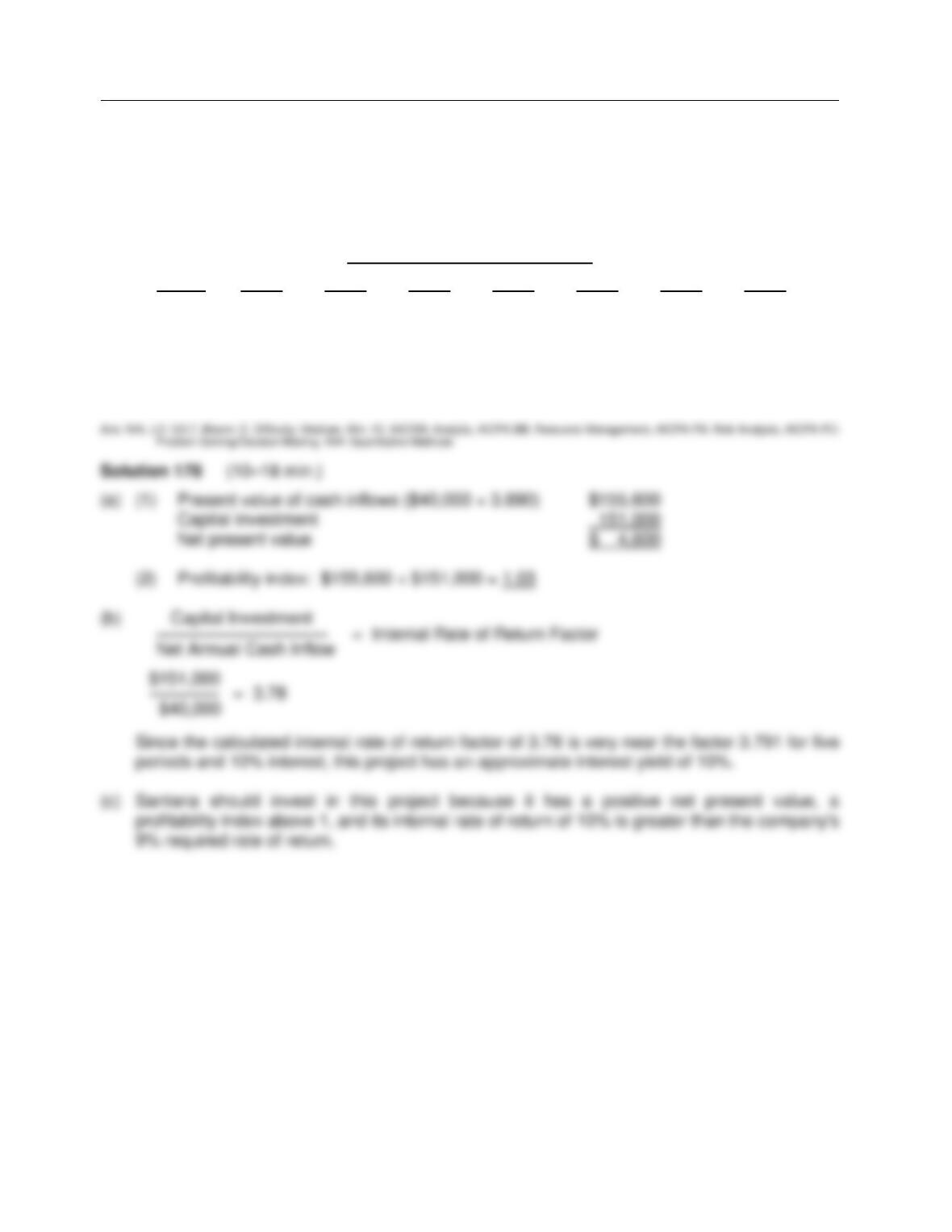
Calculate the net present value and profitability index of each machine. Assume a 9% discount
rate. Which machine should be purchased?
Test Bank for Accounting, Tools for Business Decision Making Fifth Edition
24–50
Ex. 178
Santana Company is considering investing in a project that will cost $151,000 and have no
salvage value at the end of its 5-year life. It is estimated that the project will generate annual cash
inflows of $40,000 each year. The company requires a 9% rate of return and uses the following
compound interest table:
Present Value of an Annuity of 1
Period 6% 8% 9% 10% 11% 12% 15%
5 4.212 3.993 3.890 3.791 3.696 3.605 3.352
Instructions
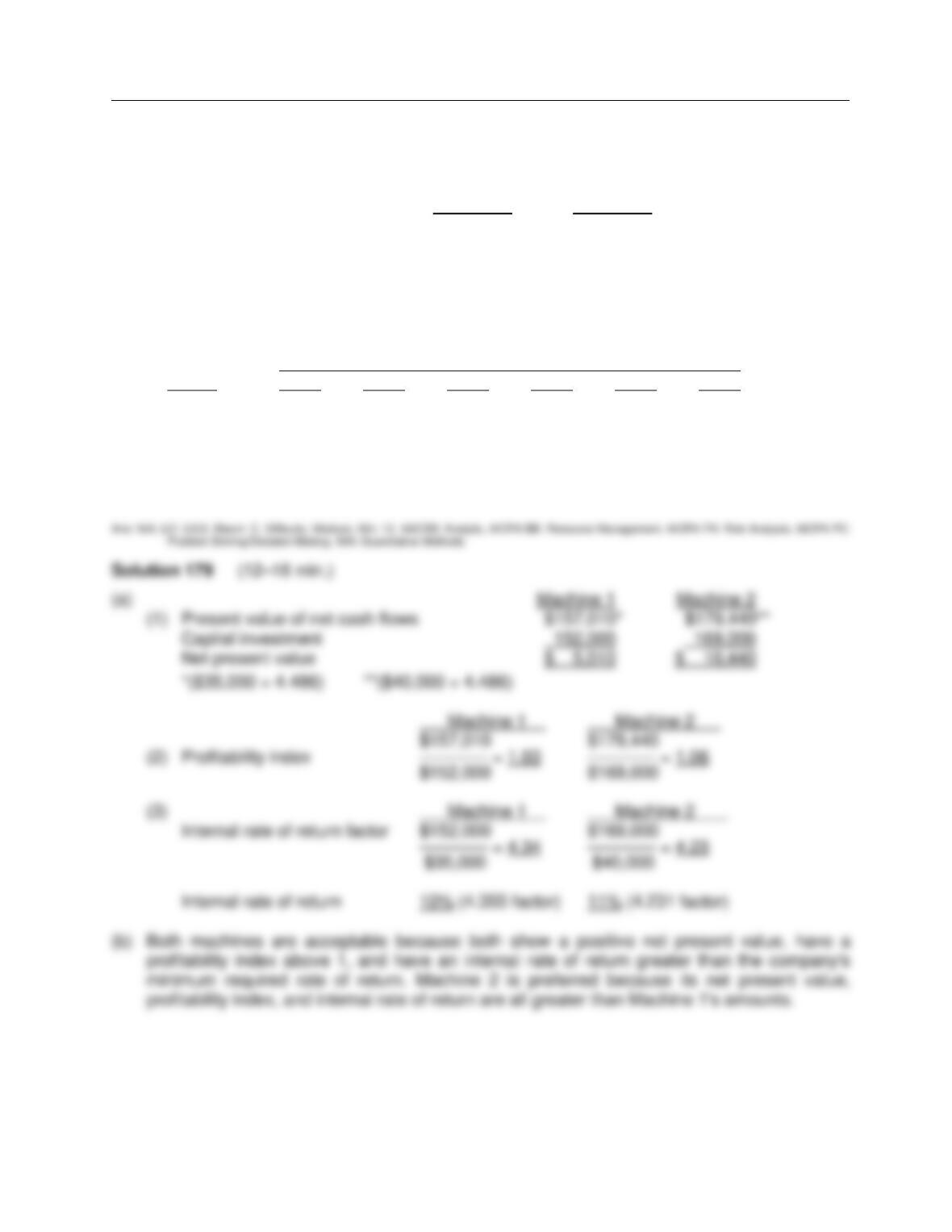
(a) Compute (1) the net present value and (2) the profitability index of the project.
(b) Compute the internal rate of return on this project.
(c) Should Santana invest in this project?
Planning for Capital Investments 24–51
Ex. 179
Johnson Company is considering purchasing one of two new machines. The following estimates
are available for each machine:
Machine 1 Machine 2
Initial cost $152,000 $169,000
Annual cash inflows 50,000 60,000
Annual cash outflows 15,000 20,000
Estimated useful life 6 years 6 years
The company’s minimum required rate of return is 9%.
Present Value of an Annuity of 1
Period 8% 9% 10% 11% 12% 15%
6 4.623 4.486 4.355 4.231 4.111 3.784
Instructions
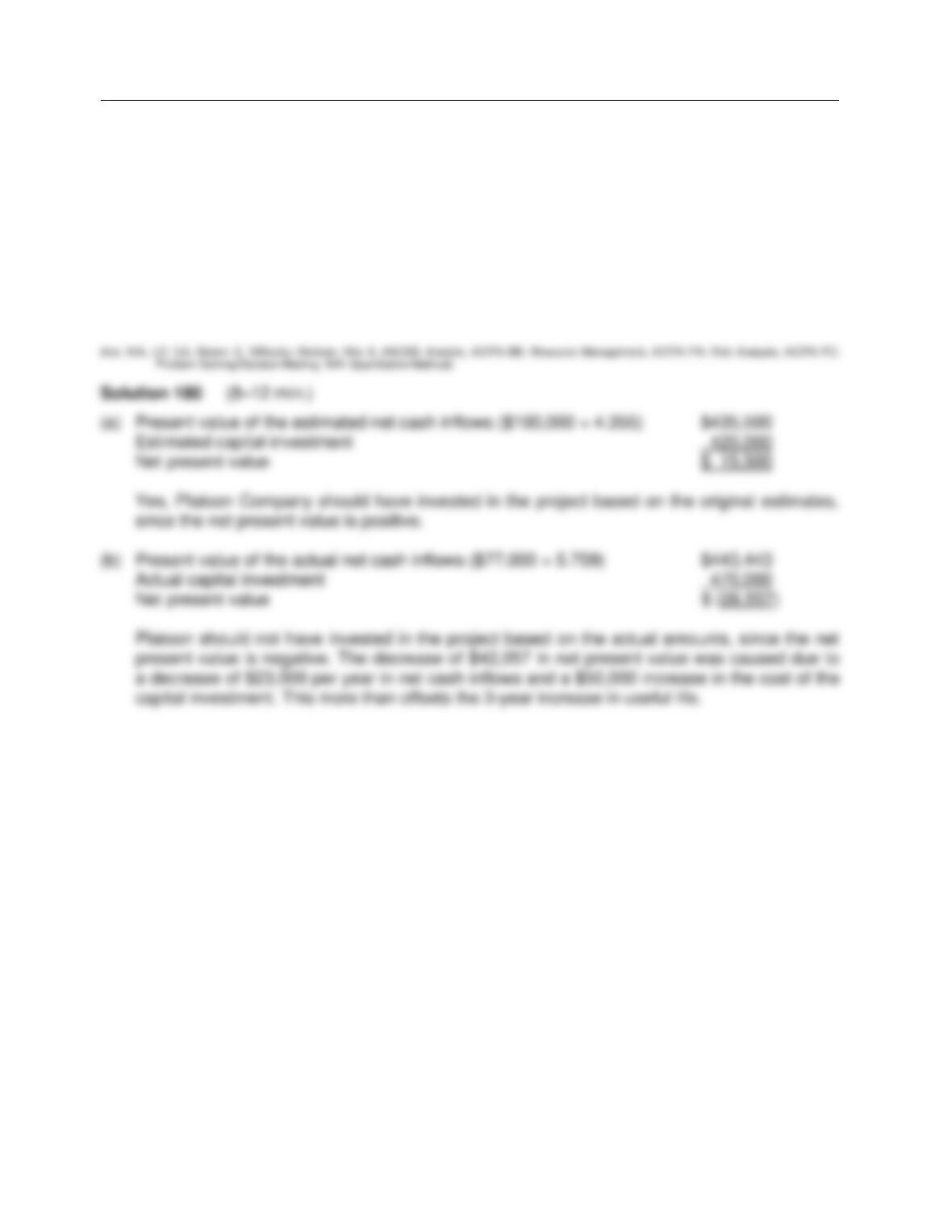
(a) Compute the (1) net present value, (2) profitability index, and (3) internal rate of return for
each machine.
(b) Which machine should be purchased?
Test Bank for Accounting, Tools for Business Decision Making Fifth Edition
24–52
Ex. 180
Platoon Company is performing a post-audit of a project that was estimated to cost $420,000,
have a useful life of 6 years with a zero salvage value, and result in net cash inflows of $100,000
per year. After the investment was in operation for a year, revised figures indicate that it actually
cost $470,000, will have a 9-year useful life, and will produce net cash inflows of $77,000. The
present value of an annuity of 1 for 6 years at 10% is 4.355 and for 9 years is 5.759.
Instructions
Determine whether the project should have been accepted based on (a) the original estimates
and then on (b) the actual amounts.
Ex. 181
Shilling Corp. is thinking about opening a baseball camp in Florida. In order to start the camp, the
company would need to purchase land, build five baseball fields, and a dormitory-type sleeping
and dining facility to house 100 players. Each year the camp would be run for 10 sessions of 1
week each. The company would hire college baseball players as coaches. The camp attendees
would be baseball players age 12-18. Property values in Florida have enjoyed a steady increase
in value. It is expected that after using the facility for 20 years, Shilling can sell the property for
more than it was originally purchased for. The following amounts have been estimated:
Cost of land $ 630,000
Cost to build dorm and dining facility 2,100,000
Annual cash inflows assuming 100 players and 10 weeks 2,520,000
Annual cash outflows 2,260,000
Estimated useful life 20 years
Salvage value 4,400,000
Discount rate 10%
Present value of an annuity of 1 8.514
Present value of 1 .149
Planning for Capital Investments 24–53
Ex. 181 (Cont.)
Instructions
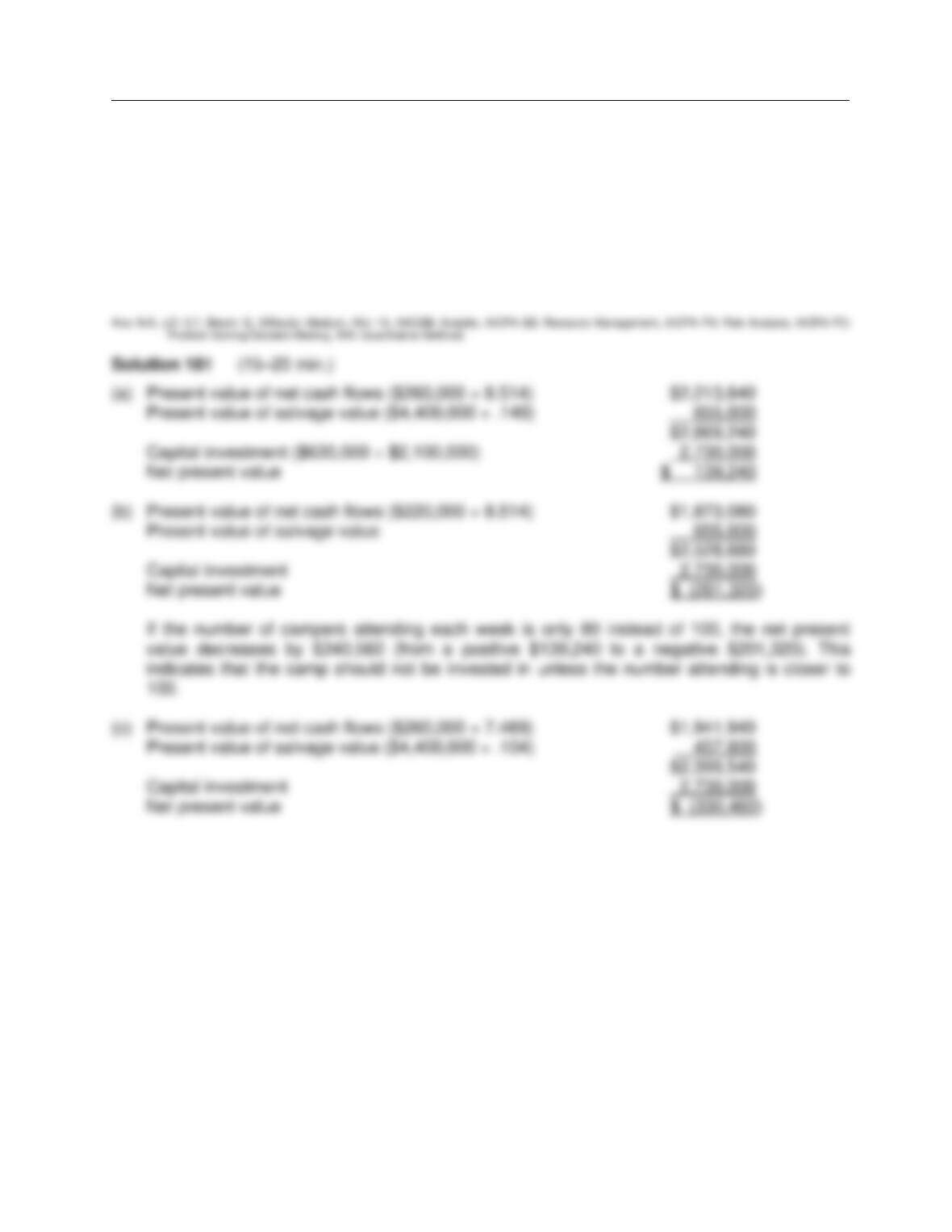
(a) Calculate the net present value of the project.
(b) To gauge the sensitivity of the project to these estimates, assume that if only 80 campers
attend each week, revenues will be $2,085,000 and expenses will be $1,865,000. What is
the net present value using these alternative estimates? Discuss your findings.
(c) Assuming the original facts, what is the net present value if the project is actually riskier than
first assumed, and a 12% discount rate is more appropriate? The present value of 1 at 12%
is .104 and the present value of an annuity of 1 is 7.469.
Test Bank for Accounting, Tools for Business Decision Making Fifth Edition
24–54
Ex. 182
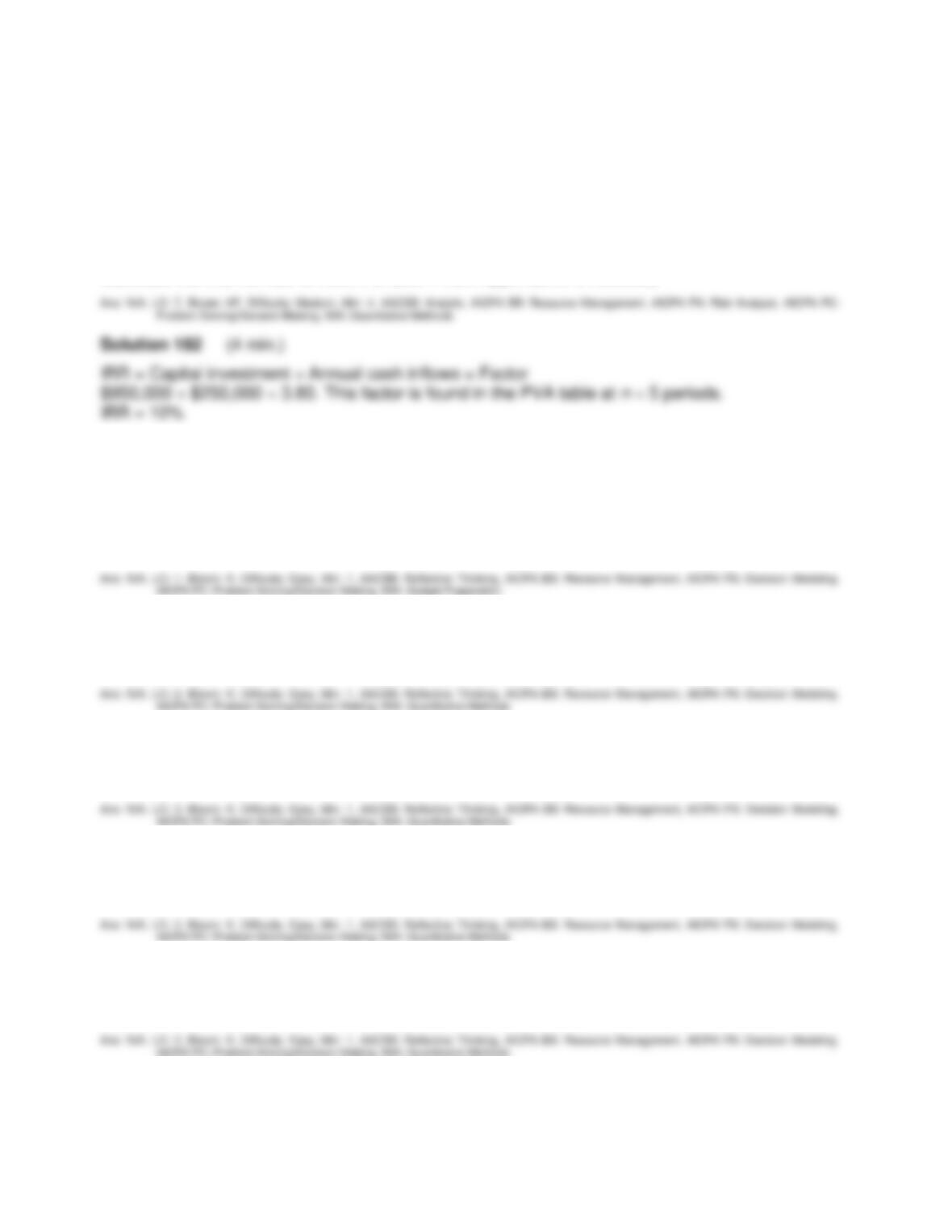
Ace Corporation recently purchased a new machine for its factory operations at a cost of
$950,000. The investment is expected to generate $250,000 in annual cash flows for a period of
five years. The required rate of return is 8%. The new machine is expected to have zero salvage
value at the end of the five-year period.
Instructions
Calculate the internal rate of return. (Table 4 from Appendix C is needed.)
COMPLETION STATEMENTS
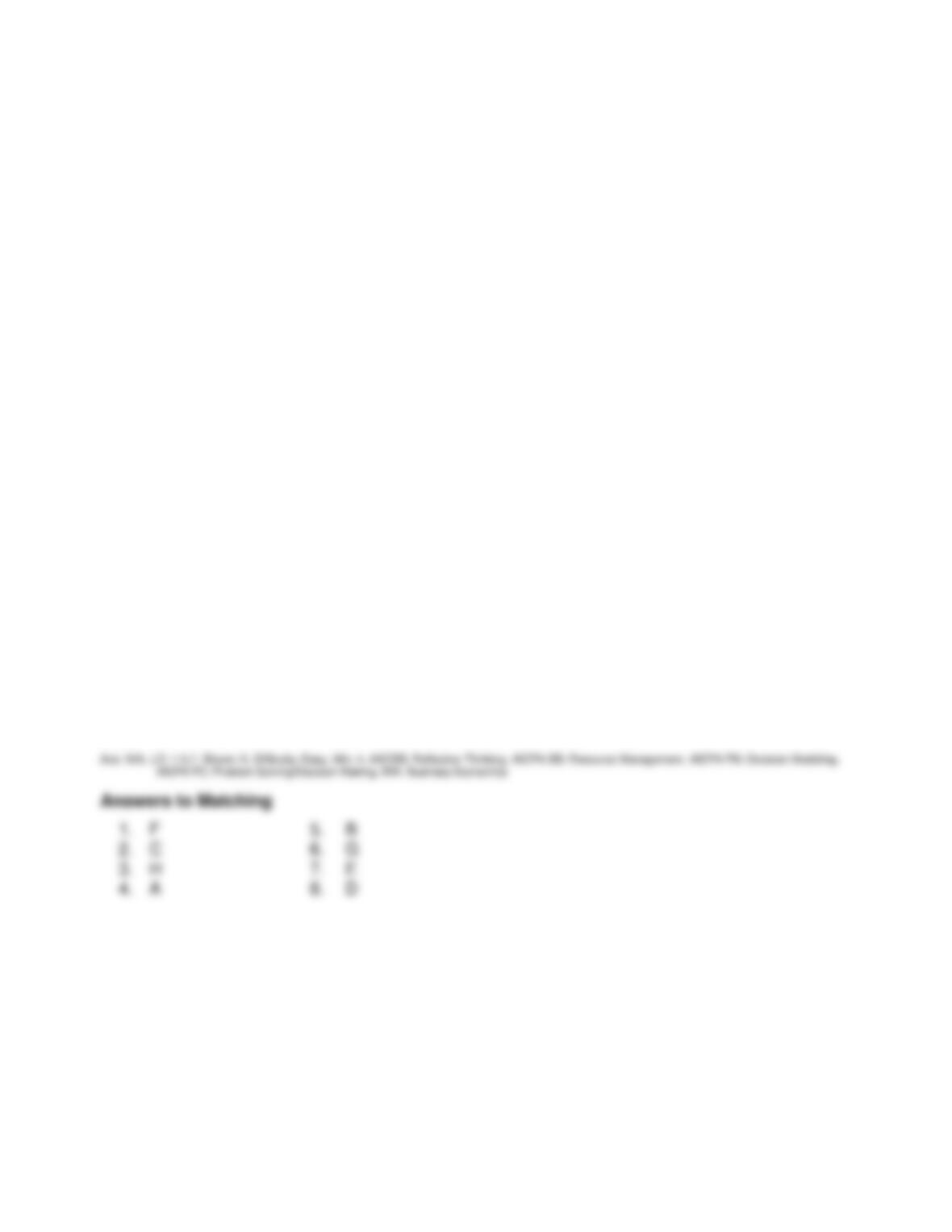
183. For purposes of capital budgeting, estimated ____________ and outflows are preferred
for inputs into the capital budgeting decision tools.
184. The technique which identifies the time period required to recover the cost of the
investment is called the ________________ method.
185. The two discounted cash flow techniques used in capital budgeting are (1) the
_______________________ method and (2) the ______________________ method.
186. Under the net present value method, the interest rate to be used in discounting the future
cash inflows is the ________________.
187. In using the net present value approach, a project is acceptable if the project’s net present
value is ____________ or_______________.
Planning for Capital Investments 24–55
188. A project’s ________________, such as increased quality or safety, are often incorrectly
ignored in capital budgeting decisions.
189. The _______________ is a method of comparing alternative projects that takes into
account both the size of the investment and its discounted future cash flows.
190. A well-run organization should perform an evaluation, called a _____________, of its
investment projects after their completion.
191. The internal rate of return method differs from the net present value method in that it
results in finding the ___________________ of the potential investment.
192. A major limitation of the annual rate of return approach is that it does not consider the
_______________ of money.
Answers to Completion Statements
Test Bank for Accounting, Tools for Business Decision Making Fifth Edition
24–56
MATCHING
193. Match the items below by entering the appropriate code letter in the space provided.
A. Profitability index E. Annual rate of return method
B. Internal rate of return method F. Cash payback technique
C. Discounted cash flow techniques G. Cost of capital
D. Capital budgeting H. Net present value method
____ 1. A capital budgeting technique that identifies the time period required to recover the
cost of a capital investment from the annual cash inflow produced by the investment.
____ 2. Capital budgeting techniques that consider both the estimated total cash inflows from
the investment and the time value of money.
____ 3. A method used in capital budgeting in which cash inflows are discounted to their
present value and then compared to the capital outlay required by the capital
investment.
____ 4. A method of comparing alternative projects that take into account both the size of the
investment and its discounted cash flows.
____ 5. A method used in capital budgeting that results in finding the interest yield of the
potential investment.
____ 6. The average rate of return that the firm must pay to obtain borrowed and equity funds.
____ 7. The determination of the profitability of a capital expenditure by dividing expected
annual net income by the average investment.
____ 8. The process of making capital expenditure decisions in business.
Planning for Capital Investments 24–57
SHORT-ANSWER ESSAY QUESTIONS
S-A E 194
Management uses several capital budgeting methods in evaluating projects for possible
investment. Identify those methods that are more desirable from a conceptual standpoint, and
briefly explain what features these methods have that make them more desirable than other
methods. Also identify the least desirable method and explain its major weaknesses.
S-A E 195
Manny Perez is trying to understand the term “cost of capital.” Define the term, and indicate its
relevance to the decision rule under the annual rate of return technique.
S-A E 196 (Ethics)
Sam Stanton is on the capital budgeting committee for his company, Canton Tile. Ed Rhodes is
an engineer for the firm. Ed expresses his disappointment to Sam that a project that was given to
him to review before submission looks extremely good on paper. “I really hoped that the cost
projections wouldn’t pan out,” he tells his friend. “The technology used in this is pie in the sky kind
of stuff. There are a hundred things that could go wrong. But the figures are very convincing. I
haven’t sent it on yet, though I probably should.”
“You can keep it if it’s really that bad,” assures Sam. “Anyway, you can probably get it shot out of
the water pretty easily, and not have the guy who submitted it mad at you for not turning it in. Just
fix the numbers. If you figure, for instance, that a cost is only 50% likely to be that low, then
double it. We do it all the time, informally. Best of all, the rank and file don’t get to come to those
sessions. Your engineering genius need never know. He’ll just think someone else’s project was
even better than his.”
Required:
1. Who are the stakeholders in this situation?
2. Is it ethical to adjust the figures to compensate for risk? Explain.
3. Is it ethical to change the proposal before submitting it? Explain.
Ans: N/A, LO: 1, Bloom: AN, Difficulty: Easy, Min: 3, AACSB: Ethics, AICPA BB: Resource Management, AICPA FN: Decision Modeling, AICPA PC:
Communications, IMA: Decision Analysis
Test Bank for Accounting, Tools for Business Decision Making Fifth Edition
24–58
Solution 196
S-A E 197 (Communication)
You are the general accountant for Word Systems, Inc., a typing service based in Los Angeles,
California. The company has decided to upgrade its equipment. It currently has a widely used
version of a word processing program. The company wishes to invest in more up–to-date software
and to improve its printing capabilities.
Two options have emerged. Option #1 is for the company to keep its existing computer system,
and upgrade its word processing program. The memory of each work station would be enhanced,
and a larger, more efficient printer would be used. Better telecommunications equipment would
allow for the electronic transmission of some documents as well.
Option #2 would be for the company to invest in an entirely different computer system. The
software for this system is impressive, and it comes with individual laser printers. However, the
company is not well known, and the software does not connect well with well-known software.
The net present value information for these options follows:
Option #1 Option #2
Initial Investment $(95,000) $(270,000)
Returns Year 1 55,000 90,000
Year 2 30,000 90,000
Year 3 10,000 90,000
Net present value 0 0
Required:
Prepare a brief report for management in which you make a recommendation for one system or
the other, using the information given.