Working Capital Management: Current Assets and Current Liabilities 24 – 16
45. Creditors are interested in assessing a borrower’s capacity and character, as well as overall
economic conditions when reviewing a loan application. Which of the following would make a
bank more willing to lend funds?
a) A small business faces deteriorating business conditions because of a recession in the overall
economy.
b) The owner of a small business has been personally bankrupt twice.
c) A retail store has been diligent in making all of its payments on time and in full over the past
five years.
d) A large corporation missed an interest payment on one of its bond issues last month.
46. The following pairs are all costs of holding inventory except:
a) storage and insurance.
b) obsolescence and inventory financing.
c) handling and spoilage.
d) purchase price and overhead.
47. The following pairs are all benefits of holding inventory except:
a) receive discounts on large-volume purchases
b) keep sufficient levels of raw materials to minimize disruptions in the production process
c) minimize lost sales because of shortage
d) reduce interest payments
48. Inventory consists of:
a) raw materials.
b) work in process.
c) finished goods.
d) all of the above.
49. The ABC approach to inventory management divides inventory into
a) several categories based on first-in, first-out basis.
b) several categories based on last-in, first-out basis.
c) several categories based on overall level of importance and profitability.
d) several categories based on overall type of product.
50. The economic order quantity (EOQ) model of inventory management determines the optimal
inventory level that:
a) minimizes shortage costs.
b) minimizes carrying costs.
c) a and b
d) none of the above describes the EOQ model.
51. Under which scenario does the economic order quantity inventory management model work
poorly?
Working Capital Management: Current Assets and Current Liabilities 24 – 18
a) A clothing retailer wants to reduce its inventory shortage costs without unnecessary increases
in carrying costs.
b) A grocery store wants to optimize its fruit and vegetable produce inventory, which has an 8%
spoilage rate per week.
c) A store that sells only Christmas decorations and Halloween costumes wants to optimize its
inventory management.
d) An online retailer wants to determine optimal inventory levels.
52. When a firm lowers its inventory period:
a) it requires additional cash investment.
b) it requires lower cash investment.
c) it does not have any impact on the cash flows of the firm.
d) none of the above
53. By adopting a just-In-time inventory management system, a company will be vulnerable:
a) to suppliers’ bargaining power.
b) to acute changes in economic environment.
c) to suppliers’ risk of bankruptcy.
d) all of the above
54. An example of a spontaneous source of funds is:
a) short-term borrowing.
b) bank credit line.
24 – 19 Test Bank for Introduction to Corporate Finance, Fourth Canadian Edition
c) trade credit.
d) commercial paper loans.
55. The prime lending rate is defined as:
a) the rate banks borrow from other commercial banks.
b) the rate banks give to their best customers.
c) the rate banks give to their smallest customers.
d) the rate banks borrow from the central bank.
56. Which of the following scenarios are examples of credit enhancements?
a) A manufacturing company makes monthly payments into a sinking fund which it will use to
repay principal to bondholders when the bonds mature.
b) A trucking company obtains a lower interest rate on a bank loan for trucks by pledging the
vehicles as collateral.
c) Mortgages on residential properties must be insured by the Canada Mortgage and Housing
Corporation if the down payment is less than 20%.
d) All of the above.
57. The most common benchmark used for pricing a bank loan is:
a) LIBOR.
b) bankers’ acceptance rate.
c) the prime rate.
d) all of the above
Working Capital Management: Current Assets and Current Liabilities 24 – 20
58. Which of the following scenarios is an example of securitization?
a) A bank issues more common shares to the public.
b) A multinational manufacturing company sells fixed income securities to a European pension
fund in a private deal.
c) A bank creates fixed income securities using the receivables from mortgages on residential
property, and sells them to a fixed income mutual fund.
d) The Government of Canada sells 25-year Treasury bonds to raise funds for infrastructure.
59. Toronto Skaters Company is being offered a one-year variable rate loan at a rate of prime +
0.75%. The loan is to be paid in quarterly installments and there are no other fees associated
with it. The prime lending rate is currently 6% compounded quarterly. What is the effective
annual cost of this loan?
a) 6%
b) 6.14%
c) 6.75%
d) 6.92%
60. All of the following are tasks performed by a factor except:
a) purchasing payables and extending loans.
b) purchasing receivables.
c) checking customers’ credit and authorizing credit.
d) receivables bookkeeping and collection.
61. Short-term financing decisions are:
a) less important than long-term financing decisions.
b) more difficult to make than long-term financing decisions.
c) easier to make than long-term financing decisions.
d) none of the above
62. The two major types of money market instruments available are
a) credit lines and T-Bills.
b) T-bonds and junk bonds.
c) bankers’ acceptances and commercial paper.
d) stocks and options.
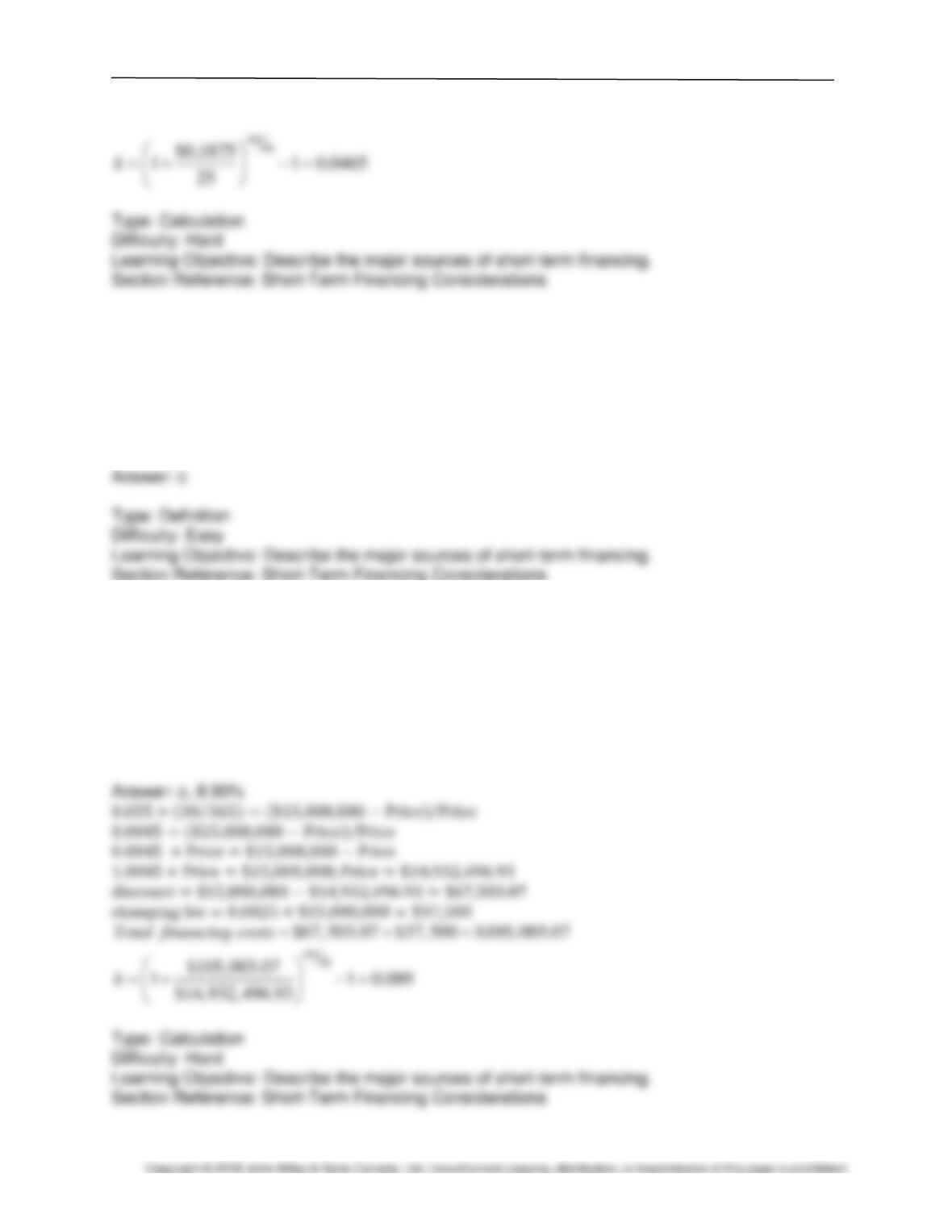
63. Laurentide Resort Company would like to issue $25 million face value of 60-day commercial
paper at a cost of 0.65%. In addition, the firm must maintain the $25 million credit line at a cost
of 0.1% as a standby fee. What is the effective annual cost of this transaction?
a) 4.02%
b) 4.56%
c) 4.65%
d) 56.57%
Working Capital Management: Current Assets and Current Liabilities 24 – 22
64. Securitization refers to the process of:
a) bonds are sold to the public at a discount.
b) stocks are issued to raise funds instead of bonds.
c) loans and / or receivables are packaged to create new securities.
d) a portfolio of securities is sold to raise funds to pay debts.
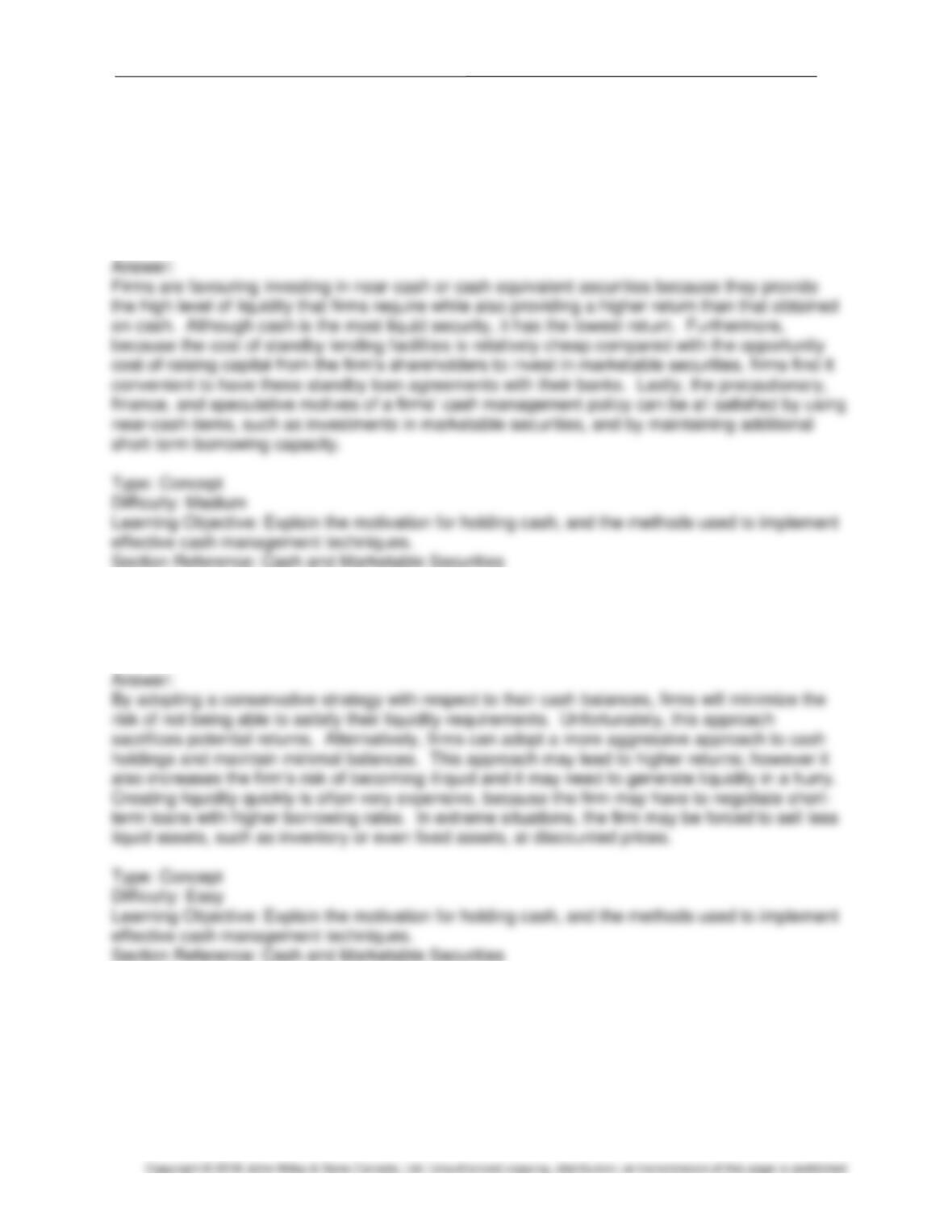
65. A firm would like to issue $15 million face value of 30-day bankers’ acceptances quoted at
5.5% at a stamping fee of 0.25%. What is the effective annual cost to the firm?
a) 4.65%
b) 5.64%
c) 8.90%
d) 23.39%
24 – 23 Test Bank for Introduction to Corporate Finance, Fourth Canadian Edition
PRACTICE PROBLEMS
66. Current trends show firms holding less cash physically and preferring to hold liquidity in near-
cash or cash equivalent securities or relying on standby lending. Explain fully why you think this
is so.
67. Identify the pros and cons for being conservative/aggressive with respect to how much cash
a firm should have. Also explain why creating liquidity quickly is expensive.
68. In light of the 2008 financial crisis, describe the importance of credit to companies and the
importance of having access to available cash.
Answer:
69. Clearly define what a zero-balance account is, how it functions, and the benefits associated
with it in terms of a firm’s cash management efforts.
70. Can trade credit be labelled as a financing strategy? Provide an example of a firm that uses
this strategy in their business model.
71. What is credit analysis? When is it done? And, generally, what are the steps involved in the
process?
72. List and explain the four C’s of credit: capacity, character, collateral, and conditions.
73. Explain the difference between a firm’s decision to grant customers trade credit and that of a
bank’s decision whether to extend loans to their customers. In your explanation provide a
numerical example.
Answer:
74. In the case of delayed or non-payment, describe in detail the general steps that firms must
take in an attempt to force payment or recover as much value as possible from the defaulting
customer or customers.
75. Discuss the limitation of the inventory turnover ratio as an effective inventory management tool.
76. An important tool used in assessing the quality of receivables is the aged accounts receivable
report. What is it, how does it work, and what are its positive and negative characteristics?
24 – 27 Test Bank for Introduction to Corporate Finance, Fourth Canadian Edition
77. Explain how revolving loans work and how they are beneficial to firms who are trying to
minimize their cost of borrowing and manage their short-term financing so that they do not become
illiquid.
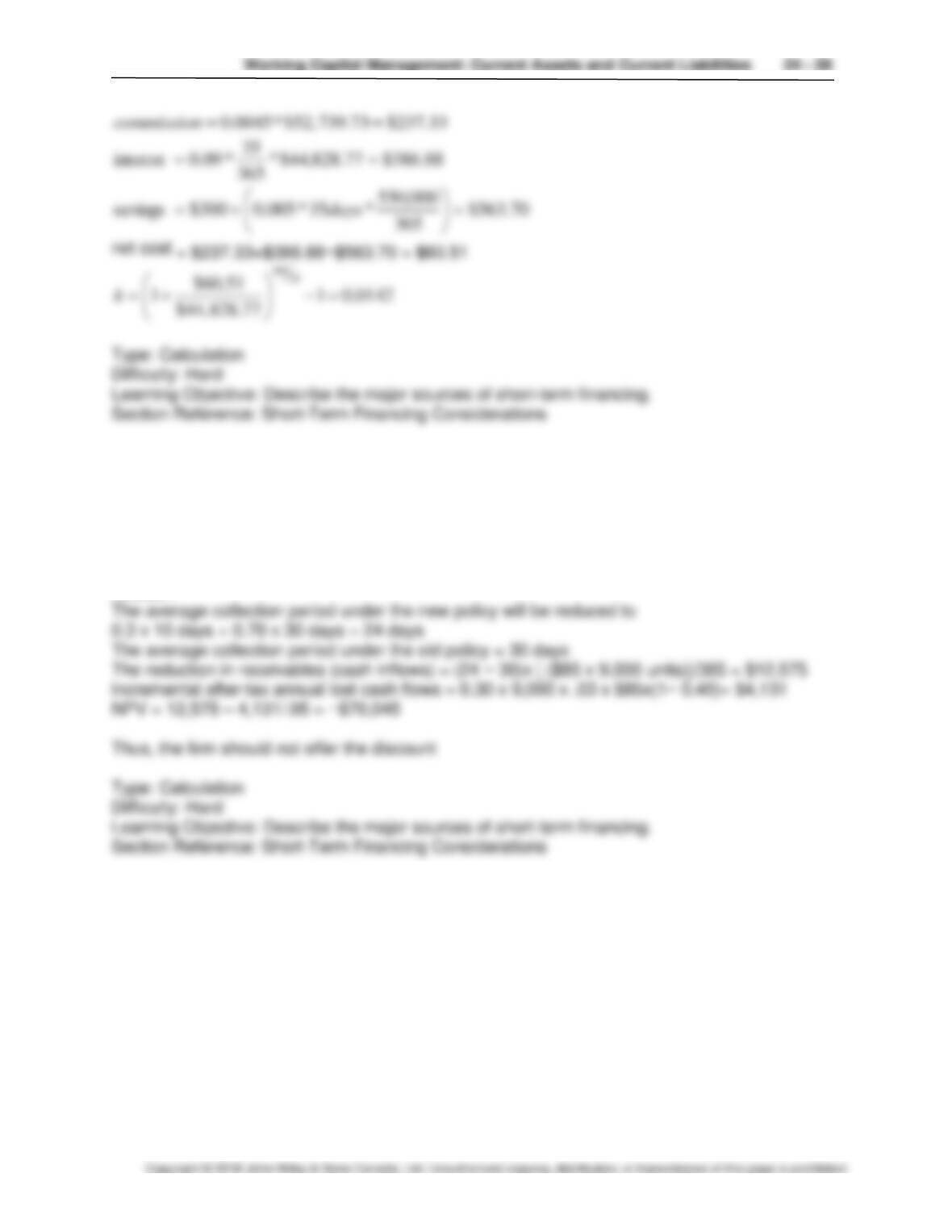
78. Poutine Cheez Company has yearly sales of $550,000 and an average collection period of
35 days. A factoring company is offering a 35-day receivables loan equal to 85% of the accounts
receivable at 9% along with a commission fee of .45% of the receivables. The firm estimates
that by taking the offer, it could save $300 in collection costs and a full half of one percent in bad
debt costs, as a percentage of sales. What is the annual cost (in percent) of the arrangement to
Poutine Cheez?
79. McGill Inc. is considering adopting a new credit policy of 3/10 net 30 instead of net 30 days.
The firm estimates that 30 percent of the customers will take advantage of the discount, while the
remaining 70 percent will pay on day 30. The selling price is $85 per unit and the unit sales are
estimated to be 9,000 per year. The after-tax discount rate is 5% and the tax rate is 40%. Should
the firm switch to the new policy?
Answer:
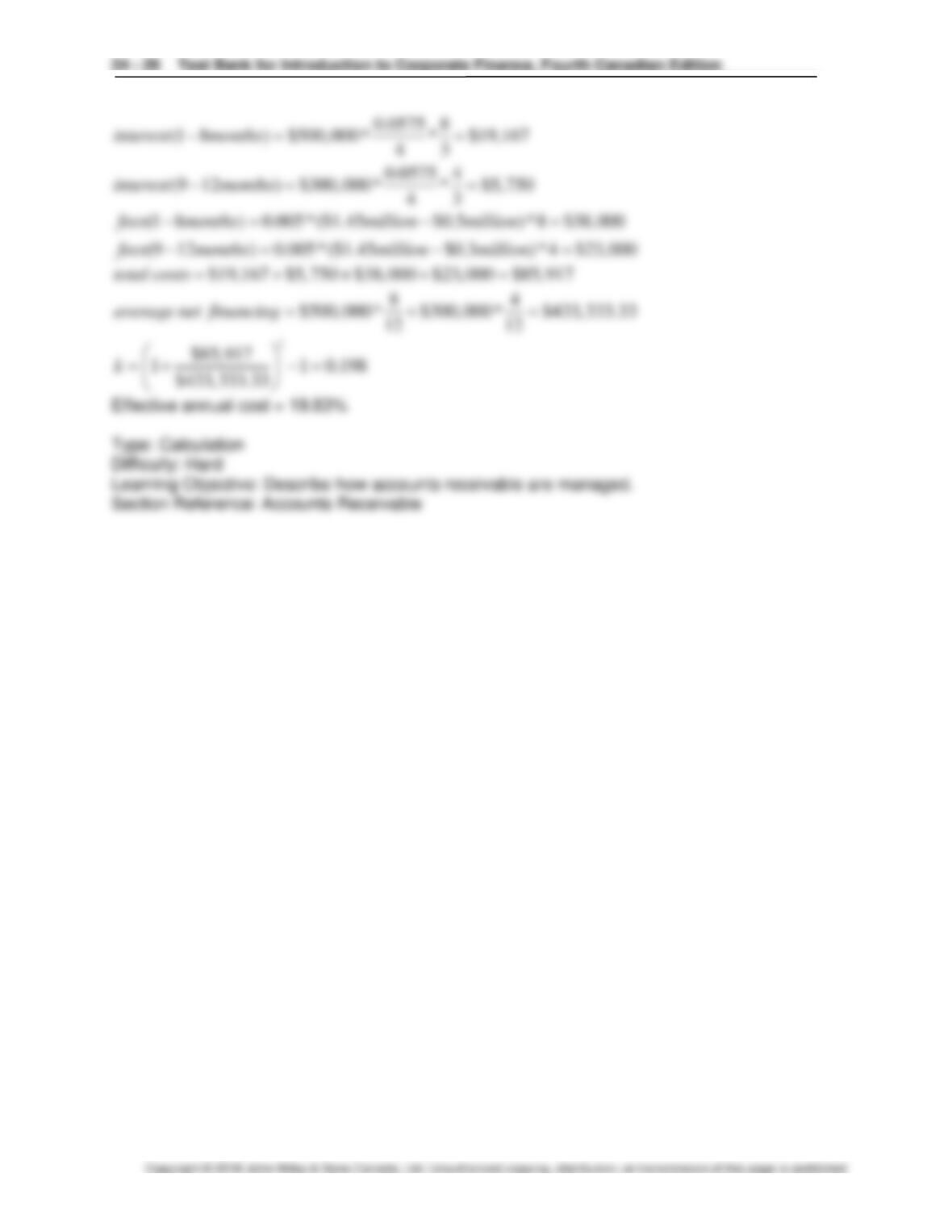
80. Queue de Castor Company is being offered a one-year $1.45 million operating line of credit
at a rate of 5.75%. There is a monthly 0.5% commitment fee on the unused amount. The firm
borrows only $0.5 million during the first 8 months of the loan and reduces its loan by a further
$0.2 million for the remaining 4 months. What is the effective annual cost (in percent) of this loan
arrangement?
Answer:
Working Capital Management: Current Assets and Current Liabilities 24 – 30
LEGAL NOTICE