CHAPTER 22—PROVIDING AND OBTAINING CREDIT
1. The credit period is the amount of time it takes to do a credit search on a potential customer.
a.
True
b.
False
False
1
capital
2. Credit standards refer to the financial strength and importance of a potential customer to the firm required in order to
qualify for credit.
a.
True
b.
False
False
1
capital
3. The collection process, although sometimes difficult, is a fairly inexpensive component of doing business.
a.
True
b.
False
False
1
capital
4. The collection process, although sometimes difficult, is also expensive in terms of out–of-pocket expenses.
a.
True
CHAPTER 22—PROVIDING AND OBTAINING CREDIT
b.
False
True
1
capital
5. Cash discounts are mostly used to get new customers in the door since existing customers almost always use the
delayed payment terms.
a.
True
b.
False
False
1
capital
6. When deciding whether to offer a discount for cash payment, a firm must balance the profits from additional sales with
the lost revenues from the discount.
a.
True
b.
False
True
1
capital
7. The primary reason to monitor aggregate accounts receivable is to see if customers, on average, are paying more
slowly.
a.
True
CHAPTER 22—PROVIDING AND OBTAINING CREDIT
b.
False
True
1
capital
8. DSO analysis of accounts receivable is the most robust way to see if customers are, on average, paying more slowly,
because it is unaffected by seasonal changes in sales.
a.
True
b.
False
False
1
capital
9. If sales are seasonal, the days sales outstanding will fluctuate from month to month, even if the amount of time
customers take to pay remains unchanged.
a.
True
b.
False
True
1
capital
10. The percentage aging schedule of accounts receivable is the most robust way to see if customers are, on average,
paying more slowly, because it is unaffected by seasonal changes in sales.
a.
True
CHAPTER 22—PROVIDING AND OBTAINING CREDIT
b.
False
False
1
Difficulty: Moderate
INTE.GENE.16.149 – LO: 22-8
United States – BUSPROG: Reflective Thinking
capital
United States – OH – Default City – TBA
Payments pattern approach
11. The uncollected balances schedule is constructed at the end of a quarter by dividing the dollar amount of remaining
receivables from each month in that quarter by that month’s sales.
a.
True
b.
False
True
1
Difficulty: Moderate
INTE.GENE.16.149 – LO: 22-8
United States – BUSPROG: Reflective Thinking
capital
Uncollected balances schedule
12. A firm’s credit policy consists of which of the following items?
a.
Credit period, cash discounts, credit standards, collection policy.
b.
Credit period, cash discounts, receivables monitoring, collection policy.
c.
Cash discounts, credit standards, receivables monitoring, collection policy.
d.
Credit period, receivables monitoring, credit standards, collection policy.
e.
Credit period, cash discounts, credit standards, receivables monitoring.
a
1
Difficulty: Moderate
INTE.GENE.16.149 – LO: 22-8
United States – BUSPROG: Analytic
capital
United States – OH – Default City – TBA
Credit policy
TYPE: Multiple Choice: Conceptual
CHAPTER 22—PROVIDING AND OBTAINING CREDIT
13. Which of the following is not correct?
a.
A more aggressive collection policy will reduce bad debt expenses, but may also decrease sales.
b.
Collection policy usually has little impact on sales since collecting past-due accounts occurs only after the
customer has already purchased.
c.
Typically a firm will turn over an account to a collection agency only after it has tried several times on its own
to collect the account.
d.
A lax collection policy will frequently lead to an increase in accounts receivable.
e.
Collection policy is how a firm goes about collecting past-due accounts.
1
Difficulty: Moderate
INTE.GENE.16.145 – LO: 22-3
United States – BUSPROG: Analytic
United States – AK – DISC: Capital budgeting and cost – DISC: Capital budgeting and cost of
United States – OH – Default City – TBA
Collection policy
TYPE: Multiple Choice: Conceptual
14. Which of the following is not correct for a firm with seasonal sales and customers who all pay promptly at the end of
30 days?
a.
The quarterly uncollected balances schedule will be the same in each quarter.
b.
The level of accounts receivable will be constant from month to month.
c.
The ratio of accounts receivable to sales will vary from month to month.
d.
The level of accounts receivable at the end of each quarter will be the same.
e.
DSO will vary from month to month.
b
1
Difficulty: Moderate
INTE.GENE.16.147 – LO: 22-6
United States – BUSPROG: Analytic
United States – AK – DISC: Capital budgeting and cost – DISC: Capital budgeting and cost of
United States – OH – Default City – TBA
Payments pattern approach
TYPE: Multiple Choice: Conceptual
15. Which of the following statements is most correct?
a.
It is possible for a firm to overstate profits by offering very lenient credit terms which encourage additional
sales to financially “weak” firms. A major disadvantage of such a policy is that it is likely to increase
uncollectible accounts.
b.
A firm with excess production capacity and relatively low variable costs would not be inclined to extend more
liberal credit terms to its customers than a firm with similar costs that is operating close to capacity.
CHAPTER 22—PROVIDING AND OBTAINING CREDIT
c.
Firms use seasonal dating primarily to decrease their DSO.
d.
Seasonal dating with terms 2/15, net 30 days, with April 1 dating, means that if the original sale took place on
February 1st, the customer can take the discount up until March 15th, but must pay the net invoice amount by
April 1st.
e.
If credit sales as a percentage of a firm’s total sales increases, and the volume of credit sales also increases,
then the firm’s accounts receivable will automatically increase.
a
1
Difficulty: Moderate
INTE.GENE.16.149 – LO: 22-8
United States – BUSPROG: Analytic
United States – AK – DISC: Capital budgeting and cost – DISC: Capital budgeting and cost of
capital
United States – OH – Default City – TBA
Credit policy and seasonal dating
TYPE: Multiple Choice: Conceptual
16. Which one of the following aspects of banks is considered most relevant to businesses when choosing a bank?
a.
Competitive cost of services provided.
b.
Size of the bank’s deposits.
c.
Experience of personnel.
d.
Loyalty and willingness to assume lending risks.
e.
Convenience of location.
d
1
Difficulty: Moderate
INTE.GENE.16.150 – LO: 22–10
United States – BUSPROG: Analytic
United States – AK – DISC: Capital budgeting and cost – DISC: Capital budgeting and cost of
capital
United States – OH – Default City – TBA
Choosing a bank
TYPE: Multiple Choice: Conceptual
Exhibit 22.1
Your brother has just taken out a loan for $75,000. The stated (simple) interest rate on this loan is 10 percent, and the bank
requires him to maintain a compensating balance equal to 15 percent of the initial face amount of the loan. He currently
has $20,000 in his checking account, and he plans to maintain this balance. The loan is an add-on installment loan which
he will repay in 12 equal monthly installments, beginning at the end of the first month.
17. Refer to Exhibit 22.1. How large are your brother’s monthly payments?
a.
$6,250
b.
$7,000
c.
$7,500
CHAPTER 22—PROVIDING AND OBTAINING CREDIT
d.
$5,250
e.
$6,875
e
1
capital
18. Refer to Exhibit 22.1. What is the nominal annual add-on interest rate on this loan?
a.
10.00%
b.
16.47%
c.
18.83%
d.
20.00%
e.
24.00%
d
1
capital
Add-on installment loan
19. Suppose that you’re planning a vacation and borrow $2,000 from a bank for one year at a stated annual interest rate of
14 percent, with interest prepaid (a discounted loan). Also, assume that the bank requires you to maintain a compensating
balance equal to 20 percent of the initial loan value. What effective annual interest rate are you being charged?
a.
14.00%
b.
8.57%
c.
16.28%
d.
21.21%
e.
28.00%
CHAPTER 22—PROVIDING AND OBTAINING CREDIT
d
1
capital
20. Faircross Farms harvests its crops four times annually and receives payment for its crop 90 days after it is picked and
shipped. However, planting, irrigating, and harvesting must be done on a nearly continual schedule. The firm uses 90-day
bank notes to finance its operations. The firm arranges an 11 percent discount interest loan with a 20 percent
compensating balance four times annually. What is the effective annual interest rate of these discount loans?
a.
11.00%
b.
15.94%
c.
11.46%
d.
13.75%
e.
12.72%
b
1
CHAPTER 22—PROVIDING AND OBTAINING CREDIT
21. Gladys Turner borrowed $12,000 from the bank using a 10.19 percent “add-on”, one-year installment loan, payable in
four equal quarterly payments. What is the effective annual rate of interest?
a.
9.50%
b.
10.19%
c.
15.99%
d.
16.98%
e.
20.38%
d
1
capital
22. The Arthos Group needs to borrow $200,000 from its bank. The bank has offered the company a 12-month installment
loan (monthly payments) with 9 percent add-on interest. What is the effective annual rate (EAR) of this loan?
a.
16.22%
b.
17.97%
c.
17.48%
d.
18.67%
e.
18.00%
c
1
capital
CHAPTER 22—PROVIDING AND OBTAINING CREDIT
23. The Somerset Bank offered Blakemore Inc. the following loan alternatives in response to its request for a $75,000, 1-
year loan.
Alternative 1:
7 percent discount interest, with a 10 percent compensating balance.
Alternative 2:
8 percent simple interest, with interest paid monthly.
What is the effective annual rate on the cheaper loan?
a.
8.00%
b.
7.23%
c.
7.67%
d.
8.43%
e.
8.30%
e
1
Difficulty: Easy
INTE.GENE.16.151 – LO: 22-9
United States – BUSPROG: Analytic
capital
United States – OH – Default City – TBA
Effective annual rate–nonalgorithmic
TYPE: Multiple Choice: Problem
24. Harris Flooring Inc. is planning to borrow $12,000 from the bank for new sanding machines. The bank offers the
choice of a 12 percent discount interest loan or a 10.19 percent add-on, one-year installment loan, payable in 4 equal
quarterly payments. What is the effective rate of interest on the 12 percent discounted loan?
a.
10.7%
b.
12.0%
INTE.GENE.16.151 – LO: 22-9
United States – BUSPROG: Analytic
capital
United States – OH – Default City – TBA
Effective annual rate
TYPE: Multiple Choice: Problem
CHAPTER 22—PROVIDING AND OBTAINING CREDIT
c.
12.5%
d.
13.6%
e.
14.1%
d
1
capital
25. Maxwell Gardens requires a $100,000 annual loan in order to pay laborers to tend and harvest its organic vegetable
crop. Maxwell borrows on a discount interest basis at a nominal annual rate of 11 percent. If Maxwell must actually
receive $100,000 net proceeds to finance its crop, then what must be the face value of the note?
a.
$111,000
b.
$100,000
c.
$112,360
d.
$89,000
e.
$108,840
c
1
capital
CHAPTER 22—PROVIDING AND OBTAINING CREDIT
26. Sunnydale Organics, Inc. harvests crops in roughly 90-day cycles based on a 360-day year. The firm receives payment
from its harvests sometime after shipment. Due in part to the firm’s rapid growth, it has been borrowing to finance its
harvests using 90-day bank notes on which the firm pays 12 percent discount interest. If the firm requires $60,000 in
proceeds from each note, what must be the face value of each note?
a.
$61,856
b.
$67,531
c.
$60,000
d.
$68,182
e.
$67,423
a
1
capital
27. Danby Design Inc. has approached the bank with its plan to borrow $12,000. The bank offers the choice of a 12
percent discount interest loan or a 10.19 percent add-on, one-year installment loan, payable in 4 equal quarterly payments.
What is the approximate (nominal) rate of interest on the 10.19 percent add-on loan?
a.
5.10%
b.
10.19%
c.
12.00%
d.
20.38%
e.
30.57%
d
1
CHAPTER 22—PROVIDING AND OBTAINING CREDIT
28. Refer to Exhibit 27.2. What would be the incremental bad losses if the change were made?
a.
$315,000
b.
$260,500
c.
−$260,500 (bad debt losses would decline)
d.
−$315,000 (Bad debt losses would decline)
e.
$0 (no change would occur)
d
1
capital
29. Refer to Exhibit 27.2. What would be the incremental cost of carrying receivables if this change were made?
a.
$108,750
b.
−$116,250 (carrying costs would decline)
c.
$157,900
d.
−$225,000 (carrying costs would decline)
e.
$260,500
b
1
capital
Add-on interest loan
CHAPTER 22—PROVIDING AND OBTAINING CREDIT
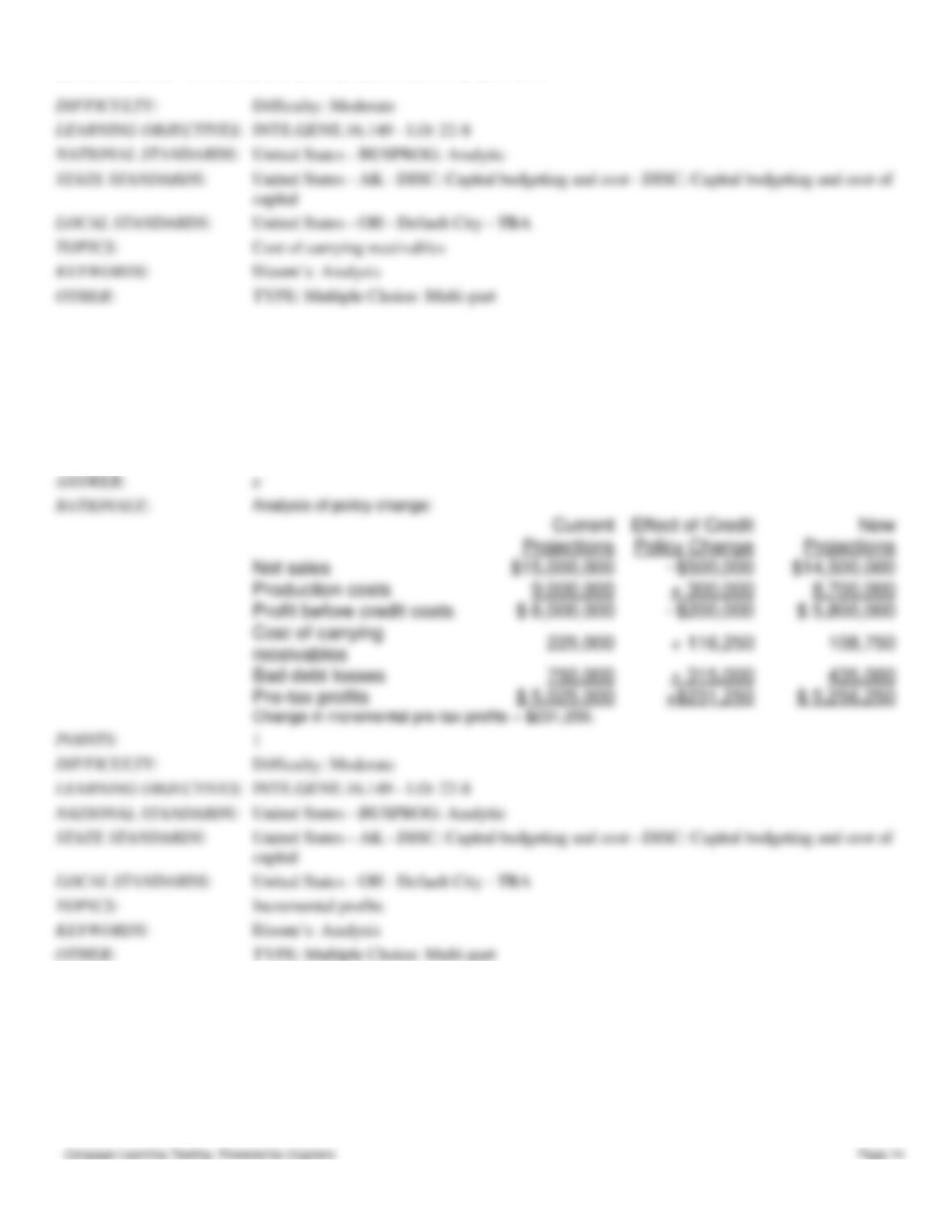
30. Refer to Exhibit 27.2. What are the incremental pre-tax profits from this proposal?
a.
$181,250
b.
$271,750
c.
$256,250
d.
$206,500
e.
$231,250
e
1
capital
31. Refer to Exhibit 272.3. What would be the cost to Van Doren of the discounts taken?
a.
$116,750
b.
−$108,750
c.
$155,000
d.
$225,000
e.
$260,500
capital
CHAPTER 22—PROVIDING AND OBTAINING CREDIT
c
1
capital
32. Refer to Exhibit 27.3. What would be the incremental bad debt losses if the change were made?
a.
$130,000
b.
$250,000
c.
−$250,000 (bad debt losses would decline)
d.
−$130,000 (bad debt losses would decline)
e.
$620,000
d
1
capital
33. Refer to Exhibit 27.3. What would be the incremental cost of carrying receivables if the change were made?
a.
−$108,750 (carrying costs would decline)
b.
$116,250
c.
$157,900
d.
−$225,000 (carrying costs would decline)
e.
$260,000
a
CHAPTER 22—PROVIDING AND OBTAINING CREDIT
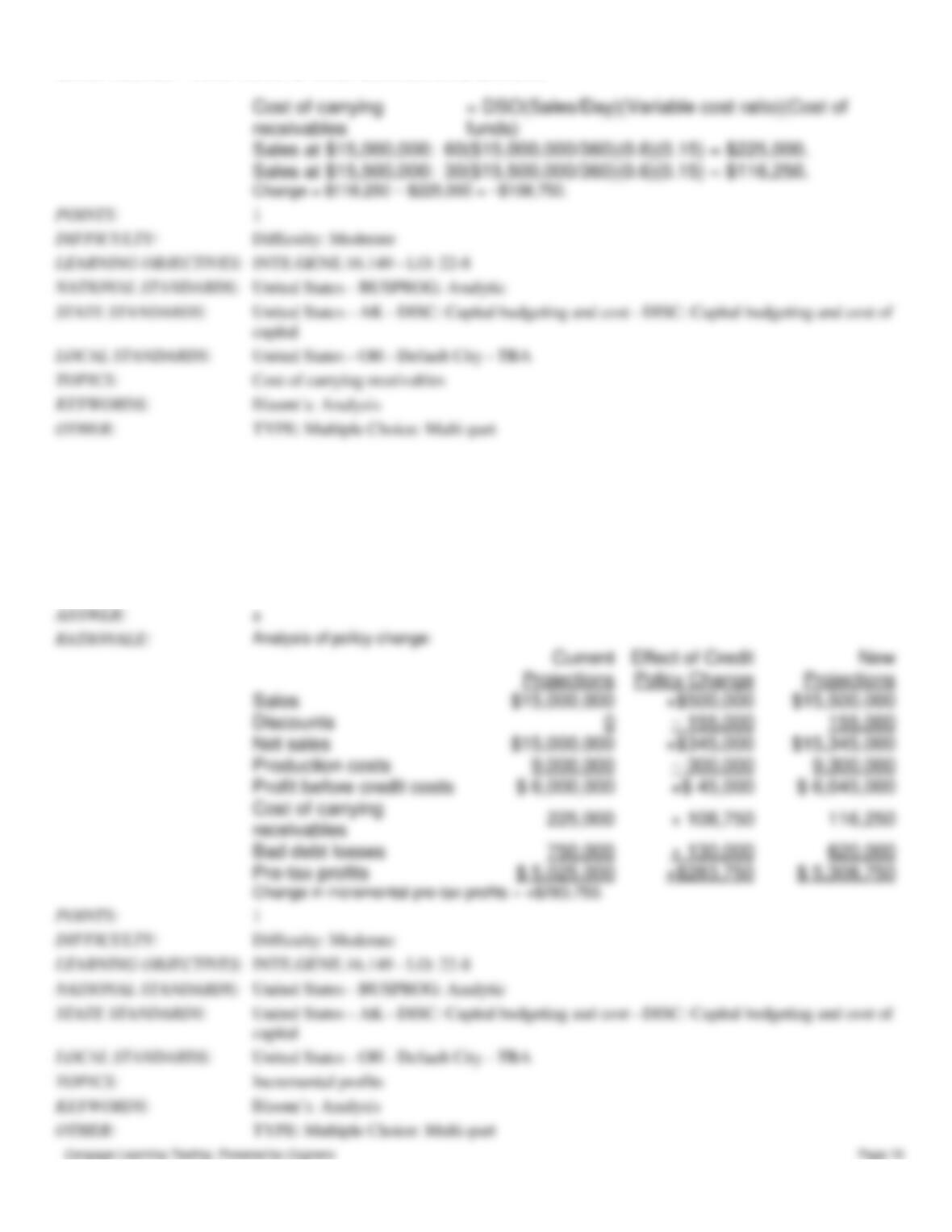
34. Refer to Exhibit 27.3. What are the incremental pre-tax profits from this proposal?
a.
$283,750
b.
$250,500
c.
$303,250
d.
$493,750
e.
$288,250
a
1
capital
Incremental profits
1
capital
CHAPTER 22—PROVIDING AND OBTAINING CREDIT
35. Darren’s Hair Products, Inc. purchases supplies from a single supplier on terms of 1/10, net 20. Currently, Darren takes
the discount, but she believes she could extend the payment to 40 days without any adverse effects if she decided not to
take the discount. Darren needs an additional $50,000 to support an expansion of fixed assets. This amount could be
raised by making greater use of trade credit or by arranging a bank loan. The banker has offered to loan the money at 12
percent discount interest. Additionally, the bank requires an average compensating balance of 20 percent of the loan
amount. Darren already has a commercial checking account at this bank that could be counted toward the compensating
balance, but the required compensating balance amount is twice the amount that Darren would otherwise keep in the
account. Which of the following statements is most correct?
a.
The cost of using additional trade credit is approximately 36 percent.
b.
Considering only the explicit costs, Darren should finance the expansion with the bank loan.
c.
The cost of expanding trade credit using the approximation formula is less than the cost of the bank loan.
However, the true cost of the trade credit when compounding is considered is greater than the cost of the bank
loan.
d.
The effective cost of the bank loan is decreased from 17.65 percent to 15.38 percent because Darren would
hold a cash balance of one-half the compensating balance amount even if the loan were not taken.
e.
If Darren had transaction balances that exceeded the compensating balance requirement, the effective cost of
the bank loan would be 12.00 percent.
d
1
Difficulty: Moderate
INTE.GENE.16.151 – LO: 22-9
United States – BUSPROG: Analytic
United States – AK – DISC: Capital budgeting and cost – DISC: Capital budgeting and cost of
capital
United States – OH – Default City – TBA
Cost of short-term financing–nonalgorithmic
TYPE: Multiple Choice: Problem
36. Tillyard Inc. requires a $25,000 1-year loan. The bank offers to make the loan, and it offers you three choices: (1) 15
percent simple interest, annual compounding; (2) 13 percent nominal interest, daily compounding (360-day year); (3) 9
percent add-on interest, 12 end-of-month payments. The first two loans would require a single payment at the end of the
year, the third would require 12 equal monthly payments beginning at the end of the first month. What is the difference
between the highest and lowest effective annual rates?
a.
1.12%
b.
2.48%
c.
3.60%
d.
4.25%
e.
5.00%
c
CHAPTER 22—PROVIDING AND OBTAINING CREDIT
37. Campbell Computing Inc. currently has sales of $1,000,000, and its days sales outstanding is 30 days. The financial
manager estimates that offering longer credit terms would (1) increase the days sales outstanding to 50 days and (2)
increase sales to $1,200,000. However, bad debt losses, which were 2 percent on the old sales, would amount to 5 percent
on the incremental sales only (bad debts on the old sales would stay at 2 percent). Variable costs are 80 percent of sales,
and Campbell has a 15 percent receivables financing cost. What would the annual incremental pre-tax profit be if Bass
extended its credit period?
a.
−$20,000
b.
−$10,000
c.
$0
d.
$10,000
e.
$20,000
e
1
capital
CHAPTER 22—PROVIDING AND OBTAINING CREDIT
38. No Tree Too Tall, Inc. is planning to borrow $12,000 from the bank. The bank offers the choice of a 12 percent
discount interest loan or a 10.19 percent add-on, one-year installment loan, payable in 4 equal quarterly payments. What is
the effective rate of interest on the 10.19 percent add–on loan?
a.
9.50%
b.
10.19%
c.
15.22%
d.
16.99%
e.
22.05%
d
1
1
capital

CHAPTER 22—PROVIDING AND OBTAINING CREDIT