53.
You exchange USD100,000 into Hong Kong dollars today at HKD7.8= USD1, earn 7% on your Hong Kong investment, and
exchange back into US dollars at a rate of HKD8.0 = USD1. How much wealthier are you as a result?
54.
If a country’s currency trades at a forward premium, interest rate parity would predict that:
55.
Which one of the following is advised when evaluating a capital project in a foreign country if you are concerned about
political risk?
56.
Current 1-year interest rates are 4% and 8% in the United States and Spain, respectively. The anticipated inflation in the
United States is 2%. If the international Fisher effect holds, what is the expected inflation rate in Spain?
57.
If you buy yen forward when the yen is selling at a forward premium, you will get:
58.
According to the expectations theory of exchange rates, what change is expected in the future spot exchange rate if the
forward rate trades at an 8% discount?
59.
If interest rates are higher in Italy than in the United States, US investors can earn a higher expected return by investing in
Italian bonds unless the euro is expected to:
60.
You are importing TV sets worth ¥10 million from a Japanese manufacturer, and this amount is payable after 6 months. You
can hedge your exchange risk by:
61.
Buckingham plc, a British corporation, owes $1 million due in 2 months. How can Buckingham hedge the exchange risk?
62.
A firm must make a large future payment in a foreign currency and wants to hedge the associated exchange rate risk. Which
one of the following identifies the cost of such a hedge?
63.
An indirect exchange rate can be converted to a direct exchange rate by:
64.
Yesterday the spot exchange rate of yen–to-dollar was JPY105 = USD1. What is today‘s spot exchange rate if the yen has
appreciated 10% against the dollar today?
65.
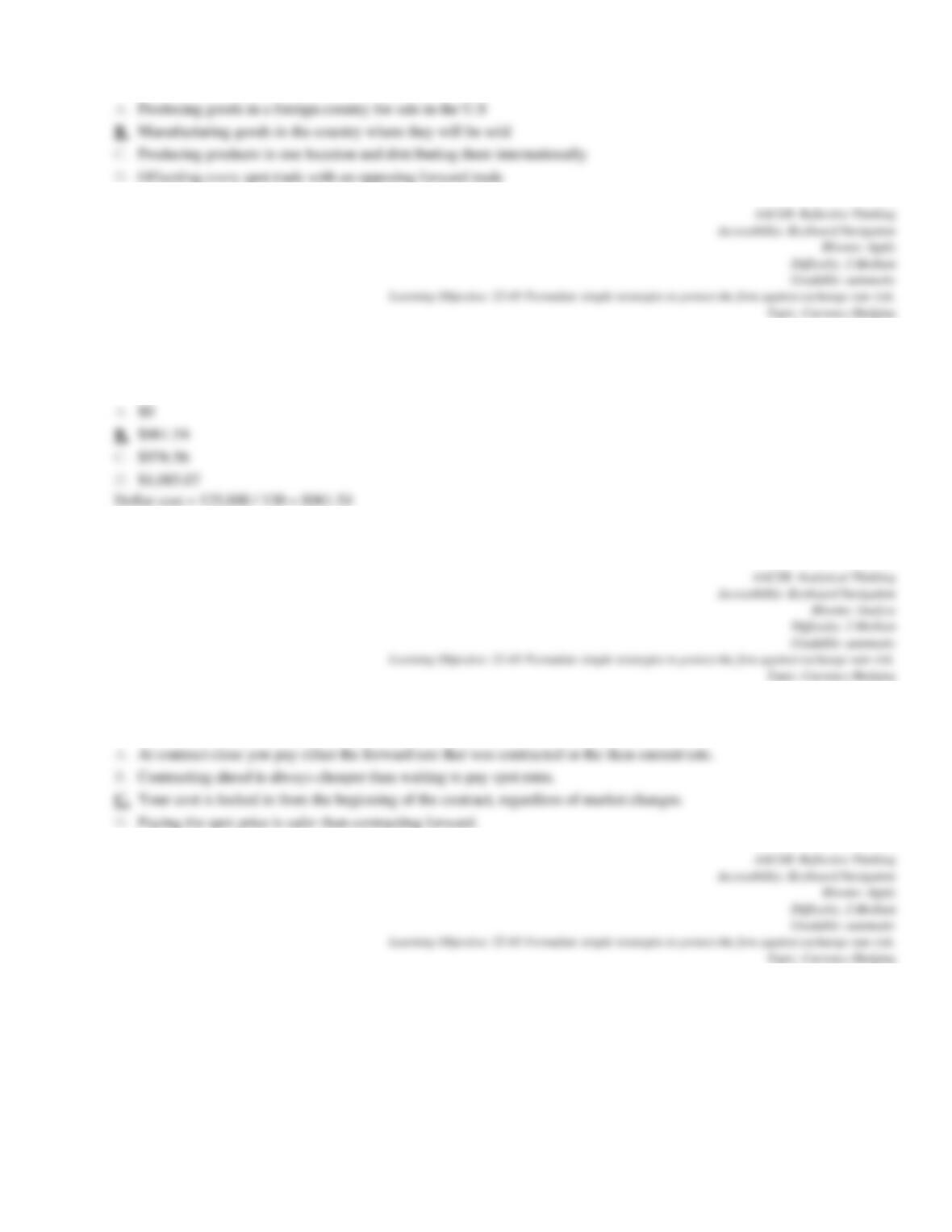
Which one of the following is correct when foreign currency is bought in the forward market?
66.
Which one of these is an example of operational hedging?
67.
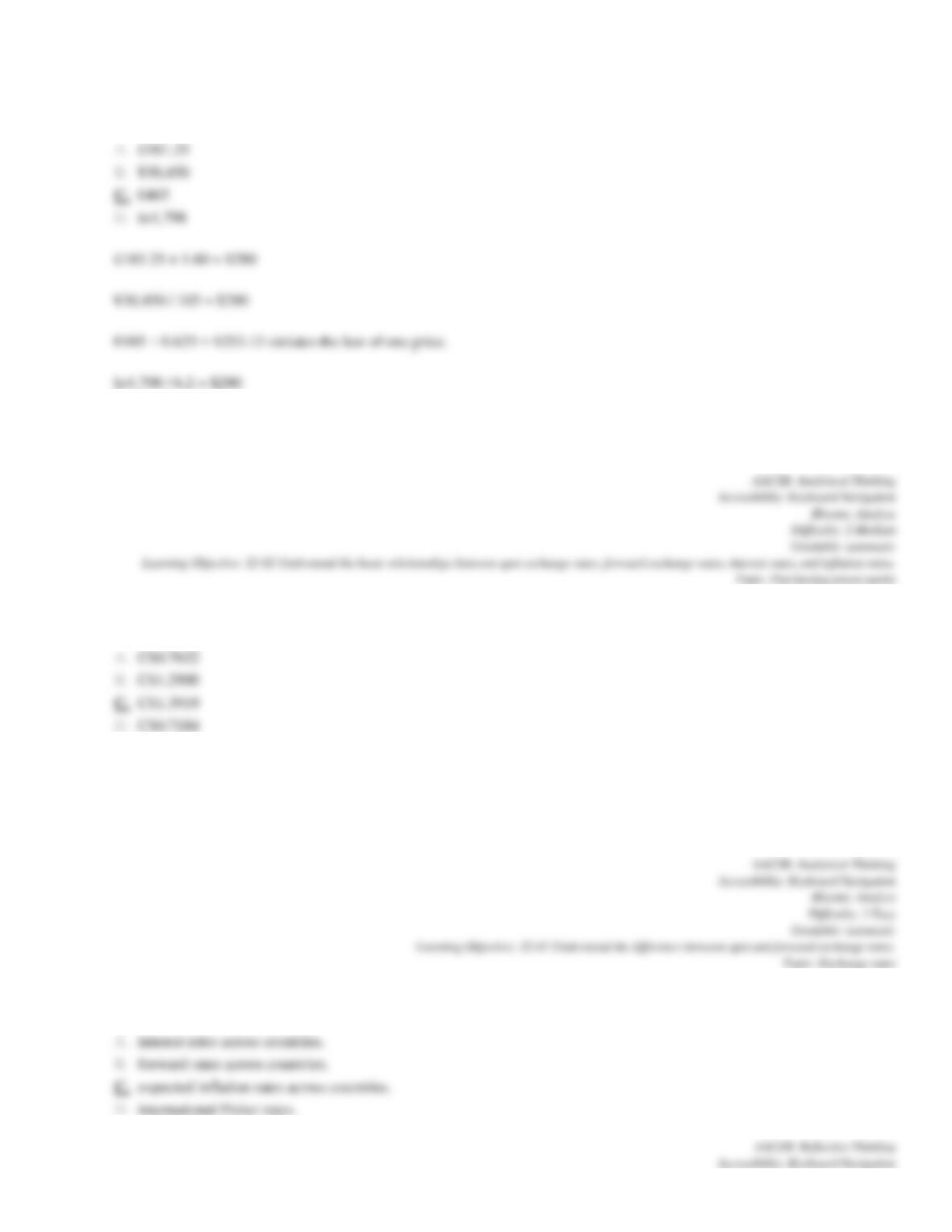
Today, you purchased 125,000 yen 6-months forward at JPY130 = USD1 per dollar. The spot rate today is JPY128 =USD1.
If the yen appreciates by 10% over the next six months, how many dollars must you pay to acquire the 125,000 yen?
68.
Which of the following is correct when contracting ahead in the forward exchange market?
69.
Consider the following spot exchange rates for the British pound, the Japanese yen, the euro and the Swedish krona:
USD1.60 = GBP1, JPY105 = USD1, USD0.625 = EUR1, and SEK6.2 = USD1. If gold sells for $290 per ounce in the
United States, which one of the following prices for 1 ounce of gold seems to violate the law of one price?
70.
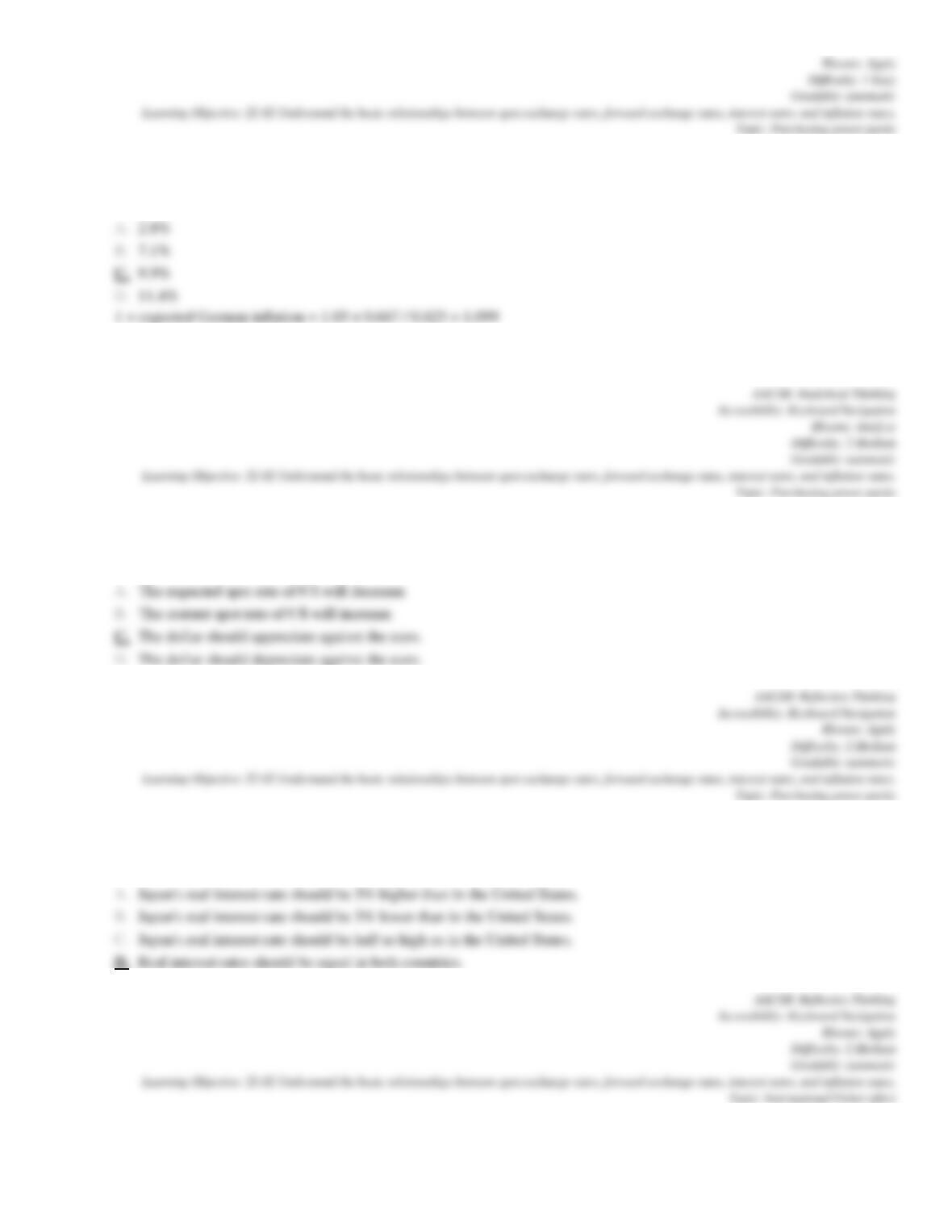
Assume you can exchange $1 for either C$1.03 or €0.74. How many Canadian dollars can be acquired with one euro?
1.03 / 0.74 = C$1.3919
71.
According to the theory of purchasing power parity, exchange rates will adjust to offset differences in:
72.
If purchasing power parity holds, what is the expected German inflation rate, if the US expected inflation rate is 3%, the spot
exchange rate is USD0.667= EUR1 and the expected spot rate is USD0.625 = EUR1?
73.
What would you expect to occur if the expected rate of inflation in the United States is considerably lower than the expected
inflation in Germany?
74.
What would you expect to be the relationship between real rates of interest in Japan and the United States if inflation is
expected to be 3% in Japan and 6% in the United States?
75.
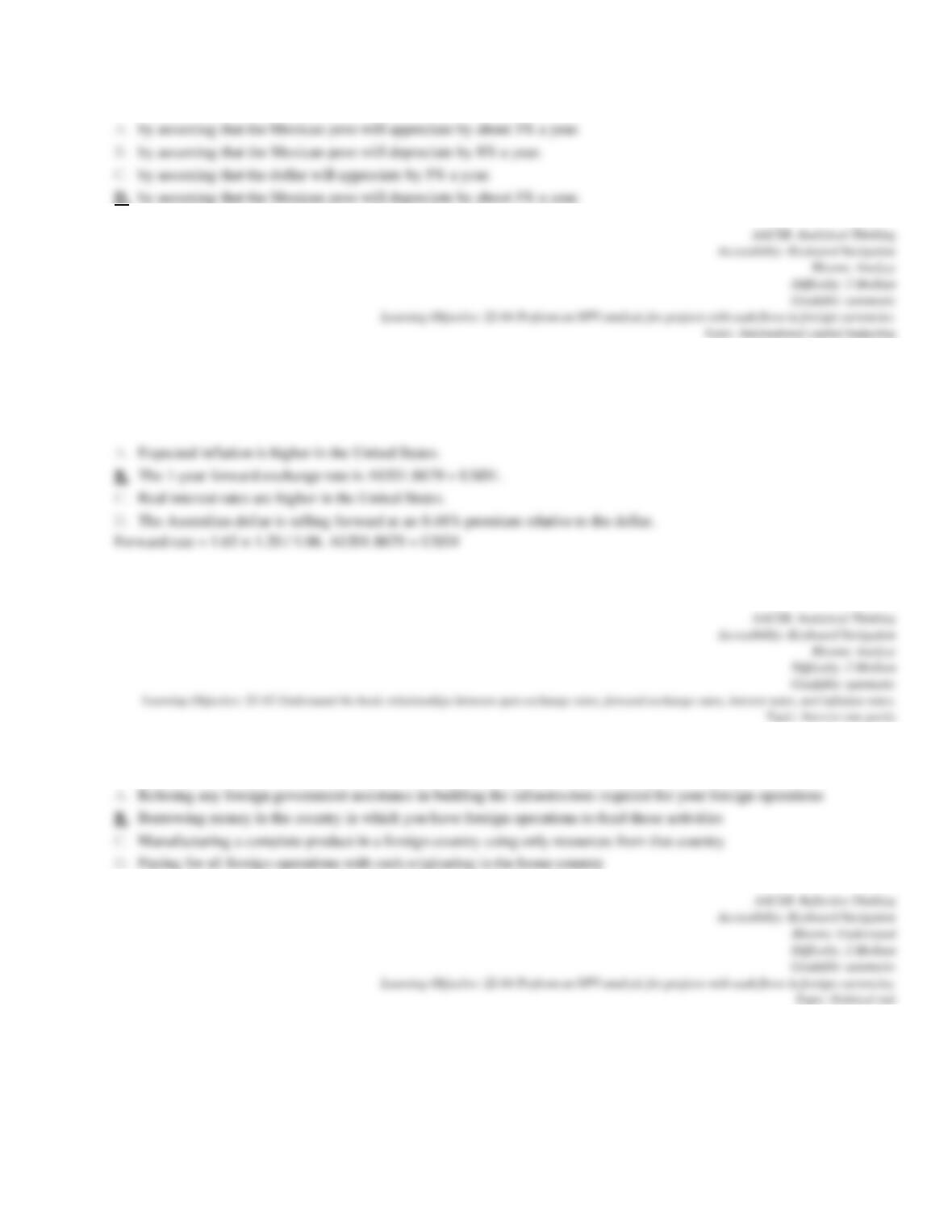
If nominal interest rates are 5% in the United States and 8% in Mexico, you should convert the expected cash flows on your
Mexican project into US dollars:
76.
You have the opportunity to invest in the United States at 6% or invest in an equally risky Australian investment that offers
20%. This is too good to be true! The current exchange rate is AUD1.65 = USD1. Which one of the following do you suspect
about this 1-year investment?
77.
Which one of these is probably the best means of reducing or offsetting political risk?
78.
Which one of the following appears to be a safe assumption when there is no difference between the forward and spot
exchange rates between two currencies?
79.
What is the expected spot rate for Japanese yen one year from now if the current spot rate is JPY106 = USD1 and the yen is
selling 1-year forward at JPY114 = USD1?
80.
The international Fisher effect is valid in the long run because:
81.
The spot exchange rate for the Canadian dollar is CAD1.02 = USD1. The 6-month interest rate in the United States is 2.5%
and 3.0% in Canada. What is the 6-month forward rate for the Canadian dollar?
82.
One of the drawbacks of using forward contracts to hedge foreign exchange risk from payables is that the:
83.
A US firm has a contractual payment of £1 million due in 3 months. Which one of the following actions would incur
exchange rate risk?
84.
Assume the spot exchange rate for the Swiss franc is CHF0.90 = USD1 and the 1-year forward rate is CHF0.871 = USD1. If
the 1-year interest rate in the U.S. is 5%, what is the 1-year interest rate in Switzerland?
85.
What is the cost of hedging a 2 million euro commitment if the spot rate is USD1.60 = EUR1, the forward rate is USD1.55 =
EUR1, and the spot rate is not expected to change before payment becomes due?
86.
The 2-year interest rate is 6.0% in Mexico and 3.0% in the USA. An American company forecast that its new plant in
Mexico will produce a cash flow of 1.3 million pesos in year 2. If the current spot rate is MXN20.0 = USD1, what is the
expected dollar cash flow from the plant in year 2?
87.
You have estimated the cash flows in pesos from a project in Switzerland and also the dollar-based cost of capital for the
project. To compute the project NPV in dollars, you now need to compute the:
88.
If managers are worried about the political risks involved in an overseas investment, they should probably adjust:
89.
If the direct quote for the euro is USD1.35=EUR1, then the indirect quote for the euro is:
90.
Assume the current spot price is USD1.62 = GBP1 and the 3-month forward rate is USD1.64 = GBP1. Which one of these
statements is correct given these rates?
91.
The spot exchange rate for the British pound is USD1.60 = GBP1. The annual inflation rate in the U.S. is 4% compared with
8% in the U.K. What is the anticipated exchange rate at the end of the year if purchasing power parity is valid?
92.
The current 1-year nominal interest in the United States is 7%. If the anticipated inflation for the coming year in the United
States is 2.5%, what is the real interest rate in the U.S.?

Chapter 22 Test bank – Static Summary
Category
# of Questions
AACSB: Analytical Thinking
27
AACSB: Communication
17
AACSB: Reflective Thinking
48
Accessibility: Keyboard Navigation
92
Blooms: Analyze
24
Blooms: Apply
39
Blooms: Remember
17
Blooms: Understand
12
Difficulty: 1 Easy
40
Difficulty: 2 Medium
48
Difficulty: 3 Hard
4
Gradable: automatic
92
Learning Objective: 22–01 Understand the difference between spot and forward exchange rates.
25
Learning Objective: 22–02 Understand the basic relationships between spot exchange rates, forward exchange rates,
interest rates, and inflation rates.
44
Learning Objective: 22–03 Formulate simple strategies to protect the firm against exchange rate risk.
16
Learning Objective: 22–04 Perform an NPV analysis for projects with cash flows in foreign currencies.
7
Topic: Currency Hedging
15
Topic: Exchange rates
13
Topic: Foreign exchange markets
4
Topic: Hedging with forward contracts
1
Topic: Interest rate parity
8
Topic: International capital budgeting
6
Topic: International Fisher effect
15
Topic: Political risk
1
Topic: Purchasing power parity
16
Topic: Spot and forward rates
12
Topic: Triangular arbitrage
1