13) Suppose the economy is producing below the natural rate of output and the government is
suffering from large budget deficits. To deal with the deficit problem, suppose the government
takes a policy action to reduce the size of the deficits. This policy action will cause ________ in
the unemployment rate in the short run and ________ in inflation in the short run, everything
else held constant.
A) an increase; an increase
B) a decrease; a decrease
C) a decrease; an increase
D) an increase; a decrease
14) According to aggregate demand and supply analysis, the negative demand shock of 2000-
2004 had the effect of
A) increasing aggregate output, lowering unemployment, and raising inflation.
B) decreasing aggregate output, raising unemployment, and raising inflation.
C) increasing aggregate output, lowering unemployment, and lowering inflation.
D) decreasing aggregate output, raising unemployment, and lowering inflation.
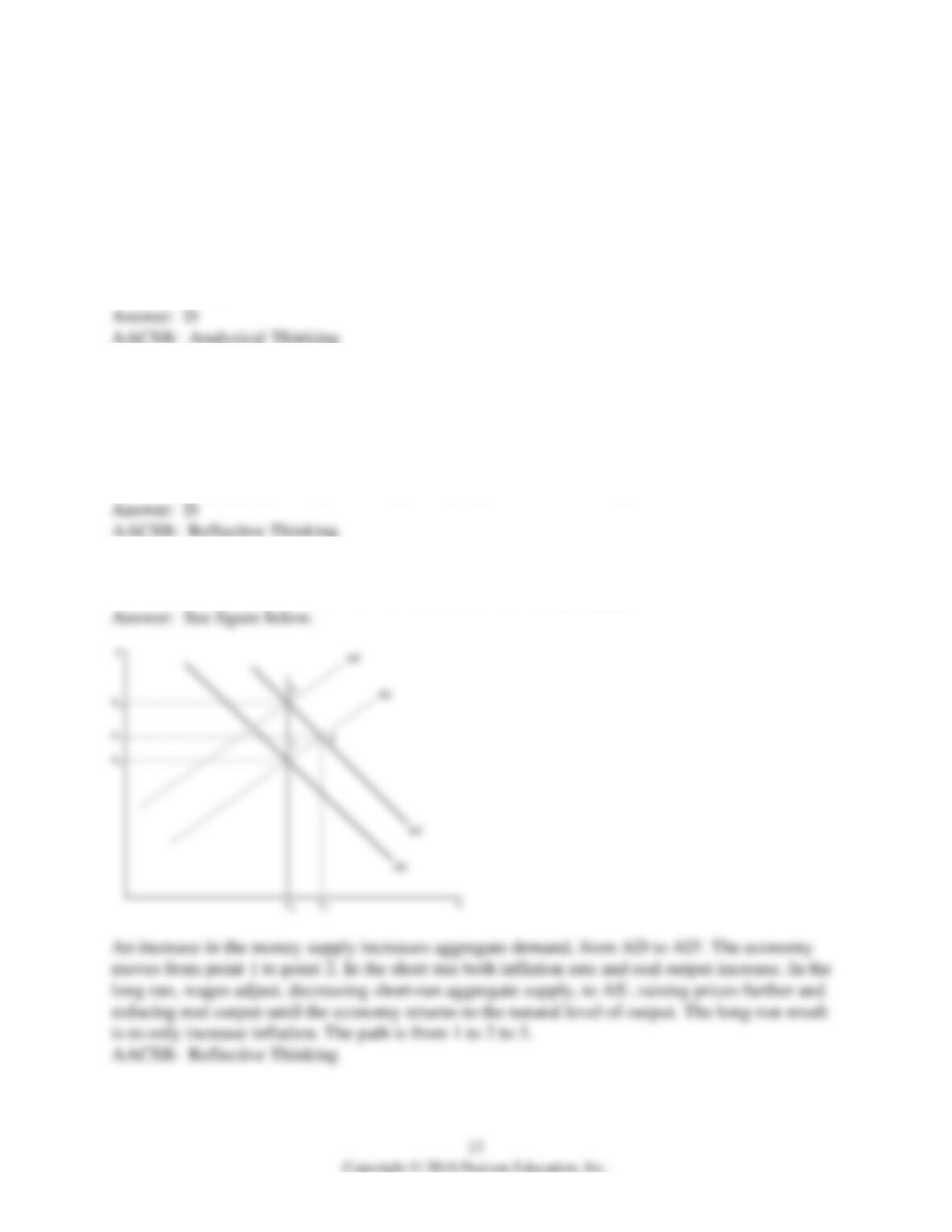
15) Using the aggregate demand-aggregate supply model, explain and demonstrate graphically
the short-run and long-run effects of an increase in the money supply.
22.6 Changes in Equilibrium: Aggregate Supply (Inflation) Shocks
1) Everything else held constant, an increase in the cost of production ________ aggregate
________.
A) increases; demand
B) decreases; demand
C) increases; supply
D) decreases; supply
2) Everything else held constant, a decrease in the cost of production ________ aggregate
________.
A) increases; demand
B) decreases; demand
C) increases; supply
D) decreases; supply
3) Everything else held constant, when output is ________ the natural rate level, wages will
begin to ________, increasing short-run aggregate supply.
A) above; fall
B) above; rise
C) below; fall
D) below; rise
4) Everything else held constant, when output is ________ the natural rate level, wages will
begin to ________, decreasing short-run aggregate supply.
A) above; fall
B) above; rise
C) below; fall
D) below; rise
5) If workers demand and receive higher real wages (a successful wage push), the cost of
production ________ and the short-run aggregate supply curve shifts ________.
A) rises; leftward
B) rises; rightward
C) falls; leftward
D) falls; rightward
6) A decrease in the availability of raw materials that increases the price level is called a
________ shock
A) negative demand
B) positive demand
C) negative supply
D) positive supply
7) A negative supply shock causes ________ to ________.
A) aggregate demand; increase
B) aggregate demand; decrease
C) short-run aggregate supply; decrease
D) short-run aggregate supply; increase
8) A positive supply shock causes ________ to ________.
A) aggregate demand; increase
B) aggregate demand; decrease
C) short-run aggregate supply; decrease
D) short-run aggregate supply; increase
9) Suppose the economy is producing at the natural rate of output and the government passes
legislation that severely restricts a company’s ability to reduce production costs via outsourcing.
Everything else held constant, this policy action will cause ________ in the unemployment rate
in the short run and ________ in inflation in the short run.
A) an increase; an increase
B) a decrease; a decrease
C) a decrease; an increase
D) no change; no change
10) Suppose the U.S. economy is operating at potential output. A negative supply shock that is
accommodated by an open market purchase by the Federal Reserve will cause ________ in real
GDP in the long run and ________ in inflation in the long run, everything else held constant.
A) no change; an increase
B) no change; a decrease
C) an increase; an increase
D) a decrease; a decrease
11) A theory of aggregate economic fluctuations called real business cycle theory holds that
A) changes in the real money supply are the only demand shocks that affect the natural rate of
output.
B) aggregate demand shocks do affect the natural rate of output.
C) aggregate supply shocks do affect the natural rate of output.
D) changes in net exports are the only demand shocks that affect the natural rate of output.
12) This theory views shocks to tastes (workers’ willingness to work, for example) and
technology (productivity) as the major driving forces behind short-run fluctuations in the
business cycle because these shocks lead to substantial short-run fluctuations in the natural rate
of output.
A) the natural rate hypothesis
B) hysteresis
C) real business cycle theory
D) the Phillips curve model
13) Because shifts in aggregate demand are not viewed as being particularly important to
aggregate output fluctuations, they do not see much need for activist policy to eliminate high
unemployment. “They” refers to proponents of
A) the natural rate hypothesis.
B) monetarism.
C) the Phillips curve model.
D) real business cycle theory.
14) According to aggregate demand and supply analysis, America’s involvement in the Vietnam
War had the effect of
A) increasing aggregate output, lowering unemployment, and raising the inflation.
B) decreasing aggregate output, lowering unemployment, and lowering the inflation.
C) increasing aggregate output, raising unemployment, and raising the inflation.
D) decreasing aggregate output, raising unemployment, and lowering the inflation.
15) According to aggregate demand and supply analysis, the negative supply shocks of 1973-
1975 and 1978-1980 had the effect of
A) increasing aggregate output, lowering unemployment, and raising the inflation.
B) decreasing aggregate output, raising unemployment, and raising the inflation.
C) increasing aggregate output, raising unemployment, and raising the inflation.
D) decreasing aggregate output, raising unemployment, and lowering the inflation.
16) According to aggregate demand and supply analysis, the favorable supply shock of 1995-
1999 had the effect of
A) increasing aggregate output, lowering unemployment, and raising inflation.
B) decreasing aggregate output, raising unemployment, and raising inflation.
C) increasing aggregate output, lowering unemployment, and lowering inflation.
D) decreasing aggregate output, raising unemployment, and lowering inflation.
17) According to aggregate demand and supply analysis, the rising oil prices coupled with the
global financial crisis in 2007-2008 caused the unemployment rate to ________ and the level of
real aggregate output to ________.
A) increase; increase
B) increase; decrease
C) decrease; increase
D) decrease; decrease
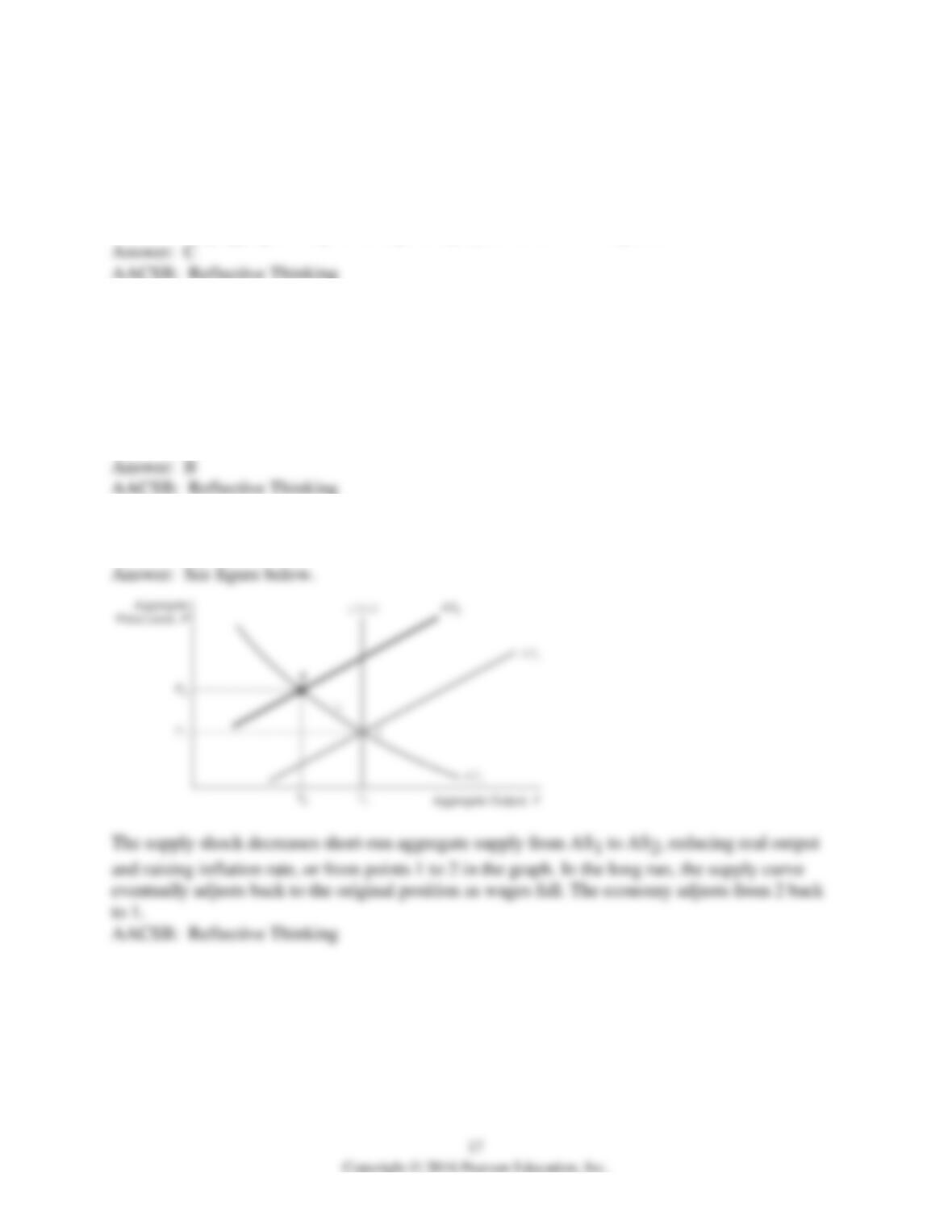
18) Explain and demonstrate graphically the effects of a negative supply shock in both the short-
run and long-run.
22.7 AD/AS Analysis of Foreign Business Cycle Episodes
1) The price of a barrel of oil doubled between 2007 and the middle of 2008. To make matters
worse, a financial crisis hit the U.S. economy starting in August of 2007. Which of the following
is an appropriate description of the mechanism that would have ensued?
A) The increase in the price of oil would have immediately shifted the AS curve to the right.
B) The financial crisis would have led to a sharp contraction in spending shifting the AD curve
to the right.
C) Shifts in both the AD and the AS curve would have ensued in the short-run but as long as
neither shock had an impact on potential output, ultimately unemployment will have been
unaffected in the long run.
D) All of the above.
E) None of the above.
2) The price of a barrel of oil doubled between 2007 and the middle of 2008. To make matters
worse, a financial crisis hit the U.S. economy starting in August of 2007. Which of the following
is TRUE of the United Kingdom’s experience?
A) The increase in the price of oil immediately shifted the AS curve to the left.
B) The financial crisis did not take hold right away so the AD curve did not immediately shift.
C) Eventually, the Lehman Brothers bankruptcy caused a negative demand shock leading to a
further fall in output and an increase in the unemployment rate.
D) All of the above.
E) None of the above.
3) The price of a barrel of oil doubled between 2007 and the middle of 2008. To make matters
worse, a financial crisis hit the U.S. economy starting in August of 2007. Which of the following
is TRUE of the Chinese experience?
A) The worldwide decline in demand led to a collapse of Chinese exports.
B) Instead of relying solely on the economy’s self-correcting mechanism, much more aggressive
fiscal expansions than those of the U.S. (in addition to a substantial monetary easing) served to
shift the AD curve back to general equilibrium relatively quickly.
C) The Chinese economy was better able than the U.S. economy to weather the financial crisis
with output growth starting to grow earlier and more quickly than that of the U.S.
D) All of the above.
E) None of the above.
4) In the long run, following a combination of a negative demand shock and a temporary
negative supply shock,
A) both inflation and output return to the original long-run equilibrium values.
B) inflation is permanently increased, while output returns to potential output.
C) output returns to potential output, while inflation may be higher or lower than its initial value.
D) inflation is permanently reduced, while output returns to potential output.
E) None of the above.
5) As of 2009, China’s economy had recovered from the global recession that began in 2008. Use
aggregate demand and aggregate supply analysis to explain why, and to explain the likely
consequences for China of an increase in the growth rate of the global economy.
22.8 Appendix: The Phillips Curve and the Short-Run Aggregate Supply Curve
1) The Phillips curve indicates that when the labor market is ________, production costs will
________ and aggregate supply increases.
A) easy; rise
B) easy; fall
C) tight; fall
D) tight; rise
2) The Phillips curve indicates that when the labor market is ________, production costs will
________ and aggregate supply decreases.
A) easy; rise
B) easy; fall
C) tight; fall
D) tight; rise
3) The expectations-augmented Phillips curve implies that as expected inflation increases,
nominal wages ________ to prevent real wages from ________.
A) fall; rising
B) fall; falling
C) rise; falling
D) rise; rising
22.9 Web Appendix 1: The Effects of Macroeconomic Shocks on Asset Prices
1) An autonomous monetary policy easing temporarily ________ real interest rates and
________ aggregate output in the short run, but in the long run real interest rates and aggregate
output return to the equilibrium levels.
A) reduces; raises
B) reduces; lowers
C) increases; lowers
D) increases; raises
2) An autonomous monetary policy easing reduces real interest rates and raises aggregate output
________ and the inflation rate rises ________.
A) temporarily; permanently
B) permanently; temporarily
C) permanently; permanently
D) temporarily; temporarily
3) Monetary policy authorities can affect real interest rates
A) in the short run, but not in the long run.
B) in the long run, but not in the short run.
C) permanently.
D) both in the long run and the short run.
4) positive spending shocks lead to ________ real interest rates ________.
A) higher; in both the short and long runs
B) higher; in the short run but not in the long run
C) lower; in both the short and long runs
D) lower; in the short run but not in the long run
5) Positive spending shocks lead to ________ output ________.
A) higher; in both the short and long runs
B) higher; in the short run but not in the long run
C) lower; in both the short and long runs
D) lower; in the short run but not in the long run
6) Positive spending shocks lead to ________ inflation ________.
A) higher; in both the short and long runs
B) higher; in the short run but not in the long run
C) lower; in both the short and long runs
D) lower; in the short run but not in the long run
7) A temporary supply shock that raises prices will cause the real interest rate to
A) rise in both the short and long runs.
B) rise in the short run but not in the long run.
C) fall in both the short and long runs.
D) fall in the short run but not in the long run.
8) A temporary supply shock that raises prices
A) will cause the real interest rate to rise in the long run.
B) has no long-run impact on inflation and output.
C) causes output to fall in the long run.
D) causes inflation to rise in the long run.
9) A permanent negative supply shock leads to ________ real interest rates ________.
A) higher; in both the short and long runs
B) higher; in the short run but not in the long run
C) lower; in both the short and long runs
D) lower; in the short run but not in the long run
10) A permanent negative supply shock leads to ________ output ________.
A) higher; in both the short and long runs
B) higher; in the short run but not in the long run
C) lower; in both the short and long runs
D) lower; in the short run but not in the long run
11) A permanent negative supply shock leads to ________ inflation ________.
A) higher; in both the short and long runs
B) higher; in the short run but not in the long run
C) lower; in both the short and long runs
D) lower; in the short run but not in the long run
12) An autonomous monetary policy easing ________ real interest rates and ________ output in
the short run, thereby ________ stock prices.
A) raises; lowers; lowering
B) raises; raises; raising
C) lowers; raises; raising
D) lowers; raises; lowering
13) A positive spending shock ________ real interest rates and ________ output in the short run,
thereby its effect on stock prices is ________.
A) raises; lowers; positive
B) raises; raises; ambiguous
C) lowers; raises; negative
D) lowers; raises; positive
14) A temporary negative supply shock ________ real interest rates and ________ output in the
short run, thereby its effect on stock prices is ________.
A) raises; lowers; negative
B) raises; raises; ambiguous
C) lowers; raises; negative
D) lowers; raises; positive
15) A permanent negative supply shock causes stock prices to ________ than they would if the
supply shock were temporary.
A) fall more
B) fall less
C) rise more
D) rise less
22.10 Web Appendix 2: Aggregate Demand and Supply: A Numerical Example
1) If firms and households form their expectations about inflation by looking at past inflation,
this form of expectations formation is known as ________ expectations.
A) adaptive
B) forward-looking
C) rational
D) perfect
2) Suppose that the short-run aggregate supply curve is: π= 2 + 1.5 (Y-10), where π is inflation
and Y is output; and the aggregate demand curve is Y= 11 – 0.5π. The equilibrium output is
________ and the equilibrium inflation rate is ________ %.
A) 10; 2
B) 17.5; 2
C) 2; 10
D) 10; 7.5
22.11 Web Appendix 3: The Algebra of the Aggregate Demand and Supply Model
1) The more willing monetary policymakers are to raise interest rates when faced with inflation,
the ________ the AD curve is, and the ________ responsive equilibrium output is to the inflation
rate.
A) steeper; more
B) steeper; less
C) flatter; more
D) flatter; less
2) An autonomous easing of monetary policy results in a ________ level of equilibrium output,
shifting the aggregate demand curve to the ________.
A) higher; right
B) lower; right
C) higher; left
D) lower; left
3) The lon-run aggregate supply curve can be expressed by
A) output as a function of potential output.
B) inflation as a function of past inflation.
C) inflation as a function of past inflation and output gap.
D) output as a function of inflation and output gap.
4) In the long-run equilibrium
A) output is a function of autonomous expenditures.
B) inflation is a function of past inflation.
C) inflation equals potential output.
D) output equals potential output.
22.12 Web Appendix 4: The Taylor Principle and Inflation Stability
1) A central bank that does NOT follow the Taylor principle will fail to raise nominal interest
rates by more than the increase in expected inflation. Therefore, higher inflation will lead to a
________ in real interest rates, resulting in ________-sloping monetary policy curves.
A) decline; downward
B) rise; downward
C) rise; upward
D) decline; upward
2) With downward-sloping monetary policy and IS curves,the aggregate demand curve is
A) downward sloping.
B) flat.
C) vertical.
D) upward sloping.
3) A central bank that does NOT follow the Taylor principle will fail to raise nominal interest
rates by more than the increase in expected inflation. As a result, the monetary policy curve is
________ sloping and the aggregate demand curve is ________ sloping.
A) upward; downward
B) downward; downward
C) upward; upward
D) downward; upward