Chapter 22: Mergers and Corporate Control
1. In a merger with true synergies, the post-merger value exceeds the sum of the separate companies’ pre-merger values.
a. True
b. False
2. Synergistic benefits can arise from a number of different sources, including operating economies of scale, financial
economies, and increased managerial efficiency.
a. True
b. False
3. A spin-off is a type of divestiture in which the assets of a division are sold to another firm.
a. True
b. False
Chapter 22: Mergers and Corporate Control
4. The purchase of assets at below their replacement cost and tax considerations are two factors that motivate mergers.
a. True
b. False
5. The primary reason managers give for most mergers is to acquire more assets so as to increase sales and market share.
a. True
b. False
6. Since managers’ central goal is to maximize stock price, managerial control issues do not interfere with mergers that
would benefit the target firm’s stockholders.
a. True
b. False
Chapter 22: Mergers and Corporate Control
7. Which of the following are legal and acceptable reasons for the high level of merger activity in the U.S. during the
1980s?
a. A profitable firm acquires a firm with large accumulated tax losses that may be carried forward.
b. Attempts to stabilize earnings by diversifying.
c. Purchase of assets below their replacement costs.
d. Reduction in competition resulting from mergers.
e. Synergistic benefits arising from mergers.
8. Which of the following statements is most CORRECT?
a. The smaller the synergistic benefits of a particular merger, the greater the scope for striking a bargain in
negotiations, and the higher the probability that the merger will be completed.
b. Since mergers are frequently financed by debt rather than equity, a lower cost of debt or a greater debt capacity
are rarely relevant considerations when considering a merger.
c. Managers who purchase other firms often assert that the new combined firm will enjoy benefits from
diversification, including more stable earnings. However, since shareholders are free to diversify their own holdings, and
at what’s probably a lower cost, diversification benefits is generally not a valid motive for a publicly held firm.
d. Operating economies are never a motive for mergers.
e. Tax considerations often play a part in mergers. If one firm has excess cash, purchasing another firm exposes the
purchasing firm to additional taxes. Thus, firms with excess cash rarely undertake mergers.

Chapter 22: Mergers and Corporate Control
9. A conglomerate merger occurs when two firms with either a horizontal or a vertical business relationship combine.
a. True
b. False
10. One of the main reasons why foreign firms are interested in buying U.S. companies is to gain entrance to the U.S.
market. A decline in the value of the dollar relative to most foreign currencies makes this competitive strategy especially
attractive.
a. True
b. False
11. If a petrochemical firm that used oil as feedstock merged with an oil producer that had large oil reserves and a drilling
subsidiary, this would be a vertical merger.
a. True
b. False
Chapter 22: Mergers and Corporate Control
12. A congeneric merger is one where the merging firms operate in related businesses but do not necessarily produce the
same products or have a producer-supplier relationship.
a. True
b. False
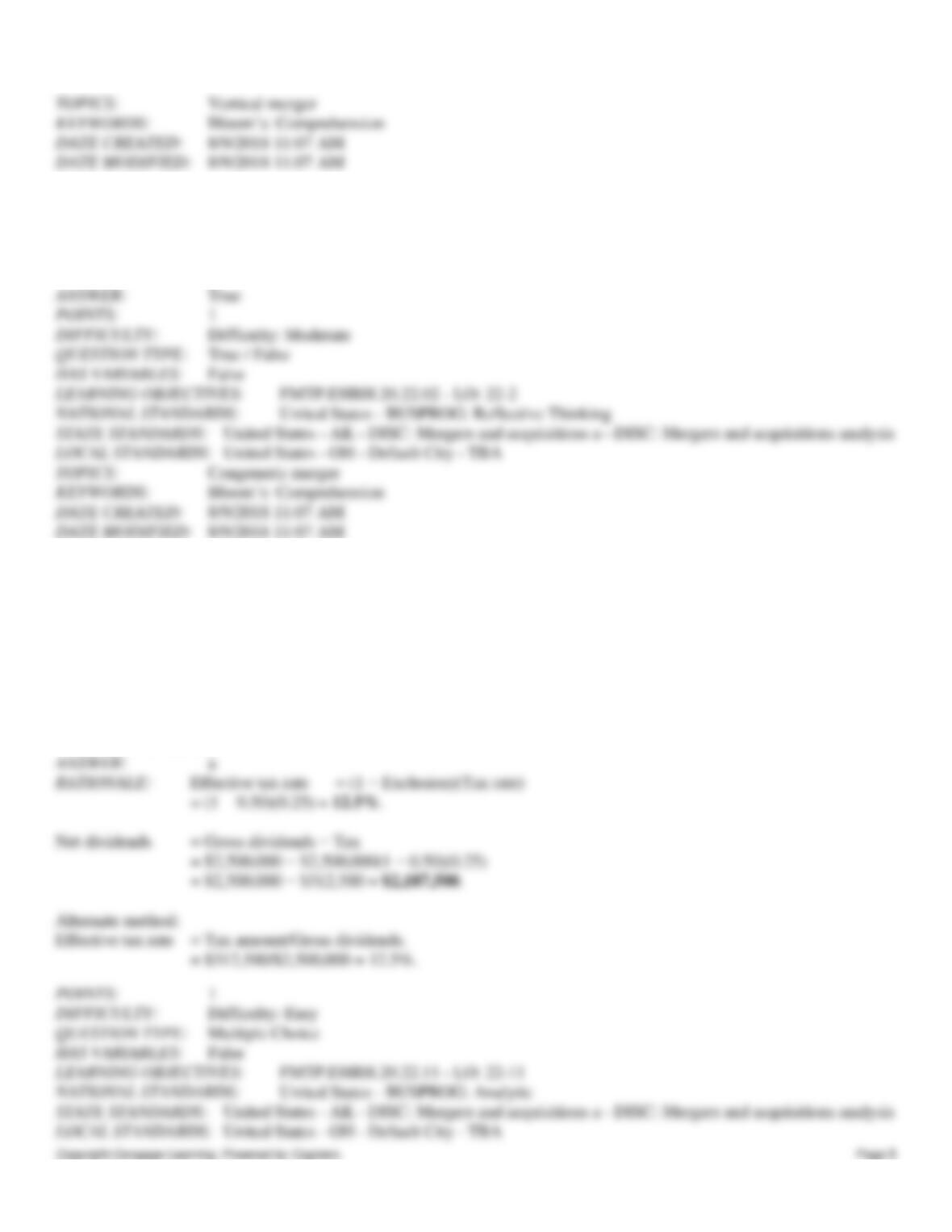
13. A parent holding company sells shares in its subsidiary such that the parent now owns only 65% of the subsidiary and,
thus, the tax returns of the parent and its subsidiary can’t be consolidated. The parent receives annual dividends from the
subsidiary of $2,500,000. If the parent’s marginal tax rate is 25% and if the exclusion on intercompany dividends is 50%,
what is the effective tax rate on the intercompany dividends, and how much net dividends are received?
a. 12.5%; $2,187,500
b. 12.5%; $2,135,000
c. 23.8%; $1,905,000
d. 12.5%; $1,750,000
e. 25.0%; $1,650,000

Chapter 22: Mergers and Corporate Control
14. Merger activity is likely to heat up when interest rates are high because target firms can expect to receive an especially
high premium over the pre-announcement stock price.
a. True
b. False
15. Most defensive mergers occur as a result of managers’ actions to maximize shareholders’ wealth.
a. True
b. False
16. Post-merger control and the negotiated price paid by the acquirer are two of the most important issues in agreeing on
the terms of a merger.
a. True
b. False

Chapter 22: Mergers and Corporate Control
17. A company seeking to fight off a hostile takeover might employ the services of an investment banking firm to develop
a defensive strategy.
a. True
b. False
18. Since a manager’s central goal is to maximize the firm’s stock price, any merger offer that provides stockholders with
significant gains over the current stock price will be approved by the current management team.
a. True
b. False
19. Firms use defensive tactics to fight off undesired mergers. These tactics do not include
a. getting a white squire to purchase stock in the firm.
b. getting white knights to bid for the firm.
c. repurchasing their own stock.
d. changing the bylaws to eliminate supermajority voting requirements.
e. raising antitrust issues.
Chapter 22: Mergers and Corporate Control
20. Which of the following statements is most CORRECT?
a. A defensive merger is one where the firm’s managers decide to merge with another firm to avoid or lessen the
possibility of being acquired through a hostile takeover.
b. Acquiring firms send a signal that their stock is undervalued if they choose to use stock to pay for the acquisition.
c. Cash payments are used in takeovers but never in mergers.
d. Managers often are fired in takeovers, but never in mergers.
e. If a company that produces military equipment merges with a company that manages a chain of motels, this is an
example of a horizontal merger.
21. Since the primary rationale for any operating merger is synergy, in planning such mergers, the development of
accurate pro forma cash flows is the single most important action.
a. True
b. False

Chapter 22: Mergers and Corporate Control
22. Only if a target firm’s value is greater to the acquiring firm than its market value as a separate entity will a merger be
financially justified.
a. True
b. False
23. Discounted cash flow methods are not appropriate for evaluating mergers because the cash flows are uncertain and the
discount rate can only be determined after the merger is consummated.
a. True
b. False
24. In a financial merger, the relevant post-merger cash flows are simply the sum of the expected cash flows of the two
companies, measured as if they were operated independently.
a. True
b. False

Chapter 22: Mergers and Corporate Control
25. Coca-Cola’s acquisition of Columbia Pictures and its announcement that it would operate its new subsidiary separately
could be described as primarily a financial merger.
a. True
b. False
26. If the capital structure is stable, and free cash flows are expected to be growing at a constant rate at the horizon date,
then the horizon value is calculated by discounting the free cash flows plus the expected future tax shields at the weighted
average cost of capital.
a. True
b. False
27. The present value of the free cash flows discounted at the unlevered cost of equity is the value of the firm’s operations
if it had no debt.
a. True
b. False

Chapter 22: Mergers and Corporate Control
28. Which of the following statements is most CORRECT?
a. Financial theory says that the choice of how to pay for a merger is really irrelevant because, although it may affect
the firm’s capital structure, it will not affect its overall required rate of return.
b. The basic rationale for any financial merger is synergy and, thus, the estimation of pro forma cash flows is the
single most important part of the analysis.
c. In most mergers, the benefits of synergy and the premium the acquirer pays over the market price are summed and
then divided equally between the shareholders of the acquiring and target firms.
d. The primary rationale for most operating mergers is synergy.
e. The acquiring firm’s required rate of return in most horizontal mergers will not be affected, because the 2 firms
will have similar betas.
29. Which of the following statements about valuing a firm using the compressed adjusted present value (CAPV)
approach is most CORRECT?
a. The horizon value is calculated by discounting the free cash flows beyond the horizon date and any tax savings at
the cost of debt.
b. The horizon value is calculated by discounting the expected earnings at the WACC.
c. The horizon value is calculated by discounting the free cash flows beyond the horizon date and any tax savings at
the WACC.
d. The horizon value must always be more than 20 years in the future.
e. The horizon value is calculated by discounting the free cash flows beyond the horizon date and any tax savings at
the levered cost of equity.
Chapter 22: Mergers and Corporate Control
30. Which of the following statements about valuing a firm using the compressed adjusted present value (CAPV)
approach is most CORRECT?
a. The value of equity is calculated by discounting the horizon value, the tax shields, and the free cash flows at the
cost of equity.
b. The value of operations is calculated by discounting the horizon value, the tax shields, and the free cash flows
before the horizon date at the unlevered cost of equity.
c. The value of equity is calculated by discounting the horizon value and the free cash flows at the cost of equity.
d. The CAPV approach stands for the accounting pre-valuation approach.
e. The value of operations is calculated by discounting the horizon value, the tax shields, and the free cash flows at
the cost of equity.
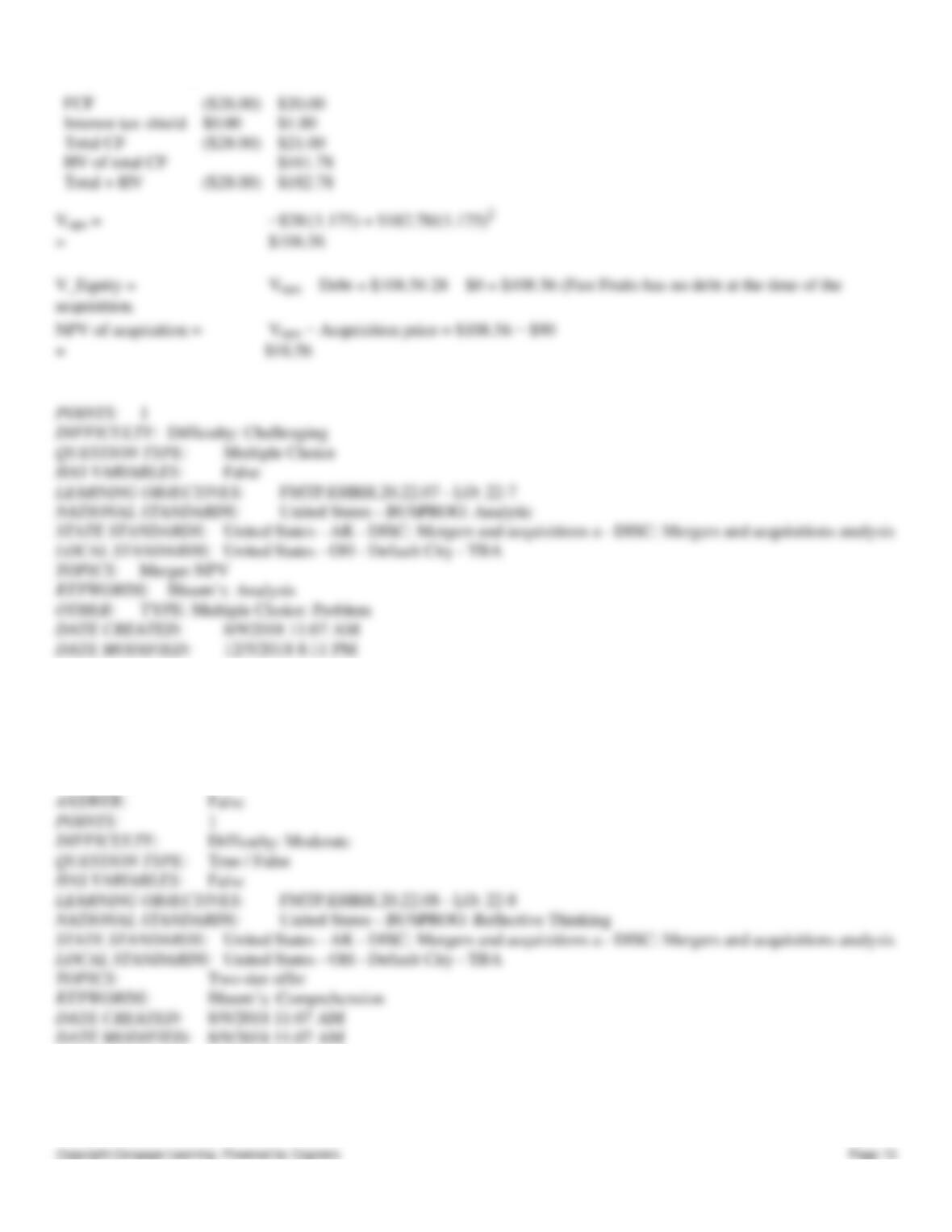
31. Juicers Inc. is thinking of acquiring Fast Fruit Company. Juicers has determined that Fast Fruit’s current cost of equity
is 17.5%; Fast Fruit currently has no debt outstanding. In Year 1, Juicers expects Fast Fruit to generate $9 million in
NOPAT and invest $50 million in total net operating capital. Fast Fruit will borrow to finance this expansion, with the
first interest payment ($5 million) due at Year 2. (There will be no interest due at Year 1.) In Year 2, Fast Fruit will
generate $25 million in NOPAT and invest $10 million in total net operating capital. Fast Fruit’s marginal tax rate is 25%.
After the second year, the free cash flows and the tax shields each will grow at a constant rate of 4%. Assume that all cash
flows occur at the end of the year. If Juicers must pay $90 million to acquire Fast Fruit, what is the NPV of the proposed
acquisition? (Report your answer in millions of dollars.)
a. $16.75 million
b. $17.63 million
c. $18.56 million
d. $19.53 million
e. $20.56 million
Chapter 22: Mergers and Corporate Control
32. A two-tier merger offer is one where the acquiring company offers to purchase the target company in a two-part
transaction. Cash is paid to some stockholders, bonds are issued to others, but the total values of each part of the
transaction are equal.
a. True
b. False
33. The distribution of synergistic gains between the stockholders of two merged firms is almost always based strictly on
their respective market values before the announcement of the merger.
a. True
Chapter 22: Mergers and Corporate Control
b. False
34. The owners of Arthouse Inc., a national artist supplies chain, are contemplating purchasing Craftworks Inc, a smaller
chain. Arthouse’s analysts project that the merger will result in incremental free flows and interest tax savings with a
combined present value of $72.52 million, and they have determined that the appropriate discount rate for valuing
Craftworks is 16%. Craftworks has 4 million shares outstanding and no debt. Craftworks’ current price is $16.25. What is
the maximum price per share that Arthouse should offer?
a. $16.25
b. $16.97
c. $17.42
d. $18.13
e. $19.00
35. Currently (2018), mergers can be accounted for using either the purchase method or the pooling method.
a. True
b. False

Chapter 22: Mergers and Corporate Control
36. Any goodwill created in a merger must be amortized over its expected life, usually 40 years, for shareholder reporting
purposes.
a. True
b. False
37. Although goodwill created in a merger may not be amortized for shareholder reporting purposes, it may be amortized
for Federal tax purposes.
a. True
b. False
38. Borrowing funds on terms that would require immediate repayment of all funds if the firm is acquired, selling off
valuable assets, and granting huge “golden parachutes” that open if the firm is acquired are three procedures used to
defend against hostile takeovers. These strategies are known as “poison pills.”
a. True
b. False
Chapter 22: Mergers and Corporate Control
39. Which of the following statements is most CORRECT?
a. Regulations in the United States prohibit acquiring firms from using common stock to purchase another firm.
b. Defensive mergers are designed to make a company less vulnerable to a takeover.
c. Hostile mergers always create value for the acquiring firm.
d. In a tender offer, the target firm’s management always remain after the merger is completed.
e. A conglomerate merger is one where a firm combines with another firm in the same industry.
40. A joint venture is one in which two, or sometimes more, independent companies agree to combine resources in order
to achieve a specific objective, usually limited in scope.
a. True
b. False

Chapter 22: Mergers and Corporate Control
41. The two principal advantages of holding companies are (1) the holding company can control a great deal of assets with
limited equity and (2) the dividends received by the parent from the subsidiary are not taxed if the parent holds at least
50% of the subsidiary’s stock.
a. True
b. False
42. The three main advantages of holding companies are (1) control with fractional ownership, (2) taxation benefits, and
(3) isolation of operating risks.
a. True
b. False