Part 8 Financial Policies
CHAPTER 21
CAPITAL STRUCTURE DECISIONS
CHAPTER LEARNING OBJECTIVES
21.1 Explain how business and financial risk affect a firm’s ROE and EPS, and
21.2 Identify the factors that influence capital structure.
21.3 Explain how Modigliani and Miller (M&M) “proved” their irrelevance
21.4 Explain how the introduction of corporate taxes affects M&M’s irrelevance
21.5 Describe how financial distress and bankruptcy costs lead to the static
21.6 Explain how information asymmetries and agency problems lead firms to
21.7 Describe other factors that can affect a firm’s capital structure in practice.
21.8 Explain how the introduction of personal taxes on investment income affects
the corporate tax advantage to using debt.
Capital Structure Decisions 21 – 2
MULTIPLE CHOICE QUESTIONS
1. Indifference analysis is developed through the relationship between
a) debt-equity ratio and expected earnings.
b) earnings before interest and taxes and earnings per share.
c) beta and expected return.
d) after-tax earnings and earnings per share.
2. Above the break-even point for earnings before interest and taxes, increased debt will
______ earnings per share.
a) decrease
b) increase
c) not change
d) Cannot be determined with the existing information
3. Which of the following represent limitations of indifference analysis?
I. Indifference analysis does not consider how equity investors may react to the increased risk
due to increased leverage.
II. Indifference analysis fails to account for corporate taxes.
III. Indifference analysis ignores sinking fund payments.
a) I only
b) I and II
c) I and III
d) I, II, and III
21 – 3 Test Bank for Introduction to Corporate Finance, Fourth Canadian Edition
4. Which of the following is NOT a result of increasing debt?
a) A decrease in the financial flexibility of the firm
b) An increase in the sales breakeven point.
c) An increase in managers’ flexibility to spend money.
d) An increase in the cost of borrowing.
5. The indifference analysis refers to the indifference of:
a) earnings with respect to two alternative financing plans.
b) sales with respect to the cost of debt.
c) cost of equity with respect to debt structure.
d) risk of bankruptcy with respect to debt structure.
6. Increasing the operating or business risk of a firm will increase the variability of:
a) return on equity (ROE).
b) return on investment (ROI).
c) increasing the operating or business risk of the firm has no effect on the variability of ROE
and ROI.
d) a and b
7. Northwest Territories Bikini Company reported the following financial data for the year ended
2015.
Sales $50,000
Variable costs $10,000
Fixed rent $25,000
Interest expense $5,000
Book value of equity $15,000
Book value of debt $25,000
Tax rate 20%
The return on equity (ROE) of Northwest Territories Bikini Company is closest to:
a) 0.1333
b) 0.3000
c) 0.3750
d) 0.5333
8. Northwest Territories Bikini Company reported the following financial data for the year ended
2015:
Sales $50,000
Variable costs $10,000
Fixed rent $25,000
Interest expense $5,000
Book value of equity $15,000
Book value of debt $25,000
Tax rate 20%
The return on investment (ROI) of Northwest Territories Bikini Company is closest to:
a) 0.1333
b) 0.3000
c) 0.3750
d) 0.5333
9. At the EPS indifference point, two companies would have:
a) the same sales level regardless of the number of outstanding shares.
b) the same sales level regardless of the debt to equity ratio.
c) the same EPS regardless of the number of shares.
d) the same EPS regardless of the financing scheme adopted.
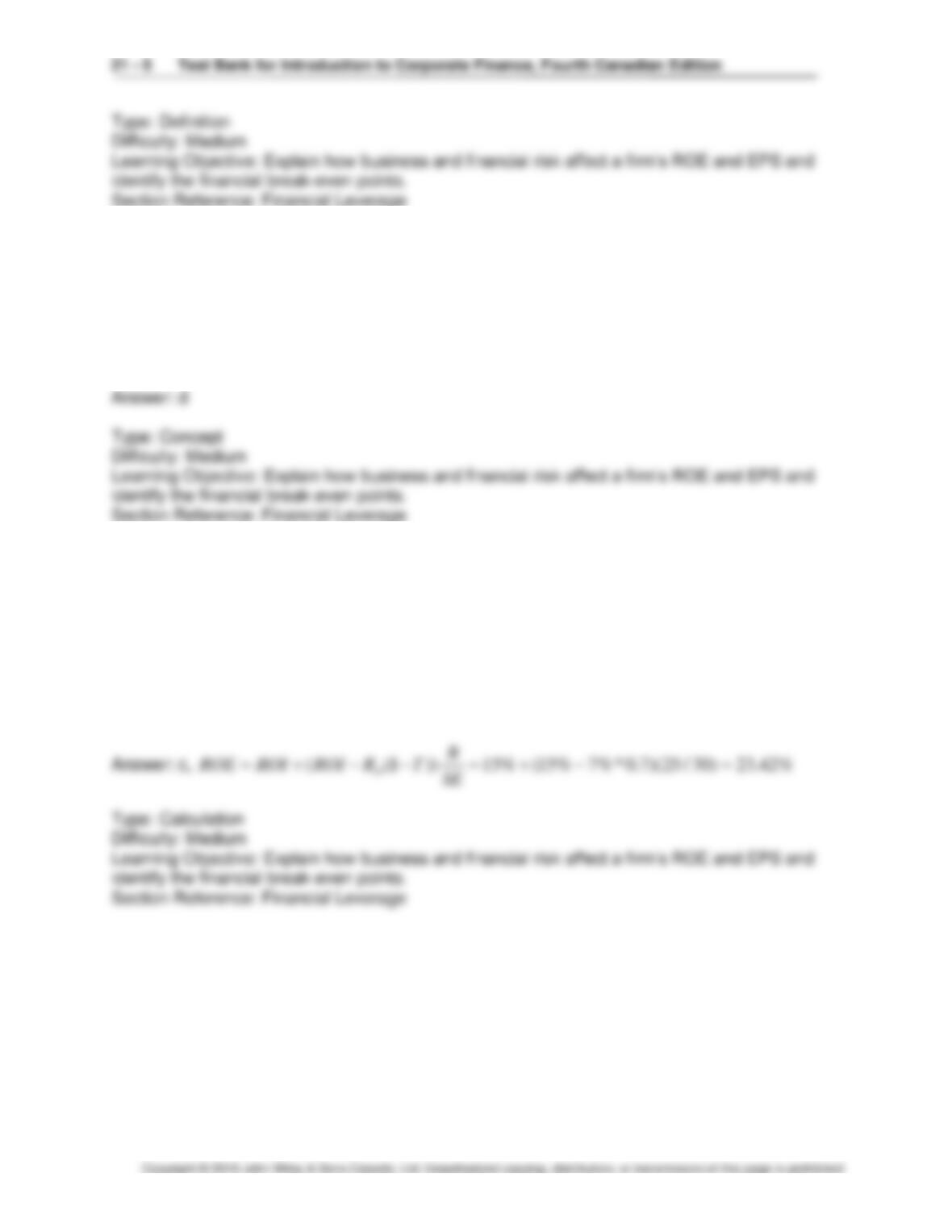
10. In 2015, Toronto Skaters earned a return on investment (ROI) of 15% and had a cost of
debt of 7 percent. The book value of debt was $25,000 and the book value of shareholders’
equity was $30,000. The firm faces a tax rate of 30 percent. The firm’s return on equity is:
a) 19.92%
b) 22.08%
c) 23.42%
d) 27.12%
11. Determine the EPS indifference EBIT level for Poutine Company for the following two
scenarios: A debt/equity ratio of .6, pre-tax cost of debt is 8 percent, annual interest payments
are $2,000, and the company has 1,000 shares outstanding. In scenario 2, the firm is all equity
financed and has 1,500 shares outstanding. The tax rate is 40 percent for both scenarios.
The EPS indifference EBIT level for Poutine Company is:
a) $10,000
b) $6,000
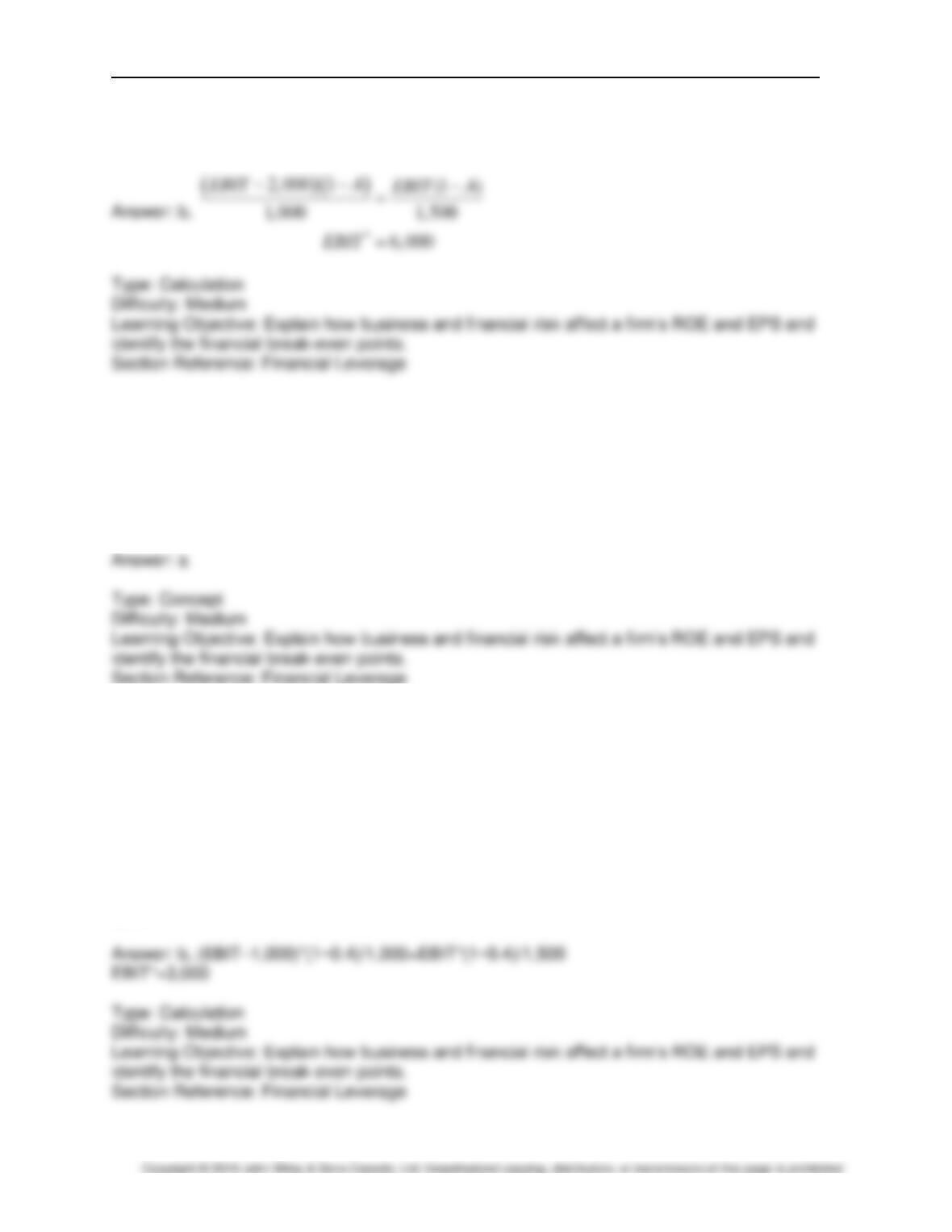
Capital Structure Decisions 21 – 6
c) $4,000
d) $2,000
12. Which of the following statements is correct?
a) Indifference point is the level at which two financing strategies produce the same ROE.
b) Indifference point is the level at which a firm’s ROE is zero.
c) Indifference point is the level at which a firm’s dividend payout is zero.
d) all of the above are correct.
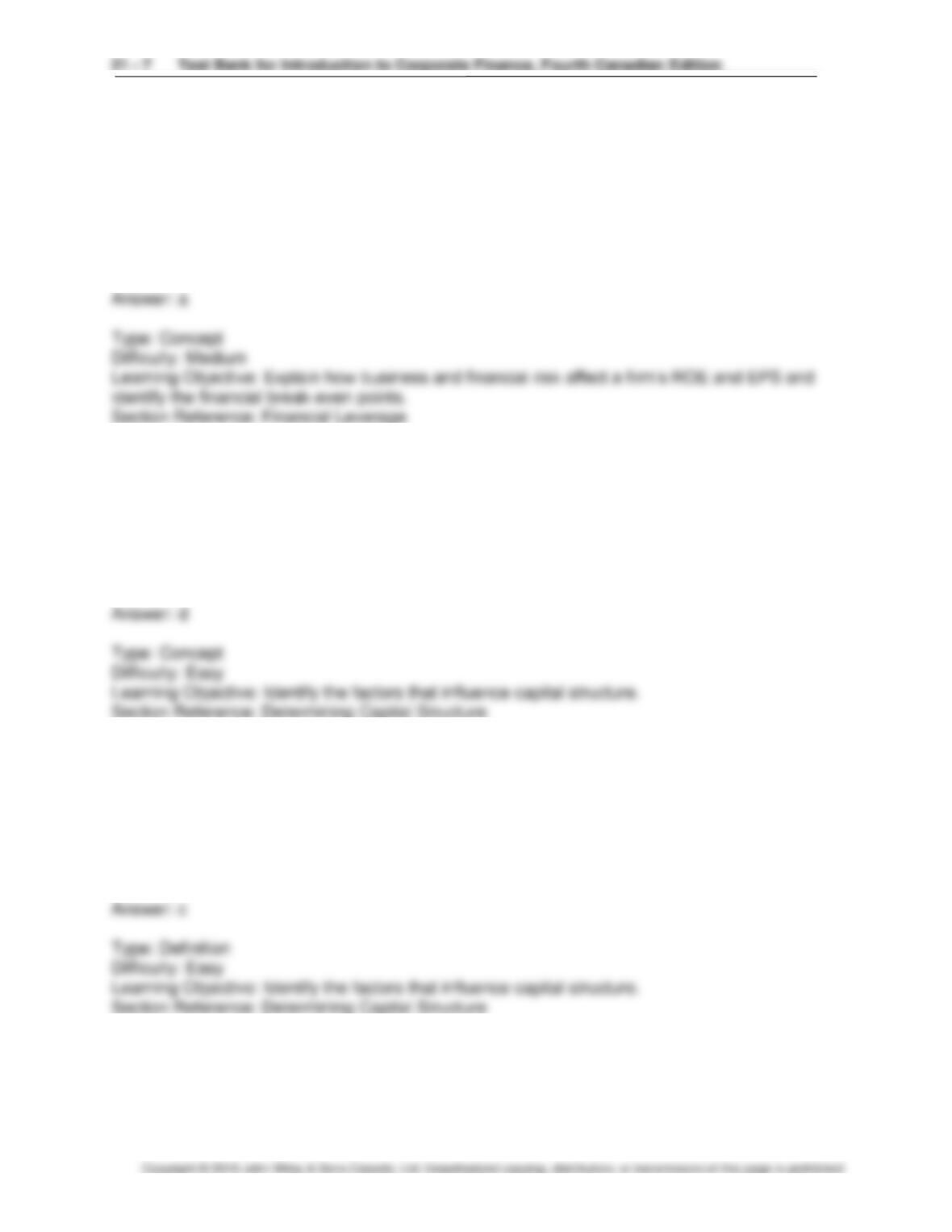
13. Determine the EPS indifference EBIT level for Poutine Company for the following two
scenarios: A debt/equity ratio of .8, pre-tax cost of debt is 4 percent, annual interest payments
are $1,000, and the company has 1,000 shares outstanding. In scenario 2, the firm is all equity
financed and has 1,500 shares outstanding. The tax rate is 40 percent for both scenarios.
The EPS indifference EBIT level for Poutine Company is:
a) $10,000
b) $3,000
c) $1,500
d) $2,000
14. The effect of financial leverage on ROE depends on:
a) the firm’s financing strategy.
b) the amount of dividends paid out.
c) the market value of the debt.
d) none of the above.
15. When measuring the potential effect of leverage on a firm, what must we consider?
a) The stock of debt outstanding
b) The maturity of the debt outstanding
c) Any sinking fund payments
d) All of the above
16. Compared to non-investment grade firms, investment grade firms, in general, do not exhibit:
a) higher coverage ratios.
b) higher cash flow to debt ratios.
c) lower return on assets.
d) higher profit margin.
17. Fixed burden coverage ratio measures:
a) the coverage of expenses associated with debt with operating income.
Capital Structure Decisions 21 – 8
b) the return on investment capital.
c) the magnitude of historical capital expenditure over the years.
d) none of the above.
18. Use the following statements to answer this question:
I. The correlation between a high Altman Z score and the rating by rating agencies is positive
II. Investment-grade firms have a low yield to maturity
a) I and II are correct.
b) I and II are incorrect.
c) I is correct and II is incorrect.
d) I is incorrect and II is correct.
19. Cash flow-to-debt ratio measures:
a) the amount of dividends paid out to common shareholders.
b) the amount the cash flow available over a period to cover a firm’s outstanding debt
c) the amount of income and expenditures financed with debt.
d) none of the above.
20. In order to show that capital structure is irrelevant, we need which of the following
assumptions?
a) Perfect markets
b) No taxes
c) Risk-free debt
d) All of the above are critical.
21 – 9 Test Bank for Introduction to Corporate Finance, Fourth Canadian Edition
21. The M&M proof of capital structure irrelevance relies on:
a) arbitrage arguments
b) personal and corporate leverage are perfect substitutes
c) both of the above
d) neither of the above
22. In the absence of taxes and bankruptcy costs, which of the following is true?
a) The total value of the firm is dependent on the firm’s capital structure.
b) Investors can undo the leverage that the corporation has undertaken.
c) Adding debt to the capital structure creates value.
d) Shareholders will pay a premium for shares merely because a firm chooses to introduce
financial leverage.
23. Which one of the following is an example of homemade leverage?
a) An investor borrows money to invest in a car.
b) An investor sells part of her stocks to put down a down payment.
c) An investor borrows money to invest more in a company that she owns.
d) An investor invests in the derivatives of a firm.
24. In a world with no taxes and no bankruptcy costs,
a) the firm’s value is unaffected by capital structure.
b) the firm should maximize the value of the firm by maximizing the firm’s debt.
c) the firm should borrow to the point where the marginal benefits of debt equal the marginal
costs.
d) the firm cannot make a decision about the optimal capital structure with the existing
information.
25. Poutine Cheese Co. operates in a world with zero taxes and zero risk of financial distress.
The firm has a debt/equity ratio of 2. The cost of debt is 6% and the cost of equity for Poutine is
15%. If the firm’s EBIT (a perpetuity) is $10,000, then the market value of the firm is:
a) $47,619
b) $66,667
c) $111,111
d) $166,667
26. Poutine Cheese Co. operates in a world with zero taxes and there is no risk of financial
distress. Currently the firm has a D/E ratio of 3.5, a cost of debt of 8 percent, and a cost of
equity of 15 percent. Xin, a junior analyst, states that if the firm increases their use of debt their
WACC should decrease. Xin is:
a) Correct because as we increase the use of debt the WACC should decrease as we are
21 – 11 Test Bank for Introduction to Corporate Finance, Fourth Canadian Edition
increasing our use of a cheaper source of capital (cost of debt < cost of equity).
b) Correct because according to M&M the value of the firm is unchanged as we increase the
level of debt but the net income of the firm will decline (due to increased interest payments). The
only way the value of the firm can remain the same is if the WACC decreases.
c) Incorrect because as we increase the use of debt we increase the riskiness of the equity and
therefore the cost of equity will increase. The net effect is that the WACC remains constant.
d) Incorrect because the firm’s D/E ratio is already above the firm’s optimal level and any further
increase in debt will result in an increase in the WACC and a decrease in firm value.
27. Which of the following statements is correct?
a) The return on equity increases as leverage increases.
b) The earnings per share decreases as leverage increases.
c) The risk of the equity remains constant as leverage increases.
d) All of the above.
28. What would happen to a firm that uses an excessive amount of debt in a world with no
taxes?
a) The value of the firm would increase because of the increase in the assets of the firm.
b) The value of the firm would decrease because of the increase in the present value of distress
costs.
c) It is completely irrelevant to the size of the firm.
d) The value of distress costs do not affect a firm in a tax-free world.
29. James Bay Water Park Company operates in a world with zero taxes and no financial
distress. The firm has a debt/equity ratio of 1. The cost of equity is 15 percent and the cost of
debt is 8 percent. The only difference between Lanudiere Resort Company and James Bay
Water Park is that Lanudiere Resort has a debt/equity ratio of 2. According to M&M, the
weighted average cost of capital for Lanudiere Resort will be:
a) greater than the weighted average cost of capital for James Bay Water Park.
b) the same as the weighted average cost of capital for James Bay Water Park.
c) less than the weighted average cost of capital for James Bay Water Park.
d) insufficient information is provided to answer the question.
30. James Bay Water Park Company operates in a world with zero taxes and no financial
distress. The firm has a debt/equity ratio of 1. The cost of equity is 15 percent and the cost of
debt is 8 percent. The only difference between Lanudiere Company and James Bay Water Park
is that Lanudiere Resort has a debt/equity ratio of 2. According to M&M, the cost of equity for
Lanudiere Resort will be:
a) greater than the cost of equity for James Bay Water Park.
b) the same as the cost of equity for James Bay Water Park.
c) less than the cost of equity for James Bay Water Park.
d) insufficient information is provided to answer the question.
31. James Bay Water Park Company operates in a world with zero taxes and no financial
distress. The firm has a debt/equity ratio of 1. The cost of equity is 15 percent and the cost of
debt is 8 percent. The only difference between Lanudiere Resort Company and James Bay
Water Park is that Lanudiere Resort has a debt/equity ratio of 2. According to M&M, the value of
Lanudiere Resort will be:
a) greater than James Bay Water Park.
b) the same as James Bay Water Park.
c) less than James Bay Water Park.
d) insufficient information is provided to answer the question.
21 – 13 Test Bank for Introduction to Corporate Finance, Fourth Canadian Edition
32. James Bay Water Park Company operates in a world with zero taxes and no financial
distress. The firm has a debt/equity ratio of 2. The cost of equity is 20 percent. The only
difference between Lanudiere Resort Company and James Bay Water Park is that Lanudiere
Resort has a debt/equity ratio of 0 and has a cost of equity of 15 percent. What is the cost of
debt for James Bay Water Park?
a) 5.0%
b) 10.0%
c) 12.5%
d) 17.5%
33. James Bay Water Park Company operates in a world with zero taxes and no financial
distress. The firm has a debt/equity ratio of 1. The cost of equity is 12 percent and the cost of
debt is 5 percent. The only difference between Lanudiere Resort Company and James Bay
Water Park is that Lanudiere Resort has a debt/equity ratio of 0. What is the cost of equity for
Lanudiere Resort?
a) 5.0%
b) 8.5%
c) 12.0%
d) 17.0%
34. James Bay Water Park Company operates in a world with zero taxes and no financial
distress. The firm has a debt/equity ratio of 1. The cost of equity is 15 percent and the cost of
debt is 8 percent. The only difference between Lanudiere Resort Company and James Bay
Water Park is that Lanudiere Resort has a debt/equity ratio of 2. What is the cost of equity for
Lanudiere Resort?
a) 11.5%
b) 13.25%
c) 15.0%
d) 18.5%
35. James Bay Water Park Company operates in a world with zero taxes and no financial
distress. The firm has a debt/equity ratio of 1. The cost of equity is 15 percent and the cost of
debt is 8 percent. The only difference between Lanudiere Resort Company and James Bay
Water Park is that Lanudiere Resort has a debt/equity ratio of 3. What is the cost of equity for
Lanudiere Resort?
a) 11.5%
b) 12.67%
c) 15.0%
d) 22.0%
36. Cayo Company is financed entirely by common stock which is priced to offer a 10% return. If
the company repurchases 40% of the stock and substitutes an equal value of debt costing 7%,
what is the cost on the common stock after repurchasing?
a) 10%
b) 18%
c) 12%
d) None of the above
37. In a world with corporate taxes but no bankruptcy costs,
a) the firm value is unaffected by capital structure.
b) the firm should maximize the value of the firm by maximizing the firm’s debt.
c) the firm should borrow to the point just below where the marginal benefits of debt equal the
marginal costs.
d) the firm cannot make a decision about its optimal capital structure with the existing
information.
38. James Bay Water Park Company and Lanudiere Resort Company operate in a world with
taxes and no financial distress. James Bay Water Park has a debt/equity ratio of 1. The cost of
equity to James Bay Water Park is 15% and the cost of debt is 8 percent. The only difference
between Lanudiere Resort Company and James Bay Water Park is that Lanudiere Resort has a
debt/equity ratio of 2. According to M&M, the cost of equity for Lanudiere Resort should be:
a) greater than the cost of equity for James Bay Water Park.
b) the same as the cost of equity for James Bay Water Park.
c) less than the cost of equity for James Bay Water Park.
d) insufficient information is provided to answer the question.
39. In a world with corporate taxes and no bankruptcy costs,
a) leverage can affect firm value by an amount that is equal to the present value of the interest
tax shield.
b) leverage lower the taxes of the firm and increase its total value.
Capital Structure Decisions 21 – 16
c) the firm uses maximum debt.
d) all of the above
40. James Bay Water Park Company and Lanudiere Resort Company operate in a world with
taxes and no financial distress. James Bay Water Park has a debt/equity ratio of 1. The cost of
equity to James Bay Water Park is 15 percent and the cost of debt is 8 percent. The only
difference between Lanudiere Resort Company and James Bay Water Park is that Lanudiere
Resort has a debt/equity ratio of 2. According to M&M, the value of Lanudiere Resort should be:
a) greater than James Bay Water Park.
b) the same as James Bay Water Park.
c) less than James Bay Water Park.
d) insufficient information is provided to answer the question.
41. James Bay Water Park Company and Lanudiere Resort Company operate in a world with
taxes and no financial distress. James Bay Water Park has a debt/equity ratio of 1. The cost of
equity to James Bay Water Park is 15 percent and the cost of debt is 8 percent. The only
difference between Lanudiere Resort Company and James Bay Water Park is that Lanudiere
Resort has a debt/equity ratio of 2. According to M&M, the weighted average cost of capital for
Lanudiere Resort should be:
a) greater than the weighted average cost of capital for James Bay Water Park.
b) the same as the weighted average cost of capital for James Bay Water Park.
c) less than the weighted average cost of capital for James Bay Water Park.
d) insufficient information is provided to answer the question.
42. Manitoba Flat Land (MFL) Company has a perpetual EBIT of $10,000, an unlevered cost of
equity of 5 percent, zero debt, and faces a tax rate of 40 percent. The firm has 1,000 shares
outstanding. MFL issues $5,000 of perpetual debt which pays interest of $500 per year and
uses the proceeds of the debt issue to repurchase shares. The change in the value of the firm
is:
a) no change in the value.
b) increase by $2,000.
c) increase by $3,000.
d) increase by $5,000.
43. Use the following statements to answer this question:
I. In a perfect M&M world with corporate taxes, WACC decreases linearly with the increase in
debt in the company.
lII. In a perfect M&M world with corporate taxes, the slope of the WACC is proportional to debt.
a) I and II are correct.
b) I and II are incorrect.
c) I is correct and II is incorrect.
d) I is incorrect and II is correct.
44. Use the following statements to answer this question:
I. Unlevered beta represents the systematic risk of the equity portion of the firm only.
II. The levered beta requires a linear adjustment with respect to the debt to equity ratio.
a) I and II are correct.
b) I and II are incorrect.
c) I is correct and II is incorrect.
d) I is incorrect and II is correct.