Capital Structure Decisions 21 – 18
45. Coco Company is financed entirely by common stock which is priced to offer a 10% return
and pays tax at the rate of 40 percent. If the company repurchases 40% of the stock and
substitutes an equal value of debt costing 7%, what is the cost on the common stock after
repurchasing?
a) 10%
b) 11.2%
c) 12%
d) None of the above
46. Toronto Skaters Company (TSC) has a before-tax cost of debt of 8 percent, a debt/equity
ratio of 0, and pays tax at the rate of 40 percent. The unlevered cost of equity for a firm with
TSC’s risk characteristics is 15 percent. If TSC expects a perpetual EBIT of $20,000, then the
value of the firm is:
a) $43,478
b) $80,000
c) $133,333
d) $190,476
47. Toronto Skaters Company (TSC) has a before-tax cost of debt of 8 percent, a debt/equity
ratio of 3, and pays tax at the rate of 40 percent. The unlevered cost of equity for a firm with
TSC’s risk characteristics is 15 percent. Debt is $30,000. If TSC expects a perpetual EBIT of
$20,000, then the value of the firm is:
21 – 19 Test Bank for Introduction to Corporate Finance, Fourth Canadian Edition
a) $38,261
b) $80,000
c) $133,333
d) $190,476
48. James Bay Water Park Company operates in a world with 15 percent taxes and no financial
distress. The firm has a debt/equity ratio of 1. The cost of equity to James Bay Water Park is 20
percent and the cost of debt is 8 percent. The only difference between Lanudiere Resort
Company and James Bay Water Park is that Lanudiere Resort has a debt/equity ratio of 2.
What is the cost of equity for Lanudiere Resort?
a) 25.52%
b) 11.20%
c) 13.40%
d) 14.49%
49. M&M Arb Co. has the following characteristics: perpetual EBIT of $25,000, zero financial
distress costs, unlevered cost of equity = 15%, cost of levered equity 20%, before-tax cost of
debt = 10%, and the tax rate is 35%. If the value of M&M Arb is $140,000, then the D/E ratio of
M&M Arb is closest to:
a) 0.2923
b) 0.5473
c) 1.8270
d) 3.4211
50. In a world with corporate taxes and bankruptcy costs,
a) the firm’s value is unaffected by capital structure.
b) the firm should maximize its value by maximizing the firm’s debt.
c) the firm should borrow to the point where the marginal benefits of debt equal the marginal
costs.
d) the firm cannot make a decision about the optimal capital structure with the existing
information.
51. Bankruptcy occurs when:
I. A firm fails to pay interest on debt and the creditors enforce their legal rights
II. A firm has insufficient assets to repay all the debt due in 10 years
a) I only
b) II only
c) Both I and II will cause bankruptcy
d) Neither I nor II will cause bankruptcy
52. The board of directors of a Canadian firm must:
a) act in the best interests of the company.
b) always act in the best interests of the shareholders.
c) always act in the best interests of all stakeholders including creditors.
d) act in the best interests of the managers of the firm.
53. Direct costs of bankruptcy do not include:
a) loss of tax losses.
b) accounting and legal fees.
c) agency costs.
d) all of the above are examples of direct costs of bankruptcy.
54. Financial distress has an impact on the value of the firm by increasing:
a) the level of risk aversion of the investors toward the debt of the firm.
b) its instability.
c) the probability that it may occur.
d) all of the above
55. Which one of the following is not a bankruptcy cost?
a) The legal costs that the firm incurs in the bankruptcy process
b) The risk premium increase in the bond yield
c) The costs involved with managers hiding information from shareholders
d) The damage to the company’s trademark and intangible assets
56. The equity holders of a firm in financial distress have an incentive:
a) to accept poor risky projects that have some upside potential
b) to forego maintenance
c) a and b
d) neither a nor b as these actions will reduce the overall value of the firm.
57. Which of the following is not an example of an agency problem?
a) Firms are not as levered as shareholders would like them to be, due to fears of insolvency
and possible bankruptcy.
b) Managers have discretion over whether or not to take on risky projects.
c) Managers can maintain control over a greater free cash flow by avoiding debt in their firm’s
capital structures.
d) Investors do not have perfect information about the value of their investments.
58. According to the static tradeoff model of capital structure, in a world with taxes, firms have
an incentive:
a) to issue debt as this will always reduce the weighted average cost of capital.
b) to issue debt until the benefits from the tax savings equals the costs of financial distress.
c) to maximize the amount of debt.
59. Which of the following statements is false?
a) With zero taxes and zero bankruptcy costs, the value of the firm is independent of its debt-
equity ratio.
b) With taxes and zero bankruptcy costs, the value of the firm reaches a maximum and then
declines as the debt-equity ratio increases.
c) With taxes and bankruptcy costs, the value of the firm reaches a maximum and then declines
as the debt-equity ratio increases.
60. Which of the following statements is correct?
a) With no taxes and no bankruptcy costs, debt is more costly than equity.
b) Bankruptcy costs are a disadvantage to debt.
c) Bankruptcy costs may offset the tax benefit of debt.
d) All of the above.
e) b and c
61. Which of the following statements is true?
a) With zero taxes and zero bankruptcy costs, the value of the firm is independent of its debt-
equity ratio.
b) With taxes and zero bankruptcy costs, the value of the firm reaches a maximum and then
declines as the debt-equity ratio increases.
c) With taxes and bankruptcy costs, the value of the firm reaches a maximum when firms
maximize their debt.
d) All of the above are true
62. Use the following statements to answer this question:
I. Increasing a firm’s debt can decrease the agency costs faced by shareholders.
II. Agency costs affect only shareholders.
a) I and II are correct.
b) I and II are incorrect.
c) I is correct and II is incorrect.
d) I is incorrect and II is correct.
63. The pecking order theory of capital structure suggests that firms follow which order when
raising capital?
a) Internal cash flow, issue debt, issue equity
b) Internal cash flow, issue equity, issue debt
c) Issue debt, internal cash flow, issue equity
d) Issue debt, issue equity, internal cash flow
64. The static trade-off capital structure theory ignores
a) the effect of informational differences among shareholders, creditors, and management.
b) managers’ own interests.
c) the risk aversion of the investors.
d) all of the above.
e) a and b
65. The management of Maritime Fisheries Company has just announced that they will be
issuing shares to finance a positive net present value (NPV) project. The likely impact on the
current share price will be:
a) an increase because the firm is investing in a positive NPV project.
b) no change – the market will only respond when the project’s value is realized.
c) a decrease because the market will think that management is not telling the truth about the
value of the project.
d) no change or a decrease because the market can’t tell if management is telling the truth
about the project and the market suspects that management thinks the stock price is
overvalued.
66. Which one of the following theories about capital structure is based on agency cost?
a) M&M proposition I
b) Homemade leverage
c) Pecking order
d) Static tradeoff
67. Which of the following statements is correct?
a) The firm should finance using retained earnings, then debt, and, finally, common equity.
b) The firm should finance using debt, then retained earnings, and, finally, common equity.
c) The firm should finance using retained earnings, then debt, and, finally, common equity.
68. According to the Deutsche Bank survey, rank the following reasons for capital structure:
I. Credit rating
II. Ability to manage earnings per share
III. Transaction costs on debt issues
IV. Tax shield
a) I, II, IV, III
b) II, I, III, IV
c) I, IV, III, II
d) IV, III, II, I
69. Use the following statements to answer this question:
I. Credit rating is the number one factor mentioned by most firms in the Deutsche Bank survey.
II. Most firms in different countries have a target capital structure.
a) I and II are correct.
b) I and II are incorrect.
c) I is correct and II is incorrect.
d) I is incorrect and II is correct.
70. What questions are related to capital structure of a firm?
a) Is the firm profitable?
b) Can the firm issue debt? Or what type of assets does the firm have?
c) How risky is the firm’s underlying business?
d) All of the above.
21 – 27 Test Bank for Introduction to Corporate Finance, Fourth Canadian Edition
71. Which of the following is the most important factor in the Deutsche Bank survey?
a) Inclusion of bond covenants in the bond contract is a factor in borrowing debt
b) Credit rating
c) Agency costs
d) Higher bankruptcy costs
72. In a world with corporate and personal taxes, but no bankruptcy costs,
a) a firm’s value is unaffected by capital structure.
b) a firm should maximize its value by maximizing its debt.
c) a firm should borrow to the point where the marginal benefits of debt equal the marginal
costs.
d) there are usually gains to firm value associated with the use of debt, but the gains are not as
large as those predicted by M&M’s corporate tax model.
73. Which region has the biggest percentage of firms pursuing a target capital structure
according to Deutsche Bank survey?
a) North America
b) Germany
c) Latin America
d) None of the above
74. Corporate and personal leverage may not be perfect substitutes because:
I. The tax system is very complex and no conclusions can be drawn
II. Investors must borrow at higher interest rates than corporations
III. Investors are not protected by unlimited liability
a) II only
b) I and III
c) II and III
d) I and II
75. If the personal tax rate on dividends (TD) equals the tax rate on interest income (TP),
a) there is no tax advantage to using debt.
b) there is a tax advantage to using debt.
c) there is a tax disadvantage to using debt.
d) none of the above
21 – 29 Test Bank for Introduction to Corporate Finance, Fourth Canadian Edition
PRACTICE PROBLEMS
76. Give two reasons why an investor may NOT be able to undo a corporation’s capital structure
to achieve their desired level of leverage.
Answer:
77. In a world with corporate taxes but no personal taxes and no risk of bankruptcy, what is a
firm’s ideal capital structure?
78. Explain the importance of debt in minimizing the agency cost problem between the
managers and the shareholders.
79. Explain the concept of M&M’s homemade leverage and why it is not equivalent to a firm’s
debt.
80. If a corporation needs to raise money, where will it try to raise the funds? What is the order?
Answer:
81. Briefly explain the trade-off theory of capital structure.
82. There are two companies, U and L, which are identical in every respect, except that U is
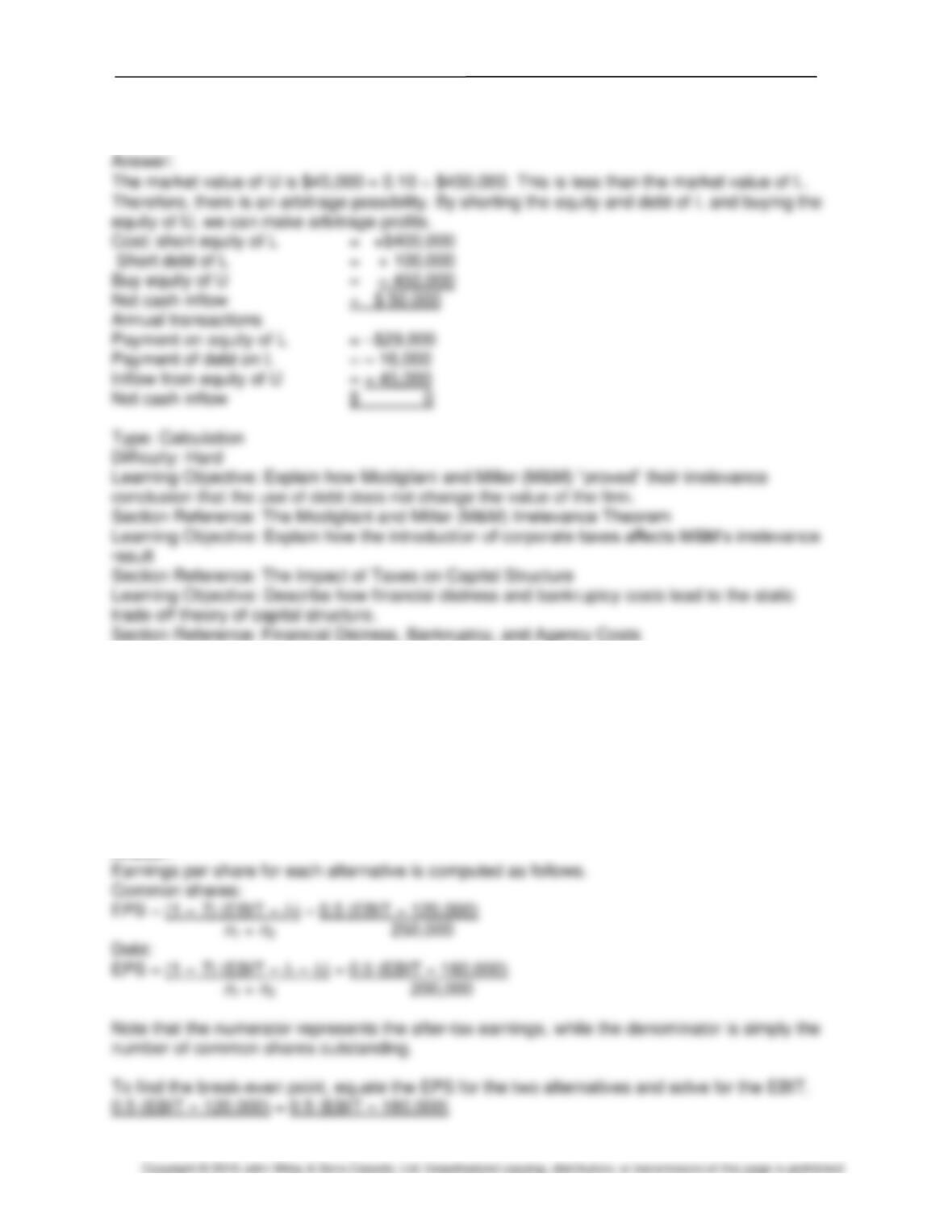
financed entirely through common equity and L has $100,000 in debt at an interest rate of 16
percent. Both companies achieve annual net operating earnings of $45,000. Assume perfect
markets and information, with no taxes and no bankruptcy costs. If the market capitalizes firm U
at a rate of 10 percent, and the total market value of L is $500,000, is there an arbitrage
21 – 31 Test Bank for Introduction to Corporate Finance, Fourth Canadian Edition
opportunity available, and if so, what is the net gain?
83. A company’s capital structure is made up of 200,000 common shares and $1,000,000 debt
at 12 percent interest. The company’s tax rate is 50 percent. An additional $500,000 has to be
raised, and the following financing alternatives are available:
Common shares: The company can sell additional shares at $10 a share. Hence, 50,000 new
shares would have to be issued.
Debt: Debt can be issued at 12 percent, requiring interest payments of $60,000.
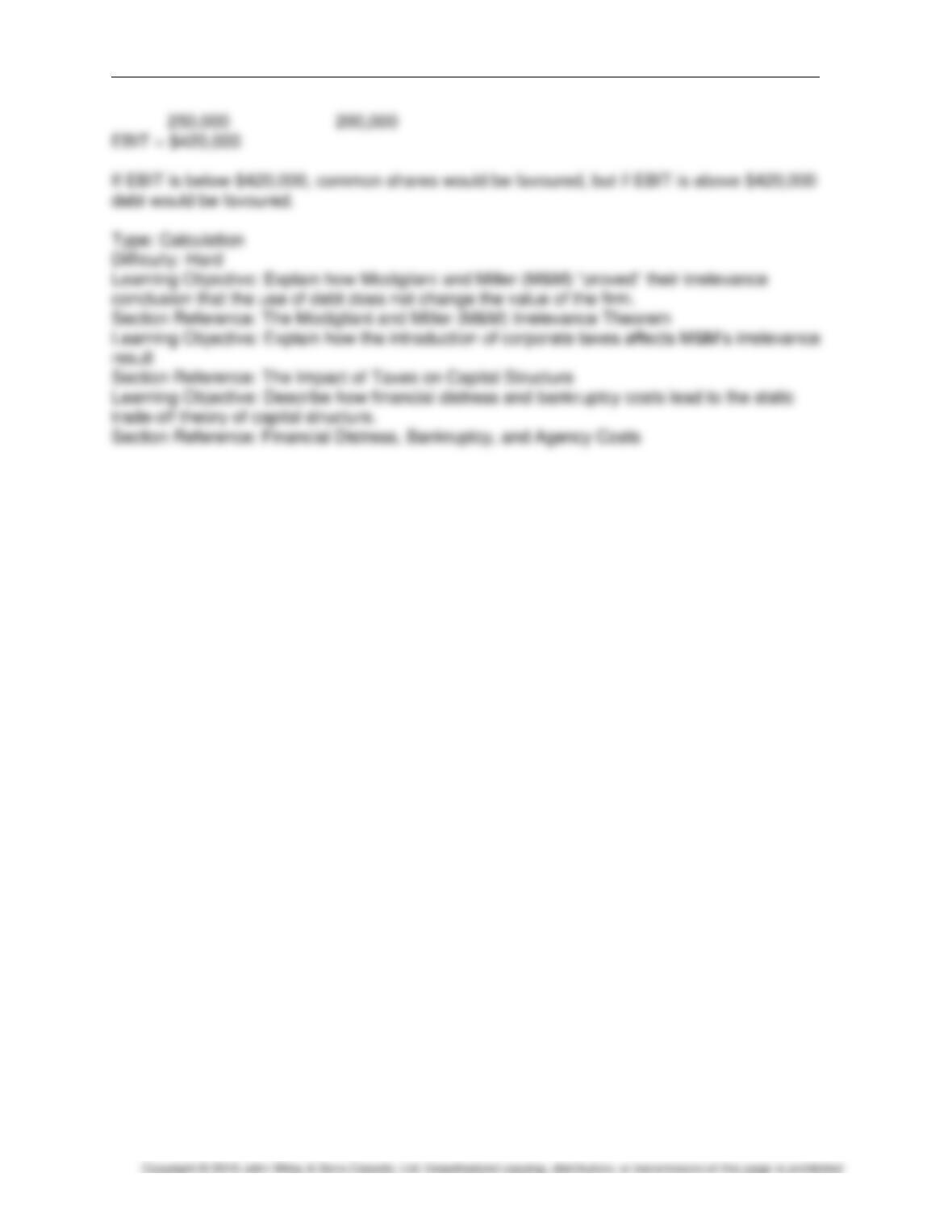
Compute EPS as a function of EBIT for both alternatives and derive the break-even point.
Answer:
Capital Structure Decisions 21 – 32
21 – 33 Test Bank for Introduction to Corporate Finance, Fourth Canadian Edition
LEGAL NOTICE