Incremental Analysis
20 – 55
Ex. 189
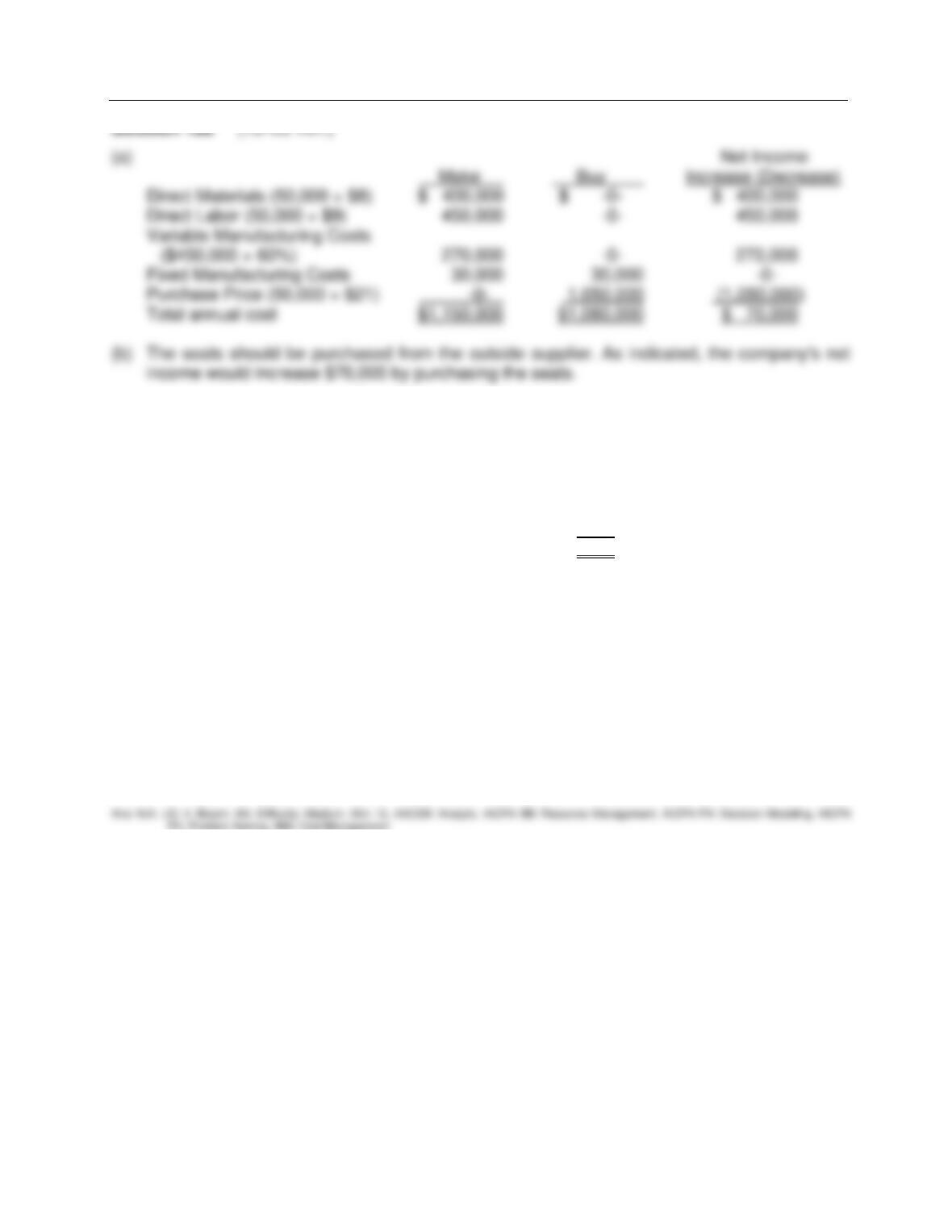
Larkin, Inc. uses 1,000 units of the component NJF1 every month to manufacture one of its
products. The unit costs incurred to manufacture the component are as follows:
Direct materials $65
Direct labor 48
Overhead 96
Total $209
Overhead costs include variable material handling costs of $10, which are applied to products on
the basis of direct material costs. The remainder of the overhead costs are applied on the basis of
direct labor dollars and consist of 50% variable costs and 50% fixed costs.
A vendor has offered to supply the NJF1 component at a price of $175 per unit.
Instructions
(a) Should Larkin purchase the component from the outside vendor if its capacity remains idle?
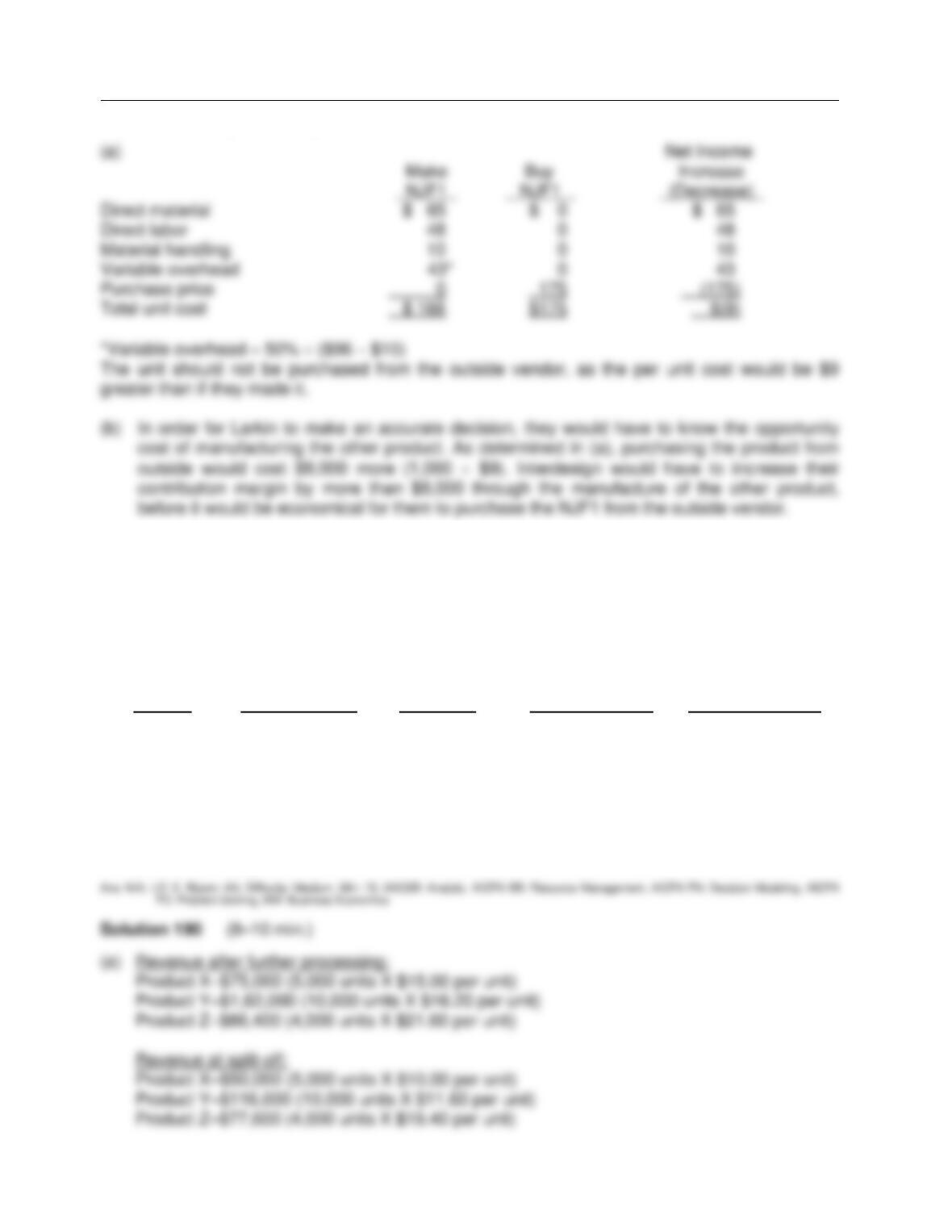
(b) Should Larkin purchase the component from the outside vendor if it can use its facilities to
manufacture another product? What information will Interdesign need to make an accurate
decision? Show your calculations.
Test Bank for Accounting, Tools for Business Decision Making Fifth Edition
20 – 56
Solution 189 (10-12 min.)
Ex. 190
A company manufactures three products using the same production process. The costs incurred
up to the split-off point are $200,000. These costs are allocated to the products on the basis of
their sales value at the split-off point. The number of units produced, the selling prices per unit of
the three products at the split-off point and after further processing, and the additional processing
costs are as follow:
Number of Selling Price Selling Price Additional
Product Units Produced at Split-off after Processing Processing Costs
X 5,000 $10.00 $15.00 $14,000
Y 10,000 11.60 16.20 21,000
Z 4,000 19.40 21.60 12,000
Instructions
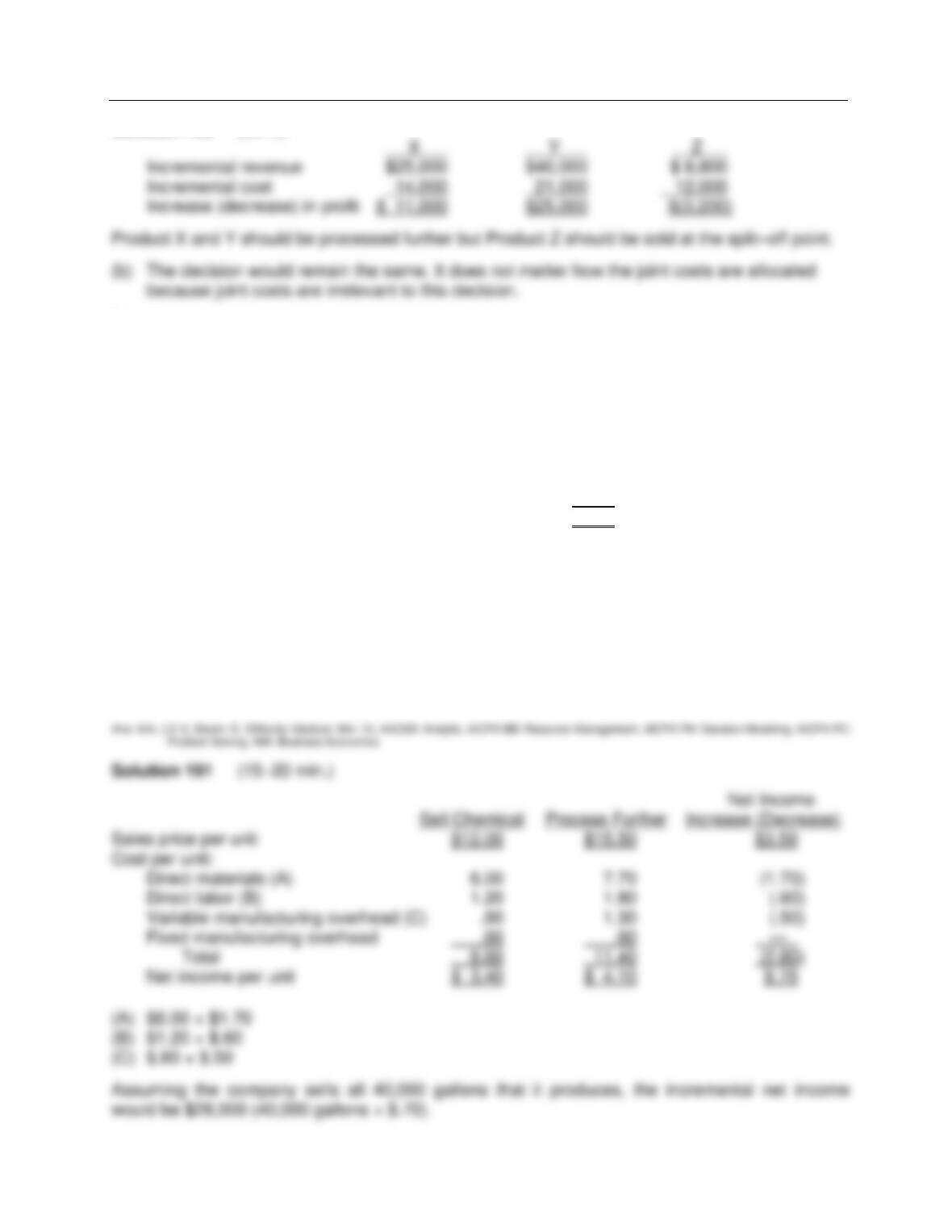
(a) Which product(s) should be processed further and which should be sold at the split-off point?
(b) Would your decision be different if the company was using the quantity of output to allocate
joint costs? Explain.
Incremental Analysis
20 – 57
Solution 190 (cont.)
Ex. 191
Spencer Chemical Corporation produces an oil-based chemical product which it sells to paint
manufacturers. In 2013, the company incurred $344,000 of costs to produce 40,000 gallons of the
chemical. The selling price of the chemical is $12.00 per gallon. The costs per unit to
manufacture a gallon of the chemical are presented below:
Direct materials $6.00
Direct labor 1.20
Variable manufacturing overhead .80
Fixed manufacturing overhead .60
Total manufacturing costs $8.60
The company is considering manufacturing the paint itself. If the company processes the
chemical further and manufactures the paint itself, the following additional costs per gallon will be
incurred: Direct materials $1.70, Direct labor $.60, Variable manufacturing overhead $.50. No
increase in fixed manufacturing overhead is expected. The company can sell the paint at $15.50
per gallon.
Instructions
Determine the incremental per gallon increase in net income and the total increase in net income
if the company manufactures the paint.
Test Bank for Accounting, Tools for Business Decision Making Fifth Edition
20 – 58
Ex. 192
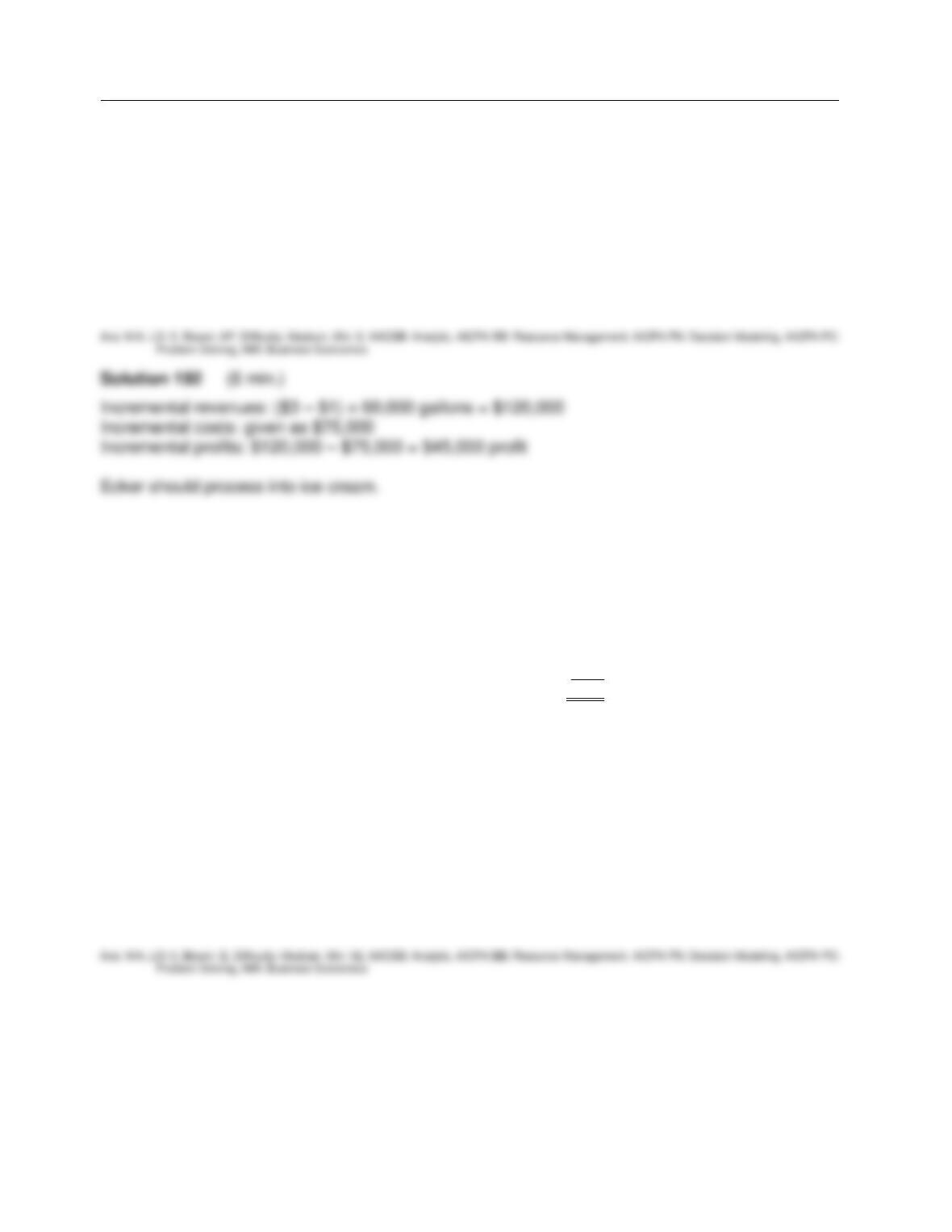
Ecker, Inc. produces milk at a total cost of $66,000. The production generates 60,000 gallons of
milk which can be sold for $1 per gallon to a pasteurization company, or the milk can be
processed further into ice cream and then sold for $3 per gallon. It costs $75,000 more to turn the
annual milk supply into ice cream.
Instructions
If Ecker processes the milk into ice cream, how much is the incremental profit or loss? Should
Ecker process the milk into ice cream or sell it as is?
Ex. 193
Speedy Bikes could sell its bicycles to retailers either assembled or unassembled. The cost of an
unassembled bike is as follows.
Direct materials $150
Direct labor 70
Variable overhead (70% of direct labor) 49
Fixed overhead (30% of direct labor) 21
Manufacturing cost per unit $290
The unassembled bikes are sold to retailers at $450 each.
Speedy currently has unused productive capacity that is expected to continue indefinitely;
management has concluded that some of this capacity can be used to assemble the bikes and
sell them at $495 each. Assembling the bikes will increase direct materials by $5 per bike, and
direct labor by $10 per bike. Additional variable overhead will be incurred at the normal rates, but
there will be no additional fixed overhead as a result of assembling the bikes.
Instructions
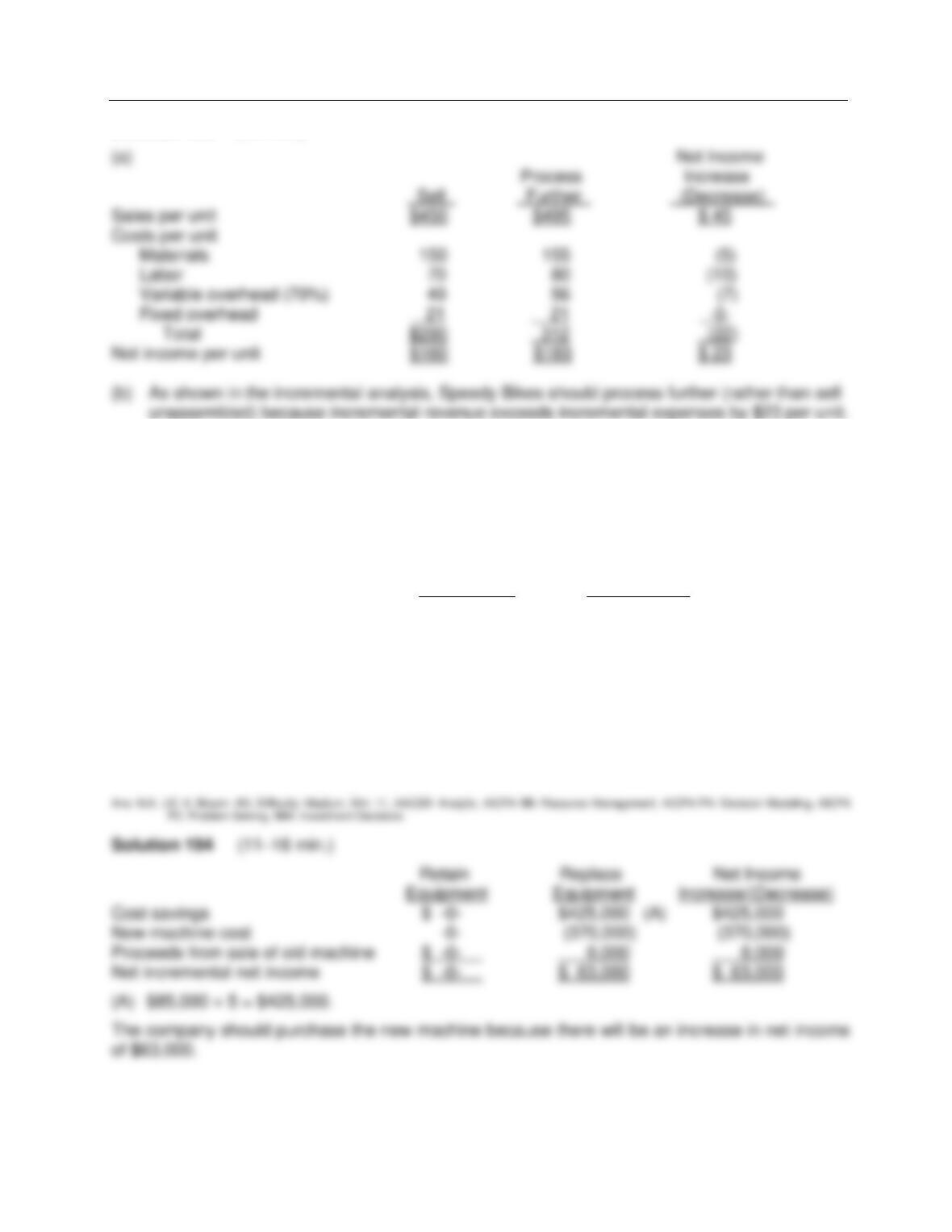
(a) Prepare an incremental analysis for the sell-or-process-further decision.
(b) Should Speedy sell or process further? Why or why not?
Incremental Analysis
20 – 59
Solution 193 (12 min.)
Ex. 194
Harris Timber Corporation uses a machine that removes the bark from cut timber. The machine is
unreliable and results in a significant amount of downtime and excessive labor costs. The
management is considering replacing the machine with a more efficient one which will minimize
downtime and excessive labor costs. Data are presented below for the two machines:
Old Machine New Machine
Original purchase cost $340,000 $370,000
Accumulated depreciation 230,000 —
Estimated life 5 years 5 years
It is estimated that the new machine will produce annual cost savings of $85,000. The old
machine can be sold to a scrap dealer for $8,000. Both machines will have a salvage value of
zero if operated for the remainder of their useful lives.
Instructions
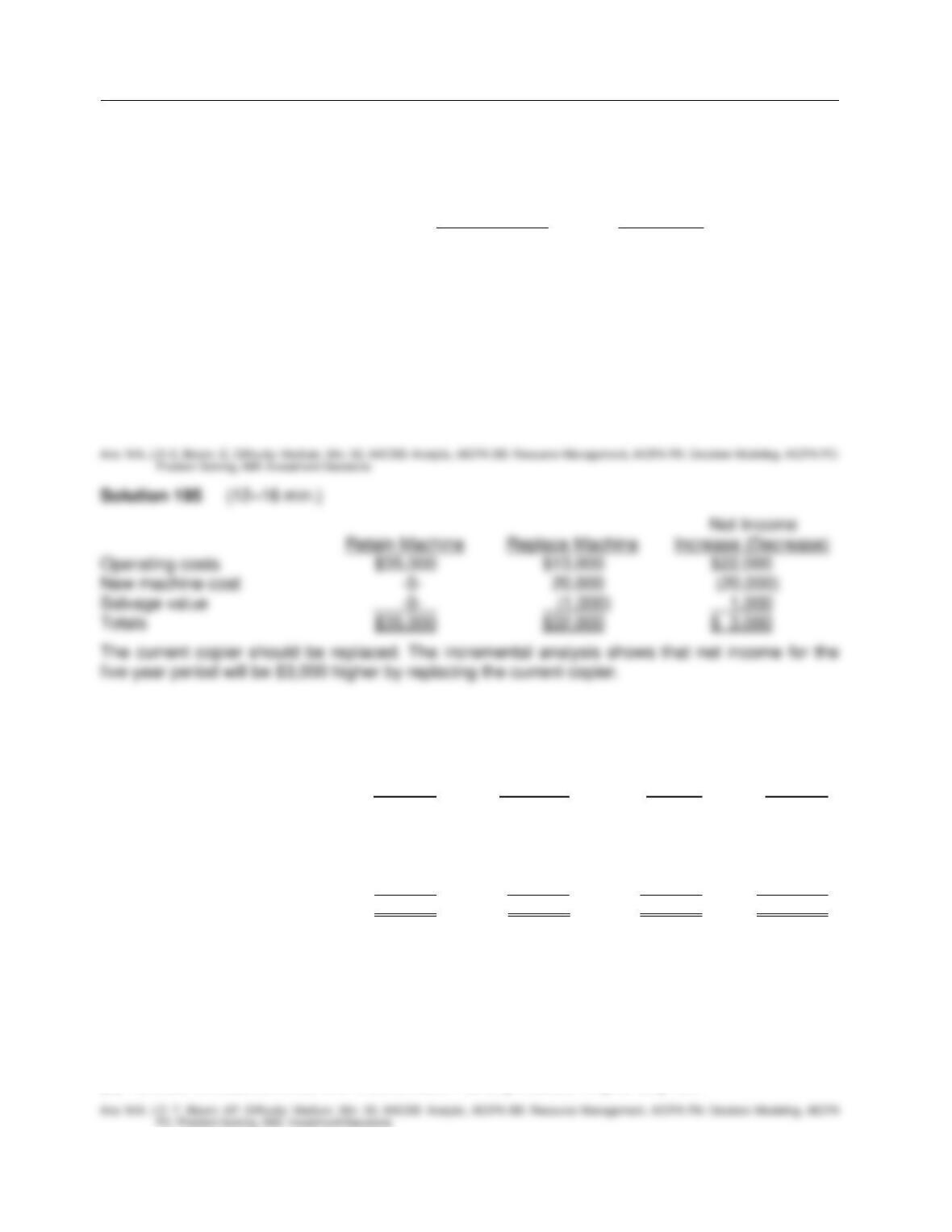
Determine whether the company should purchase the new machine.
Test Bank for Accounting, Tools for Business Decision Making Fifth Edition
20 – 60
Ex. 195
Kinder Enterprises relies heavily on a copier machine to process its paperwork. Recently the copy
clerk has not been able to process all the necessary copies within the regular work week.
Management is considering updating the copier machine with a faster model.
Current Copier New Model
Original purchase cost $10,000 $20,000
Accumulated depreciation 8,000 —
Estimated operating costs (annual) 7,000 2,600
Useful life 5 years 5 years
If sold now, the current copier would have a salvage value of $1,000. If operated for the
remainder of its useful life, the current machine would have zero salvage value. The new machine
is expected to have zero salvage value after five years.
Instructions
Prepare an analysis to show whether the company should retain or replace the machine.
Ex. 196
Milwaukee, Inc. has three divisions: Bud, Wise, and Er. The results of May, 2013 are presented
below.
Bud Wise Er Total
Units sold 3,000 5,000 2,000 10,000
Revenue $70,000 $50,000 $40,000 $160,000
Less variable costs 32,000 26,000 16,000 74,000
Less direct fixed costs 14,000 19,000 12,000 45,000
Less allocated fixed costs 6,000 10,000 4,000 20,000
Net income $18,000 $ (5,000) $ 8,000 $ 21,000
All of the allocated costs will continue even if a division is discontinued. Milwaukee allocates
indirect fixed costs based on the number of units to be sold. Since the Wise division has a net
loss, Milwaukee feels that it should be discontinued. Milwaukee feels if the division is closed, that
sales at the Bud division will increase by 12%, and that sales at the Er division will stay the same.
Instructions
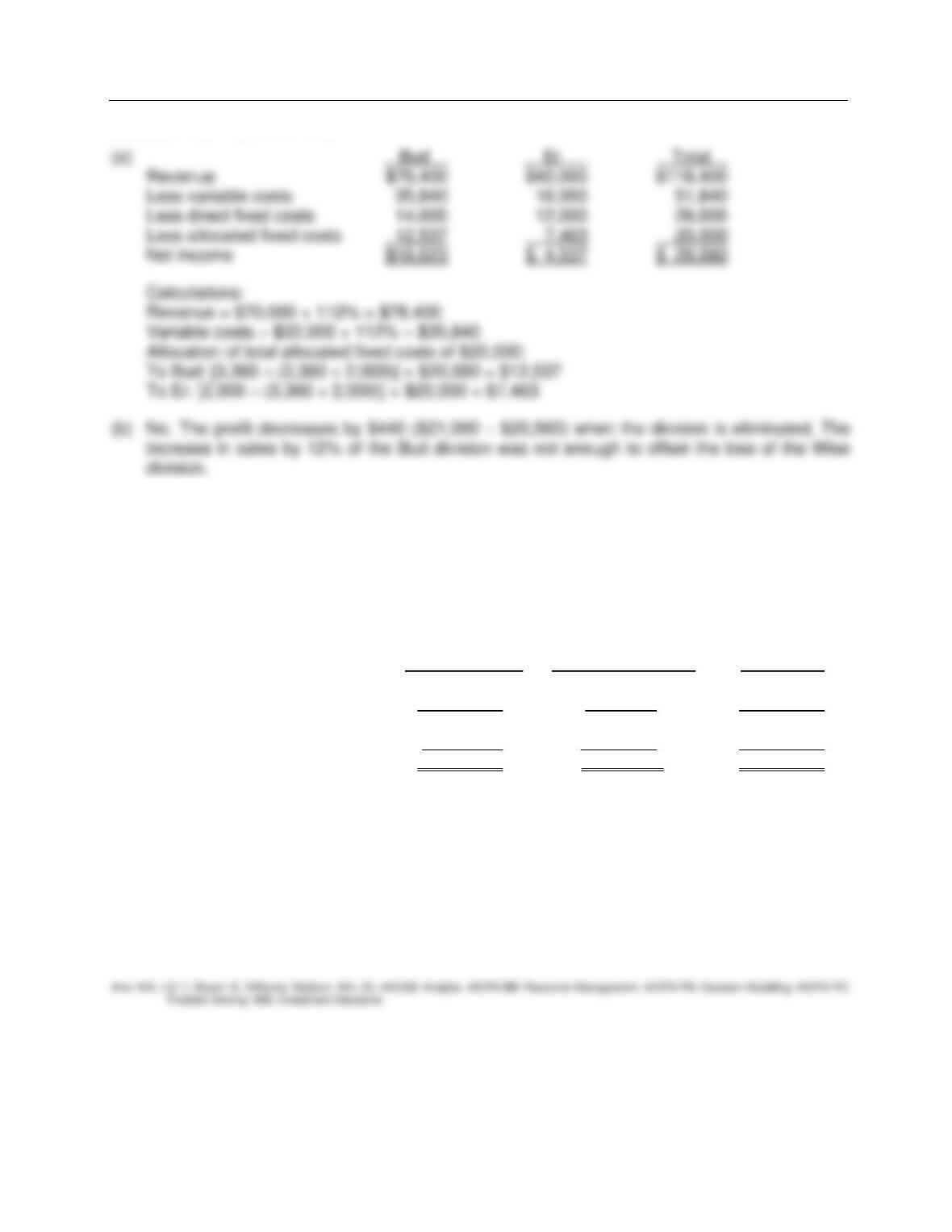
(a) Prepare an analysis showing the effect of discontinuing the Wise division.
(b) Should Milwaukee close the Wise division? Briefly indicate why or why not.
Incremental Analysis
20 – 61
Solution 196 (10–12 min.)
Ex. 197
Trump Forest Corporation operates two divisions, the Timber Division and the Consumer
Division. The Timber Division manufactures and sells logs to paper manufacturers. The
Consumer Division operates retail lumber mills which sell a variety of products in the do-it–
yourself homeowner market. The company is considering disposing of the Consumer Division
since it has been consistently unprofitable for a number of years. The income statements for the
two divisions for the year ended December 31, 2013 are presented below:
Timber Division Consumer Division Total
Sales $1,500,000 $500,000 $2,000,000
Cost of goods sold 900,000 350,000 1,250,000
Gross profit 600,000 150,000 750,000
Selling & administrative expenses 250,000 180,000 430,000
Net income $ 350,000 $ (30,000) $ 320,000
In the Consumer Division, 70% of the cost of goods sold are variable costs and 35% of selling
and administrative expenses are variable costs. The management of the company feels it can
save $45,000 of fixed cost of goods sold and $50,000 of fixed selling expenses if it discontinues
operation of the Consumer Division.
Instructions
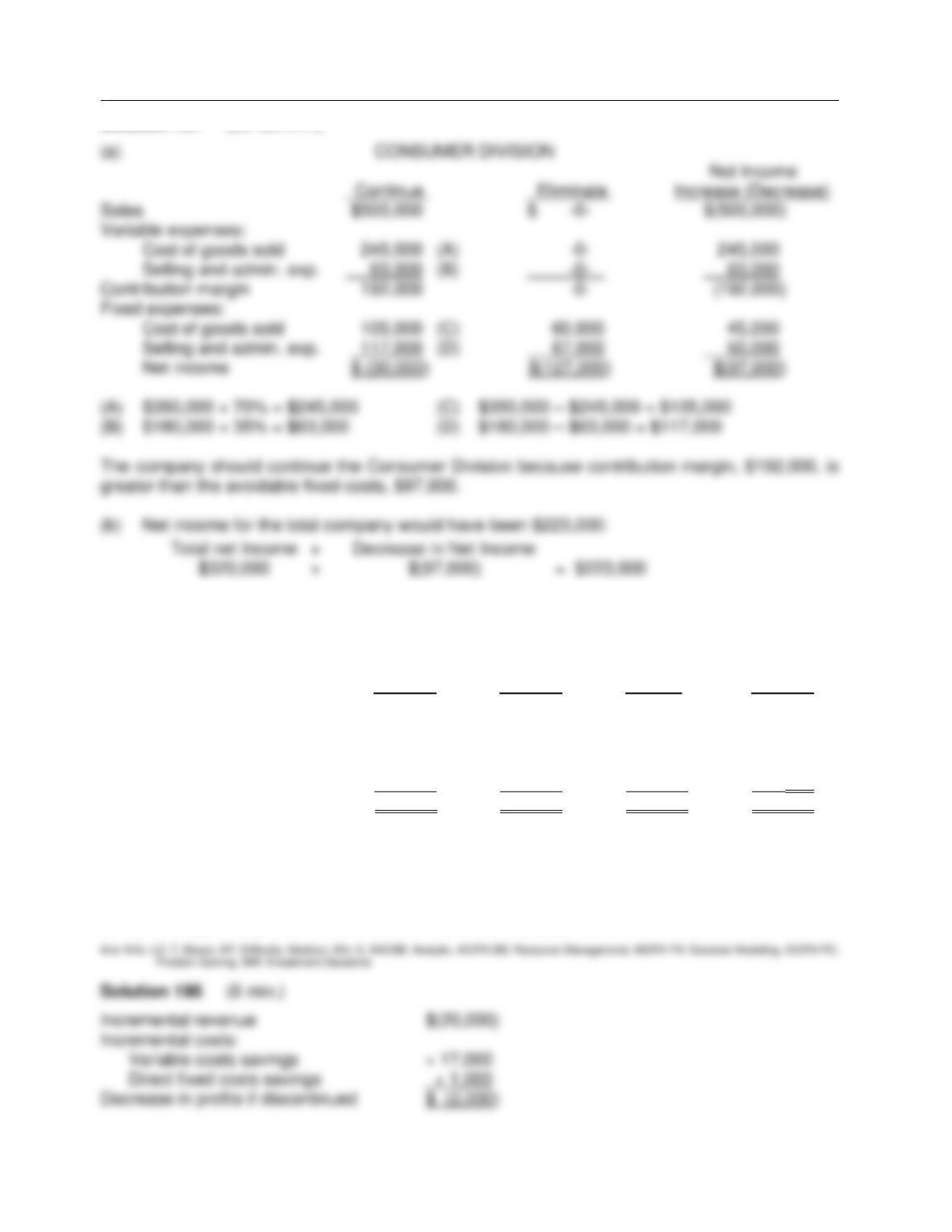
(a) Determine whether the company should discontinue operating the Consumer Division.
(b) If the company had discontinued the division for 2013, determine what net income would
have been.
Test Bank for Accounting, Tools for Business Decision Making Fifth Edition
20 – 62
Solution 197 (20–25 min.)
Ex. 198
Mercer has three product lines in its retail stores: books, videos, and music. Results of the fourth
quarter are presented below:
Books Music Videos Total
Units sold 1,000 2,000 2,000 5,000
Revenue $20,000 $40,000 $25,000 $85,000
Variable departmental costs 17,000 22,000 12,000 51,000
Direct fixed costs 1,000 3,000 2,000 6,000
Allocated fixed costs 7,000 7,000 7,000 21,000
Net income (loss) $ (5,000) $ 8,000 $ 4,000 $ 7,000
The allocated fixed costs are unavoidable. Demand of individual products are not affected by
changes in other product lines.
Instructions
What will happen to profits if Mercer discontinues the Books product line?
Incremental Analysis
20 – 63
Ex. 199
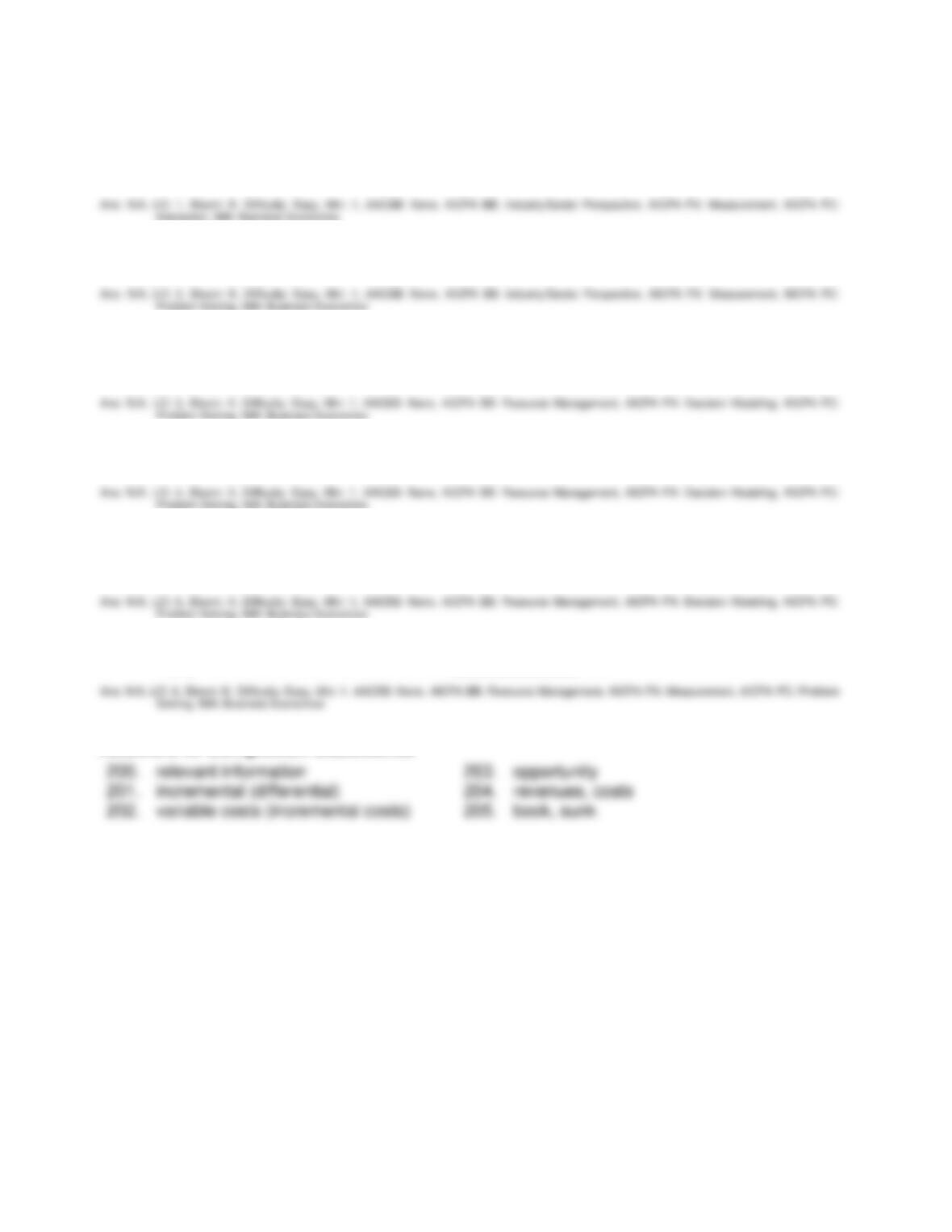
A recent accounting graduate from Marvel State University evaluated the operating performance
of Fanning Company’s four divisions. The following presentation was made to Fanning’s Board of
Directors. During the presentation, the accountant made the recommendation to eliminate the
Southern Division stating that total net income would increase by $60,000. (See analysis below.)
Other Three Divisions Southern Division Total
Sales $2,000,000 $480,000 $2,480,000
Cost of Goods Sold 950,000 400,000 1,350,000
Gross Profit 1,050,000 80,000 1,130,000
Operating Expenses 800,000 140,000 940,000
Net Income $ 250,000 $ (60,000) $ 190,000
For the other divisions, cost of goods sold is 80% variable and operating expenses are 70%
variable. The cost of goods sold for the Southern Division is 30% fixed, and its operating
expenses are 75% fixed. If the division is eliminated, only $15,000 of the fixed operating costs will
be eliminated.
Instructions
Do you concur with the new accountant’s recommendation? Present a schedule to support your
answer.
Test Bank for Accounting, Tools for Business Decision Making Fifth Edition
20 – 64
COMPLETION STATEMENTS
200. An important purpose of management accounting is to provide _____________________
for decision making.
201. The process used to identify the financial data that change under alternative courses of
action is called __________________ analysis.
202. In a decision on whether an order should be accepted at a special price when there is
plant capacity available, a major consideration is whether the special price exceeds
__________________.
203. The potential benefit that may be obtained by following an alternative course of action is
called an _________________ cost.
204. A decision whether to sell a product now or to process it further, depends on whether the
incremental _____________ from processing further are greater than the incremental
processing ______________.
205. The ______________ value of old equipment is irrelevant in a decision to replace that
equipment and is often referred to as a _____________ cost.
Answers to Completion Statements
Incremental Analysis
20 – 65
MATCHING
206. Match the items below by entering the appropriate code letter in the space provided.
A. Incremental analysis
B. Opportunity cost
C. Sunk cost
____ 1. A cost that cannot be changed by any present or future decision.
____ 2. The process of identifying the financial data that change under alternative courses of
action.
____ 3. The potential benefit that may be lost from following an alternative course of action.
Test Bank for Accounting, Tools for Business Decision Making Fifth Edition
20 – 66
SHORT-ANSWER ESSAY QUESTIONS
S-A E 207
Management is often faced with the alternative of continuing to make a product or component
internally, or going to an external source and purchasing the product or component. In gathering
relevant information for these two alternatives, briefly identify the quantitative factors that should
be considered. Are there any qualitative factors that should also be considered?
S-A E 208
Define the term “opportunity cost.” How may this cost be relevant in a make–or-buy decision?
S-A E 209 (Communication)
You are the general accountant for Word Systems, Inc., a typing service based in Los Angeles,
California. The company has decided to upgrade its equipment. It currently has a widely used
version of a word processing program. The company wishes to invest in more up–to-date software
and to improve its printing capabilities.
Two options have emerged. Option #1 is for the company to keep its existing computer system,
and upgrade its word processing program. The memory of each individual work station would be
enhanced, and a larger, more efficient printer would be used. Better telecommunications
equipment would allow for the electronic transmission of some documents as well.
Option #2 would be for the company to invest in an entirely different computer system. The
software for this system is extremely impressive, and it comes with individual laser printers.
However, the company is not well known, and the software does not connect well with well-known
software. The net present value information for these options follows:
Option #1 Option #2
Initial Investment $(95,000) $(270,000)
Cost savings of labor over 4 years 95,000 270,000
Incremental Analysis
20 – 67
S-A E 209 (Cont.)
Required:
Prepare a brief report for management in which you make a recommendation for one system or
the other, using the information given.